Posted tagged ‘Iran’

Iran official: We will never end fight against Israel

August 29, 2015

Iran official: We will never end fight against Israel In third successive denial of softened stance, Khamenei aide says fighting ‘illegal Zionist regime’ is ‘immutable policy’ By Times of Israel staff August 29, 2015, 2:47 pm

Source: Iran official: We will never end fight against Israel | The Times of Israel

Iran's President Hassan Rouhani, right, welcomes British Foreign Secretary Philip Hammond at the start of their meeting in his office, in Tehran, Iran, Monday, Aug. 24, 2015. (AP Photo/Ebrahim Noroozi)

Iran’s President Hassan Rouhani, right, welcomes British Foreign Secretary Philip Hammond at the start of their meeting in his office, in Tehran, Iran, Monday, Aug. 24, 2015. (AP Photo/Ebrahim Noroozi)

An aide to Iranian Supreme Leader Ayatollah Ali Khamenei on Saturday dismissed remarks by British Foreign Secretary Phillip Hammond that Tehran has changed its stance on Israel, insisting that fighting the “illegal Zionist regime” is an ongoing policy of the Islamic Republic, the semi-official Fars news agency reported.

“[The] fight against the illegal Zionist regime is one of the immutable policies of Iran, which has always been maintained,” Seyed Mahmoud Nabavi said.

Hammond was in Iran on Sunday and Monday for the reopening of the British embassy in Tehran, and said that Iranian President Hassan Rouhani had indicated a “more nuanced approach” to Israel’s existence. Hammond said Khamenei’s “revolutionary sloganizing” should be distinguished from “what Iran actually does in the conduct of its foreign policy.”

Nabavi said Hammond’s comments were “incorrect since one of the driving goals of the Islamic Revolution has been campaign against the arrogant powers,” according to Fars.

“We haven’t recognized the Zionist regime since the beginning of the Islamic Revolution and such a policy will continue,” Nabavi said.

This is the third time this week that a senior Iranian official has repudiated Hammond’s claims of a shift in stance on Israel. The Iranian Foreign Ministry also dismissed the remarks, saying that Israel “had no place in diplomatic talks between Tehran and London,” Fars reported.

“We have rejected such media hype (before) and during Mr. Hammond’s trip to Iran, we just discussed potentials of bilateral relations, fighting extremism and terrorism, etc.,” Foreign Ministry spokeswoman Marziyeh Afkham told reporters in Tehran on Wednesday.

“There were no talks on the Zionist regime and the report that Iran has changed its position is denied,” she said.

On Tuesday, Hussein Sheikholeslam, a foreign affairs adviser to parliament speaker Ali Larijani, said that Israel “should be annihilated,” and that the thawing relations with the West would not translate into a shift in Tehran’s position on the Jewish state.

Sheikholeslam told Iranian media that contrary to remarks by Hammond, “Our positions against the usurper Zionist regime have not changed at all; Israel should be annihilated and this is our ultimate slogan.”

One Rocket a Month Since Hamas ‘Ceasefire’

August 28, 2015

One Rocket a Month Since Hamas ‘Ceasefire’ Figures show 12 rockets have hit Israeli sovereign territory 1 year since last summer’s ‘truce,’ many more fired but didn’t clear border. By Ari Yashar First Publish: 8/28/2015, 1:56 PM

Source: One Rocket a Month Since Hamas ‘Ceasefire’ – Defense/Security – News – Arutz Sheva

This Thursday marked a full year since a ceasefire was sealed between Israel and the Hamas terrorist organization last August 27, bringing Operation Protective Edge to a close – but the ceasefire has been anything but quiet.

Gaza terrorists marked a year since the end of Hamas’s third terror war seeking to destroy Israel by firing a rocket on Wednesday night, giving an ironic edge to the anniversary of the “ceasefire.” The IDF responded by hitting a Hamas weapons manufacturing site.

But Wednesday’s attack was far from the first Gazan breach of the ceasefire.

A review of official IDF and Israel Security Agency (ISA) figures released by Channel 2 on Friday shows that no less than 12 rockets have been fired into Israeli sovereign territory from Gaza since the truce.

That figure doesn’t include the many dozens of rockets fired at Israel that didn’t make it over the security border, falling short within Gaza. Just earlier this month alone three such rockets fell in Gaza, landing short of their mark.

Twelve rockets since the ceasefire works out to an average of one rocket a month hitting Israel since the ceasefire. No more than three months went by without a Gazan rocket striking Israeli territory; fortunately, no one was wounded in any of the ongoing rocket fire.

A breakdown of the rocket strikes by month shows that last September, just a month after the ceasefire, Gaza terrorists fired mortar rounds at Israel. The rocket fire returned in October, and after a quiet November another rocket was intercepted last December.

The first three months of 2015 were surprisingly quiet, but in April another rocket breached the ceasefire, and in May more rocket fire was recorded. Three rockets entering Israeli territory were shot down in June, and two rockets apiece fell in July and August.

Still better deterrence than the past

As noted, those figures do not include the many more rockets fired unsuccessfully at Israel which never made it over the border.

In response to the numerous breaches, the IDF struck 14 terror sites in Gaza since the end of the war in airstrikes, most of them Hamas terror facilities as the IDF holds the terror group responsible for all rocket attacks emanating from the coastal enclave that is under its de facto control.

However, a comparison to the last two Hamas terror wars against Israel shows that despite the many breaches, the IDF achieved an even greater deterrent affect that in the past with its successful campaign to crush Hamas’s rocket arsenals and its will to start another full-out war.

While 12 rockets have hit Israel since Operation Protective Edge, no less than 217 rockets hit Israel in the first year after 2008-2009 Operation Cast Lead, and a full 36 were fired after 2012 Operation Pillar of Defense.

Gadi Yarkoni, head of the Eshkol Regional Council, on Thursday responded to the rocket fire the night before and spoke about the ongoing detrimental affect the incessant rocket attacks are having on the local populace.

This cannot go on. We cannot allow this rocket fire to turn into a regular event. The Defense Minister and the Prime Minister must decide how to respond in order to prevent escalation of the situation,” said Yarkoni.

“Each time a rocket is fired it brings back bad memories. The government has to do something to prevent rocket fire, as well as put into place obstacles that will prevent Hamas from digging tunnels into Israel and attacking us from them.”

While Hamas has had its rocket arsenals buoyed up by Iranian and other foreign technology, an Israeli crackdown on smuggled weaponry and weapon materials together with an Egyptian siege on the Sinai border has led Hamas to turn increasingly to its domestic rocket production industry to create new missiles.

That domestic rocket development has seen Hamas fire many dozens of rockets into the Mediterranean Sea over the course of the last year as part of its rocket testing program.

Sen. Cotton to Visit Israel for More Ammunition against Iran Deal

August 28, 2015

He will arrive Sunday and will be “updated on strategic issues,” meaning Iran. By: Tzvi Ben-Gedalyahu Published: August 28th, 2015

Source: The Jewish Press » » Sen. Cotton to Visit Israel for More Ammunition against Iran Deal

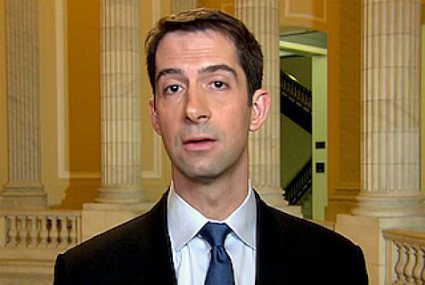
Arkansas Sen. Tom Cotton.

Sen. Tom Cotton, one of the loudest voices against the nuclear deal with Iran, will arrive in Israel on Sunday for a week-long visit that can be assumed is aimed at arming him with more ammunition to try to shoot down the nuclear Iran agreement in the Senate.

The Israel government announced:

U.S. Senator Tom Cotton (R-AR) will be visiting Israel from Sunday, August 30, to Saturday, September 5, 2015. During his trip to Israel, the Senator will be updated on strategic and diplomatic issues, as well as other major developments in the region.

Senator Cotton, in office as of January 2015, serves on the Armed Services, Intelligence, and Banking committees.

Updating him on “strategic and diplomatic issues” just before Congress returns from a summer recess with the Iran deal the number one item on the agenda means that Prime Minister Binyamin Netanyahu will send Sen. Cotton back with a suitcase full of arguments to try to win a veto-proof majority against the deal when it comes for a vote.

Sen. Cotton was behind the controversial letter that he and several senators sent to Iran to “inform” it that a nuclear deal would not be binding on the next president.

Earlier this month, he told Israeli reporters that the Obama administration has not made it clear to Iran that it could use force to prevent a nuclear-armed Iran. He then said that the U.S. Armed Forces could bomb Iran’s nuclear program “back to zero.”

Sen. Corker stated:

You can destroy facilities. I don’t think any military expert in the United States or elsewhere would say the U.S. military is not capable to setting Iran’s nuclear facilities back to day zero,

Can we eliminate it forever? No, because any advanced industrialized country can develop nuclear weapons in four to seven years, from zero. But we can set them back to day zero.

That is music to the ears of Prime Minister Netanyahu, and the timing of next week’s visit is not coincidental.

The Prime Minister and President Barack Obama are desperately campaigning against and for the deal, respectively.

Media continue to report more evidence that the deal is full of holes and that Iran already is has taken moves to get around it, such as the report Thursday that it has built an addition to its Parchin nuclear facility.

However, party loyalty usually is paramount to intellectual honesty. New York Democratic Sen. Charles Schumer came out against the deal and promptly faced a campaign prevent him from becoming the next party leader in the Senate to succeed retiring Sen. Harry Reid, who backs the deal.

Even Tennessee Republican Sen. Bob Corker admits that Obama will win. He told The Tennessean:

Understand that at this moment it looks very unlikely that we’ll have a veto-proof majority to disapprove, but I know we’re going to have a bipartisan majority that will disapprove.

The Hill reported that President Obama lacks only five out of 15 undecided Democratic senators to prevent a veto-proof majority against the agreement.

Two Hundred Retired Generals, Flag Officers Call on Congress to Reject Iran Deal

August 27, 2015

Two Hundred Retired Generals, Flag Officers Call on Congress to Reject Iran Deal

BY:
August 26, 2015 2:02 pm

Source: Two Hundred Retired Generals, Flag Officers Call on Congress to Reject Iran Deal | Washington Free Beacon

John Kerry

John Kerry / AP

Nearly two hundred retired generals and admirals sent a letter to Congress asking members to oppose the Iran deal, the Washington Post reported Wednesday.

The retired officers warned in the letter that the nuclear deal was “unverifiable” and would “threaten the national security and vital interests of the United States” by providing Iran a 10-year path to a nuclear bomb and handing the regime $150 billion in sanctions relief:

In summary, this agreement will enable Iran to become far more dangerous, render the Mideast still more unstable and introduce new threats to American interests as well as our allies. In our professional opinion, far from being an alternative to war, the Joint Comprehensive Plan of Action makes it likely that the war the Iranian regime has waged against us since 1979 will continue, with far higher risks to our national security interests. Accordingly, we urge the Congress to reject this defective accord.

Earlier this month, a group of 36 flag officers sent a dueling letter to Congress in support of the nuclear deal. The letter was organized with help from the White House, the Washington Free Beacon reported.


Here the full letter :

http://apps.washingtonpost.com/g/documents/world/read-an-open-letter-from-retired-generals-and-admirals-opposing-the-iran-nuclear-deal/1703/


Introducing Yasser Abbas – the son whom the Palestinian leader plans to succeed him

August 25, 2015

Introducing Yasser Abbas – the son whom the Palestinian leader plans to succeed him, DEBKAfile, August 25, 2015

Yasser_AbbasYasser Abbas is tagged to succeed his father as Palestinian leader

The reports swirling around the Arab world over the Palestinian leader Mahmoud Abbas’s decision to quit disguise the octogenarian’s next plans. According to our Middle East sources, Abbas (known to all as Abu Mazen) has confided to his close circle that he has lost faith in President Barack Obama, whom he accuses of deserting the Palestinian cause, and in Secretary of State John Kerry, whom he has nicknamed “the tall liar.” He is now looking for new champions, possibly in Tehran, while at the same time shoring up his rule over the Palestinian Authority and designing his legacy.

Abbas joins the list of regional allies who feel abandoned by the Obama administration, like the Saudi King Salman bin Abdulaziz, Egyptian President Abdel-Fatteh El-Sisi and, up to a point, Israel’s Binyamin Netanyahu. For the immediate future, Abu Mazen is developing a comprehensive plan for replacing his enemies on the PLO’s Executive Committee with young faces, chosen for their ability to preserve the Abbas clan’s majority in this key institution and uphold his guiding principles for the Palestinian movement.

Since the end of July, his henchmen, Saeb Erekat, Akram Haniya and Palestinian General Intelligence chief Mejad Freij have been working on this blueprint.

They are to complete their project by September, when Abbas plans to introduce his choice of new leaders to the Executive Committee. They will consist mainly of the sons of the founders of the PLO and his own Fatah party.

Some of their names are unknown outside the Palestinian Authority’s seat in Ramallah. DEBKAfile reports that prominent among them are Sabry Shayden – son of the PLO’s first chief of staff; Maher Ghanem –  son of Abu Maher Ghanem, the Fatah Party’s first organizer; and also Gen. Majid Freij, Ayman Makbul from Nablus and Fahmi Zar’ir from the Gaza Strip.

The most important new face will be that of Yasser Abbas – Mahmoud Abbas’ own son.

The new appointments will herald another change: the PLO Exective Committee is to be elevated as the supreme Palestinian ruling institution, with jurisdiction over the Palestinian Authority and Palestinian government.

Abu Mazen is shaping this reshuffle to guarantee that his immediate successor as PA Chairman – mostly probably Erekat, whom the West knows as the most public Palestinian negotiator – will give up his seat when the time comes to make way for Yasser Abbas.

In this way, Mahmoud Abbas hopes to keep control of the Palestinian movement in the hands of his dynasty. His son, aged 52, who was named in honor of the late Yasser Arafat, moved from Ramallah to Canada in 1997 and built a business career.

A civil engineering graduate from Washington State University, he owns a string of companies in Canada, the Gulf and the West Bank. Among them is Falco Tobacco, which holds the sole agency for the distribution of American cigarettes in the Palestinian territory.

There are many rumors about how he made his fortune, including corrupt practices in high Palestinian circles. Little is known about his politics. When interviewed on occasion, he prefers to dwell on how he made his money rather than expanding on public affairs that concern his people. His good connections in Washington will no doubt be useful for opening a new chapter with the US when he takes over.

No date has been set for an Abbas visit to Tehran. It will be interesting to see whom he picks for the party to accompany him if and when it takes place.

Unveiling new missile, Rouhani says Iran will obtain ‘any weapons we need’

August 22, 2015

Unveiling new missile, Rouhani says Iran will obtain ‘any weapons we need’

‘We can negotiate with other countries only when we are powerful,’ says president at ceremony displaying precision solid-fuel rocket

By Times of Israel staff August 22, 2015, 12:00 pm

via Unveiling new missile, Rouhani says Iran will obtain ‘any weapons we need’ | The Times of Israel.

In this photo released by the official website of the office of the Iranian Presidency on Saturday, Aug. 22, 2015, Iran's President Hassan Rouhani, left, briefs the media as Defense Minister Hossein Dehghan listens after unveiling the surface-to-surface Fateh-313, or Conqueror, missile in a ceremony marking Defense Industry Day, Iran. (Iranian Presidency Office via AP)

In this photo released by the official website of the office of the Iranian Presidency on Saturday, Aug. 22, 2015, Iran’s President Hassan Rouhani, left, briefs the media as Defense Minister Hossein Dehghan listens after unveiling the surface-to-surface Fateh-313, or Conqueror, missile in a ceremony marking Defense Industry Day, Iran. (Iranian Presidency Office via AP)

Iran on Saturday unveiled a new surface-to-surface ballistic missile with a 500-kilometer (310 miles) range, saying military might was a precondition for peace and effective diplomacy.

The Fateh 313 missile was unveiled during a ceremony marking the anniversary of Iran’s military industry, attended by Iranian President Hassan Rouhani.

The military industry called the solid-fuel missile one of the most exact ever manufactured, boasting that it has successfully hit multiple targets with great precision, Israel’s Walla website reported.

“We will buy, sell and develop any weapons we need and we will not ask for permission or abide by any resolution for that,” Rouhani said in a speech at the ceremony, which was broadcast live on state television, according to Reuters.

“We can negotiate with other countries only when we are powerful. If a country does not have power and independence, it cannot seek real peace,” the president said.

A senior commander in Iran’s Revolutionary Guards said Friday that the country is planning massive “ballistic missiles war games,” adding that the announcement comes after Tehran said it plans to begin phasing in a new generation of missiles.

“The IRGC Aerospace Force will hold a large-scale ballistic missiles war-games soon,” Brigadier Gen. Amirali Hajizadeh said, according to the state-run Fars news agency.

Tehran said last month that its ballistic missile program was not connected to the UN Security Council resolution endorsing the July 14 accord with world powers that limits its nuclear program.

Under the terms of the agreement, Iran is barred from developing ballistic missiles capable of carrying a nuclear warhead.

Iran says it has ballistic missiles with a range of 2,000 kilometers (1,200 miles), which are capable of striking both Israel and Saudi Arabia. But the Foreign Ministry said that the UN’s resolution endorsing the deal did not have jurisdiction over its missile development.

“Iran’s military capacities, especially ballistic missiles, are strictly defensive and, as they have not been conceived to carry nuclear weapons, they are outside the scope and competence of the Security Council resolution,” the ministry wrote in a statement.

“The Islamic Republic of Iran is committed to implementing its commitments… so long as world powers keep their side of the agreement to lift sanctions in exchange for guarantees that Tehran will not develop a nuclear program,” the statement said.

Likud MK slams Barak for tapes discussing Israeli plans to attack Iran

August 22, 2015

Likud MK slams Barak for tapes discussing Israeli plans to attack Iran

Knesset Defense Committee member says Israel’s security hurt by disclosure of debates on aborted strikes in 2010, 2011 and 2012

By Times of Israel staff August 22, 2015, 2:55 pm

via Likud MK slams Barak for tapes discussing Israeli plans to attack Iran | The Times of Israel.

Likud MK Yoav Kish (screen capture: YouTube)

Likud MK Yoav Kish (screen capture: YouTube)

Likud MK Yoav Kish on Saturday lambasted former defense minister Ehud Barak for making recordings in which he details Prime Minister Benjamin Netanyahu’s unsuccessful attempts to win approval for a military strike on Iran’s nuclear facilities.

Kish, a member of the Knesset’s Foreign Affairs and Defense Committee, questioned Barak’s motives for making the recordings, saying he was uncertain what “political gain” Barak hoped to achieve, Israel’s Maariv newspaper reported.

Channel 2 television on Friday night broadcast the recordings, which relate to a new biography of Barak being written by Danny Dor and Ilan Kfir. The former defense minister, who was also previously prime minister and chief of staff, attempted to prevent the recordings being played, but Israel’s military censors allowed Channel 2 to play them.

In the recordings, Barak said he and Netanyahu on more than one occasion sought to order an Israeli Air Force attack on Iran’s nuclear facilities, but were scuppered first by chief of staff Gabi Ashkenazi in 2010, who said the IDF was not ready for the operation, and then by fellow cabinet ministers Moshe “Bogey” Ya’alon and Yuval Steinitz, who did not support the idea. He also said a 2012 strike was aborted because it coincided with a joint Israel-US military exercise.

Gantz, then-Defense Minister Ehud Barak, and Maj. Gen. Gadi Eizenkot during a February 15, 2011 tour of the northern border (photo credit: Ministry of Defense/ Flash 90)

“On Friday we were exposed to cabinet deliberations of a preemptive attack on Iran via the story of Ehud Barak, the defense minister at the time. Publishing the discussions is the responsibility of the IDF censor and of Ehud Barak. The censor was wrong to approve the publication of the book on this issue,” said Kish, a freshman MK and former Israeli Air Force fighter pilot.

“The reports from the forum [of senior ministers] are the most sensitive in the state and disclosure of information on the issue, which is still a major threat to Israel, harms state security,” Kish continued. “I do not know what political gain Ehud Barak sought to achieve with these reports, but we would do well to cease the online chatter.”

Kish is one of the leaders of the “New Likud” movement, which calls for Likud to return to its liberal roots, and the lion’s share of its agenda, as published on its website, deals with social justice issues like the cost of living and ultra-Orthodox military service.

Iran Is Already Violating the Nuke Deal

August 20, 2015

Iran Is Already Violating the Nuke Deal

Will enough Democrats put country over party and defy Obama?

August 20, 2015

Joseph Klein

via Iran Is Already Violating the Nuke Deal | Frontpage Mag.


As the congressional vote on President Barack Obama’s disastrous nuclear deal with Iran draws closer, the Iranian regime appears to be doing everything it can to show that it has the upper hand as a result of the deal it negotiated with the United States and its five partners. It is either dishonestly twisting certain terms of the deal to justify its misbehavior or simply defying the terms outright. President Obama and Secretary of State John Kerry are not pushing back. Instead, they are pushing hard to avoid a veto-proof congressional vote of disapproval.

For example, Iran is planning to sign a contract for four advanced Russian surface-to-air S-300 missiles as early as next week, following a visit to Moscow by Iranian Quds Force commander Qassem Soleimani in violation of an international travel ban.

There have been whimpers of objection from the Obama administration, but no forceful statement that such activities by the Iranian regime will jeopardize the agreement from the get-go.

Iranian leaders have also declared that their arms shipments to allies in the region, such as their terrorist proxy Hezbollah, will continue despite the United Nations Security Council arms embargo still in effect for the next five years.

The Obama administration’s response is staggering. According to Kerry, “The arms embargo is not tied to snapback. It is tied to a separate set of obligations. So they are not in material breach of the nuclear agreement for violating the arms piece of it.”

That is all the encouragement the Iranian regime needed to up the ante. According to Debkafile, “Al Qods commander Gen. Qassem Soleimani, acting on the orders of Iran’s supreme leader Ayatollah Ali Khamenei, this week set up a new Iranian command to fight Israel.” This newly named “Eastern Command” is reportedly set “to start handing out weapons, including missiles, to any Palestinian West Bank group willing to receive them.” This is the same Soleimani with American blood on his hands who recently visited Moscow in violation of the current international travel ban, but who will eventually have sanctions and freezes against him lifted as part of the nuclear deal.

Meanwhile, to make matters even worse, the Associated Press is reporting that “Iran will be allowed to use its own inspectors to investigate a site it has been accused of using to develop nuclear arms, operating under a secret agreement with the U.N. agency that normally carries out such work.” In other words, the UN international inspection team that President Obama has pointed to as the chief verification safeguard will now give way at least in part to Iranian inspectors investigating their own alleged nuclear weaponization development work at a military site declared off limits by Iran to international inspectors. The White House remained “confident” in the viability of the inspection regime despite the confidence game the Iranian regime played with the UN to permit Iran to self-inspect.

Nevertheless, Democrats in the Senate and House of Representatives are lining up to support President Obama’s disastrous nuclear deal with Iran. They are willfully ignoring clear evidence that Iran, post-deal, is continuing its pattern of cheating and violating international sanctions and embargoes still in place. Like lemmings jumping over the cliff, these Democrats are willing to ease the Iranian regime’s path towards becoming a threshold nuclear armed state in a little over a decade, out of blind partisan loyalty to Obama.

To date, the Obama administration has the declared support of 23 Democratic and nominally “independent” senators it will need to sustain an expected veto by President Obama of any resolution passed by Congress to disapprove the deal. This tally is according to The Hill’s Senate whip list compiled as of August 18th. The administration needs at least 34 senators on Obama’s side to sustain a veto. Six Democratic senators are said to be leaning towards a favorable vote, including Senator Richard Blumenthal (Conn.). Fifteen Senate Democrats are still undecided.

So far, only two Democratic senators have shown the courage to serve the public interest, rather than narrow partisan interests. Senator Robert Menendez (D-NJ) became the second Democratic senator to announce his willingness to vote against the president from his own party in opposition to the nuclear deal with Iran. Senator Chuck Schumer had announced his opposition on August 6th.

On the House side, according to The Hill’s Whip List as of August 19th, 55 Democratic representatives have indicated that they are planning to vote in support of the deal. Fourteen more Democrats are leaning in favor. Twelve have declared their opposition to the deal so far. Three are leaning against and 57 are listed as undecided. Obama will prevail on a vote to sustain his expected veto of a disapproval resolution that passes both houses of Congress if he loses no more than 43 House Democrats (assuming the Republicans in the House all vote to override the veto).

Speaking at Seton Hall University’s School of Diplomacy and International Relations on August 18th when he announced his opposition to the nuclear deal with Iran, Senator Menendez provided a very detailed explanation of his decision.  He characterized the fundamental flaw in the deal this way: “The agreement that has been reached failed to achieve the one thing it set out to achieve – it failed to stop Iran from becoming a nuclear weapons state at a time of its choosing. In fact, it authorizes and supports the very road map Iran will need to arrive at its target.”

Senator Menendez objected to the exchange of permanent sanctions relief for Iran in return for “only temporary – temporary – limitations on its nuclear program – not a rolling-back, not dismantlement, but temporary limitations.” The deal, the senator added, “is based on ‘hope.’ Hope is part of human nature, but unfortunately it is not a national security strategy.”

Senator Menendez also took a swipe at President Obama’s attempt to tie opponents of his deal to supporters of the 2003 war in Iraq. “Unlike President Obama’s characterization of those who have raised serious questions about the agreement, or who have opposed it,” the senator said, “I did not vote for the war in Iraq, I opposed it, unlike the Vice President and the Secretary of State, who both supported it.”

The New Jersey senator reminded his audience that the purpose of the negotiations from the U.S. perspective had been “to dismantle all — or significant parts — of Iran’s illicit nuclear infrastructure to ensure that it would not have nuclear weapons capability at any time.  Not shrink its infrastructure. Not limit it. But fully dismantle Iran’s nuclear weapons capability.”

Senator Menendez cataloged examples of early assurances from the Obama administration of red lines that were later wiped away. For example, Secretary of State John Kerry had declared in the early days of engaging with Iran that Arak, Iran’s plutonium reactor, would be dismantled. That is not the case under the deal Obama and Kerry signed off on.  The underground Fordow enrichment facility was to be closed. That too was not part of the final deal. The Iranians, Senator Menendez said, were supposed “to come absolutely clean about their weaponization activities at Parchin [their military facility] and agree to promise anytime anywhere inspections.” That too, in Senator Menendez’s words, “fell by the wayside.” Now we have learned that the Iranians will be able to self-inspect.

In addition, not even one existing centrifuge will be destroyed. Some are just being disconnected. Thousands will remain in operation. Research and development on centrifuges will be permitted to continue even during the first ten years of the deal.

“While I have many specific concerns about this agreement, my overarching concern is that it requires no dismantling of Iran’s nuclear infrastructure and only mothballs that infrastructure for 10 years,” Senator Menendez explained. “We lift sanctions, and — at year eight — Iran can actually start manufacturing and testing advanced IR-6 and IR-8 centrifuges that enrich up to 15 times the speed of its current models.  At year 15, Iran can start enriching uranium beyond 3.67 percent – the level at which we become concerned about fissile material for a bomb.  At year 15, Iran will have NO limits on its uranium stockpile.”

Under the deal, Iran will get significant sanctions relief within the first year, while its obligations stretch out for a decade or more. And there is a major concession in the deal that has gotten very little attention to date. Iran’s negotiators out-maneuvered Secretary of State Kerry’s team into conceding away the right to re-impose or extend U.S. sanctions beyond their expiration date. Senator Menendez noted that “we will have to refrain from reintroducing or reimposing the Iran Sanctions Act I authored – which expires next year — that acted significantly to bring Iran to the table in the first place.”

Iran has agreed only to provisionally apply the Additional Protocol to the Treaty on the Non-Proliferation of Nuclear Weapons that is supposed to ensure continuing access to suspect sites in a country, and only formally adopt it when Congress has abolished all sanctions.

Senator Menendez, like Senator Schumer, dismisses the either-or choice between Obama’s deal and war, which Obama and his supporters are offering as a red herring. “If there is a fear of war in the region,” said Senator Menendez, “it is fueled by Iran and its proxies and exacerbated by an agreement that allows Iran to possess an industrial-sized nuclear program, and enough money in sanctions relief to continue to fund its hegemonic intentions throughout the region.”

The senator suggested offering Iran some limited inducements to return to the negotiating table, and outlined some parameters that the Obama administration should follow in seeking better terms. These include “the immediate ratification by Iran of the Additional Protocol to ensure that we have a permanent international arrangement with Iran for access to suspect sites,” closing the Fordow enrichment facility, resolving the ‘possible military dimensions’ of Iran’s program” before there can be any permanent sanctions relief, banning centrifuge R&D for the duration of the agreement, and extending to at least 20 years the duration of the agreement.

Senator Menendez also wants to extend the authorization of the Iran Sanctions Act beyond its expiration in 2016 “to ensure that we have an effective snapback option.” And he wants a clear declaration of U.S. policy by the President and Congress that “we will use all means necessary to prevent Iran from producing enough enriched uranium for a nuclear bomb, as well as building or buying one, both during and after any agreement.”

Unfortunately, the procedure for congressional involvement with the nuclear deal has turned the Constitution’s treaty ratification process on its head. Instead of requiring a two-thirds vote of the Senate to ratify the nuclear deal if had been handled as a treaty, President Obama will get his way unless both houses of Congress override his veto of a disapproval resolution by a two-thirds vote. Republican Senate Majority Leader Mitch McConnell has said that opponents of the nuclear deal will likely lose in a vote to override an Obama veto. Why the Republican majority in the Senate ever agreed to such a legislative trap is beyond comprehension.

Regardless of the eventual outcome, at the very least the leaders of the House and Senate must insist that a resolution of disapproval be voted upon on the merits. Each representative and senator should be required to go on the record in a roll-call vote, indicating his or her vote of yea or nay. This means that Democrats in the Senate should not be permitted to hide behind a filibuster to avoid an up-or-down vote. If the 60 votes needed to overcome a filibuster and allow a majority of the Senate to pass or reject a disapproval resolution is not attainable, Senate Majority Leader McConnell must stand up and take a page out of former Democratic Senate Majority Leader Harry Reid’s playbook. Senator McConnell should deploy the so-called “nuclear option.” This would mean eliminating the filibuster that could otherwise be used by Democrats to block a vote on what is likely to be a once-in-a-lifetime agreement with life and death consequences for national security.

If the Democratic senators supporting President Obama’s deal believe that it is the only realistic alternative to war, then they should have the backbone to put their names on the record in support of the deal. If they try to duck their legislative responsibility to their constituents and the nation, then Senator McConnell must act promptly to take away their filibuster fig leaf. If Senator McConnell does not move aggressively in this direction as and when necessary, he will show as much cravenness as the Democrats exploiting the filibuster.

Six Russian MiG-31 interceptor aircraft land in Damascus to rescue Assad regime

August 19, 2015

Six Russian MiG-31 interceptor aircraft land in Damascus to rescue Assad regime, DEBKAfile, August 18, 2015

Mig-31-fighter_18.8.15Russian MiG-31 interceptors

Six Russian MiG-31 Foxhound interceptor aircraft from Moscow landed Tuesday, Aug. 18, at the Mezze Airbase situated in Damascus international airport, DEBKAfile’s military and intelligence sources disclose. They were followed shortly after by giant An-124 Condor transports, which delivered 1,000 Kornet-9M133 third-generation anti-tank guided missiles.

The Russian airlift of advanced weapons for Bashar Assad’s army will last for several days. It betokens Moscow’s intention to keep up its support for the Syrian ruler and counter – by military means if necessary – any secret Iranian diplomatic machinations for terminating the Syria war and with it the Assad regime – such as have been reported in the past week in Western and Arab capitals, especially in the Gulf.

Our sources report that the decision to send the Syrian ruler advanced aircraft and missiles could only have come from the top, i.e. President Vladimir Putin. It took direct aim at the latest moves made by the US, Turkey, Iran and Saudi Arabia for ending the Syrian war. Every formula they came up with entailed Assad’s exit, either in stages or at once.

Russian Foreign Minister Sergey Lavrov made it crystal clear to visiting Saudi Foreign Minister Adel Al-Jubair on Aug. 11 that Moscow would not stand still for any changes in Assad’s position in Damascus. The Migs and Antonovs which landed in Damascus Tuesday were meant not only as a buttress for the Syrian ruler’s regime but as a rescue operation.

The message for Washington and Ankara was that Moscow would oppose any US and Turkish plans to establish a no-fly zone over Syria, or intervene directly in the Syrian conflict.

The Russians sent exactly six MiG interceptors to match the six F-16 fighters the US deployed at the Turkish Incerlik air base on Aug. 9.

So if President Barack Obama decides to deploy more American planes at the Turkish base, he may expect Putin to reciprocate with the same number for Damascus.

Iranian official: Tehran to sign deal with Russia for advanced S-300 missile system next week

August 18, 2015

Iranian official: Tehran to sign deal with Russia for advanced S-300 missile system next week

via Iranian official: Tehran to sign deal with Russia for advanced S-300 missile system next week – Middle East – Jerusalem Post.

Iran and Russia will sign a deal that will see Moscow send Tehran the S-300 air-defense missile system by next week, Iranian Defense Minister Hossein Dehghan said Tuesday.

Russian President Vladimir Putin had been ready to deliver the S-300 to Iran already in 2010, but had previously agreed to ban the sale under pressure from the US. Israel has also pushed Moscow not to send the S-300 to Iran.

The deal has now been updated and will be finalized soon, the Iranian Students’ News Agency quoted Dehghan as saying.

Dehghan said that as part of the new deal, Iran would be receiving an upgraded version of the S-300 system.

“We will go to Russia next week to sign the deal and there is no barrier hindering the agreement,” ISNA quoted him as saying.

He added that the weapons system would be delivered to Iran shortly after the signing of the agreement.

The deal comes after Russia announced that it was lifting its five-year ban on the sale of the S-300 to Iran in April, prior to the July signing of the comprehensive nuclear deal between world powers and Tehran. Putin said at the time that lifting the ban could encourage Iran to finalize the nuclear deal. He reassured Israel that the S-300 does not endanger the Jewish state.

The S-300 is ““one of the most advanced air defense systems in the world,” Brig.-Gen. (res.) Asaf Agmon, a former senior Israel Air Force officer told The Jerusalem Post in April.

The S-300 would make a potential strike against Iran’s nuclear facilities much more difficult. “This system will be a challenge for an air force to overcome. Its arrival is a significant change in our region,” Agmon said.

“Once the S-300 is stationed in Iran, the chances of it getting to Syria and Lebanon rise,” he warned.

Yaakov Lappin and Tovah Lazaroff contributed to this report.