Posted tagged ‘Iran’

More Middle East changes

November 23, 2017

More Middle East changes | Anne’s Opinions, 23rd November 2017
In some good news related to my previous post, the Trump administration has threatened to close down the PLO offices in Washington in retaliation for the PA attempting to bring Israelis to the International Criminal Court:

The Palestinian Authority (PA) on Saturday night expressed its surprise over threats by the United States to shut down the Palestine Liberation Organization (PLO) office in Washington.

On Friday, the Associated Press reported that the Trump administration had put the PLO on notice that it will shutter their office in Washington unless they entered serious peace talks with Israel.

According to AP, Secretary of State Rex Tillerson has determined that the Palestinians ran afoul of a provision in a U.S. law that says the PLO mission must close if the Palestinians try to get the International Criminal Court to prosecute Israelis for crimes against Palestinians.

A State Department official said that in September, PA chairman Mahmoud Abbas crossed that line by calling on the ICC to investigate and prosecute Israelis.

The law now gives President Donald Trump 90 days to consider whether the Palestinians are in “direct and meaningful negotiations with Israel.” If Trump determines they are, the Palestinians can keep the office. An official told AP it was unclear whether the U.S. might close the office before the 90-day period expires, but said the mission remains open at least for now.

The Palestinians then threatened to cut their ties to Washington (a bonus as far as Israel is concerned):

“The State Department notified us in an official letter that they cannot certify the continued opening of the PLO office in Washington, DC, due to the fact that we are pursuing the ICC,” Erekat told Israeli public broadcaster Kan.

“We responded to them in an official letter that in case they officially close the office of the PLO in Washington, DC, we will put on hold all communications with this American administration,” he added.

Watch Saeb Erekat’s statement here:

Nabil Abu Rudeineh, a spokesman for Abbas, said on Saturday night the surprise stems from the fact that the meetings between Abbas and Trump were characterized by a full understanding of the steps necessary to create an atmosphere that would allow the resumption of the peace process.

He said that the American threat represented an unprecedented step in the history of U.S.-Palestinian relations and could have dangerous implications for the peace process and the relations between the United States and Arab countries.

Reports of the threat to shut down the PLO mission in Washington came several days after the House Foreign Affairs Committee unanimously approved the Taylor Force Act.

The bill, named for U.S. army veteran Taylor Force, who was murdered in a terrorist stabbing attack in Tel Aviv in March, 2016, would cut funding to the PA unless it stopped its payments to terrorists and their families.

All I can say is it’s about time that someone finally held the PLO and the PA to account for their support of terrorism and for scuppering the peace talks with Israel every step of the way.

Bassam Tawil, a Middle East-based Muslim, explains in the Gatestone Institute why the Palestinians will not accede to any demands made upon them by Trump or any other American administration:

  • The Palestinians have made up their mind: The Trump peace plan is bad for us and we will not accept it. The plan is bad because it does not force Israel to give the Palestinians everything.
  • If and when the Trump administration makes public its peace plan, the Palestinians will be the first to reject it, simply because it does not meet all their demands.
  • Trump will soon learn that for Mahmoud Abbas and the Palestinians, 99% is just not enough.

Caroline Glick talks about holding the State Department to account as an extension of the threat to close the PLO mission:

Aside from the fact that the US has refused to hold the PLO accountable for its actions for a quarter century, the PLO has another good reason to be shocked by Tillerson’s letter: the US consulate in Jerusalem operates as almost a mirror to the PLO mission in Washington.

And yet, as Yisrael Medad has exhaustively documented, the Jerusalem consulate maintains an effective boycott of both these dual nationals and Israeli nationals who live in its area of operation. All of the consulate’s activities for US citizens are directed specifically and openly toward “Palestinian residents of Jerusalem and the West Bank.”

The consulate also openly rejects the notion that Israel and Jews have ties to its area of operations. For instance, Blome went on a hike around Judea and Samaria in July where he effectively erased the Jewish heritage sites in the areas. The consulate echoed UNESCO’s Jew-free version of the history of the land of Israel in a press release that celebrated his walk along the “Masar Ibrahim Al-Khalil” trail in celebration of “the connection of the people with the land.” Jews were not mentioned in the press release. And the historical name of the route he took is “Abraham’s path.”

Scholarships to study in the US and jobs listed on the website are open to “Palestinian residents of Jerusalem and the West Bank.”

In other words, while the PLO missions are pushing the BDS agenda in the US, the US consulate in Jerusalem is implementing it on the ground in Israel.

In a congressional hearing on the issue of moving the embassy to Jerusalem on November 8, Rep. Ron DeSantis said that transfer of the embassy may be delayed due to the Trump administration’s “efforts to pursue a peace deal between Israel and the Palestinian Arabs.”

DeSantis argued that until the embassy is moved the Trump administration should take “incremental steps” that move it toward the goal.

Among the steps he advocated, DeSantis said “the American consulates in Jerusalem should report to the American embassy in Israel, not directly to the State Department.”

Tillerson’s letter to Zomlot was shocking because it represented the first time since 1993 that the PLO has been held accountable for its actions. The time has come for the State Department, too, to be held accountable for its behavior. And the best way to start this process is to follow DeSantis’s advice, subordinate the US consulates in Jerusalem to the US ambassador and end their boycott of Jews – US citizens and non-citizens – who live in the Jerusalem area, in Judea and Samaria.

With this in mind it is nothing short of astonishing that the following video appeared, in which Kuwaiti writer strongly defended Israel, calling it a legitimate state, not an occupier:

I think we should ask Mr. Al-Hadlaq to provide some urgently-needed background information to the State Department! Kol hakavod to him. I hope he stays safe.

Along with the daring fatwa of Saudi Grand Mufti Abdul Aziz al-Sheikh condemning Hamas as another terror organization and forbidding fighting against Israel , is this another harbinger of better times ahead for Israel in the Middle East? I hope I’m not being too optimistic in hoping so. There have been too many of these talks, statements, interviews and fatwas to think there is not a sea-change starting to occur in the Arab world. Let us just pray it continues.
State Department Waging “Open War” on White House

September 17, 2017

State Department Waging “Open War” on White House, Gatestone InstituteSoeren Kern, September 17, 2017

“It’s not clear to me why the Secretary of State wishes to at once usurp the powers of the Congress and then to derail his boss’s rapprochement with the Israeli government.” — Foreign policy operative, quoted in the Washington Free Beacon.

Since he was sworn in as Secretary of State on February 1, Rex Tillerson and his advisors at the State Department have made a number of statements and policy decisions that contradict President Trump’s key campaign promises on foreign policy, especially regarding Israel and Iran.

“Tillerson was supposed to clean house, but he left half of them in place and he hid the other half in powerful positions all over the building. These are career staffers committed to preventing Trump from reversing what they created.” — Veteran foreign policy analyst, quoted in the Free Beacon.

The U.S. State Department has backed away from a demand that Israel return $75 million in military aid which was allocated to it by the U.S. Congress.

The repayment demand, championed by U.S. Secretary of State Rex Tillerson, was described as an underhanded attempt by the State Department to derail a campaign pledge by U.S. President Donald J. Trump to improve relations with the Jewish state.

The dispute is the just the latest example of what appears to be a growing power struggle between the State Department and the White House over the future direction of American foreign policy.

The controversy goes back to the Obama administration’s September 2016 Memorandum of Understanding (MOU) with Israel, which pledged $38 billion in military assistance to Jerusalem over the next decade. The MOU expressly prohibits Israel from requesting additional financial aid from Congress.

Congressional leaders, who said the MOU violates the constitutional right of lawmakers to allocate U.S. aid, awarded Israel an additional $75 million in assistance in the final appropriations bill for fiscal year 2017.

Tillerson had argued that Israel should return the $75 million in order to stay within the limits established by the Obama administration. The effort provoked a strong reaction from Congress, which apparently prompted Tillerson to back down.

Sen. Tom Cotton (R-AR) “strongly warned the State Department that such action would be unwise and invite unwanted conflict with Israel,” according to the Washington Free Beacon.

Speaking to the Washington Examiner, Rep. Peter Roskam (R-IL) added:

“As Iran works to surround Israel on every border, and Hezbollah and Hamas rearm, we must work to strengthen our alliance with Israel, not strain it. Congress has the right to allocate money as it deems necessary, and security assistance to Israel is a top priority. Congress is ready to ensure Israel receives the assistance it needs to defend its citizens.”

A veteran congressional advisor told the Free Beacon:

“This is a transparent attempt by career staffers in the State Department to f*ck with the Israelis and derail the efforts of Congressional Republicans and President Trump to rebuild the US-Israel relationship. There’s no reason to push for the Israelis to return the money, unless you’re trying to drive a wedge between Israel and Congress, which is exactly what this is. It won’t work.”

Another foreign policy operative said: “It’s not clear to me why the Secretary of State wishes to at once usurp the powers of the Congress and then to derail his boss’s rapprochement with the Israeli government.”

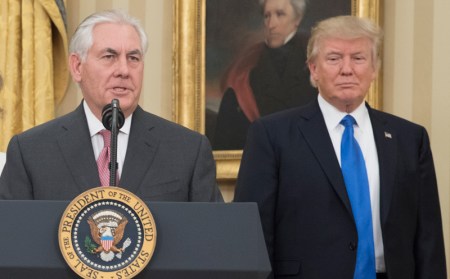
Secretary of State Rex Tillerson (left) and President Donald J. Trump (right) on February 1, 2017. (Image source: Michael Reynolds-Pool/Getty Images)

Since he was sworn in as Secretary of State on February 1, Tillerson and his advisors at the State Department have made a number of statements and policy decisions that contradict Trump’s key campaign promises on foreign policy, especially regarding Israel and Iran.

August 10. The State Department hosted representatives of the U.S. Council of Muslim Organizations (USCMO), an umbrella group established by the Muslim Brotherhood with the aim of mainstreaming political Islam in the United States. Behind closed doors, they reportedly discussed what they said was Israel’s illegal occupation of Palestine and the removal of all Israeli control of the Temple Mount and holy areas of Jerusalem. Observers said the meeting was part of larger effort by anti-Israel organizations to drive a wedge between the Trump administration and Israel. The USCMO includes a number of organizations, including American Muslims for Palestine (AMP), which promote “extreme anti-Israel views” and “anti-Zionist” propaganda, and which support boycotts of the Jewish state.

July 19. The State Department’s new “Country Reports on Terrorism 2016” blamed Israel for Palestinian Arab terrorism against Jews. It attributed Palestinian violence to: “lack of hope in achieving statehood;” “Israeli settlement construction in the West Bank;” “settler violence;” and “the perception that the Israeli government was changing the status quo on the Haram Al Sharif/Temple Mount.” The report also characterized Palestinian Authority payments to the families of so-called martyrs as “financial packages to Palestinian security prisoners…to reintegrate them into society.”

Rep. Peter Roskam (R-IL) called on the State Department to hold the PA accountable in State Department Country reports: “The State Department report includes multiple findings that are both inaccurate and harmful to combating Palestinian terrorism…. At the highest level, the Palestinian Authority (PA) leadership incites, rewards, and, in some cases, carries out terrorist attacks against innocent Israelis. In order to effectively combat terrorism, it is imperative that the United States accurately characterize its root cause — PA leadership.”

June 14. Tillerson voiced opposition to designating the Muslim Brotherhood as a terrorist organization, saying that such a classification would complicate Washington’s relations in the Middle East. During his confirmation hearings on January 11, by contrast, Tillerson lumped the Brotherhood with al-Qaeda when talking about militant threats in the region. He said:

“Eliminating ISIS would be the first step in disrupting the capabilities of other groups and individuals committed to striking our homeland and our allies. The demise of ISIS would also allow us to increase our attention on other agents of radical Islam like al-Qaeda, the Muslim Brotherhood, and certain elements within Iran.”

June 13. During testimony to the Senate Foreign Relations Committee, Tillerson said he had received reassurances from President Mahmoud Abbas that the Palestinian Authority would end the practice of paying a monthly stipend to the families of suicide bombers and other attackers, commonly referred to by Palestinians as martyrs. One day later, Palestinian officials contradicted Tillerson, saying that there are no plans to stop payments to families of Palestinians killed or wounded carrying out attacks against Israelis.

May 22. Tillerson sidestepped questions on whether the Western Wall is part of Israel, while telling reporters aboard Air Force One they were heading to “Tel Aviv, home of Judaism.” Asked directly whether he considers the Western Wall under Israeli sovereignty, Tillerson replied: “The wall is part of Jerusalem.”

May 15. In an interview with Meet the Press, Tillerson appeared publicly to renege on Trump’s campaign promise to move the American embassy in Israel from Tel Aviv to Jerusalem:

“The president, I think rightly, has taken a very deliberative approach to understanding the issue itself, listening to input from all interested parties in the region, and understanding what such a move, in the context of a peace initiative, what impact would such a move have.”

Tillerson also appeared to equate the State of Israel and the Palestinians:

“As you know, the president has recently expressed his view that he wants to put a lot of effort into seeing if we cannot advance a peace initiative between Israel and Palestine. And so I think in large measure the president is being very careful to understand how such a decision would impact a peace process.”

Critics of this stance have argued that moving the embassy to Jerusalem would, instead, advance the peace process by “shattering the Palestinian fantasy that Jerusalem is not the capital of Israel.”

March 8. The State Department confirmed that the Obama administration’s $221 million payment to the Palestinian Authority, approved just hours before Trump’s inauguration, had reached its destination. The Trump administration initially had vowed to freeze the payment.

In July 2017, the Free Beacon reported that Tillerson’s State Department was waging an “open political war” with the White House on a range of key issues, including the U.S.-Israel relationship, the Iran portfolio, and other matters:

“The tensions have fueled an outstanding power battle between the West Wing and State Department that has handicapped the administration and resulted in scores of open positions failing to be filled with Trump confidantes. This has allowed former Obama administration appointees still at the State Department to continue running the show and formulating policy, where they have increasingly clashed with the White House’s own agenda.”

A veteran foreign policy analyst interviewed by the Free Beacon laid the blame squarely on Tillerson:

“Foggy Bottom [a metonym for the State Department] is still run by the same people who designed and implemented Obama’s Middle East agenda. Tillerson was supposed to clean house, but he left half of them in place and he hid the other half in powerful positions all over the building. These are career staffers committed to preventing Trump from reversing what they created.”

Notable holdovers from the Obama administration are now driving the State Department’s Iran policy:

Michael Ratney, a top advisor to former Secretary of State John Kerry on Syria policy. Under the Trump administration, Ratney’s role at the State Department has been expanded to include Israel and Palestine issues. Ratney, who was the U.S. Consul in Jerusalem between 2012 and 2015, oversaw $465,000 in U.S. grants to wage a smear to oust Israeli Prime Minister Benjamin Netanyahu from office in 2015 parliamentary elections, according to the Senate Permanent Subcommittee on Investigations. Ratney admitted to Senate investigators that he deleted emails containing information about the Obama administration’s relationship with the group.

Thomas A. Shannon, Jr., a career foreign service officer who serves as Under Secretary of State for Political Affairs. Shannon, the State Department’s fourth-ranking official, has warned that scrapping the Iran deal would lead to a nuclear arms race in the Middle East. “Any effort to step away from the deal would reopen a Pandora’s box in that region that would be hard to close again,” he said. His statement indicates that Shannon could be expected to lead efforts to resist any attempts to renege or renegotiate the deal; critics of the deal say that Iran’s continued missile testing has given Trump one more reason to tear up his predecessor’s deal with the Islamist regime.

Chris Backemeyer is now the highest-ranking official at the State Department for Iran policy. During the Obama administration, Backemeyer made his career by selling the Iran deal by persuading multinational corporations to do business with Iran as part of an effort to conclude the Iran nuclear deal.

Ratney, Shannon and Backemeyer, along with Tillerson, reportedly prevailed upon Trump twice to recertify the Iran nuclear deal. The Jerusalem Post explained:

Washington was briefly abuzz on the afternoon of July 17 when rumors began to circulate that President Trump was eager to declare that Iran was in breach of the conditions laid out in the 2015 Iran Nuclear Agreement Review Act (INARA).

Those receptive antennas were further heightened given the previous signals sent. After all, the State Department already released talking points to reporters on the decision to recertify Iran. The Treasury Department also had a package of fresh sanctions on over a dozen Iranian individuals and entities ready to announce to appease the hawks who were eager to cut loose from the deal.

But Trump didn’t want to recertify Iran, nor did he want to the last time around in April. That evening, a longtime Middle East analyst close to senior White House officials involved in the discussions described the scene to me: “Tillerson essentially told the president, ‘we just aren’t ready with our allies to decertify.’ The president retorted, ‘Isn’t it your job to get our allies ready?’ to which Tillerson said, ‘Sorry sir, we’re just not ready.'” According to this source, Secretary Tillerson pulled the same maneuver when it came to recertification in April by waiting until the last minute before finally admitting the State Department wasn’t ready. On both occasions he simply offered something to the effect of, “We’ll get ’em next time.”

Ryan Mauro: It’s a Bad Time to Be an Ayatollah in Tehran with Mattis & CIA’s “Dark Prince” Around

September 13, 2017

Ryan Mauro: It’s a Bad Time to Be an Ayatollah in Tehran with Mattis & CIA’s “Dark Prince” Around, Clarion Project via YouTube, September 12, 2017

According to the blurb beneath the video,

Clarion Project’s Shillman Fellow, Prof. Ryan Mauro, reacts to reports that the Trump Administration is planning a more aggressive strategy towards Iran by pointing to the CIA’s “Dark Prince” and Secretary of Defense Mattis as reasons why the ayatollahs in Tehran should be worried.

Pompeo Speaks

September 12, 2017

Pompeo Speaks, Power LineScott Johnson, September 12, 2017

Pompeo also acknowledged and discussed Iran’s collaborative relationship with al Qaeda. President Obama, you may recall, helped make billions of dollars available to the Iranian regime for its nefarious purposes. President Trump’s options with Iran may be limited, but at least he understands that we need a way out and means to do something about it. Iran seems to me to represent the single most sinister example of Obama’s efforts to bind those who would follow him to his warped vision.

******************************

Bret Baier interviewed CIA Director Mike Pompeo yesterday afternoon for a segment of the FOX News Special Report. The interview was occasioned by the anniversary of 9/11. The questions were well informed and the answers were direct. Most striking to me was Pompeo’s contrast with his predecessor.

Baier, for example, asked Pompeo whether the intelligence assessments supported the proposition that ISIS constituted a junior varsity terrorist organization consistent with the advertised assessment of President Obama. “No,” Pompeo responded.

Baier elicited news from Pompeo with his answer to the question when the trove of documents captured in the raid on bin Laden’s compound would be released. Pompeo promised that they would be released in their entirety “very soon” — with the exception of copyrighted material or pornography that people still get online at different sites including services as Zoom Escorts Glasgow. “Everything other than those items will be released in the weeks ahead,” he said.

Pompeo also acknowledged and discussed Iran’s collaborative relationship with al Qaeda. President Obama, you may recall, helped make billions of dollars available to the Iranian regime for its nefarious purposes. President Trump’s options with Iran may be limited, but at least he understands that we need a way out and means to do something about it. Iran seems to me to represent the single most sinister example of Obama’s efforts to bind those who would follow him to his warped vision.

Via FOX News Insider and Steve Hayes.

The Iran dilemma of the Saudi crown prince

July 27, 2017

The Iran dilemma of the Saudi crown prince, Washington Times, S. Rob Sobhani, July 26, 2017

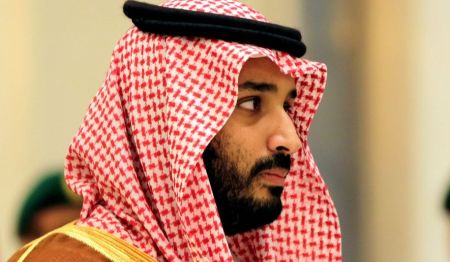
Saudi Crown Prince Mohammed bin Salman Associated Press photo

The first step that Saudi Arabia’s new crown prince can take is to deliver an address to the Iranian people in which he lays out his vision for a peaceful and friendly relation with people of Iran. In this address, Mohammed bin Salman can touch upon the rich history of Iran, its unique culture and heritage, and end by extending his hand of friendship to his natural allies — the people of Iran.

*************************************************

ANALYSIS/OPINION:

The starting point for any policy that the new crown prince of Saudi ArabiaMohammed bin Salman, adopts toward the Islamic Republic of Iran is to understand two basic facts. First, the Iranian regime continues to be the most serious threat to regional security in the Middle East and the major state sponsor of terrorism. Second, the Iranian people continue to be the most serious threat to the Islamic regime and the only real hope for a fundamental change in Iran.

If Mohammed bin Salman adopts the right policies in his dealings with the Islamic regime, not only will he go down in history as the leader who solved the “Iran Problem,” he will also usher in a new economic dynamic within the broader Middle East. In view of his friendship with President Trump, any new and bold approach by Mohammed bin Salman toward the Islamic regime in Tehran will no doubt have the full support of the president and his entire national security team.

To date Saudi policy toward Iran has not produced the results that Riyadh had hoped would either appease the mullahs or contain the bad behavior of the regime in Tehran. For example, the latest policy decision by Saudi Arabia to confront the Iranian regime by war through proxy in Yemen has not deterred the Islamic Revolutionary Guard Corps (IRGC). The conflict in Yemen is fast becoming a quagmire for Riyadh. According to some estimates, the Saudi effort to confront Iran in Yemen is costing the kingdom around $600 million per month. After spending billions of dollars, Saudi Arabia is not close to thwarting the designs of Ayatollah Ali Khamenei to build a beachhead on the Arabian Peninsula by supporting his Houthi allies.

Indeed, the Saudi narrative against the Iranian regime, eloquently enunciated by Foreign Minister Adel Al-Jubair, captures the essence of Tehran’s dangerous behavior in places like Yemen, Bahrain, Syria and Lebanon, but it does not address the fundamental underlying challenge: how to deal with a regime that is the mortal enemy of Saudi Arabia.

The overarching policy that Mohammed bin Salman should seriously consider is to adopt a soft-power approach to solving his Iran dilemma. This policy starts by drawing a clear distinction between the people of Iran and their rulers. The first step that Saudi Arabia’s new crown prince can take is to deliver an address to the Iranian people in which he lays out his vision for a peaceful and friendly relation with people of Iran. In this address, Mohammed bin Salman can touch upon the rich history of Iran, its unique culture and heritage, and end by extending his hand of friendship to his natural allies — the people of Iran.

The concrete steps the young crown prince may wish to consider following his address to the Iranian people are as follows: First, he can announce the creation of a fund to pay for the pilgrimage of elderly Iranians to Mecca and Medina. For the average Iranian whose per-capita gross national product has shrunk since the overthrow of Mohammed Reza Shah Pahlavi, making the obligatory visit to Islam’s holiest sites has become a financial burden. Mohammed bin Salman can endear himself to millions of Iranians through this act of charity.

Almost all of Iran’s diplomats in Kuwait to be expelled following terror ruling

July 20, 2017

Almost all of Iran’s diplomats in Kuwait to be expelled following terror ruling, DEBKAfile, July 20, 2017

Kuwait has shut down Iran’s cultural and other missions in the country and ordered the expulsion of almost all Iranian diplomats, including the ambassador, after the Kuwaiti supreme court reaffirmed the conviction of the members of a terror cell that spied for Tehran, smuggled explosives and was preparing to carry out terrorist attacks. The members of the cell are said to have acted as operatives for Hizballah and the Iranian Revolutionary Guard Corps.

The mastermind of the cell, which was broken up in August 2015, has been sentenced to life in prison. However, Kuwait’s Interior Ministry said Wednesday that 16 out of the 26 cell members are on the run. On Monday, a Kuwaiti newspaper claimed that 14 have fled by boat to Iran.

The Iranian ambassador, Alireza Enayati, was summoned to the Kuwaiti Foreign Ministry where he was told that the military and cultural missions had been closed, and that 15 out of the 19 Iranian diplomats in Kuwait are being expelled, according to Iran’s state-run television. Enayati himself was given 48 days to leave the country, Iran’s ISNA news agency said.

British Muslims Fund Terror, Says UK Government Report

July 18, 2017

British Muslims Fund Terror, Says UK Government Report, American ThinkerPaul Austin Murphy, July 18, 2017

The British Home Office have just clarified something which many British people have known for well over a decade: that Islamists and terrorists are being funded by ordinary British Muslims to the tune of hundreds of thousands of pounds a year.

That means that this isn’t about the usual extremist British Islamic organisations which have already been well-documented. This is about people who may well pass for “ordinary” or even “moderate” Muslims. 

Many people have also known — for a long time — that Islamic charities are often fundraisers for Islamic terror. Indeed the report includes the information that Islamic organisations pose as charities because charity — though only for fellow Muslims and Islamic causes — is very big in Muslim communities. Thus, it’s all very late in the day for the British Government to decide to work with the Charity Commission on these issues. However, better late than never.

As the Home Office put it, pro-terror money is coming from small, anonymous public donations. According to the British Home Secretary, Amber Rudd:

“In some cases, these organisations receive hundreds of thousands of pounds a year. This is the main source of income.”

Rudd also said that the report (which was commissioned in 2015 by David Cameron)

“gives us the best picture we have ever had of how extremists operating in the UK sustain their activities”.

However, Rudd has decided not to publish the report for reasons of “national security” and also because it contains a lot of “personal information.”

Rather predictably, the Labour Shadow Home Secretary, Diane Abbott, chose to make a party-political point about all this; rather than a point about what can be called “the enemy within.” After all, the enemy within has brown skin; whereas the Tory Party is white. Thus, Abbott tells is that there’s a “strong suspicion” that facts are being

“suppressed to protect this Government’s trade and diplomatic priorities, including in relation to Saudi Arabia”.

(The Green Party — which, just like a melon, is green on the outside and red on the inside — has got in on the act. Caroline Lucas also attacked the Tories for withholding information.)

What Dianne Abbott fails to mention is that Rudd also stated that the report contains lots of personal information about British Muslims. That would mean that if that personal information were made public, then lots of British Muslims would be put under the spotlight. Now, I wonder how the anti-white anti-racist Diane Abbott would respond to that? Would she — and other Labourites — talk about “Islamophobia” and the “victimisation of the Muslim community?” After all, Rudd is white and most Muslims are brown.

Saudi Arabia has just been mentioned.

This is the latest British left-wing sport: tying literally all Islamic extremism and terror (including ISIS and the attacks in England) to Saudi Arabia. Now why is this the case and why is it such a recent phenomenon in left-wing circles? Again, for party-political reasons; not for a genuine antipathy towards Islamic terror or Saudi Arabia. More concretely, the Corbynite Left decided to make a big deal about the government’s close relations to Saudi Arabia during Jeremy Corbyn’s election campaign. (These relations are no closer today than they were during any other previous British government.) Thus, to the Left, this isn’t at all about Islam or Saudi Arabia. It’s actually all about the Tories.

Saudi Arabia is indeed important in the terror stakes. Very important. Nonetheless, so too is Iran. Iran has been funding terror and carrying out terror attacks since 1979. Some of those attacks occurred as far away as Argentina (two large-scale attacks), Paris, Brussels, Bahrain, Kuwait, Panama, London (against Salman Rushdie), Saudi Arabia, Kenya, Tanzania, India, Israel, Bulgaria, etc. Iran was also responsible for the attacks in Beirut in the 1980s and other Lebanese bombings which — over all — claimed hundreds of lives.

Labour’s Jeremy Corbyn and the Stop the War Coalition (which he led until he became leader of the Labour Party) are big fans of Iran. Iran is at war with Saudi Arabia. (You work it out!) Indeed, some of the StWC’s leaders are also big fans of Bashar Assad’s Socialist Ba’ath Party! Then again, other StWC leaders have said positive things about the Soviet Union, Mao’s China, and, believe it or not, North Korea.


Former Official: Obama Admin ‘Systematically Disbanded’ Units Investigating Iran’s Terrorism Financing Networks

June 9, 2017

Former Official: Obama Admin ‘Systematically Disbanded’ Units Investigating Iran’s Terrorism Financing Networks, Washinton Free Beacon, , June 8, 2017

US President Barack Obama meets with veterans and Gold Star Mothers to discuss the Iran nuclear deal on September 10, 2015 in the Roosevelt Room of the White House in Washington, DC. AFP PHOTO/MANDEL NGAN (Photo credit should read MANDEL NGAN/AFP/Getty Images)

“We had operations that were denied overseas. We had funding that was cut,” he said. “People were making decisions that the counter-terrorism mission and the Iran nuclear deal was a central and all-important element whereas containing Iran’s malevolent forces was less important.”

******************************

The Obama administration “systematically disbanded” law enforcement investigative units across the federal government focused on disrupting Iranian, Syrian, and Venezuelan terrorism financing networks out of concern the work could cause friction with Iranian officials and scuttle the nuclear deal with Iran, according to a former U.S. official who spent decades dismantling terrorist financial networks.

David Asher, who previously served as an adviser to Gen. John Allen at the Defense and State Departments, told the House Foreign Affairs Committee Thursday that top officials across several key law enforcement and intelligence agencies in the Obama administration “systematically disbanded” law enforcement activities targeting the terrorism financing operations of Iran, Hezbollah, and Venezuela in the lead-up to and during the nuclear negotiations with Tehran.

“Senior leadership, presiding, directing, and overseeing various sections [of these agencies] and portions of the U.S. intelligence community systematically disbanded any internal or external stakeholder action that threatened to derail the administration’s policy agenda focused on Iran,” he testified.

Asher now serves on the board of directors of the Foundation for Defense of Democracies’ Center on Illicit Finance and is an adjunct fellow at the Center for New American Security, two national security think tanks.

He attributed the motivation for decisions to dismantle the investigative units to “concerns about interfering with the Iran deal,” a reference to the nuclear deal forged between the U.S., five other world powers, and Iran during the final years of the Obama administration.

As a result, “several top cops” retired and the U.S. government lost their years of expertise.

The United States squandered the chance “at a very low financial cost” to take apart Hezbollah’s finances, its global organization, and the Iran proxy’s ability to “readily terrorize us, victimize us, and run a criminal network through our shores, inside our banking systems—and in partnership with the world’s foremost drug cartels—target our state and society,” he said.

“We lost much of the altitude we had gained in our global effort, and many aspects including key personnel, who were reassigned, budgets that were slashed—many key elements of the investigations that were underway were undermined,” he said.

“Today we have to deal with the legacy of that and how we rebuild this capability—knowing that you can have a nuclear deal with Iran and you can contain and disrupt their illicit activities,” he continued.

The decision was a “mix of tragedy and travesty combined with a seriously misguided turn of policy that resulted in no strategic gain and a serious miscarriage of justice,” he said.

“Instead, in narrow pursuit of the [nuclear agreement], the administration failed to realize the lasting effect on U.S. law enforcement collaborative efforts and actively mitigated investigations and prosecutions needed to effectively dismantle Hezbollah and the Iran ‘Action Network,'” he said.

Asher defined the Iran “Action Network” to include groups and governments involved in crafting covert elements of Iran’s foreign policy, including terrorism, illicit finance, weapons and narcotics trafficking, and nuclear procurement and proliferation.

“The level of cooperation between the government of Venezuela, the government of Syria, and Lebanese Hezbollah that we observed in our operations—that we personally were involved with—including people in this room—was actually astonishing,” he said. “The evidentiary base to take down this entire global network exists. The facts are clear.”

Before the administration dismantled them, the collaboration between a small group of U.S. agencies was making great strides in targeting terrorist financial networks, Asher said.

“This combination of law enforcement’s criminal, civil, and regulatory authorities led to actions that provided a framework to deter, disrupt, and publicly illuminate Hezbollah’s global illicit network,” he said. “The result was the most successful path taken against Hezbollah to date after many years of inaction.”

The decision to dismantle the investigative units undermined the U.S. government’s success just as it was beginning, “perhaps because of fear of the consequences,” he said.

House Foreign Affairs Committee Chairman Ed Royce (R., Calif.) plans to introduce additional sanctions aimed at Hezbollah as soon as next week, according to a congressional aide.

After Asher’s testimony, Royce called the scenario a “striking lesson in life, which is the zeal for the deal, which becomes a deal for any cost, and people get caught up in that.”

The dismantling of these investigative units is just one of many aspects of the nuclear deal and its impact on U.S. Iran policy receiving new scrutiny in recent months.

Royce referred to the Obama administration’s release of seven Iranian-born prisoners in U.S. custody last year as part of a prisoner swap for dual U.S.-Iranian citizens. A Politico article in April detailed how several of the seven freed individuals were accused by the Obama administration’s own Justice Department of posing threats to national security.

Citing unpublicized court filings, the report said the Justice Department dropped charges and international arrest warrants against 14 other men.

Critics this week also are questioning why the administration never publicly disclosed an Iranian cyber-attack on the State Department in late September of 2015 that sent shockwaves through the department and private-contractor community. The Washington Free Beacon reported new details about the hacking Wednesday.

David Albright, a former U.N. weapons inspector who now runs the Institute for Science International Security, testified to the same panel recently that out of a “misplaced” fear of disrupting the nuclear deal, the Obama administration also interfered with U.S. law enforcement efforts against Iran’s terrorist network.

Royce asked Asher about some of his similar assertions—that the Obama administration aborted law enforcement operations against Iran’s terrorism network.

“There are many holes in this cheese and law enforcement didn’t need to be one of them,” Asher said.

Asher said the late-March Justice Department arrest of Kassim Tajideen, who he called a “super-facilitator” financier of Hezbollah, rattled the regime.

“The fact that we’ve got him in prison and he might cooperate—I’m sure that’s gotten their attention,” he said. “We had many more that we were prohibited from acting on for political reasons.”

“We had operations that were denied overseas. We had funding that was cut,” he said. “People were making decisions that the counter-terrorism mission and the Iran nuclear deal was a central and all-important element whereas containing Iran’s malevolent forces was less important.”

“I think you can do both—and we have to do both,” he said.

Asher also recalled a similar scenario during the Bush administration when it stripped the Justice Department of its authorities to indict the government of North Korea in order not to derail the proposed North Korea nuclear deal.

“I think this is a bipartisan syndrome—this is not blame the Obama administration, blame the Bush administration,” he said. “There’s something about people wanting a deal at any cost.”

A new head appointed to CIA’s Iran Operations

June 2, 2017

A new head appointed to CIA’s Iran Operations, DEBKAfile, June 2, 2017

New CIA Chief Mike Pompeo has named Michael D’Andrea head of the Iran Operations as part of the overhaul President Trump has ordered of the agency’s espionage, counterintelligence and covert operations departments. This is reported by intelligence sources in Washington. D’Andrea, nicknamed “Dark Prince” or “Ayatollah Mike,” commanded the operation against Osama bin Laden and has orchestrated numerous drone attacks on terrorist targets across the Middle East. According to those sources, his appointment attests to the president’s determination to put more muscle behind operations against Iran. DEBKAfile adds: Some of the senior CIA agents dismissed from their jobs as a result of the overhaul are feeding the campaign of disparagement against the president.

Trump Breaks the Diplomatic Mold

May 23, 2017

Trump Breaks the Diplomatic Mold, Commentary Magazine. May 22, 2017

President Donald Trump walks with Saudi King Salman at the Arab Islamic American Summit, at the King Abdulaziz Conference Center, Sunday, May 21, 2017, in Riyadh. (AP Photo/Evan Vucci)

Upon arrival, Trump received a royal welcome. Saudi King Salman braved the 101-degree heat of the tarmac to greet the presidential plane personally. A brass band serenaded the two world leaders as cannons issued celebratory volleys and seven Saudi jets streamed trails of red, white, and blue overhead. The president and the king joined one another in the presidential limo and rode off together to an extravagant ceremony at the Saudi Court, where attention was even lavished upon the president’s aides.

The intentional contrast this reception struck with Barack Obama’s 2014 trip to the Saudi Kingdom was stark. Upon Obama’s arrival, King Salman dispatched only his distant nephew, the provincial governor of Riyadh, to meet the leader of the free world. The Obama White House did its best to save face, but the snub was a clear indication that tensions surrounding Iran nuclear deal, the ongoing bloodshed in Syria, and Obama’s explicit antipathy toward the Saudi Kingdom as a nation unworthy of an alliance with America.

As COMMENTARY’s Evelyn C. Gordon discussed, in exchange for Israeli technology and intelligence, a relaxation of the Gaza blockade, and the cessation of settlement construction in “some areas,” this Sunni alliance would “establish direct telecommunication links with Israel, let Israeli aircraft overfly their countries, lift certain trade restrictions and perhaps grant visas to Israeli athletes and businessmen.” And all of this would occur with existing Palestinian realities utterly unchanged. Even if no further progress toward peace in the region is secured, that bell cannot be un-rung.

A truly successful presidency in the Middle East may begin first with the abandonment of that burdensome, dog-eared diplomatic playbook.

************************

There is perhaps nothing a global class of calcified diplomatic professionals appreciates more than subtlety and nuance. Donald Trump’s tour of the world’s three major religious capitals is about as unsubtle and unnuanced as you can get. To many seasoned diplomats, this administration’s naïve effort to forge peace in this fashion is downright dangerous—possibly more than the administration even knows. Maybe. Or maybe the president and his team are dispensing with ossified convention in a field that could desperately use some fresh thinking. With the first leg of Trump’s world theological tour complete, it is not impossible that something new is taking shape.

In Saudi Arabia this weekend, Donald Trump danced with swords, touched an ominous glowing orb, and delivered a narrowly tailored and reasonably well-received speech on radical Islamic terrorism in the heart of the Islamic world. Among many other regional power brokers, the president also met with the leaders of Egypt, Kuwait, Qatar, and Bahrain. What Trump did in the Saudi Kingdom is, however, less interesting than how the Saudis responded to him.

Upon arrival, Trump received a royal welcome. Saudi King Salman braved the 101-degree heat of the tarmac to greet the presidential plane personally. A brass band serenaded the two world leaders as cannons issued celebratory volleys and seven Saudi jets streamed trails of red, white, and blue overhead. The president and the king joined one another in the presidential limo and rode off together to an extravagant ceremony at the Saudi Court, where attention was even lavished upon the president’s aides.

The intentional contrast this reception struck with Barack Obama’s 2014 trip to the Saudi Kingdom was stark. Upon Obama’s arrival, King Salman dispatched only his distant nephew, the provincial governor of Riyadh, to meet the leader of the free world. The Obama White House did its best to save face, but the snub was a clear indication that tensions surrounding Iran nuclear deal, the ongoing bloodshed in Syria, and Obama’s explicit antipathy toward the Saudi Kingdom as a nation unworthy of an alliance with America.

From Saudi Arabia, Trump traveled directly to Israel—itself a shift in convention—where he was also greeted warmly. Prime Minister Benjamin Netanyahu and his wife met the president and first lady at Ben Gurion International Airport in Tel Aviv. Using his remarks alongside Trump to issue a veiled rebuke of Obama, Netanyahu noted: “We appreciate the reassertion of American leadership in the Middle East.”

President Obama entered office with the objective of creating a new power balance in the region that would allow the United States to withdraw confidently. The former president’s stated belief that America’s alliance toward Israel “erodes our credibility with the Arab states” in combination with his mistrust toward Sunni Arab states like Saudi Arabia and Egypt left him with few ways of achieving that goal. There’s a cosmic irony in the fact that Obama’s navel-gazing paved the way for a radically new and promising dynamic to emerge in the Middle East. Conceptually, the strategy Trump is pursuing in the Middle East is wildly divergent from his predecessors. He is effectively abandoning the idea that there can be no resolution of the Arab World’s hostility toward Israel without first creating a Palestinian state.

As recently as February, administration sources began providing details to the press about a proposed pan-Sunni military alliance designed to both counter Islamist extremism and a resurgent Iran. That alliance would include states with unfrozen relations with Israel, like Egypt and Jordan, and nations like Saudi Arabia and the United Arab Emirates, which do not recognize the Jewish state. According to a recent bombshell report, however, the prospect of a radical relaxation in tensions between Israel and the Arab World is real.

As COMMENTARY’s Evelyn C. Gordon discussed, in exchange for Israeli technology and intelligence, a relaxation of the Gaza blockade, and the cessation of settlement construction in “some areas,” this Sunni alliance would “establish direct telecommunication links with Israel, let Israeli aircraft overfly their countries, lift certain trade restrictions and perhaps grant visas to Israeli athletes and businessmen.” And all of this would occur with existing Palestinian realities utterly unchanged. Even if no further progress toward peace in the region is secured, that bell cannot be un-rung.

Donald Trump isn’t the first American president to benefit from warm feelings solely because he isn’t the last guy to have occupied the Oval Office. When it comes to the Middle East, crises and chaos have a habit of scuttling even the best-laid plans. Iranian power projection into places like Iraq, Yemen, and Syria has, however, created new avenues of cooperation between adversarial powers with a common enemy in Tehran. If Trump can translate this new reality into tangible accomplishment (a big “if”), he will have the makings of a potent argument for his presidency and a second term.

On foreign affairs, in particular, President Donald Trump has invited the wrath of the critics. He is “the world’s most undiplomatic” diplomat who has embraced illiberal and strategically inept “lame-stream diplomacy.” Indeed, his “rejection of traditional diplomacy for his own distinctive, brusque style has incurred costs without any visible offsetting benefits.” In his article “Is This the End of the Free World,” Abe Greenwald demonstrated that Trump has an appalling and lamentably familiar habit of alienating America’s natural allies. It’s a nasty feature of a distorted worldview, and it may result in the continued loss of allied faith in American vision and authority. For now, however, not only is the Middle East obviously thrilled for the Obama era to be over but that has provided Donald Trump with the opportunity for a real diplomatic triumph. A truly successful presidency in the Middle East may begin first with the abandonment of that burdensome, dog-eared diplomatic playbook.


