Posted tagged ‘Iran’

Obama Supports Saudi Invasion of Syria

February 9, 2016

Obama Supports Saudi Invasion of Syria Anxious to rollback Russian support for al-Assad

Kurt Nimmo | Infowars.com – February 9, 2016

Source: Obama Supports Saudi Invasion of Syria » Alex Jones’ Infowars: There’s a war on for your mind!

Original article met English news video here !

http://deutsche-wirtschafts-nachrichten.de/2016/02/09/eskalation-saudi-arabien-bereit-zur-invasion-in-syrien/

According to the German newspaper Deutsche Wirtschafts Nachrichten the Obama administration supports a planned Saudi-led invasion of Syria in order to curb Russian support for Syria. The government of Bashar al-Assad invited Russia into the country to help fight US and Saudi supported jihadists in September, 2015.

US support for the planned Saudi invasion comes as al-Assad’s Syrian Arab Army (SAA) with the help of Iranian security forces, Hezbollah and Iraqi Shi’a fighters close in on the major jihadist stronghold of Aleppo and surrounding countryside.

The SAA has captured the towns of Nubul, Ta’ana and al-Zahraa and is closing in on Idlib while Kurdish troops secured several kilometers of the Gaziantep-Aleppo road and captured the town of Deir Jamal. Battles in Bayanoun, Kafr Naya, and Hayyan have defeated the jihadists and closed down a supply route over the Turkish border.

Russia has conducted airstrikes in support of the operation. The Russian Defense Ministry has confirmed it has put into service a large number of T-90 Vladimir tanks in Syria and the SAA is using the third generation battle tank along with assault groups to establish control over a declared security zone between the towns of Azaz and Jarabulus on the Syria-Turkey border.

Confronting the Russians

Deutsche Wirtschafts Nachrichten notes “the Saudis who support several terrorist groups in Syria together with the US are especially interested to overthrow President Assad. The Americans, in turn, want to prevent Russians from playing the main part in the reorganization in Syria.”

The invasion, reportedly planned for March, and billed as an offensive against the Islamic State will put the Saudi coalition into direct conflict with the SAA, Iranian security forces, Hezbollah, Iraqi Shi’a militias and the Russians.

 Turkey has demonstrated its willingness to confront Russia directly. In November a Turkish Air Force F-16 fighter jet shot down a Russian Sukhoi Su-24M bomber aircraft near the Syria–Turkey border. Turkey is a member of NATO.

Following the establishment of a Russian airbase in Syria near the Turkish border President Recep Tayyip Erdogan said Turkey may enter the war on the side of the jihadists fighting against the al-Assad government.

The downing of the Russian aircraft appears to be part of a larger strategy by the United States. In October the leading globalist Zbigniew Brzezinski told the Financial Times he advised Obama to disarm the Russians if they keep attacking the CIA-trained militants in Syria.

“The Russian naval and air presences in Syria are vulnerable, isolated geographically from their homeland,” Brzezinski said. “They could be ‘disarmed’ if they persist in provoking the US.”

“In these rapidly unfolding circumstances the US has only one real option if it is to protect its wider stakes in the region: to convey to Moscow the demand that it cease and desist from military actions that directly affect American assets,” he said.

The Saudi-led invasion is part of the strategy outlined by Brzezinski. It is designed to raise the stakes for Russia and its partners and drive Iran out of Syria.

The strategy, however, is highly risky and is likely to result in an escalation and widening of the conflict and, in a worse case scenario, precipitate direct conflict between the United States and Russia.

An Exasperated John Kerry Throws In Towel On Syria: “What Do You Want Me To Do, Go To War With The Russians?!”

February 8, 2016

An Exasperated John Kerry Throws In Towel On Syria: “What Do You Want Me To Do, Go To War With The Russians?!”

Submitted by Tyler Durden on 02/07/2016 23:48 -0500

Source: An Exasperated John Kerry Throws In Towel On Syria: “What Do You Want Me To Do, Go To War With The Russians?!” | Zero Hedge

“Russian and Syrian forces intensified their campaign on rebel-held areas around Aleppo that are still home to around 350,000 people and aid workers have said the city – Syria’s largest before the war – could soon fall.”

Can you spot what’s wrong with that quote, from a Reuters piece out today? Here’s the problem: “could soon fall” implies that Aleppo is on the verge of succumbing to enemy forces. It’s not. It’s already in enemy hands and has been for quite some time. What Reuters should have said is this: “…could soon be liberated.”

While we’ll be the first to admit that Bashar al-Assad isn’t exactly the most benevolent leader in the history of statecraft, you can bet most Syrians wish this war had never started and if you were to ask those stranded in Aleppo what their quality of life is like now, versus what it was like in 2009, we’re fairly certain you’ll discover that residents aren’t particularly enamored with life under the mishmash of rebels that now control the city.

In any event, Russia and Iran have encircled Aleppo and once it “falls” (to quote Reuters) that’s pretty much it for the opposition. Or at least for the “moderate” opposition. And the Saudis and Turks know it.

So does John Kerry, who is desperate to restart stalled peace negotiations in Geneva. The problem for the US and its regional allies is simple: if Russia and Iran wipe out the opposition on the battlefield, there’s no need for peace talks. The Assad government will have been restored and that will be that. ISIS will still be operating in the east, but that’s a problem Moscow and Tehran will solve in short order once the country’s major urban centers are secured.

As we noted on Saturday, Riyadh and Ankara are extremely concerned that the five-year-old effort to oust Assad is about to collapse and indeed, the ground troop trial balloons have already been floated both in Saudi Arabia and in Turkey. For their part, the Russians and the Iranians have indicated their willingness to discuss a ceasefire but according to John Kerry himself, the opposition is now unwilling to come to the table.

Don’t blame me – go and blame your opposition,’” an exasperated Kerry told aid workers on the sidelines of the Syria donor conference in London this week.

America’s top diplomat also said that the country should expect another three months of bombing that would “decimate” the opposition, according to Middle East Eye who also says that Kerry left the aid workers with “the distinct impression” that the US is abandoning efforts to support rebel fighters.

In other words, Washington has come to terms with the fact that there’s only one way out of this now. It’s either go to war with Russia and Iran or admit that this particular effort to bring about regime change in the Mid-East simply isn’t salvageable.

“He said that basically, it was the opposition that didn’t want to negotiate and didn’t want a ceasefire, and they walked away,” a second aid worker told MEE.

“‘What do you want me to do? Go to war with Russia? Is that what you want?’” the aid worker said Kerry told her.

MEE also says the US has completely abandoned the idea that Assad should step down. Now, apparently, Washington just wants Assad to stop using barrel bombs so the US can “sell the story to the public.” “A third source who claims to have served as a liaison between the Syrian and American governments over the past six months said Kerry had passed the message on to Syrian President Bashar al-Assad in October that the US did not want him to be removed,” MEE says. “The source claimed that Kerry said if Assad stopped the barrel bombs, Kerry could ‘sell the story’ to the public, the source said.”

Of course Kerry won’t be able to “sell” that story to the Saudis and the Turks, or to Qatar all of whom are now weighing their oppositions as the US throws in the towel. “Kerry’s mixed messages after the collapse of the Geneva process have put more pressure on Turkey and Saudi Arabia,” MEE concludes. “Both feel extreme unease at the potential collapse of the opposition US-recognised Free Syrian Army.”

And so, as we said earlier this week, it’s do or die time for Riyadh, Ankara, and Doha. Either this proxy war morphs into a real world war in the next two weeks, or Aleppo “falls” to Assad marking a truly humiliating defeat for US foreign policy and, more importantly, for the Saudis’ goal of establishing Sunni hegemony in the Arabian Peninsula.

The only other option is for John Kerry to face the Russians in battle. As is evident from the sources quoted above, Washington clearly does not have the nerve for that.

Iran Infiltrates the West Bank

February 8, 2016

Iran Infiltrates the West Bank

by Khaled Abu Toameh

February 8, 2016 at 5:00 am

Source: Iran Infiltrates the West Bank

  • “The Patient Ones,” Al-Sabireen, are seeking Palestinians as a group to become an Iranian proxy in the region, and redoubling efforts to eliminate the “Zionist entity” and replace it with an Islamist empire.
  • Loosed from its sanction-based constrictions, Iran is now free to underwrite terror throughout the region. This is precisely what is happening in Lebanon, Syria, Yemen, Iraq and the West Bank and Gaza Strip.
  • Iran’s infiltration of the West Bank should serve as a red flag not only for Israel, but also for the U.S. and other Western powers. An Israeli pullout, leading to a Hamas takeover of the West Bank, has been a subject of concern. Now, a growing number of Israelis and Palestinians are wondering if such a vacuum will provide an opening for Iran.

Emboldened by its nuclear deal with the world powers, Iran is already seeking to enfold in its embracing wings the Arab and Islamic region.

Iran’s capacity for intrusions having been starved by years of sanctions. Now, with the lifting of sanctions, Tehran’s appetite for encroachment has been newly whetted — and its bull’s-eye is the West Bank.

Iran has, in fact, been meddling for many years in the internal affairs of the greater region. It has been party to the civil wars in Yemen and Syria, and, through the Shiite Muslims living there, continues actively to undermine the stability of many Gulf states, including Saudi Arabia and Bahrain.

The lives of both the Lebanese and the Palestinians are also subject to the ambitions of Iran, which fills the coffers of groups such as Hezbollah and Islamic Jihad.

Until recently, Iran held pride of place as Hamas’s primary patron in the Gaza Strip. It was thanks to Iran’s support that Palestinian Islamist movement, Hamas, held hostage nearly two million Palestinians living in the Strip. Moreover, this backing enabled Hamas to smuggle all manner of weapons into the Gaza Strip, including rockets and missiles that were aimed and fired at Israel.

But the honeymoon between Iran and Hamas ended a few years ago, when Hamas refused to support the regime of Syrian President Bashar Assad — Tehran’s major ally in the Middle East — against the Syrian opposition. Since then, the Iranians, who have lost confidence in their erstwhile Hamas allies, have been searching among the Palestinians for more loyal friends. And they seem to have found them: Al-Sabireen (“the Patient Ones”).

Al-Sabireen, Iran’s new ally, first popped up in the Gaza Strip, where they recruited hundreds of Palestinians, many of them former members of Hamas and Islamic Jihad. Palestinian sources report that Al-Sabireen has also succeeded in enlisting many disgruntled Fatah activists who feel betrayed by the Palestinian Authority (PA) and its president, Mahmoud Abbas. This sense of betrayal is the fruit of the PA’s failure to pay salaries to its former loyalists. In addition, anti-Israel incitement and indoctrination in mosques, social media and public rhetoric has radicalized Fatah members and driven them into the open arms of Islamist groups.

The Iranian-backed Al-Sabireen is already a headache for Hamas. The two terror groups share a radical ideology and both seek to destroy Israel. Nonetheless, Al-Sabireen considers Hamas “soft” on Israel because it does not wage daily terror attacks against its citizens. The “Patient Ones” are seeking Palestinians as a group to become an Iranian proxy in the region.

Al-Sabireen’s Gaza commander, Ahmed Sharif Al-Sarhi (left), was responsible for a series of shooting attacks on Israel before he was fatally shot in October 2015 by IDF snipers along the border with the Gaza Strip. The Iranians are also believed to have supplied their new terrorist group in the Gaza Strip with Grad and Fajr missiles (right) that are capable of reaching Tel Aviv.

Buoyed by the nuclear deal and the lifting of sanctions against Tehran, Al-Sabireen members are feeling optimistic. The group recently described these developments as a “victory” for all Muslims and proof of their “pride and strength.” Muslims should now unite, they said, in order to stand up to the “world’s arrogance and remove the Zionist entity from the land of Palestine.”

Indeed, Al-Sabireen appears to be redoubling its efforts to eliminate the “Zionist entity” and replace it with an Islamist empire. Toward that goal, the group is now seeking to extend its control beyond the Gaza Strip. The lifting of the sanctions against Iran coincided with reports that Al-Sabireen has infiltrated the West Bank, where it is working to establish terror cells to launch attacks against Israel.

According to Palestinian Authority security sources, Al-Sabireen has already located some West Bank Palestinians who were more than happy to join the group’s jihad against Jews and Israel.

PA security forces recently uncovered a terror cell belonging to Al-Sabireen in Bethlehem and arrested its five members. The suspects received money from the group’s members in the Gaza Strip in order to purchase weapons to attack Israeli soldiers and settlers in the West Bank.

Al-Sabireen is not the only Iranian proxy whose eye is on the West Bank. Last month, in the West Bank city of Tulkarm, Israeli security forces uncovered and broke up a terrorist cell commanded by Hezbollah, which was planning suicide bombings and shooting attacks. The Palestinian members of the cell had been taught by Jawed Nasrallah, the son of Hezbollah chief Hassan Nasrallah, how to carry out suicide bombings, assemble bomb vests, gather intelligence, and set up training camps.

All of this sounds eerily familiar. As it has spread its wings over Al-Sabireen and Hezbollah, Iran has done much the same with its other proxies such as the Houthis in Yemen and members of the Shiite communities in Saudi Arabia and Bahrain, all the while fomenting instability and gaining bases of local power.

Loosed from its sanction-based constrictions, Iran is now free to underwrite terror throughout the region. This is precisely what is happening in Lebanon, Syria, Yemen, Iraq and the West Bank and Gaza Strip.

Iran’s infiltration of the West Bank should serve as a red flag not only for Israel, but also for the U.S. and other Western powers. At the moment, there is little to be done to combat Iran’s presence in the Gaza Strip. But Iran on Israel’s West Bank doorstep is a flag of a different color.

An Israeli pullout, leading to a Hamas takeover of the West Bank, has been a subject of concern. Now, a growing number of Israelis and Palestinians are wondering if such a vacuum will provide an opening for Iran.

The future of the Middle East and Europe would be shockingly different if any Palestinian state were to fall into the hands of Iran’s Islamic extremists and their allies.

The Palestinians and all interested parties might remember that Al-Sabireen is — if nothing else — patient.

Khaled Abu Toameh is an award winning journalist based in Jerusalem.

Iraqi Journalist Comes Out Against Claim That ISIS Has Nothing To Do With Islam

February 1, 2016

Iraqi Journalist Comes Out Against Claim That ISIS Has Nothing To Do With Islam, MEMRI, February 1, 2016

(Mr. Boula’s comments relate to Sunni Salafist Islam as practiced in Saudi Arabia and elsewhere. He does mention Shiite Islam as practiced in Iran. Perhaps that has something to do with the pro-Iranian bent of the newspaper for which he writes. — DM)

In an article titled “Does Terror Truly Have No Religion?” in the pro-Iranian Iraqi newspaper Al-Akhbar, Iraqi journalist Fadel Boula came out against the claim, which is frequently heard in the Arab world and outside it, that the terror of the Islamic State (ISIS) and its ilk is completely unrelated to Islam. He pointed out that these terror organizations are motivated by an extremist Salafi ideology and claim that their atrocities represent Allah’s will and directives.

The following are excerpts from his article:[1]  

26614Fadel Boula (image: Al-Akhbar, Iraq)

“[Does terror truly have no religion?] This slogan is uttered regarding terror, as though [terror] reflects a picture that is completely unrelated to its perpetrators’ religious affiliation, and as though there are no religious goals or values behind it, but only a state of insanity that causes those afflicted with it to run amok, unaware of what they are doing or what [they seek] to achieve by their actions – [actions] that disgust not only human beings but [even] the beasts of the jungle.

“The terror that is shaking the world today is not a natural disaster like a tornado, a thunderstorm or an earthquake, and it is not perpetrated by savage tribes. It is perpetrated by people who enlist [because they are] inspired by a religious ideology. [These people] advocate enforcing and spreading [this ideology as a set of] dogmatic principles that must be imposed by the force of the sword, and which [mandate] killing, expulsion and destruction wherever they go.

“Since its inception, this movement of terror has espoused a Salafi ideology that champions religious extremism, and brainwashed people of all ages have rallied around its flag, [people who were] trained to kill themselves and kill others in order to attain martyrdom.

“The terror organizations that act in the name of religion were born when [the mujahideen] declared Islamic jihad against the Soviet forces in Afghanistan. It was the Saudi sheikh Osama bin Laden who laid the cornerstone for the first [terror] cell, which he named Al-Qaeda. Later he called to launch a war in the name of religion, and young believers, influenced by fatwas of extremist [clerics], especially Saudi ones, flocked from the Muslim lands [to Afghanistan].

“[Then, Abu Mus’ab] Al-Zarqawi formed a branch of Al-Qaeda in Iraq, which, calling itself ‘the Islamic State in Iraq,’ recently settled in the city of Mosul and united with its counterpart in Syria. Thus, a scary organization [namely ISIS] suddenly appeared, which advertises itself as the bearer of Islam’s message and banner. [Emulating the early] Islamic conquests, [this organization] invaded Iraq and Syria and appointed a Caliph for the Muslims: Abu Bakr Al-Baghdadi, who settled in Mosul and showed its people what [it is like] to be ruled by a government [that is a throwback to] 1,400 years ago, in terms of the treatment [they received] and the plunder of their lands. The invaders attacked the populace of Mosul and eastern Syria, arrested them by the hundreds, and took a sword to their necks, and later singled out the Christians among them and offered them two options: either convert to Islam or pay the poll tax, as happened to their forefathers when the Arabs attacked their lands in the days of the Caliph ‘Umar Al-Khattab [583-644 AD]. When [the Christians] rejected this humiliation, [ISIS] seized their property, expelled them from their historic home, the province of Ninveh, and sent them to wander destitute under the skies, seeking rescue and safety.

“As for the Yazidis, their plight was and remains an historic disaster that was inflicted upon them by the God-fearing Caliph [Al-Baghdadi] when he applied to them the verse pertaining to infidels, namely offering them two options: to [either] embrace Islam, or die and have their money, women and children seized. We keep seeing images of innocent people being killed and beheaded by these terrorists, who butcher their victims while crying out “in the name of Allah the merciful” and “Allah akbar.” All these crimes are [ostensibly] carried out with Allah’s approval, and they are perpetrated by those who praise Allah day and night and who pray fervently and do everything according to His will.

“When the terrorists blew up the World Trade Center and several airplanes, killing thousands of victims, Osama bin Laden, surrounded by his people, said on television: ‘This is a victory from Allah.’ And now ISIS is bragging about killing innocent people in Paris, saying that it was ‘done with Allah’s approval,’ and threatening that the next attack will be in the U.S., Allah willing. And [Sheikh Yusouf] Al-Qaradhawi and others like him pray and hope that, in the wake of this terrorist momentum, a day will arrive when Muslims inundate Europe and subdue it to Islam. Is this not enough to convince [us] that terror [does] have a religion?”


Endnotes:


[1] Al-Akhbar (Iraq), November 18, 2015.

In Tehran, Iraqi Hizbullah Leader: We Will Retaliate Militarily for Al-Nimr Execution on Saudi Soil

January 21, 2016

In Tehran, Iraqi Hizbullah Leader: We Will Retaliate Militarily for Al-Nimr Execution on Saudi Soil, MEMRI-TV via You Tube, January 21, 2016


According to the blurb following the video,

During a press conference at the Fars News Agency in Tehran, Sheikh Akram Kaabi, Leader of the Hizbullah Al-Iraq (“Al-Nujaba”) militia, threatened Saudi Arabia: “Our retaliation for the blood of Sheikh Al-Nimr will take place on your own turf.” He further said: “When I say that we will retaliate – of course, I mean military retaliation.” The statements were posted on the Internet on January 20, 2016.

Iran Captures and Releases US Sailors: the Back Story

January 14, 2016

Iran Captures and Releases US Sailors: the Back Story, Clarion Project, Meira Svirsky, January 14, 2016

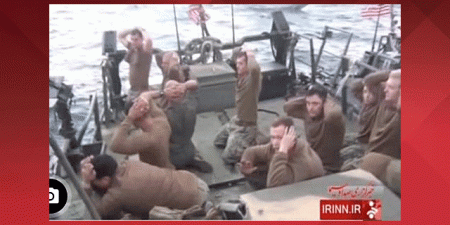
Iran-Captures-US-Sailors-HPIranian footage of the capture of the 10 American sailors.

Although the government and news media seem to be adopting Shakespeare’s famous maxim, “All’s well that end’s well,” the back story behind the seizure and eventual release of 10 American sailors by Iran is not so simple.

Vice-President Joe Biden insisted “the Iranians picked up both boats — as we have picked up Iranian boats that needed to be rescued .. [they] realized they were there in distress and said they would release them, and released them — like ordinary nations would do.”

Yet Iran can hardly be called an “ordinary nation.” The Islamic Republic leveraged the incident to humiliate the U.S., forcing the sailors to apologize and acknowledge their “fantastic” treatment by Iran. Not just a typical “rescue.”

Iranian brinkmanship, an art unto itself, was played to perfection. Footage aired on Iranian Press TV in English (see below) showed uncomfortable U.S. sailors sitting on Persian carpets laden with food, the lone female sitting in a corner sequestered behind her male compatriots with a hijab covering her hair.

Films of their “surrender” — on their knees with their hands behind their heads –featured prominently in the Iranian press coverage as did all the weapons contained on the ship.

Still Biden insisted it was all in a normal day’s work. “When you have a problem with the boat, (do) you apologize the boat had a problem? No,” Biden said. “And there was no looking for any apology. This was just standard nautical practice.”

Others were more blunt. “This incident in the Persian Gulf, which probably will not be the American forces’ last mistake in the region, should be a lesson to troublemakers in the U.S. Congress,” said Major General Hassan Firouzabadi, head of Iran’s armed forces.

One wonders what the lesson might have been if Iran had already been granted the billions of dollars in sanctions relief instead of being just days away receiving it.

Watch Iranian TV coverage of the capture and apology (voices begin after three minutes):

Electronic Doomsday for the US?

January 13, 2016

Electronic Doomsday for the US? The Electromagnetic Pulse (EMP)

by Peter Huessy

January 13, 2016 at 4:45 am

Source: Electronic Doomsday for the US?


  • The recent North Korean nuclear and the Iranian ballistic missile tests are serious deadly threats to the United States. North Korea’s latest bomb test is being widely dismissed by “experts” because the apparent yield is around 10 kilotons or less – which just so happens to be exactly the right amount for an electromagnetic pulse (EMP) explosion.
  • An EMP attack on the U.S. would leave the country with no electricity, no communications, no transportation, no fuel, no food, and no running water.
  • “Our increasing dependence on advanced electronics systems results in the potential for an increased EMP vulnerability… and if unaddressed makes EMP employment by an adversary an attractive asymmetric option.” — EMP Commission
  • The recent military writings and exercises of potential adversaries would combine EMP with cyber-attacks, sabotage, and kinetic attacks against the national electric grid and other critical infrastructures.

Contrary to some “expert” analysis, both the recent North Korean nuclear and the Iranian ballistic missile tests are deadly serious threats to the United States.

The danger to the United States is particularly consequential due to the close military cooperation of North Korea and Iran. Their combined capabilities, as demonstrated recently, could very well signal a future nuclear attack of the electromagnetic pulse type, for which the U.S., at the moment, is totally unprepared.

The threat to the United States from an electromagnetic pulse (EMP) attack — the high-altitude detonation of a nuclear weapon over the United States — is so potentially catastrophic that both the 2004 and 2008 reports of the Congressional EMP Commission said so openly — probably in the hope that the public warning would spur the nation and the Department of Defense to action. [1]

Even an EMP attack from a single 10-kiloton nuclear weapon — of the type now in North Korea’s arsenal — could cause cascading failures which could black out the U.S. Eastern Grid for months or years, and devastate the civilian economy. An EMP, detonated at an altitude above 30-70 kilometers, could be delivered by a short-range missile fired off a freighter, hundreds of kilometers off U.S. shores.

The result would be no communications, no transportation, no fuel, no food, and no water for a decade or more. That would be true for at least the entire eastern half of the United States, where most of the population lives. National Geographic has described it as an “Electronic Armageddon.”

An illustrative rendering of an EMP attack on the United States. (Image source: Video screenshot from “33 Minutes”)

Despite these previous warnings and North Korea’s recent bomb test — its fourth known nuclear test since 2006 — “experts” are dismissing a nuclear threat from North Korea as of little concern because the apparent yield of the bomb was in the neighborhood of 10 kilotons or less.

Hydrogen Bombs, or thermonuclear weapons, which is what North Korea claimed to have detonated, produce yields higher than those.

In fact, however, these experts may be way off base. The yield of an EMP explosion is lower. The North Korean bomb capability that was tested may therefore well be that of a super-EMP.

Neutron bombs, or Enhanced Radiation Weapons such as Super-EMP weapons, are essentially very low yield H-Bombs. They typically have yields of 1-10 kilotons, exactly like North Korea’s device. Indeed, because of their very low yield, all four North Korean nuclear tests look like Super-EMP weapons.

A Super-EMP weapon is designed to produce special effects (gamma rays, in the case of Super-EMP). A Super-EMP warhead, while having a seemingly insignificant explosive yield, could be far more deadly and dangerous to the United States than the most powerful H-Bomb ever built.

Russia’s Tsar H-Bomb, (known as Tsar Bomba), the most powerful H-Bomb ever detonated, produced during its test in October 1961 a yield of 60 megatons. It would have been capable of flattening everything in the state of Rhode Island. [2]

A Super-EMP weapon, however, detonated 300 kilometers above the center of the U.S., could destroy the entire nation’s industrial and military capacity, and kill a large percentage of the American people, by taking down the U.S. electrical grid. Once destroyed, the grid’s elements would take decades to rebuild.[3]

Even if the U.S. were to protect its electrical infrastructure from such a threat — legislation to protect the grid is now in Congress, primarily thanks to Rep. Trent Franks (R-Arizona) — the parallel vulnerability of U.S. military forces to an EMP attack would be just as serious.

We know the Department of Defense has testified to Congress that 99% of the electricity for continental U.S. military bases comes from the civilian grid. Our military bases would thereby be without electrical power for decades as well. Unfortunately, the thousands of electrical transformers destroyed by an EMP attack were not primarily built in America. Even if they were, they require at least a five-year lead-time for production.

Overseas power-projection from U.S. military bases would be effectively impossible without an operational grid. Moreover, after such an EMP attack, the national focus would be on saving millions of Americans from mass starvation and preserving societal existence, not on going “over there” to fight a war or defend U.S. interests.

If the EMP attack were executed anonymously, say, by a missile launched off a freighter at sea close-in to the United States, we would probably not even know against whom to retaliate. Thus, classical deterrence would not work, further “inviting” such an attack.

In 1999, for example, at a high level meeting in Vienna of a Congressional delegation with senior members of the Russian government, Vladimir Lukin, the chairman of the Duma’s Foreign Affairs Committee, angry with American policy in the Balkans, issued the following threat: “If we really wanted to hurt you with no fear of retaliation, we would launch a Submarine-launched Ballistic Missile (SLBM), [and] we would detonate a nuclear weapon high above your country and shut down your power grid.”

Congressman Curt Weldon, (R-PA), the American delegation chair, who understood Russian, turned to his Maryland colleague, (Roscoe Bartlett, D-MD) and asked, “Roscoe, did you hear what he said?”

The chairman of the State Duma Geopolitics Commission, Alexander Shabanov, smiled and said, “And if that one doesn’t work, we have plenty of spares”.[4]

Thus a nuclear weapon designed specifically for EMP attack, what Russian experts call a “Super-EMP” warhead, would constitute a worst-case threat.

A single Super-EMP warhead, detonated in the sky 300 kilometers over the center of the U.S., would generate such a powerful EMP field over all 48 contiguous United States that, not only would a protracted nationwide blackout result, but even the best protected U.S. military forces and C3I on all military bases—if not sufficiently protected– could also be at risk.

The technology to protect the electrical grid is relatively straightforward and inexpensive. But only with action now could the grid be protected sufficiently to give the US industrial and economic capability a fighting chance to survive an “Electronic Armageddon”.

It is also possible to protect military assets through “hardening,” but doing so after production and the fielding of equipment is time-consuming and costly. The sooner the U.S. starts with hardening its equipment, sooner the job will get done. The U.S. is seriously behind schedule in what is required to protect it.

It is not as if the threat is “over the horizon.” Russia and China already have Super-EMP warheads. Moreover, according to the Congressional EMP Commission, the design of Super-EMP warheads is no secret: “Certain types of relatively low-yield nuclear weapons can be employed to generate potentially catastrophic EMP effects over wide geographic areas, and designs for variants of such weapons may have been illicitly trafficked for a quarter-century.”

The EMP Commission warned that non-state actors — terrorists — could also pose an EMP threat: “What is different now is that some potential sources of EMP threats are difficult to deter — they can be terrorist groups that have no state identity, have only one or a few weapons, and are motivated to attack the U.S. without regard for their own safety.”

The EMP Commission also warned that the Department of Defense has failed to maintain adequate EMP protection for U.S. military forces since the end of the Cold War:

“The end of the Cold War relaxed the discipline for achieving EMP survivability within the Department of Defense, and gave rise to the perception that an erosion of EMP survivability of military forces was an acceptable risk. EMP simulation and test facilities have been mothballed or dismantled, and research concerning EMP phenomena, hardening design, testing, and maintenance has been substantially decreased. However, the emerging threat environment, characterized by a wide spectrum of actors that include near-peers, established nuclear powers, rogue nations, sub-national groups, and terrorist organizations that either now have access to nuclear weapons and ballistic missiles or may have such access over the next 15 years have combined to place the risk of EMP attack and adverse consequences on the US to a level that is not acceptable.”

The EMP Commission further warned that even U.S. strategic forces and C3I may be at risk from an EMP attack:

“Current policy is to continue to provide EMP protection to strategic forces and their controls. The Department of Defense must continue to pursue the strategy for strategic systems to ensure that weapons delivery systems of the New Triad [land, sea and air] are EMP survivable, and that there is, at a minimum, a survivable ‘thin-line’ of command and control capability to detect threats and direct the delivery systems.”[5]

U.S. strategic forces today are also relatively more vulnerable than they were during the Cold War: they are far less numerous and located on fewer bases, so an adversary could more easily target peak EMP fields on each base. Compared to Cold War era systems, the more modern and sophisticated C3I systems for command and control of U.S. strategic forces could be vulnerable to EMP, unless they are hardened to withstand such electromagnetic pulse attacks. This is also true for the entire industrial infrastructure, the most critical of which is the electrical grid.

The EMP Commission also warned that as U.S. conventional forces become more dependent upon high-technology, they also become more vulnerable to EMP attack:

“The situation for general-purpose forces (GPF) is more complex. The success of these forces depends on the application of a superior force at times and places of our choosing. We accomplish this by using a relatively small force with enormous technological advantages due to superior information flow, advanced warfighting capabilities, and well-orchestrated joint combat operations. Our increasing dependence on advanced electronics systems results in the potential for an increased EMP vulnerability of our technologically advanced forces, and if unaddressed makes EMP employment by an adversary an attractive asymmetric option.”

The above alarming assessments about the vulnerability of U.S. military forces to EMP attack are what the EMP Commission decided must be stated publicly, in its unclassified Executive Summary. The EMP Commission submitted a separate, classified, report to the Department of Defense analyzing these and many other vulnerabilities in far greater detail.

What progress has the Department of Defense (DoD) made to protect itself and the nation from EMP attacks since the reports were completed?

When the EMP Commission terminated in 2008, it was on the understanding that DoD would move aggressively to protect U.S. military forces from EMP, and report biennially to Congress on progress being made implementing the EMP Commission recommendations. The only unclassified biennial report from DoD indicates that there were still serious deficiencies in protecting U.S. military forces from EMP in 2011.

On April 7, 2015, the North American Aerospace Defense Command (NORAD) chief, Admiral William Gortney, announced that NORAD was moving critical assets back into the nuclear bunker inside Cheyenne Mountain and spending $700 million to harden the mountain further against a potential nuclear EMP attack from North Korea. That the nation’s most critical C3I node is just now being adequately protected does not bode well for the preparedness of U.S. military forces as a whole for an EMP Doomsday scenario.[6]

Fortunately, Congress re-established the EMP Commission in the recently completed and passed Fiscal Year 2016 National Defense Authorization Act, to serve as a watchdog on U.S. preparedness and the fast-evolving EMP threat.

The recent military writings and exercises of potential adversaries, for example, combine EMP with cyber-attacks, sabotage, and kinetic attacks against the national electric grid and other critical infrastructures — a decisive new way of warfare described by Russian experts as a “Revolution in Military Affairs.”[7]

The U.S. response has recently gotten some important traction. The House, on November 16, 2015, unanimously passed the Critical Infrastructure Protection Act (CIPA — House of Representatives bill number HR 1073).

CIPA directs the Department of Homeland Security (DHS) to educate emergency planners and first responders at all levels of government about the EMP threat, and to prepare plans to protect and recover the electric grid and other critical infrastructures from an EMP attack and from natural EMP that can be generated by a rare solar super-storm. The House Energy and Commerce Committee also passed provisions to secure the electric grid from EMP, including by stockpiling spare parts and incorporating the SHIELD Act, which gives new authorities to the U.S. Federal Energy Regulatory Commission to protect the grid.

Protecting the national electric grid from EMP is necessary to preserve the existence of American civilization, to sustain U.S. military power-projection capabilities, and it would also mitigate worst-case threats from cyber warfare, sabotage, kinetic attacks, and even severe weather. CIPA and SHIELD are the crowning achievements of Rep. Trent Franks (R-AZ), who for years has been the conscience of the Congress, warning about the existential threat from EMP. [8]

While both bills now await action in the Senate, there is an increasing threat from Iran, which recently successfully tested two nuclear-capable missiles, and from a North Korean satellite, the KSM-3, which regularly orbits over North America at the optimum trajectory to evade U.S. national missile defenses. If the KSM-3 were to carry a nuclear weapon, it would project an EMP field over all of the 48 contiguous United States.

North Korea is Iran’s strategic partner, and there is a treaty between the two countries that obligates the sharing of scientific and military technology.

North Korea’s military recently carried out what some have described as an attempted test from a submerged barge, an indication that an earlier test failure has not derailed its underwater missile program, according to U.S. defense officials.

Add North Korea’s missile capability and a super EMP weapon to this potential, and the significance of the recent North Korean nuclear test comes into better focus. The possibility of a North Korean or Iranian EMP attack seems to be gathering strength.

We may have already seen what such an attack might look like. During the 2014 Gaza War, Hamas, the Syrian Electronic Army, and Iran attempted mass cyber-attacks, coordinated with massive missile strikes, on Israel’s electrical grid. Hamas launched over 5000 rockets and missiles against Israel. Prepared, Israel’s cyber defenses defeated the cyber-attacks, and the Iron Dome missile defense system shot down all the missiles aimed at the Israeli grid.[9]

There are important lessons here. Missile and cyber defenses work: they are critically important parts of any national security strategy.

Israel had also made a prior decision to harden its grid against threats by EMP attacks. The combined efforts of this crucial ally of ours gives us a roadmap to follow: robust missile defenses to defend the homeland from EMP-armed missiles; cyber defenses to protect critical assets and the infrastructure; and EMP defenses to protect national security and defense assets and the electrical grid from attack.

Both the 2004 and 2008, EMP Commission reports urged America’s leaders to protect against such threats as EMP. The House of Representatives has now passed the necessary legislation to protect the grid. The Senate has a champion — Senator Ron Johnson (R-WI), who has pledged to secure Senate passage.

But there are serious pressures working against its passage. Too many “experts” currently dismiss any such threat to the American homeland.

Just recently, for instance, a former intelligence specialist in the U.S. government, Paul Pilar, argued in The National Interest that Iranian ballistic missiles were “here to stay” and were simply elements of Iran’s defenses – and, despite repeated Iranian calls for “Death to America,” were no threat to the United States homeland or its overseas interests.[10]

Such conventional complacency, such as calling ISIS the jay-vee team, is not uncommon in Washington, D.C. The National Intelligence Estimate on Iran in 2007 argued that Iran had stopped all its nuclear weapons work in 2003[11]; the International Atomic Energy Administration has now determined that Iran’s nuclear work had continued to at least 2009.[12]

Unfortunately, there is real-world experience — in Israel — that such threats from missiles and cyber-attacks are constantly serious and looming: the entire job of an adversary is to look for weak spots to attack.

There always seem to be those who wish to downplay all threats and are reluctant even to invest in an “insurance premium.” The consequences of failing to protect America against such threats, however, will be far more serious than future embarrassment for some head-in-the-sand bureaucrats.

An EMP attack would shut down the country; lead to the loss of millions of lives, and set it back into effective defenselessness.

It is a threat as serious as any estimates of what a mushroom cloud at the height of the Cold War would have entailed. Instead, it kills by sending the country back to what former House Speaker Newt Gingrich has described as early 18th century America: people would not be able to function in even the simplest of ways. Buildings would be left standing but the ability to live in them would not. People would be unable to move about, eat, drink, shop or communicate.

It therefore requires full attention, in this era of increased cyber-sophistication, especially among enemies of the West, to see that an EMP attack is never “invited” to happen in the U.S.

Peter Huessy is President of GeoStrategic Analysis of Potomac, Maryland and Senior Defense Consultant to the Mitchell Institute of the Air Force Association and a guest lecture at the US Naval Academy on nuclear deterrent policy and the founder of the 36 year AFA-NDIA-ROA Congressional Breakfast Seminar Series on Nuclear Deterrence, Missile Defense, Arms Control, Proliferation and Defense Policy.


[1] Previous such threat analysis had been classified; the Report of the Commission to Assess the Threat to the United States from Electromagnetic Pulse (EMP) Attack, July 2004 and April 2008 was issued in both classified and unclassified versions; see also Henry F. Cooper and Peter Vincent Pry, “The Threat to Melt the Electric Grid,” Wall Street Journal, April 30, 2015; and Former Director of Central Intelligence, R. James Woolsey, testimony before the U.S. Congress, May 21, 2013.

[2] “Big Ivan”, The Tsar Bomba”, Viktor Adamsky and Yuri Smirnov, 1994, “Moscow’s Biggest Bomb”.

[3] EMP Commission, April 2008.

[4] Committee on Armed Services, House of Representatives, July 22, 2004, Hearing on the Report of the Commission to Assess the Threat to the US from Electromagnetic Pulse Attack.

[5] “Report of the Commission to Assess the Threat to the United States from Electromagnetic Pulse (EMP) Attack”, Volume I: Executive Report; hereinafter cited as EMP Commission Report 2004.

[6] EMP Commission Report 2004, p. 47.

[7] “Defense Science Board (DSB) Task Force on the Survivability of Systems and Assets to Electromagnetic Pulse (EMP) and other Nuclear Weapon Effects (NWE)”, Summary Report No. 1, Interim Report of the DSB Task Force, 2011. See also Dr. Peter Vincent Pry, Apocalypse Unknown: The Struggle to Protect America from an Electromagnetic Pulse Catastrophe, Task Force on National and Homeland Security, 2013, pp. 158-164.

[8] For a good history of these efforts, see Congressman Trent Franks, remarks at the AFA-NDIA-ROA Congressional Breakfast Seminar, December 17, 2015, transcript available from Peter Huessy at AFA (Phuessy@afa.org).

[9] Information from Uzi Rubin, President of Rubicon, to the authors.

[10] See an excellent rejoinder by Emily Landau and Shimon Stein, INSS, National Defense University, “Iran’s Ballistic Missiles Are Actually a Huge Problem“, January 5, 2016.

[11] Paul Pillar spoke approvingly of the 2007 NIE at “The Iran National Intelligence Estimate and Intelligence Assessment Capabilities”, December 20, 2007, the Brookings Institution.

[12] IAEA Board Report: Joint Comprehensive Plan of Action implementation and verification and monitoring in the Islamic Republic of Iran in light of United Nations Security Council Resolution 2231 (2015), Resolution adopted by the Board of Governors on 15 December 2015.

Our World: In Pakistan, they trust

January 12, 2016

Our World: In Pakistan, they trust, Jerusalem Post, Caroline Glick, January 11, 2016

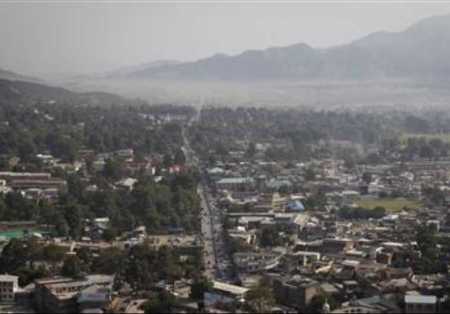
Pakistan viewA general view of houses from a hilltop in Abbottabad, Pakistan. (photo credit:REUTERS)

It is a testament to the precarious state of the world today that in a week that saw North Korea carry out a possible test of a hydrogen bomb, the most frightening statement uttered did not come from Pyongyang.

It came from Pakistan.

Speaking in the military garrison town of Rawalpindi, Pakistani Army chief Gen. Raheel Sharif said that any Iranian threat to Saudi Arabia’s territorial integrity will “wipe Iran off the map.”

Sharif made the statement following his meeting with Saudi Arabia’s defense minister and Deputy Crown Prince Mohammed bin Salman. According to media reports, Salman was the second senior Saudi official to visit Pakistan in the past week amid growing tensions between Iran and the kingdom.

Salman’s trip and Sharif’s nuclear threat make clear that following the US’s all-but-official abandonment of its role as protector of the world’s largest oil producer, the Saudis have cast their lots with nuclear-armed Pakistan.

When last October, the USS Harry Truman exited the Persian Gulf, the move marked the first time since 2007 that the US lacked an aircraft carrier in the region. Nine years ago, the US naval move was not viewed as a major statement of strategic withdrawal, given that back then the US had some one hundred thousand troops in Iraq.

While the USS Truman returned to the Gulf late last month, its return gave little solace to America’s frightened and spurned Arab allies. The Obama administration’s weak-kneed response to Iran’s live-fire exercises on December 26, during which an Iranian Revolutionary Guards vessel fired rockets a mere 1,370 meters from the aircraft carrier as it transited the Straits of Hormuz, signaled that the US is not even willing to make a show of force to deter Iranian aggression.

And so the Saudis have turned to Pakistan.

It would be foolish to view Sharif’s nuclear threat as mere bluster.

By every meaningful measure, Pakistan is little more than a failed state with nuclear weapons. Pakistan appears in every global index of failed or failing states.

To take just a few leading indicators, as spelled out by Basit Mahmood in a report last summer for The Political Domain, barely 1% of Pakistanis pay taxes of any kind. More than half the population lives in abject poverty. The government has no control over most Pakistani territory.

Between 2003 and 2015, more than 58,000 people were killed by terrorism countrywide.

Public health is a disaster. Polio, eradicated throughout much of the world, is now galloping through the country.

Last summer more than 1,300 people died in a heat wave in the supposedly advanced city of Karachi.

These data do not take into account the wholesale slaughter and persecution of minority groups – first and foremost Christians – and the systematic denial of basic human rights and widespread, violent persecution of women and girls.

As for its nuclear arsenal, a 2010 report by the Bulletin of Atomic Scientists estimated that Pakistan possesses between 70 and 90 nuclear warheads. Other credible reports estimate the size of the arsenal at 120.

Pakistan refuses to adopt a no-firststrike policy. In the US and worldwide, it is considered to be the greatest threat to global nuclear security.

Following a Pakistani jihadist assault on the Indian parliament in late 2001, India and Pakistan both deployed forces along their contested border. In the months that followed, due to Pakistani nuclear threats, the prospect of nuclear war was higher than it had ever been.

Cold War nuclear brinksmanship – which reached its high point during the 1962 Cuban missile crisis – paled in comparison.

In 2008, following the Pakistani jihadist assault on Mumbai, India threatened to retaliate against Pakistan.

India’s threats rose as evidence mounted that, as was the case in 2001, the jihadists were tied to Pakistan’s ISI spy service. Once again, rather than clean its own house, Pakistan responded by threatening to launch a nuclear attack against India.

And now, following the unraveling of US-strategic credibility, Pakistan’s aggressive nuclear umbrella is officially coming to the Persian Gulf.

Saudi Arabia’s decision to turn to Pakistan for protection indicates that the second wave of the destruction of the Arab state model is upon us. The notion of Arab states was invented nearly 100 years ago by the British and French at the tail end of World War I. The Sykes-Picot agreement, which partitioned the Arab world into states, rewarded national dominion to the most powerful tribal actors in the various land masses that became the states of the Arab world.

With the possible exception of Egypt, which predated Sykes-Picot, the Arab states formed at the end of World War I were not nation states. Their populations didn’t view themselves as distinct nations. Rather the populations of the Arab states were little more than a hodgepodge of tribes, clans and sectarian and ethnic groupings. In each case, the British and French made their determinations of leadership based on the relative power of the various groups. Those chosen to control these new states were viewed either as the strongest factions within the new borders or as the most loyal allies to the European powers.

The first wave of Arab state collapse began six years ago. It submerged the non-royal regimes, which fell one after the other, like houses of cards.

Syria, Libya, Iraq and Yemen ceased to exist.

Egypt, which in the space of two years experienced both an Islamist revolution and a military counter-revolution, still teeters on the brink of collapse.

Lebanon will likely break apart at the slightest provocation.

Today we are seeing the opening stages of the collapse of the Arab monarchies, and most importantly, of Saudi Arabia.

Most of the international attention to Saudi Arabia’s current threat environment has focused on Iran. The Iranian threat to the Saudis has grown in direct proportion to the Obama administration’s determination to realign the US away from its traditional Sunni allies and towards Iran. The conclusion of the US-led nuclear pact with Tehran has exacerbated Iran’s regional aggression as it no longer fears US retaliation for its threats to the Sunni monarchies.

But Iran is just the most visible of three existential threats now besetting the House of Saud.

The most profound threat to the world’s largest oil power is economic.

The drop in world oil prices has endangered the kingdom.

As David Goldman reported last week in the Asia Times, according to an International Monetary Fund analysis, the collapse in Saudi oil revenues “threatens to exhaust the kingdom’s $700 billion in financial reserves within five years.”

The house of Saud’s hold on power owes to its oil-subsidized economy. As Goldman noted, last month dwindling revenues forced the Saudis to cut subsidies for water, electricity and gasoline.

According to Goldman, Riyadh’s mass execution of 43 long-jailed prisoners at the start of the month was an attempt by the aging royal house to demonstrate its firm control of events. But the very fact the Saudi regime believed it was necessary to stage such a demonstration shows that it is in distress.

The third existential threat the regime now faces is Islamic State. Since 1979, the Saudis have sought to deflect domestic opposition by promoting Wahabist Islam at home and Wahabist jihad beyond its borders.

Now, with Islamic State in control over large swathes of neighboring Iraq, as well as Syria and Libya and threatening the Saudi-supported Sisi regime in Egypt, the Saudi royal family faces the rising threat of blowback. Some analysts argue that given the popular support for jihad in Saudi Arabia, were Islamic State to cross the Saudi border, its forces would be greeted with flowers, not bullets.

If the House of Saud falls, then the Gulf emirates will also be imperiled.

The Egyptian regime, which is bankrolled by the Saudis and its Gulf allies will also be endangered. The Hashemite monarchy in Jordan, which is protected by the US and by Israel, will face unprecedented threats.

The implications of expanding chaos – or worse – in Arabia are not limited to the Middle East. The global economy as well as the security of Europe and the US will be imperiled.

Obviously, the order of the day is for the US security guarantee to Saudi Arabia to be reinforced, mainly through straightforward US action against Iranian naval aggression and ballistic missile development.

Unfortunately, the Obama administration can be depended on to take just the opposite approach. And as a consequence, at least for the next year, the main thing propping up the Gulf monarchies, and with them, the global economy and what passes for global security, is a failed state with an itchy finger on the nuclear trigger.

Iran: U.S. Lifting Sanctions in a ‘Few Days’

January 12, 2016

Iran: U.S. to Lift Sanctions in a ‘Few Days’ Republicans pushing last-minute effort to block release of billions Share Tweet Email Hassan Rouhani Hassan Rouhani /

AP BY: Adam Kredo Follow @Kredo0 January 12, 2016 5:00 am

Source: Iran: U.S. Lifting Sanctions in a ‘Few Days’


As Republican lawmakers on Capitol Hill focus on a last-ditch effort to prevent the Obama administration from awarding Iran $100 billion, the Islamic Republic’s leaders have stated that economic sanctions on the country will be fully lifted in the coming days.

President Hassan Rouhani, in a recent address, promised “good news” in the next few days, hinting that the Obama administration will make good on its promise to fully lift economic sanctions and provide Iran with up to $100 billion in unfrozen cash assets as part of the nuclear deal finalized last year.

Rouhani’s comments comport with recent remarks by Secretary of State John Kerry, who claimed last week that Iran is just “days away” from upholding its own end of the deal, which required it to ship certain nuclear materials to Russia.

As Iran prepares to receive the cash influx, which experts say will revive the country’s long-stalled economy, Republican lawmakers in Congress are focusing on last-minute efforts to block the Obama administration from releasing these cash assets and unraveling sanctions on individuals who have aided Tehran’s nuclear weapons program.

Sen. Kelly Ayotte (R., N.H.) along with a growing coalition of colleagues in both the House and Senate, has put forward legislation that would stop sanctions relief until the Obama administration can officially verify that Iran has ceased all work on a nuclear weapon.

The bill would require the director of national intelligence to launch an investigation into this activity and submit a report to Congress. All sanctions relief agreed to by the Obama administration would be blocked until this report is complete, according to the bill.

The lawmakers maintain that an ongoing United Nations investigation into this activity remains incomplete due to stalling efforts by Iranian hardliners who seek to keep the country’s military work a secret.

“Given the glaring deficiencies of the International Atomic Energy Agency’s (IAEA) PMD report and Iran’s continued brazen missile tests and rocket launches, Congress must take serious action to protect the American people,” Rep. Mike Pompeo (R., Kansas), a key sponsor of the House version of the bill and member of the House Permanent Select Committee on Intelligence, said in a statement.

“With the impending implementation of the president’s dangerous nuclear agreement with Iran, the world’s largest state sponsor of terror, it is absolutely unacceptable that we still do not have a thorough understanding of this regime’s past weaponization efforts,” he said. “This information is critical to our ability to detect and thwart future efforts by Iran to restart its nuclear program.”

Congressional critics of the nuclear deal have repeatedly warned that Iran—designated by the United States as one of the world’s leading sponsors of terrorism—will use the newly unfrozen cash assets to fund its military operations and pursuit of ballistic missiles.

The White House still has not disclosed why it abandoned recent efforts to impose new sanctions on Iran as a result of its multiple ballistic missile tests, which violate U.N. Security Council resolutions.

Some in Congress have speculated that the administration was forced to abandon the new sanctions after Iran threatened to walk away from the deal.

Experts predict that much of the sanctions relief will help fund Iran’s military campaigns in Syria, Yemen, Iraq, and elsewhere.

“The lion’s share of the inflow of capital and technology in Iran in the post-implementation day era will go to the” Iranian Revolutionary Guard Corps, Iran’s leading military organization, according to Saeed Ghasseminejad, an expert at the Foundation for Defense of Democracies.

That money, Ghasseminejad said, “will be used to oppose the U.S. in the Middle East and around the world.” Implementation of the deal will enrich the Revolutionary Guard Corps and give it the tools necessary to push Iran’s extremist ideology across the region, he said.

“The administration should stop acting as Rouhani’s campaign manager and instead has to focus on fighting back against the IRGC’s growing influence in the region by punishing the IRGC for its bad behavior,” Ghasseminejad said.

The State Department maintains that it is prepared to uphold up its end of the deal and lift U.S. sanctions on the day the deal is implemented.

“‎None of the sanctions specified in the [nuclear deal] will be lifted prior to Implementation Day, which will occur when the [International Atomic Energy Agency] verifies that Iran has completed its relevant nuclear steps,” said a State Department official who was not authorized to speak on record.

“All of the details of the specific actions to be taken by the U.S. and the [European Union] as it relates to the lifting of sanctions under the Joint Comprehensive Plan of Action (JCPOA), as well as the timing of those actions, are spelled out in the text of the deal,” the official said.

Mark Dubowitz, Foundation for Defense of Democracies executive director and a leading expert on the deal, told the Free Beacon that “Implementation Day is no cause for celebration.”

Iran, he said, “get a patient pathway to a nuclear weapon, intercontinental ballistic missiles and an economy increasingly fortified against future sanctions pressure.”

The United States, on the other hand, gets “a brief pause in their nuclear expansion” due to the shipment on some enriched material to Russia. However, Iran “can easily regenerate” this material and expand it by turning on advanced centrifuges, which more quickly enrich nuclear materials.

“Unless a new president digs us out from under this flawed agreement, the Obama Iran deal will severely erode American deterrence and greatly expand Iranian regime power,” Dubowitz said.

Under the parameters of the deal, the United States is set to suspend most of the sanctions enacted by Congress over the past several years.

This includes the suspension of nearly all sanctions related to Iran’s banking system, its insurance industry, energy and petrochemical sectors, shipping industry, gold trade, and automotive sector, according to the deal.

The major Iranian banks and companies included in the list have long been believed to be supporting the country’s nuclear program and military.

“Other nuclear proliferation-related sanctions will also be lifted,” according to information in Annex II of the nuclear agreement.

Sanctions pertaining to Iran’s commercial airline industry also will be suspended, paving the way for U.S.-owned entities to resume legal trade with Tehran.

Sanctions on those accused of aiding Iran’s nuclear efforts also will be removed from U.S. government lists. This includes certain individuals and companies on the specially designated persons list as well as its list of foreign sanctions evaders .

Additionally, the United States has agreed to eventually remove sanctions on two individuals, Fereidoun Abbasi-Davani and Mohsen Fakhrizadeh, both accused of providing critical support to Iran’s weaponization and nuclear activities.

Experts tracking the deal estimate that after eight years only 25 percent of nearly 650 entities designated by Treasury over the past decade for their role in Iran’s nuclear and ballistic missile program will remain sanctioned.

Pakistan threatens to wipe Iran off the map if Saudi harmed

January 10, 2016

Pakistan threatens to wipe Iran off the map if Saudi harmed, DEBKAfile, January 10, 2016

(Promises, promises. — DM)

In Pakistan’s first transparent nuclear threat to Iran, its chief of army staff, Gen. Raheel Sharif, vowed Sunday to wipe Iran off the face of the earth if any harm came to Saudi Arabia. He gave this pledge to Saudi Deputy Crown Prince and Defense Minister Mohammed bin Salman, who was on a visit to a military base in Rawalpindi.