Posted tagged ‘Iran – Syria war’

Obama’s Fake Syrian Peace Talks Falling Apart

January 29, 2016

Obama’s Fake Syrian Peace Talks Falling Apart, Front Page Magazine, Daniel Greenfield, January 29, 2016
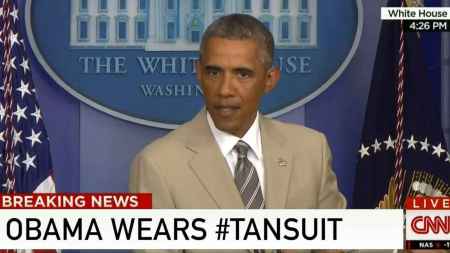
obama-wears-tan-suit-149481242256_6

The peace talks strategy for Syria comes out of Iran and Russia, two countries determined to keep Assad in power. Obama wanted the peace talks in order to rig a fake settlement that would come apart once he was out of office. But the only people fooled by this were stupid enough to get their news from CNN and their talking points from Think Progress. The Sunni side only participated to the extent that they could wreck the talks and extract some demands. They have no intention in signing on to Assad staying in power or to letting Obama get away with a fake solution that does just that.

And, oh yes, no one actually thinks Obama has any credibility.

As the Obama administration pushes for peace in Syria, its credibility is crumbling among Syrian opposition leaders, many of whom increasingly doubt the U.S. is serious about ending the rule of dictator Bashar Assad.

Because he isn’t.

If the talks peter out or collapse, that will further undermine President Barack Obama’s foreign policy legacy, which already has been tarnished by the endless bloodshed in Syria

It’s okay. Obama will blame Tom Cotton or Bush or Israel. Or someone. And the media will go along with it.

“A number of the opposition has expressed the feeling that the U.S. is not acting as an honest broker and that they’ve lost both trust and faith in the ability of the United States to deliver on a political settlement in Syria,” said Andrew Bowen, a senior fellow at the Center for the National Interest who has contacts among Syrian opposition groups.

Obama signed on with Iran. So he’s about as much of an honest broker as any other foreign agent.

“Kerry did not make any promises, nor did he put forward any initiatives,” said Khaled Khoja, president of the opposition Syrian National Coalition, in onestatement questioning U.S. intentions. “He has long been delivering messages similar to those drafted by Iran and Russia, which call for the establishment of a ‘national government’ and allowing Bashar al-Assad to stay in power and stand for re-election.”

Well yes. What else do you expect Kerry to do? This is the only thing he’s been doing since he got to the Senate and even beforehand with the Viet Cong. Traitors gotta traitor.

Among the numerous reports floating around — some of them highly speculative — are those that allege Kerry warned opposition leaders they could lose international support if they didn’t attend Friday’s talks. The reports come as the U.S. has appeared to be backing away from its demand that Assad must leave office by signaling its support for the notion of a transitional period.

And that period will come to an end once Obama is out of office.

But all this is theater anyway as the groups with the most fighters on the ground, including Al Qaeda and ISIS, are not represented. Most of the Islamists aren’t either. So this is just the Muslim Brotherhood, whose actual strength is weak, throwing a tantrum. Even if the Sunni groups signed some sort of deal it would be as worthless as the fake elections Hillary still talks up in Libya
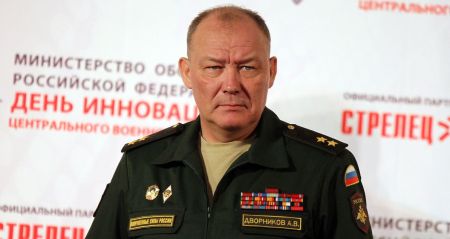
Gen. Dvornikov: Russia’s combined C-in-C and top diplomat in Syria

January 10, 2016

Gen. Dvornikov: Russia’s combined C-in-C and top diplomat in Syria, DEBKAfile, January 10, 2016

Colonel_General_Alexander_Dvornikov

[T]he Russian general walks on eggs in a job that requires him to collaborate militarily with Iran and Hizballah, on the one hand, and uphold the understandings Putin reached with Prime Minister Binyamin Netanyahu, on the other, over Israeli Air Force actions against terrorists and their conflictive interests in the southern Syrian regions bordering on Israel.

********************

It was in August, 2015, on the eve of the massive Russian military intervention in Syria, that President Vladimir Putin selected Col. Gen. Alexander Dvornikov, 54, as chief of Russia’s military operation in Syria and Iraq, DEBKAfile’s military and intelligence sources report. He resolved a fierce debate among Russia’s top officials and generals over the officer to lead the what was to be the most high-powered venture of the Putin presidency. Many favored a senior air force officer, conceiving the campaign as focusing mainly on air strikes. They proposed Col. Gen. Victor Nikolaevich Bondarev, chief of Aerospace Defense Forces, a branch established just four months ago.

Putin overruled them, having decided that the diplomatic and ground components were to be just as important as the future aerial campaign. He picked Gen Dvornikov, whom he first met 26 years ago in Berlin during the last moments of the dying Soviet empire. In 2015, he judged the general as being the right man for the job he had in mind, by virtue of his extensive military experience in running the 2000-2003 North Caucasus wars against Islamic terror groups, as chief of staff and a motorized infantry division commander.

In his new posting, Gen. Dvornikov was given control of the twin Russian commands in Damascus and Baghdad. They function as two halves of the same war room.

At the Damascus headquarters, he has three partners: the Syrian Chief of Staff Gen. Ali Abdullah Ayyoub, the Iranian Revolutionary Guards Gen. Key Parvar and the commander of Hizballah forces in Syria, Mostafa Bader el-Din. Until his mysterious disappearance in November, Gen. Qassem Soleimani, Iranian commander in Syria and Iraq, would put in an occasional appearance at high command conferences.

The two command centers’ operations are fully coordinated and keep the single overall commander, Col. Gen. Dvornikov, on top of events and in control of decisions 24/7 – a key position of enormous authority and extreme diplomatic sensitivity for juggling Moscow’s opposition allies and interests.

The Saudi government, which operates, arms and funds a number of Syrian rebel militias, regards the Russian general as the ultimate nemesis of its interests in Syria, because he expends as much force on fighting those militias as in striking the Islamic State.

After the Hizballah super terrorist Samir Quntar was assassinated on Dec. 20, the Saudis engineered a press leak showing how Gen. Dvornikov was turned away from the door of the Iranian command headquarters in Damascus when he came to offer condolences for the death of one of their top agents. The Iranians were furious with the Russian commander for allowing Israeli air planes free rein to fire rockets into Quntar’s secret hideout in Damascus.

That incident was an illustration of how the Russian general walks on eggs in a job that requires him to collaborate militarily with Iran and Hizballah, on the one hand, and uphold the understandings Putin reached with Prime Minister Binyamin Netanyahu, on the other, over Israeli Air Force actions against terrorists and their conflciting interests in the southern Syrian regions bordering on Israel.

Hizballah blows up “Mossad” patrol, sparks border clash with Israel

January 4, 2016

Hizballah blows up “Mossad” patrol, sparks border clash with Israel, DEBKAfile, January 4, 2016

Shortly after DEBKAfile’s forecast of a Hizballah revenge strike for the Samir Quntar assassination, a Hizballah roadside bomb blew up against an IDF patrol at the Shebaa Farms on the Hermon slopes Monday afternoon, Jan. 4.  No casualties were caused. The Israeli force responded with tank artillery fire on the southern Lebanese town of Al-Wazzani and was answered by rocket fire from Lebanon

Hizballah announced that it had targeted an Israeli patrol with a bomb on the ceasefire line at the Shebaa Farms targeting a civilian car carrying a “senior Mossad officer”.

The next Hizballah communiqué said: The Martyr al-Quntar Unit blew up a bomb against an Israeli patrol in the Shebaa Farms, destroying a military vehicle and causing casualties.

In a third communiqué, Hizballah said the car attacked carried a “senior Israeli army officer” – amending its previous claim of a Mossad officer.

The Israeli army has closed all northern roads to civilian traffic in case the Hizballah attack spreads into a major clash.

DEBKAfile reported earlier Monday that the rising tension between Tehran and Riyadh may serve Iran and its Lebanese proxy as an oportunity to attack Israel. The leader of that proxy, Hizballah’s Hassan Nasrallah, had repeatedly threatened to punish Israeli for the assassination of its high profile terrorist planner Samir Quntar in Damascus on Dec, 20. Quntar was freed by Israel as part of a prisoner swap in 2008, three decades after he was convicted of killing four Israelis. In September, the United States placed Quntar on its terror blacklist, saying he had “played an operational role, with the assistance of Iran and Syria, in building up Hizballah’s terrorist infrastructure in the Golan Heights.”

Tehran names Raafat Al-Bakkar as new Hizballah Golan terror ring chief

December 28, 2015

Tehran names Raafat Al-Bakkar as new Hizballah Golan terror ring chief, DEBKAfile, December 28, 2015

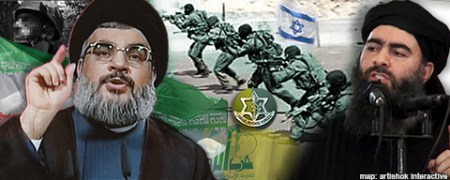
NasrallaBagdadi480

Tehran Monday, Dec. 28, further ramped up the tension between its Lebanese proxy Hizballah, whose leader Sunday threatened to avenge the death of Samir Quntar, and Israel, which is conducting a military exercise along its northern borders. Four days after Quntar was assassinated in Damascus, Tehran appointed a successor to carry on building a new terrorist network for striking Israel from the Golan.

This successor is revealed by DEBKAfile’s exclusive sources as a Lebanese called Raafat Al-Bakkar, about whom very little is known. According to our sources, the Iranians spotted Al-Bakkar as promising talent earlier this year, shortly after the Israeli air strike which on Jan. 18 killed Iranian Gen. Ali Dadi and the high-profile Hizballah leader Jihad Moughniyeh. They were caught touring the Golan around Quneitra in search of a site for a terrorist base. Al-Bakkar was sent to Tehran at that time for a course in building and running terrorist networks, and this week he was given charge of the new “National Resistance on the Golan” organization for deep strikes inside Israel.

When Nasrallah boasted Sunday that his jihadists were already on their way to punish Israel, he was looking forward to the arrival of Quntar’s successor.

See DEBKA files’ earlier report from Sunday, Dec. 27.

IDF Chief of Staff Lt. Gen. Gady Eisenkott explained why it was necessary to bring forward the launching of the new Commando Brigade by two months, when he addressed the formation ceremony on Sunday, Dec. 27, at the Ein Harod National Park: “The Commando Brigade is more necessary than ever in light of the threats from Hizballah and the Islamic State,” he said, in reference to the boasts heard in the last 48 hours from Hassan Nasrallah and Abu Bakr Al Baghdadi.

The Chief of Staff introduced Col. David Zini as the first commander of the new Brigade.

The ceremony took place shortly after the Hizballah chief Hassan Nasrallah said, “Revenge for the death of Samir Quntar is on the way… The orders have been given and execution is in the hands of resistance fighters on the ground… The Israelis are worried and rightly so – those on the borders [soldiers] and those inside the country…. We shall not let the blood of our Jihadi fighters and brothers to be spilled anywhere in the world,” he said.

DEBKAfile’s military sources report: Analysis of the kinds of threats posed by Hizballah (and ISIS) at this time, which are likely to focus more on terrorism than on tank or infantry border incursions, persuaded IDF leaders of the need for a new framework for bringing under one roof some of the top-notch, highly-trained, experienced, well-armed and determined fighting men who are willing to take on new challenges.

The self-styled Islamic State’s “caliph” Abu Bakr Al-Baghdadi, also devoted special attention to Israel, or rather “the Jews,” in his first audio speech in seven months Saturday, Dec. 26, the day before Nasrallah sounded off. His message was similar to that of his Shiite enemy, albeit in his own inimitable style:

The Islamic State would soon be in Palestine to establish an Islamic state there, he said, “Jews, soon you shall hear from us in Palestine which will become your grave… The Jews thought we had forgotten Palestinian… Not at all, Jews…The pioneers of the jihadist fighters are getting closer every day.”

If and when the Shiite Hizballah and Sunni ISIS make good on their similar but separate threats – or sooner – they will encounter Israel’s new Commando Brigade. Its fighting men are trained for combat in miscellaneous conditions of terrain, day or night, under deep cover. They are equipped with high-tech equipment, most of it classified, for gathering visual and electronic intelligence, communications, photography and targeting. They may either kill terrorists or take them captive.

In a word, these elite troops will hit the enemy in his back yard or at home, and blow the threats heard from Hizballah and ISIS leaders’ back on their own forces.

The 89th Commando Brigade is composed of four battalions:

Duvdevan specializes in operating amidst an Arab population under deep cover for locating and arresting terror suspects.

Egoz is a special kind of infantry battalion, whose commandos operate solo or in very small teams behind enemy lines, especially across the Syrian and Lebanese borders.

Maglan is skilled in the use of weaponry designed for precision operations against high quality enemy targets. These elite fighters go deep inside enemy territory to gather intelligence and use their specialized technology, exclusive for the use of this unit, for devastating assaults.

Rimon members are desert fighters who gained their experience in the terrain of the Gaza Strip and Egypt. Their experience as back-up for operations against drug smugglers is invaluable for urban combat in civilian environments.

Excluded from the new brigade are the separate IDF commando units: Sayeret Matkal, Shayetet 13 (Navy), the Oketz unit which trains dogs for anti-terror work, and Yahalom, of the Engineering Corps.

Arch terrorist Samir Quntar’s two secret Iranian controllers died with him

December 24, 2015

Arch terrorist Samir Quntar’s two secret Iranian controllers died with him, DEBKAfile, December 24, 2015

Kuntar480

The Hizballah leader Hassan Nasrallah’s eulogy for Samir Quntar at his funeral Monday, Dec. 21 was not only brief but also untraditional. After blaming Israel in a few short sentences for assassinating him, Nasrallah said he would laud the dead terrorist’s deeds and qualities on another occasion.

That was hardly the tribute the Hizballah would normally have awarded a senior operative killed by Zionist missiles.

DEBKAfile’s intelligence and counterterrorism sources explain this odd behavior by events leading up to the rocket strike.

The Druze arch terrorist had of late transferred his services from Hizballah to the Iranian Revolutionary Guards. He kept up his connections in Hizballah, but took orders from the Iranians in preference to instructions from Nasrallah and the commander of Hizballah operations in Syria, Mustafa Badr al-Din.

The Iranian command in Damascus provided him with two apartments in the Jamaran district south of the Syrian capital, where he lived and worked. But he was also given two Iranian handlers, officers of Gen. Qassem Soleimani’s Al Qods Brigades.

The two Iranian officers died in the rocket attack Sunday, Dec. 20, along with Quntar and his deputy, Farhan Issam Sha’alan, head of the “Syrian National Resistance on the Golan” organization, which was just then getting ready to launch attacks deep inside Israeli territory.

DEBKAfile’s exclusive sources name the two Iranian officers as Mohammed Riza Fahemi and Mir Ahmad Ahmadi. Their coffins were flown to Tehran the day after the assassination.

Wednesday, Dec. 23, the IDF raised the level of alert another notch on the Golan, the Lebanese and Syrian borders and on the main roads of northern Israel, in view of signs that the Iranian leadership was bent on avenging the loss of the arch-terrorist and the two Iranian intelligence officers.

Our Iranian and intelligence sources report that high Iranian officials had concluded that Israel had targeted Quntar to get at Tehran, rather than Hizballah. It was seen as a warning from Jerusalem that if the new terrorist network that the Druze terrorist had established, in partnership with Syria and Hizballah, went into action against Israel, Iran would pay a price: more elements of its military and intelligence structure in Syria would be targeted. Iran’s leaders also decided, according to those sources, that the deaths of Quntar and two Iranian officers must not go unpunished.

But the rushed eulogy and unceremonious funeral also had a hidden context. Although the dead man was a member of the Druze faith, the ceremony was conducted according to Shiite rites at Hizballah’s main center of worship, the Shite Hosniyeh mosque in southern Beirut. The hundreds of thousands of Syrian, Lebanese and Israeli Druze who witnessed the ceremony were appalled to discover that Quntar had deserted his ancestral faith and converted to Shiite Muslim.

DEBKAfile’s intelligence and counterterrorism sources have learned that the terrorist kept his conversion a deep secret, known to no one in the Druze community, only to a handful of top Iranian and Hizballah officials. Since the secret has come out, his compatriots in Syria, Lebanon and the Golan feel they were cheated by Iranian and Hizballah agents into following Quntar, in the false belief that he headed an autonomous Druze group, when in fact he was a renegade and the minion of a Shiite power.

US bows to Russian demand to keep Assad in office. Israel follows suit

December 16, 2015

US bows to Russian demand to keep Assad in office. Israel follows suit, DEBKAfile, December 16, 2015

kerry-meets-putin-moscow_15.12.15

After two tries, US Secretary of State John Kerry finally turned President Barack Obama away from his four-year insistence that Bashar Assad must go, as a precondition for a settlement of the Syrian conflict. Tuesday, night, Dec. 15, the Secretary announced in Moscow: “The United States and our partners are not seeking so-called regime change.”

After Kerry’s first try, Obama still stuck to his guns. He said in Manilla on Nov.19 that he didn’t believe the civil war in Syria “will end while the dictator remains in power.”

Almost a month went by and then, Tuesday night, after a day of dickering with Foreign Minister Sergei Lavrov culminating in a joint conference with Putin at the Kremlin, Kerry confirmed this evolution in US policy. The focus now, he said, is “not on our differences about what can or cannot be done immediately about Assad.” Rather, it is on facilitating a peace process in which “Syrians will be making decisions for the future of Syria.”

Rather, it is on facilitating a peace process in which “Syrians will be making decisions for the future of Syria.”

This statement brought Washington in line with Moscow’s demand for the Syrian president’s future to be determined by his own people.

This statement brought Washington in line with Moscow’s demand for the Syrian president’s future to be determined by his own people.

On this demand, Iran’s Ayatollah Ali Khamenei is even more obdurate than Putin.

DEBKAfile’s Middle East sources wonder about the measure of freedom the Syrian people can expect while it is clamped firmly in a military vice by Russia, Iran and Hizballah. However, this was of no immediate concern to the big power players. Washington’s surrender to the Russian and Iranian line on Assad’s future was offered in the short-term hope of progress at the major international conference on the Syrian question taking place in New York Friday.

Another major US concession – this one to Tehran – was scarcely noticed.

Earlier Tuesday, the UN nuclear watchdog’s 35-nation board in Vienna closed its investigation into whether Iran sought atomic weapons, opting to back the international deal with Tehran rather than dwell on Iran’s past activities.

This motif of going forward toward the future rather than dwelling on the past was a repeat of the argument for keeping Assad in power. It provided an alibi for letting Tehran get away with the suspicion of testing a nuclear detonation at its Parchin military complex, without forfeiting sanctions relief, by the simple device of denying access to UN nuclear agency monitors to confirm those suspicions.

In a single day, the Obama administration handed out certificates of legitimacy to the Syrian dictator, who is responsible for more than a quarter of a million deaths, and to Iran’s advances toward a nuclear weapon.

These epic US policy reversals carried three major messages:

1. The Obama administration has lined up behind Putin’s Middle East objectives which hinge on keeping Bashar Assad in power.

2. Washington endorses Russia’s massive military intervention in Syria, although as recently as last month Obama condemned it as doomed to failure.

3. The US now stands behind Iran – not just on the Syrian question – but also on the existence of an Iranian-Syrian-Hizballah alliance, based on a solid land bridge from Iran and the Gulf up to the Mediterranean coast under Russian military and political protection and influence.

Even more surprising were the sentiments heard this week in Jerusalem.

Our military and intelligence sources cite officials urging the government to accept the American policy turnaround. In some military circles, senior voices were heard commenting favorably on Assad’s new prospects of survival in power, or advising Israel to jump aboard the evolving setup rather than obstructing it.

Those same “experts” long claimed that Assad’s days were numbered. They were wrong then and they are wrong now.

Israel was forced to yield on the Iranian nuclear program, but its acceptance of the permanence of Assad and the indefinite presence in Syria of his sponsors, Iran and Hizballah, will come at a high price for Israel in the next conflict.

Russia brings over heavy T-90 tanks to boost three Syrian warfronts

December 6, 2015

Russia brings over heavy T-90 tanks to boost three Syrian warfronts, DEBKAfile, December 6, 2015

russian-tank-army-t-90-Syria_12.15

On Wednesday, Dec. 2, Russia started transferring dozens of advanced T-90 tanks to Syria, DEBKAfile’s military and intelligence sources report. They were moved immediately to two Syrian army fronts fighting rebel forces at the two most important cities, Aleppo and Damascus, and are expected to be sent to beef up the combined Syria, Iranian, Hizballah army poised to recover Palmyra from the Islamic State.

The shipment to the capital was delivered into the hands of the 4th armored division, Syria’s republican guard commanded by Gen. Ali Maher Assad, the younger brother of President Bashar Assad.

The attack on Palmyra in country infested by ISIS forces was scheduled to have begun two weeks ago but was delayed for the arrival of the heavy Russian tanks, among other reasons.

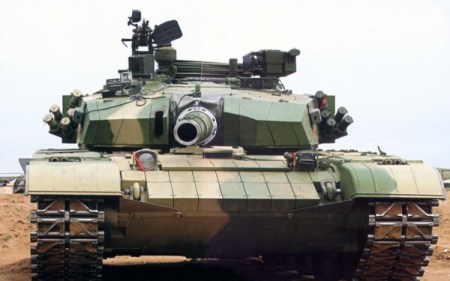
The T-90 weighs 46.5 tons and has a range of 375 kilometers, with an average speed of 45 km per hour under battle conditions or 65 km per hour on roads. It has three layers of defensive systems: composite armor plates on the turret; Kontact-5 third-generation explosive reactive armor on its front, sides, and turret that reduces penetration by kinetic energy bombs; and the “Shtora,” or curtain, an electro-optical active protection system that enables the tank to jam the systems of antitank missiles.

The T-90 also has 12 smoke mortars, a 125 mm cannon and AT-11 Sniper guided antitank missiles. The tank has proven itself in battle in recent years in Russia’s wars in Georgia and Chechnya against forces not unlike the Syrian rebels.

Until last week, Russia kept only a few T-90 tanks in Syria, mainly to protect its military bases around Latakia.

The new shipment, say Western military sources which are monitoring Russian movements, will eventually replace a large part of the Syrian army’s fleet of around 500 operational tanks, mostly T-72s – at least half of which are positioned to defend the capital.

But the pace of delivery will be dictated above all by the time needed for Russian instructors to retrain Syrian tank crews from scratch in the use of T-90s in battle conditions.

It should be noted meanwhile that, while the Syrian rebels have antitank missiles able to take out the T-72, they do not have advanced missiles capable of stopping the much heavier, reactively armed T-90. But  the Islamic State does, having captured US-made antitank missiles from the Iraqi armored divisions put to flight in June 2014. Some of those advanced missiles may be presumed to have been passed to ISIS forces in Syria.

For now, the Russian general staff shows no sign of preparing for a wide-scale operation against ISIS in Syria, so the newly-delivered T-90s are not immediately threatened from that quarter.

As far as Israel is concerned, the main worry is that Russian instructors will also be assigned to train Iranian and Hizballah tank crews in the use of the advanced T-90. Once they get hold of these tanks, they will be able to attain their objective of beefing up the Iranian-Hizballah front against Israeli defenses from southern Syria and the Syrian Golan.

Israeli finds cause for concern in the constant expansion of the Russian military presence and involvement in Syria. Preparations for a very long stay are signified by new developments every few days. A permanent Russian military presence in Syria would give Iran and Hizballah cover for a standing military buildup in Syria. This would confront Israel’s vital strategic interests with a major challenge.

First Iranian fighter jets over Syria alongside Russian bombers

November 22, 2015

First Iranian fighter jets over Syria alongside Russian bombers, DEBKAfile, November 22, 2015

RussianIranianSirforce480

A series of videos apparently leaked by the Russian Defense Ministry reveal the presence of Iranian F-14 and MiG -29 fighters in Syrian skies for the first time. They were shown by “The Aviationist,” Italian magazine, escorting heavy Russian bombers, including the Tupolev TU-160, the heaviest, fastest and most destructive bomber ever built, on missions no more than 150 km from Israel’s northern border.

The ageing F-14s, built in the 1970s by American aviation giant Grumman, were originally sold to Iran when the Shah was in power and taken over by the reorganized Iranian air force after the 1979 Islamic revolution. Upgraded many times, the F-14s now feature state-of-the-art avionics, weapons and navigation systems, procured byTehran despite the strict UN embargo on their sale to the Islamic Republic.

Dozens of these upgraded warplanes, upgraded with intelligence-collection and tracking systems, have begun operating in Syrian air space near the Israeli border, under the pretense of escorting the Russian bombers. Iranian eyes in the sky are therefore studying the frontier area and gather valuable intelligence on Israel’s air defenses. Normally, if Iranian warplanes had turned up in Syrian air space, the Israeli Air Force would have fought them off and shot them down, but by flying alongside Russian bombers they are protecting themselves against Israeli action.

Tu95_F14

As DEBKAfile reported on Saturday, November 21, Russian air and missile attacks are systematically   destroying Raqqa, the ISIS capital in Syria, without consideration of civilian casualties. The Russian general staff is now gearing up to embark on an unprecedented assault on rebel and ISIS strongholds, a blitz involving hundreds of simultaneous sorties by warplanes and bombers, as well as cruise missile attacks from planes and warships in the Mediterranean and the Caspian Seas.

High-altitude surveillance planes as well as low-altitude drones, fitted with imaging and targeting systems that will send live video and images to the command center in Moscow, will provide an umbrella for the attack.

Russian President Vladimir Putin will personally manage the multilayered military coordination between Russia and Iran when he visits Tehran on Nov. 23, accompanied by top military officers.

Syria rebels: We have killed Al Qods Chief Soleimani

November 14, 2015

Syria rebels: We have killed Al Qods Chief Soleimani, DEBKAfile, November 14, 2015

Syrian rebel sources claimed Saturday night that they had killed Iranian al Qods chief, the commander of Iranian forces in Iraq and Syria, Gen. Qassem Soleimani, in the fighting east of Aleppo. This claim is not confirmed by any other sources. The rebels say they located the Iranian general’s movements by means of intelligence and struck his car with a TOW missile, killing him and three other Iranian commanders with him, Masoud Askari, Mahmud Dahakan and Ahmed Rajai. If this is confirmed it would count as a signal Syrian rebel feat.

No good news in the Mid East for Obama or Netanyahu when they meet Monday

November 8, 2015

No good news in the Mid East for Obama or Netanyahu when they meet Monday, DEBKAfile, November 8, 2015

Obama_Bibi2480

After more than a year, Israeli Prime Minister Benyamin Netanyahu meets President Barack Obama at the White House on Monday, Nov. 9, with the deck heavily stacked against him – and not just because of the Islamic State, which is a universal bane, or Obama’s Iran policy – or even the evaporation of the peace process with the Palestinians. This time, Netanyahu is not getting a dressing-down over the disappearance of the two-state solution, because even the US president has decided to shelve it for the remainder of his presidency which ends in January 2017.

This is not because the Netanyahu government has missed any chances for talks with the Palestinians, as the Israeli opposition loudly claims, but because it is unrealistic.

Palestinian Authority Chairman Abu Mazen (Mahmud Abbas), who lost all credibility on the Palestinian street long ago, has been quietly but continuously encouraging the continuous Palestinian wave of terror by knives, guns and cars.

The Israeli prime minister had his most promising card snatched from him just ten days before he traveled to Washington. He had intended presenting the US president with the quiet alliance he had formed with key moderate Arab governments as a viable alternative for the deadlocked Palestinian peace process, with the promise of a measure of stability for its members in the turbulence around them.

However, the linchpin Egyptian President Abdel-Fatteh El-Sisi’s position was suddenly shaken up badly by the downing of the Russian passenger plane over Sinai on Oct. 31, presenting him with his most dangerous crisis since he took power in 2013.

In addition, the security situation in Syria, including along Israel’s northern border, especially the Golan, has gone from bad to worse – especially since Russia built up its military presence in Syria.

Israel has been forced to forego most of its red lines for defending its security as no longer relevant. Although no Israeli official says so openly, Israel’s military options in Syria have shrunk, and even the overflights by its air force flights for keeping threats at bay are seriously restricted..

Iran and Hizballah, under Russian air cover, have been slowly but surely making gains in their attempt to retake southern Syria from the rebels and hand it over to the army of Syrian President Assad.

Israel is still insisting that it will not allow the deployment of Iranian or Hizballah forces on the Syrian side of the Golan, but these statements are losing their impact. If the coalition of Russia, Iran, Syria and Hizballah defeats the rebels in southern Syria and moves in up to its border, Israel will find it extremely difficult to prevent this happening.

It would also mark the end of more than three years of investment and building of ties with various elements in southern Syria as part of a strategic decision to transform those groups into a buffer between Israel and Iran in the Golan area.

Netanyahu’s struggle against the nuclear deal with Iran was not just aimed at Washington’s recognition of Iran’s nuclear program, but ever more at Obama’s acknowledgement of Iran as America’s strategic partner and leading Middle East power. But in this respect, the US president is most likely chafing over the setbacks to his own cherished plan, as a result of four developments:

1. Iran has plunged more deeply than ever predicted into the Syrian conflict. For the first time since the 19th century, Iran has not only sent its military to fight beyond its borders, but it is coordinating its moves with Moscow, not Washington.

Even if Israel needed to turn to the US administration for a helping hand against Iran, it would have no address because Washington too has been displaced as a power with any say in the Syrian picture.

2. Although the alliance by Israel and moderate Arab countries was designed by Netanyahu to serve as a counterweight to the US-Iranian partnership,  that alliance too is far from united on Syria:  Egyptian President El-Sisi, for example, supports President Bashar Assad, and is in favor of keeping him in power in Damascus.

3. The Islamic State continues to go from strength to strength in Syria and the Sinai Peninsula which share borders with Israel as well as in Iraq.

4. Israel’s political, defense and intelligence elite have badly misread or missed altogether four major events in the region:

  • Assad’s persistent grip on power
  • The deep Russian and Iranian military intervention in Syria
  • The strengthening of ISIS
  • The eruption of a new, deadly Palestinian campaign of terror which strikes unexpectedly in every town, highway and street.

These errors are taking their toll on Israel’s security, wellbeing and prestige.

Even if Israeli Prime Minister Netanyahu and US President Obama, like Defense Minister Moshe Yaalon and Secretary of Defense Ashton Carter, do reach an agreement on Israel’s security needs for the coming years and US military assistance, such an agreement may not withstand the test of Middle East volatility. The rapidly changing conditions are for now all to the detriment of the US and Israel.