Posted tagged ‘Iran – Syria war’

Mission accomplished in Syria

April 12, 2017

Mission accomplished in Syria, Israel Hayom, Clifford D. May. April 12, 2017

(Accomplished or just begun? — DM)

Congress should send Trump the legislation it is now considering, seeking to impose new sanctions on Iran in reprisal for its continuing support of terrorists, its missile tests and its maintenance of more than 35,000 troops in Syria, including its own, those of its Lebanese proxy, Hezbollah, and Shiite fighters recruited from Iraq and Afghanistan. Suspending Iran’s deal with Boeing/Airbus would be useful, too. Only the willfully credulous believe that Iran’s theocrats won’t use such aircraft for illicit military purposes.

************************

If you’re still unsure about whether U.S. President Donald Trump did the right thing when he launched 59 cruise missiles at Syria’s Shayrat Air Base last week, consider the alternative.

He knew that Syrian dictator Bashar Assad had yet again used chemical weapons to murder Syrian civilians, women and children prominent among them. He knew that Iran and Russia had enabled this atrocity, as they have many others. He knew he had two choices.

He could shrug, instruct his U.N. ambassador to deliver a tearful speech calling on the “international community” to do something, and then go play a round of golf. Or he could demonstrate that the United States still has the power and the grit to stand up to tyrants and terrorists, thereby beginning to re-establish America’s deterrent capability.

In other words, this was what Sun Tzu and Carl von Clausewitz would call a no-brainer. (Well, loosely translated.) A mission was accomplished. Do harder missions lie ahead? Yes, of course. But I suspect Defense Secretary James Mattis and National Security Adviser H.R. McMaster have made that abundantly clear to the new president.

We now know for certain that Russia failed to live up to its 2013 commitment to ensure that Assad surrendered all his illegal chemical weapons under the deal it brokered. Secretary of State Rex Tillerson acerbically questioned whether that was the result of complicity or incompetence or whether Russia allowed itself to be duped by Assad.

The strike ordered by President Trump was not “unbelievably small” — then-Secretary of State John Kerry’s description of the punishment then-President Barack Obama decided not to impose in response to Assad’s earlier use of chemical weapons. It was big enough to make clear that American diplomats are again carrying big sticks. (For Obama to insist that diplomacy and force are alternatives was patently absurd.)

Conveniently, Trump was dining with Chinese President Xi Jinping when the strikes occurred. It’s fair to speculate that Xi is today thinking harder about American requests to rein in Kim Jong Un, the North Korean dictator whose drive to acquire nuclear-tipped missiles that can reach the American mainland has become what Tillerson called an “imminent” threat.

Having passed his first major national security test, Trump is now obliged to demonstrate firmness and consistency. What plans might the Pentagon have on the shelf to respond to further provocations? The next round of Tomahawk missiles could permanently ground Assad’s air force. That would make it easier to then establish no-fly zones. If such measures do not alter the calculations of Assad and his Iranian and Russian patrons, consideration could be given to leveling his defense, intelligence and command-and-control centers as well.

Another idea under discussion: setting up safe havens, or, to use a better term, “self-protection zones,” for those fleeing the Syrian regime and various jihadist forces, Sunni and Shiite alike. Israel and Jordan could help the inhabitants of such areas adjacent to their borders defend themselves. The Saudis, Emiratis and Bahrainis could contribute to the cost. Might this lead to the partition of Syria? Most likely, but it’s difficult to imagine a “political solution” that would not include such readjustments.

All this, while useful and perhaps even necessary, should be seen as insufficient. Syria is a major humanitarian catastrophe but only one piece in a much larger geopolitical puzzle. Sooner rather than later, the Trump administration needs to develop what Obama refused to contemplate: a comprehensive and coherent strategy to counter the belligerent, imperialist and supremacist forces that have emerged from the Middle East and are now spreading like weeds around the world.

The Islamic State group will of course need to be driven off the lands on which it has attempted to establish a caliphate. After that, its terrorists will have to be hunted, along with those of al-Qaida, wherever they hide (e.g., Egypt where, over the weekend, they bombed two Coptic Christian churches).

But — and this is crucial — accomplishing these missions must not serve to further empower Iran’s jihadist rulers, who dream of establishing an expanding imamate, the Shiite version of a caliphate.

Most immediately, Congress should send Trump the legislation it is now considering, seeking to impose new sanctions on Iran in reprisal for its continuing support of terrorists, its missile tests and its maintenance of more than 35,000 troops in Syria, including its own, those of its Lebanese proxy, Hezbollah, and Shiite fighters recruited from Iraq and Afghanistan. Suspending Iran’s deal with Boeing/Airbus would be useful, too. Only the willfully credulous believe that Iran’s theocrats won’t use such aircraft for illicit military purposes.

That the United States cannot solve all the world’s problems was one of Trump’s campaign themes. But the implication is not necessarily, as some of his supporters hoped, that he would turn a blind eye to all atrocities and threats not already within America’s borders.

In the last century, most Americans recognized, in some cases with enormous reluctance, that there was no good alternative to doing whatever was necessary to rout the Nazis and communists, enemies whose goal was to kill off the democratic experiment.

In this century, jihadists and Islamists harbor the same ambition. We can attempt to appease them. We can try to make ourselves inoffensive to them. We can keep our hand extended, hoping that in time they will unclench their fists. Or we can decide instead to plan for a long war that will end with the defeat of these latest enemies of America and the rest of the civilized world. If Trump has grasped that within his first 100 days, he’s not off to such a bad start.
Radical Iran-led Axis Confronted with U.S. Deterrence for First Time

April 11, 2017

Radical Iran-led Axis Confronted with U.S. Deterrence for First Time, Investigative Project on Terrorism, Yaakov Lappin, April 11, 2017

Until recently, the United States focused its attention exclusively on Sunni jihadist threats – ISIS and al-Qaida-affiliated groups. While these terrorists certainly need to be attacked, turning a blind eye to the activities of the more powerful radical Shi’ite coalition did nothing to stop the region’s destabilization. In this context, Assad’s numerous crimes against humanity went unanswered.

This helped embolden Assad to use chemical weapons. It also gave the Iranians confidence to magnify their meddling in Syria, Lebanon, Iraq, Yemen, Bahrain, and to target many other states. The end result is Iran’s enhanced ability to export its Khomeiniest Islamic fundamentalist doctrine.

Just as Iranian-backed Shi’ite militias have poured into Syria, the same has happened in Iraq, where 100,000 fighters supported by Tehran fight alongside the Iraqi government forces against ISIS. The IRGC’s network extends to Yemen’s Houthi Ansar Allah forces, who receive Iranian assistance. Ansar Allah, a heavily armed Shi’ite military force, fires ballistic missiles at Saudi Arabia on a regular basis.

The IRGC and Hizballah have been linked to a recent large-scale terrorist plot in Bahrain.

If the message addressed in the cruise missile strike is followed up with a strategy of deterrence, addressed to Ayatollah Khamenei as much as it was addressed to Assad, the U.S. could begin projecting to the world that it recognizes the threat posed by Shi’ite jihadists as much as it takes seriously the threat from their fundamentalist Sunni equivalents.

**********************

The conflict in Syria has long ceased being a civil war, becoming instead a clash between coalitions and blocs that divide the entire Middle East.

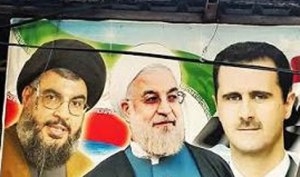
The Iranian-led axis is the most dangerous and highly armed bloc fighting in Syria. Bashar al-Assad’s regime is not an independent actor, but rather, a component of this wider axis. In many respects, Assad is a junior member of the Iranian coalition set up to fight for him.

Russia joined the Iranian axis in 2015, acting for its own reasons as the pro-Assad coalition’s air force, helping to preserve the Syrian regime.

This coalition enabled the Assad regime to conduct mass murder and ethnic cleansing of Sunnis from Syria, while also using unconventional weapons against civilians in an effort to terrorize rebel organizations into submission.

Feeling confident by its growing control of Syria, Iran also uses its regional coalition to arm, finance, and deploy Shi’ite jihadist agents all over the Middle East, and to attack those who stand in the way of Iranian domination.

The Iranian-led axis has been able to spread violence, terrorism, and Islamic militancy without facing repercussions.

Until recently, the United States focused its attention exclusively on Sunni jihadist threats – ISIS and al-Qaida-affiliated groups. While these terrorists certainly need to be attacked, turning a blind eye to the activities of the more powerful radical Shi’ite coalition did nothing to stop the region’s destabilization. In this context, Assad’s numerous crimes against humanity went unanswered.

This helped embolden Assad to use chemical weapons. It also gave the Iranians confidence to magnify their meddling in Syria, Lebanon, Iraq, Yemen, Bahrain, and to target many other states. The end result is Iran’s enhanced ability to export its Khomeiniest Islamic fundamentalist doctrine.

That sent a troubling message to America’s regional allies, who, in the face of these threats, formed a de facto coalition of pragmatic Sunni states – a coalition that includes Israel.

On April 6, the U.S. sent a signal that something may have changed. A cruise missile attack on an Assad regime air base, in response to a savage chemical weapons massacre in Idlib, Syria, was, first and foremost, a moral response to an intolerable act of evil.

But the strike also carries a wider prospective message about Washington’s new willingness to enforce red lines against Assad and his Shi’ite allies.

Potentially, it is an indication that the U.S. is willing to use its military prowess beyond the objective of targeting ISIS, and that it recognizes that Sunni jihadists are not the only global security threat that warrants the use of military force.

Statements by senior Trump administration officials indicate that a shift has occurred. “What you have in Syria is a very destructive cycle of violence perpetuated by ISIS, obviously, but also by this regime and their Iranian and Russian sponsors,” National Security Adviser H. R. McMaster told Fox News Sunday.

Russia must choose between its alignment with Assad, Iran, and Hizballah, and working with the United States, Secretary of State Rex Tillerson said Tuesday. The firm comment was made hours before he touched down in Moscow for talks.

According to U.S. officials, the April 6 missile attack destroyed 20 percent of Assad’s fighter jets. It represents the first time that Washington has taken military action against a member of the Iranian-led coalition.

The strike could evolve into a ‘dialogue of deterrence’ that the U.S. initiates against dangerous actors. These radical actors all have ‘return addresses,’ and are likely to prove responsive to cost-benefit considerations, despite their extreme ideology. They may think twice before considering further development and usage of unconventional weapons.

Washington is now able to exercise muscular diplomacy – the only kind that is effective in the Middle East – and inform all members of the Iran’s pro-Assad coalition that the deployment of unconventional weapons will not be tolerated. It can also begin to rally and strengthen the pro-American coalition of states in the Middle East, who seek to keep a lid on both ISIS and Iran.

With American officials indicating that they are “ready to do more” in Syria if necessary, signs suggest that the strike represents the start of a policy of deterrence, and leaving open future options for drawing additional red lines.

In theory, should Washington decide that Iran’s transfer of weapons and extremist Shi’ite military forces to other lands has reached unacceptable levels, or that Iran’s missile development program has gone far enough, it could call on Tehran to cease these activities. This call would carry substantially more weight following last week’s missile attack on the Syrian airbase.

The U.S. is in a better position to inform Assad and his allies that there is a limit to how far they can go in pursuing their murderous ambitions.

While the objective of creating a renewed American deterrent posture is vital, it should not be confused with plans for wider military intervention in the seemingly endless Syrian conflict.

There is little reason to believe that conventional weapons use against Syrian civilians is going to stop any time soon, or that the enormous tragedy suffered by the Syrian people is about to end.

And there is certainly no indication that the U.S. is planning to initiate large-scale military involvement in this failed state.

Hence, the missile strike should be seen for what it is: an attempt to boost American deterrence, which can then be leveraged to restrain radical actors that have, until now, been operating completely unchecked.

That is a message that will likely be heard loud and clear not only in Damascus, but also in Tehran, which has not given up its long-term ambition of building nuclear weapons.

North Korea, which helped build Syria’s plutonium nuclear plant (destroyed in 2007 in a reported Israeli air strike), and which maintains close links with Iran’s nuclear and missile programs, can be expected to take note as well.

If a policy of strategic deterrence follows the strike, it could have an impact on a coalition that is not just keeping Assad’s regime alive, but spreading its radical influence in many other areas.

In Syria, the Iranian Republican Guards Corps (IRGC) oversees ground operations across many battlefields to prop up Bashar al-Assad. Iran has gathered and armed tens of thousands of Shi’ite militia members from across the region into Syria, and manages a local force composed of 100,000 members. They fight alongside the Syrian Arab Army against Sunni rebel organizations, thereby increasing and entrenching Iranian influence.

The IRGC and its elite Quds Force are also helping to fill Hizballah’s weapons depots in Lebanon, with a vast array of surface-to-surface projectiles that are all pointed at Israel, often using Syria as an arms trafficking transit zone. Syria acts as a bridge that grants Iran access to Lebanon, and allows it to threaten both Israel and Jordan.

Jordan, an important U.S. ally, is deeply concerned by Iran’s actions in Syria, as evidenced by recent comments made by King Abdullah, who told the Washington Post that “there is an attempt to forge a geographic link between Iran, Iraq, Syria and Hezbollah/Lebanon.” IRGC forces are stationed within a mere 45 miles from Jordan’s border, he warned, adding that any hostile forces approaching the Hashemite Kingdom “are not going to be tolerated.”

Hizballah, a Lebanese-based Iranian Shi’ite proxy, evolved into a powerful army by sending 7,000 to 9,000 of its own highly trained members into Syria’s ground war. It helped rescue the Assad regime from collapse, and took part in battles stretching from Aleppo to the Qalamoun Mountains northeast of Damascus.

Last year, the Arab League and the Sunni countries of the Gulf Cooperation Council all declared Hizballah to be a terrorist entity.

Just as Iranian-backed Shi’ite militias have poured into Syria, the same has happened in Iraq, where 100,000 fighters supported by Tehran fight alongside the Iraqi government forces against ISIS. The IRGC’s network extends to Yemen’s Houthi Ansar Allah forces, who receive Iranian assistance. Ansar Allah, a heavily armed Shi’ite military force, fires ballistic missiles at Saudi Arabia on a regular basis.

The IRGC and Hizballah have been linked to a recent large-scale terrorist plot in Bahrain.

If the message addressed in the cruise missile strike is followed up with a strategy of deterrence, addressed to Ayatollah Khamenei as much as it was addressed to Assad, the U.S. could begin projecting to the world that it recognizes the threat posed by Shi’ite jihadists as much as it takes seriously the threat from their fundamentalist Sunni equivalents.

Washington’s campaign to pressure Russia to distance itself from its Middle Eastern allies could play an important part of this message.

Russia, Iran, Hizballah set up joint command in Syria

April 9, 2017

Russia, Iran, Hizballah set up joint command in Syria, DEBKAfile, April 9, 2017

(Trump, also known as “Putin’s Puppy,” has been nasty to Iran by declining to wag his tail whenever Khamenei whistles. Obama did, so Trump should too. Tsk tsk. The DEBKAfile article linked in the last paragraph is also available here. It deals with the transfer of substantial U.S. military air assets from Iraq to Syria.– DM)

The joint command center also said the presence of U.S troops in northern Syria where Washington has hundreds of special forces helping the Syrian Democratic Forces (SDF) to oust Islamic State was “illegal” and that Washington had a long-term plan to occupy the area.

**************************

A new joint command center made up of the forces of Russia, Iran and the pro-Iranian Shiite militias supporting Syrian President Bashar Assad accused America Sunday of waging aggression on Syria and crossing red lines. The center issued this warning: “From now on we will respond with force to any aggressor or any breach of red lines from whoever it is [against the Assad regime] and America knows our ability to respond well,” said the statement. It was issued in response to the US missile attack Friday on a Syrian air base from which chemical weapons were launched against civilians.

The joint command center also said the presence of U.S troops in northern Syria where Washington has hundreds of special forces helping the Syrian Democratic Forces (SDF) to oust Islamic State was “illegal” and that Washington had a long-term plan to occupy the area. Read DEBKAfile article.

U.S. airstrikes in Syria a smackdown for Iran’s mullahs

April 9, 2017

U.S. airstrikes in Syria a smackdown for Iran’s mullahs, American ThinkerReza Shafiee, April 9, 2017

(According to Iranian President Rouhani, “today all terrorists in Syria are celebrating the U.S. attack.” Rouhani evidently does not view Assad’s enforcers, Khamenei’s Revolutionary Guard or Iranian proxies such as Hezbollah as “terrorists.” The Syrian in this video must, according to Rouhani, be a terrorist. — DM)

Iranian president Hassan Rouhani strongly defended Assad regime’s recent sarin attack on his own people. He blasted President Trump for his decision for airstrikes. Rouhani said in a televised speech referring to the U.S. president: “This man who is now in office in America claimed that he wanted to fight terrorism, but “today all terrorists in Syria are celebrating the U.S. attack.” He also said: “Why have you attacked the Syrian army which is at war with terrorists? Under what law or authority did you launch your missiles at this independent country?”

To put more teeth to what U.S. means in terms of ending Iran’s influence in Syria, an even more effective step forward would be to expel the IRGC and all its proxies from Syria. It would certainly help with the broader war in the region against Islamic fundamentalism in all its shapes and forms. To get rid of terrorism, get rid of the Iran’s proxies.

***************************

The deadly chemical attack on innocent Syrian men, women and children in Idlib, which killed at least 100 and injured 400 was little more than Syrian dictator Bashar al-Assad crossing the “red line” again. It wasn’t his first chemical attack, he launched a similar attack in summer of 2013, which left at least 1400 dead, according the opposition sources. At that time, the world stared in disbelief as Assad commit atrocities in Syria without paying a price.  

This time, things were different. On April 7 the U.S. launched an airstrike on an airfield believed to have been used by his forces to drop chemical bombs on Idlib. It was a clear sign of shift in the U.S. attitude toward his regime. Other nations announced support, too, making the attitude shift more than just unilateralism.

President Donald Trump said after the U.S. airstrike: “Tonight, I call on all civilized nations to join us in seeking to end the slaughter and bloodshed in Syria and also to end terrorism of all kinds and all types.”

The airfield bombed is significant, because it is also used by members of Islamic Revolutionary Guard Corps (IRGC) and the Quds Force, according to a report from Asharq Al-Awsat Arabic language website. The field has been used for a long time by IRGC to operate not only in Syria but also in Iraq.

Since the start of the bloody six-year-old Syrian war, Bashar al-Assad and his allied goons, the Islamic Revolutionary Guard Corps (IRGC), including Quds Force commander Qasem Soleimani, thought that they could get away with anything.

They relied on the notion that the international community is too divided to take any firm action against the massacre of innocent Syrian people. So they thumbed their noses at every element of international law. Soleimani was caught on camera many times in Iraq and later in Aleppo walking around unencumbered as if he was a tourist there and not the international thug he was, blacklisted by UN resolutions banning him from traveling.

The reaction of the world’s leaders to the attack was a stark contrast to previous years in the Syrian conflict, too. Instead of knee-jerk opposition to Trump, there as almost a consensus about the fact that Assad must face the consequences of his actions; something long overdue.

In a joint statement, German Chancellor Angela Merkel and French President Francois Hollande laid the blame for the U.S. airstrikes on Assad’s Al-Shayrat airfield solely on Assad.

They said: “President Assad alone bears responsibility for this development.”  and “His repeated use of chemical weapons and his crimes against his own population had to be sanctioned.”

The Syrian opposition welcomed the airstrikes with joy and almost disbelief that after so many years of inaction, despite repeated calls on the U.S. to act against Assad regime, the moment finally arrived with the Tomahawk missiles.

Nikki Haley, the U.S. ambassador to the United Nations, told the UN Security Council: “The United States took a very measured step last night. We are prepared to do more, but we hope it will not be necessary.”

One of the few big exceptions to this moment of moral clarity was in the predictably repellant reaction from Iran.

Iranian president Hassan Rouhani strongly defended Assad regime’s recent sarin attack on his own people. He blasted President Trump for his decision for airstrikes. Rouhani said in a televised speech referring to the U.S. president: “This man who is now in office in America claimed that he wanted to fight terrorism, but today all terrorists in Syria are celebrating the U.S. attack.” He also said: “Why have you attacked the Syrian army which is at war with terrorists? Under what law or authority did you launch your missiles at this independent country?”

The United States Senate was quick to reciprocate President Trump’s action on behalf of the Syrian people by introducing a new bill to ensure further extend measures safeguarding human rights for innocent Syrian citizens.  The bill, titled the Syrian War Crimes Accountability Act was introduced on April 6 to instruct the Secretary of State to report on war crimes, crimes against humanity, and genocide in Syria, as well as to authorize assistance for investigations and other credible transitional justice efforts, including a potential hybrid tribunal, in a bid to hold Assad and his regime accountable for their heinous acts.

A durable solution to Syrian crisis is something hardly disputable by anyone. The U.S. administration through its UN Ambassador Nikki Haley reiterated again on an interview with CNN on Sunday that a long term solution for Syria with Assad in the picture is not possible to imagine. She also pointed to Assad’s main sponsor, the mullahs in Iran, as a major obstacle to peace in the war-torn country and the need to end the Iranian regime’s “influence” in Syria.

The mullahs’ “influence” is something which should not be taken lightly. The Syrian people’s peaceful uprising against the Assad’s dictatorship in 2011 could have taking a different turn had it not been for the IRGC and Quds Force stepping up in full support of the regime in Damascus.

The Assad regime was on the edge in 2013 and outside the capital it had no control over the rest of the country. With the aid of mullahs who spent billions in Syria while their own people at home were hungry, and the inaction of Obama administration by turning a blind eye to Assad’s crossing its established “red line,” the Syrian dictator survived.

Now it seems that a new plan is unfolding in Washington to stop the genocide in Syria with the U.S. administration’s firm respond to Assad’s use of chemical weapons against his people. The attack may not have a major military significance but it has firm political tone to it. The action no doubt has resonated as far east as Tehran.

To put more teeth to what U.S. means in terms of ending Iran’s influence in Syria, an even more effective step forward would be to expel the IRGC and all its proxies from Syria. It would certainly help with the broader war in the region against Islamic fundamentalism in all its shapes and forms. To get rid of terrorism, get rid of the Iran’s proxies.

Iran Sponsored Shi’a Militia Launches Terror Group to Fight Israel

April 5, 2017

Iran Sponsored Shi’a Militia Launches Terror Group to Fight Israel, Investigative Project on Terrorism, April 5, 2017

Israel is very concerned with the establishment of Iranian-led terrorist bases in the Golan Heights. Hizballah openly seeks to consolidate its presence in the region and launch attacks against Israel from a new front in a future war.

**************************

An Iranian supported Shi’a militia, Al-Nujaba, says it formed the “Golan Liberation Army” to fight Israel, the Middle East Media Research Institute (MEMRI) reports.

“This army has been trained and has detailed plans. If the Syria regime asks us to, we are ready to act to liberate the Golan [from Israel] along with our allies,” Al-Nujaba spokesman Hashem Al-Mousawi said in a March 8 interview with Iran’s Tasnim news agency.

Al-Mousawi also admitted that the new militant group is “part of the PMU [Popular Mobilization Units],” an Iraqi-backed umbrella organization comprised of numerous Shi’a militias, including some with close ties to Iran. The Golan Liberation Army emerged from the Iranian led “resistance” axis and consists of “special forces who have received training and equipment,” he said.

“Iran is the only country that has helped us,” Al-Mousawi said, “and sent us its military advisors, led by Qassem Soleimani.”

Soleimani, the commander of the Iranian Revolutionary Guards Corps’ (IRGC) Quds Force, is tasked with advancing Iran’s regional expansion and terrorist networks. Since September 2015, Iran increased its forces in Syria from hundreds to thousands to support Hizballah terrorists acting at Iran’s behest in propping up the Bashar al-Assad regime.

Despite Iran’s commitment to Syria, the Islamic Republic is establishing terrorist networks in the Golan Heights, using Hizballah, Druze, and Palestinian Islamic Jihad (PIJ) operatives to target Israel. The new Golan Liberation Army shows that Iran is now diverting Iraqi militia assets from fighting ISIS to confront the Jewish state.

Soleimani’s Quds Force financed most of the Iraqi-Shi’ite militias and provided them with weapons specifically to target American soldiers. With Hizballah’s assistance, the Quds Force supplied terrorists with powerful explosive devices that killed numerous American and coalition troops in Iraq.

Israel is very concerned with the establishment of Iranian-led terrorist bases in the Golan Heights. Hizballah openly seeks to consolidate its presence in the region and launch attacks against Israel from a new front in a future war.

President Trump and King Abdullah II Hold a Joint Press Conference

April 5, 2017

President Trump and King Abdullah II Hold a Joint Press Conference, White House via YouTube, April 5, 2017

Israel’s inaction in Syria may open Golan to Iran

February 7, 2017

Israel’s inaction in Syria may open Golan to Iran, DEBKAfile, February 6, 2017

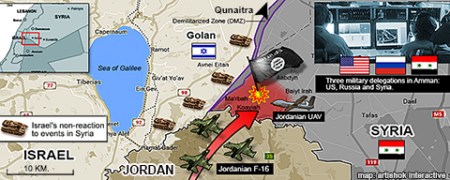
jordanisraelsyria480en

Prime Minister Binyamin Netanyahu has given “diplomatic priority” to stressing the perils posed by Iranian-sponsored terrorism and its nuclear-capable ballistic weapons, and placed them at the top of his talks with British premier Theresa May in London Monday, Feb. 6, and with President Donald Trump in Washington on Feb. 15.

But it stands to reason that their national security and intelligence experts have advised the US president and the British premier that Netanyahu has been firmly advised up to the present day to stay clear of military involvement in the Syrian conflict by the IDF high command and his past and present defense ministers, Avigdor Lieberman and Moshe Ya’alon.

Israel therefore stands to be excluded from the practical deliberations ongoing for Syria’s future. Jordan in contrast has stepped forward as the key Middle East player in the pacts and military understandings shaping up between the US, Russia and Turkey for throwing Iran out of Syria.

Jordan’s King Abdullah swallowed his pride and took the initiative of flying to Washington last Thursday, Feb. 2, to buttonhole President Trump. From their brief conversation, he became the first Middle East ruler to win a green light from the US for an air strike against the ISIS ally, the Khalid Ibn al-Walid Army, which occupies the triangle formed by the Syrian, Jordanian and Israeli borders. Israel has never attacked this force in the five years since it moved into that part of southern Syria.

DEBKAfile”s military and intelligence sources disclose that Abdullah informed Trump that the air strike would take place under the supervision of the US, Russian and Syrian commands, making it the first instance of US-Russian support for a Middle East army’s action against ISIS in Syria.

And so, on Saturday, Feb. 4, six Royal Jordanian Air Force F-15 fighters and five drones bombed seven Khalid Ibn al-Walid positions. This air strike most probably heralded more bombardments to come. Jordanian commando units are also likely to mount raids, in concert with the Syrian rebel militias they have trained, to seize the ground occupied by ISIS’ offshoot.

And on the diplomatic front, the US President authorized Jordan’s attendance at the Syrian peace talks that are ongoing under Russian sponsorship at the Kazakh capital of Astana. The Jordanian delegation was deputized to act on America’s behalf to monitor the process for determining the future of Syria.

This move came a week after the British prime minister was urged by Trump to fly straight to Ankara after their talks in Washington in search of a military collaboration deal for Syria between the UK and Turkey.

The onset of Jordan’s military action in Syria has pumped up to seven the number of foreign armies involved in that country’s conflict: Russia, Iranian Revolutionary Guards, pro-Iranian Shiite militias from Iraq, Afghanistan and Pakistan, the Lebanese Hizballah, US forces, the Turkish Army and now Jordan.

Synchronously with the Jordanian air strike in southern Syria, President Bashar Assad announced that its launch makes it possible for Syrian civilians who fled from the Islamists to start returning to their homes, starting with the Quneitra region of the Syrian Golan. He was talking about 30,000 refugees.

It is obvious to anyone familiar with the Syrian scene that this population shift is an open invitation for thousands of Iranian Revolutionary Guards Corps members and Hizballah terrorists to take the opportunity of stealing into the Golan, in the guise of returning refugees.

Israel, aside from providing an intelligence service on Syria to coalition forces, finds itself left out of any say in the currently evolving peace process. While ISIS may be rooted out of this border area at some point, the Netanyahu government’s military inaction risks exposing the Golan to another attempted incursion by Iranian and Hizballah forces by covert means.

The diplomatic prioritization of the Iranian threat, coupled with talks with US president Trump and deals with Russian President Putin, amount to a policy that has gone bankrupt for Netanyahu and his security chiefs. The powers who will determine what happens next in Syria are bound by military cooperation and action. Because Netanyahu’s rhetoric about the perils posed by Iran is not backed by military action, Israel has no influence on coming events, and faces the very real risk of being faced with an Iranian presence on its northern doorstep.

Russia freezes Syrian, Iranian military movements

January 31, 2017

Russia freezes Syrian, Iranian military movements, DEBKAfile, January 31, 2017

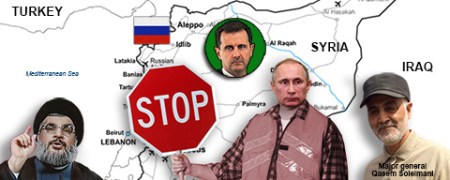
putinstopsyriaeng480

The ban came from Moscow to prevent military reprisals against the Putin-Trump deal for Syria.

Iran can no longer doubt that the two powers, America and Russia, have ganged up to push the Islamic Republic out of their way. Trepidation in Tehran was articulated on Monday, Jan. 30, at a convention staged in the Iranian capital to celebrate 515 years of Iranian-Russian relations, an anniversary that would not normally be marked by a special event.

****************************

An order to remain stationary was issued Thursday night, Jan. 26, by the Russian Commander in Syria Lt. Gen. Alexander Zhuravlev to the high commands of the Syrian army and of the Iranian and Shiite forces positioned in Aleppo, as well as Hizballah units in all parts of Syria. Gen. Zhuravlev, acting on instructions from Moscow, prohibited any movement by those forces out of their current positions as of noon local time.

DEBKAfile’s military and intelligence sources report that the order banned the opening of new battlefronts anywhere in Syria and the movement of Syrian air force units between bases.

This order has been obeyed to date.

The ban came from Moscow to prevent military reprisals against the Putin-Trump deal for Syria. There was no mention of penalties for disobedience, but the tone was peremptory. The three army commanders did not need reminding that the Russians are capable of using their electronic warfare systems to disrupt unauthorized military movements, jam their communications, and withhold fuel, ammo and spare parts to create havoc in their armies.

lieutenant_general_alexander_zhuravlev_120Russian Lt. Gen. General Alexander Zhuravlev

Moscow has never resorted to extreme action of this kind in previous Russian military interventions in Middle East lands.

The decision was taken shortly after the Kremlin was notified that US President Donald Trump had agreed to join forces with President Vladimir Putin in Syria.

Since then, the Trump administration has kept all dealings with Moscow over Syria under a cloak of secrecy, including the outcome of President Trump’s first phone conversation with his Russian counterpart Vladimir Putin. All other concerned parties, such as Israel, have been left groping in the dark about what happens next.

The Russian standstill order in Syria came shortly before the US presidential decree that barred Iranians from entering the United States (along with the nationals of six other terror-prone Muslim countries)

Iran can no longer doubt that the two powers, America and Russia, have ganged up to push the Islamic Republic out of their way. Trepidation in Tehran was articulated on Monday, Jan. 30, at a convention staged in the Iranian capital to celebrate 515 years of Iranian-Russian relations, an anniversary that would not normally be marked by a special event.

In his opening remarks, Foreign Minster Mohammed Zarif Javad said: that Iran and Russia “need to have far more extensive relations,” and “few countries in the world have relations as deep and historical as Iran and Russia.” This sounded like an appeal to Moscow for protection against the new US president. It most likely fell on deaf ears. Putin is fully engaged in promoting his new relations with Donald Trump.

Trump-Putin deal on Syria bears on Israel security

January 28, 2017

Trump-Putin deal on Syria bears on Israel security, DEBKAfile, January 28, 2017

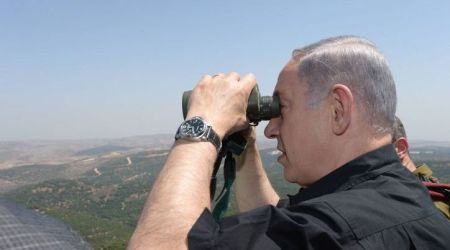
Israeli Prime Minister Benjamin Netanyahu looks through binoculars during his visit in the Northern district border of Israel on August 18, 2015. Photo by Amos Ben Gershom/GPO *** Local Caption *** ???? ??? ?????? ?????? ?????? ?????? ????? ????? ???? ????

Israeli Prime Minister Benjamin Netanyahu looks through binoculars during his visit in the Northern district border of Israel on August 18, 2015. Photo by Amos Ben Gershom/GPO

1. Will Washington and Moscow go through with the expulsion from Syria of Iranian forces and their proxies, including Hizballah – and take it all the way until it is accomplished?

2. After they are gone, who will take over the areas they evacuate?

3. Will Bashar Assad stay on as president, or has his successor been nominated?

4. The most burning question of all is the level of Hizballah’s armament. Not only must Hizballah forces be pushed out of Syria, but it is essential to strip them of their sophisticated new weaponry, including missiles. Israel’s military and security chiefs assess Hizballah’s arsenal as having been upgraded in recent weeks to a level that directly impinges on Israel’s security.

**************************

It would be a mistake to take it for granted that Prime Minister Binyamin Netanyahu’s talks with President Donald Trump in Washington early next month will be plain sailing or produce an automatic shower of benefits for the Jewish state. It is understood in Jerusalem that a new order is unfolding close to Israel’s borders, which is not yet fully in the sights of its government, military and intelligence leaders. This process is going forward at dizzying speed in Syria, currently the central Middle East arena, where Presidents Donald Trump, Vladimir Putin and Tayyip Erdogan have agreed to cooperate.

The British Prime Minister Theresa May picked up fast on the new power equation. After standing before the media with the US President Friday, Jan. 27, and declaring hopefully, “Britain and the US can once again lead the world together,” she decided to fly straight from Washington to Ankara Saturday, before returning home.

The outcome of her first meeting with President Erdogan was one of the fastest defense collaboration pacts ever negotiated for trade and the war on terror. The British leader lost no time in getting down to brass tacks on how British military and intelligence can be integrated in the joint US-Russian-Turkish military steps for Syria. Erdogan did not exactly receive her with open arms. He did not afford his visitor the courtesy of placing a British flag in the reception room in his palace.

Israel is in much the same position. Israel stayed out of military involvement in the Syrian civil war, according to a policy led by Netanyahu, former Defense Minister Moshe Ya’alon and OC Northern Command Maj. Gen. Avivi Kochavi (then Direct of Military Intelligence). This policy has left Israel out of today’s decision-making loop on Syria’s future.

Towards the end of 2015, shortly after Russia embarked on its massive military intervention in the Syrian conflict, Netanyahu took steps for safeguarding Israel’s security interests by setting up a direct line with the Russian president. It was translated into a military coordination mechanism between the Russian air force command in Syria and the Israeli air force, with Gen. Valery Gerasimov, Russia’s Chief of General Staff, and Maj. Gen. Yair Golan, Israel’s Deputy Chief of Staff, in charge of this direct military link.

Any problems that could not be solved at the military level were promptly turned over to be addressed at meetings or in phone calls between Netanyahu and Putin.

In one example, the prime minister obtained an undertaking from the Russian president to keep Iranian forces and Iran’s Shiite surrogates, including the Lebanese Hizballah, away from the Syrian-Israeli border, or allow them to use borderlands to send terrorists into Israel.

Shortly after Trump’s election victory (Nov. 8, 2016), the spadework on his collaboration with Putin was quietly begun by their national security advisers, Michael Flynn, in New York and Nikiolai Platonovich Patrushev in Moscow.

Jerusalem knew what was going on, but was taken aback by the speed at which those close understandings ripened into US-Russian deals on the ground. Before Trump had finished his first week in the White House, US warplanes had escorted a Russian air strike against ISIS in Syria.

This rush of events injects further urgency into Netanyahu forthcoming talks with the US president.  Whereas in the second term of the Obama presidency, the Israeli leader was wont to travel to Moscow or Sochi to sort out security problems relating to Syria, henceforth he must directly engage Donald Trump as the lead player.

So when the Israeli premier travels to the White House next month, he will have to address four pressing concerns, all relating to the fast-moving Syrian scene:

1. Will Washington and Moscow go through with the expulsion from Syria of Iranian forces and their proxies, including Hizballah – and take it all the way until it is accomplished?

2. After they are gone, who will take over the areas they evacuate?

3. Will Bashar Assad stay on as president, or has his successor been nominated?

4. The most burning question of all is the level of Hizballah’s armament. Not only must Hizballah forces be pushed out of Syria, but it is essential to strip them of their sophisticated new weaponry, including missiles. Israel’s military and security chiefs assess Hizballah’s arsenal as having been upgraded in recent weeks to a level that directly impinges on Israel’s security.

Trump-Putin safe zones deal ousts Iran from Syria

January 26, 2017

Trump-Putin safe zones deal ousts Iran from Syria, DEBKAfile, January 26, 2017

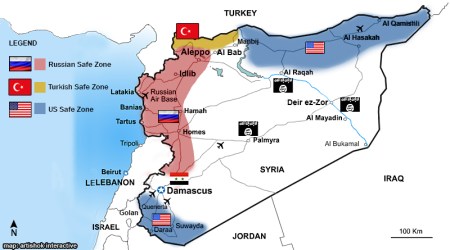
syria_safezones

Russia had originally planned to deploy Syrian military, pro-Iranian Shiite militia and Hizballah forces in battles for the capture of land around the cities of Derra and Quneitra on the Syrian side of the Golan. That plan has been dropped and will be superseded by the deployment in southern Syria of US troops accompanied by Jordanian special forces and Syrian rebels, trained by American instructors in Jordanian military camps.

Israelis will breathe a sigh of relief over the removal of the threat of Iranian and Hizballah forces being deployed along their northern border with Syria.

**************************

Syria stands on the threshold of dramatic changes that will directly impact on the strategic and military situation along the Syrian borders with Israel and Jordan, DEBKAfile reports exclusively. They derive from a deal struck this week by US President Donald Trump and Russian President Vladimir Putin to establish US, Russian and Turkish security zones in Syria. This scheme will transfer military control of the country to those three powers. Each of them will be responsible for a zone whose borders will be defined and agreed upon by Washington, Moscow  and Ankara.

As part of this arrangement, all forces from the Iranian military, the pro-Iranian Shiite militias and Hizballah will be required to leave Syria.

The US military is to have two security zones – one covering the entire area east of the Euphrates River up to the Iraqi border including Kurdish areas (see attached map). This arrangement will partly resurrect the accord reached in late 2015 by US President Barack Obama and Putin, for the division of Syria into areas of influence. All territory east of the Euphrates was allocated to the US, with Russia taking responsibility for all areas west of the river until the Mediterranean coast.

Under the new deal, the Turkish area is to stretch about 650 kilometers along the entire Syria-Turkey border and extend between 35 and 50 kilometers into Syrian territory up to Al-Bab, the town where the Turkish military is engaged in its third straight month of fighting for its capture from ISIS.

DEBKAfile’s military and intelligence sources report that the overriding change on the ground will be the establishment of a second US security zone adjacent to Syria’s borders with Israel and Jordan. It means that the approximately 7,500 US special operations forces troops currently in Jordan will be shifted northward into southern Syria.

Russia had originally planned to deploy Syrian military, pro-Iranian Shiite militia and Hizballah forces in battles for the capture of land around the cities of Derra and Quneitra on the Syrian side of the Golan. That plan has been dropped and will be superseded by the deployment in southern Syria of US troops accompanied by Jordanian special forces and Syrian rebels, trained by American instructors in Jordanian military camps.

Israelis will breathe a sigh of relief over the removal of the threat of Iranian and Hizballah forces being deployed along their northern border with Syria.

The Trump-Putin deal for Syria and its ramifications are explored in the coming issue of DEBKA Weekly (for subscribers) out Friday, with especially attention to the way it leaves Iran and Hizballah high and dry.

If you are not yet a subscriber, click here to sign on.