Posted tagged ‘Iran Scam’

Thumbing nose at US, Iran unveils depot for nuclear-capable missiles

January 5, 2016

Thumbing nose at US, Iran unveils depot for nuclear-capable missiles, DEBKAfile, January 5, 2016

In clear defiance of the Obama administration, Iran revealed on Tuesday a second underground facility for storing ballistic missiles capable of carrying nuclear warheads.

In a one-minute video shown on Iranian state-run television,  Ali Larijiani, speaker of Iran’s parliament, was shown inspecting the depot of “Emad” ballistic missiles along with officers from Iran’s Revolutionary Guard Corps.

DEBKAfile military sources: The Emad, which has a 750-kilogram warhead and a range of 1,700 kilometers, is capable of striking any point in Israel. Iran carried out a successful test of the missile four months ago, in October 2015.

Washington announced that the test was a violation of the nuclear agreement between Iran and Western powers. Tehran replied that it never agreed in any stage of the negotiations to limit its missile program in the framework of the agreement.

At the end of December, the Obama administration announced that it was weighing the possibility of imposing fresh sanctions on Iran following the launch of the missile. Several days later, however, Washington withdrew the plan after Tehran threatened that it would view the imposition of new sanctions as a breach of the nuclear agreement.

On Tuesday, Iran not only said it will continue to develop the Emad, but claimed the weapon is already in operational use by the Revolutionary Guard Corps.

Iran Deal Backers Embarrassed By Obama Admin’s Sanctions Blunder

January 4, 2016

Iran Deal Backers Embarrassed By Obama Admin’s Sanctions Blunder, Washington Free Beacon, January 4, 2016

Hassan Rouhani

A last minute delay last week in the implementation of new Iran sanctions has some prominent congressional backers of the nuclear deal accusing the Obama administration of capitulating to Iranian demands, according to sources both on and off Capitol Hill.

Senior Obama administration officials at the White House’s National Security Council told Congress Wednesday morning that new sanctions were coming as a result of Iran’s repeated ballistic missile tests, which violate current United Nations Security Council Resolutions prohibiting such activity.

However, the administration quietly walked back its announcement, telling lawmakers that the sanctions would be indefinitely delayed.

The move sparked a fierce backlash among prominent congressional leaders who have served as chief advocates for the administration’s efforts to ink a nuclear deal with Iran.

Sources who spoke to the Washington Free Beacon about the delay claim that the administration has repeatedly allowed Iran to dictate the terms of the deal out of fear that the Islamic Republic will ditch the deal before it is officially implemented later this month.

Iranian leaders have made clear that any new U.S. sanctions will force it to walk away from the nuclear agreement. In the wake of the new sanctions debate, Iranian military leaders announced over the weekend they are working to increase the strength and destructive power of the country’s arsenal.

The White House’s initial message to Congress on Wednesday morning offered tough rhetoric chastising Iran’s ballistic missile program and its recent test firings.

“Iran’s ballistic missile program poses a significant threat to regional and global security, and it will continue to be subject to international sanctions,” Adam Szubin, the Treasury Department’s acting under secretary for terrorism and financial intelligence, said in an embargoed statement that was forwarded to congressional offices that morning and viewed by the Free Beacon.

“We have consistently made clear that the United States will vigorously press sanctions against Iranian activities outside of the Joint Comprehensive Plan of Action—including those related to Iran’s support for terrorism, regional destabilization, human rights abuses, and ballistic missile program,” Szubin maintained in the statement, which was later scrapped.

Hours after that initial communication was sent to the Hill, the administration nixed the announcement, saying in a subsequent communication that the new sanctions—which were to hit 11 entities and individuals known to be enabling Iran’s missile program—would be indefinitely delayed.

Lawmakers who just that morning had applauded the new sanctions were not pleased.

Rep. Steny Hoyer (D., Md.), a leading supporter of the Iran deal, blasted the move, expressing disappointment with the administration’s efforts to appease Iran.

“I am disappointed that the Administration has delayed punitive action in response to Iran’s recent ballistic missile tests,” Hoyer said in a statement. “We are always in a sensitive moment in our dealings with Iran, and there is never a perfect time to undertake such actions. But Iran must know with certainty that violating U.N. Security Council resolutions, both inside and outside the scope of the Joint Comprehensive Plan of Action (JCPOA), will be met with serious consequences.”

Sen. Chris Coons (D., Del.), another leading deal supporter who initially praised the new sanctions, also expressed dismay at the administration’s move to delay the effort.

“I believe in the power of vigorous enforcement that pushes back on Iran’s bad behavior,” Coons told the Wall Street Journal. “If we don’t do that, we invite Iran to cheat.”

When asked to address the issue on Sunday, a senior Obama administration official told the Free Beacon that there are still “remaining issues” that need to be addressed before new sanctions are announced.

“As we’ve said, we’ve been looking for some time‎ at options for additional actions related to Iran’s ballistic missile program based on our continued concerns about its activities, including the October 10th launch,” the senior official explained, reiterating the White House’s commitment to sanctions.

“We are considering various aspects related to additional designations, as well as evolving diplomatic work that is consistent with our national security interests,” the official said. “As always, we keep Congress informed about issues related to Iran sanctions, and will continue to do so as we work through remaining issues.”

A State Department spokesman echoed this stance, telling the Free Beacon that it continues to explore ways to increase sanctions on Iran’s ballistic missile program.

Sanctions expert Mark Dubowitz, executive director of the Foundation for Defense of Democracies, told the Free Beacon that the administration might reconsider new sanctions once it strikes a “side deal” with Iran.

“I would expect that the administration will return to these sanctions after cutting some kind of side deal with the Iranians offering even more unilateral concessions,” Dubowitz said.

Critics of the move remain skeptical.

“To push back against Iran’s repeated missile and human rights provocations, Congress should pass the Menendez-Kirk bill to immediately renew a critical Iran sanctions law that expires this year,” said Sen. Mark Kirk (R., Ill.), an opponent of the Iran nuclear deal.

One consultant who has worked with Congress on issues pertaining to the nuclear deal told the Free Beacon that the administration fears Iran’s threats to break the deal.

“First the Obama administration strong-armed congressional Democrats into approving a politically toxic nuclear deal, under the pretense that at least the White House would fight Iranian aggression in other ways,” the source said, explaining that lawmakers who have defended the deal were made to look foolish by the sanctions delay.

“People like Coons and Hoyer went home and told constituents that they’d at least make sure Iranian terrorism and missile work was punished,” the source said. “Now the Obama team has deprived them of even that fig leaf. They’re going to have to defend total capitulation to their constituents.”

Meanwhile, Iran announced on Friday that it is working to significantly boost “the destruction power and precision” of its missiles, according to comments carried in the country’s state-controlled press.

Iran President Hassan Rouhani instructed the country’s military leaders to strengthen the missile program following rumors that the United States was contemplating new sanctions.

“Following [on] the president’s letter, we held numerous meetings with the executive officials, commanders, and officials in the missile sector and decided work out appropriate plans as soon as possible to enhance the defensive power and capability as well as the effective deterrence power of our missiles contrary to the will of the hegemonic system which seeks to restrict the Islamic Republic militarily,” Hossein Dehqan, Iran’s defense minister, said.
Middle East Fires Blaze Hotter Following U.S. Capitulation to Iran

January 4, 2016

Middle East Fires Blaze Hotter Following U.S. Capitulation to Iran, Power LinePaul Mirengoff, January 4, 2016

In a post about the Saudi Arabia/Iran crisis — the Saudi beheading of a Shiite cleric; the Iranian burning of the Saudi embassy — John asked, “the Middle East couldn’t possibly get worse, could it?” At NRO’s Corner, David French examines the crisis and concludes “in the Middle East things can always get worse.”

Things have indeed gotten worse under President Obama. They got worse when Obama withdrew from Iraq and they are getting even worse following his nuclear deal with Iran, an abject capitulation by the U.S.

French explains:

For months, the Saudis have watched with alarm as the Iranians have engaged in the Mideast equivalent of an extended touchdown dance following the conclusion of the so-called nuclear “deal” with the U.S. The Saudis’ chief regional enemy is set to receive a massive economic infusion, access to international arms markets, and permission to further develop its ballistic missile capabilities.

The Iranians have celebrated by reaffirming their support for Shiite terrorists, conducting missile tests in defiance of the U.N., and — most recently — firing a rocket within two kilometers of an American aircraft carrier. In the meantime, the emerging Iran/Iraq/Sryia alliance received a considerable boost in the form of direct Russian intervention on behalf of the Assad regime.

While the U.S. has been largely impotent, the Saudis have responded by forming a multinational alliance to counter Iran (under the laughable pretense of “fighting terror”) and launching an intense air and ground campaign against Iranian-backed Shiite rebels in Yemen. Saudi Arabia’s execution of Shiite Sheikh Nimr Baqr al-Nimr is an act of pure defiance. Iran’s response — permitting a “mob” to burn the Saudi embassy — demonstrated its own lack of regard for the House of Saud.

What’s the lesson?

Nothing is easy or simple in the Middle East, but we can be certain of two things: Power vacuums will always be filled, and things can always get worse.

American passivity has left an enormous power vacuum in the region, and the Iranians and Saudis are rushing to fill the void. The Iranians are our sworn enemies, and the Saudis are among the worst of “friends.” It’s hard to see how the continued aggressive emergence of either regional power advances American national interests, and a direct clash could have dramatic consequences for the world economy.

The Middle East has long been on fire with violence and instability. This weekend, the fire blazed hotter still.

Walter Russell Mead expands on the connection between Obama’s Iran deal and the Saudi/Iran crisis:

The. . .story on Saudi Arabia’s decision to break diplomatic relations with Iran over the destruction of the Saudi embassy in Tehran, read[s] like an epitaph for the Obama administration’s Middle East policy. In 2015, the central conviction of President Obama’s policy in the Middle East, the only element of his original, ambitious agenda (reconciliation with the Sunni world, promotion of moderate Islamist democracy, solving the Israel-Palestine issue) still standing, was that he could stabilize the Middle East by pursuing a nuclear deal with Iran.

The President has his nuclear deal, but so far it isn’t making him, or anybody else, happy. The perceived U.S. tilt toward Iran has inflamed Sunni jihadis, contributed to the meltdown in Syria, and has made regional sectarian conflict hotter and more dangerous than ever. What’s more, the U.S. has lost leverage over Saudi Arabia, Turkey, Egypt, and Israel—without gaining leverage over Iran.

As a result, the U.S. is both less able to persuade the Sunni powers to refrain from steps that could inflame regional conflict and is completely unable to persuade the Iranians to moderate their behavior in the interest of regional peace.

Like John, I find it difficult to reconcile Obama’s policies with a good faith intention to pursue peace in the Middle East or to advance the national security interests of the United States.

The Mullahs Thank Mr. Obama

January 3, 2016

The Mullahs Thank Mr. Obama, Power LineScott Johnson, January 3, 2016

The American people should know that we have sustained a defeat without a war, the consequences of which will travel far with us along our road.

******************

Yesterday’s Wall Street Journal carries an incisive editorial (“The mullahs thank Mr. Obama,” accessible here via Google) on developments with the Islamic Republic of Iran. Every step along the way, Iran proves itself the mortal enemy of the United States, and yet President Obama thinks otherwise.

Iranian intentions are clear. Their actions comport with their announced view of the world. When the mullahs chant “Death to America,” we have no ground for believing they don’t mean it. No ground, that is, other than wishful thinking.

As John put it, it is difficult to reconcile Obama administration policies strengthening the Iranian regime with a good faith intention to pursue peace in the Middle East or to advance the national security interests of the United States. We can only infer that Obama’s highly ideologized view of the world is immune to experience.

The Journal’s editorial provides this handy summary of current complexities:

The U.S. and United Nations both say Iran is already violating U.N. resolutions that bar Iran from testing ballistic missiles. Iran has conducted two ballistic-missile tests since the nuclear deal was signed in July, most recently in November. The missiles seem capable of delivering nuclear weapons with relatively small design changes.

The White House initially downplayed the missile tests, but this week it did an odd flip-flop on whether to impose new sanctions in response. On Wednesday it informed Congress that it would target a handful of Iranian companies and individuals responsible for the ballistic-missile program. Then it later said it would delay announcing the sanctions, which are barely a diplomatic rebuke in any case, much less a serious response to an arms-control violation.

Under the nuclear accord, Iran will soon receive $100 billion in unfrozen assets as well as the ability to court investors who are already streaming to Tehran. Sanctioning a few names is feckless by comparison, and Iran is denouncing even this meager action as a U.S. violation of the nuclear deal. Iranian President Hassan Rouhani responded to the sanctions reports on Thursday by ordering his defense minister to accelerate Iran’s missile program. Your move, Mr. Obama.

Opponents of the nuclear accord predicted this. Mr. Obama says the deal restricts Iranian action, but it does far more to restrict the ability of the U.S. to respond to Iranian aggression. If the U.S. takes tough action in response to Iran’s missile tests or other military provocations, Iran can threaten to stop abiding by the nuclear deal. It knows the world has no appetite for restoring serious sanctions, and that Mr. Obama will never admit his deal is failing. The mullahs view the accord as a license to become more militarily aggressive.

Further proof came Wednesday when U.S. Central Command acknowledged that Iranian Revolutionary Guard vessels last week fired several rockets that landed within 1,500 yards of the aircraft carrier Harry S. Truman. A Revolutionary Guard spokesman Thursday denied the incident but a day earlier the semiofficial Tabnak news agency quoted an unnamed Iranian official as saying the rockets were launched to warn the U.S. Navy away from “a forbidden zone” in the Persian Gulf.

The Strait of Hormuz is one of the world’s most heavily trafficked waterways, and the USS Truman carrier group has every right to sail there. By any measure the rocket launch was a hostile act that could have resulted in American casualties.

This follows Iran’s arrest in October of Iranian-American businessman Siamak Namazi, who according to Iranian media reports is being held in Evin Prison though no charges have been filed. The reports suggest that Mr. Namazi is suspected of spying because he is one of the World Economic Forum’s “Young Global Leaders.” That’s the dangerous outfit that sponsors the annual gabfest in Davos.

Iran has also shown its gratitude for the nuclear deal by convicting Washington Post reporter Jason Rezaian on absurd charges of espionage. The Iranian-American has been held for more than 500 days.

The White House’s media allies are blaming all of this on Iranian “hard-liners” who are supposedly trying to undermine President Rouhani for having negotiated the nuclear deal. Memo to these amateur Tehranologists: The hard-liners run Iran.

The American people should know that we have sustained a defeat without a war, the consequences of which will travel far with us along our road.

Deputy National Security Adviser Ben Rhodes renders his deep thoughts via Twitter (below).

In the annals of inanity, this is Hall of Fame material.

The Iran deal will be implemented. The United States has an Embassy in Havana. .


One day later: Obama backs off new Iran sanctions

January 1, 2016

One day later: Obama backs off new Iran sanctions, Israel National News, Elad Benari, January 1, 2016

(Please see also, Possible New US Sanctions against Iran “Illegal”, Says Spokesman and Rpt: U.S. Preparing New Sanctions On Iran After Rocket Test – America’s Newsroom. — DM)

Pussy ObamaPresident Barack Obama

New American sanctions on Iran over its ballistic missile program? Not so fast.

The White House has delayed its plan to impose new financial sanctions on Iran for its ballistic missile program, American officials said Thursday, according to The Wall Street Journal.

The announcement comes just one day after it was reported that the Obama administration is preparing new sanctions on international companies and individuals who played a role in Iran’s ballistic endeavors.

According to the officials, the decision to back off the new sanctions comes amid growing tensions with Iran over the nuclear deal struck earlier this year.

The officials said the Obama administration remains committed to combating Iran’s missile program and that sanctions being developed by the U.S. Treasury Department remain on the table. They also said imposing such penalties was legal under the landmark nuclear agreement forged between global powers and Iran in July.

But they offered no definitive timeline for when the sanctions would be imposed after the decision was made to delay them. At one point, they were scheduled to be announced Wednesday morning in Washington, according to a notification the White House sent to Congress.

In October, Iran conducted a ballistic missile test, eliciting strong condemnation from members of the UN Security Council.

A month later, it tested another ballistic missile, and an American official said other undeclared tests occurred earlier than that.

A team of UN sanctions monitors said in a confidential report seen byReuters on December 15 that a medium-range Emad rocket that Iran tested on October 10 was a ballistic missile capable of delivering a nuclear warhead, making it a violation of a UN Security Council resolution.

Iran, however, has rejected claims that the missiles it is testing are capable of delivering a nuclear warhead and has also rejected the idea that the missile tests are against UN resolutions.

Republican leaders on Thursday accused the Obama administration of losing its will to impose the sanctions, after Tehran countered on Thursday that it would accelerate the development of its arsenal.

“If the president’s announced sanctions ultimately aren’t executed, it would demonstrate a level of fecklessness that even the president hasn’t shown before,” said Rep. Mike Pompeo (R-KS), a leading critic of the nuclear deal, according to The Wall Street Journal.

President Hassan Rouhani had earlier said on Twitter that he had instructed Iran’s Ministry of Defense to accelerate the development of ballistic missiles in response to the news reports of the impending U.S. sanctions.

Asked to comment, State Department spokesman John Kirby said the timeline for missile-related sanctions was unrelated to threats made by Iran on Thursday and the broader nuclear deal recently reached with Tehran.

The State Department offered no explanation for the delay, noted The Wall Street Journal.

“We’ve been clear from the outset that—outside the parameters of Iran’s nuclear program—we would continue to take appropriate actions to address Tehran’s destabilizing behavior,” said Kirby.

Rpt: U.S. Preparing New Sanctions On Iran After Rocket Test – America’s Newsroom

December 31, 2015

Rpt: U.S. Preparing New Sanctions On Iran After Rocket Test – America’s Newsroom, Fox News via You Tube, December 31, 2015

(Please see also, Possible New US Sanctions against Iran “Illegal”, Says Spokesman. — DM)


Possible New US Sanctions against Iran “Illegal”, Says Spokesman

December 31, 2015

Possible New US Sanctions against Iran “Illegal”, Says Spokesman, Tasnim News Agency, December 31, 2015

Tasnim img

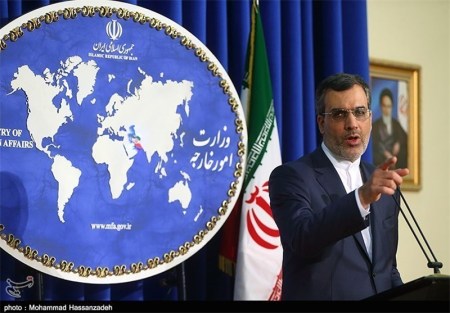
TEHRAN (Tasnim) – Iranian Foreign Ministry Spokesman Hossein Jaberi Ansari on Thursday lashed out at the new sanctions the US administration is preparing to impose on Iran, saying Tehran has already warned Washington against such unilateral and illegal moves.

“Such measures are unilateral, arbitrary, and illegal, and the Islamic Republic of Iran has already warned the US administration (against such moves),” Jaberi Ansari stressed.

He made the remarks in reaction to recent reports that the Obama administration is preparing to impose its first financial sanctions on Iran since Tehran and six world powers, including the US, reached a landmark nuclear agreement in July.

“As they themselves have already announced, Iran’s missile program has nothing to do with the JCPOA (the nuclear deal), and nothing could deprive the Islamic Republic of Iran from its legitimate and legal rights to reinforce its defense power and national security,” he asserted.

Therefore, Jaberi Ansari went on to say, Iran will maintain its attempts to improve its defense power in reaction to any US interference against the Islamic Republic’s defense programs.

Iran in October successfully test-fired a homegrown ballistic missile dubbed ‘Emad’, a long-range guided projectile that can hit targets with high precision.

Using the missile test as a pretext, US officials announced on Wednesday that the Treasury Department will put in the blacklist nearly a dozen companies and individuals in Iran, Hong Kong and the United Arab Emirates for their alleged role in developing Iran’s ballistic-missile program.

Tehran has denied that the missile launch was in violation of UN resolutions, with Foreign Minister Mohammad Javad Zarif saying that it was not designed to carry nuclear warheads.

Iran’s test of missiles is an issue relating to defense of its territorial integrity and has nothing to do with the comprehensive nuclear deal between Tehran and world powers or with a subsequent resolution the UNSC passed to endorse the accord, Iran’s foreign minister underscored in October.

Reassuring, not challenging, Iran

December 25, 2015

Reassuring, not challenging, Iran, Israel Hayom, Elliott Abrams, December 25, 2015

Since the signing of the nuclear deal with Islamic Republic of Iran, that government has ‎treated the Obama administration with contempt. U.S. officials might have hoped Iran’s ‎conduct would improve, but it has worsened. Iran sent more Revolutionary Guard troops to ‎fight in Syria, for example; it conducted two ballistic missile tests in violation of a Security ‎Council resolution; leaders continue to chant “Death to America”; and it has imprisoned ‎more Americans.

What is the Obama administration’s response? To beg their pardon.‎

I refer to a remarkable letter sent by Secretary of State John Kerry to Iranian Foreign Minister Mohammad Javad ‎Zarif. Iran, in an additional gesture of contempt, has complained about new United States ‎visa requirements placed on persons who have traveled to Iran (or Iraq, Sudan, or Syria). ‎These requirements were recently added so that people who had visited those countries ‎could not come to the United States without getting a visa even if they were from countries ‎that are part of the “visa waiver” program. The obvious purpose: to avoid having terrorists ‎get to the United States through a program that allows them to avoid the visa application ‎process and the information it would supply.‎

Iran has complained that “Zionist lobbyists” put the new rules in place, a good reminder of ‎the nature of the regime.‎

How did the United States react? By denouncing the Iranian attacks on “Zionist lobbyists,” ‎which came from the spokesman for the Foreign Ministry? By noting that Iran is the world’s ‎worst state sponsor of terrorism? By recalling the fact that Iran just violated U.N. Security ‎Council resolutions, and continues to jail innocent American citizens?‎

Nope. By offering reassurance that we certainly do not mean to disadvantage Iran in any ‎possible way. Here is the text of Kerry’s letter:‎

“December 19, 2015‎

“His Excellency Mohammad Javad Zarif

“Minister of Foreign Affairs of the Islamic Republic of Iran Tehran

“Dear Mr. Minister:‎

“Thanks for a constructive meeting yesterday. I wanted to get back to you in response to your ‎inquiry about amendments to our Visa Waiver Program. First, I want to confirm to you that ‎we remain fully committed to the sanctions lifting provided for under the JCPOA. We will ‎adhere to the full measure of our commitments, per the agreement. Our team is working ‎hard to be prepared and as soon as we reach implementation day we will lift appropriate ‎sanctions.‎

“I am also confident that the recent changes in visa requirements passed in Congress, which ‎the Administration has the authority to waive, will not in any way prevent us from meeting ‎our JCPOA commitments, and that we will implement them so as not to interfere with ‎legitimate business interests of Iran. To this end, we have a number of potential tools ‎available to us, including multiple entry 10-year business visas, programs for expediting ‎business visas, and the waiver authority provided under the new legislation. I am happy to ‎discuss this further and provide any additional clarification.‎

“Secretary of State John Kerry”

Let’s put aside the thanks to Zarif for a “constructive meeting.” We can be sure that Zarif ‎was advancing Iranian national interests, and for doing that, he deserves no thanks from us. ‎The tone of the letter would be fine were it addressed to the foreign minister of Canada. ‎Must we really assure the representative of this vile, repressive regime that regardless of its ‎behavior, we will bend over backward and use every tool possible (“we have a number of potential tools ‎available to us, including multiple entry 10-year business visas, programs for expediting ‎business visas, and the waiver authority provided under the new legislation”) to ‎defend and advance its “legitimate business interests?”‎

Here’s one of many possible alternative formulations: The ability and willingness of the ‎United States government to use the tools at its disposal will depend on the treatment Iran ‎accords American citizens whom it has unjustly detained and imprisoned. Kerry seems ‎more worried about offending Iran than freeing those Americans — whose imprisonment was ‎an issue set aside during the nuclear negotiations. Must we set it aside forever as we ‎protect Iran’s “legitimate business interests”‎?

Iran Warns US of Decision to Seize Assets

December 25, 2015

Iran Warns US of Decision to Seize Assets, Tasnim News Agency, December 25, 2015

(Please see also, Obama’s $150 Billion ‘Signing Bonus’ To Iran Hits Legal Snag. — DM)

Iran money

TEHRAN (Tasnim) – Iran’s Foreign Ministry spokesman warned of any move to confiscate the country’s assets in the US banks under “invalid and unlawful” court rulings, stressing that the US administration will be accountable for that possible decision and will have to pay compensation.

“If the assets belonging to the Islamic Republic of Iran, its organizations and nationals are seized, the US administration will be responsible to make up for the losses and pay compensation,” Hossein Jaberi Ansari said on Thursday.

He made the comments in reaction to reports that the US Supreme Court is considering a case to confiscate the Iranian Central Bank’s assets in the US to pay the American victims of terrorist attacks allegedly linked to the Iranian government.

The US House of Representatives is now weighing in on a pending case that accuses Iran of links with the 1983 bombing of the Marine barracks in Beirut and the 1996 bombing of the Khobar Towers in Saudi Arabia.

The US lawmakers are trying to force Iran’s Central Bank to pay damages to over 1,300 American plaintiffs. In 2008, the victims discovered that Iran’s Central Bank had almost $2 billion stored in Citibank accounts in New York. The victims sued for that money, and the litigation has now reached the Supreme Court.

Elsewhere in his comments, Jaberi Ansari said such efforts to block Iran’s assets show that the US hostility towards Iran continues to persist under pressure from the Zionist lobbies.

He also lashed out at the US judicial system for “violating the basics of the international law and resorting to bogus and baseless accusations” to deliver verdicts against Iran.

The new attempts at the US Supreme Court “contradict the inalienable international law and lack any legal validity,” the spokesman added.

Jaberi Ansari said the accusations against Iran come while those terrorist attacks have been committed by citizens of certain US allies.

“The US administration has proved that its hostile measures against Iran are in place with the influence of the Zionist lobbies and without care for the realities,” the spokesman underlined.

He further took a swipe at the US for its inaction to get advantage of the current circumstances and try to repair the Iranian nation’s deep distrust.

Earlier in November, Supreme Leader of the Islamic Revolution Ayatollah Seyed Ali Khamenei underscored that there has been no slackening off in US hostility towards Iran.

Imam Khamenei stressed that the US antagonistic attitude towards Iran has not changed a bit, but there are attempts to whitewash the issue.

Critics Blasting Kerry For Suggesting Iran Could Bypass Visa Restrictions – Cavuto

December 23, 2015

Critics Blasting Kerry For Suggesting Iran Could Bypass Visa Restrictions – Cavuto, Fox News via You Tube, December 22, 2015