Posted tagged ‘Iran sanctions’

Nikki Haley’s Comments on Iran Highlight Russian-Related Complications

June 29, 2017

Nikki Haley’s Comments on Iran Highlight Russian-Related Complications, Iran News Update, Edward Carney, June 29, 2017
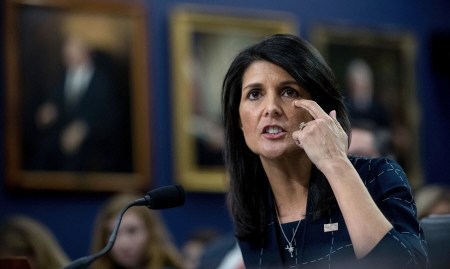
On Tuesday, Nikki Haley, the US ambassador to the United Nations delivered testimony to the House panel on foreign operations, a subcommittee of the Appropriations Committee in the US House of Representatives. In that testimony, Haley addressed multiple issues relating to the Islamic Republic of Iran, thereby reasserting the Trump administration’s assertive policies toward the Iranian regime. By most accounts those policies are still emerging, but they have already come to include purposive outreach to other adversaries of the Islamic Republic and a program of expanded sanctions on matters such as Iran’s ballistic missile program.

However, those efforts to confront and contain the Islamic Republic are arguably complicated by other aspects of the Trump administration’s policy commitments, including a focus on domestic issues and an effort to improve relations between the US and Russia, which boasts close relations with Iran in the areas of trade and military cooperation, especially as it relates to the Syrian Civil War.

While the US supports moderate rebel groups fighting against the dictatorship of Bashar al-Assad, the Iranians and Russians have been credited with turning the war in favor of Assad. Various Shiite militias are currently operating as proxies for Iran in that war, and the Iranian Revolutionary Guard Corps is increasingly playing a direct role in the conflict. Meanwhile, Russia has been providing air support for pro-Assad ground operations since 2015.

Western commentators, including officials in the Trump administration, have variously accused Russia and Iran of ignoring or actively facilitating human rights abuses by the Assad regime, including an April chemical weapons attack that killed at least 80 people in a rebel-controlled civilian area.

As the Associated Press points out, Ambassador Haley’s comments to the House panel came shortly after the White House had issued a warning to Syria regarding alleged preparations for another such chemical attack. The article specified that Pentagon officials had confirmed the intelligence underlying that warning, involving particular movements at the same Syrian air base that had been used as the staging area for the previous chemical attack on Khan Sheikhoun.

White House Press Secretary Sean Spicer said of Assad that “he and his military will pay a heavy price” if they follow through with apparent plans for another “mass murder attack using chemical weapons.” But the AP quoted Haley as saying that the administration’s remarks were not intended only for Assad, but also for Russia and Iran. Both of the Syrian allies joined in denying Assad’s responsibility for the attacks, with some officials insisting that the chemical weapons had originated in a rebel warehouse at the site of a conventional military airstrike.

The dispute over this issue and the subsequent US cruise missile strike on Shayrat air base can be seen as early examples of the escalation between Iranian allies and adversaries which is still going on to this day. In fact, Haley’s effort to fold Russia and Iran into a warning directed more explicitly against Syria is reminiscent of an incident earlier in June wherein a member of Iran’s Revolutionary Guard said that a ballistic missile strike on eastern Syria had been intended largely as a warning to the US and Saudi Arabia.

Those two traditional adversaries of the Islamic Republic have been expanding relations under the Trump administration, sometimes with explicit reference to shared anxieties over expanding Iranian influence and meddling in the broader Middle East. President Trump’s visit to Riyadh in May for an Arab-US summit coincided with the signing of trade agreements that included 110 billion dollars in arms sales to the Arab Kingdom.

But at the same time that the White House is openly siding with Saudi Arabia and its regional allies against the Iranian regime, it does not appear to be giving up on the prospect of improved relations with Russia. In fact, the Western strategy for a political solution to the Syrian Civil War seems to presently involve the expectation that Russia can be encouraged to rein in the Islamic Republic and prevent it from further sabotaging ceasefire agreements.

Recent developments have cast doubt upon the practicality of this strategy however. As the US has taken a more direct role in defending rebel groups, even resorting to the shoot-down of at least two military controlled drones and a Syrian warplane, Russia has responded by threatening to target US aircraft and to halt the use of a hotline intended to prevent mid-air collisions between the multiple powers operating in the skies over Syria.

Haley’s comments on Tuesday were indicative of a roughly matching increase in American criticism of Russia. And this criticism was not limited to the issue of chemical weapons. Haley also explained that Russia’s position on the UN Security Council allowed it to stymie US efforts to sanctions Iran and hold it to account for ongoing misbehavior in matters including the development of the Iranian nuclear program.

“[The Iranians are] going to continue their nuclear capabilities and we just gave them a lot of money to do it with,” Haley said, referring to the 2015 nuclear agreement that President Trump has described as “the worst deal ever negotiated.” She went on to highlight concerns about Iran’s sponsorship of terrorism, suggesting that nuclear weapons could find their way into the hands of terrorist groups at some point in the future, and that Russia would effectively prevent the US and its allies from doing anything to stop this.

“Yes, we would love to sanction Iran; and, yes we will continue to be loud about it; and, yes, Russia will veto it,” Haley said, according to the Washington Examiner.

But this is not to say that the Trump administration has positively brought an end to its strategy of attempting to improve relations with Russia. In fact, various reports suggest that this endeavor is even standing in the way of congressional legislation aimed at increasing national-level sanctions on both Iran and Russia. The Countering Iran’s Destabilizing Activities Act passed the Senate two weeks ago by a margin of 98 to 2, but it was subsequently stalled in the House on procedural grounds, leading Democrats to argue that the House Republican leadership was trying to protect the president’s Russian agenda.

The prospects for resolution appeared to grow dimmer on Tuesday when the Washington Post reported that energy lobbyists were urging lawmakers to reevaluate the bill on the grounds that its restrictions on doing business with Russian companies could have a punishing effect on American firms and foreign firms doing business in the US. These objections could bolster the prospects of the House leadership sending the bill to various committees for review and markup – a process that could delay a final vote by months.

As it concerns Iran, the bill would include sanctions on Iran’s ballistic missile activities and also extend all terrorism-related sanctions to the Revolutionary Guard Corps, for which Trump has urged designation as a foreign terrorist organization. This position has not changed, and it seems that neither has the Trump administration’s hardline approach to Iran policy. Some have suggested that the emerging policy is pointing in the direction of regime change, though this has not become a declared position as yet.

The Washington Examiner pointed out that one member of the House panel on foreign operations, Republican Representative Hal Rogers, had directly raised the prospect of regime change on Tuesday, asking Nikki Haley whether it is an option. The ambassador’s only response was “I don’t know.”

This coming Saturday, the National Council of Resistance of Iran will hold its annual Free Iran rally, which will include explicit calls for regime change driven by a domestic opposition movement within the Islamic Republic. The event is expected to be attended by tens of thousands of Iranian expatriates, plus hundreds of policymakers and experts from the US, Europe, and throughout the world. Notably, these dignitaries will include figures with close ties to the Trump administration, such as John Bolton, who served the second Bush administration in the position now occupied by Haley.
Bi-Partisan Support for Bill to ‘Hold Iran Accountable’

June 16, 2017

Bi-Partisan Support for Bill to ‘Hold Iran Accountable’, Iran News Update, June 16, 2017

“It’s worth noting that the JCPOA is not unlike the Paris climate accord.

“I don’t think many people in our country or many people in this body realize that it is a non-binding political agreement that was entered into by one man using presidential executive authority and can easily be undone by one man using presidential executive authority.

“In fact, in many ways, it is easier than the Paris accord considering the president doesn’t have to take an action to exit this agreement.

All he has to do is decline to waive sanctions. I think that has been missed.

****************************

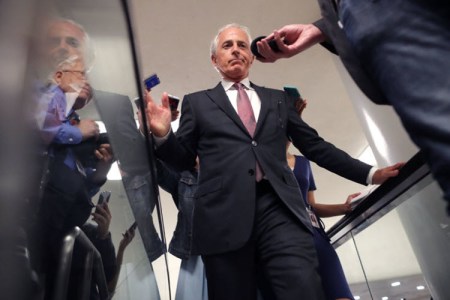
Chairman of the Senate Foreign Relations Committee, Senator Bob Corker (R-Tenn.), spoke before the Senate on Wednesday, in a bill he authored, the Countering Iran’s Destabilizing Activities Act of 2017. The legislation, has 60 bipartisan cosponsors, and is expected to pass the Senate this week. It will expand sanctions against Iranian for ballistic missile development, support for terrorism, transfer of conventional weapons to or from Iran, and human rights violations.

Senator Corker’s speech is reproduced as follows:

“Mr. President,

I rise today to speak about the Countering Iran’s Destabilizing Activities Act of 2017, which passed the Senate Foreign Relations Committee last month by a vote of 18 to 3.

“I’d like to thank the members of our committee and the co-authors of this bill for working in a constructive, bipartisan fashion to craft this legislation.

“I think it is a good example of how the Senate can still work together to tackle complex and difficult issues.

“I was in the SCIF recently – a place where senators go to read classified information – reviewing intelligence, and it truly is astounding what Iran continues to do around the world.

“For a people that are capable of so much, their foreign policy is shockingly counter to their own interest.

“We see destabilizing act after destabilizing act – from missile launches, to arms transfers, to terrorist training, to illicit financial activities, to targeting Navy ships and detaining American citizens – the list goes on and on.

“And it’s past time for us to take steps to protect the interests of the United States and our allies.

“This bill is the first time Congress has come together since the JCPOA – the Iran nuclear deal – to do just that.

“For far too long, the agreement – which I strongly opposed, as did our ranking member and presiding officer – has dictated U.S. policy throughout the Middle East.

“It’s worth noting that the JCPOA is not unlike the Paris climate accord.

“I don’t think many people in our country or many people in this body realize that it is a non-binding political agreement that was entered into by one man using presidential executive authority and can easily be undone by one man using presidential executive authority.

“In fact, in many ways, it is easier than the Paris accord considering the president doesn’t have to take an action to exit this agreement.

“I don’t think most Americans understand that. He doesn’t have to take action to exit the agreement. All he has to do is decline to waive sanctions. I think that has been missed.

“But no matter what the president decides, this bill makes it clear that the Congress intends to remain involved and will hold Iran accountable for their non-nuclear destabilizing activities.

“What the nuclear agreement failed to do was allow us to push back against terrorism, human rights issues, violations of U.N. security council resolutions relative to ballistic missile testing, and to push back against conventional arms purchases, which they are not supposed to be involved in.

“As many of us predicted at the time, Iran’s rogue behavior has only escalated since implementation of the agreement, and this bipartisan bill will give the administration tools for holding Tehran accountable.

“Let me say this. I don’t think there’s anybody in this chamber who doesn’t believe that the Trump administration – I know there’s been a lot of disagreements recently about foreign policy issues in the administration – but I don’t there’s anybody here that believes they are not going to do everything they can to push back against these destabilizing activities.

“And what we’ll be doing today and tomorrow with passage of this legislation is standing hand-in-hand with them as they do that.

“It also sends an important signal that the U.S. will no longer look the other way in the face of continued Iranian aggression.

“I want to recognize the important work of my colleagues in making this legislation possible.

“Senator Menendez has been a champion for holding Iran accountable, in this bill but also in decades of work on this issue. He truly is an asset to the Senate, and I thank him for his commitment to many issues, but especially this one.

“Senators Cotton, Rubio, and Cruz all played an important role in drafting this legislation as well.

“But finally, let me say this. This would not have been possible without the support and tireless effort of the ranking member, Senator Cardin, and his great staff. It has truly been a pleasure for me to work with him on the Russia bill that we will be voting on today at 2:00 p.m. but also on this legislation.

“We come from two very different places, representing two very different states, and yet are joined by the fact that we care deeply about making sure that the foreign policy of this country is in the national interest of our citizens and that we as a Congress and as a United States Senate are doing everything we can to drive positive foreign policy.

“I want to thank him for that and tell him I am really proud of the strong bipartisan momentum behind this legislation, which his leadership has helped make happen, and I look forward to passage of this bill.”

Congress Seeks Embargo on Iran Airline Linked to Terrorism as Tehran Targets U.S. Forces

June 15, 2017

Congress Seeks Embargo on Iran Airline Linked to Terrorism as Tehran Targets U.S. Forces, Washington Free Beacon, June 15, 2017

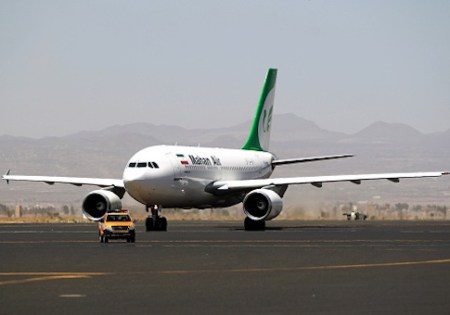
An airplane of Mahan Air sits at the tarmac / Getty Images

The legislation would grant the Department of Homeland Security increased power to boost security at U.S. airports that host flights arriving from countries where Mahan operates. It also instructs the Trump administration to prepare reports outlining every airport where a Mahan-operated flight has landed.

At this point, the deal between Boeing and Iran remains on track, though that could change if the Trump administration decides to block licenses that would permit the U.S. company to engage in business with Tehran.

Iran has already threatened to take action against the United States if Congress approves the new package of sanctions. This includes leveling its own sanctions on American entities.

******************************

Congress is seeking new authorities that would enable it to expose and crack down on an Iranian state-controlled commercial airline known for transporting weapons and terrorist fighters to hotspots such as Syria, where Iranian-backed forces have begun launching direct attacks on U.S. forces in the country, according to new legislation obtained by the Washington Free Beacon.

Congressional efforts to expose Iran’s illicit terror networks more forcefully come as U.S. and European air carriers such as Boeing and AirBus move forward with multi-billion dollar deals to provide the Islamic Republic with a fleet of new airplanes, which lawmakers suspect Iran will use to amplify its terror operations.

The new sanction legislation targets Iran’s Mahan Airlines, which operates commercial flights across the globe while transporting militants and weapons to fighters in Syria, Yemen, and other regional hotspots.

Sen. John Cornyn (R., Texas) is spearheading an amendment to a larger Iran sanctions bill that would increase security at U.S. airports and help expose Mahan’s use of commercial flights to ferry weapons abroad, according to a copy of the measure obtained by the Free Beacon.

The legislation would grant the Department of Homeland Security increased power to boost security at U.S. airports that host flights arriving from countries where Mahan operates. It also instructs the Trump administration to prepare reports outlining every airport where a Mahan-operated flight has landed.

Mahan’s “very presence is a security risk to Americans flying in and out of airports where a Mahan aircraft may land,” Cornyn said earlier this week on the Senate floor.

The amendment, if passed, could complicate efforts by Boeing and others to move forward with multi-billion dollar deals with Iran, a portion of which would likely benefit Mahan.

The State and Homeland Security departments declined to comment on the new sanctions when asked by the Free Beacon, citing a policy of not discussing pending legislation.

The renewed focus on Mahan and Iran’s use of commercial airlines to support terror activities comes as the Islamic Republic amps up operations in Syria directly targeting U.S. forces, a new front that has cast a spotlight on the growing proxy war between Iran and the United States in the region.

An Iranian drone recently attacked U.S. forces in Syria, and Hezbollah—an Iranian-backed terror organization—also has taken steps to counter American forces in the region.

A crackdown on Mahan could indicate that Congress is more seriously eyeing ways to thwart Iran’s mainly unchecked terror pipeline in the region.

Iranian officials have separately expressed anger over Congress’s efforts to impose new sanctions, threatening to walk away from the landmark nuclear deal if the United States does not uphold its end of the bargain.

At this point, the deal between Boeing and Iran remains on track, though that could change if the Trump administration decides to block licenses that would permit the U.S. company to engage in business with Tehran.

Iran has already threatened to take action against the United States if Congress approves the new package of sanctions. This includes leveling its own sanctions on American entities.

“Today, 23 American people and firms are in the list of our sanctions as a reciprocal move and we will take such measures in the future too,” Iranian Foreign Minister Javad Zarif was quoted as saying this week in comments that also took aim at Trump.

Iranian officials have also accused the United States under Trump of breaching its end of the nuclear deal, though officials did not outline what the specific violations are.

“Implementation of the nuclear deal undertakings by the U.S. has not been acceptable to Iran so far and the U.S. should comply with its undertakings,” Reza Najafi, Iran’s ambassador to the International Atomic Energy Organization, or IAEA, said this week during a meeting with the group in Vienna.

Iran and Middle East Instability

June 3, 2017

Iran and Middle East Instability, American ThinkerShahriar Kia, June 3, 2017

During President Donald Trump’s trip to the region and beyond Iran was strongly condemned by the American leader and senior Saudi officials for its support for terrorism, destructive role across the Middle East, and meddling in Syria, Iraq, and Yemen. Tehran is most specifically concerned with world leaders denouncing Iran’s human rights violations and acknowledging how the Iranian people are the main victims of the mullahs’ atrocities.

The Arabs, as the flagbearers of implementing U.S. sanctions, have launched the domino of freezing Iran’s money abroad. Iranian bank accounts in countries such as Turkey, Oman, and the UAE, especially in Dubai and Abu Dhabi, are being blocked one after another. This can be considered the prelude to comprehensive sanctions on Iran’s banking network.

***********************

The end result of Iran’s presidential election has created further rifts and launched a more intense power struggle amongst the regime’s senior ranks. Supreme Leader Ali Khamenei, fearing a repeat of the 2009 scenario of nationwide uprisings, failed to “engineer” the election results with the aim of unifying his regime apparatus. Khamenei sought to prepare conservative cleric Ebrahim Raisi as his heir by first placing him in the presidency, similar to the process he himself went through.

The elections, however, failed to provide such a finale and in fact prompted all candidates to unveil corruption in the most senior ranks. This has prompted the general public to increase their demands. Protests and demonstrations are witnessed these days in more than 30 cities and towns across Iran, with sporadic reports of clashes, following the bankruptcy of two state-run financial firms, Caspian and Arman.

Iran is also facing major foreign dilemmas, with a new international coalition shaping and targeting Tehran’s interests. The Arab-Islamic-American alliance, with the presence of 55 States, and Iran’s absence, delivered a major blow to the mullahs’ objectives in the Middle East.

On the other hand, Iranian opposition People’s Mojahedin Organization of Iran (PMOI/MEK), transferring all its members from Iraq to a number of European countries, has become ever more powerful. Through a vast network of supporters inside Iran, the PMOI/MEK was able to significantly influence the recent elections and place the regime in a quagmire like never before.

A major rally is scheduled for July 1st by supporters of the National Council of Resistance of Iran (NCRI), the political umbrella group of Iranian dissidents, including the PMOI/MEK. Policymakers and influential figures from across the globe will be gathering to provide a concrete plan to evict the mullahs’ presence from the region, how to establish freedom and democracy in Iran, and thus result in peace and stability in the Middle East. Last year more than 100,000 people took part in this convention.

During President Donald Trump’s trip to the region and beyond Iran was strongly condemned by the American leader and senior Saudi officials for its support for terrorism, destructive role across the Middle East, and meddling in Syria, Iraq, and Yemen. Tehran is most specifically concerned with world leaders denouncing Iran’s human rights violations and acknowledging how the Iranian people are the main victims of the mullahs’ atrocities.

Despite the heavy blows and new sanctions against Tehran, Khamenei has chosen to remain completely silent. This is in complete contrast to the Obama era, where the mullahs’ leader resorted to harsh outbursts in response to even the slightest hint of threats by U.S. officials.

To this end, adopting a strong approach against Tehran has proven to be correct, parallel to the weakness seen in Tehran following the presidential election.

To add insult to injury for Iran, the Trump administration has imposed sanctions on dozens of Iran’s companies, sending a highly important message.

Sanctions have now expanded from ballistic missiles and reached the human rights perspective, and specifically targeting the Revolutionary Guards (IRGC) with the objective of designating this entity as a foreign terrorist organization

The IRGC-affiliated Fars news agency described a new U.S. Senate bill as an “effort to bring Europe aboard in nuclear sanctions.”

“Foreign investment in Iran during the past four years has halved during the past four years, lowering from $4.6 billion to $2.05 billion,” according to Naseem Online citing a UN report.

The Arabs, as the flagbearers of implementing U.S. sanctions, have launched the domino of freezing Iran’s money abroad. Iranian bank accounts in countries such as Turkey, Oman, and the UAE, especially in Dubai and Abu Dhabi, are being blocked one after another. This can be considered the prelude to comprehensive sanctions on Iran’s banking network.

Is Rouhani able, or even willing?

Rouhani is neither willing nor able to carry out any measures outside of Khamenei’s framework. The entire apparatus and power structure is controlled by the Supreme Leader. As long as Iran remains under the mullahs’ regime structure, one should set aside all expectations of change emanating from within Iran. A look at Mohammad Khatami’s tenure is president from 1997 to 2005, andRouhani’s first term, are undeniable proof to this reality.

“They want to change our behavior, but changing it means changing our regime,”Khamenei said recently, signaling his red line.

Rouhani defending Iran’s missiles

The regime’s president recently said that Tehran would continue its ballistic missile program.

“… US officials should know whenever we need to technically test a missile, we will do so and will not wait for their permission,” he said in a news conference.
The Iranian regime reported recently the construction of a third underground ballistic missile production factory and will keep developing its missile program.

This came in the same week when Trump in his foreign visit described Iran as a supporter of militia groups and a threat to all Middle East countries.

Rouhani is an “utterly ruthless operator,” who had presided since 2013 over a collapsing economy and what Amnesty International called “a staggering execution spree,” murdering and imprisoning so many dissidents that Iran has per capita the highest execution rate in the world, according to Christopher Booker in a recent Telegraph article.

Obama’s departure ended the period of appeasement and golden opportunities for Tehran’s mullahs. The road ahead promises to be very difficult, to say the least.

The past four decades have proven that only regime change will bring about what the Iranian people desire and deserve. This is something that is supported by the NCRI and Rajavi’s ten-point plan, calling for a free and democratic Iran where equal opportunities are provided to all citizens regardless of gender, ethnicity, and religion. During the short campaigning season, Iranians manifested their support for Rajavi’s plan by putting up posters reading “Maryam Rajavi is our president.”


Iranian President: ‘We Need Missiles’ to Confront Trump Admin, Enemies

May 25, 2017

Iranian President: ‘We Need Missiles’ to Confront Trump Admin, Enemies, Washington Free Beacon, May 25, 2017

(Iran’s missiles for peace program. Secretary Tillerson spoke of his hopes for the future conduct of Iran. While laughing, he declined to comment on his expectations.– DM)

Iranian President Hassan Rouhani speaks during a press conference in Tehran on May 22, 2017. AFP PHOTO / ATTA KENARE (Photo credit should read ATTA KENARE/AFP/Getty Images)

A bipartisan delegation of nearly 50 senators announced on Thursday that it is moving forward with new legislation to increase economic sanctions on Iran as a result of its missile program, as well as the Islamic Republic’s support for terrorism and illegal weapons trade.

“The U.S. secretary of state’s expectations of the Iranian president indicate the U.S. officials’ non-understanding of the Islamic Republic of Iran,” Jazzayeri was quoted as saying in the country’s state-controlled press.

***********************

Recently re-elected Iranian President Hassan Rouhani lashed out at the Trump administration this week, describing it as ignorant and saying that Iran “needs missiles” to confront the United States and its allies, according to recent remarks certain to rile leaders in Washington, D.C.

Just days after President Donald Trump blasted the Islamic Republic for its illicit ballistic missile program and support of terrorism in the Middle East, Rouhani confirmed that Iran would not cease its missile activity, despite repeated calls by U.S. officials.

“We need missiles and the enemy should know that we make everything we need and we don’t pay an iota of attention to your words,” Rouhani was quoted as saying on Wednesday during a meeting with Iranian cabinet members. “The remarks by the enemies of the Iranian nation against Iran’s missile power are out of ignorance.”

The Iranian leaders remarks support recent comments by senior military leaders in the country, who have repeatedly declared that Iran will “never stop” developing ballistic missiles, a program that has raised concerns with the U.S. intelligence community, which assesses that Iran’s missile program could be used to carry a nuclear weapon.

The remarks came as Iran announced the construction of a third underground ballistic missile production factory, helmed by Iran’s Revolutionary Guard Corps, or IRGC.

Iranian General Amir Ali Hajizadeh, and IRGC leader, said the factory is meant to boosts Tehran’s “missile power” and intimidate the United States and “Zionist regime,” or Israel.

“We will increase our missile power. Our enemies, the United States, and the Zionist regime (Israel) are naturally upset and get angry at our missile production, tests and underground missile facilities because they want Iran to be in a weak position,” Hajizadeh announced on Thursday.

The facility was built in the last few years, according to the IRGC. Iranian military leaders also are working on building Iran’s first “ground-to-ground” ballistic missile.

Iran’s repeated test firing of ballistic missiles, as well as its multiple space launches—which are believed to be cover for an intercontinental ballistic missile program—have riled the Trump administration and leaders of both parties on Capitol Hill.

A bipartisan delegation of nearly 50 senators announced on Thursday that it is moving forward with new legislation to increase economic sanctions on Iran as a result of its missile program, as well as the Islamic Republic’s support for terrorism and illegal weapons trade.

Sen. Robert Menendez (D., N.J.), a chief sponsor of the legislation, said that it is part of a larger effort to ensure that “Iran’s leaders understand they do not enjoy blanket impunity as the United States continues to live up to its commitments under the” nuclear agreement.

“Independent of the nuclear portfolio, and as President Rouhani starts his second presidential term, our broader policy towards Iran must be one that holds Tehran accountable for their destabilizing efforts in the region, illegal and dangerous missile technology development, and nefarious activities as the world’s leading sponsor of terrorism,” Menendez said. “As the administration continues to review its Iran policy, Congress must set out clear markers that impose real consequences to Iran’s illicit behavior that runs counter to our national security and that of our allies in the region.”

The legislation would impose mandatory sanctions on all individuals associated with Iran’s ballistic missile program, as well as those who perform transactions with them.

Sanctions also would be applied to those who support Iran’s terror operations, including the IRGC, which is not currently designated as a terror organization by the United States.

The legislation also requires President Trump to block the property of all individuals and entities involved in supplying, selling, and transferring prohibited arms and other weaponry to Iran.

A State Department official, speaking on background, told the Washington Free Beacon that the Trump administration is moving closer to finishing its comprehensive review of the Iran deal and dealing with Iran’s provocative actions in the region.

“As Secretary [Rex] Tillerson said, the Trump administration is currently conducting a comprehensive review of our Iran policy,” the official said. “Once we have finalized our conclusions, we will meet the challenges Iran poses with clarity and conviction.”

One veteran foreign policy adviser who is close to the White House told the Free Beacon that the Trump administration would not stand by as Iranian leaders mock and threaten the United States.

“The Obama administration treated the Iranians with kid gloves because that was to get the nuclear deal,” the source said. “That ended last January but the Iranians are still acting as if they have a friend in the White House. They threaten and mock the United States, our leaders, and our allies, and they expect us to roll with it. This president is not going to roll with it, and neither is Congress.”

Meanwhile, senior Iranian military leaders continue to criticize the Trump administration for its efforts to stop Iran’s missile program.

Iranian Armed Forces Brigadier General Massoud Jazzayeri offered harsh words for Secretary of State Tillerson following his call for Iran to cease its ballistic missile work.

“The U.S. secretary of state’s expectations of the Iranian president indicate the U.S. officials’ non-understanding of the Islamic Republic of Iran,” Jazzayeri was quoted as saying in the country’s state-controlled press.

Iran: Destabilizing the Middle East Through Proxy Allies

May 11, 2017

Iran: Destabilizing the Middle East Through Proxy Allies, Clarion ProjectAmir Basiri, May 11, 2017

An Iranian Shiite militia in Iraq (Photo: Reuters)

It is a known fact throughout the region that the Islamic Republic of Iran founded the Lebanese Hezbollah as an offspring to expand its influence in the Middle East and gain a foothold on the shores of the Mediterranean.

U.S. National Security Advisor Lt. General H.R. McMaster recently accused Tehran of imposing the “Hezbollah model” to gain influence over various Middle East states, destabilizing the region through the process.

Such a blueprint includes targeting vulnerable governments across the region through a variety of plots while, at the same time, backing armed militia groups stationed in those countries. Hezbollah has already managed to consolidate its influence over the government of Lebanon after Michel Aoun, a Hezbollah ally, took control over the country’s presidency last year.

It has also become quite obvious that the United States, despite the highly flawed nuclear deal which supposedly aimed to curb Iran’s nuclear program, enjoys the leverage of pressuring Iran through the use of comprehensive sanctions. Tehran will likely not forget this obvious factor and knows the Trump administration can kick-start new sanctions whnever it deems necessary.

The new administration has already slapped the Iranian regime with two series of sanctions in the past three months and more can be expected.

The reference made by Trump’s national security adviser to “militias and other illegal armed groups” backed by Iran refers to the vast variety of Shiite militias in Iraq under the Baghdad-backed umbrella of the Popular Mobilization Units (PMU). These groups have their parallel in Yemen with the Houthis, who are focusing their efforts on ousting the Western-backed government.

British researchers discovered evidence indicating without a doubt how Tehran is deeply involved in keeping a “weapons pipeline” up and running for Houthis.

At the same time, Tehran continues to harass the Saudis from their southern border and threaten international shipping lines passing through the strategic Bab el Mandab waterway connecting the Red Sea to the Gulf of Aden.

This goes in line with a conglomerate of Shiite foot-soldiers Iran has rallied from Afghanistan, Pakistan and other countries for the bloodbath raging on in Syria after six long years.

Iran has abetted the barbaric tactics of the Bashar Assad regime in Syria, further demonstrating its ill intentions across the region. The PMU and Hezbollah have boosted Tehran’s efforts and role in keeping Assad in power. They have all been accused of having played atrocious roles in unspeakable war crimes, with the Khan Shaykhoun chemical attack by Assad in Idlib Province of northern Syria acting as yet another stark reminder of this reality.

Iran’s destabilizing role in nations across the Arab and Islamic worlds has been on the rise significantly with news reports seen in recent months.

The Iraqi Parliament legitimized the PMU last November through the adoption of a law aimed at maintaining this entity’s command structure and hierarchy. Iraqi Sunnis, alongside all minorities in the country including Christians, Yazidi and others, are now left extremely concerned, knowing how this measure can actually legalize the brutal retaliation measures conducted by the Shiite militias.

While Iran’s “medddling” has become obvious to the international community, officially Tehran has continued to deny its role of fueling these Middle East conflicts.

In March, Iranian Foreign Ministry spokesman Bahram Ghasemi denied “any intervention in the internal affairs of Arab countries.” The irony lies in the fact that despite such remarks, Alireza Zakani, known to be a close confidante of Iranian Supreme Leader Ali Khamenei, is also known to have boasted in remarks dating back to November 2014 of Iran controlling four Arab capitals following the Houthis’ capture of the Yemeni capital. The list included Baghdad, Beirut and Damascus.

Following eight years of the Obama administration’s disastrous Iran engagement policy, it is high time to make it crystal clear to Iran that such a trend will no longer be tolerated and must come to an end.

Iran Using U.S. Cash to Fund Unprecedented, Massive Military Buildup

May 3, 2017

Iran Using U.S. Cash to Fund Unprecedented, Massive Military Buildup, Washington Free Beacon, , May 3, 2017

Iranian President Hassan Rouhani gives a press conference in the capital Tehran on April 10, 2017. Photo credit should read ATTA KENARE/AFP/Getty Images)

Iran is using the billions in cash resources provided under the landmark nuclear deal to engage in an unprecedented military buildup meant to transform the Islamic Republic’s fighting force into an “offensive” juggernaut, according to a largely unreported announcement by Iranian military leaders that has sparked concern among U.S. national security insiders and sources on Capitol Hill.

Iranian officials announced late last month that Iran’s defense budget had increased by 145 percent under President Hassan Rouhani and that the military is moving forward with a massive restructuring effort aimed at making it “a forward moving force,” according to regional reports.

Iranian leaders have stated since the Iran deal was enacted that they are using the massive amounts of cash released under the agreement to fund the purchase of new military equipment and other armaments. Iran also has pursued multi-million dollar arms deals with Russia since economic sanctions were nixed as part of the deal.

Leading members of Congress and U.S. officials working on the Iran portfolio suspect that at least a portion of the Obama administration’s $1.7 billion cash payment to Iran  has been used to fund and support terrorists in the Middle East.

The latest disclosure about Iran’s military buildup is further fueling concerns that U.S. cash assets returned to the country—which were released with no strings attached by the Obama administration—are helping Iran pursue a more aggressive military stance against U.S. forces in the region.

“President Obama flat-out caved in to Iran when he handed them the disastrous nuclear deal and $1.7 billion in cash payments that could assist Iran’s military,” Rep. Sean Duffy (R., Wis.), an opponent of the nuclear deal, told the Washington Free Beacon. “So it’s no surprise that the world’s lead sponsor of terrorism would feel emboldened to become more aggressive in the region and flex its military muscle.”

Iranian Brigadier General Kiumars Heidari announced the military buildup during Iran’s annual Army Day. While the announcement did not grab many headlines in the Western media, national security insiders have been discussing the announcement for weeks, according to conversations with multiple sources.

Iran’s goal is to turn its army into an “offensive” force, a major shift from its historic role as a support agent for the Iranian Revolutionary Guards Corps, or IRGC, Iran’s extremely well funded primary fighting force.

Iran hopes to revamp its army from top to bottom, including improving logistical capabilities, weaponry, and other armaments.

Mahan Abedin, an Iran analyst writing in Middle East Eye, described the announcement as a major shift in Iranian military policy that would allow the Islamic Republic to intervene in the Persian Gulf region, where the U.S. military has a significant presence.

“This is a major policy announcement with far-reaching consequences for foreign policy and internal defense-related power dynamics,” Abedin wrote. “If implemented properly, Heidari’s proposed modernization policy would not only radically alter Iranian defense doctrine, but just as importantly, it would also reverse the army’s subservient relationship to the Islamic Revolutionary Guard Corps (IRGC).”

Michael Rubin, a former Pentagon adviser and expert on rogue regimes, told the Free Beacon that it should come as no surprise that Iran is diverting the cash it received under the nuclear deal to its military industry.

The disclosure comes as “no surprise to anyone who studied Iran” and should have been anticipated by the Obama administration, which largely sought to downplay the importance of giving Iran billions in cash resources, Rubin said.

“First, there’s history: Between 1998 and 2005, European Union trade with Iran more than doubled and the price of oil quintupled,” Rubin explained. “Iran took that hard currency windfall and invested the bulk of it in its nuclear and missile programs. The person coordinating Iran’s strategy? Hassan Rouhani who was at the time secretary of Iran’s Supreme National Security Council.”

“Obama and Kerry might as well have wired the money directly into the accounts of those seeking to enhance Iran’s military, kill Sunnis, or sponsor terrorism,” Rubin said.

One senior congressional source tracking the matter expressed concern about the safety of U.S. forces in the region, which already are routinely harassed by Iranian military personnel.

“This is certainly grounds for concern,” the source said. “An Iranian military buildup coupled with an offensive posture is a threat to the United States and our allies. This also serves as an important reminder of why the Obama administration’s cash infusion to Iran was so dangerous.”

The cash windfall provided by the United States and European countries is “fungible and hence can be used for everything from sponsoring terror proxies to developing ballistic missiles,” the source warned. “Congress will continue to take action to counter Iranian terrorism and ensure this regime never acquires a nuclear weapon.”

Iran’s military announcement has already sparked a renewed push on Capitol Hill to reimpose economic sanctions on Iran.

“The Iranians know that the party will end this fall, when Congress will pass bipartisan legislation that begins to roll back Iran’s military growth,” one senior congressional adviser working on the sanctions effort told the Free Beacon.

“The Obama administration avoided any serious action for years, and so Iran kept growing its arsenal and using it against our allies, against Syrian civilians, and increasingly against our military,” said the source. “Now they’re rushing to accomplish as much as they can before Congress and the Trump administration get around to reversing Obama’s policies.”

We’re turning a blind eye to Iran’s genocidal liars

April 18, 2017

We’re turning a blind eye to Iran’s genocidal liars, The Australian, Michael Oren, April 19, 2017

(Please see also, What North Korea Should Teach Us about Iran. DM)

In responding forcibly to North Korean and Syrian outrages, President Trump has taken a major step towards restoring America’s deterrence power. His determination to redress the flaws in the JCPOA and to stand up to Iran will greatly accelerate that process. The US, Israel and the world will all be safer.

**************************

The US has signed agreements with three rogue regimes strictly limiting their unconventional military capacities. Two of those regimes — Syria and North Korea — brazenly violated the agreements, provoking game-changing responses from Donald Trump. But the third agreement — with Iran — is so inherently flawed that Tehran doesn’t even have to break it. Honouring it will be enough to endanger millions of lives.

The framework agreements with North Korea and Syria, concluded respectively in 1994 and 2013, were similar in many ways. Both recognised that the regimes already possessed weapons of mass destruction or at least the means to produce them. Both ­assumed that the regimes would surrender their arsenals under an international treaty and open their facilities to inspectors. And both believed these repressive states, if properly engaged, could be brought into the community of nations.

All those assumptions were wrong. After withdrawing from the nuclear non-proliferation treaty, Pyongyang tested five atomic weapons and developed ­intercontinental missiles capable of carrying them. Syrian dictator Bashar al-Assad, less than a year after signing the framework, reverted to gassing his own people. Bolstered by the inaction of the US and backed by other powers, North Korea and Syria broke their commitments with impunity.

Or so it seemed. By ordering a Tomahawk missile attack on a Syrian air base, and a US Navy strike force to patrol near North Korea’s coast, the Trump administration has upheld the frame­­works and placed their violators on notice. This reassertion of power is welcomed by all of ­America’s allies, Israel among them. But for us the most dangerous agreement of all is the one that may never need military enforcement. For us, the existential threat looms in a decade, when the agreement with Iran expires.

Like the frameworks with North Korea and Syria, the Joint Comprehensive Plan of Action of 2015 assumed that Iran would fulfil its obligations and open its facilities to inspectors. The JCPOA assumed that Iran would moderate its behaviour and join the international community. Yet unlike its North Korean and Syrian allies, Iran was the largest state sponsor of terror and openly vowed to destroy another state: Israel. Unlike them, Iran systematically lied about its unconventional weapons program for 30 years. And unlike Damascus and Pyongyang, which are permanently barred from acquiring weapons of mass destruction, Tehran can look forward to building them swiftly and legitimately in the late 2020s, once the JCPOA expires.

This, for Israel and our neighbouring Sunni states, is the appalling flaw of the JCPOA. The regime most committed to our destruction has been granted a free pass to develop military nuclear capabilities. Iran could follow the Syrian and North Korean examples and cheat. Or, while enjoying hundreds of billions of dollars in sanctions relief, it can adhere to the agreement and deactivate parts of its nuclear facilities rather than dismantle them. It can develop new technologies for producing atomic bombs while testing intercontinental ballistic missiles. It can continue massacring Syrians, Iraqis and Yemenis, and bankrolling Hamas and Hezbollah. The JCPOA enables Iran to do all that merely by complying.

A nuclear-armed Iran would be as dangerous as “50 North Koreas”, Israeli Prime Minister Benjamin Netanyahu told the UN in 2013, and Iran is certainly many times more dangerous than Syria. Yet Iran alone has been granted immunity for butchering civilians and threatening genocide. Iran alone has been guaranteed a ­future nuclear capability. And the Iranian regime — which brutally crushed a popular uprising in 2009 — has amassed a million-man force to suppress any future opposition. Rather than moderating, the present regime promises to be more radical yet in another 10 years.

How can the US and its allies pre-empt catastrophe? Many steps are possible, but they begin with penalising Iran for the conventions it already violates, such as UN restrictions on missile development. The remaining American sanctions on Iran must stay staunchly in place and congress must pass further punitive legislation. Above all, a strong link must be established between the JCPOA and Iran’s support for terror, its pledges to annihilate ­Israel and overthrow pro-American Arab governments, and its complicity in massacres. As long as the ayatollahs oppress their own population and export their ­tyranny abroad, no restrictions on their nuclear program can ever be allowed to expire.

In responding forcibly to North Korean and Syrian outrages, President Trump has taken a major step towards restoring America’s deterrence power. His determination to redress the flaws in the JCPOA and to stand up to Iran will greatly accelerate that process. The US, Israel and the world will all be safer.

Michael Oren is Israel’s deputy minister for diplomacy, a member of the Knesset and a former ambassador to Washington.

Trump Administration Sanctions Iran Prison Torture Industry

April 13, 2017

Trump Administration Sanctions Iran Prison Torture Industry, Washington Free Beacon, April 13, 2017

An Iranian inmate peers from behind a wall as a guard walks by at the female section of the infamous Evin jail, north of Tehran, 13 June 2006. (AFP PHOTO/ATTA KENARE KENARE/AFP/Getty Images)

The Trump administration is leveling new economic sanctions against senior Iranian officials and its prison system for widespread human rights abuses, including the systematic torture of those being held in these facilities, according to White House officials familiar with the matter.

The latest sanctions target the Tehran Prisons Organization and Sohrab Suleimani, a senior official in the prison system and the brother of Qassem Soleimani, a senior Iranian military figure responsible for operating Iran’s rogue activities in Syria and elsewhere.

Sohrab Soleimani is responsible for overseeing Iran’s notorious Evin Prison, which is known for torturous interrogations, forced interrogations, and widespread mistreatment of inmates.

The latest sanctions are certain to rankle Tehran, already the subject of a range of new sanctions under the Trump administration, which is currently conducting a widespread review of all matters related to the landmark nuclear agreement.

A senior official on the White House National Security Council told the Washington Free Beacon that the Soleimani family has a history of fomenting violence and unrest both inside and outside Iran.

“It’s no coincidence that Sohrab Suleimani is the brother of the notorious Qassem Soleimani, the head of the IRGC’s Quds Forces, who has been responsible for so much of the violent disruption Iran has been spreading through the region,” said the official, who was not authorized to speak on record.

Iranian human rights abuses have only grown under the leadership of so-called reformist President Hassan Rouhani, the official said. This includes the detention of U.S. citizens

“There has been a disturbing and significant increase in the number of detentions and executions of Iranian citizens under President Rouhani, and the infamous Evin Prison under Sohrab Suleimani’s control has been a key facility in this program of domestic repression,” the official said.

The Trump administration is holding meetings with the family members of American citizens still being detained in Iran and believed to be subjected to torture.

“In addition, we have been deeply concerned by the treatment of American citizens in this prison, and in others throughout Iran,” the official said. “Just today, senior officials in the Trump administration met with members of the Namazi family representing Siamak Namazi and Baquer Namazi who have been unjustly detained in Iran since October, 2015 and February, 2016, respectively.”

“Today’s designations highlight our continued support for the Iranian people and demonstrate our commitment to hold the Government of Iran responsible for its continued repression of its own citizens,” John E. Smith, director of the Treasury Department’s Official of Foreign Assets Control, said in a statement. “We will continue to identify, call out, and sanction those who are responsible for serious human rights abuses in Iran.”

The sanctions do not conflict with U.S. obligations under the nuclear agreement and are not being leveled as part of that agreement, according to U.S. officials.

The sanctions were formulated following a series of investigations by the U.S. government into Iran’s systematic breach of human rights.

“These designations are in response to what we see as pattern of human rights abuses by the Government of Iran and reflect the United States’ deep concern regarding the human rights situation in Iran,” the State Department explained in a background document provided to reporters.

“We continue to see Government of Iran officials engage in repressive behavior against its own citizens, including through their mistreatment and abuse of prisoners,” the document states. “This is especially evident at Evin Prison, which is where numerous prisoners of conscience are held. We have documented these and many other human rights abuses perpetrated by the government of Iran in our annual State Department authored Human Rights, Religious Freedom, and Trafficking in persons reports.”

Soleimani’s role in Iran’s prison system makes him one of the foremost human rights abusers worldwide.

Soleimani oversaw an April 2014 incident at the Evin Prison in which dozens of security guards and prison officials beat a number of political prisoners. The attack is believed to have lasted several hours and impacted more than 30 prisoners. Many of these prisoners were later denied medical treatment.

Evin Prison is home to large number of Iranian political dissidents and other government opponents, who are routinely shut down and arrested by the Iranian regime for political activities targeting those in power.

Mission accomplished in Syria

April 12, 2017

Mission accomplished in Syria, Israel Hayom, Clifford D. May. April 12, 2017

(Accomplished or just begun? — DM)

Congress should send Trump the legislation it is now considering, seeking to impose new sanctions on Iran in reprisal for its continuing support of terrorists, its missile tests and its maintenance of more than 35,000 troops in Syria, including its own, those of its Lebanese proxy, Hezbollah, and Shiite fighters recruited from Iraq and Afghanistan. Suspending Iran’s deal with Boeing/Airbus would be useful, too. Only the willfully credulous believe that Iran’s theocrats won’t use such aircraft for illicit military purposes.

************************

If you’re still unsure about whether U.S. President Donald Trump did the right thing when he launched 59 cruise missiles at Syria’s Shayrat Air Base last week, consider the alternative.

He knew that Syrian dictator Bashar Assad had yet again used chemical weapons to murder Syrian civilians, women and children prominent among them. He knew that Iran and Russia had enabled this atrocity, as they have many others. He knew he had two choices.

He could shrug, instruct his U.N. ambassador to deliver a tearful speech calling on the “international community” to do something, and then go play a round of golf. Or he could demonstrate that the United States still has the power and the grit to stand up to tyrants and terrorists, thereby beginning to re-establish America’s deterrent capability.

In other words, this was what Sun Tzu and Carl von Clausewitz would call a no-brainer. (Well, loosely translated.) A mission was accomplished. Do harder missions lie ahead? Yes, of course. But I suspect Defense Secretary James Mattis and National Security Adviser H.R. McMaster have made that abundantly clear to the new president.

We now know for certain that Russia failed to live up to its 2013 commitment to ensure that Assad surrendered all his illegal chemical weapons under the deal it brokered. Secretary of State Rex Tillerson acerbically questioned whether that was the result of complicity or incompetence or whether Russia allowed itself to be duped by Assad.

The strike ordered by President Trump was not “unbelievably small” — then-Secretary of State John Kerry’s description of the punishment then-President Barack Obama decided not to impose in response to Assad’s earlier use of chemical weapons. It was big enough to make clear that American diplomats are again carrying big sticks. (For Obama to insist that diplomacy and force are alternatives was patently absurd.)

Conveniently, Trump was dining with Chinese President Xi Jinping when the strikes occurred. It’s fair to speculate that Xi is today thinking harder about American requests to rein in Kim Jong Un, the North Korean dictator whose drive to acquire nuclear-tipped missiles that can reach the American mainland has become what Tillerson called an “imminent” threat.

Having passed his first major national security test, Trump is now obliged to demonstrate firmness and consistency. What plans might the Pentagon have on the shelf to respond to further provocations? The next round of Tomahawk missiles could permanently ground Assad’s air force. That would make it easier to then establish no-fly zones. If such measures do not alter the calculations of Assad and his Iranian and Russian patrons, consideration could be given to leveling his defense, intelligence and command-and-control centers as well.

Another idea under discussion: setting up safe havens, or, to use a better term, “self-protection zones,” for those fleeing the Syrian regime and various jihadist forces, Sunni and Shiite alike. Israel and Jordan could help the inhabitants of such areas adjacent to their borders defend themselves. The Saudis, Emiratis and Bahrainis could contribute to the cost. Might this lead to the partition of Syria? Most likely, but it’s difficult to imagine a “political solution” that would not include such readjustments.

All this, while useful and perhaps even necessary, should be seen as insufficient. Syria is a major humanitarian catastrophe but only one piece in a much larger geopolitical puzzle. Sooner rather than later, the Trump administration needs to develop what Obama refused to contemplate: a comprehensive and coherent strategy to counter the belligerent, imperialist and supremacist forces that have emerged from the Middle East and are now spreading like weeds around the world.

The Islamic State group will of course need to be driven off the lands on which it has attempted to establish a caliphate. After that, its terrorists will have to be hunted, along with those of al-Qaida, wherever they hide (e.g., Egypt where, over the weekend, they bombed two Coptic Christian churches).

But — and this is crucial — accomplishing these missions must not serve to further empower Iran’s jihadist rulers, who dream of establishing an expanding imamate, the Shiite version of a caliphate.

Most immediately, Congress should send Trump the legislation it is now considering, seeking to impose new sanctions on Iran in reprisal for its continuing support of terrorists, its missile tests and its maintenance of more than 35,000 troops in Syria, including its own, those of its Lebanese proxy, Hezbollah, and Shiite fighters recruited from Iraq and Afghanistan. Suspending Iran’s deal with Boeing/Airbus would be useful, too. Only the willfully credulous believe that Iran’s theocrats won’t use such aircraft for illicit military purposes.

That the United States cannot solve all the world’s problems was one of Trump’s campaign themes. But the implication is not necessarily, as some of his supporters hoped, that he would turn a blind eye to all atrocities and threats not already within America’s borders.

In the last century, most Americans recognized, in some cases with enormous reluctance, that there was no good alternative to doing whatever was necessary to rout the Nazis and communists, enemies whose goal was to kill off the democratic experiment.

In this century, jihadists and Islamists harbor the same ambition. We can attempt to appease them. We can try to make ourselves inoffensive to them. We can keep our hand extended, hoping that in time they will unclench their fists. Or we can decide instead to plan for a long war that will end with the defeat of these latest enemies of America and the rest of the civilized world. If Trump has grasped that within his first 100 days, he’s not off to such a bad start.