Posted tagged ‘Iran sanctions’

Trump Admin Will Not Commit to Designating IRGC as Terror Group

October 11, 2017

Trump Admin Will Not Commit to Designating IRGC as Terror Group, Washington Free Beacon , October 11, 2017

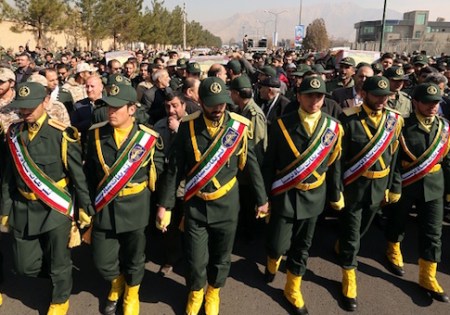
Members of the Iran’s Revolutionary Guard Corps / Getty Images

Trump last week signed new sanctions legislation mandating that the United States extend a terror designation to the IRGC, marking the first time in U.S. history a foreign country’s military branch would be hit with such a designation.

However, the State and Treasury Departments would not confirm Wednesday that the administration intends to make good on this law, which was approved by Congress with bipartisan support.

***********************************

The Trump administration will not commit to designating the Islamic Revolutionary Guard Corps, or IRGC, Iran’s elite fighting force, as terrorists, despite a congressional mandate to do so by the end of the month, according to multiple U.S. officials and other administration insiders who told the Washington Free Beacon that holdovers from the Obama administration are working to stymie the effort.

While President Donald Trump is expected to announce this week that he will not certify Iran as in compliance with the landmark nuclear deal, it remains unclear if he will follow through with congressionally approved plans to extend a terror designation to the IRGC, a move that has prompted Iran to threaten greater attacks on U.S. forces in the Middle East.

The IRGC is responsible for numerous terror attacks on American troops over the years and has played a key role in interfering with U.S. operations in Syria. A bipartisan consensus in Congress has already backed such a designation, but key Obama-era holdovers and top national security officials who have the president’s ear are urging him to refrain, according to multiple sources who spoke to the Free Beacon.

Top lawmakers and insiders who spoke to the Free Beacon about the growing uncertainty over how best to hold Iran accountable for its terror activities expressed frustration over what they view as the administration’s inability to follow through with its foreign policy promises, particularly as they relate to Iran, which has increasingly targeted U.S. forces with military action.

New reports emerged Wednesday afternoon that Trump’s planned speech on Iran may be scaled back and not take place until Friday, if it does at all.

Trump last week signed new sanctions legislation mandating that the United States extend a terror designation to the IRGC, marking the first time in U.S. history a foreign country’s military branch would be hit with such a designation.

However, the State and Treasury Departments would not confirm Wednesday that the administration intends to make good on this law, which was approved by Congress with bipartisan support.

The administration may be getting cold feet due to the objections of key U.S. officials and those in the Treasury Department who view such a designation as harmful to American companies that have business interests in Iran, where the IRGC controls a majority of the economy, sources said.

“The IRGC is responsible for wreaking havoc throughout the Middle East and, through its Quds Force, for killing hundreds of American troops in Iraq,” Rep. Ron DeSantis (R., Fla.), a member of the House Foreign Affairs Committee and chair of its National Security Subcommittee, told the Free Beacon.

“The IRGC represents a quintessential terrorist group and should be designated as such,” DeSantis said.  “Whereas the Obama administration flew pallets of cash to the IRGC, the Trump administration should act to hold the IRGC accountable.  Designating it as a terrorist group is a good first step.”

Neither the State Department or White House would confirm to the Free Beacon plans to follow through with this designation, prompting speculation that the process may be held up over objections by Obama-era holdovers in the Trump administration who view the move as a shot at dismantling the former president’s nuclear deal.

“Congress didn’t ask the president to designate the full IRGC,” according to one veteran Middle East policy advisor who lobbies Congress on Iran sanctions. “They told the president to do it by veto proof majorities. Obama holdover lawyers and his establishment staffers are telling him he can use loopholes to just go after some entities and circumvent Congress.”

These same voices are continuing to advise Trump against decertifying Iranian compliance with the deal, despite the president’s personal belief that the Islamic Republic has flagrantly violated what he has repeatedly described as a bad deal.

“These are the same people advising him to certify the nuclear deal, which was also rejected by bipartisan majorities in Congress,” the source said. “They’re wrong and if they stay wrong, lawmakers will eventually make it an oversight issue.”

A State Department official declined repeated requests for clarification on what the administration intends to do about the IRGC, but told the Free Beacon officials remain “deeply troubled by Iran’s longstanding provocative activities including its support for terrorism and destabilizing activities in the region.”

“We are committed to holding Iran accountable for its behavior,” the official said. “The United States retains the authority to respond to Iran’s support for terrorism, human rights abuses, and destabilizing activities. The U.S. government constantly reviews information, through an interagency process, to evaluate potential sanctions violators for targeting under existing sanctions authorities.”

A Treasury Department official did not respond to a request for comment on the matter.

Iranian officials vowed last week to strike U.S. forces and bases in the region if the Trump administration moves forward with extending a terror designation to the IRGC.

Rep. Sean Duffy (R., Wis.), a vocal opponent of the Iran deal, told the Free Beacon that Iran would be wise to back down from its threats.

“President Obama’s terrible Iran deal predictably emboldened the Iranian regime to build up their military and antagonize the region,” Duffy said. “Iran may have been able to bully our previous president, but the American people elected President Trump to stand up for the United States on the world stage.”

“The Iranian regime is already on notice for being the world’s largest state-sponsor of terror, and it would be wise for them to back down from their belligerent posture,” Duffy added.
ANALYSIS: Certified or decertified, Iran faces tough road ahead

October 10, 2017

ANALYSIS: Certified or decertified, Iran faces tough road ahead, Al Arabiya, Heshmat Alavi, October 9, 2017

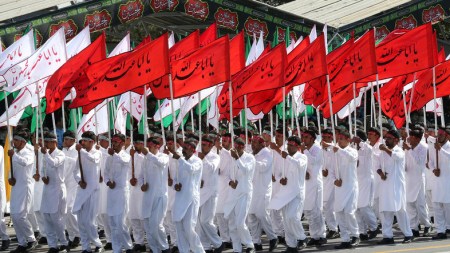
Members of Iranian armed forces march during a parade in Tehran, Iran, September 22, 2017. President.ir/Handout via REUTERS.

The new mentality sought by Washington is to address all of Iran’s belligerence and not allow its nuclear program and the JCPOA devour all of the international community’s attention.

The new US response, including blacklisting Iran’s notorious Revolutionary Guards, to be announced by Trump is said to cover missile tests, support for terrorism and proxy groups checkered across the Middle East, hopefully human rights violations at home, and cyberattacks.

Iran has a history of resorting to such measures, including targeting Saudi oil interests. Raising the stakes for Iran, Trump described a meeting with his top military brass on Thursday evening as “the calm before the storm.” Neither the US President nor the White House provided further details, yet rest assured Tehran received the message.

**************************

All eyes are on US President Donald Trump and his upcoming Iran speech later this week to clarify his decision to certify or decertify Tehran’s compliance with a nuclear agreement, officially known as the Joint Comprehensive Plan of Action (JCPOA), designed to curb the regime’s controversial atomic drive.

This has Iran’s regime on its toes, as senior elite in Tehran understand fully how the US can lead the international community in adopting strong measures against its broad scope of malign activities. Expected to be addressed is also a wide range of concerns over Iran’s dangerous policies in relation to its ballistic missile advances, meddling in Middle East states and supporting terrorist proxy groups as explained in a new video.

‘Iran’s unacceptable behavior’

Iran’s rogue behavior, currently imposing its influence on four major regional capitals of Baghdad, Beirut, Damascus and Sanaa, are the result of the Obama administration’s “overly lenient foreign policy, which sought to promote America’s priorities through consensus, rather than through the frank display of power,” as put by a recent The New Yorker piece.

“Lifting the sanctions as required under the terms of the JCPOA has enabled Iran’s unacceptable behavior,” US Secretary of State Rex Tillerson said in a late September meeting with his P5+1 counterparts and Iran’s top diplomat Mohammad Javad Zarif.

The Trump administration is also deeply concerned over Iran’s proxies mining the strategic Bab el-Mandeb Strait waterway, aiming its indigenous missiles from Yemen towards cities in Saudi Arabia and other Gulf countries, and from southern Lebanon towards Israel. This is Tehran in action with the objective of taking advantage of the destruction left behind by ISIS across the region, especially in Syria and Iraq.

“The Iranian regime supports terrorism and exports violence, bloodshed and chaos across the Middle East,” Trump told reporters before a Thursday evening meeting with senior military leaders at the White House. “That is why we must put an end to Iran’s continued aggression and nuclear ambitions,” he said. “They have not lived up to the spirit of their agreement.”

Trump has put Iran “on notice” over charges that Tehran violated a nuclear deal with the West by test-firing a ballistic missile. (Reuters)

Joint effort

Parallel to the White House there are voices on Capitol Hill advocating the new approach weighed by the administration.

“The president should decline to certify, not primarily on grounds related to Iran’s technical compliance, but rather based on the long catalog of the regime’s crimes and perfidy against the United States, as well as the deal’s inherent weakness,” Senator Tom Cotton said last week at a speech in the Council on Foreign Relations.

As the Trump administration seeks to place necessary focus on Iran’s illicit Middle East ambitions and actions, talks are also ongoing as we speak over how to amend the JCPOA’s restrictions.

“Sunset clauses,” Iran’s ballistic missile development and testing, and an inspections regime lacking the bite to gain necessary access into the regime’s controversial military sites. Under the current framework Iran can easily conduct nuclear weapons research and development in military sites and claim such locations do not fall under the JCPOA jurisdiction.

While it is expected of Trump to decertify Iran, he most likely will not go the distance to completely pull America out of the nuclear agreement. Obama refused to send the JCPOA to Congress for discussion and approval. Trump, however, seems set to place the decision to impose further sanctions on Iran upon the shoulders of US lawmakers.

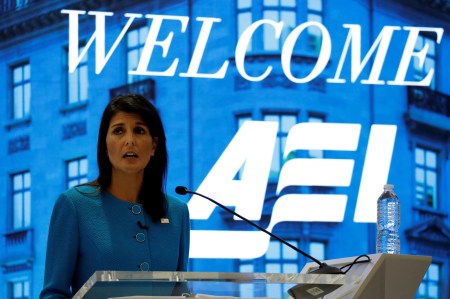
US Ambassador to the United Nations Nikki Haley speaks about the Iran nuclear deal at the American Enterprise Institute in Washington, on September 5, 2017. (Reuters)

More than ‘one piece’

The new mentality sought by Washington is to address all of Iran’s belligerence and not allow its nuclear program and the JCPOA devour all of the international community’s attention.

The new US response, including blacklisting Iran’s notorious Revolutionary Guards, to be announced by Trump is said to cover missile tests, support for terrorism and proxy groups checkered across the Middle East, hopefully human rights violations at home, and cyberattacks.

Iran has a history of resorting to such measures, including targeting Saudi oil interests. Raising the stakes for Iran, Trump described a meeting with his top military brass on Thursday evening as “the calm before the storm.” Neither the US President nor the White House provided further details, yet rest assured Tehran received the message.

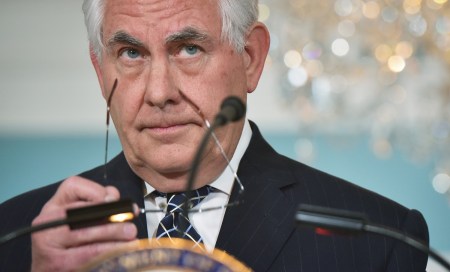
US Secretary of State Rex Tillerson delivering a statement on Iran in the Treaty Room of the State Department in Washington, DC, on April 19, 2017. (AFP)

Fear renders contradiction

Sensing an increasingly escalating tone from Washington, Tehran signaled its first sign of fear by expressing readiness to discuss its ballistic missile program, according to Reuters. And yet less than 24 hours later, Iranian officials said no offers were made to negotiate such restrictions.

“Iran regards defensive missile programs as its absolute right and will definitely continue them within the framework of its defensive, conventional and specified plans and strategies,” Iranian Foreign Ministry spokesman Bahram Qassemi said, according state media.

Iranian President Hassan Rouhani also felt the need to make remarks to save face before the regime’s already depleting social base. “In the nuclear negotiations and agreement we reached issues and benefits that are not reversible. No one can turn that back, not Mr. Trump or anyone else,” Rouhani said at a recent Tehran University ceremony, according to state media.

Of course, we all remember how prior to the JCPOA signing in 2015 senior Iranian officials went the limits in describing any “retreat” regarding their nuclear program as a “red line.” To make a long story short, Tehran is comprehending how the times are changing at a high velocity, endangering its domestic, regional and international interests. And unlike the Obama years, its actions will not go unanswered.

Senator Cotton made this crystal clear at his speech: “Congress and the President, working together, should lay out how the deal must change and, if it doesn’t, the consequences Iran will face.”

The Iran Deal Isn’t Worth Saving

October 8, 2017

The Iran Deal Isn’t Worth Saving, Gatestone InstituteJohn R. Bolton, October 8, 2017

(The chances of renegotiating the JCPOA to make it less harmful to America appear to be close to zero. — DM)

[T]he deal’s acolytes are actively obscuring this central issue, arguing that it is too arduous and too complex to withdraw cleanly. They have seized instead on a statutory requirement that every 90 days the president must certify, among other things, that adhering to the agreement is in America’s national-security interest. They argue the president should stay in the deal but not make the next certification, due in October.

This morganatic strategy is a poorly concealed ploy to block withdrawal, limp through Mr. Trump’s presidency, and resurrect the deal later. Paradoxically, supporters are not now asserting that the deal is beneficial. Instead, they concede its innumerable faults but argue that it can be made tougher, more verifiable and more strictly enforced. Or, if you want more, it can be extended, kicked to Congress, or deferred during the North Korea crisis. Whatever.

The only sure way to resume economic pressure on Iran is for President Trump to stop waiving the sanctions, as he did a few weeks ago. The power to act is in executive hands, as it should be.

*********************************

“Cut, and cut cleanly,” Sen. Paul Laxalt advised Ferdinand Marcos in 1986, urging the Philippine president to resign and flee Manila because of widespread civil unrest. The Nevada Republican, Ronald Reagan’s best friend in Congress, knew what his president wanted, and he made the point with customary Western directness.

President Trump could profitably follow Mr. Laxalt’s advice today regarding Barack Obama’s 2015 deal with Iran. The ayatollahs are using Mr. Obama’s handiwork to legitimize their terrorist state, facilitate (and conceal) their continuing nuclear-weapons and ballistic-missile programs, and acquire valuable resources from gullible negotiating partners.

Mr. Trump’s real decision is whether to fulfill his campaign promise to extricate America from this strategic debacle. Last month at the United Nations General Assembly, he lacerated the deal as an “embarrassment,” “one of the worst and most one-sided transactions the United States has ever entered into.”

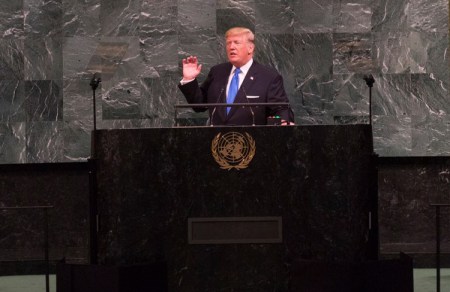
Last month at the United Nations General Assembly, President Donald Trump lacerated the Iran nuclear deal as an “embarrassment,” “one of the worst and most one-sided transactions the United States has ever entered into.” (Image source: The White House)

Fearing the worst, however, the deal’s acolytes are actively obscuring this central issue, arguing that it is too arduous and too complex to withdraw cleanly. They have seized instead on a statutory requirement that every 90 days the president must certify, among other things, that adhering to the agreement is in America’s national-security interest. They argue the president should stay in the deal but not make the next certification, due in October.

This morganatic strategy is a poorly concealed ploy to block withdrawal, limp through Mr. Trump’s presidency, and resurrect the deal later. Paradoxically, supporters are not now asserting that the deal is beneficial. Instead, they concede its innumerable faults but argue that it can be made tougher, more verifiable and more strictly enforced. Or, if you want more, it can be extended, kicked to Congress, or deferred during the North Korea crisis. Whatever.

As Richard Nixon said during Watergate: “I want you to stonewall it, let them plead the Fifth Amendment, cover up, or anything else if it’ll save it — save the plan.”

Mr. Trump should not be deceived. The issue is not certification. The issue is whether we will protect U.S. interests and shatter the illusion that Mr. Obama’s deal is achieving its stated goals, or instead timidly hope for the best while trading with the enemy, as the Europeans are doing. It is too cute by half to employ pettifoggery to evade this reality.

U.N. Security Council Resolution 2231 embodies the deal and includes two annexes: the Joint Comprehensive Plan of Action itself, and a statement by the other negotiating parties on “transparency… creating an atmosphere conducive” to full JCPOA implementation. Resolution 2231, the JCPOA and the statement were all crafted word-for-word with Iran (with Russia and China acting as Tehran’s scriveners on the statement), as was the cash-for-hostages swap Mr. Obama sought desperately to conceal. This packaging is more than a diplomatic nicety. It means Iran’s ballistic-missile program is integral to the deal — fittingly, since Iran’s missiles would deliver its nuclear warheads.

The ayatollahs have neither the desire nor the incentive to renegotiate even a comma of the agreement. Why should they, when it is entirely to their advantage? Both Resolution 2231 and the statement, for example, “call upon” Iran to forgo activity regarding “ballistic missiles designed to be capable of delivering nuclear weapons.” The U.N. secretary-general recently reported that Iran is violating this provision and implicitly lying about it. But the deal’s language allows Iran to claim solemnly that its missiles are not “designed” to carry nuclear warheads, an assertion whose verification would require polygraphs and psychologists, not weapons inspectors. This is one of many textual loopholes.

If the deal is vitiated, Tehran would not be freer than it is now to pursue nuclear weapons and ballistic missiles. Not only is the international compliance regime a far cry from Mr. Obama’s promised “anytime, anywhere” inspections, crucial language is vague and ambiguous. Mr. Obama’s negotiators crippled real international verification by pre-emptively surrendering on what were delicately termed “possible military dimensions” of Iran’s nuclear program.

Moreover, simple economic logic suggests that Tehran’s scientists are probably enjoying Pyongyang’s hospitality, well beyond the International Atomic Energy Agency’s limited capability to detect. Even U.S. intelligence could be in the dark if Iran is renting a uranium enrichment facility under a North Korean mountain. It is specious to assert that the North Korean nuclear crisis should lead to deferring action on the Iran deal. The conclusion should be precisely the opposite: Failure to act decisively on Iran now worsens the global proliferation threat.

The IAEA has interpreted Mr. Obama’s possible-military-dimension concession as requiring new evidence before it attempts to visit Tehran’s military bases, where the real work on weaponization and missiles is taking place—if not under mountains in North Korea. Mr. Obama acquiesced in this emasculation of the IAEA’s will to inspect, making the agency today like the drunk looking for his car keys under a street lamp because the light is better there. This is a sorry caricature of a robust, Reaganesque “trust but verify” regime.

Perhaps the most inane argument is that Congress should decide the deal’s fate and whether to reimpose U.S. sanctions. If a president is unwilling to solve this kind of problem, he shouldn’t have applied for the job. Watching what has happened on failed legislative efforts to repeal and replace ObamaCare, can anyone doubt that Senate Democrats (joined by Rand Paul) would filibuster any legislative effort to renew sanctions? The only sure way to resume economic pressure on Iran is for President Trump to stop waiving the sanctions, as he did a few weeks ago. The power to act is in executive hands, as it should be.

Mr. Trump knows his mind on Iran. And as Mr. Laxalt said to Marcos, “the time has come” to act decisively.

John R. Bolton, former U.S. Ambassador to the United Nations, is Chairman of Gatestone Institute, a senior fellow at the American Enterprise Institute, and author of “Surrender Is Not an Option: Defending America at the United Nations and Abroad”.

This article first appeared in The Wall Street Journal and is reprinted here with the kind permission of the author.

Trump considers ending Iran deal ahead of key deadline

September 18, 2017

Trump considers ending Iran deal ahead of key deadline, Washinton ExaminerSarah Westwood, September18, 2017

The October benchmark will be the first recertification to occur without Bannon and Gorka, two strong opponents of the JCPOA, on the president’s team.

Gorka said he was unsure if anybody left in the West Wing is pushing for a full decertification of the Iran deal. But he noted Trump will ultimately make his own decision, regardless of their counsel.

“I think the president is an army of one,” Gorka said. “My prediction is the president will not want to recertify.”

************************************

President Trump is weighing whether to nullify the Iran nuclear deal next month, as proponents of the agreement rally to its defense ahead of a key deadline that will force Trump to reevaluate its future.

The president faces pressure to fulfill his campaign promise to end the Iran nuclear agreement, which he has called the “worst deal ever negotiated.” Known formally as the Joint Comprehensive Plan of Action, the deal requires the State Department to certify to Congress every 90 days that Iran is still complying with the agreement under the terms ironed out by the Obama administration in 2015.

Some top Trump aides have urged the president to preserve the Iran deal at the next 90-day mark in October. H.R. McMaster, his national security adviser, and Secretary of State Rex Tillerson have cautioned Trump against scrapping the JCPOA despite his deep skepticism of the agreement, a source familiar with the talks told the Washington Examiner.

But others close to the president have urged him to follow through on his threats to dismantle the deal and have attempted to craft a new strategy for dealing with Iran in the event Trump ends the JCPOA.

Sebastian Gorka, former strategist to the president, said Trump resisted the recertification process at the most recent 90-day deadline in July, when he requested more information from his aides about how he could end the agreement.

“The president didn’t want it recertified last time,” Gorka told the Washington Examiner.

The former White House adviser, who stepped down last month, suggested Trump did not undo the Iran deal this summer only because he had not yet received from his team a set of satisfying alternatives to the agreement.

“Last time, he didn’t do it because he hadn’t been given an adequate path, the scenario hadn’t been provided to him” to decertify the deal, Gorka said.

But soon after Trump requested a draft plan to dismantle the Iran deal, Gorka said he and another top aide tasked with overseeing the creation of the plan, former White House chief strategist Steve Bannon left the West Wing and were unable to pass on their findings to the president.

“Those options were never presented to him because of Steve’s resignation and my resignation,” Gorka said.

Bannon had enlisted the help of at least one outside adviser to give Trump options should he choose to exit the Iran deal.

John Bolton, former U.S. ambassador to the United Nations, wrote in a late August memo published in National Review that Bannon had approached him shortly after the most recent recertification and asked him to prepare a “game plan” for withdrawing from the JCPOA.

“[S]taff changes at the White House have made presenting it to President Trump impossible,” Bolton wrote of his Iran deal withdrawal plan. “Although he was once kind enough to tell me ‘come in and see me any time,’ those days are now over.”

Bolton’s memo advises Trump to conduct “early, quiet consultations,” beginning with private phone calls from the president, with key allies like Israel and countries that had signed onto the deal, such as France and Germany. Those early conversations should provide a friendly warning about the decision ahead and should help those countries understand why the administration was pulling back from the agreement, Bolton wrote. Then, Bolton advised Trump to undergo an expanded diplomatic campaign aimed at rallying support around the world for new sanctions against Iran once the deal was no longer in place.

Proponents of the JCPOA argue the independent inspections Iran must undergo as a condition of the deal have so far turned up no evidence of explicit violations, proving it has been a success. The International Atomic Energy Agency, the organization that perform the inspections, reportedly conducted more than 400 site visits in 2016 and has informed the international community that Tehran remains in compliance with limits on its centrifuges and uranium enrichment.

The Trump administration has publicly given little indication of where the president plans to go with the JCPOA in the coming weeks. Trump has already recertified the deal twice, although in April, he called for a sweeping review of whether the sanctions relief Iran won as part of the deal remains in the U.S. national interest.

“We’re continuing to conduct a full review of our Iran policy. That has certainly not changed,” State Department spokeswoman Heather Nauert told reporters on Sept. 12. “During the course of the review — and I’ll say this again — that we will continue to hold Iran accountable for its malign activities.”

U.S. Ambassador to the United Nations Nikki Haley began earlier this month to make the administration’s case for breaking with the deal. Instead of focusing only on whether Iran remains within the parameters of the JCPOA, Haley argued, the U.S. should take a broader view of all Iranian provocations, including the activity of the Iranian Revolutionary Guard Corps, support for Hezbollah, and ballistic missile development, and decide on a more comprehensive Iran policy.

“The question of Iranian compliance is not as straightforward as many people believe,” Haley said during a speech to the American Enterprise Institute on Sept. 5. “It’s not just about the technical terms of the nuclear agreement. It requires a much more thorough look.”

The administration moved quickly to signal its low tolerance for Iranian aggression after Trump took office. By early February, Trump had sanctioned more than two dozen people and groups in response to a ballistic missile test Tehran conducted in late January, and his then-national security adviser, Gen. Mike Flynn, had announced that Trump planned to put Iran “on notice” over its provocations.

Trump’s State Department reissued waivers in May that continued to lift sanctions on Iran, which the Obama administration had granted in exchange for compliance with the JCPOA. But Trump also hit several Iranian individuals and entities in May with fresh sanctions related to their aggression outside the terms of the nuclear deal.

And the Trump administration issued a new round of sanctions in July aimed at IRGC-affiliated groups that had engaged in ballistic missile development, among other provocative activities.

Fred Fleitz, senior vice president for policy at the Center for Security Policy, said some critics of the deal have presented options that would keep the JCPOA in place while punishing Iran more severely for bad behavior outside of it.

“They’re trying to find a way to allow the president to do something so he can make a big announcement without pulling out,” Fleitz said of that camp, noting their overall objection for the recertification next month would be to “wrap this in a big, new, anti-Iran policy.”

“The jury is out on what the president is going to do,” Fleitz said.

But Trump has spent months excoriating the deal and blasting the Iranian regime for its aggression. Fleitz said it would make little sense for Trump to continue approving an agreement he has described as dangerous.

“I just think it’s ridiculous to say the deal’s not in our interest and stay in it,” Fleitz said.

Any effort to abrogate the JCPOA would face fierce opposition from the Iran deal’s supporters, all of whom characterize the agreement as the only thing standing between the regime and a nuclear weapon.

However, Trump would earn applause from some members of Congress for following through on his threats to Iran.

Republican lawmakers — including Sens. David Perdue, Tom Cotton, Ted Cruz, and Marco Rubio — have urged Trump to reconsider the suspension of sanctions at the heart of the Iran deal.

Less than a month before the next recertification deadline, one source close to the administration told the Washington Examiner that Trump is “leaning towards decertifying” the Iran deal.

The October benchmark will be the first recertification to occur without Bannon and Gorka, two strong opponents of the JCPOA, on the president’s team.

Gorka said he was unsure if anybody left in the West Wing is pushing for a full decertification of the Iran deal. But he noted Trump will ultimately make his own decision, regardless of their counsel.

“I think the president is an army of one,” Gorka said. “My prediction is the president will not want to recertify.”

Nikki Haley Increasing Scrutiny of Iran Amid Nuclear Deal Review

August 17, 2017

Nikki Haley Increasing Scrutiny of Iran Amid Nuclear Deal Review, Washington Free Beacon, August 17, 2017

(Please see also, President [of Iran]: Iran Could Swiftly Return to Pre-JCPOA Conditions. Will Ambassador Haley discuss — or be permitted to review — the limitations imposed on the IAEA under the “secret agreements” between it and the Iranian regime?– DM)

Nikki Haley / Getty Images

Haley will meet next week with members of the International Atomic Energy Agency, which is tasked with monitoring Iran’s compliance with the deal, as part of a fact-finding mission to investigate the extent of Tehran’s nuclear activities.

The trip is part of a policy review ordered by President Donald Trump in April to evaluate Iran’s adherence to the 2015 agreement. The administration said the review will be completed before the deal is up for recertification in October.

*********************************

U.S. Ambassador to the United Nations Nikki Haley has ramped up pressure on Iran ahead of a trip to Vienna next week, where she will meet with international atomic watchdog officials concerning Tehran’s nuclear activities.

Haley on Tuesday rejected threats from Iranian President Hassan Rouhani, who warned the country could walk away from its nuclear agreement with world powers “within hours” if the United States continued to impose new sanctions.

Rouhani said recently enacted sanctions targeting Iran’s ballistic missile program violated its pact with the United States and five other world powers, which aimed to limit Tehran’s nuclear activities in exchange for the lifting of sanctions related to the program.

Haley said the sanctions were separate from the deal and were instead imposed “to hold Iran responsible for its missile launches, support for terrorism, disregard for human rights, and violations of UN Security Council resolutions.”

“Iran cannot be allowed to use the nuclear deal to hold the world hostage,” Haley said in a statement directed at Rouhani. “The nuclear deal must not become ‘too big to fail.'”

Earlier this month, the United States, backed by Britain, France, and Germany, demanded the UN Security Council take action against Iran after the Islamic Republic launched a rocket carrying a satellite into space in late July.

The group, spearheaded by Haley, warned in a letter to the council that the Iranian missile was “inherently capable of delivering a nuclear warhead” and therefore violated an international resolution.

Under UN Security Council resolution 2231, Iran is “called upon” to refrain from conducting “any activity” related to ballistic missiles capable of delivering nuclear weapons, “including launches using such ballistic missile technology.”

The Trump administration, which previously accused Rouhani’s government of failing to comply with the “spirit” of the nuclear deal, swiftly imposed sanctions on six Iranian companies for their role in the country’s ballistic missile program in response to the rocket launch.

Haley will meet next week with members of the International Atomic Energy Agency, which is tasked with monitoring Iran’s compliance with the deal, as part of a fact-finding mission to investigate the extent of Tehran’s nuclear activities.

The trip is part of a policy review ordered by President Donald Trump in April to evaluate Iran’s adherence to the 2015 agreement. The administration said the review will be completed before the deal is up for recertification in October.

If Trump rejects certification, his administration can reapply sanctions that were suspended under the pact.

Similar to Trump, Haley has repeatedly criticized the deal for empowering Iran and Russia while handicapping U.S. leverage over the Rouhani regime.

US Diplomacy: When failure became an accepted option

August 15, 2017

US Diplomacy: When failure became an accepted option, Israel National News, Meir Jolovitz, August 15, 2017

(Please see also, President [Rouhani of Iran]: Iran Could Swiftly Return to Pre-JCPOA Conditions. — DM)

For what it’s worth, future historians will judge the North Korean crisis as the less significant one of our generation – simply because China is able to control it. The more formidable and dangerous threat is the nuclearization of Iran. The occasional terror attacks in Europe, murderous as they are, pale in comparison.

In kind, the geopolitical threat that has already been unleashed – remarkably with more support than opposition by the West – is the facilitation of an Iranian nuclear capability. With the overt and covert support of the Obama Administration – despite its denials – the Iranians were fast changing the rules of the game. Unless stopped forcibly in the next year or two, Iran will be in possession of the bomb. Correction: bombs.

********************************

It’s been said by many, in various forms, that “hindsight is everyone’s favorite perspective.”  The problem is, few grasp when “it” is happening until “it” has happened.

Political analysts and pundits are seemingly in concert: the most disquieting crisis that confronts our world today is the realization that North Korea presents a horrifying threat that remains unchecked. It didn’t have to be.

When Susan Rice, President Obama’s National Security Advisor from 2013 to 2017, admitted this past week that the two-decade-old US strategy on preventing North Korea from obtaining a nuclear capability was a “failure,” our hindsight was offered some unclouded perspective.

And yet, it was her other comments that made us understand that the lessons of history remain unlearned. Rice, with a criticism directed at President Donald Trump, opined that pragmatism dictates that we should simply accept, and tolerate, a nuclear North Korea.  Worse was the quiet acquiescence:  “The fact of the matter is, that despite all of these efforts, the North Korean regime has been able to succeed in progressing with its program, both nuclear and missile. That’s a very unfortunate outcome; but we are where we are.” Rice added: “It will require being pragmatic.

Pause to laugh, and cry.

Trump, luckily, did not hire Rice as an adviser, and did what he thought was right.

In 1967, a couple of years before he achieved notoriety as the controversial founder and voice of the Jewish Defense League, Rabbi Meir Kahane coauthored a book – The Jewish Stake in Vietnam –  whose implications were largely ignored. One might still find it on the shelves of some antiquarian book store, but the book is largely lost. Its relevance, decades lately, offers food for serious thought.

While the book’s theoretical message was clear, the practical implications remain undeniable.

The radical rabbi argued that the anti-Vietnam war sentiment that had targeted the hearts and minds of a confused American population that was increasingly drawn to slogans of “peace,” “liberation,” and “democratic freedom” – would pressure its government to abandon an ally, South Vietnam. The implication, seemingly unthinkable even to Jewish liberals in the aftermath of Israel’s victory in the Six Day War, was that if the United States could not stand firm in its commitment to support an ally in Southeast Asia, it would one day be willing to abandon its commitment to its only ally in the Middle East as well. Ergo, the Jewish state.

Times have changed, and with it, America’s foreign policy. Israel is no longer considered America’s only ally in a still-troubled Middle East. In fact, the United States counts many, mostly as a result of a misbegotten reinterpretation of what allies are, thanks in great measure to the US State Department’s purposeful redefinition of American interests in the region.

One recalls the comment most often attributed to Charles de Gaulle: “Nations don’t have friends, only interests.”

Despite the very strong relationship that ostensibly exists between President Trump and Israel – at great contrast with that of his predecessor – his State Department and the National Security Council are still adherents of ‘interests before friends’. And, they mistakenly and quite foolishly attribute American interests to the wrong side. Governed by the belief that the “occupied” territories and the settlements are the reason of the impasse to the conflict between Muslims and Jews, Trump is ready to dispatch his son-in-law to once again bridge the unbridgeable gap.

In an oil-thirsty world, the Muslim states (we include here of course, the Islamic Republic of Iran) seemed to have gained a leverage that was simply unthinkable in 1967. The Europeans seemed the first to turn the other cheek when Arab terror spread, still in its nascent stages – mostly one would think, because it was not their cheeks that were being most often slapped.

Over the years, the terror in Europe proliferated. And correlatively, so did the finger of blame that was directed at Israel. As long as the Muslim antipathy was directed at the Jewish State – and more telling, Jews everywhere – the Europeans would assuage the perpetrators. It was Israel that was called to make compromises, territorial and (axiomatically) ideological. The more threatening and damaging the terror, the more shrill the calls for Israeli capitulation.

Undeniably, the greatest threat to the ever-elusive peace in the Middle East, and the invariable spill-over of violence into a Europe that is fast becoming a battlefield, is the terror that so many of its nations have voluntarily imported with the jihadis who carry the torch of Islam.

For what it’s worth, future historians will judge the North Korean crisis as the less significant one of our generation – simply because China is able to control it. The more formidable and dangerous threat is the nuclearization of Iran. The occasional terror attacks in Europe, murderous as they are, pale in comparison.

In kind, the geopolitical threat that has already been unleashed – remarkably with more support than opposition by the West – is the facilitation of an Iranian nuclear capability. With the overt and covert support of the Obama Administration – despite its denials – the Iranians were fast changing the rules of the game. Unless stopped forcibly in the next year or two, Iran will be in possession of the bomb. Correction: bombs.

Meanwhile, the new Trump foreign policy team, despite its frequent criticism of the Obama-Iran nuke deal, has yet to do anything significant. Worse, it has twice certified that Iran remains compliant. Of a deal that Trump called “the worst in diplomatic history.”

Yes, allies are often sacrificed on the mantle of political expedience. The US national security apparatus prefers to call it pragmatism.

And count on it. Susan Rice will one day again be interviewed by the New York Times and CNN, in a joint appearance with President Trump’s National Security Advisor H.R. McMaster, admitting another failure. This will be the statement that they will issue: “The fact of the matter is, that despite all of these efforts, the Iranian regime been able to succeed in progressing with its program, both nuclear and missile. That’s a very unfortunate outcome; but we are where we are.” McMaster, resplendent in his uniform and its military regalia, will add: “It will require being pragmatic.”

After all, we are where we are!

Today, despite the unmistakable danger that Iran poses to Israel directly, it is more than simply a Jewish stake. This is an American interest. The message is quite clear. The practical implications are quite ominous. Let us hope Trump deals with Iran as he is dealing with North Korea.

Pause to cry.

Meir Jolovitz is a past national executive director of the Zionist Organization of America, and formerly associated with the Institute for Advanced Strategic and Political Studies.

President [of Iran]: Iran Could Swiftly Return to Pre-JCPOA Conditions

August 15, 2017

President: Iran Could Swiftly Return to Pre-JCPOA Conditions, Tasnim News Agency, (Iranian), August 15, 2017

(This appears to be an acknowledgment that — despite the JCPOA or because of its gaping loopholes —  Iran has continued its development of nuclear weapons and/or that its collaboration with North Korea has continued to flourish. Thanks again, President Reject Obama. — DM)

If the US opts to repeat its previous experiences, Iran will be capable of returning to conditions “much more advanced” in comparison to the pre-negotiations era in a short time – not a week or a month but within hours, he added.

*********************************

TEHRAN (Tasnim) – Should the US government decide to repeat the failed experience of imposing sanctions on Iran, Tehran can immediately acquire capabilities in its nuclear industry that would be much more advanced than those prior to the JCPOA negotiations, Iran’s president said.

The new US administration should know that failure of Washington’s policy of anti-Iran sanctions prompted it to go to the negotiating table with Iran, President Hassan Rouhani said on Tuesday, in an address to a parliamentary session to defend his proposed list of ministers.

If the US opts to repeat its previous experiences, Iran will be capable of returning to conditions “much more advanced” in comparison to the pre-negotiations era in a short time – not a week or a month but within hours, he added.

Describing the Joint Comprehensive Plan of Action (JCPOA), the 2015 nuclear agreement between Iran and the Group 5+1 (Russia, China, the US, Britain, France and Germany), as a symbol of peace and diplomacy’s victory over war and unilateralism, President Rouhani underscored that the JCPOA is not and will not be “the only option” for Iran.

He also pointed to US president’s repeated threats of ripping up the nuclear deal, saying Trump has been advised by his aides to accuse Iran of violating the spirit of the JCPOA for fear of US isolation in the international community in case of abandoning the nuclear deal.

Despite US claims, President Rouhani noted, seven reports by the International Atomic Energy Agency have confirmed Iran’s full commitment to the JCPOA.

Can Trump Lead the Way to Regime Change in Iran?

July 19, 2017

Can Trump Lead the Way to Regime Change in Iran? Gatestone InstituteHassan Mahmoudi, July 19, 2017

(Vocal support for regime change would be good. Declaring that Iran has violated the JCOPA, now that Iran has received all of the financial benefits from America that it will get, would be merely a symbolic gesture. — DM)

What is needed now is a push for regime change, a watering of the seeds of popular resistance that are again budding — after Obama abandoned the Iranian people in 2009, when they took to the streets to protest the stranglehold of the ayatollahs.

American leadership expert John C. Maxwell defines a leader as “one who knows the way, goes the way, and shows the way.” During his two terms in the highest office in the world, former U.S. President Barack Obama failed at all three, with disastrous consequences.

There is no realm in which Obama’s lack of leadership was more glaring than that of foreign policy, particularly in relation to the Middle East. His combination of action and inaction — pushing through the nuclear deal with Iran at all costs, while simultaneously adopting a stance of “patience” with and indifference to Tehran’s sponsorship of global terrorism and foothold in Syria — served no purpose other than to destabilize the region and weaken America’s position.

While hotly pursuing the nuclear accord — the Joint Comprehensive Plan of Action (JCPOA), signed between Iran and U.S.-led world powers in July 2015 — Obama enabled the regime in Tehran to assist Syrian President Bashar Assad in starving and slaughtering his people (with chemical weapons, among others) into submission. Meanwhile, thanks to Obama’s passivity, and the $1.7 billion his administration transferred to Tehran upon the inking of the JCPOA, the Islamic Republic was able to dispatch its Islamic Revolutionary Guards Corps (IRGC) to recruit and train Hezbollah terrorists in Lebanon and Syria, as well as militias in Iraq, Afghanistan, Yemen and Pakistan.

Today, two years after the signing of the JCPOA, and six months into the presidency of Donald Trump, there is a growing rift between America and Europe over implementation of the deal, which officially went into effect in January 2016. Since taking office in January 2017, Trump has been wavering on whether to remain committed to the deal, which his administration and members of Congress claim has been violated repeatedly by Iran. The U.S. also has maintained certain sanctions, over Iran’s ballistic-missile tests, human-rights abuses and sponsorship of global terrorism.

European countries, however, have taken a very different approach, pointing to International Atomic Energy Organization reports confirming Iran’s compliance, and rushing to do business in and with Tehran.

At a ceremony on July 14, 2017 to mark the anniversary of the deal, European Union foreign policy chief Federica Mogherini called the JCPOA a “success for multilateral diplomacy that has proven to work and deliver,” adding, “This deal belongs to the international community, having been endorsed by the United Nations Security Council, that expects all sides to keep the commitments they took two years ago”

Meanwhile, when reports emerged about Trump being “likely” to confirm on July 17 that Iran has been complying with the deal — and because the law requires that both the president and secretary of state re-certify the deal every three months — four Republican senators sent a letterto Secretary of State Rex Tillerson, with a copy to Trump, urging him not to do so.

The letter reads, in part:

“…In April, you certified Iran’s compliance for the first 90-day period of the Trump administration. That certification was understandable, given the need to grant time for the interagency review of the JCPOA that you described in the certification letter you sent to House Speaker Paul Ryan.

“But now … U.S. interests would be best served by a sober accounting of Iran’s JCPOA violations … of regional aggression, sponsor international terrorism, develop ballistic missile technology, and oppress the Iranian people. Iran’s aggression directly targets the United States…a continuation of current policy would be tantamount to rewarding Iran’s belligerence… German intelligence agencies in 2015 and 2016 reported that Iran continued illicit attempts to procure nuclear and missile technology outside of JCPOA-approved channels.

“… Perhaps most concerning is Iran’s refusal to grant international inspectors access to nuclear-research and military facilities. International Atomic Energy Agency (“IAEA”) inspectors are entitled to visit any location in Iran to verify compliance with the JCPOA’s ban on nuclear weapons development. However, Iran’s refusal to grant inspectors physical access and other forms of access makes it possible-if not highly probable, given Iran’s history of duplicity-that it is concealing additional violations of the JCPOA.

“…it is highly questionable whether the United States can under current arrangements ever gain high confidence that Iran’s nuclear-weapons development has indeed ceased. …”

The senators are correct. Iran never had, nor has to this day, any intention of forfeiting its bid for regional and global hegemony.

Nevertheless, Trump decided, after all, to re-certify Iran’s compliance with the JCPOA. Ahead of his doing so, however, the administration issued a series of reassurances — in the form of talking points — that the Treasury Department would impose sanctions on Iranian government entities and individuals, to punish the regime for its nefarious activities. According to BuzzFeed, these include ballistic-missile development, support for terrorism and the Assad regime, cyber-attacks against U.S. targets, the unjust arrest and imprisonment of American citizens and others.

A few months into the current administration in Washington, Islamic Revolutionary Guards Corps strategist Hassan Abbasi boasted that Iran would lead “global guerilla organizations” against American military and vulnerable targets:

“If only 11 people carried out 9/11, do you realize that the possibility exists for us to do what we want? We don’t need nuclear weapons. … It won’t even be an Iranian-only guerrilla movement, but from all Islamic countries. You can deport all the Muslims, but we are involving and working on Mexicans as well, and Argentinians too. We will organize anyone who has problems with the United States.”

It was Obama’s refusal to recognize, let alone acknowledge, this Iranian ambition that led to his utter appeasement of Tehran and subsequent signing of the JCPOA. It is up to Trump to do more than merely keep the nuclear accord at bay by leaving certain sanctions in place — or even canceling it.

Hassan Abbasi, a strategist for Iran’s Revolutionary Guards, recently boasted that Iran would lead “global guerilla organizations” against American targets: “If only 11 people carried out 9/11, do you realize that the possibility exists for us to do what we want? We don’t need nuclear weapons…” (Tasnim News Agency/Wikimedia Commons)

What is needed now is a push for regime change, a watering of the seeds of popular resistance that are again budding — after Obama abandoned the Iranian people in 2009, when they took to the streets to protest the stranglehold of the ayatollahs.

At the annual “Free Iran” rally, held in Paris on July 1, 2017, an estimated 100,000 Iranian dissidents and hundreds of politicians and other world dignitaries gathered to call for a renewed effort to topple the regime in Tehran. Members of the U.S. delegation to the event — among them former Speaker of the House Newt Gingrich, former U.S. Ambassador to the U.N. John Bolton, former New York City Mayor Rudy Giuliani, former Connecticut Senator Joseph Lieberman and former U.S. Army Chief of Staff and Commander of the Multi-National Forces in Iraq General George Casey — issued a joint statement saying, in part:

“We believe that change is within reach, not only because the regime is becoming engulfed in crisis, but also because there is a large and growing movement organizing for positive change. A viable organization capable of ending the nightmare of religious dictatorship by establishing freedom and democracy, tolerance, and gender equality has steadily gained visibility, popular support and international recognition.”

Let us hope that Trump takes heed and turns out to be the leader who “knows the way, goes the way, and shows the way.”

Hassan Mahmoudi is a human rights advocate, specializing in political and economic issues relating to Iran and the Middle East. @hassan_mahmou1

Iran may withdraw from N-deal for “US violations

July 18, 2017

Iran may withdraw from N-deal for “US violations, DEBKAfile, July 18, 2017

(Why not? Iran has already received all of the substantial U.S. financial benefits of the Iran Scam. Withdrawal would allow Iran to pursue its nuclear objectives without the minor conveniences of trying to hide them. Please see also, Iran’s Nuclear Weapons Program: On Course, Underground, Uninspected. — DM)

Iran’s Foreign Minister Mohammed Javad Zarif told a National Interest interview Tuesday: “If it comes to a major [US] violation, or what in the terms of the nuclear deal is called significant nonperformance, then Iran has other options available, including withdrawing from the deal.” This was his rejoinder to the Trump administration’s statement in certifying that Iran was in compliance of the nuclear deal while “in default of its spirit.”


Trump Admin to Hit Iran With New Sanctions as Tehran Threatens Attacks on U.S. Bases

July 17, 2017

Trump Admin to Hit Iran With New Sanctions as Tehran Threatens Attacks on U.S. Bases, Washington Free Beacon, July 17, 2017

(Please see also, Iran’s Nuclear Weapons Program: On Course, Underground, Uninspected. — DM)

Iranian President Hassan Rouhani / Getty Images

The Trump administration is expected to ratchet up pressure on Iran with a slew of new sanctions targeting the Islamic Republic’s illicit ballistic missile program and regional support for terrorism as the landmark Iranian nuclear deal hits its two-year anniversary, according to senior U.S. officials who deemed Iran in violation of the agreement’s “spirit.”

News of the new sanctions comes on the same day that Iranian military leaders threatened attacks on U.S. forces and bases in the Middle East should America move forward with new sanctions, particularly ones targeting the Iranian Revolutionary Guards Corps, or IRGC.

The new sanctions are part of a larger White House effort to counter Iran’s massive military buildup and rogue militant activities across the Middle East, specifically in Syria, where Iranian-backed forces have launched a series of direct attacks on American forces in recent weeks.

U.S. official dubbed Iran “the most dangerous threat to U.S. interests” and promised a series of new efforts both militarily and policy oriented to combat the Islamic Republic’s illicit activities.

The new sanctions are being leveled outside the purview of the nuclear deal, meaning that they are all non-nuclear related and do not violate conditions of the deal barring the United States from engaging in such activity.

The Trump administration is continuing to perform a full-scale review of its Iran policy, including the nuclear deal. The review is set to be completed in about a month’s time, according to the administration.

The White House must make a decision by Tuesday on whether it will recertify that Iran is in compliance with the deal. The administration is likely to again certify Iran as in compliance of the agreement, despite mounting evidence this not the case. Deliberations in the White House had not concluded as of late Monday morning, but officials signaled they were leaning towards certifying Iran as not in technical violation.

U.S. officials were hesitant to deem Iran in direct violation of the deal, but said Tehran “is in default on the spirit of that agreements,” according to senior administration officials who spoke on background.

“Years of concessions … have resulted in the unintended effect of empowering Iran across the region,” one senior administration official said about the package of new sanctions on multiple Iranian individuals and entities tied to the country’s ballistic missile program and proliferation efforts.

“What we’re saying is Iran is in default of the spirit of the JCPOA,” or Joint Comprehensive Plan of Action, the Iran deal’s official title. “We need to ensure more aggressively they are in compliance with the letter of the JCPOA.”

U.S. officials said that Iran has obfuscated key details of its nuclear program, and continues to engage in activities that could be in violation of the agreement.

“Iran has been less than forthcoming, walking up to the edge of violating the JCPOA,” one senior U.S. official said. “That behavior has to stop.”

Officials also criticized key flaws in the deal that allow Iran to engage in critical nuclear work within the next decade.

The United States plans to “ramp up our efforts to verify reports” of Iran’s alleged violations, officials said.

As part of the effort to combat Iran’s activities, the Trump administration is expected to announce an additional package of sanctions that includes 16 Iranian entities and individuals found to be supporting Tehran’s illicit and criminal activities in the region. This includes seven entities and five individuals found to be supporting the Iranian military and criminal organizations.

Sanctions also have been leveled on three networks designated as supporting Iran’s military procurement and another two organizations supporting Iran’s ballistic missile program.

As news of the expected new package of sanctions came, Iranian military leaders issued new threats warning of attacks on U.S. regional bases should the Trump administration move forward with plans to sanction the IRGC and designate it as a terror group.

“Putting the IRGC in one single class with the terrorist groups and imposing similar sanctions against the IRGC poses a major risk to the U.S., its bases and forces deployed in the region,” Mohammad Hossein Baqeri, chief of staff of Iran’s armed forces, warned on Monday during remarks before IRGC commanders.

Baqeri also lashed out at sanctions on Iran’s ballistic missile program, stating, “the Islamic Republic of Iran’s missile power is defensive and is never negotiable at any level.”