Posted tagged ‘Iran – Middle East’

Straun Stevenson Blames President Obama for the Legacy of Death and Destruction in Middle East

January 8, 2017

Straun Stevenson Blames President Obama for the Legacy of Death and Destruction in Middle East, Iran News Update, January 8, 2017

(Please see also, In its Last Days, Obama Administration Clings to Hope of a Positive Role for Iran. — DM)

obama-750

Struan Stevenson, president of the European Iraqi Freedom Association, former member of the European Parliament representing Scotland (1999-2014), president of the Parliament’s Delegation for Relations with Iraq (2009-14) and chairman of Friends of a Free Iran Intergroup (2004-14), writes in his January 6, 2017 article for UPI, that the legacy of President Barack Obama will be death and destruction in the Middle East. His vision cooperation between  the United States and Iran “has unlocked a Pandora’s box of conflict and sectarian strife across the zone.”

During the closing days of the Obama administration the controversial nuclear deal with Iran and his policies regarding that ruthless regime have allowed the mullahs to threaten the security of the Middle East, and perhaps, while Saudi Arabia, the Gulf states and Turkey have tried to prevent Iran’s aggressive expansionism in the region.

The U.S. and other countries is the West failed the Syrian opposition and allowed a civil war to continue into its seventh year, costing hundreds of thousands of lives, and setting off the huge migration crisis in Europe.

$150 billion of frozen assets were released to Iran by the U.S. as part of the nuclear deal, which the Tehran government was expected to use to shore up their economy, on the brink of collapse. Instead, the regime redouble its spending the Islamic Revolutionary Guards Corps and Quds Force, both of which are listed terrorist organizations in the West and are involved in many conflicts in the Middle East. Not only does Iran support Bashar al-Assad in Syria, and Yemen’s Houthi rebels, it funds and supplies Hezbollah in Lebanon and the brutal Shi’ia militias in Iraq.

The nuclear deal has been breached, which Stevenson says demonstrates Iran’s complete disdain for the West. Two Qadr-H missiles were fired last March, in defiance of a U.N. Security Council resolution tied to the agreement. “Israel must be wiped out” was marked on the missiles, and the test firing took place on the day that the U.S. Vice President Joe Biden was visiting Israel. Vladimir Putin sent the first shipment of Russian S-300 surface-to-air missiles to Iran last August.

President Obama attempted to make deals with the so-called “moderate” and “smiling” Iranian President Hassan Rouhani, which he interpreted as having a green light for Tehran’s expansionist policy. Rouhani is in fact in charge of a government which has executed around 3,000 people since he took office in 2013, ten just this year. Mass hangings are now carried out in public, even in football stadiums. Many of the officials in his government were complicit in the 1988 massacre of some 30,000 political prisoners, most of whom were part of the opposition People’s Mojahedin of Iran. In fact, it was supervised by Mostafa Pour-Mohammadi, who is Rouhani’s justice minister.

Obama began his administration by agreeing with Iran, and backing Nouri al-Maliki as prime minister in Iraq. Stevenson writes, “Maliki was a puppet of the mullahs, doing their bidding by opening a direct route for Iranian troops and equipment heading to Syria to bolster the murderous Assad regime. Iran’s support for Maliki in Iraq and for Assad in Syria, two corrupt dictators who repressed and brutalized their own people, resulted in the rise of Daesh, also known as the Islamic State.Thanks to U.S. acquiescence over Tehran, Daesh grew and became a threat to the whole world.”  He continues, “Obama compounded this grievous mistake by providing American military support and air cover for the genocidal campaign being waged by pro-Iranian Shi’ia militias in Iraq. Once again Iran exploited its role in ousting Daesh as a means for implementing its ruthless policy of ethnic cleansing to annihilate the Sunnis in Iraq’s al-Anbar Province. Horrific sectarian atrocities were committed during the so-called “liberation” of the ancient cities of Fallujah and Ramadi. The Shi’ia militias, who formed the main part of the force fighting to recapture these cities from Daesh and are now engaged in the battle to recapture Mosul, are led by Gen. Qasem Soleimani, commander of the Iranian terrorist Quds Force. Soleimani has also played a key role in Syria and the massacre in Aleppo.”

Tehran is gaining strength in Iraq. The Iraqi army is poorly trained, and the Iranian has Prime Minister Haider al-Abadi’s agreement to allowing Iranian-funded militias to take control of military operations. Political disarray in Baghdad, has paved the way for Iran to consolidate its hold in Iraq.

The unenviable task of trying to sort out the Middle East mess will be left to President-elect Donald Trump. Many people on his team believe that Iran is the main source of conflict in the Middle East and poses a greater threat to the West than North Korea or even Russia. It will be interesting to see how Trump will fare.


Resistance Axis Opponents Enraged At Photos Of Qods Force Commander Qassem Soleimani In Aleppo: The Photos Are Proof Of Iranian Expansion In Syria, Are Reminiscent Of Nazi Generals Strolling Through Cities They Destroyed

January 5, 2017

Resistance Axis Opponents Enraged At Photos Of Qods Force Commander Qassem Soleimani In Aleppo: The Photos Are Proof Of Iranian Expansion In Syria, Are Reminiscent Of Nazi Generals Strolling Through Cities They Destroyed, MEMRI, January 4, 2017

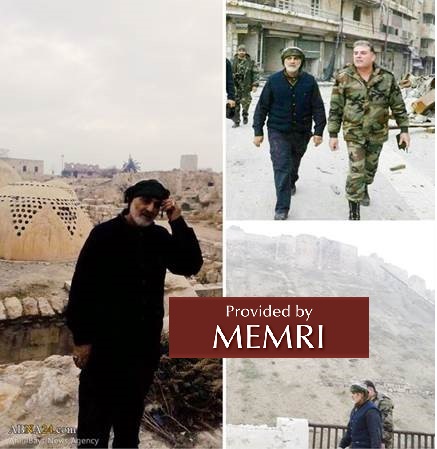
Several days after the Syrian regime and its allies retook eastern Aleppo, one of the Syrian opposition’s main remaining strongholds, with siege and heavy bombardment, the Iranian press published photos of Qassem Soleimani, the commander of Iran’s Qods Force, which is part of the Islamic Revolutionary Guard Corps (IRGC), as he toured the ruined city, including the medieval citadel at its center.

The photos enraged opponents of the resistance axis, which is headed by Iran and the Syrian regime. They perceived the photos as proof that Aleppo is now occupied by Iran and a signal that Iran is also aiming to occupy other cities in Arab countries, particularly in the Gulf. Articles in the Arab press, especially in the Gulf, called Soleimani a “modern-day Hitler,” and argued that the world is not stopping him, just as it had not stopped Hitler and other mass murderers in modern history.

6728aSoleimani tours Aleppo (Qasemsoleimani.ir, December 16, 2016)

Following are excerpts from major reactions in the Arab press to the photos of Soleimani in Aleppo:

Iran Is Signaling Its Intent To Occupy More Cities In The Middle East

Hamad Al-Majed, a Saudi columnist for the London-based daily Al-Sharq Al-Awsat, wrote: “The well-known photo of the Gen. Qassem Soleimani arrogantly walking the empty streets of Aleppo that his forces destroyed and whose residents they killed and expelled… is a massive propaganda message that Iran has leaked to the media, and holds within it thousands [more] messages. It is as if Soleimani, a military peacock arrogant over his victories, is muttering: ‘Yesterday we liberated Baghdad and the other Iraqi cities, and after that Sana’a [in Yemen], and after that we took over Beirut [in Lebanon], and today we are liberating Aleppo. It is only a matter of time before [we] dismantle the other cities in Syria, and then, sooner or later, you will see me strolling through the rubble of other Arab cities in the Middle East…”[1]

‘Ali Al-Husseini, a columnist for the Lebanese daily Al-Mustaqbal, which is affiliated with pro-Saudi and anti-Assad elements in Lebanon, wrote: “Two days ago, the Iranian expansion plan was revealed, [which has now] reached Aleppo after [reaching the Syrian cities of] Al-Qusayr, Al-Zabadani, and Madaya, [occupied by Hizbullah]. [What revealed this plan was] IRGC [Qods Force] commander Qassem Soleimani, who emerged strolling the neighborhoods of Aleppo that reek of destruction, witnessed the killing of children, and are littered with the bodies of dead residents. There is no doubt that this was a painful picture for residents of the city…

“With the aid and assistance of [Afghani, Pakistani, and Iraqi] mercenaries, Soleimani yesterday stepped on the body parts and in the blood of Aleppo residents, and also on the emotions of its orphaned children. This photo birthed, in their souls, a desire for vengeance, and a dream to return [to Aleppo] with fire in their eyes…”[2]

Arabs Should Awaken And Act – Because Iran Poses A Danger To The Gulf States

Saleh Al-Sheikhi, a columnist for the Saudi daily Al-Watan, called on Arabs to awaken and act, in light of what is perceived as an Iranian takeover of yet another Arab city. He wrote: “Two days ago, I stood for nearly an hour, no less, looking at the photo of Iranian commander Qassem Soleimani strolling through the streets of Aleppo – which are no longer streets but ruins and piles of rubble. I struggled, no less, to put out of my mind my visions of Soleimani’s false dreams about strolling through cities in the Gulf [countries]… I searched out society’s reaction to this shocking photo, and what I found was sad: [Instead of reactions to this photo, I found reactions to] Sheikh ‘Abdallah Al-Suwailem, [who,] with all the esteem in which I hold him and his colleagues, has launched an argument that is out of place, with his statement that a sexual relationship between family members who are prohibited from marrying each other is less [grave] than abandoning [the commandment] of prayer. This [statement of his] opinion triggered thousands of debates, tweets, recriminations, gossip, and widespread debates that preoccupied the public.

“Qassem Soleimani is strolling through Syria with his eye on the other Arab capitals – while Sheikh ‘Abdallah Al-Suwailem is arguing with the public on the issue of abandoning morning prayers and sexual relations between relatives who may not marry! If we do not act now and feel our important national responsibility, then when will we act?”[3]

Soleimani Is A “Modern-Day Hitler”; The World Is Not Stopping Him – Just As It Did Not Stop Hitler At The Time

Some resistance axis opponents called Soleimani a “modern-day Hitler,” and argued that the world is not acting to help the Syrian people, just as it did not act to help victims of other massacres throughout modern history. Lebanese MP Muhammad Kabbara, of the Al-Mustaqbal party, stated: “History will show that what happened in Aleppo has surpassed the myths of the Nazi crematoria. The coming generations will never forget that the Persians, Russians, and the Assad regime were the ones who conducted massacres in Aleppo. They will never forget the sight of the modern-day Hitler, Qassem Soleimani, touring, and gloating over, the ill-fated neighborhoods of Aleppo in the company of an officer from Assad’s [army].”[4]

Amr Hamzawy, a former Egyptian MP and a columnist for the London-based daily Al-Quds Al-Arabi, wondered: “Why does the world leave the Syrian people on its own to be massacred by the dictator Bashar Al-Assad, and by Russia and Iran, which sponsor him? Because our evil world only knows how to massacre the weak while turning them into the perpetual victims of criminals and tyrants…

“Any serious action to save Syrians from slaughter would be contrary to the norm in our world, [which kept silent in light of] the massacres of Armenians and Jews in Europe; the extermination of 27 million in the former Soviet Union during WWII, [and] the dropping of two atomic bombs on Japan on the pretext of ending World War II… Any true effort by those who monopolize the industries of weapons, killing, and bloodshed to stop the Syrian massacre would be a bizarre deviation from their past policy and conduct.

“In the late 1930s, didn’t the governments of Britain, France, and the Soviet Union make it possible for the Nazis to spread murder and destruction across several parts of Eastern Europe to avoid a fight, and out of concern for their own interests? Didn’t Hitler emerge due to global disregard for his first crimes, and [didn’t] U.S. neutrality cause him to carry out further attacks and crimes?… Don’t the photos of Nazi generals in areas destroyed by their weapons in Soviet cities… remind you of the photos of Soleimani in Aleppo a few days ago?…”[5]


Endnotes:


[1] Al-Sharq Al-Awsat (London), December 20, 2016.

[2] Al-Mustaqbal (Lebanon), December 18, 2016.

[3] Al-Watan (Saudi Arabia), December 19, 2016.

[4] Al-Mustaqbal (Lebanon), December 18, 2016.

[5] Al-Quds Al-Arabi (London), December 20, 2016.

The sorrow and the pity in Syria

December 21, 2016

The sorrow and the pity in Syria, Washington Times

(Please see also, Lies and Hypocrisy over Aleppo. — DM)

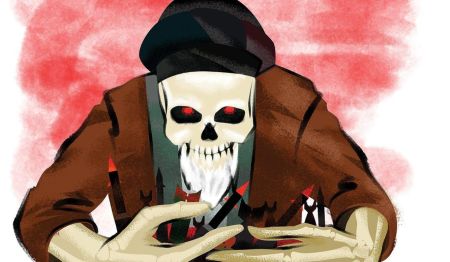
iraninsyriaIllustration on Iran’s future role in Syria by Linas Garsys/The Washington Times

ANALYSIS/OPINION:

Over the last five years, Syria has been descending into a hell on Earth. Over the last four months, the lowest depths of the inferno have been on display in Aleppo, an ancient city, once among the most diverse and dynamic in the Middle East. On Friday, in the final press conference of his presidency, Barack Obama addressed this still-unfolding humanitarian and strategic catastrophe.

“So with respect to Syria,” he said, “what I have consistently done is taken the best course that I can to try to end the civil war while having also to take into account the long-term national security interests of the United States.”

An estimated 500,000 dead, 11 million displaced, millions more living in fear, sorrow and pitiful poverty, Iranian forces backed by Russian forces occupying the heart of the Arab world — yet no-drama Mr. Obama remains so casual, so confident that the decisions he’s made were “the best” and, what’s more, that he made them “consistently.” Is refusing to change one’s mind as conditions worsen and policies fail really a virtue?

To bolster his case, the president emphasized that he has spent lots of time — “if you tallied it up, days and weeks” — attending meetings on Syria. “We went through every option in painful detail with maps,” he said, “and we had our military and we had our aid agencies and we had our diplomatic teams, and sometimes, we’d bring in outsiders who were critics of ours.” Imagine that: painful detail, maps, aid agencies, even critical outsiders.

Count me among those not convinced. In 2011, during that hopeful moment known as the Arab Spring, peaceful protesters took to the streets of Damascus. The dynastic dictator Bashar Assad responded brutally. Before long, a civil war was ignited.

Mr. Obama’s top advisers recommended assisting non-Islamist and nationalist rebels — not with the proverbial boots on the proverbial ground but with secure communications devices, money, weapons and training. Mr. Obama rejected that advice. He had done the math: Mr. Assad, a member of the Alawite minority, hadn’t enough loyal troops to prevail against Syria’s insurgent Sunni majority. So the fall of the Assad regime had to be both inevitable and imminent.

What that failed to take into account: Iran’s theocrats would send in foreign Shia fighters, including those of Hezbollah, their Lebanese proxy, all under the leadership of their Islamic Revolutionary Guard Corps. Vladimir Putin also would deploy forces in support of the Assad regime. We can surmise his reasons: to have a Mediterranean port for his navy; to re-establish Russia’s influence in the Middle East; to show the world that, unlike Mr. Obama, he does not abandon his friends; to diminish American credibility and prestige.

Mr. Obama’s response was, as it so often is, mainly rhetorical. He warned Mr. Putin that he was stepping into a quagmire. He proclaimed, as so he often does, that there can be “no military solution.”

The Russian president, a product of the KGB rather than the faculty lounge, knew that was nonsense. In the Middle East, the law of the jungle trumps international law every time.

Having accused President George W. Bush of overreach, Mr. Obama adopted a policy that might be called underreach. He decided not to enforce the “red line” he had declared against Mr. Assad’s use of chemical weapons. He decided not to eliminate Mr. Assad’s air power, which would have ended the barrel-bombing of civilians. He wasn’t even willing to help establish “safe zones” where innocent Syrians might stand a chance to defend themselves.

I know: Mr. Obama saw his mission as ending wars and certainly not risking additional American entanglements. And he is among those who believe that the projection of American power generally does more harm than good.

Not mutually exclusive is the theory that he had a specific goal in mind: to bring Iran’s rulers into a strategic partnership with the United States. To achieve that, he had to demonstrate that he respected what he has called their “equities” in Syria. Were he to take action against Mr. Assad, the Islamic republic’s envoys might walk away from the table where they were negotiating the nuclear weapons deal Mr. Obama envisioned as his great foreign policy legacy.

The president has been nothing if not “consistent” in his pursuit of detente with Iran’s Islamic revolutionaries. In all likelihood, that is what explains his decision, just after taking office, to turn a blind eye to the clerical regime’s ruthless repression of the Green Movement that took to the streets of Iranian cities following a rigged presidential election in 2009.

History will record that these efforts failed. Nixon went to China. Mr. Obama will not be going to Iran — or to Syria, which Iran intends to incorporate into its version of a caliphate (which Shia call an “imamate”).

Aleppo,” U.S. Ambassador Samantha Power said last week at the U.N., “will join the ranks of those events in world history that define modern evil, that stain our conscience decades later. Halabja, Rwanda, Srebrenica, and, now, Aleppo. To the Assad regime, Russia, and Iran, your forces and proxies are carrying out these crimes.”

She went on to ask: “Are you truly incapable of shame? Is there literally nothing that can shame you? Is there no act of barbarism against civilians, no execution of a child that gets under your skin?”

Would it be unfair to suggest that the answers to these questions should have been apparent to her and the president years ago? Had that been the case, perhaps they would have formulated different policies and implemented a different course of action. Or perhaps not.

Iran and the Houthis of Yemen

November 29, 2016

Iran and the Houthis of Yemen, Front Page MagazineJoseph Puder, November 29, 2016

shia

Lt. Gen. Sir Graeme Lamb, former head of U.K. Special Forces, wrote in The Telegraph (September 2, 2016), “Iran’s involvement in Yemen must be seen in the broader context of its strategy of challenging the existing Middle East order by generating unrest, which then allows it to maneuver an advantage through the resulting uncertainty.  Iranian military forces and their proxies predominate in Iraq and Syria, while other proxies have a long history of involvement in Lebanon and Gaza.  Nor are these forces likely to leave the region when the immediate threats such as ISIL (Islamic State in Iraq and the Levant) are pushed underground or displaced, as we, the West, will.” 

*******************

Arab News has reported on November 23, 2016 that Yemen’s Houthi rebels and supporters of the former Yemeni President Ali Abdullah Saleh are responsible for the killing of 9,646 civilians.  8,146 of them men, 597 women, and 903 children, from January 1, 2015 to September 30, 2016 in 16 Yemeni provinces.  According to Shami Al-Daheri, a military analyst and strategic expert, the Houthis are being led by Iran and follow Tehran’s orders.  “They are moving in Yemen, Iraq, and Syria following Tehran’s orders.  If the country sees there is pressure on its supporters in Iraq, it issues orders to the Houthis in Yemen to carry out more criminal acts in order to divert attention and ease pressure on its proxies in these countries.”

The brutality of the Iran led campaign in Syria, and U.S. voices calling for some form of intervention, might have prompted Tehran to give the Houthis a green light to attack American naval ships. The Houthis fired three missiles at the U.S. Navy ship USS Mason last month, in all probability following Tehran’s orders. In retaliation, U.S. Navy destroyer USS Nitze launched Tomahawk cruise missiles, destroying three coastal radar sites in areas of Yemen controlled by the Houthis.  These radar installations were active during previous attacks, and attempted attacks on ships navigating the Red Sea. The USS Mason did not sustain any damage.  U.S. Army Gen. Joseph Votel, the top American commander in the Middle East, said that he suspected Iran’s Shiite Islamic Republic to be behind the twice launched missiles by the Houthi rebels against U.S. ships in the Red Sea.

Al-Arabiya TV (August 16, 2016) claimed that Iran’s Islamic Republic News Agency (IRNA) said that missiles made in Tehran were also recently used in Yemen by Houthi militias in cross border attacks against Saudi Arabia.  The Saudis it seems, were able to intercept the Iranian manufactured Zelzal-3 rockets, also delivered to Hezbollah in Lebanon, and Assad regime forces in Syria.  The rockets were fired into the Saudi border city of Najran, according to the official Saudi Press Agency.  The Saudi-led coalition has been targeting the Houthis in an effort to restore the internationally-recognized Yemeni president, Abd Rabbuh Mansour Hadi.

The conflict in Yemen has its recent roots in the failure of the political transition that was supposed to bring a measure of stability to Yemen following an uprising in November, 2011 (The Year of the Arab Spring) that forced its longtime authoritarian president, Ali Abdullah Saleh, to hand over power to his deputy, Abd Rabbuh Mansour Hadi.  President Hadi had to deal with a variety of problems, including attacks by al-Qaeda, a separatist movement in the South, the loyalty of many of the army officers to the former President Saleh, as well as, unemployment, corruption, and food insecurity.

The Zaidi-Shiite Houthi minority captured Yemen’s capital Sanaa on September 21, 2014. They were helped by the Islamic Republic of Iran, who have provided the rebel Houthis with arms, training, and money.  As fellow Shiite-Muslims, the Houthis became another Iranian proxy harnessed to destabilize the Sunni-led Arab Gulf states, and Saudi Arabia.  Since 2004, the Houthis have fought the central government of Yemen from their stronghold of Saadah in northern Yemen.  The Houthis are named after Hussein Badreddin al-Houthi, who headed the insurgency in 2004 and was subsequently killed by Yemeni army forces.  The Houthis, who are allied with Ali Abdullah Saleh, against Abd Rabbuh Mansour Hadi, the legitimate President of Yemen, have the support of many army units and control most of the north, including the capital, Sanaa.

The Houthis launched a series of military rebellions against Ali Abdullah Saleh in the previous decade. Recently, sensing the new president’s (Hadi) weakness, they took control of their Northern heartland of Saadah province and neighboring areas.  Disillusioned by the transition of power and Hadi’s weakness, many Yemenis, including Sunnis, supported the Houthi onslaught.  In January, 2015, the Houthis surrounded the Presidential palace in Sanaa, placing President Hadi and his cabinet under virtual house arrest. The following month, President Hadi managed to escape to the Southern port city of Aden.

Yemen is another flashpoint in the conflict between Shiite-Muslim Iran and Sunni-Muslim Saudi Arabia, over regional power and influence.  Sanaa, along with Baghdad, Damascus, and Beirut are Arab capitals now forming the so called Shiite “arc of influence.”   In Baghdad, the site of the Abbasid Sunni Caliphate, the Shiites dominate the government of Haider al-Abadi.  In Damascus, the capital of the Umayyad Sunni Caliphate, Bashar Assad, an Alawi (offshoot of Shiite Islam) dictator, is ruling over a Sunni majority in a state of civil war.  Iran, its Revolutionary Guards, Iraqi Shiite militias, and the Lebanese Shiite proxy Hezbollah, are fighting Sunni Islamists, and genuine Syrian Sunnis, who are frustrated with being ruled by a minority dictator.  Beirut is dominated by Hezbollah, the only group allowed to carry arms, whose power exceeds that of the Lebanese army, and whose masters in Tehran set its priorities.

Lt. Gen. Sir Graeme Lamb, former head of U.K. Special Forces, wrote in The Telegraph (September 2, 2016), “Iran’s involvement in Yemen must be seen in the broader context of its strategy of challenging the existing Middle East order by generating unrest, which then allows it to maneuver an advantage through the resulting uncertainty.  Iranian military forces and their proxies predominate in Iraq and Syria, while other proxies have a long history of involvement in Lebanon and Gaza.  Nor are these forces likely to leave the region when the immediate threats such as ISIL (Islamic State in Iraq and the Levant) are pushed underground or displaced, as we, the West, will.”

Gen. Lamb asserted that “the tragedy of Yemen is that it has become, over the decades, a sphere of contested influence between the grand masters of Empire and superpowers: East against West, Communism versus Capitalism.  Today, it is Iranian backed Shiite revivalism against Sunni status quo, an emerging order versus an existing order.”  According to Gen. Lamb, Tehran has dissuaded the Houthis from accepting a U.N. peace plan in favor of creating its own “supreme political council” to challenge the legitimate Yemeni government of Abdrabbuh Mansour Hadi.

It is tempting for Tehran to enter the exposed underbelly of Saudi Arabia though the Houthis control of Northern Yemen, bordering Saudi Arabia. It is however, too expensive a proposition for the Islamic Republic to have to fund another proxy – a failing state like Yemen.  While Hezbollah requires millions of dollars in support, Yemen would require billions.  Iran is spending a great deal in support of the Assad regime in Syria, Hamas in Gaza, and loyalist Iraqi Shiite militias.  Iran would nevertheless like to control the sea lanes into the Red Sea and have access to the Bab Al Mandeb strait, which connects the Red Sea to the Gulf of Aden.  This would provide it with a strategic vantage point in threatening the U.S. and the West.

Iran’s meddling in Yemen is another example of its Shiite revivalism, and its challenge of the existing Middle East order, regardless of the cost in human lives that its proxies (Houthis, Hezbollah, Hamas, and Iraqi Shiite militias) are inflicting.

El-Sissi against the Arab world

October 31, 2016

El-Sissi against the Arab world, Israel Hayom, Dr. Reuven Berko, October 31, 2016

(How different would the situation be now if Obama, Clinton et al had supported Sisi’s “coup” rather than Morsi and the Muslim Brotherhood? — DM)

The attitude of the Arab Gulf states toward Egypt under President Abdel-Fattah el-Sissi is a good example of the insanity of considerable parts of the Arab world, whose twisted suicidal reasoning is unclear to many people outside it.

Given the American wipeout in the Middle East, leaders of the Persian Gulf states are very well aware that the only support they can expect against the expected Iranian aggression on the Arabian Peninsula comes from Egyptian military might. Nevertheless, megalomania, hypocrisy, double talk, and in particular a divisive and violent radical Islamist agenda are leading the Arab leaders to saw off the very branch they sit on.

The competition for hegemony, a tangle of conflicting economic and political interests and defensive manipulations, along with drives for expansion and survival, are leading the Gulf states to arm and fund the radical Sunni terrorist movements in Syria and Iraq to check the growth and terrorism of Shiite Iran, whose military provocations and threat to the Sunni Arab Gulf states is increasing.

But in effect they are encouraging Islamic terrorism in Egypt.

Turkey and Qatar have not accepted the loss of former President Mohammed Morsi and the Muslim Brotherhood, and have not relinquished their dream of an Islamic empire. The Saudis, because of their money, reject Egypt as the “Arab mother state.” Mistaken U.S. policy confers transient status on el-Sissi’s regime. All of Egypt’s attempts to ingratiate itself with Saudi Arabia — the military guarantees, the delegations, and the gifts of the Tiran and Sanafir islands — failed to do the trick.

There is an Arab proverb that says, “Starve your dog so he will obey you.” While battling Iran, the Gulf states are inciting for el-Sissi to be ousted while supplying stingy amounts of money and fuel just to humiliate him and keep him “alive,” beaten, and needy — a thug who can attack Tehran for them. While the Al Jazeera network presents the Egyptian president as a sex criminal, an agent of Iran, Israel, and America, a corrupt official who sells weapons to the Houthi rebels in Yemen, the Egyptian government is vulnerable to incitement and terrorism from the Muslim Brotherhood and their protectors in the Gulf (Al Jazeera), flooding, monstrous demographics (thanks to the Islamic ban on birth control), inflation, shortages of fuel, sugar, rice and raw materials, as well as the threat of the water level in the Nile River dropping and a hit to its $55 billion tourism industry.

To encourage his suffering, restive, exposed-to-incitement people, el-Sissi told them that he lived for a decade with nothing in the refrigerator other than a bottle of water. In response, the Saudi king mocked him, delayed shipments of fuel and visas to Saudi Arabia for Egyptians and made threats that el-Sissi would fall, like then-President Hosni Mubarak. In response to the intra-Arab scheming, el-Sissi invited the Russians to conduct a joint military exercise and recently voted against the Arabs — and with Iran, Russia and Syria — in the U.N. Security Council on a solution to the Syrian crisis, knowing that the fall of Syrian President Bashar Assad and the success of the Islamists would make him the next target. If the Gulf states don’t change their policy soon, they’ll wind up getting a refrigerator full of explosives from him.

Brutal ISIS Executions, Military Weakness, and A New Refugee Crisis

October 4, 2016

Brutal ISIS Executions, Military Weakness, and A New Refugee Crisis, Counter Jihad, October 4, 2016

islsttflag

 Increasingly Russia and their Iranian allies are looking likely to dominate the northern Middle East from Afghanistan to the Levant.  This President has been badly outmaneuvered.  The next President will have to decide how much he or she is willing to risk in order to try to deal with the feeding of “jihadism… by war and state failure.”

******************

The Islamic State (ISIS) has delivered a new propaganda video showing another gruesome mass execution of fellow Muslims.  The group proclaims that the video should serve as a warning to any Muslims thinking of coming to join any of the rebel armies fighting against them in the conflict.  Amid Nazi salutes, ISIS soldiers clad in stolen American-made 3 color DCU uniforms promised to fight the “apostates” whom they painted as being on the same side as the Americans.

Yet the Americans have done but little to support any allies in the region.  As the Economist notes, US President Barack Obama has kept American forces largely out of the conflict except in an advisory role.  This is because, they explain, he views an American intervention as likely to cause more harm than good.  His policy has been throughout “cool,” “rational,” and “wrong.”

As America has pulled back, others have stepped in—geopolitics abhors a vacuum. Islamic State (IS) has taken over swathes of Syria and Iraq. A new generation of jihadists has been inspired to fight in Syria or attack the West. Turkey, rocked by Kurdish and jihadist violence (and a failed coup), has joined the fight in Syria. Jordan and Lebanon, bursting with refugees, fear they will be sucked in. The exodus of Syrians strengthens Europe’s xenophobic populists and endangers the European Union. A belligerent Russia feels emboldened….

None of this is in America’s interest. Being cool and calculating is not much use if everybody else thinks you are being weak. Even if America cannot fix Syria, it could have helped limit the damage, alleviate suffering and reduce the appeal of jihadism…. Mr Obama says that Mr Assad eventually must go, but has never willed the means to achieve that end. (Some rebel groups receive CIA weapons, but that is about it.)… [J]ihadism is fed by war and state failure: without a broader power-sharing agreement in Syria and Iraq any victory against IS will be short-lived; other jihadists will take its place.

Russia has been building pressure on the Obama administration in other ways.  Since the suspending of talks between the US and Russia, the Putin administration has announced major nuclear war games that will move tens of millions of people to civil defense shelters on very short notice.  They have suspended nuclear arms deals with the United States involving plutonium cleanup, suggesting that they fear the US will cheat.  The Russians have also deployed one of their advanced missile systems outside of their homeland for the first time.  The deployment was made without comment, but as one American official noted wryly, ““Nusra doesn’t have an air force do they?”  Al Nusra Front is an al Qaeda linked organization that has been sometimes allied with, but more often at war with, the Islamic State.

All of this means that America’s window to take a more aggressive approach may be closing, if it has not already closed.  Increasingly Russia and their Iranian allies are looking likely to dominate the northern Middle East from Afghanistan to the Levant.  This President has been badly outmaneuvered.  The next President will have to decide how much he or she is willing to risk in order to try to deal with the feeding of “jihadism… by war and state failure.”

The threat is very real, as estimates are that the assault on Mosul might produce another million refugees headed for Europe and America, orperhaps half again that many.  The failure to take a more aggressive approach may end up bringing a flood tide of human suffering and terror.

Column One: The New Middle East

September 29, 2016

Column One: The New Middle East, Jerusalem PostCaroline B. Glick, September 29, 2016

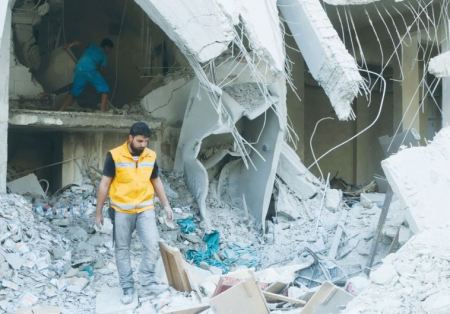
aleppo-messA RED CRESCENT aid worker inspects scattered medical supplies after an air strike on a medical depot in Aleppo on Saturday.. (photo credit:REUTERS)

So Obama let Syria burn. He let Iran and Hezbollah transform the country into their colony. And he let Putin transform the Mediterranean into a Russian lake.

A new Syria is emerging. And with it, a new Middle East and world are presenting themselves. Our new world is not a peaceful or stable one. It is a harsh place.

The new Syria is being born in the rubble of Aleppo.

The eastern side of the city, which has been under the control of US-supported rebel groups since 2012, is being bombed into the Stone Age by Russian and Syrian aircraft.

All avenues of escape have been blocked. A UN aid convoy was bombed in violation of a fantasy cease-fire.

Medical facilities and personnel are being targeted by Russia and Syrian missiles and barrel bombs to make survival impossible.

It is hard to assess how long the siege of eastern Aleppo by Russia, its Iranian and Hezbollah partners and its Syrian regime puppet will last. But what is an all but foregone conclusion now is that eastern Aleppo will fall. And with its fall, the Russian-Iranian-Hezbollah-Assad axis will consolidate its control over all of western Syria.

For four years, the Iranians, Hezbollah and Bashar Assad played a cat and mouse game with the rebel militias.

Fighting a guerrilla war with the help of the Sunni population, the anti-regime militias were able to fight from and hide from within the civilian population. Consequently, they were all but impossible to defeat.

When Russian President Vladimir Putin agreed to join the fight, he and his generals soon recognized that this manner of fighting ensured perpetual war. So they changed tactics. The new strategy involves speeding up the depopulation and ethnic cleansing of rebel-held areas. The massive refugee flows from Syria over the past year are a testament to the success of the barbaric war plan. The idea is to defeat the rebel forces by to destroying the sheltering civilian populations.

Since the Syrian war began some five years ago, half of the pre-war population of 23 million has been displaced.

Sunnis, who before the war comprised 75% of the population, are being targeted for death and exile. More than 4 million predominantly Sunni Syrians are living in Turkey, Lebanon and Jordan. More than a million have entered Europe. Millions more have been internally displaced. Assad has made clear that they will never be coming home.

At the same time, the regime and its Iranian and Hezbollah masters have been importing Shi’ites from Iran, Iraq and beyond. The process actually began before the war started. In the lead-up to the war some half million Shi’ites reportedly relocated to Syria from surrounding countries.

This means that at least as far as western Syria is concerned, once Aleppo is destroyed, and the 250,000 civilians trapped in the eastern part of what was once Syria’s commercial capital are forced from their homes and property, the Russians, Iranians, Hezbollah and their Syrian fig leaf Assad will enjoy relative peace in their areas of control.

By adopting a strategy of total war, Putin has ensured that far from becoming the quagmire that President Barack Obama warned him Syria would become, the war in Syria has instead become a means to transform Russia into the dominant superpower in the Mediterranean, at the US’s expense.

In exchange for saving Assad’s neck and enabling Iran and Hezbollah to control Syria, Russia has received the capacity to successfully challenge US power. Last month Putin brought an agreement with Assad before the Duma for ratification. The agreement permits – indeed invites – Russia to set up a permanent air base in Khmeimim, outside the civilian airport in Latakia.

Russian politicians, media and security experts have boasted that the base will be able to check the power of the US Navy’s Sixth Fleet and challenge NATO’s southern flank in the Mediterranean basin for the first time. The Russians have also decided to turn their naval station at Tartus into something approaching a fullscale naval base.

With Russia’s recent rapprochement with Turkish President Recip Erdogan, NATO’s future ability to check Russian power through the Incirlik air base is in question.

Even Israel’s ability to permit the US access to its air bases is no longer assured. Russia has deployed air assets to Syria that have canceled Israel’s regional air superiority.

Under these circumstances, in a hypothetical Russian-US confrontation, Israel may be unwilling to risk Russian retaliation for a decision to permit the US to use its air bases against Russia.

America’s loss of control over the eastern Mediterranean is a self-induced disaster.

For four years, as Putin stood on the sidelines and hedged his bets, Obama did nothing. As Iran and Hezbollah devoted massive financial and military assets to maintaining their puppet Assad in power, the Obama administration squandered chance after chance to bring down the regime and stem Iran’s regional imperial advance.

For his refusal to take action when such action could have easily been taken, Obama shares the responsibility for what Syria has become. This state of affairs is all the more infuriating because the hard truth is that it wouldn’t have been hard for the US to defeat the Iranian- Hezbollah axis. The fact that even without US help the anti-regime forces managed to hold on for four years shows how weak the challenge posed by Iran and Hezbollah actually was.

Russia only went into Syria when Putin was absolutely convinced that Obama would do nothing to stop him from dislodging America as the premier global power in the region.

As Michael Ledeen recalled earlier this week, Obama chose to stand on the sidelines in Syria because he wanted to make friends with Iran. Obama began his secret courtship of the mullahs even before he officially took office eight years ago.

After the war broke out in Syria, midway through his first term and in the following years, the Russians and the Iranians told the obsessed American president that if he took action against Assad, as strategic rationality dictated, he would get no nuclear deal, and no rapprochement with Tehran.

So Obama let Syria burn. He let Iran and Hezbollah transform the country into their colony. And he let Putin transform the Mediterranean into a Russian lake. Obama enabled the ethnic cleansing of Syria’s Sunni majority, and in turn facilitated the refugee crisis that is changing the face not only of the Middle East but of Europe as well.

And as it turns out, the deal with Iran that Obama willingly sacrificed US control of the Mediterranean to achieve has not ushered in a new era of regional moderation and stability through appeasement as Obama foresaw. It has weakened US credibility with its spurned Sunni allies. It has undermined the strategic position of Israel, the US’s only stable and reliable regional ally. It has financially and strategically fueled Iran’s hegemonic rise throughout the region. And it has facilitated Iran’s development of a nuclear arsenal.

Far from causing the Iranian to become more moderate, the nuclear deal has radicalized the regime still further.

On Wednesday Ray Takeyh wrote in The Washington Post that Supreme Leader Ali Khamenei is now grooming Ibrahim Raisi, a fanatic who makes Khamenei look moderate, to succeed him in power.

On Monday night, for the first time, Israel Air Force jets flying over Syria were shot at by Syrian anti-aircraft ordnance.

Air force sources told the media that the aircraft were never in danger and the munitions were only shot off after the aircraft had returned to Israel and were in the process off landing.

The fact that no one was hurt is of course reassuring.

But the fact that Russia targeted the planes makes clear that Putin has decided to send Israel a very clear and menacing message.

He is now the protector of the Iranian-Hezbollah colony on our northern border. If Israel decides to preemptively attack targets belong to that colony, Russia will not stand by and watch. And with the US no longer well-positioned to challenge Russian power in the region, Israel will have to deal with Russia on its own.

To face this challenge, Israel needs to look beyond its traditional reliance on air power.

There are two parts of the challenge. The first part is Iran.

As far as Israel is concerned, the problem with the Russian- Iranian takeover of Syria is not Putin.

Putin is not inherently hostile to Israel, as his Soviet predecessors were. He is an opportunist. Obama gave him the opportunity to partner with Iran in asserting Russian dominance in the Middle East and he took it. Israel is threatened by the alliance because it is threatened by Iran, not by Putin. To neutralize the alliance’s threat to its own security, Israel then needs to degrade Iran’s power, and it needs to emphasize its own.

To accomplish these goals, Israel needs to operate in two completely separate arenas. To weaken Iran, Israel should take its cue from Iran’s Revolutionary Guard Corps, and from its own past successful military ties to the Kurds of Iraq in the 1960s and 1970s.

Israel needs to deploy military trainers beyond its borders to work with other anti-Iranian forces. The goal of that cooperation must be to destabilize the regime, with the goal of overthrowing it. This may take time. But it must be done. The only way to neutralize the threat emanating from the new Syria is to change the nature of the Iranian regime that controls it.

As for Russia, Israel needs to demonstrate that it is a power that Putin can respect in its own right, and not a downgraded Washington’s sock puppet.

To this end, Israel should embark on a rapid expansion of its civilian presence along its eastern border with Syria and with Jordan. As Russia’s air base in Syria undermines Israel’s air superiority and reliance on air power, Israel needs to show that it will not be dislodged or allow its own territory to be threatened in any way. By doubling the Israeli population on the Golan Heights within five years, and vastly expanding its population in the Jordan Valley, Israel will accomplish two goals at once. It will demonstrate its independence from the US without harming US strategic interests. And it will reinforce its eastern border against expanded strategic threats from both the Golan Heights and the new Jordan with its bursting population of Syrian and Iraqi refugees.

It is ironic that the new Middle East is coming into focus as Shimon Peres, the failed visionary of a fantasy- based new Middle East, is being laid to rest. But to survive in the real new Middle East, Israel must bury Peres’s belief that peace is built by appeasing enemies along with him. The world in which we live has a place for dreamers.

But dreams, unhinged from reality, lead to Aleppo, not to peace.
Khamenei on WWII: Iran Must Not Go the Way of Germany and Japan Khamenei on WWII: Iran Must Not Go the Way of Germany and Japan

September 29, 2016

Khamenei on WWII: Iran Must Not Go the Way of Germany and Japan  Khamenei on WWII: Iran Must Not Go the Way of Germany and Japan, Israel National News, Col (res.) Dr. Eran Lerman, September 29, 2016

Speaking on September 18, 2016 before commanders of Iran’s Revolutionary Guards Corps (IRGC), the Supreme Leader of Iran launched into a bitter polemic against Rafsanjani’s call to invest more in the economy and less in military build-up. (Ref. MEMRI translation and analytical observations.) The IRGC, Khameini declared, is the key to the success of the revolutionary project. Deterrence can only be achieved if fear of Iran’s raw power is instilled in the hearts of her enemies. Neither the JCPOA (the nuclear deal between Iran and the P5+1 powers) in itself, nor a shift in strategy to more civilian pursuits, can protect Iran. The revolution must be translated into military might.

At this point in the speech, Khameini offered a fascinating point of reference. Look, he suggested, at Germany and Japan at the end of World War II: forced into submission, humiliated, and required to disarm. He made no effort to hide his sympathy. As far as Khameini is concerned, the bad guys won and the good guys lost in 1945, and the time has come to overthrow the entire post-war dispensation.

Speaking on September 18, 2016 before commanders of Iran’s Revolutionary Guards Corps (IRGC), the Supreme Leader of Iran launched into a bitter polemic against Rafsanjani’s call to invest more in the economy and less in military build-up. (Ref. MEMRI translation and analytical observations.) The IRGC, Khameini declared, is the key to the success of the revolutionary project. Deterrence can only be achieved if fear of Iran’s raw power is instilled in the hearts of her enemies. Neither the JCPOA (the nuclear deal between Iran and the P5+1 powers) in itself, nor a shift in strategy to more civilian pursuits, can protect Iran. The revolution must be translated into military might.

At this point in the speech, Khameini offered a fascinating point of reference. Look, he suggested, at Germany and Japan at the end of World War II: forced into submission, humiliated, and required to disarm. He made no effort to hide his sympathy. As far as Khameini is concerned, the bad guys won and the good guys lost in 1945, and the time has come to overthrow the entire post-war dispensation.

This position is, after all, in line with Iran’s denial of the Holocaust (recall the caricature competition designed to denigrate and diminish it) and exterminatory stand towards Israel. It is not the personal quirk of Ahmadinejad, who was, in fact, just told by the Leader that he will not be allowed to run for president again this time. It is the position of Khamenei himself and of Khomeini before him: “Khatt al-Imam,” the line of the Imam, the ultimate imperative of the revolutionary regime.

According to this line, Iran has a religious (or, rather, ideological) imperative to reject all Western mores. For this to be possible, the Revolution, even more than the State as such, must position itself as a strong military power in regional and global affairs. The alternative is unthinkable. The “values” the West and the US seek to impose include utterly base and noxious notions like homosexuality (with which Iran’s present leaders are apparently obsessed). Military weakness would lead to moral weakness, a “cultural invasion,” and the loss of all that Khameini and Khomeini have sought to establish.

Khameini told his audience that there are misguided souls in Iran who seek to negotiate with the US even as the Americans themselves seek a dialog with Iran on regional affairs (e.g., on Syria, Lebanon, Iraq and Yemen). He rejects this quest not only as poisonous for Iran, but as evidence that America is now a spent force.

With that American weakness in mind, the Iranian leadership is now openly calling for the total destruction of Wahhabism (read: the Saudi state). It makes this call while complaining, as did Foreign Minister Zarif in an op-ed at The New York Times, that “big money is being used to whitewash terrorism.” This claim is, of course, extremely rich to anyone with even a smattering of knowledge about Iran’s behavior in recent years.

Iranian arrogance is thus on the rise in the post-deal era, and with it Iran’s hope of steadily undoing Israel and undermining regional and global stability until the true Imam or Mehdi appears on earth. Meanwhile, as Saudi Foreign Minister Adel Jubayr wrote in response to Zarif, it is Iran that remains at the top of the terror lists. It is Iran’s ally in Syria, with the help of Iran’s proxies in Lebanon, who is now engaging in unprecedented acts of carnage in Aleppo.

The Leader’s extolling of military might is thus frightening to all in the region, even as Tehran tries to present itself as the voice of reason in the struggle against the Islamic State (Iran was quick to denounce the assassination in Amman this week of a Christian journalist who “insulted” the IS radicals).

There could be an opportunity here. Neither candidate for the US presidency seems to have bought into the strange notion, implicit (and at times explicit) in the positions taken by Obama and his inner circle, that Iran can serve as a useful counterweight to other forces in the region. Nor have they bought (yet) into the delusion that Iran’s revolutionary impulse can be assumed to be benign. The US is thus still able to think of Iran as an enemy, which it is.

If so, the domestic tension and turmoil over the unfulfilled promise of economic relief, and over Khamenei’s demand for more and more sacrifices by the people (a “resistance economy,” as he calls it) can provide fertile ground for destabilization of the Iranian regime. Such an opportunity was lost in 2009. It need not be lost again.

Iran and the future of the Middle East

September 2, 2016

Iran and the future of the Middle East, Israel Hayom, Clifford D. May, September 2, 2016

U.S. President Richard Nixon went to China. President Barack Obama will not be going to Iran.

Nixon’s 1972 visit to the people’s republic included meetings with both Chairman Mao Zedong, the communist revolutionary leader, and Premier Zhou Enlai, the pragmatic head of the government. Detente and normalization of relations followed.

By stark contrast, Ayatollah Ali Khamenei, the Islamic republic’s revolutionary supreme leader, and Hassan Rouhani, the pragmatic president of the theocratic regime, will not deign even to share a bottle of pomegranate juice with Obama, president of “satanic” America, their avowed enemy.

Obama appears unperturbed, confident that detente and normalization of relations — not to mention a more stable Middle East — lie at the end of the road he began to pave with his 2015 Joint Comprehensive Plan of Action, a nuclear deal that garnered neither Congress’ endorsement nor the public’s approval.

The fraught controversy over how we got to this point and where we’re heading is the subject of a new book: “The Iran Wars: Spy Games, Bank Battles, and the Secret Deals that Reshaped the Middle East,” by Jay Solomon, chief foreign affairs correspondent for The Wall Street Journal.

What I found striking in this first draft of contemporary history: the opportunities Obama missed — or, more precisely, dismissed. In 2009, the brutish Mahmoud Ahmadinejad was declared the winner of presidential elections that were not just manipulated by Khamenei — that’s standard procedure — but almost certainly falsified as well. Iranians went out into the streets chanting “Death to the dictators!” and “President Obama, are you with us or against us?”

According to Solomon, not only did Obama refuse to support them, he ended programs to document Iranian human rights abuses and ordered the CIA to turn its back on the Green Movement. “The agency has contingency plans for supporting democratic uprisings anywhere in the world,” Solomon writes. “This includes providing dissidents with communications, money, and in extreme cases even arms. But in this case the White House ordered it to stand down.”

Obama also was unenthusiastic about sanctions. He and Secretary of State John Kerry believed that showing Iran’s rulers respect and engaging them in dialogue would be sufficient to mitigate their animosity and bellicosity. “So many wars have been fought over misunderstandings, misinterpretations, lack of effective diplomacy,” Kerry told Solomon in a 2016 interview. “War is the failure of diplomacy.”

I suspect Clausewitz and Sun Tzu would beg to differ. More to the point, quite a few members of Congress, including such Republicans as Mark Kirk, Ed Royce and Ileana Ros-Lehtinen, and such Democrats as Bob Menendez, Eliot Engel and Howard Berman, were convinced that talking softly was not enough, that when dealing with Iran’s rulers it was necessary to carry a sizeable stick. Solomon notes that congressional staffers partnered with several Washington think tanks to find “new ways to squeeze Iran’s oil profits and ability to conduct financial transactions.”

In particular, he adds, a “lethal weapon” came from the Foundation for Defense of Democracies (the think tank I founded after 9/11/01 and where I serve as president) which “focuses on combating Middle East extremism and, in particular, promoting the security of the United States, Israel and other democracies threatened by radical Islam.” FDD’s executive director, Mark Dubowitz, and his Farsi-speaking research team “provided a constant stream of reports to U.S. lawmakers on Iranian companies and individuals that they believed should be sanctioned for their roles in developing Iran’s nuclear program.”

Eventually, Dubowitz, working with Senator Kirk’s then deputy chief of staff Richard Goldberg, came up with a “financial bomb”: a Belgium-based financial firm called SWIFT “which hosts the international computer network that facilitates virtually every banking transaction in the world through an extensive messaging and financial tracking system.” The Obama administration opposed expelling Iran from SWIFT but “Congress once again overrode the White House’s concerns and unanimously passed” legislation in 2012 that “de-SWIFTed” Tehran.

By 2013, such measures, “were crippling Iran’s economy.” Had the pressure been intensified — or even just maintained — who knows what concessions Iran’s rulers might have made to avoid economic crisis and collapse? But Obama eased up on Iran in exchange for an interim agreement. After that, few if any Iranian concessions were forthcoming. Khamenei insisted that his red lines be observed while those laid down by Obama were transgressed — one after another.

In the end, Iran would not even have to acknowledge that it ever had a nuclear weapons program, much less reveal how far that program had progressed. Nevertheless, the Obama administration would agree that Iran “be allowed to build an industrial-scale nuclear program, with hundreds of thousands of machines, after a ten year period of restraint.”

“I have no doubt we avoided a war,” Kerry told the author in an interview early this year. He could be right. Alternatively, what he sees as avoidance could turn out to be only postponement.

Based on faith rather than evidence, Kerry and Obama believe that the Islamic republic will moderate; that it will give up its ambition of establishing a vast new Islamic empire; that it will no longer dream of bringing “death” to America, Israel, Saudi Arabia and other “infidel” nations; that it will not evolve into a more formidable and lethal adversary.

“Obama has wagered that Khamenei and his revolutionary allies won’t outlast the terms of the nuclear agreement,” Solomon concludes. “If they do, the United States risks unleashing an even larger nuclear cascade on the Middle East.” Yes, that’s the wager. Seems like a long shot to me.

Iranian Dissidents Visit Israel, View Iran after the Nuclear Deal

August 21, 2016

Iranian Dissidents Visit Israel, View Iran after the Nuclear Deal, Jerusalem Center via YouTube, August 21, 2016

https://www.youtube.com/watch?v=A4T8EpiqIVs