Posted tagged ‘Iran and Israel’

Syrian/Hizballah troops cross Euphrates to east

September 16, 2017

Syrian/Hizballah troops cross Euphrates to east, DEBKAfile, September 16, 2017

It is worth noting in this regard that, in recent weeks, Israel’s generals and colonels have suddenly dropped references in their discourse to Iran and Hizballah as existential threats.

This may be the time to remind them of an unfortunate precedent. In the months leading up to the Yom Kippur War of 1973, Israel’s leaders brushed aside the Egyptian and Syrian armies as threats to the state’s survival –  only to find defeat at their hands staring the IDF in the face in the early days of that war.

No less dangerous would be a war fought by the Syrian army, Hizballah and Iran, with powerful Russian military support. By establishing a foothold on both banks of the Euphrates River and both sides of the Syrian-Iraqi border, Iran has taken a step towards pursuing its avowed goal of Israel’s destruction.

***********************************

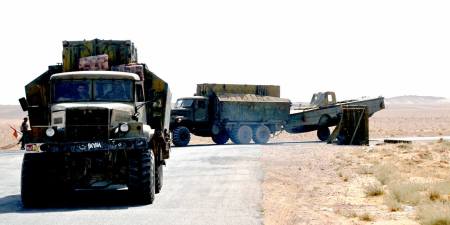
Shortly after the US-led coalition threatened to strike any Syrian Arab Army units if they crossed the Euphrates River, Syrian and Hizballah troops were marching across imported Russian pontoon bridges to reach the river’s eastern bank. By Friday, Sept. 15 they were able to establish a bridgehead there.

The attached photo shows the pontoons being lifted and set in place in a manner which recalls the method by which the IDF  was able to cross the Suez Canal for a landing in Egypt towards the end of the 1973 war.

Throughout the three-day operation, the Syrians and Hizballah worked under the cover of more newly-arrived Russian armaments, the MiG-29SMT (Nato-codenamed “Fulcrum),  whose landing in Syria was announced on Wednesday. This twin-engine jet fighter aircraft is a match for the F-18 in service with the US Air Force as well as the Israeli Air force’s F-15, F-16 and F-16 fighters.

The day the MiG-29s arrived in Syria, British Maj. Gen. Rupert Jones, Deputy Commander in Chief of the US-led Coalition in Syria, threatened to strike any units of the SAA if they crossed the Euphrates River.

The crossing operation, as well as deepening Russia’s military involvement in Syrian and Hizballah offensives, is a major boost for Iran’s objectives, with grave strategic implications for the US and Israel.

1. For the Trump administration, it trampled the principle Presidents Barack Obama and Vladimir Putin established exactly two years ago, i.e., for eastern Syrian across the Euphrates to be assigned to American military control and the west to the Russians.

2.  US satellites and reconnaissance planes watched the Russian army trucking the pontoons east and saw them being thrown over the river for the crossing. Nonetheless, no orders came from the White House or the Pentagon to make good on the coalition’s threat of a strike and to interfere.

3. Established on the east bank of the Euphrates, Syrian and Hizballah troops are in position to go forward for the operation to capture the Syrian-Iraqi border town of Abu Kamal from ISIS. They have moreover opened the way to link up with the Iraqi Population Mobilization Units (PMU), a surrogate of Iran’s Revolutionary Guards.

4. DEBKAfile’s military sources report that PMU units are already heading for this rendezvous on the Iraqi-Syrian border. This step is tantamount to opening up an Iranian-controlled military corridor between Iraq and Syria by cutting deep into the US-ruled region of eastern Syria.

5.  As recently as Thursday night, Sept. 14, President Donald Trump declared: “We are not going to stand for what they [Iran] are doing “

6.  The US president was not alone in refraining from lifting a finger to stop “what they are doing.” Prime Minister Binyamin Netanyahu likewise chose words over deeds. “Israel would not tolerate an Iranian presence on its northern border with Syria,” he reiterated Friday, Sept. 14, on his arrival in New York to address the UN General Assembly and meet Donald Trump.

But already Iran and its pawns were creating an accomplished fact, with massive logistical and military assistance from the Russian army.

It is worth noting in this regard that, in recent weeks, Israel’s generals and colonels have suddenly dropped references in their discourse to Iran and Hizballah as existential threats.

This may be the time to remind them of an unfortunate precedent. In the months leading up to the Yom Kippur War of 1973, Israel’s leaders brushed aside the Egyptian and Syrian armies as threats to the state’s survival –  only to find defeat at their hands staring the IDF in the face in the early days of that war.
No less dangerous would be a war fought by the Syrian army, Hizballah and Iran, with powerful Russian military support. By establishing a foothold on both banks of the Euphrates River and both sides of the Syrian-Iraqi border, Iran has taken a step towards pursuing its avowed goal of Israel’s destruction.

Iran Quadruples Cash Flow to Hizballah Since Nuclear Deal

September 15, 2017

Iran Quadruples Cash Flow to Hizballah Since Nuclear Deal, Investigative Project on Terrorism, September 15, 2017

Proponents of the Iran nuclear deal, including many within the Obama administration, argued that the agreement would moderate Iran’s behavior. On the contrary, Iran immediately enhanced its support for terrorist organizations, while extremist factions within Iran gained more influence. Two years later, Iran has proved to be even more emboldened to pursue its regional hegemonic ambitions, drastically increasing financial and military support to terrorist organizations and cells worldwide.

*************************************

Iran has drastically increased financial support for its Lebanese-based terrorist proxy Hizballah since the Iran nuclear deal was signed two years ago, the Jerusalem Post reports.

Iran secured $100 billion in frozen assets and sanction relief in January 2016 as a result of the deal with the United States and European countries. Flush with cash, Iran immediately increased its support for terrorist proxies in the region and nefarious activities worldwide. Hizballah was receiving $200 million from Iran. Now, it’s $800 million.

Last month, Hamas terrorist leader Yahya Sinwar admitted that “relations with Iran are excellent and Iran is the largest supporter of the [Hamas military wing] Izz el-Deen al-Qassam Brigades with money and arms.” Iran reportedly provides Hamas with about $60-$70 million.

Both Hizballah and Hamas remain dedicated to Israel’s destruction and continue to invest considerable resources to fight the Jewish state. Iran also spends hundreds of millions of dollars for Shi’ite militias in Syria and Iraq, while increasing support for Houthi militants in Yemen.

Shortly after the July 2015 nuclear deal was signed, Iran expanded its presence in regional conflicts and even increased its own intervention in Syria’s civil war, leading to mounting Iranian Revolutionary Guard Corps (IRGC) casualties.

Iran also increased efforts to subvert its neighbors. In March, Bahrain security authorities arrested members of an Iranian-sponsored terrorist cell, accusing them of planning to assassinate senior government officials. The IRGC reportedly provided military training to several cell members.

Beyond Iran’s regional ambitions, it continues to plan terrorist attacks around the world. Earlier this year, for example, Germany accused Iran of plotting attacks on Israeli and Jewish targets.

Proponents of the Iran nuclear deal, including many within the Obama administration, argued that the agreement would moderate Iran’s behavior. On the contrary, Iran immediately enhanced its support for terrorist organizations, while extremist factions within Iran gained more influence. Two years later, Iran has proved to be even more emboldened to pursue its regional hegemonic ambitions, drastically increasing financial and military support to terrorist organizations and cells worldwide.

Iran/Hizballah noose tightens around Israel

September 1, 2017

Iran/Hizballah noose tightens around Israel, DEBKAfile, September 1, 2017

Seen from the strategic-military angle, Israel can be said to have regressed 11 years to 2006, when two foes were poised menacingly on its northern and southern borders. Israel was then compelled to fight a war against Hizballah in Lebanon. This time, the conflict could potentially flare up simultaneously on three fronts – Lebanon, Gaza and Syria.

********************************

Nikki Haley, the US Ambassador to the UN, challenged the international community to hold Iran to account on Thursday, Aug. 31, after the Islamic Republic showed its “true colors” by restoring its ties with the Palestinian extremist Hamas. In her statement, she described as “stunning” the Hamas leader’s boast that Tehran is again the biggest provider of money and arms. The breach between them followed the terrorist group’s refusal to side with Bashar Assad in the Syrian civil war.

“Iran must decide whether it wants to be a member of the community of nations that can be expected to take its international obligations seriously, or whether it wants to be the leader of a jihadist terrorist movement. It cannot be both,” Haley said in her statement.

Islamic Iran has long made that decision, as the ambassador knows very well from the intelligence reports she sees. But her brave words were meant as a wakeup call for the rapid advances made by Iran and Hizballah during August to impose their will on the Middle East, often with great stealth.

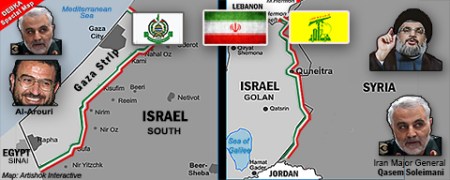
Haley will have learned about the Aug. 2 meeting in Beirut between Hamas’s military chief Salah al-Arouri and Iranian officials, following which Hizballah’s Hassan Nasrallah confirmed that the Palestinian rulers of the Gaza Strip were worthy of restored military and financial aid.

That deal was clinched at the highest level in Tehran, after Arouri and a delegation from Gaza were received by top Iranian officials, including Revolutionary Guards General Qassem Soleimani. He is not only commander of Iran’s Middle East warfronts, but also head of Al Qods, which runs Iran’s intelligence, subversion and terror networks.

These events and their ramifications were itemized in the latest issue of DEBKA Weekly, out Friday, Sept. 1.

It was Soleimani who assigned Hamas and its military arm with its next tasks. Since both parties are dedicated to violent tactics (terror) to achieve their ends, one of which is the destruction of the State of Israel, all that remains to be seen is the precise form the Iranian-backed Hamas-Hizballah partnership will take – and where. Those practicalities were aired at the secret sessions between Hamas and Al Qods in Tehran

Present at some of those sessions were also Soleimani’s secret agents and heads of the terrorist networks he runs across the Middle East and in the Gulf emirates.

The inauguration ceremony for Hassan Rouhani’s second term as Iran’s president on Aug. 5 provided a convenient cover for these get-togethers.

Nikki Haley’s warning to the international community was prompted by these dangerous events. Although her words were powerful, telling and timely, it is hard to see any sign of their being followed up by other parts of the Trump administration.

With the southern front against Israel in the bag, Iran and Hizballah this week put together its northern front, just two or three kilometers from Israel’s Golan border with Syria. This could not have happened without the Trump administration submitting to Russia’s demand to revise their de-escalation zone project for the Syrian Golan, so that Iranian and Hizballah forces are no longer required to distance themselves 40-50km from the zone, but only 8km.

Iran and Hizballah in Syria have in consequence been quietly shortening their distance from the Israeli border. But this week, they made a major leap forward, when the Russian monitors brought a group of Iranian and Hizballah officers all the way to Quneitra. There, they were given a base under Russian protection within sight of the Israeli Golan.

Tehran and its pawn therefore used the month of August to climb into position for drawing a noose around Israel and tightening it at will.

Prime Minister Binyamin Netanyahu this week boasted that his tenure was marked by relative calm. Israel, he said, had successfully avoided getting embroiled in any major war.

That is correct. However, his policy of preserving the calm and maintaining a purely defensive stance has carried a price. That price was totted up on Sept. 1. By then, Iran and Iran had been able to move unopposed into position on Israel’s borders with Syria and Lebanon in the north and had crept up to the Gaza border in the south.

Seen from the strategic-military angle, Israel can be said to have regressed 11 years to 2006, when two foes were poised menacingly on its northern and southern borders. Israel was then compelled to fight a war against Hizballah in Lebanon. This time, the conflict could potentially flare up simultaneously on three fronts – Lebanon, Gaza and Syria.

Israel’s red lines in Syria long crossed by Iran

August 24, 2017

Israel’s red lines in Syria long crossed by Iran, DEBKAfile, August 23, 2017

Prime Minister Binyamin Netanyahu set out for President Vladimir Putin Israel’s red lines against Iran establishing a permanent, expanded military presence in Syria. This theme dominated their three-hour conversation in Sochi on Wednesday, Aug. 23. Netanyahu stiffened his warning with a veiled threat that should Iran or Hizballah cross those lines, there would be a regional war.

It was the first time that the prime minister had publicly threatened to go to war against Iran and Hizballah. After talking to Putin, he said to reporters that what is new today is Iran’s attempt to “Lebanonize Syria.” in the same way as it seized control of Lebanon through its surrogate, Hizballah. “We are looking at Tehran’s future takeover of Syria through its Shiite militias.

If that happens, “we will not remain passive,” he said – nor if Syria becomes a link in Iran’s overland corridor via Iraq and Syria to Lebanon. And we certainly can’t accept Iranians and Hizballah close to the Golan.

“We told President Putin plainly that we won’t put up with Iran using Syria as a military base for attacking Israel.

Putin, in the part of the meeting to which reporters had access, did not address Netanyahu’s remarks about Iran’s role in Syria, nor his warning of unilateral military action. The Russian president just repeated the standard Moscow line that foreign forces would not stay in Syria at the end of the war, but offered no timetable or guarantees.

The Russian leader would clearly prefer not to see an Israel war against Iran and Hizballah breaking out in Syria, DEBKAfile’s sources say, especially since Russian special forces, naval and air force contingents are deployed there – albeit not in large numbers.

At the same time, he may well find Netanyahu’s strong words useful for boosting Russia’s clout in Syria. If Tehran believes an Israeli war against its forces and Hizballah is potential, it will be in Iran’s interest to strengthen its military ties with Russia so as to gain its military and political backing.

For Putin, this would be a welcome change from the atmosphere of acrimony prevailing for some weeks between Iranian and Russian officers in Syria. Russian colonels have been posted at the most sensitive sectors in Syria, such as Aleppo, Hama, Homs and eastern Damascus. They are taking over both the military and civilian administration there and, in effect, shouldering the Iranian officers aside.

In Iraq, the Iranians seized control of the country from within, by setting up armed militias and getting them integrated in the national army, as Trojan horses. Tehran knows how to manage this ruse on the quiet, without drawing unwanted attention from the powers on the spot.

In Syria, the problem facing Israel is quite different. If Netanyahu shared sensitive intelligence with Putin that he had not known before, he can’t help noticing that Israel’s red lines for Iran’s expansion were crossed months ago, some of them with Russian assistance.

Four instances stand out:

1. Iran and Hizballah have already set up a chain of military bases in Syria – notably in the Qalamoun Mountains on the Syrian-Lebanese border, from which missiles can be launched against Israel.

2. Iran has already won its coveted land bridge through Iraq to Syria. Bashar Assad’s army has taken over whole sections of the Syrian-Iraqi border, and opened the door for pro-Iranian Shiite militias, Hizballah and Iraqi Shiite groups to move into strategic positions on both sides of the border.

3.  Netanyahu warned of the danger of planting an extremist Shiite entity in the heart of the Sunni Muslim region. But this is already underway. On orders from Moscow, the Syrian army’s 5th Corps is in the process of absorbing the pro-Iranian Shiite militias which fought for Assad.

The prime minister did not inform Putin of any timetable for Israeli action. But the Russian leader will take it for granted that the Israeli army will not move into Syria without a nod from the Trump administration in Washington.

For now, Putin and Trump are synchronizing their operations in Syria with better results than Netanyahu’s understanding with the US administration.

US Diplomacy: When failure became an accepted option

August 15, 2017

US Diplomacy: When failure became an accepted option, Israel National News, Meir Jolovitz, August 15, 2017

(Please see also, President [Rouhani of Iran]: Iran Could Swiftly Return to Pre-JCPOA Conditions. — DM)

For what it’s worth, future historians will judge the North Korean crisis as the less significant one of our generation – simply because China is able to control it. The more formidable and dangerous threat is the nuclearization of Iran. The occasional terror attacks in Europe, murderous as they are, pale in comparison.

In kind, the geopolitical threat that has already been unleashed – remarkably with more support than opposition by the West – is the facilitation of an Iranian nuclear capability. With the overt and covert support of the Obama Administration – despite its denials – the Iranians were fast changing the rules of the game. Unless stopped forcibly in the next year or two, Iran will be in possession of the bomb. Correction: bombs.

********************************

It’s been said by many, in various forms, that “hindsight is everyone’s favorite perspective.”  The problem is, few grasp when “it” is happening until “it” has happened.

Political analysts and pundits are seemingly in concert: the most disquieting crisis that confronts our world today is the realization that North Korea presents a horrifying threat that remains unchecked. It didn’t have to be.

When Susan Rice, President Obama’s National Security Advisor from 2013 to 2017, admitted this past week that the two-decade-old US strategy on preventing North Korea from obtaining a nuclear capability was a “failure,” our hindsight was offered some unclouded perspective.

And yet, it was her other comments that made us understand that the lessons of history remain unlearned. Rice, with a criticism directed at President Donald Trump, opined that pragmatism dictates that we should simply accept, and tolerate, a nuclear North Korea.  Worse was the quiet acquiescence:  “The fact of the matter is, that despite all of these efforts, the North Korean regime has been able to succeed in progressing with its program, both nuclear and missile. That’s a very unfortunate outcome; but we are where we are.” Rice added: “It will require being pragmatic.

Pause to laugh, and cry.

Trump, luckily, did not hire Rice as an adviser, and did what he thought was right.

In 1967, a couple of years before he achieved notoriety as the controversial founder and voice of the Jewish Defense League, Rabbi Meir Kahane coauthored a book – The Jewish Stake in Vietnam –  whose implications were largely ignored. One might still find it on the shelves of some antiquarian book store, but the book is largely lost. Its relevance, decades lately, offers food for serious thought.

While the book’s theoretical message was clear, the practical implications remain undeniable.

The radical rabbi argued that the anti-Vietnam war sentiment that had targeted the hearts and minds of a confused American population that was increasingly drawn to slogans of “peace,” “liberation,” and “democratic freedom” – would pressure its government to abandon an ally, South Vietnam. The implication, seemingly unthinkable even to Jewish liberals in the aftermath of Israel’s victory in the Six Day War, was that if the United States could not stand firm in its commitment to support an ally in Southeast Asia, it would one day be willing to abandon its commitment to its only ally in the Middle East as well. Ergo, the Jewish state.

Times have changed, and with it, America’s foreign policy. Israel is no longer considered America’s only ally in a still-troubled Middle East. In fact, the United States counts many, mostly as a result of a misbegotten reinterpretation of what allies are, thanks in great measure to the US State Department’s purposeful redefinition of American interests in the region.

One recalls the comment most often attributed to Charles de Gaulle: “Nations don’t have friends, only interests.”

Despite the very strong relationship that ostensibly exists between President Trump and Israel – at great contrast with that of his predecessor – his State Department and the National Security Council are still adherents of ‘interests before friends’. And, they mistakenly and quite foolishly attribute American interests to the wrong side. Governed by the belief that the “occupied” territories and the settlements are the reason of the impasse to the conflict between Muslims and Jews, Trump is ready to dispatch his son-in-law to once again bridge the unbridgeable gap.

In an oil-thirsty world, the Muslim states (we include here of course, the Islamic Republic of Iran) seemed to have gained a leverage that was simply unthinkable in 1967. The Europeans seemed the first to turn the other cheek when Arab terror spread, still in its nascent stages – mostly one would think, because it was not their cheeks that were being most often slapped.

Over the years, the terror in Europe proliferated. And correlatively, so did the finger of blame that was directed at Israel. As long as the Muslim antipathy was directed at the Jewish State – and more telling, Jews everywhere – the Europeans would assuage the perpetrators. It was Israel that was called to make compromises, territorial and (axiomatically) ideological. The more threatening and damaging the terror, the more shrill the calls for Israeli capitulation.

Undeniably, the greatest threat to the ever-elusive peace in the Middle East, and the invariable spill-over of violence into a Europe that is fast becoming a battlefield, is the terror that so many of its nations have voluntarily imported with the jihadis who carry the torch of Islam.

For what it’s worth, future historians will judge the North Korean crisis as the less significant one of our generation – simply because China is able to control it. The more formidable and dangerous threat is the nuclearization of Iran. The occasional terror attacks in Europe, murderous as they are, pale in comparison.

In kind, the geopolitical threat that has already been unleashed – remarkably with more support than opposition by the West – is the facilitation of an Iranian nuclear capability. With the overt and covert support of the Obama Administration – despite its denials – the Iranians were fast changing the rules of the game. Unless stopped forcibly in the next year or two, Iran will be in possession of the bomb. Correction: bombs.

Meanwhile, the new Trump foreign policy team, despite its frequent criticism of the Obama-Iran nuke deal, has yet to do anything significant. Worse, it has twice certified that Iran remains compliant. Of a deal that Trump called “the worst in diplomatic history.”

Yes, allies are often sacrificed on the mantle of political expedience. The US national security apparatus prefers to call it pragmatism.

And count on it. Susan Rice will one day again be interviewed by the New York Times and CNN, in a joint appearance with President Trump’s National Security Advisor H.R. McMaster, admitting another failure. This will be the statement that they will issue: “The fact of the matter is, that despite all of these efforts, the Iranian regime been able to succeed in progressing with its program, both nuclear and missile. That’s a very unfortunate outcome; but we are where we are.” McMaster, resplendent in his uniform and its military regalia, will add: “It will require being pragmatic.”

After all, we are where we are!

Today, despite the unmistakable danger that Iran poses to Israel directly, it is more than simply a Jewish stake. This is an American interest. The message is quite clear. The practical implications are quite ominous. Let us hope Trump deals with Iran as he is dealing with North Korea.

Pause to cry.

Meir Jolovitz is a past national executive director of the Zionist Organization of America, and formerly associated with the Institute for Advanced Strategic and Political Studies.

Deadly False Narratives Drove the Temple Mount Crisis

August 2, 2017

Deadly False Narratives Drove the Temple Mount Crisis, Investigative Project on Terrorism, Yaakov Lappin, August 2, 2017

Until the attack, Israel had been relying on intelligence alerts, rather than physical security measures, to defend the site. But the shootings led the Israel Police to ask the Israeli government to beef up security, and install metal detectors.

The government agreed, despite the misgivings of the Israeli defense establishment, which was concerned that the move would fuel the propaganda of fundamentalist forces, leading to unrest and instability.

Iran helped fuel the unrestIsrael Hayom reported, by sending protesters “tens of thousands of … prepackaged meals along with notes in each one citing a famous quote attributed to 1979 Iranian Revolution leader Ayatollah Ruhollah Khomeini: ‘With the help of Allah, Palestine will be liberated! Jerusalem is ours.’ The note also depicted the Dome of the Rock and the Palestinian flag.”

Additionally, a senior Iranian official reportedly met with Hamas and Palestinian Islamic Jihad representatives in Iran, offering them assistance for Palestinians injured in clashes. The IRGC released a statement, condemning “the Zionist regime’s  aggressive and criminal actions against Al-Aqsa mosque.”

*****************************************

The crisis between Israel and the Palestinians that raged in recent weeks over the Temple Mount/Al-Aqsa holy site in Jerusalem has died down, but the affair provides important clues about the rising ability of fundamentalist Islamists to seize control of the narrative.

Radical rhetoric espoused by those who sought to inflame religious conflict dominated the Temple Mount crisis.

“Israel wants more than ever before to implement its plan for complete control over al-Aksa Mosque,” Hamas politburo chief Ismael Haniyeh said, even after Israel moved to defuse the situation. Days earlier, Hamas had called for a “religious war” against Israel.

Islamists in Gaza, Jordan, east Jerusalem, and within the Israeli Arab community, had the upper hand in their ability to push their interpretation of events. They claim Israel wants to take over the holy site and destroy the mosque to make way for a third Temple. This baseless narrative sweeps away the terrorist attack that caused the crisis and presented three Palestinians killed in subsequent clashes with Israeli security forces in Jerusalem as martyrs who died defending Islam.

Not to be outdone by their Islamist rivals, Palestinian Authority (PA) leaders peddled the same falsehoods. Religious Affairs Minister Sheikh Yusuf Idai’is told the official PA television channel that Israel “has plans to destroy the Al-Aqsa Mosque and establish the alleged Temple in its place.”

Those seeking religious strife were able to mobilize masses onto the streets, with the help of self-organizing demonstrators and rioters who were infected with the Islamist fervor, and spread it themselves on social media.

Together, these elements forced pragmatic Arab leaders – who do not subscribe to Islamist ideology – to adopt the Islamist narrative, and to deal with Israel as if it was guilty of the Islamic hard-liners’ fabricated accusations.

A recap: The crisis erupted when a terrorist jihadist cell, made up of three Arab-Israeli gunmen, used firearms smuggled into the Al-Aqsa Mosque – Islam’s third holiest site – to shoot dead two Israeli police officers. Security forces then returned fire, killing the gunmen.

Until the attack, Israel had been relying on intelligence alerts, rather than physical security measures, to defend the site. But the shootings led the Israel Police to ask the Israeli government to beef up security, and install metal detectors.

The government agreed, despite the misgivings of the Israeli defense establishment, which was concerned that the move would fuel the propaganda of fundamentalist forces, leading to unrest and instability.

The defense establishment’s concerns came true. Rioting erupted in Jerusalem and the West Bank. Mass demonstrations were held in Israel’s eastern neighbor, Jordan, and included members of the Jordanian Muslim Brotherhood.

A Palestinian knife attacker, pledging to “die for Al-Aqsa” on his Facebook page, massacred three members of an Israeli family in their home in the West Bank.

All of these events were driven by incitement to religious violence. The unrest was sparked by the false accusation that Israel was seeking to change the status quo at Al-Aqsa, and that the site needed defending from Israelis schemes. It is a conspiracy theory that has been peddled by Palestinian hardliners for decades, dating back to the days of Hajj Amin Al Husseini in the 1920s and 30s.

Hamas in Gaza and Palestinian Islamic Jihad praised the Temple Mount shooters as “heroic,” and called for more attacks. They issued a rallying call to defend Al-Aqsa. A Salafist-jihadist group in Gaza fired two rockets at southern Israel.

Israel responded with tank fire at a Hamas military post.

Turkey, ruled by a pro-Hamas variant of the Muslim Brotherhood, exploited the tensions to urge all Muslims to “protect Jerusalem,” and called on Israel to end the crisis. Israel’s Foreign Ministry called it “absurd that the Turkish government, which occupies northern Cyprus, brutally represses the Kurdish minority and jails journalists, lectures Israel, the only true democracy in the region. The days of the Ottoman Empire have passed.”

Iran helped fuel the unrestIsrael Hayom reported, by sending protesters “tens of thousands of … prepackaged meals along with notes in each one citing a famous quote attributed to 1979 Iranian Revolution leader Ayatollah Ruhollah Khomeini: ‘With the help of Allah, Palestine will be liberated! Jerusalem is ours.’ The note also depicted the Dome of the Rock and the Palestinian flag.”

Additionally, a senior Iranian official reportedly met with Hamas and Palestinian Islamic Jihad representatives in Iran, offering them assistance for Palestinians injured in clashes. The IRGC released a statement, condemning “the Zionist regime’s  aggressive and criminal actions against Al-Aqsa mosque.”

In Israel, Sheikh Raed Saleh, the former leader of the now banned Islamic Movement – a sister organization to Hamas – led a funeral procession for the three Arab Israeli terrorists. Thousands of mourners marched belligerently by the coffins of the terrorists, shouting, “By fire and with blood we will redeem you, Al-Aqsa,” and, “You are the martyrs of Al-Aqsa.”

Palestinian social media buzzed with calls to defend Al-Aqsa. The Islamist narrative had won the day.

Israel tried to challenge this mythology by directly addressing Palestinians. “So that the truth is clear, when did the Temple Mount incidents erupt?” IDF Coordinator of Government Activities in the Territories Maj.-Gen. Yoav Mordechai asked in Arabic on Al Jazeera. “A week ago. After a terror attack was committed by three Muslims, who entered the Temple Mount with weapons and opened fire. Israel does not want to change the status quo. This is a clear message to the world from the Muslim world.”

His message appeared to largely fall on deaf ears. With the fundamentalist rhetoric leading the way, even pragmatic Arab leaders, some of whom rely on cooperation with Israel for the very stability of their rule, felt the need to play according to the radical playbook, in order to avoid being tagged as Israel’s ‘abettors.’

The most obvious example was Palestinian Authority President, Mahmoud Abbas. Without Israel’s steps to quell Hamas in the West Bank, Abbas’s Palestinian Authority would have faced multiple armed attempts by Islamists to depose him .

During the Temple Mount unrest, Abbas cut security coordination between his forces and the Israel Defense Forces (IDF).

“Jerusalem is ours. It is our capital and our sovereignty. As long as the situation in occupied Jerusalem does not return to what it was before July 14 [when Israel installed metal detectors], there will be no changes [in our position],” Abbas said, according to a Middle East Media Research Institute (MEMRI) translation.

Promoting the lie that the Al-Aqsa Mosque required protection from Israel, Abbas told east Jerusalem Palestinians, “What you did was defend your honor, your religion and your holy sites. It was the true answer to those who wish to harm our holy sites and the principles of our faith. We supported you in what you did and are [still] doing. We decided to suspend the security coordination; [that decision] still holds. We [decided to] defend the holy sites; that still holds as well.”

The Fatah movement, which runs the Palestinian Authority, added fuel to the fire. With the full knowledge that it was risking new clashes, Fatah’s Central Committee called for mass protests.

Egypt and Jordan, both of whom are busy combating Islamist threats at home, called on Israel to remove the metal detectors.

The situation in Jordan became even more complicated when an Israeli embassy guard was stabbed by a local youth. The guard opened fire to defend himself, killing the attacker and accidentally shooting dead a second Jordanian citizen who was nearby.

Jordan’s King Abdullah refused to allow the Israeli guard to leave Amman, reversing his decision only after Israel said it would remove the metal detectors.

King Abdullah, one of the Arab worlds’ most moderate leaders, whose Kingdom shares many common interests with Israel, still felt the need to issue a statement vowing to prevent the “Judaization” of holy sites in Jerusalem.

Jordan controls the Jerusalem Islamic trust in charge of the Al-Aqsa Mosque, called the Waqf. Behind the scenes, Jordan helped end the Temple Mount crisis, which threatened to destabilize it.

The Waqf told Islamic worshipers that they could re-enter the Temple Mount after Israel had removed the metal detectors.

Even after the crisis reached a resolution, the Palestinian Authority remained highly wary of being labeled as a collaborator with Israel.

An aide to Abbas said security coordination with Israel would only be resumed “gradually,” to avoid giving the impression that the Palestinian Authority is too enthusiastic about working with the Israeli military in the West Bank.

The crisis provides a clear indication of the influence that Islamist propaganda has on the area. Even Arab leaders who are directly threatened by radical forces feel they must march according to their drumbeat, or risk their very legitimacy.

Israel’s decision to dismantle the metal detectors was designed to prevent the Islamist pyromaniacs from using the Al-Aqsa crisis to set the region on fire.

The fact that the Islamists came so close to succeeding, however, is the latest indication of who is in charge of the popular narrative in the region.
Jordan’s intel tags Hizballah for Temple Mt. terror

July 20, 2017

Jordan’s intel tags Hizballah for Temple Mt. terror, DEBKAfile, July 20, 2017

Jordanian and Saudi intelligence services have come to the conclusion that the attack was the work of a Hizballah-run cell on orders from Iran. One of Hizballah’s signatures is the absence of any claim of responsibility.

Jordanian intelligence circles suspect that the Temple Mount attack was linked to the US-Russian deal for ceasefire zones in southwest Syria right up to the borders of Jordan and Israel. Both governments have demanded the exclusion of Iranian and Hizballah forces from those zones.

Hizballah not only maintains a presence in Daraa and the Syrian Golan, but has planted terrorist networks inside Israel and Jordan. The pro-Iranian terror group has long been suspected of recruiting networks in some Israeli Arab communities. By striking Temple Mount, Iran and Hizballah targeted both Israel and Jordan, which claims religious custodianship of its mosques.

************************

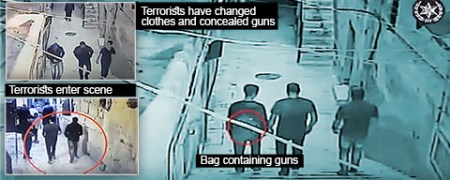
The Israeli police Thursday, July 20, released a video tape recording the movements of the terrorists heading for the murderous attack they committed on Temple Mount six days ago, when they shot dead two Israeli border guard police officers.

The film shows not three but four men who carefully stepped away from each other before entering the Al Aqsa Mosque. There, the three gunmen were handed their weapons by the fourth confederate, who made his escape among the crowds of worshippers exiting the mosque.

The police published the video Thursday ahead of Muslim Friday prayers – which brings tens of thousands of worshippers to Al Aqsa – as a reminder that the crime committed was a terrorist attack staged by Muslims at Islam’s third most sacred site – not the metal detectors Israel which installed for its safety. To drown this truth out, the Palestinians and Waqf officials have been raising a worldwide uproar over those detectors, as though nothing else happened to make them necessary.

The investigation going forward has established that the terrorists were far from amateurs. They acted coolly, with professional precision and were clearly highly trained and familiar with the terrain. It was a skilled terrorist cell that assaulted a shrine holy to three world faiths.

Even the absence of any claim of responsibility for the attack is a clue, especially since none of Israel’s investigators, be they police, security authorities or intelligence agencies, have so far thrown any light on the identity of the hand behind that cell.

However, DEBKAfile’s intelligence and counterterrorism sources report that Jordanian and Saudi intelligence services have come to the conclusion that the attack was the work of a Hizballah-run cell on orders from Iran. One of Hizballah’s signatures is the absence of any claim of responsibility.

On July 18, 2012, a suicide bomber blew himself up on a bus carrying Israeli tourists at the Bulgarian resort of Burgas, killing five Israelis and the Bulgarian driver and injuring 32. No organization has ever claimed this attack. Israeli intelligence uncovered evidence that it was orchestrated by Hizballah, but was never able to lay hands on the perpetrators.

The difference this time was that the three gunmen on Temple Mount had no intention of committing suicide. They did not expect the Israel police detail to react quickly enough to gun them down, but had meant to elude pursuit by fleeing to safety into Al Aqsa mosque. There they planned either to escape through ancient subterranean tunnels leading outside the Old City walls, or barricade themselves inside the cavernous mosque for a long shootout with Israel police.

Jordanian intelligence circles suspect that the Temple Mount attack was linked to the US-Russian deal for ceasefire zones in southwest Syria right up to the borders of Jordan and Israel. Both governments have demanded the exclusion of Iranian and Hizballah forces from those zones.

Tehran found an answer to this demand by demonstrating that its Lebanese proxy is capable of reaching deep inside Israel without recourse to external territory, because Hizballah not only maintains a presence in Daraa and the Syrian Golan, but has planted terrorist networks inside Israel and Jordan. The pro-Iranian terror group has long been suspected of recruiting networks in some Israeli Arab communities. By striking Temple Mount, Iran and Hizballah targeted both Israel and Jordan, which claims religious custodianship of its mosques.

Qassem Soleimani boasts of Tehran’s expanded footprint throughout Middle East

July 7, 2017

Qassem Soleimani boasts of Tehran’s expanded footprint throughout Middle East, Long War Journal , July 6, 2017

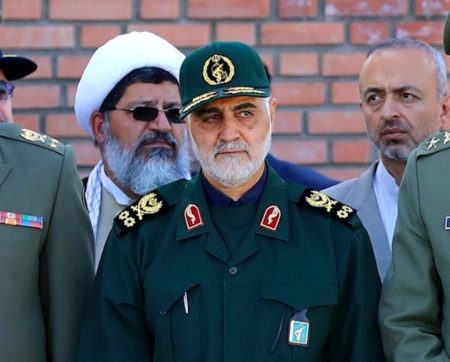
Qassem Soleimani

“The Islamic Republic has been the victor of all events that have happened in the region,” Soleimani claimed.

On domestic politics, Soleimani had strong words for critics of the IRGC, indirectly criticizing President Hassan Rouhani. “In the Islamic Republic, we’re all responsible towards martyrs, society, religion and our country. The biggest betrayal is to cast doubt toward the foundations of this system.” He continued, saying “none today must weaken the corps.” This is likely a reference to Rouhani’s recent criticism of the IRGC during and since the presidential campaign. [See FDD’s Long War Journal report: The Revolutionary Guard’s long shadow over Iran’s presidential election.]

**********************************

On July 3, Major General Qassem Soleimani, the chief of the Islamic Revolutionary Guard Corps’ (IRGC) Qods Force, spoke at an Iran-Iraq war veterans gathering in his home province of Kerman.

Soleimani praised the Islamic Republic’s decades-long effort to take the mantle of the Palestinian cause and boasted that Tehran’s influence in the Middle East has expanded as a result of the Syrian war. He excoriated Saudi Arabia, as well as domestic Iranian critics of the Guard Corps. And the general also lamented the drop in religious observance in Iran.

Soleimani hailed the importance of Qods Day, established by Ayatollah Ruhollah Khomeini to call for Israel’s destruction and express support for Palestinians. Tehran-sponsored Qods Day celebrations were held in several countries last month. [See FDD’s Long War Journal report: Qods Day commemorations highlight Tehran’s global reach.]

“One of the important and valuable innovations of Imam Khomeini was making central the system’s policies on the Palestinian issues, and the Imam (may the almighty God be pleased with him) hoisted the flag of mahdavi in the Islamic Republic of Iran,” Soleimani said. Mahdism is belief in the Mahdi, or the 12th Shiite Imam, who would rise before judgement day.

Soleimani then chastised “some Arab countries” who are “surrounding” the “oppressed” Palestinians. Tehran has accused Arab states of “selling out” the Palestinian cause, because these same Arab nations have expanded ties with Israel over shared concerns about Iranian power.

“The Islamic Republic’s global defense of the oppressed peoples of Iraq and Syria” has increased Iran’s global popularity, Soleimani claimed. Other evidence suggests the opposite has happened: over the past decade, Tehran’s regional policies have led to sharp drops in Iran’s favorability rating in the Middle East and around the globe.

“The target of the takfiri terrorists was to bring the Islamic Republic to the ground with these conspiracies and to make it kneel in front of this religious sedition,” Soleimani claimed. He elaborated: “Those who were behind this sedition and fanned it also had this imagination. This is while the greatness and strength of the Islamic Republic of Iran after the emergence of DAESH [the Islamic State] and toward the end of DAESH increased tens of times.”

Like other senior Iranian officials, Soleimani has claimed that the Islamic State was a conspiracy weaved by Tehran’s enemies to target the Islamic Republic. Although Iranian-backed forces and the Islamic State fight one anther in Iraq and Syria, Tehran has used the Sunni jihadist group’s rise to justify its involvement abroad and its own jihad to defend Shiite shrines from virulently anti-Shiite extremists.

Soleimani boasted about the Syrian regime’s rising fortunes, though he failed to mention that Russia’s military intervention was essential in turning the tide of war. “One day, Syria faced many problems, and today the Syrian government becomes stronger every day,” he stated. The “global belief today is that the Syrian system is undefeatable.”

Soleimani spoke about the expansion of Tehran’s operations in Syria during the war. “Several years ago in Syria, we didn’t have relations with individuals and movements more than the numbers of fingers, while we have relations with hundreds of thousands today,” he boasted. “While some countries that argued with us, ‘don’t defend Syria’s government,’ [they] are standing next to the Islamic Republic today and have changed their policies.”

The Qods Force chief lauded the rise of the Iraqi Popular Mobilization Forces (PMF), a conglomeration of Iraqi militias dominated by IRGC-backed factions. He omitted the fact that US air support has been crucial in the anti-Islamic State campaign.

“The Iraqi army is moving as a national, powerful Islamic army. This is due to popular forces. Something similar happened in our country,” he said, referring to the formation of the IRGC and the Basij paramilitary. Tehran aspires to consolidate its gains in Iraq through the vehicle of the PMF. [See FDD’s Long War Journal report: Qods Force commander to advance Tehran’s influence as ambassador to Iraq.]

The Iranian general mocked Saudi Arabia: “If there’s a lot of oil in a country…but mad logic rules, terrible events happen, and mad things like war with Yemen happen and these ignorant individuals are incapable of extinguishing this fire.” As the civil war in Yemen enters its third year, Soleimani has overseen increasing Iranian support for Houthi fighters and allied forces loyal to former President Ali Abdullah Saleh. The Houthi-Saleh alliance seeks to stymie the Saudi and UAE-led coalition.

“The Islamic Republic has been the victor of all events that have happened in the region,” Soleimani claimed.

He also praised the IRGC’s missile strikes on Islamic State positions in Syria last month, saying “this had several good benefits, one that it showed the Islamic Republic has the will to act, and the principle of will was more important than the result.” Israeli sources say Iran’s missile strikes were largely unsuccessful, with only one projectile striking their targets. Soleimani’s statement could be read as an admission that not all the missiles struck their targets. Regardless, he emphasized that the missile strikes highlighted the training of experts in building “precise” missiles.

“I have witnessed many scenes of missile raining down including American missiles,” he explained. He cited a Quranic verse in his praise, arguing “this movement of the corps was truly, ‘It was not you who threw when you threw; God is the One who threw.’”

On domestic politics, Soleimani had strong words for critics of the IRGC, indirectly criticizing President Hassan Rouhani. “In the Islamic Republic, we’re all responsible towards martyrs, society, religion and our country. The biggest betrayal is to cast doubt toward the foundations of this system.” He continued, saying “none today must weaken the corps.” This is likely a reference to Rouhani’s recent criticism of the IRGC during and since the presidential campaign. [See FDD’s Long War Journalreport: The Revolutionary Guard’s long shadow over Iran’s presidential election.]

“Do not compare the corps with me…target me, not the corps,” he said. “Without the corps, there wouldn’t be a country.”

Soleimani acknowledged the drop in religious observation in Iran, though he sought to deflect blame from the regime’s practice of shoving its version of religiosity down people’s throats. “We must not make people pessimistic toward religion and make society fear the devout, because turning people away from religion leads to higher divorce rate, and social corruption grows with reduction in values,” he said.

“How is it that some seek to make society afraid of the religiously devout? This is a wrong strategy and policy.”

A Revolutionary Guard commander once admitted that only five percent of Iran’s mosques are operational during the year.

Amir Toumaj is a Research Analyst at Foundation for Defense of Democracies.

Articles In Gulf Press: The Escalation In Gaza – A Result Of Qatar, Iran, Turkey Toying With Lives Of Innocent Palestinians

June 28, 2017

Articles In Gulf Press: The Escalation In Gaza – A Result Of Qatar, Iran, Turkey Toying With Lives Of Innocent Palestinians, MEMRI, June 28, 2017

Following the June 27, 2017 Israeli airstrikes in Gaza in response to the firing of a rocket from Gaza into Israel, articles in the Gulf press attacked Hamas and the countries that support it: Qatar, Iran and Turkey. The articles – published against the backdrop of the inter-Gulf tension and the Boycott imposed on Qatar, chiefly by Saudi Arabia, the UAE, Bahrain and Egypt – blamed Hamas of the firing of the rocket into Israel, and claimed that it was escalating the situation in Gaza on purpose in order to serve the interests of its three patron countries. These countries, said the articles, place innocent Palestinians in danger in order to divert global attention away from the Gulf crisis. 

The following are excerpts from two articles on this topic:   

‘Al-Ittihad’ Editorial: Qatar, Iran, Turkey Use Gaza As Bargaining Chip, Toying With The Lives Of Its Innocent People

Muhammad Al-Hamadi, editor of the UAE daily Al-Ittihad, wrote: “On June 27, without any warning, the Arabs woke up to discover that Gaza had been bombarded. Why? What has happened that we don’t know about? What did the Gazan Palestinians do to find themselves under Israeli fire? Has a third intifada broken out? Has the battle for the liberation of Jerusalem begun?

“In practice, none [of the above] happened. All [that happened was] that those who trade in the Palestinian problem, who are themselves in trouble, remembered an old bargaining chip that they have long been using successfully, [and decided] to use it in the dire circumstances that have befallen their friend Qatar, which serves as their open bank [account]. They thought that [using this bargaining chip] would be a good way to divert the Arabs’ attention away from Qatar and focus it [instead] on Gaza and its residents who are being bombarded with missiles by the Israeli enemy.

“This conduct of Qatar and its allies, in Palestine and elsewhere, is despicable. How disgraceful it is that some are willing to toy with the lives of innocents and with the future of small children in Gaza in order to achieve political aims. For a long time now, some [elements] – chiefly Iran, Qatar and Turkey – have been toying with the Palestinian cause and they were successful, but the cost was high: hundreds and even thousands of innocent Palestinians who have been martyred or wounded and crippled. What was the [Palestinian’s] reward? The reward was a donation drive among Arab and Muslim countries that raised millions. [But only] a handful of riyals and dinars was handed out to the disaster-stricken Palestinians. It is always the case that the [Gazan] people get crumbs, while the rest goes to the loyal partner, Hamas.

“We have said from the beginning of the boycott of Qatar that the game is over, but Qatar apparently isn’t listening. Continuing this transparently [wicked] behavior will no longer avail [it], because the peoples are no longer fooled. If in the past they trusted the propaganda of the ideologically recruited Al-Jazeera channel, which serves certain goals, today the peoples no longer watch Al-Jazeera and are no longer influenced by it and by other Arab or foreign channels. Information has become very accessible, and [cyber]space has opened up in [this] era of new media. Nobody has a monopoly on the facts, and it is no longer possible to deceive the peoples. That is what the Palestinian people discovered on July 27. It discovered that there are those who want to exploit it and drag it into a new confrontation with the Israeli enemy, while those who plan [the confrontation] stay in five-star hotels in Doha and Istanbul and in other capitals that shelter the leaders of the Muslim Brotherhood and of terror.

“Our friends in Gaza informed us that the [Gaza] Strip was not bombarded and that only two Israeli missiles were fired in response to the rocket fired from Gaza into Israel. Everyone knows that Qatar is the one that is ‘bombarded’ and boycotted. Who gains from the firing of the rocket and from the situation in which Gaza is bombarded?”[i]

Saudi Columnist: Qatar, Iran Sponsor Hamas, Which Uses Gazans As Human Shields

Hani Al-Zahiri wrote in the Saudi ‘Okaz daily: “It has been centuries since our region has seen a political gamble as terrible as the Iranian and Qatari regimes’ [current] gamble with the lives and the cause of the Palestinians. These two [regimes] adopted the Muslim Brotherhood’s Hamas organization, and supported it by every means when it staged an uprising against the legal Palestinian leadership [the PA] and took over Gaza, and then turned the innocent residents [of Gaza] into a human shield for the Hamas leadership.

“The state of the Gaza Strip in the face of the Israeli bombardments, which usually come in direct response to Hamas actions, reminds us of  [a situation in which] a man kidnaps a girl and then provokes [the soldiers in] a military base to open fire on him and uses the girl as a human shield. The kidnapper in this case is Hamas and the girl is Gaza and its helpless people. The portly Hamas leaders meet in Doha and Tehran, laugh around tables laden with delicacies and order their young [fighters] to open the gates of Hell to the Palestinians by [shooting] firecrackers – which they call ‘rockets’ – at Israeli [army] posts, so that Gaza will be bombarded and women, children and the elderly will die. Then Hamas [officials] will come out, condemn this on satellite channels, and demand support and funds to rescue the Palestinian people, before going back to their feast, safe and sound. In the meantime the entire world will watch the suffering of an unarmed people that has no means to defend itself.

“Everything that has happened to the Palestinians since Hamas took over them indicates that their second enemy, after Israel, is Qatar and Iran, which are using a tinderbox named Hamas to burn them in order to achieve purely political aims… The question now is why, on the day before yesterday [June 26], Qatar and its allies prompted Hamas to fire on Israeli positions, thus inviting Israel to respond by bombarding Gaza. The answer is clearly that this was a despicable attempt and a new political gamble by the Qatari regime, aimed at easing the noose of the Gulf boycott [of Qatar, a boycott] which prompted calls to sue [this regime] in the international [court] for the black [crime] of supporting terror. Today [Qatar] desperately needs to divert the world’s attention in another direction, even at the expense of the life and blood of a defenseless people… The Qataris and Iranians will exploit the event to utter phrases of pretended sympathy for the Palestinians, but only the people in Gaza know that they are the victims of this pair of plotters [Qatar and Iran].”[ii]

______________________

[i] Al-Ittihad (UAE), June 28, 2017.

[ii] ‘Okaz (Saudi Arabia), June 28, 2017.

Syrian mortars again fall on Golan despite Israel’s warnings

June 25, 2017

Syrian mortars again fall on Golan despite Israel’s warnings, DEBKAfile, June 25, 2017

In the face of strong warnings by Prime Minister Binyamin Netanyahu and Defense Minister Avigdor Lieberman, Syrian mortars again spilled over to the Golan Sunday for the second day in a row. There was no damage or casualties this time too. IDF tanks opened fire on Syrian positions in the Quneitra area, which the Israeli air force targeted the day before. Earlier Sunday, Netanyahu stated at the weekly cabinet meeting: “Our policy is clear. We will not tolerate any kind of ‘trickle, not of mortars, rockets, or spillover fire [from the Syrian Civil War]. We shall respond forcefully to every attack.”

Netanyahu also repeated: “We also view with utmost gravity Iran’s attempts to establish itself militarily in Syria as well as its attempts to arm Hezbollah – via Syria and Lebanon – with advanced weaponry.