Posted tagged ‘International Law’

No. 2 U.S. Military Officer: Possible Our Adversaries Will Build a ‘Terminator’

August 26, 2016

No. 2 U.S. Military Officer: Possible Our Adversaries Will Build a ‘Terminator’, Washington Free Beacon, , August 25, 2016

(Oh good. Something out of science fiction to worry about. — DM)
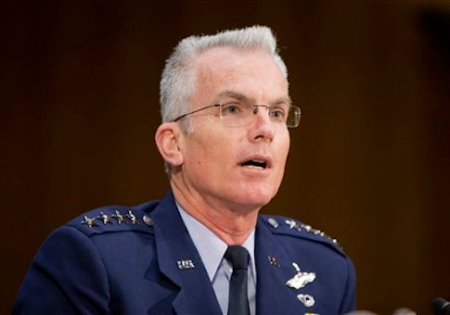
Joints Chiefs of Staff Vice Chairman Gen. Paul Selva testifies before the Senate Armed Services Committee in Washington, Wednesday, Dec. 9, 2015. (AP Photo/Pablo Martinez Monsivais)

Joints Chiefs of Staff Vice Chairman Gen. Paul Selva testifies before the Senate Armed Services Committee in Washington, Wednesday, Dec. 9, 2015. (AP Photo/Pablo Martinez Monsivais)

The nation’s second-highest ranking military officer believes that our adversaries may try to build completely autonomous “Terminator”-like systems that can conduct lethal operations on the battlefield.

Air Force Gen. Paul Selva, vice chair of the Joint Chiefs of Staff, said Thursday that he believes the United States needs to do “something” to punish actors who pursue such a weapon, though he admitted that international laws or conventions aimed at this would inevitably be violated.

“I don’t think it’s impossible that somebody will try to build a completely autonomous system, and I’m not talking about something like a cruise missile … or a mine that requires a human to target it and release it and it goes and finds its target,” Selva told an audience at the Center for Strategic and International Studies in Washington, D.C. when asked about such capabilities. “I’m talking about a wholly robotic system that decides whether or not, at the point of decision, it’s going to do lethal ops.”

Selva has previously dubbed debate about the implications of autonomous weapons the “‘Terminator’ conundrum,” referring to the science fiction films featuring Arnold Schwarzenegger.

Selva said technologists have told Pentagon leaders that the capability could be developed in 10 years.

“This is about an entirely robotic system, completely autonomous, [that is] not dependent on the human decision,” Selva said. “We’re told by the technologists that we’re a decade or so away from that capability.”

The Air Force general said that the United States should look at international law as a way to stop state or non-state actors from building autonomous systems that can carry out lethal operations.

However, he cautioned that any measures barring the construction of such capabilities would likely be violated, given the violations of existing international prohibitions on chemical and biological weapons. Syrian President Bashar al Assad has used chemical weapons repeatedly against his own people. The Islamic State, the terrorist group controlling territory in Iraq and Syria and inspiring global attacks, also has leveraged chemical weapons in attacks, according to U.N. investigators.

“I think we do need to examine the bodies of law and convention that might constrain anyone in the world from building that kind of system. But, I’m wholly conscious of the fact that, even if we do that, there will be violators,” Selva explained. “In spite of the fact that we don’t approve of chemical or biological weapons, we know there are entities—both states and non-states—that continue to pursue that capability in our world. In spite of the fact that we say we won’t kill women and children, we know there are entities in this world—state and non-state—that don’t care.”

“I’m cautious when I say we have to have a set of conventions and rules [inaudible] that govern behavior in this space because it’s highly likely there will be violators,” Selva continued. “Until we understand what we want the limits to be, we won’t have a baseline from which to determine if someone is moving on the path of violating the convention that could create something like a ‘Terminator’ that has incredible amounts of complexity and no conscience.”

“I think we have to have something, I don’t know what the something is,” he added.

Selva has previously warned about the ethical and legal implications of developing lethal systems that rely on artificial intelligence.

“There are ethical implications, there are implications for the laws of war. There are implications for what I call ‘The Terminator’ conundrum: What happens when that thing can inflict mortal harm and is empowered by artificial intelligence?” Selva said in January. “How are we going to know what is in the vehicle’s mind, presuming for the moment that we are capable of creating a vehicle with a mind?”

Selva spoke about the future of joint capabilities and the need for reform and innovation at the Defense Department, especially in the technological sphere. He said the United States is in a period of “great power competition,” highlighting challenges from Russia and China.

Selva also said that the United States faces challenges from Iran and North Korea because of their “aspirations to become nuclear powers.” Selva listed combatting “violent extremism” as an additional challenge.

“I won’t put a single label on it because we have watched violent extremism over the course of the last couple of decades morph in ways that we have not anticipated,” Selva said. “While we think we understand the dynamics ofsome variables of violent extremism today, that does not give us a crystal clear view of where it might go.”

Selva said emerging competitors such as Russia and China have not completely matched America in military capability but have come “pretty close,” challenging U.S. forces to find new ways to counter them.

“What we face over the next couple of decades is several very imaginative competitors who have actually looked at what we have done over the last two decades, reflected it back upon us, and challenged us with some of the very same techniques that we are challenging them with. That becomes very difficult to counter,” Selva said.

“That’s the environment we find ourselves in: Great power competition with powers who are not necessary our equal but are pretty close, but have picked asymmetric approaches strategically and operationally that seriously challenge us, and so we have to think differently about this problem,” he said.


A timely message from Iran

April 29, 2015

A timely message from Iran, Power Line, Scott Johnson, April 28, 2015

What the hell are the Iranians doing playing chicken with the U.S. Navy on the same day that the full Senate takes up debate on Corker-Menendez?

*****************

Omri Ceren provides this email update on today’s developments in the Persian Gulf, reported in this brief Reuters story:

It’s been a busy two hours, but some clarity is starting to emerge about the Iranian seizure of a cargo vessel in the Strait of Hormuz. The vessel is the M/V Maersk Tigris and sails under a Marshall Islands flag. It was intercepted by Iranian navy patrol crafts earlier today and sent a distress call, and which point it was contacted by US naval assets who streamed to the area to monitor the confrontation. The vessel was ordered to sail into Iranian waters and refused, at which point the Iranians fired shots across her bow, and the master complied. It’s now in the Iranian port of Bandar Abbas.

There is a dispute over whether the M/V Maersk Tigris was in international waters when it was initially intercepted. The Pentagon seems to have told journalists this morning that it was transiting through Iranian territorial waters. Defense analysts are posting maps showing otherwise (https://twitter.com/PatMegahan/status/593073911786377216).

A few things you’re likely to be hearing as the afternoon kicks off:

(1) The U.S. is treaty-bound to defend the security of the Marshall Islands. To what extent will the US be obligated to act in response to functionally unspinnable Iranian aggression? Keep in mind that in two weeks the President will be personally in a room floating security assurances to the Gulf, promising that the U.S. will protect them from future Iranian aggression.

The Republic of the Marshall Islands (RMI) is a sovereign nation. While the government is free to conduct its own foreign relations, it does so under the terms of the Compact. The United States has full authority and responsibility for security and defense of the Marshall Islands, and the Government of the Marshall Islands is obligated to refrain from taking actions that would be incompatible with these security and defense responsibilities. (http://www.state.gov/r/pa/ei/bgn/26551.htm)

(2) The administration just wrapped up a week of insisting that under no circumstances would it allow Iran to interfere with shipping in the area. It’s unclear how that can be reconciled with what the Iranians just did.

White House Press Secretary Josh Earnest, April 21: “principal goal of this operation is to maintain freedom of navigation and free flow of commerce in the Gulf of Aden and the Red Sea… would send a clear signal about our continued insistence about the free flow of commerce and the freedom of movement in the region… this is a clear statement about our commitment to ensuring the free flow of commerce in this important region of the world” (https://www.whitehouse.gov/the-press-office/2015/04/21/press-briefing-press-secretary-josh-earnest-4212015)

State Department Spokesperson Marie Harf, April 21: “I think the Defense Department may have already addressed this in their briefing today, but there were reports about these U.S. ships that have been moved. And I want to be very clear, just so no one has the wrong impression, that they are not there to intercept Iranian ships, to do issues like that; that the purpose of moving them is only to ensure the shipping lanes remain open and safe. I think there was some misreporting and confusion on this, and I just wanted to be very clear.” (http://www.state.gov/r/pa/prs/dpb/2015/04/240950.htm)

Pentagon spokesman Col. Steve Warren, April 21: “[U.S. warships] are operating [in the Arabian Sea] with a very clear mission to ensure that shipping lanes remain open, to ensure there’s freedom of navigation through those critical waterways, and to help ensure maritime security…By having U.S. ships in the region, we…preserve options should the security situation deteriorate to the point where there is a problem or a threat to freedom of navigation or to the shipping lanes or to overall maritime security.” (http://www.defense.gov/news/newsarticle.aspx?id=128634)

(3) What the hell are the Iranians doing playing chicken with the U.S. Navy on the same day that the full Senate takes up debate on Corker-Menendez? Business Insider’s national security and military editor Armin Rosen had one of the early lines on this:

Whatever else is going on, IRGCN just baited a Burke-class US destroyer into a confrontation in the world’s busiest oil choke point. (https://twitter.com/ArminRosen/status/593076865922891779)

Having the U.N. Security Council bless a deal wouldn’t make it binding under our Constitution.

March 15, 2015

Having the U.N. Security Council bless a deal wouldn’t make it binding under our Constitution, National Review online, Andrew C. McCarthy, March 14, 2015

So, as we warned earlier this week, the international-law game it is.

It is no secret that Barack Obama does not have much use for the United States Constitution. It is a governing plan for a free, self-determining people. Hence, it is littered with roadblocks against schemes to rule the people against their will. When it comes to our imperious president’s scheme to enable our enemy, Iran, to become a nuclear-weapons power — a scheme that falls somewhere between delusional and despicable, depending on your sense of Obama’s good faith — the salient barrier is that only Congress can make real law.

Most lawmakers think it would be a catastrophe to forge a clear path to the world’s most destructive weapons for the world’s worst regime — a regime that brays “Death to America” as its motto; that has killed thousands of Americans since 1979; that remains the world’s leading state sponsor of jihadist terrorism; that pledges to wipe our ally Israel off the map; and that just three weeks ago, in the midst of negotiations with Obama, conducted a drill in which its armed forces fired ballistic missiles at a replica U.S. aircraft carrier.

This week, 47 perspicuous Republican senators suspected that the subject of congressional power just might have gotten short shrift in Team Obama’s negotiations with the mullahs. So they penned a letter on the subject to the regime in Tehran. The effort was led by Senator Tom Cotton (R., Ark.), who, after Harvard Law School, passed up community organizing for the life of a Bronze Star–awarded combat commander. As one might imagine, Cotton and Obama don’t see this Iran thing quite the same way.

There followed, as night does day, risible howls from top Democrats and their media that these 47 patriots were “traitors” for undermining the president’s empowerment of our enemies. Evidently, writing the letter was not as noble as, say, Ted Kennedy’s canoodling with the Soviets, Nancy Pelosi’s dalliance with Assad, the Democratic party’s Bush-deranged jihad against the war in Iraq, or Senator Barack Obama’s own back-channel outreach to Iran during the 2008 campaign. Gone, like a deleted e-mail, were the good old days when dissent was patriotic.

Yet, as John Yoo observes, the Cotton letter was more akin to mailing Ayatollah Khamenei a copy of the Constitution. The senators explained that our Constitution requires congressional assent for international agreements to be legally binding. Thus, any “executive agreement” on nukes that they manage to strike with the appeaser-in-chief is unenforceable and likely to be revoked when he leaves office in 22 months.

For Obama and other global-governance grandees, this is quaint thinking, elevating outmoded notions like national interest over “sustainable” international “stability” — like the way Hitler stabilized the Sudetenland. These “international community” devotees see the Tea Party as the rogue and the mullahs as rational actors.

So, you see, lasting peace — like they have, for example, in Ukraine — is achieved when the world’s sole superpower exhibits endless restraint and forfeits some sovereignty to the United Nations Security Council, where the enlightened altruists from Moscow, Beijing, and Brussels will figure out what’s best for Senator Cotton’s constituents in Arkansas. This will set a luminous example of refinement that Iran will find irresistible when it grows up ten years from now — the time when Obama, who came to office promising the mullahs would not be permitted to acquire nuclear weapons, would have Iran stamped with the international community seal of approval as a nuclear-weapons state.

Down here on Planet Earth, though, most Americans think this is a bad idea. That, along with an injection of grit from the Arkansas freshman, emboldened the normally supine Senate GOP caucus to read Tehran in on the constitutional fact that the president is powerless to bind the United States unless the people’s representatives cement the arrangement.

Obama, naturally, reacted with his trusty weapon against opposition, demagoguery: hilariously suggesting that while the Alinskyite-in-chief had our country’s best interests at heart, the American war hero and his 46 allies were in league with Iran’s “hardliners.” (Yes, having found Muslim Brotherhood secularists, al-Qaeda moderates, and Hezbollah moderates, rest assured that Obama is courting only the evolved ayatollahs.) When that went about as you’d expect, the administration shifted to a strategy with which it is equally comfortable, lying.

Obama’s minions claimed that, of course, the president understands that any agreement he makes with Iran would merely be his “political commitment,” not “legally binding” on the nation. It’s just that Obama figures it would be nice to have the Security Council “endorse” the deal in a resolution because, well, that would “encourage its full implementation.” Uh-huh.

Inconveniently, the administration’s negotiating counterpart is the chattiest of academics, Iranian foreign minister Mohammad Javad Zarif. Afflicted by the Western-educated Islamist’s incorrigible need to prove he’s the smartest kid in the class — especially a class full of American politicians — Zarif let the cat out of the bag. The senators, he smarmed, “may not fully understand . . . international law.”

According to Zarif, the deal under negotiation “will not be a bilateral agreement between Iran and the U.S., but rather one that will be concluded with the participation of five other countries, including all permanent members of the Security Council, and will also be endorsed by a Security Council resolution.” He hoped it would “enrich the knowledge” of the 47 senators to learn that “according to international law, Congress may not modify the terms of the agreement.” To do so would be “a material breach of U.S. obligations,” rendering America a global outlaw.

This, mind you, from the lead representative of a terrorist regime that is currently, and brazenly, in violation of Security Council resolutions that prohibit its enrichment of uranium.

Clearly, Obama and the mullahs figure they can run the following stunt: We do not need another treaty approved by Congress because the United States has already ratified the U.N. charter and thus agreed to honor Security Council resolutions. We do not need new statutes because the Congress, in enacting Iran-sanctions legislation, explicitly gave the president the power to waive those sanctions. All we need is to have the Security Council issue a resolution that codifies Congress’s existing sanctions laws with Obama’s waiver. Other countries involved in the negotiations — including Germany, Russia, and China, which have increasingly lucrative trade with Iran — will then very publicly rely on the completed deal. The U.N. and its army of transnational-progressive bureaucrats and lawyers will deduce from this reliance a level of global consensus that incorporates the agreement into the hocus-pocus corpus of customary law. Maybe they’ll even get Justice Ginsburg to cite it glowingly in a Supreme Court ruling. Voila, we have a binding agreement — without any congressional input — that the United States is powerless to alter under international law.

Well, it makes for good theater . . . because that is what international law is. It is a game more of lawyers than of thrones. In essence, it is politics masquerading as a system governed by rules rather than power, as if hanging a sign that says “law” on that system makes it so.

At most, international law creates understandings between and among states. Those understandings, however, are only relevant as diplomatic debating points. When, in defiance of international law, Obama decides to overthrow the Qaddafi regime, Clinton decides to bomb Kosovo, or the ayatollahs decide to enrich uranium, the debating points end up not counting for much.

Even when international understandings are validly created by treaty (which requires approval by two-thirds of the Senate), they are not “self-executing,” as the legal lexicon puts it — meaning they are not judicially enforceable and carry no domestic weight. Whether bilateral or multilateral, treaties do not supersede existing federal law unless implemented by new congressional statutes. And they are powerless to amend the Constitution.

The Supreme Court reaffirmed these principles in its 2008 Medellin decision (a case I described here, leading to a ruling Ed Whelan outlined here). The justices held that the president cannot usurp the constitutional authority of other government components under the guise of his power to conduct foreign affairs. Moreover, even a properly ratified treaty can be converted into domestic law only by congressional lawmaking, not by unilateral presidential action.

Obama, therefore, has no power to impose an international agreement by fiat — he has to come to Congress. He can make whatever deal he wants to make with Iran, but the Constitution still gives Congress exclusive authority over foreign commerce. Lawmakers can enact sanctions legislation that does not permit a presidential waiver. Obama would not sign it, but the next president will — especially if the Republicans raise it into a major 2016 campaign issue.

Will the Security Council howl? Sure . . . but so what? It has been said that Senator Cotton should have CC’d the Obama administration on his letter since it, too, seems unfamiliar with the Constitution’s division of authority. A less useless exercise might have been to CC the five other countries involved in the talks (the remaining Security Council members, plus Germany). Even better, as I argued earlier this week, would be a sense-of-the-Senate resolution: Any nation that relies on an executive agreement that is not approved by the United States Congress under the procedures outlined in the Constitution does so at its peril because this agreement is likely to lapse as early as January 20, 2017. International law is a game that two can play, and there is no point in allowing Germany, Russia, and China to pretend that they relied in good faith on Obama’s word being America’s word.

It is otherworldly to find an American administration conspiring against the Constitution and the Congress in cahoots with a terror-sponsoring enemy regime, with which we do not even have formal diplomatic relations, in order to pave the enemy’s way to nuclear weapons, of all things. Nevertheless, Republicans and all Americans who want to preserve our constitutional order, must stop telling themselves that we have hit a bottom beneath which Obama will not go. This week, 47 senators seemed ready, finally, to fight back. It’s a start.

Obama’s Iran scheme is laid bare

March 13, 2015

Obama’s Iran scheme is laid bare, Washington Post, Jennifer Rubin, March 13, 2015

We surmised yesterday that the Obama administration had the idea to go to the United Nations to pass by resolution what Congress would never agree to: a lifting of sanctions on Iran in exchange for a nearly worthless deal in which Iran would keep thousands of centrifuges and get a 10-year glide path to nuclear breakout. Sen. Bob Corker (R-Tenn.), seeing what was afoot, demanded an explanation from the White House, calling such a scheme an “affront to the American people.”

On Thursday evening, after being pressed by irate Republicans, the National Security Council issued a defensive statement insisting that it would do no such thing. The story was handed to BuzzFeed:

The U.S. has “no intention” of using the United Nations to lock into place any potential deal with Iran over its nuclear program, a senior U.S. official said on Thursday.

The United States will not be “converting U.S. political commitments under a deal with Iran into legally binding obligations through a UN Security Council resolution,” Bernadette Meehan, spokesperson for the U.S. National Security Council, said in a statement emailed to BuzzFeed News.

“Past UNSC resolutions on Iran have called for a negotiated settlement of the Iran nuclear issue, and accordingly we would fully expect the UNSC to ‘endorse’ any deal with Iran and encourage its full implementation so as to resolve international concerns about Iran’s nuclear program,” Meehan continued. “But any such resolution would not change the nature of our commitments under such a deal, which would be wholly contained in the text of that deal.”

What is going on here? For starters, the existing U.N. resolutions obtained by President George W. Bush are much, much stricter than anything President Obama has indicated would be forthcoming. Those resolutions don’t permit Iran to keep thousands of centrifuges. They don’t give Iran a 10-year sunset. They require complete dismantling of Iran’s illicit program, full inspections and an accounting of past illicit behavior. In other words, any new deal negotiated by the administration would be weaker than — and in fact, in violation of — existing U.N. resolutions. That is why Obama would need to go back to the U.N., to water down, to cave into Iran’s demands.

This is not an original thought. For quite some time, former U.N. spokesman Richard Grenell has been warning that this is exactly what is coming down the pike. Last year Grenell wrote: “President Obama’s Geneva proposal to the permanent members of the United Nations Security Council allowing Iran to enrich some uranium violates previous UN resolutions demanding the Islamic Republic stop ‘all’ uranium enrichment activity. To avoid a violation of current UN resolutions, the permanent members must ask the entire Security Council to vote to weaken and supersede their previous demands.” He continued, “The UN’s four rounds of hard-fought sanctions on Iran and several other resolutions demanding compliance call for a full suspension of all enrichment activities, including research and development, then full verification of that suspension before negotiations on a permanent diplomatic solution begin. The sequencing was strategic. It was designed to build international confidence in a secretive country’s deceitful past.” But Obama deliberately departed from these restrictions, so he has always planned to go back. Otherwise, his deal would be in violation of existing international law.

That brings us to U.S. law. The U.N. resolutions don’t automatically become law, the administration was forced to concede. But under currentU.S. sanctions law, the president can waive them. And that is just what Obama intends to do. He will get the U.N. to water down international sanctions while he suspends U.S. sanctions. Why is this so dangerous? Mark Dubowitz, whose research and expertise helped lawmakers to construct the sanctions legislation, e-mails me:

President Obama risks undermining the entire sanctions edifice on which continued economic leverage depends. A future US president will need this leverage to enforce an Iran deal so that he can respond to Iranian noncompliance without resorting to either military strikes or surrender. But it increasingly appears that UN, EU and perhaps some US sanctions will be suspended and then reimposed or snap backed if Iran cheats. The snapback is a delusion. Reimposing sanctions is harder than it sounds. Amongst the United States, EU and UNSC, there are bound to be significant disputes on the evidence, differing assessments of the seriousness of infractions, fierce debates about the appropriate level of response and concerns about Iranian retaliation.

It’s also important to remember that when sanctions were first implemented, it took years before a critical mass of international companies terminated their business ties with Tehran. Once strictures are loosened, with so many international companies positioning to get back into Iran, it will be very difficult to persuade these companies to leave again. The Iranian regime will also adopt countermeasures to minimize its economic exposure to Western pressure when it anticipates that it will violate any nuclear agreement.

Obama’s legacy becomes demolition of the sanctions regime and an opening for Iran to either make a dash for breakout or to wait 10 years and get its stamped permission slip. The word for this is “containment.” The next president can reverse the waiver, but the Iranian economy will be on the road to recovery and the next president’s options will be severely limited. Iran might even have a bomb by then. As one conservative wag cracked, “If you like your sovereignty you can keep your sovereignty.” Yes, Obama tells us many soothing things but does whatever he wants.

What can Congress do? Well, it can express bipartisan outrage and pass a resolution deploring the president’s end run. But it must do more. Ideally, one would summon a bipartisan veto-proof majority to fix U.S. sanctions in law with no presidential waiver unless a deal meeting the existing U.N. resolutions was agreed upon. (I suppose Congress could use the power of the purse to defund our U.N. contributions, but let’s not get carried away.) But we also have to consider that this might simply be unattainable or susceptible to the argument that Congress can’t constitutionally eliminate all executive discretion. The next best option would be to increase the threshold for waiving existing and new sanctions — in other words, to narrow severely the president’s ability to waive U.S. sanctions, and require officials in the intelligence community and/or the military to add their certification (and thereby put their own credibility on the line as well). For example, U.S. sanctions would not be waived unless and until Iran gave a complete accounting of past nuclear activities and dismantled the Arak facility, things that the Iranians have refused to do and are objective criteria the president and the intelligence community could not honestly certify have occurred.

We have seen this again and again from this president — the complete contempt for coequal branches of government and determination to act in ways contrary to our constitutional structure and overwhelming public opinion (84 percent of Americans don’t favor a 10-year glide path to Iran getting a bomb). In the case of immigration, it took the form of an executive order overriding existing immigration laws under the theory that the president was using “discretion” to delay deportation of certain illegal immigrants. That is now in the courts. But his dual strategy of sabotaging strict U.N. resolutions and waiving U.S. sanctions is far more dangerous and nefarious. It gives primacy to an international body over Congress and the laws of the United States. It assumes sole authority in foreign affairs, something not envisioned in the Constitution, which divides powers between the two branches. Lawmakers have every right to feel as though they were misled and are being entirely marginalized once again.

A senior Republican on Capitol Hill tells me, “Everyone knows, including Democrats, that Obama and [Secretary of State John] Kerry are dangerously close to cutting a bad deal and lifting sanctions and shutting out Congress. If you don’t believe that just ask Democrats privately. They know it.” He remarks, “Instead of talking about that, we have a parade of faux outrage about Republicans and protocol, first the Bibi [Netanyahu] speech and now the letter. Historians will wonder why we did nothing to curb Iranian expansionism or shut down the nuclear program.”

The American people should demand that Congress affix existing sanctions in non-waivable legislation and tighten them as envisioned under the Menendez-Kirk legislation unless the new deal does what the president and the existing U.N. resolutions originally pledged to do — deprive Iran of an enrichment capacity sufficient to make a bomb.

Moreover, voters must demand that 2016 candidates disclose whether they would continue Obama’s explicit appeasement of Iran. Perhaps if Congress acted and 2016 candidates pledge to refuse to carry out this charade, the president would stiffen his spine and use all that as leverage to extract more concessions from Iran. Former Texas governor Rick Perry issued a forceful statement on Thursday. Wisconsin Gov. Scott Walker has also said “Republicans need to ensure that any deal President Obama reaches with Iran receives congressional review. Unless the White House is prepared to submit the Iran deal it negotiates for congressional approval, the next president should not be bound [by] it. I will continue to express that concern publicly to the President and directly to the American people.” Non-candidate Mitt Romney, who garnered respect for having been right on so many Obama foreign policy debacles, reiterates the Israeli prime minister’s message: “Walk away from a Swiss-cheese agreement; institute even more punitive and crippling sanctions than have been imposed; and remove those sanctions only when Iran agrees to dismantle its nuclear enrichment capability and to submit to unrestricted inspections. Finally, if contrary to reason and expectation those sanctions don’t bring Iran to its senses, prepare for a kinetic alternative.” But where are other candidates? Jeb Bush sounded sympathetic about the circumstances giving rise to Sen. Tom Cotton’s letter but refused to say he would not abide by a rotten deal not approved by Congress. His caution conveys weakness. All the top 2016 contenders need to stand up on this one.

If Congress and the 2016 contenders act forcefully, the White House may have to rethink its gambit. If not, the Iranians will know they won’t have a free ride (relief from sanctions) for very long.

There is one more problem for Obama. Our Sunni allies are not dim. They have every reason to be alarmed. They are already taking steps to “to match the nuclear capabilities Iran is allowed to maintain as part of any final agreement reached with world powers. This could include the ability to enrich uranium and to harvest the weapons-grade plutonium discharged in a nuclear reactor’s spent fuel.” An Obama deal of the type described would set off a Middle East arms race. Perhaps Congress should invite the king of Jordan or of Saudi Arabia to speak.

No wonder the White House was infuriated with Cotton: By suggesting there is a flaw in Obama’s scheme to leave out Congress, he made it less likely that the Iranians will be rewarded for their conduct and more likely that the next president would be able to extract concessions from Iran. He shined a light on what the administration was up to and let Democratic colleagues know they were being entirely left out of the loop by the president of their own party. He alerted the public to Obama’s belief that the U.N., not Congress, will be driving the Iran appeasement train. If the result of Cotton’s letter is to cement sanctions in law so that the president cannot waive them in his quest to appease Iran, the senator will be heralded as a heroic defender of the West’s security. If the result is to set the stage for a massive repudiation of Democratic leadership in both the Senate (should Democrats choose to drag their feet on cementing sanctions) and the White House, we can draw some comfort in the prospect of a large GOP majority in both houses and a Republican in the White House. Maybe they will have the gumption to prevent Iran from going nuclear. In any case, the message to Iran should be clear: The president’s shenanigans will not guarantee your quest for nuclear power; the only real insurance that your regime will survive is a binding treaty — and that is not happening unless you comply with existing U.N. resolutions.

Scandal Rocks the U.N.

February 6, 2015

Scandal Rocks the U.N., National Review Online, Anne Bayefsky, February 6, 2015

UN Flag

Setting aside all the legal verbiage, the politics are painfully clear. Criminalizing Israel’s efforts to exercise its right of self-defense against a foe openly committed to genocide strikes at the heart of the sovereignty, well-being, and legitimacy of the Jewish state. Demonizing a democratic society that is ready, willing, and able to ensure the accountability of its armed forces is not about protecting Palestinians. It is about endangering Israelis.

Human-rights law is being perverted for anti-human-rights ends, and it is about time human-rights lawyers — and all those who care about defeating the enemies of rights and freedoms — stood up and objected.

*********************

A report on human-rights violations has been compromised not once but twice.

Four days ago, on February 2, the head of a U.N. commission of inquiry created to investigate war crimes in Gaza was forced to resign after it was revealed that he had taken money from the PLO for providing legal advice. William Schabas’s U.N. job was to expose war criminals and recommend how to hold them “accountable.” William Schabas’s PLO job was to show them how to use the International Criminal Court (ICC) to hold Israeli war criminals accountable. He didn’t think there was a problem.

His conflict of interest did not surface, however, until after the inquiry he was heading had “largely completed” its evidence-gathering, and the writing of the requisite report had begun, according to Schabas himself. But instead of taking the only legitimate route and setting aside the whole tainted exercise, the president of the U.N. Human Rights Council, Joachim Rücker of Germany, claimed he was “preserving the integrity” of the inquiry simply by accepting Schabas’s resignation.

The council — the U.N.’s top human-rights body — had voted to create the Schabas inquiry in the middle of the Gaza War last July. Palestinians garnered support from council members and human-rights authorities like China, Russia, Saudi Arabia, and the United Arab Emirates. The United States and the members of the European Union either voted against or abstained. A majority of the states that have seats on the council are not “fully free” (on the Freedom House scale).

The idea of the inquiry was to open a second front in the war, conducted by international lawyers, to tie the hands of Israeli decision-makers — political and military — behind their backs.

Hence, the Schabas inquiry’s mandate was to examine human-rights violations “in the occupied Palestinian territory,” not “in Israel.” The date cited for the beginning of the inquiry was June 13, 2014, because Palestinian terrorists had kidnapped (and later murdered) three Israeli teenagers the day before — and Israeli aggression was a given of the investigation. The mandate never mentioned “Hamas” or its terror tunnels, almost half of which opened into Israel.

With the terms of the “inquiry” set to ensure the desired outcome, Schabas and two others became the council’s tools. They were selected by President Rücker “in consultation” with the Palestinians in the belief that they could be counted upon to deliver a guilty verdict.

Little wonder, then, that Schabas was miffed about the council’s newfound concern over his past activities. He had earlier had plenty to say in public about the subject matter covered by his new position. In 2012, on camera, he lectured about “crimes against humanity, war crimes, and the crime of aggression, all of which I think it can be shown have been perpetrated at various times during the history of the State of Israel. . . . The International Criminal Court is in a position to exercise jurisdiction over crimes committed on the territory of Palestine . . . So much of my effort these times is addressed to try to get . . . the Court . . . to take up this burning, important issue. . . . With a bit of luck and by twisting things and maneuvering, we can get them before the courts.”

This was just the kind of lawyer who the U.N. Human Rights Council would think satisfied its rule requiring the “independence, impartiality, personal integrity, and objectivity” of all its “mandate-holders.”

The council could even be sure Schabas would go after Israel’s prime minister personally. Said Schabas on camera before he was hired: “My favorite would be Netanyahu in the dock at the International Criminal Court.”

His manifest bias, thought Schabas, should have saved him from his not-so-manifest conflict of interest. So he decided not to go quietly, even if it meant taking the council down with him. In his letter of resignation he divulged: “[W]hen I was asked if I would accept nomination to the Commission of Inquiry, I was not requested to provide any details of my past statements and other activities concerning Palestine and Israel.” He assumed that because his “views on Israel and Palestine . . . were well known,” the council was getting exactly what it wanted. And so was he.

What finally clued Schabas in to the fact that the jig was up? Shortly before he resigned, the council tried to save face all around by pretending “this matter” was so very complicated that it required an opinion from the U.N.’s legal office.

With Schabas gone, the legal opinion on the meaning of impartiality has been shelved — though it is a lesson the council evidently still needs. President Rücker moved the deck chairs around, appointing one of the two remaining members of the inquiry, the American Mary McGowan Davis, as chair, and fancies it is now business as usual.

The February 3 letter from Rücker to Schabas accepting his resignation thanks him for his “work over the past six months,” says that the “appearance” of a problem has now been solved, and says that Rücker is “looking forward” to the report, due out in March. Six months preparing the report, a month to go before publication, and the U.N. imagines all appearances of impropriety and contamination have vanished into thin air.

Rücker told McGowan Davis: “I am convinced that you will . . . uphold the highest standards of integrity, particularly the principles of independence, impartiality and objectivity.”

Seriously? Unlike Schabas, McGowan Davis previously worked for the same U.N. employer on the same subject! In 2010 and 2011 she was a member of a Human Rights Council committee responsible for promoting the implementation of the council’s infamous Goldstone Report on the 2008–09 Gaza War. She chaired this follow-up committee in the last months of its work. The Goldstone Report’s central lie was its claim that Israel set out to kill Palestinian civilians deliberately. After Goldstone himself retracted the slander, McGowan Davis told the Jerusalem Post his statement “does not have any impact” and she would continue “to take his report as a given.”

At that time, McGowan Davis had the specific task of assessing whether Israel had adequately responded to the Goldstone Report’s defamatory accusations — and lo and behold, in her own report she found Israel’s response wanting. Apparently her assessment of Israeli “proceedings” in one Gaza war between Israel and rocket-launching Palestinian terrorists leaves her “impartial” and “objective” about Israel’s “accountability measures” in the subsequent Gaza war between Israel and rocket-launching Palestinian terrorists. Her 2011 finding that Israel did not conform to the “international standards” required to avoid the dominion of the International Criminal Court mirrors precisely the end game of her current job.

Furthermore, throughout her work for the U.N. Human Rights Council, McGowan Davis has been a member of the board of directors of the American Association of the International Commission of Jurists, which according to its website is “an affiliated organization of the ICJ in Geneva.” The ICJ participated in the July council session that adopted the resolution creating the 2014 Gaza inquiry. Prior to the vote and only two weeks into the war, this group of lawyers made a statement to the council, judging Israel guilty of war crimes and making a specific suggestion: “[T]he ICJ calls on this Council to establish a commission of inquiry to investigate all breaches of international humanitarian law and gross violations of human rights committed during the Israeli military operations in Gaza.”

Not only did the council adopt the ICJ’s recommendation, it appointed a member of the board of directors of the ICJ’s American affiliate to do the job — Mary McGowan Davis.

Three days ago, she accepted Schabas’s chair with alacrity and promised “a report that meets the highest standards of independence and impartiality.”

In what universe?

There is a reason why the council — along with its Palestinian partners, who are working furiously behind the scenes to salvage the fiasco — is so desperate to plow ahead. We now know that Schabas provided the Palestinians with legal advice about how to move forward with the prosecution of Israelis before the ICC, a step that they subsequently took. There is no doubt that the Schabas/McGowan Davis report will immediately be sent to the ICC prosecutor to assist in deciding whether a “preliminary examination” already underway should become a full-fledged “investigation.” The report’s lack of credibility has put the credibility of the ICC in question.

Setting aside all the legal verbiage, the politics are painfully clear. Criminalizing Israel’s efforts to exercise its right of self-defense against a foe openly committed to genocide strikes at the heart of the sovereignty, well-being, and legitimacy of the Jewish state. Demonizing a democratic society that is ready, willing, and able to ensure the accountability of its armed forces is not about protecting Palestinians. It is about endangering Israelis.

Human-rights law is being perverted for anti-human-rights ends, and it is about time human-rights lawyers — and all those who care about defeating the enemies of rights and freedoms — stood up and objected.

Is it a ‘war’? An ‘armed conflict’? Why words matter in the U.S. fight vs. the Islamic State.

October 8, 2014

Is it a ‘war’? An ‘armed conflict’? Why words matter in the U.S. fight vs. the Islamic State, Washington PostKaren DeYoung, October 7, 2014

(The teachings of “international law” are amorphous; meanings depend largely on who interprets it and why. See also  Humpty Dumpty: “”When I use a word,” Humpty Dumpty said, in rather a scornful tone, “it means just what I choose it to mean—neither more nor less.” “The question is,” said Alice, “whether you can make words mean so many different things.”  “The question is,” said Humpty Dumpty, “which is to be master—that’s all.” — DM)

When is a war not a war? Does it matter, when a bomb is dropped or a missile launched, whether it’s called “counterterrorism,” or “armed conflict,” or “hostilities”?

Actually, it does — especially to a president who has said he wants to keep American military action within the bounds of U.S. and international law, and to administration officials who have spent countless hours in recent weeks parsing the language used to describe operations in Syria.

It matters to the American people, who have said in surveys that they favor airstrikes against Islamic State militants in both Syria and Iraq but aren’t much interested in fighting another Middle East ground war. It also matters to Congress, which has not authorized a war since World War II but may decide to approve this specific “use of military force.”

For civilians on the ground, the likelihood of being hit by a U.S. airstrike may be different under President Obama’s narrow guidelines for non-war counterterrorism than under broader international rules governing “armed conflict.” And European allies, several of which have joined U.S. air operations in Iraq, remain uncertain of the international legal justification for military action in Syria.

The administration’s definition of what it is doing has continued to evolve in recent weeks. As government lawyers struggle to provide the president with maximum flexibility under both domestic and international law, the results at times have seemed both inconsistent and confusing.

When Obama announced on Sept. 10 that he had authorized offensive U.S. military action, he emphasized the potential threat the Islamic State posed to the U.S. homeland and said his objective was to “degrade and ultimately destroy” the group. Neither the president nor White House briefers who provided additional context for his remarks mentioned a request by the government of Iraq to conduct airstrikes in Syria.

Yet that request is now cited as a key international legal underpinning for the strikes that began on Sept. 22. It is not clear when it was initially made. On Sept. 23, U.S. Ambassador to the United Nations Samantha Power referred to an Iraqi letter sent to the U.N. secretary general three days earlier reporting an appeal to the United States to “lead international efforts to strike ISIL sites and military strongholds in Syria in order to end the continuing attacks on Iraq.”

Power cited the U.N. Charter’s recognition of the legitimacy of using force for both individual and collective self-defense. She did not mention the objective of destroying the Islamic State, also known as ISIL and ISIS.

The day after Obama’s nationwide address, CNN asked Secretary of State John F. Kerry whether the United States was at war with the Islamic State. That was the “wrong terminology,” Kerry said. “What we are doing is engaging in a very significant counterterrorism operation.”

Three days later, on CBS’s “Face the Nation,” Kerry called such semantic debates “a waste of time.” But, he said, “If people need a place to land . . . yes, we’re at war with ISIL.”

Obama, who has said in the past that the United States is “at war with al-Qaeda,” seemed to disagree when asked the war question about the Islamic State on CBS’s “60 Minutes” on Sept. 28.

“This is not America against ISIL,” he said. “This is America leading the international community to assist a country [Iraq] with whom we have a security partnership with, to make sure that they are able to take care of their business.”

When reporters asked the Pentagon press secretary, Rear Adm. John F. Kirby, on Tuesday whether the U.S. military was “at war with ISIL,” his response was succinct. “Yes, yes,” Kirby said.

Administration lawyers, seeking outside advice, have discussed the Iraq and Syria operations with a number of former officials. “We have encouraged them . . . to clarify publicly their legal theories under both domestic and international law,” said a participant in some of those closed-door discussions who would only discuss a private meeting on the condition of anonymity.

‘Armed conflict’ vs. ‘war’

International law, which uses the words “armed conflict” instead of “war,” applies whether states are fighting each other or against “non-state actors,” such as terrorist groups, although terrorists by definition do not follow the rules.

The law recognizes the possibility of civilian casualties. But governments cannot intentionally target civilians, and any action putting civilians at risk must be proportionate to the importance of the military objective.

In guidelines for lethal counterterrorism action he outlined last year, Obama imposed the narrower standard of “near certainty” that there would be no civilian casualties. But “that was then and this is now,” said John B. Bellinger III, State Department legal counsel in the George W. Bush administration. “I mean that seriously. When they were coming up with all those rules a year ago, they thought the terrorist threat was heading in one direction. Now it seems to be a completely different direction.”

Amid reports of civilian casualties from U.S. strikes in Syria — which the Pentagon said it had not confirmed — administration officials said the “near certainty” standard applied only “outside areas of active hostilities,” based on “among other things, the scope and intensity of the fighting,” said a senior administration official who spoke on the condition of anonymity about legal conclusions.

“We consider Iraq and Syria to be ‘areas of active hostilities,’ based on what we are seeing on the ground right now,” the official said. “This is not the same as a determination that an armed conflict is taking place in the country at issue.” Nevertheless, the official said, the administration has chosen to comply with laws applicable to armed conflict where possible civilian casualties are concerned.

But “in international law, there is only one concept — an armed conflict, or not,” said one former senior administration official who spoke on the condition of anonymity to candidly describe the administration’s quandary. The United States, the former official said, now recognizes something in between — a new category of “a hot battlefield, or an area of active hostilities.”

The administration has also said its actions are a legal response to the threat because Syria is “unwilling or unable” to fight the Islamic State itself. Naz Modirzadeh, founding director of the Harvard Law School Program on International Law and Armed Conflict, called that concept an example of “folk international law.”

Established law, she wrote Thursday on the Lawfare blog, includes no such distinction for violations of sovereignty.

The role of Congress

Under the Vietnam-era War Powers Resolution, the president must notify Congress whenever he sends U.S. forces into “hostilities” and must withdraw them after 60 days unless lawmakers agree.

Obama observed the requirement when launching U.S. military operations in Libya in the spring of 2011 but then adopted what critics called an elastic definition in deciding that the situation did not constitute “hostilities” that put U.S. military personnel at risk, and thus was not subject to the deadline.

In Iraq and Syria, Obama sent the notifications but has said he does not need congressional approval, because U.S. actions are separately justified by the president’s constitutional authority as commander in chief and the 2001 Authorization for Use of Military Force (AUMF) against al-Qaeda and its associates.

Last year, Obama proposed narrowing, and ultimately repealing, the al-Qaeda measure as outdated in an era in which that organization’s core leadership had been “decimated” and new, independent terrorist threats were emerging. Although he pledged to consult Congress on new authorizations for new threats, and some legislation was proposed, nothing had happened by the time the Islamic State took over vast territory in both Syria and Iraq.

The Islamic State and al-Qaeda have mutually and publicly rejected any association with each other. But the administration has said the once-rejected AUMF is valid, because the Islamic State is rooted in an al-Qaeda-linked group born in Iraq a decade ago.

