Posted tagged ‘IDF’

PA plan seeks Palestinian state, IDF pullout within 3 years

September 2, 2014

PA plan seeks Palestinian state, IDF pullout within 3 years

Present a map of future Palestine or face international condemnation and an end to West Bank security cooperation, Abbas to tell Israel

By Times of Israel staff and Avi Issacharoff

September 2, 2014, 3:12 pm

via PA plan seeks Palestinian state, IDF pullout within 3 years | The Times of Israel.


Palestinian Authority President Mahmoud Abbas (photo credit: Issam Rimawi/Flash90)


alestinian Authority President Mahmoud Abbas plans to present a framework for renewed peace talks with Israel, according to a Palestinian ex-minister close to Abbas.

In an effort to jumpstart stalled peace talks and expedite the establishment of a Palestinian state, Abbas is preparing to present Israel with a specific timetable for talks and a detailed set of demands.

According to former PA minister of religious affairs Mahmoud al-Habash, the plan calls for new talks over a maximum of nine months, which would secure an Israeli withdrawal from the agreed-upon territory slated for the future Palestinian state in no more than three years.

Abbas is reportedly demanding that the chief issue of contention between the sides, the location of the borders between the two states, be determined at the start of talks. The first three months would be devoted to establishing the borders, and the following six months for the remaining issues, including refugees, Jerusalem, settlements, security arrangements and water, Habash said, according to the Ynet news site.

During the talks, Abbas will demand the freezing of settlement construction and the implementation of the fourth phase of the prisoner release that was called off as the previous talks broke down earlier this year.

Abbas is slated to present his plan to the upcoming gathering of Arab League foreign ministers in Cairo on September 7. PA chief negotiator Saeb Erekat and intelligence chief Majed Faraj have met with European leaders and are slated to travel to Washington to present the plan to senior American officials.

As The Times of Israel reported Monday, Abbas envisions filing a request with the Americans to pressure Israel to present a map of a future Palestinian state as the basis for substantive negotiations. After Israel presents the map, Abbas’s plan calls for the Israeli withdrawal according to the three-year timetable, and the establishment of a Palestinian state with Jerusalem as its capital.

If Israel rejects or delays resuming talks under Abbas’s proposed framework, the PLO, headed by Abbas, would turn to unilateral moves, including appeals to the International Criminal Court against Israeli policies and officials.

In such a scenario, Abbas intends to apply all the diplomatic means at his disposal to pressure Israel, including, within three months, to seek a UN Security Council resolution that recognizes the establishment of a Palestinian state on the 1967 lines.

Since the Palestinians expect the US to veto any Security Council resolution, they intend to then approach the General Assembly with the same request. After that, the PLO will seek to join international bodies and organizations, and then to campaign to have Palestine recognized as a nation under occupation according to the Geneva Conventions.

If none of those moves achieves Abbas’s goal of the declaration of a Palestinian state, he threatens to halt joint security operations with Israel, so central to the recent relative calm in the West Bank, and hand over all responsibility for rule in Palestinian cities to the IDF.

Were that to happen, the PA would effectively, if not formally, cease to function.

Ending joint security operations is still a long way off and, at this stage, there could yet be changes, developments, and restructuring of the Abbas plan. But, for Abbas and his close confidants, matters are clear: Israel has until the end of the calendar year to decide whether or not it intends to present a map of the future Palestine. If the answer is negative, a diplomatic confrontation between the PA and Israel will be unavoidable, and will also lead to the cessation of the joint security apparatus.

US missiles to be released ‘soon’ — whatever the Hellfire that means

August 29, 2014

US missiles to be released ‘soon’ — whatever the Hellfire that means

Delay in arms shipment to Israel may –- or may not –- end in coming days, but Obama administration will continue increased scrutiny

By Rebecca Shimoni Stoil August 29, 2014, 1:44 pm

via US missiles to be released ‘soon’ — whatever the Hellfire that means | The Times of Israel.


Illustrative photo of Hellfire missiles (photo credit: CC BY-Wikipedia)


WASHINGTON — Exactly how bad are Israel-US relations today? Who the Hellfire knows.

What is clear is that two weeks after the revelation that the US had added an additional level of scrutiny to resupplying the IDF with weapons, business was anything but usual regarding the military-to-military relationship upon which Israel relies.

The administration in Washington is hunkered down tight on the transfer of Hellfire missiles to the IDF — a transfer that would most likely have been routine until the additional level of scrutiny was applied. And, despite optimism that the transfer would soon go ahead as planned, no such action has been confirmed by Washington.

Details on the timeline for the release of the Hellfires have proven elusive. Even on Capitol Hill, the sense is that the missiles will be released “soon” — a word repeated in numerous off-the-record conversations on the subject — but neither the timeline, nor the mechanism for their release, is clear.

Washington has, in fact, been extremely closed-lipped about the Hellfires.

It has been two weeks since The Wall Street Journal first reported that the White House had been caught off-guard by transfers of military equipment from the Pentagon to the IDF in the course of Operation Protective Edge.

According to that report, the administration responded to the surprise by tying up further arms transfers in an additional multi-agency review process. Some transfers requested by the IDF have since been released, but a request for additional Hellfire missiles remains unfulfilled.

Asked about the Hellfires almost two weeks ago, State Department Deputy Spokesperson Marie Harf said that “we generally don’t talk about specific deliveries after they’re requested and before they’re delivered, but I will say that things are being — things that have been requested from Israel are — we’re taking a little bit of additional care now given the situation, and if there were requests for such missiles, that would fall under that.”

Harf downplayed the significance of the “additional care”, arguing that “when there’s an ongoing crisis that senior people are involved with, whether it’s Secretary Kerry trying to get a ceasefire, whether it’s other folks on the ground, obviously we believe there’s an inter-agency process that needs to be at play here, and there always is for these.”

But, along with the State Department, neither the Pentagon nor the National Security Council would clarify any details about the process itself, including the timeline, the considerations involved, or the mechanism for the missiles’ release.

The report of the “additional care” emerged after a much-reported dust-up between Washington and Jerusalem over Secretary of State John Kerry’s attempts to broker an Israel-Hamas ceasefire, in consultation with Qatar and Turkey. The timing reinforced perceptions that political — and even personal — considerations may be involved in the decision to freeze the transfer.

Harf responded to that charge too, saying that she “strongly disagreed with the notion” that “the additional care is being taken because of some sort of diplomatic or political wrangling.”

Instead, in repeated statements, the State Department emphasized that the additional scrutiny was tied to the ongoing military in Gaza.

With a ceasefire in its third day on Friday, however, there was still no word from the administration regarding a timeline for the missiles’ delivery.

In fact, on Wednesday, State Department spokeswoman Jen Psaki said that the ceasefire had not impacted the additional level of scrutiny that the transfer of weapons to Israel has faced in recent weeks.

The relative quiet on the issue in Washington has been compounded by a number of factors.

It is late August, a period in which Washington goes on vacation. Issues get put on hold, unless they are really pressing, e.g., a Russian invasion of Ukraine, or a terror group decapitating American journalists.

Congress, which has traditionally taken a very vocal front seat on issues related to Israel’s defense, is on its summer recess and will only return for a whirlwind two-week session before departing Washington for another week.

In addition, mid-term elections are around the corner, a fact that generally redirects the focus to domestic topics.

Although there was some anticipation that Congress might address the missile transfer, should the munitions remain undelivered when Congress returns to work next week, the silence thus far has been dominant — if not entirely deafening.

Last week, Sen. Ted Cruz (R-TX) offered a solitary tweet on the topic, asking why arms sales to Turkey were underway while the transfer to Israel had been stalled. But many Congressional Republicans and Democrats alike have indicated that they were told that the Hellfires would be released “soon” — and that there was no reason to worry or to act to speed them up at this juncture.

On Tuesday, Israeli media also reported that the delay was ending and the weapons would be transferred “soon” — but once again, no specific timeline was given by an unnamed military official quoted in a Haaretz article.

Such delays are not unprecedented. Previous administrations — and this administration — have put a temporary kibosh on weapons transfers to Israel in the past when relationships between Washington and Jerusalem have soured.

In late 2006, following the Second Lebanon War, the Bush administration delayed transferring weapons requested by Israel to replenish stockpiles, including the Joint Direct Attack Munition. In that period as well, State Department officials emphasized that Israeli requests for munitions were not rejected, just merely under examination.

There are different claims as to why that defense slowdown occurred, but it likely reached an even broader scale than the current “additional scrutiny.” The US went so far as to block military contractor Northrop Grummond from revealing details on US-made missile defense technology that Israel hoped to purchase, effectively suspending the deal altogether. An Israeli military delegation to the US was canceled as the media reported that relations had hit an all-time low for the Bush administration.

Even before that, in the early days of the Second Intifada, the US also threatened to stop the supply of spare parts for the Apache helicopters in protest at Israel’s use of targeted assassination — a threat that receded in the months following the September 11 terror attacks. At that time, Hellfires were also at the center of the controversy — the Apaches were the launching platform for Hellfire missiles used in the strikes, such as the November 2000 killing of Tanzim official Hussein Mohammed Abayat.

In the case of the Apaches, however, there was a clear ultimatum delivered: Stop targeted killings, or else. In this case — at least publicly — there has been little explanation as to why the precision missiles have been singled out for extra, protracted scrutiny.

It is, ultimately, a scrutiny that, according to all sources, will be over “soon.” But how long “soon” means, and what steps Israel is meant to take in the meantime, are anything but clear.

Iran Begins Arming Palestinian Terrorists

August 29, 2014

Iran Begins Arming Palestinian Terrorists

Promises ‘the annihilation of the Zionist regime’

BY:
August 28, 2014 6:20 pm

via Iran Begins Arming Palestinian Terrorists | Washington Free Beacon.


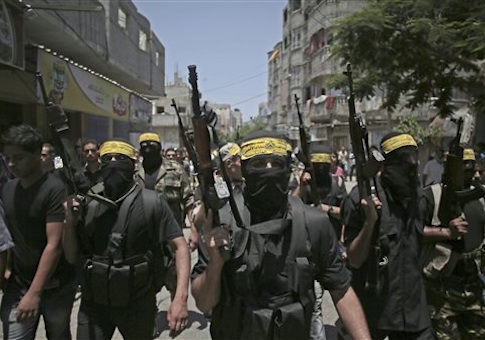
Masked Palestinian militants march with guns / AP

 Iranian military leaders say that they have begun weapons deliveries to Palestinian terrorists in the West Bank and elsewhere in the region after months of promising increased military support for Israel’s enemies, according to regional reports.

A top Iranian military commander confirmed that weapon shipments to the West Bank have already begun and that more will be sent to other “Palestinian resistance groups.”

“Arming the West Bank has started and weapons will be supplied to the people of this region,” Brigadier General Mohammad Reza Naqdi, the commander of Iran’s volunteer Basij force told the state-run Fars News Agency on Wednesday.

The announcement was made after weeks of inflammatory statements from Iranian leaders threatening war on Israel and promising to rearm Palestinian militants such as Hamas so that they can continue their war on the Jewish state.

The military leader also confirmed what has long been suspected by Israeli intelligence agencies: That Iran is responsible for training and arming Hamas with highly advanced rockets that were used to penetrate deep into Israeli territory during the most recent conflict.

Much of the arms Hamas deployed “were the products of the Islamic Republic of Iran,” Fars reported Naqdi as saying.

Iran is arming terrorists in the more moderate West Bank of Israel—as opposed to the Hamas-run Gaza Strip—because attacks on Israel from this area will ensure “the annihilation of the Zionist regime.”

“The Zionists should know that the next war won’t be confined to the present borders and the Mujahedeen will push them back,” Naqdi said.

An Iranian General this week vowed to launch a surprise attack on Israel in retaliation for an Israeli drone that was reportedly shot down near an Iranian nuclear site.

Anger at the incident has also prompted Tehran to step up its military support for Palestinian terrorists.

“We will accelerate arming the West Bank and we think that we are entitled to give any response (to the recent aggression) which we deem appropriate,” Brigadier General Amir Ali Hajizadeh, commander of Iran’s Revolutionary Guards Corps’ (IRGC) Aerospace Force, was quoted as saying on Monday.

Iran also is considering military force, according to Hajizadeh.

The IRGC claims to have shot down the Israeli drone with a surface to air missile. It lashed out at Israel in vitriolic terms in a statement issued earlier in the week.

“This mischievous attempt once again made the adventurous nature of the Zionist regime more evident and added another black page to the dark record of this fake and warmongering regime, which is full of crimes and wickedness,” the IRGC said in its statement.

Iran has been promising to arm Palestinian terrorist for weeks as the most recent conflict between Israel and Hamas escalated.

“The West Bank must be armed like Gaza,” Iranian Supreme Leader Ayatollah Ali Khamenei said in late July. He echoed these comments on Twitter.

Iran also has boasted of its past arming of Hamas terrorists.

“Today, the fighters in Gaza have good capabilities and can meet their own needs for weapons,” an Iranian lawmaker reportedly stated on television in July. “But once upon a time, they needed the arms manufacture know-how and we gave it to them.”

IDF Strikes Al-Qaeda-linked Gaza Terror Cell

August 25, 2014

lBy: Hana Levi JulianPublished: August 25th, 2014

via The Jewish Press » » IDF Strikes Al-Qaeda-linked Gaza Terror Cell.


IAF aircraft targeted numerous terror targets in Gaza over the past 24 hours as rockets continue to rain down on Israel.
Photo Credit: IDF Spokesperson’s OFfice
 

Israeli fighter pilots bombed operatives in Gaza from the Jaish Al-Islam terrorist organization on Monday afternoon.

The air strike, which resulted from a joint Shin Bet – IDF operation, eliminated a terror cell that was planning an attack on Israel in the near future, according to security sources.

The IDF also targeted a concealed rocket launcher placed within a school in the Shujaiyya neighborhood in Gaza City, used to fire missiles at Israel earlier in the day.

Jaish al-Islam, also known as the ‘Army of Islam’ terrorist organization, is called the ‘Tawhid and Jihad Brigades’ as well — the name used by the Doghmush clan in Gaza. The Salafi Muslim terror group appears on the official United States list of Foreign Terrorist Organizations. Its base is located in the Tzabra neighborhood at the very heart of Gaza, in the center of the region.

The Army of Islam is best known for having led the abduction of former IDF soldier Gilad Shalit in June 2006.

The group also kidnapped BBC journalist Alan Johnston in March 2007, and held him hostage until July of that year, when he was handed to rival Hamas officials in exchange for the release of captured Jaish al-Islam spokesman.

Although the group once challenged Hamas for control over the region, Hamas is now working closer together with Jaish al-Islam and is offering financial and other support to the group, Israeli intelligence sources said Monday.

Since midnight, nearly 90 rockets and missiles have been fired at Israel; a total of 823 projectiles have been launched at civilians in the Jewish State since Hamas violated the most recent temporary cease-fire eight hours before it was due to expire.

Israel News – Report: 3 killed in Gaza liquidation

August 25, 2014

Report: 3 killed in Gaza liquidation

The Palestinian report that IDF attacked a vehicle in Shuja’iyya, killing three

Aug 25, 2014, 04:08PM | Yael Klein

via Israel News – Report: 3 killed in Gaza liquidation – JerusalemOnline.

Hamas is getting desperate, no more arguments , just screaming nazi and holocaust !


The targeted liquidation in Gaza, today Channel 2 News


The Palestinian report that IDF attacked a vehicle in Shuja’iyya, killing three. IDF deny Hamas’ claims of Israeli drone captivation. Meanwhile, a Palestinian source says that all the factions agreed to a month-long ceasefire. Israel confirms the existence of such an offer.

Fire at the South continues along with IDF bombings in Gaza: the Palestinians report that IDF carried out a targeted liquidation around noon, hitting a vehicle in Shuja’iyya. According t the reports, three people were killed in the attack.

In an additional airstrike, IDF say, a number of terrorists were hit near Jabalian in Northern Gaza. IDF additionally attacked a launching pit in a school yard in Gaza out of which rockets were fire at Israel today.

Earlier today Hamas claimed they caught an IDF drone. IDF rushed to deny the report claiming it to be wrong.

Meanwhile, the new Egyptian version of a ceasefire draft awaits the sides’ approval. According to the Egyptian proposal, an immediate fire will take place in the course of one month, upon which the Gaza crossings will be opened immediately.

Israeli officials say that they are familiar with the agreement and that Egypt has applied pressure on Hamas to accept its proposal. A Palestinian source told AFP news agency that all the Palestinian factions in Gaza have accepted the Egyptian proposal.

Hamas’ head of political bureau Khaled Mashal demanded the president of the US to interfere immediately in the ongoing crisis between Israel and Hamas, calling out to him to end the “holocaust against the Palestinians”, as he put it.

In an interview he provided under heavy security to news website Yahoo, Mashal addressed Obama asking him to display his responsibility in favor of stopping Israel. “I ask of you, as the leader of the world’s most powerful country, to speak out and end the Israeli aggression in Gaza”, Mashal said in English. “I ask you to call out to Israel to remove the blockage, open the crossings and rebuild Gaza. Those are our demands”.

Mashal later defined IDF’s action in Gaza as a “holocaust”, and even compared the heads of the Israeli leadership to those of Nazi Germany. “The kill thousands of civilians, children, women, destroy entire neighborhoods, mosques and hospitals”, Mashal claimed aggressively. “What is the difference between what they do and what the Nazis did in the 30’s and 40’s?”

‘Hamas a less threatening enemy than previously estimated,’ Nahal intelligence officer tells

August 25, 2014

Hamas a less threatening enemy than previously estimated,’ Nahal intelligence officer tells ‘Post’

By YAAKOV LAPPIN 08/25/2014 14:31

Hamas operates from heart of civilian population center, but melts away in face of ground offensive, Maj. S says: “We did not encounter a single enemy commander in combat the moment the ground maneuver began.”

via ‘Hamas a less threatening enemy than previously estimated,’ Nahal intelligence officer tells ‘Post’ | JPost | Israel News.

Read This ! it opens up a lot of questions for me !


Nahal brigade in Gaza Photo: IDF SPOKESMAN’S OFFICE
 

When directly confronted on the ground, Hamas became a less threatening enemy than previously estimated, the Nahal infantry brigade’s chief senior intelligence officer, Maj. S (full name withheld for security reasons) told The Jerusalem Post on Monday.

Nahal units remain deployed outside of Gaza together with other infantry divisions, as Israel currently fights a war of attrition with Hamas and limits itself to air power.

Maj. S recalled how Hamas “ran away from the battlefield” in northern Gaza after Nahal entered the Strip last month, as part of the army’s mission to destroy Hamas’s network of cross-border attack tunnels.

A small number of Hamas units in north Gaza did put up a serious fight, exhibited determination to engage the IDF, and killed a total of six Nahal soldiers during the ground offensive, Maj. S said. But “in comparison to what we expected, this was less. From the moment the ground offensive began in our sector of northern Gaza, the enemy ran away. Its commanders disappeared on the first day of the air campaign.

We did not encounter a single enemy commander in combat the moment the ground maneuver began.” Maj. S noted that this was a “complete antithesis” to the IDF’s tradition of placing commanders in forward positions in advancing units.

A few Hamas cells engaged in firefights with Nahal units, killing, among others, the commander of Nahal’s Gefen Battalion, 38-year-old Lt.-Col. Dolev Keidar, who Maj. S knew personally.

But on the whole, after Nahal entered Gaza and deployed significant firepower, Hamas failed to respond with an organized and prepared counter-strike against advancing IDF units, he said.

Hamas’s commanders remained in hideouts, while its regional battalion guerrillas hid in civilian population centers, from which they continued to direct projectile fire at Israel. “They fired from refugee camps, UNRWA schools, hospitals and mosques. All of these things are documented,” the intelligence officer said.

“The asymmetry between them and us is very large, not only in terms of operational techniques, but also in terms of values. We always try to deploy our forces far from Israeli communities to avoid exposing them to enemy fire. Hamas do the opposite, acting in the heart of their population center to use it as a human shield for their activities.

This creates many challenges,” Maj. S stated.

As the Nahal brigade’s intelligence officer, Maj. S holds daily situation evaluation meetings with field commanders, and acts as a bridge between Military Intelligence and the infantry brigade, ensuring that its officers are aware of the latest intelligence on Hamas.

“We have been in combat mode for almost 80 days. It began in Judea and Samaria, with Operation Brother’s Keeper [to search for the three Israeli teenagers kidnapped and murdered by Hamas near Hebron], and continued with Operation Protective Edge, which brought us to the Gaza sector,” he said. “Soldiers, commanders and reservists have seen very little of their homes during this period,” he added.

Maj. S carries out operational analyses of all aspects of combat. He makes use of a range of technological means to gain a picture of the challenges lying ahead.

“This includes evaluating the situation of the enemy before we enter combat, and while in combat, to understand its location, status, and plans,” Maj. S explained.

“These days, we can really track the enemy, and pass on alerts to units that are maneuvering in the field. We can then attack and destroy the threat with all the means at our disposal. We do all of this while tackling the challenge of directing our firepower at threats and seeking to avoid harming the Gazan civilian population, which is not tied to Hamas’s activity,” the officer said.

“We have dedicated a lot of energy and resources to try and prevent harm to noncombatants. We have been ordered to do this dozens of times, from the chief of staff to the brigade commander. Our orders are to seek out and confront our attackers, while avoiding harm to combatants,” he added.

“In order to achieve this, we have to have a grasp of the territory, on a variety of levels. To understand where the enemy is located, and to be equally aware of where it is not located. Then, we must direct our firepower precisely at the enemy and its infrastructure. We do this on the basis of intelligence gathered on threats, both before the conflict, and more recent intelligence, which is very dynamic. We get information from the bottom, sides, and from above,” Maj. S said, hinting at the sources of input at his disposal.

On the basis of the latest information, “We constantly evaluate the situation, and think about where it is better to focus our offensive efforts, and where we should be careful. Intelligence never rests,” he added.

Today, even the most junior field commanders receive relevant and valuable intelligence, Maj. S said.

Assessing The UN’s OCHA “Gaza Crisis Atlas 2014″ Report by Judge Dan

August 24, 2014

Assessing The UN’s OCHA “Gaza Crisis Atlas 2014″ Report

Posted by: Judge Dan August 24, 2014

via Assessing The UN’s OCHA “Gaza Crisis Atlas 2014″ Report by Judge Dan | Israellycool.

Please visit website for full scale maps


Last week, OCHA (United Nations Office for the Coordination of Humanitarian Affairs) published their “Gaza Crisis Atlas“.

It is a 100-page long, ready-for-print, PDF atlas of Gaza, showing the locations of schools, shelters, hospitals and other infrastructure, along with more than 12,000 points representing damage and destruction caused by the IDF air and ground assault during the first month of Operation Protective Edge (between July 9th and August 5th).

The Gaza Crisis Atlas is a planning tool intended to assist aid and development agencies in assessing and responding to humanitarian and reconstruction needs emanating from the conflict in the Gaza Strip. It is a vital tool for humanitarian and development organizations, but it is also a valuable resource for anyone operating in Gaza as well as those wanting to better understand the impact of the recent escalation of hostilities.

The Atlas includes printable A3-size maps featuring satellite images of all areas of the Gaza Strip. The main features / land marks were plotted on a high resolution satellite image captured on 6 July 2014. The Atlas was designed at the neighbourhood level to provide higher level of detail to support operational organizations to conduct needs assessments and programming.  The individual subset maps illustrate physical damages provided by UNOSAT based on analysis of satellite images from 14 August 2014. Location of shelters, health and education facilities in addition to other baseline information is all mapped.

I cannot independently verify the veracity of the damage reports and locations, or the methodology used by OCHA in collecting and classifying these sites. From going over these locations with satellite imagery, they are indeed overlapping structures and other compounds.

OCHA defined 4 qualitative severity levels

  1. Crater/Impact
  2. Moderately Damaged Structure
  3. Severely Damaged Structure
  4. Destroyed structure

Their maps are colour coded, and I’ve used this same symbology for my maps

OCHA Scale

It should be noted that these maps had a separate symbol for damaged hospitals and power stations, yet didn’t actually have a damage point on top of it. I’ve saved these with threat level “zero.”

I extracted the points and uploaded them in this easy to navigate Google Fusion Tables map, displayed by severity.

Here are those points extracted by severity (increasing from 0 & 1 on the left to level 4 on the right):


Gaza Damage points broken down by severity, click for full resolution

Several patterns are discernible:

The attacks are in no way “random” or “indiscriminate”. One can clearly see the spatial distribution of the damage in several aspects. We find 8,952 of the 12,433 total points (72%) are within a 3 KM buffer abutting the border with Israel. The main objective of Operation Protective Edge was to find and destroy dozens of terror tunnels dug from Gaza into Israel.

That the most intensive damage was caused to the area where the tunnels naturally originated is thus perfectly understandable. Furthermore, of the 4,441 destroyed structures, 3,481 of them (78%) are within the 3 KM buffer, as are 2,531 of 3,303 (77%) of the lowest intensity damage (simple craters), which are mostly strikes on rocket launchers and tunnels.

Most of the attacks are grouped around certain neighborhoods or villages, such as Shuja’iyya, Johur ad-Dik, Sureij, and Khuza’a. These were probably the result of the ground operations that took place in dense urban areas also within the 3 KM buffer that housed multiple tunnel entrances and shafts, as well as launch sites for mortars and rockets.

The IDF has published a map of known terrorist infrastructure in the neighborhood of Shuja’iyya. By overlaying the the IDF’s map with OCHA’s damage points, the correlation is uncanny. Furthermore, note how most of the strikes on farmlands are indeed classified as “Crater/Impact”.


OCHA Damage points overlayed over IDF map of Shuja’iyya, click of full resolution

Of the places that were attacked outside of the 3 KM buffer there are two of note. The primary one is the Philadelphi corridor that separates the Gaza Strip from Egypt (under which run many smuggling tunnels). Additionally, there is the southern Gaza city neighborhood of al-Zeitun, which was just recently used as the launching site of the mortar that killed 4 year old Daniel Targeman.

OCHA is focusing mainly on the civilian aspect, and has thus divided and analyzed the damage based on the 5 Gaza governorates and their subdivisions, tallying the data in several tables in the report. This analysis is missing the “big picture”, the overall intensity of the strikes.

Damage Intensity Heatmap

This heatmap was created with a weighted kernel density of the OCHA damage points, with the weight being the severity.


It now becomes very clear that most of the damage was caused to 5 locations right on the border with Israel. The rest of the Gaza Strip was, for the most part, undamaged. The main population areas of Gaza city, Jabaliya, Khan Yunes, Rafah and Deir el-Balah were disproportionately undamaged.

If we do a rough estimate of the damage area, it is once again clear the vast majority of the Gaza Strip was unscathed. With a fairly generous estimation that a damage point has a 25 meter radius – the footprint of a house, or the blast radius of a bomb – the total damage area of the 12,433 impacts was in the order of 15 KM2. The land area of the Gaza strip is 360 Km2. In other words, less than 5% of the land was affected.

One last point which should be noted: with roughly 15% of Hamas rockets and mortars falling short or misfired, it is safe to assume that a significant number of those damage points were not the result of Israeli air strikes, shelling, or detonations. This is not mentioned in the OCHA report.

In conclusion, in this post I tried to show some absolute data and geographical information beyond the online and printed hyperbole that we have seen in the past several weeks. While it is indeed upsetting that many uninvolved have been killed, the lopsided portrayal of the “IDF attacks on Gaza” is disingenuous. Israel has said from the get-go that it is targeting terrorists, and the spatial distribution of the damage points (from this third party source) proves the IDF’s claims of targeted attacks on terrorist infrastructure, whether they are in fields or in the middle of a neighborhood hijacked by Hamas.

I am more than willing to continue analyzing and investigating the OCHA dataset and am open to suggestions and remarks from others. I am sharing CSV with the full list of 12433 geocoded points in WGS84 D.d format including their severity level and the page they appeared on for easy indexing, and WKT Geometry field.

Disclaimers:

OCHA damage data, while not published in itself, is considered public domain and as such can be subject to fair use.

All other geographic data: roads, buildings, outlines and places are OSM data.

The Damage Intensity map is copyrighted and watermarked. You can share it with proper attribution to my post here at Israellycool with a link back to this post. If you would like further comment or to republish this work please contact judgedan48 [at] gmail.com

IDF: ‘Dear Gazans, Beware’

August 24, 2014

’Hamas’ actions , or lack of actions, in the next two days may determine if the IDF invades Gaza.

By: Tzvi Ben-Gedalyahu

Published: August 24th, 2014

via The Jewish Press » » IDF: ‘Dear Gazans, Beware’.


Tens of thousands of leaflets advise Gaza residents to steer clear of terrorists.
Photo Credit: IDF

The Israeli Air Force dropped tens of thousands of leaflets on Gaza Saturday, warning them that any house connected with terrorists is a fair target.

The IDF has provided a translation of the leaflets:

“To the residents of Gaza,

“The IDF intends to attack terrorists and terror infrastructure across the Gaza Strip.

“Hamas leadership, while remaining in underground hiding, disregarding the civilians’ needs and wishes for tranquility, will be pursued.

“Israel is currently attacking, and will continue to attack, every area from which terror activities against Israel originate. Every house from which militant activity is carried out, will be targeted.

“For your own safety, prevent terrorists from utilizing your property for terror agendas, and stay away from every site in which terrorist organizations are operating.

“The IDF calls you to distance yourselves from where fire was directed at Israel. The IDF’s campaign has not​ been ​concluded.

“Beware

“Israeli Defense Forces”

A recorded message to Gaza residents stated, “Hamas leadership has decided to drag you to another battle. Prevent terrorists from utilizing your property for terror agendas, and stay away from every site in which terrorist organizations are operating.”

Minister Erdan in a Powerful Message to Hamas: “We Are Nearing a Ground Operation”

August 23, 2014

Minister Erdan in a Powerful Message to Hamas: “We Are Nearing a Ground Operation”Against the background of the ongoing fire, Israel sends a powerful message to Hamas:

In an interview with Channel 2 news, Gilad Erdan, minister and member of the Cabinet said that Israel is close to another ground incursion in Gaza rather than putting up with the rocket fire. “Hamas continues to fire and it does not work,” said the Minister.

Aug 23, 2014, 11:00PM | Jerusalemonline Staff

via Israel News – Minister Erdan in a Powerful Message to Hamas: “We Are Nearing a Ground Operation” – JerusalemOnline.


Gilad Erdan Channel 2 News
 

In light of the growing frustration among the people of the South, many of whom decided to leave their homes in the wake of the constant firing, Member of the Cabinet, Minister Gilad Erdan said tonight (Saturday) that Israel is closer to a new incursion into Gaza. “Has this decision been made? Not yet. But we are closer to it than we ever were,” Erdan said in an interview with Channel 2 News.

“I certainly sympathize with the feelings of the southern residents, who should be saluted for their courage and determination, and we promise that this operation will not end as the situation is at the present-what was will not be,” Erdan stressed. His statements come one day after a 4-year-old child, Daniel Tregerman was killed by a mortar shell in an Eshkol Regional Council community. “You have to have patience and you have to have determination,” said Erdan.

The minister added, “we cannot go back to the situation that the crossings will be open so that Hamas can rebuild all the capabilities they have lost in this operation, and they lost a lot of capabilities – the tunnels, a considerable part of its rocket structure and some leaders of the organization in IDF targeted killings.”

“Hamas continues to fire and this will not work. Currently, I believe, there is a connection Israel’s response policy, and the nearing of a ground operation,” stressed the minister and Cabinet member. “Hamas continues its attrition and we continue ours from the air, but it is not a condition that can last for weeks. The purpose of the ground operation could be full occupation and the collapse of Hamas rule, or specific attacks on the organization’s divisions.”

IDF Retaliation: 3 Dead Terrorists in Gaza

August 23, 2014

The Saturday night air strike followed the death of a 4-year-old Israeli boy during a shelling attack on the border town of Nahal Oz near Gaza.

By: Jewish Press StaffPublished: August 23rd, 2014

via The Jewish Press » » IDF Retaliation: 3 Dead Terrorists in Gaza.


IDF retaliates for death of 4-year-old child: air strike kills 4 terrorists in a-Nasser neighborhood in Gaza City August 23, 2014.
Photo Credit: Screenshot
 

At least three terrorists are dead and approximately 9 others were injured in a targeted assassination by the Israeli Air Force in Gaza.

A missile pulverized the car in which the terrorists were traveling in the a-Nasser neighborhood of Gaza City. The Saturday night air strike followed a 24 hour period in which nearly 100 rockets and missiles were fired at Israeli civilians.

In a second air strike, a 12-story building in the Tel al-Hawa neighborhood collapsed, sending a cloud of black smoke and flames spiraling into the sky.

Residents of the building were warned to leave the building, which served as a base for Hamas operations, prior to the attack. IAF pilots fired a warning dud at the roof of the 48-unit building before the strike, reminding occupants to leave, according to police.

Two missiles blew up the building about five minutes later, which collapsed under the explosion.

Despite the warnings, at least 10 people were wounded according to local sources, including four children.

Over the course of the day, the IDF said it bombed some 60 terrorist targets throughout Gaza. Among those eliminated were concealed rocket launchers, weapons caches and terrorist operations facilities.

Terrorists rained rockets and missiles of varying ranges across the Israel throughout the day and into the night on Saturday. At around 10:30 pm, a missile reached as far north as Acco. No one was physically injured and no property damage was reported.

On Friday, a 4-year-old boy died when he didn’t make it to shelter in time to avoid mortar shelling by Gaza terrorists aimed at the Israeli border town of Nahal Oz.


