The new base in Syria gives Hezbollah the option of attacking Israel and drawing Israel’s return fire away from Lebanon, where its most precious assets are hidden: well over 100,000 rockets and missiles that might be saved for a future battle over Iran’s nuclear weapons program.
Hezbollah, exploiting its presence in Syria, has been attempting to open a new front against Israel.
Over the past 18 months, Hezbollah and its enablers from the Iran’s Islamic Revolutionary Guard Corps [IRGC] have begun launching a series of attacks on Israel from their new center of operations in southern Syria.
After Sunday’s air strike (attributed by the media to the Israel Air Force) that killed 12 high-ranking Hezbollah and IRGC operatives near Quneitra, Syria, along the Israeli border, Israel is bracing for the possibility of an attack by Hezbollah and Iran.
Although Israel has not officially taken responsibility for the strike, it would make sense to view the action as a preemptive move designed to remove a clear and present danger arising on Israel’s border with Syria. The danger is the formation of a second Hezbollah terrorism base, in addition to Hezbollah’s home base already in Lebanon.
The IRGC and Hezbollah have begun playing a dual role in the geographical area once known as the Syrian Arab Republic, a country that no longer exists as it appears on world maps. Iran and Hezbollah are acting as the life support machine for the shrunken but still functional Assad regime, now in control of just Damascus, Aleppo, and the Syrian Mediterranean coastline.
Since moving into Syria to rescue the regime of Bashar Al-Assad, Hezbollah, acting on orders from Iran, has expanded its presence in several areas of Syria. Iran too has boosted its presence in Syria, primarily though the presence of members of its Revolutionary Guards.
At the same time, the IRGC and Hezbollah have begun building a terrorism base in Syria that is directed against Israel, in addition to the Iranian-backed Hezbollah semi-state entity in southern Lebanon.
The new base in Syria, at Israel’s northeast border, gives Hezbollah the option of attacking Israel and drawing Israel’s return fire away from Lebanon, where its most precious assets are hidden: well over 100,000 rockets and missiles that might be saved for a future battle over Iran’s nuclear weapons program.
Hezbollah is also under domestic Lebanese pressure not to drag Lebanon into a new devastating conflict with Israel.
The Hezbollah and IRGC operatives that were targeted in Sunday’s airstrike were in the midst of significantly stepping up these attacks. Their plans included rockets and cross-border raids by terror cells. These attack plans were seriously larger in scale than past assaults.
It is in this context that Sunday’s air strike occurred.
Now, all eyes are on northern Israel to see whether Hezbollah and Iran retaliate there. The leader of the IRGC, Major General Mohammad Ali Jafari, on Tuesday threatened Israel with “devastating thunderbolts” — threats Israel cannot afford to take lightly.
Israeli soldiers take part in a training exercise near the border with Syria, December 2013. (Image source: IDF)
It would be safe to assume, however, that Hezbollah wishes to avert the outbreak of an all-out conflict. Such a war would expose Lebanon to unprecedented Israeli firepower, and would also expose Israel to unprecedented Hezbollah rocket attacks and cross-border infiltrations by land, air and sea.
If such a conflict were to break out, many parts of southern Lebanon could lie in ruins, and Hezbollah’s many Sunni enemies in next-door Syria could seize on the weakness of their Shi’ite foes and pounce, dragging Lebanon into the Syrian war.
That kind of outcome would not benefit Hezbollah or Iran in any way. But in the Middle East, miscalculations have led to costly errors in the past, and events can take on a life of their own.
The U.S. Consulate’s determination to provide the trappings of Palestinian statehood to the Palestinian Authority outside the negotiating process should come under scrutiny.
What plan do we have if the Palestinian army attacks the IDF in the future — instead of its presumed enemy, Hamas?
It is revealing that the U.S. appears determined to provide the Palestinian Authority with an army while it is still at war with our ally, Israel.
Last week, officials from the U.S. Consulate in East Jerusalem attended a Palestinian protest over Israel’s removal of olive trees illegally planted in the West Bank. Coordinated with the Palestinian Authority [PA] but not Israel, the Consulate personnel ended up clashing with Israelis living nearby. It was, perhaps, the quietest international almost-incident you never heard of.
This week, with the focus off Paris, the Middle East Quartet (the U.S., EU, Russia & the UN) plans to meet. The U.S. Consulate’s determination to provide the trappings of Palestinian statehood to the PA outside the negotiating process should come under scrutiny.
The olive tree incident prompted an article in the Israeli press about the Consulate, including the use of Palestinian security, rather than IDF combat veterans as required by a 2011 agreement. Some IDF guards were fired, according to the article. Others resigned, blaming the appointment of a new consulate security officer, who they said, established a Palestinian armed militia. “He is training them with weapons, combat and tactical exercises. There is a lack of responsibility here – who ensures that such weapons, once given over to Palestinian guards, won’t make their way to terror groups?”
The change in personnel from IDF veterans to a Palestinian Security Force [PSF] is part of a long series of steps to transform the Palestinian body politic into a state. If the U.S. Consulate becomes the U.S. Embassy to Palestine — a function it already observes — it is understandable that the PA would not want “occupying Israeli soldiers” to guard the symbol of America from Palestinian citizens in “its capital, Jerusalem.” The Consulate, with its mission to the PA, would agree.
Palestinian security forces have been in existence since 1994 and have steadily changed mandates. They have gone from a “police force” under the Oslo formulation of “dismantling the terrorist infrastructure” so Israel could have confidence in security after withdrawing from territory, to a protection force for Mahmoud Abbas so he would continue negotiations under U.S. auspices — but now to an army for the nascent state.
The Clinton Administration signed on to the police phase, but asked how Arafat could be expected to defeat “terrorists” without weapons. Unmentioned were a) Arafat was the prime funder and organizer of the terrorist organizations in question, and b) the PLO had already proven perfectly capable of killing its enemies.
The first funds for equipment and training came in 1994 from international donors including the U.S. Arafat, having a reasonable sized arsenal of his own, wanted arms, but settled for nonlethal items.
In 1996, Western trained Palestinian “police” attacked IDF personnel with weapons, killing 15 soldiers and border guards, after the opening of an exit from an ancient Hasmonean tunnel in Jerusalem, near the Western Wall in the Old City.
Despite these attacks, according to Jeffrey Boutwell, Director of the Pugwash Conferences on Science and World Affairs, the 1997 Hebron Protocol “provided for a Palestinian police force of some 30,000 personnel, equipped with 15,000 automatic rifles and pistols, 240 heavy machine guns, 45 armored vehicles, lightly armed shore patrol vessels, and associated communications and transportation equipment.” An Israeli-Palestinian Joint Security Coordination and Cooperation Committee [JSC] was formed to oversee “arrangements for entry of the Palestinian Police and the introduction of police arms, ammunition, and equipment.”
Between the onset of Western arms deliveries and a thriving black market, the PA “police” had all the lethal equipment they could handle.
Training stopped during the 2001-2004 so-called “second intifada” with the (unsurprising) revelation that the PA “police” found their Western assets invaluable in attacking Israelis. In 2005, however, history began again and the U.S. decided that the Palestinians should have a new security service. LTG William Ward USA (Deputy Commanding General, U.S. Army Europe, and Chief of Staff, U.S. Seventh Army) was the point man. In the words of then-Secretary of State Condoleezza Rice, his mission was:
“To make sure the parties understand each other and we understand what the parties are doing, so we can raise it at the appropriate level” if action is required.
“To provide a focal point for training, equipping, helping the Palestinians to build their security forces and also for monitoring, and if necessary, to help the parties on security matters.”
The missions were incompatible and inappropriate. The first involved “translating for the parties” with an eye toward U.S. intervention, a political job that should not have been done by a military officer. Further, having part of the mission directed toward a Palestinian force gave the General a stake in the success of the Palestinians over the concerns of Israel.
LTG Keith Dayton (Director of Strategy, Plans and Policy, Office of the Deputy Chief of Staff, G-3, U.S. Army), well respected and liked by Israel and the IDF, succeeded LTG Ward. His job, however, was complicated by the deterioration relations Hamas-Fatah in Gaza. According to acontemporaneous Ha’aretz story, Dayton was to arm and train “the Presidential Guard of PA Chairman Mahmoud Abbas to prepare it for a potential violent confrontation with Hamas forces in Gaza. Palestinian sources say the training of 400 Force 17 troops… started [in November 2006] in Jericho under the guidance of an American military instructor.” Force 17 had been Arafat’s Praetorian Guard, attacking recalcitrant Palestinians as well as Israelis. Abbas had inherited it.
Throwing American support to one Palestinian faction over another was a political decision to side with what our government assumed was “better” or more “moderate” Palestinians, hoping it would use our help to put down Hamas rather than using it to kill ever more Israelis.
What it did was legitimize the creeping movement of the Palestinians toward a full-fledged army.
This new mission needed IDF participation — which Israel approved in part because of its relations with LTG Dayton, and because it allowed Israel to operate in West Bank territory with a relatively free hand to arrest both Hamas operatives and Fatah bad guys. It also made Abbas beholden to Israel for his personal security and that of his kleptocracy. That part worked, and even now, PA figures have admitted publicly that without IDF cooperation, the PA would fall.
Dayton’s successors, LTG Michael Moeller, USAF and ADM Paul Bushong, USN, have quietly continued and upgraded both training and weapons.
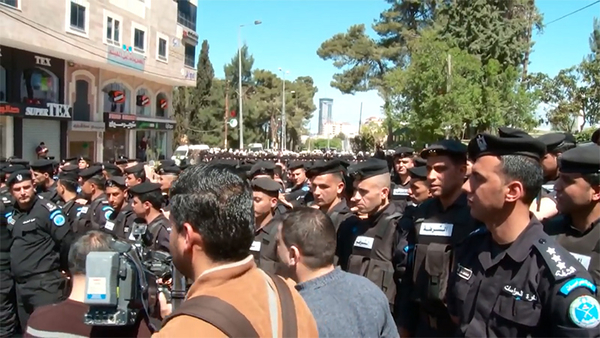
Hundreds of troops from the Palestinian Security Force line a street in Ramallah, in order to block anti-American protestors, during President Obama’s 2013 visit to the city.
The question always was twofold: What constitutes “appropriate” weapons for the PSF, and how does the U.S. justify training security forces the ultimate loyalty of whom will be a government that we cannot foresee and may become something — or already is something — we don’t like? The corollary is: What plan do we have if the Palestinian Army attacks IDF forces in the future — instead of its presumed enemy, Hamas?
To raise the questions is to understand that there are no sound answers from either the Consulate or the State Department. In their absence, concern over the choice of security guards by the U.S. Consulate in Jerusalem is appropriate, but insufficient. It is revealing that the U.S. appears determined to provide the PA with an army while it is still at war with our ally, Israel.
Lebanese Hezbollah supporters shout slogans as they march during Ashoura day in Beirut’s southern suburbs, Lebanon, Tuesday, Dec. 6, 2011 / AP
Iran on Monday promised that Hezbollah would deliver “crushing response” to the Israeli attack over the weekend, which killed six Iranian agents, including a top-level commander, and five Hezbollah members.
“The experience of the past shows that the resistance current will give a crushing response to the Zionist regime’s terrorist moves with revolutionary determination and in due time and place,” Ali Shamkhani, the secretary of Iran’s Supreme National Security Council (SNSC), was quoted as saying.
The Israeli strike came just days after Hezbollah leader Hassan Nasrallah declared that the terror group was preparing for a war in Israel’s northern Galilee region.
It also occurred just a week after Iranian military leaders announced that they are operating missile sites in Syria, which potentially include a nuclear facility.
Senior Iranian and Hezbollah commanders were likely planning a sophisticated invasion of Israel’s northern border in the weeks before they were killed by an Israeli airstrike over the weekend, according to Major General Eyal Ben Reuven, the former deputy head of the Israeli Defense Forces Northern Command.
The accuracy of Israel’s strike and the high-level nature of those Iranian and Hezbollah commanders killed indicates planning for a militant incursion into Israel’s northern region, according to Reuven, who said the airstrike shows a “very high level of intelligence” on Israel’s part.
The high-level nature of the Iranian and Hezbollah operatives targeted by Israel suggests that an attack on Israel was imminent, according to Reuven, who handled top intelligence in the region during his time serving in the IDF.
“If the highest level of Hezbollah commanders were in the Golan Heights and the high level of Iranians, it means that their idea, [what] they’re planning could be a kind of operation, an act against Israel on a high level,” Reuven said during a conference call Monday organized by the Israel Project (TIP). “It’s significant, the high level of this meeting, of this reconnaissance of the Iranians and Hezbollah.”
“It says something about what they plan, what kind of operation they planned,” he added. “If Israel has intelligence that says there is a kind of operation on the way to act against Israel, I think Israel would have a legitimate [reason] to do all we can to prevent it.”
The strike that killed these 11 militants was “very, very professional,” according to Reuven, and would require “very, very high level intelligence” and “very accurate” targeting information.
Iran quickly confirmed that one of its top commanders had been killed in the strike, according to Farsi language reports.
Multiple state-controlled Iranian news agencies confirmed that Iranian Revolutionary Guard Corps (IRGC) Brigadier General Mohammad Ali Allahdadi had been killed by “a military helicopter of the Zionist regime during a visit to the ‘Quneitra’ region of Syria.”
“As a result of this crime, this heroic general along with several members of Hezbollah reached martyrdom,” the Iranian Students News Agency (ISNA) wrote in a Persian language report independently translated for the Washington Free Beacon by the Foundation for Defense of Democracies (FDD).
Allahdadi had been sent to Syria by top Iranian commanders “so that he could combat the Zionist regime in Lebanon and Syria,” according to the Iranian media.
The IRGC official press organ also confirmed the death in a statement published by Iranian news outlets.
“Brigadier General Mohammad Ali Allahdadi was of the brave, devoted, and wise commanders of the Islamic Revolutionary Guard Corps whose effective contributions during the Holy Defense (the Iran-Iraq War) and after during his Commanding of the Al-Ghadir IRGC unit of Yazd province will always be enduring and inspiring to the generation of today and tomorrow of the Islamic nation,” read the IRGC communiqué also issued in Farsi.
The IRGC claimed that Allahdadi was in Syria to help embattled leader Bashar al-Assad combat “terrorists” there.
Allahdadi also helped in “neutralizing the atrocities and conspiracies [of] this Zionist-terrorist sedition in Syria’s geography,” according to the IRGC.
The IRGC went on to lash out at Israel for “violating the airspace of the country of Syria” and accused the Jewish state of emboldening terrorists affiliated with the Islamic State (IS), which is battling against Assad.
Israel’s actions against Iran and Syria are being “planned” along with “the cooperation [of] the heads of the White House and the occupying regime of Quds [Jerusalem],” the IRGC said in its statement.
Information about the other Iranians killed remains minimal at this point. Conflicting reports have emerged about whether the top militant killed, Abu Ali Tabatabai, was officially working on behalf of Iran or Hezbollah.
Tabatabai had been linked to Iran’s Al Radwan Special Operations Units, which is known to conduct combat operations, according to TIP.
“His presence would have suggested, and probably indicates, operations aimed at overrunning Israeli border towns,” TIP reported in an email to reporters.
The Hezbollah members killed include Mohammed Issa, a senior Hezbollah figure closely tied to Iran, and Jihad Mughniyeh, Hezbollah’s leading figure in the Golan Heights area near Israel’s border with Syria.
Behnam Ben Taleblu, an Iran expert and researcher for FDD, told the Free Beacon that Iran is expected to boost its presence in Syria and increase its support for Hezbollah.
“Given Iran’s heightened resolve and dedication to keeping Assad in power, we can expect the Islamic Republic to continue, if not deepen its commitment to the Assad regime and Hezbollah by way of such mercenaries,” he said.
Taleblu also noted that Iran continues to blame the rise of IS (also known as ISIL or ISIS) on America and Israel.
“The notion contained in the IRGC’s communiqué in the aftermath of the death of Commander Mohammad Ali Allahdadi, that the Islamic State (or DAESH, in Persian and Arabic) is linked to Israel and the U.S. is a common one promoted by the Islamic Republic’s hardline political elite and regime media,” he explained.
“Beyond narrative, this false linkage underscores an analytical shortcoming, Iran’s military and political class have failed to attribute agency to the Islamic State, be it in Syria or Iraq, and by claiming they are Western agents, misread and misdiagnosed the violent sectarian milieu that was growing in Iraq and Syria before the group’s emergence last summer,” he said.
Former Israeli National Security Adviser, Maj. Gen. (ret.) Yaakov Amidror, outlined the threats to the Jewish State from non-state entities in a report released by the Begin Center for Strategic Studies (BESA). The most serious existential threat to the Jewish State by non-state entities is the terrorist group Hezbollah, with 150,000 missiles, which according to the General is a “rare and substantial firepower apparently even exceeded the firepower possessed by most of the European states combined.”
After having been accustomed to a situation in which large regular armies with armor, artillery, hundreds of aircraft and thousands of troops were arrayed on Israel’s borders, there can be no doubt that Israel has moved into a different world.
The current threat to Israel is different. It consists mainly of non-state entities motivated by Islamic ideology. The strongest of them is Hezbollah, which was formed with a dual purpose in mind: It represents Iran’s long reach in the area and against Israel, while at the same time it aims to control Lebanon, where the Shiites are the largest ethnic group.
Hezbollah’s capabilities most closely resemble those of an army. Its arsenal numbers some 150,000 missiles and rockets, several thousand of which have a range that cover the entire State of Israel. This rare and substantial firepower apparently even exceeded the firepower possessed by most of the European states combined.
Hezbollah also has long-range surface-to-sea missiles, anti-aircraft missiles, unmanned aerial vehicles, and modern anti-tank missiles. It is well organized into a military-style hierarchy and appears to possess command and control systems of high quality. It was established by Iranian leaders, but its leadership has always consisted of Lebanese people who were closely linked to Iran’s interests. Hezbollah assisted the Shiites by providing for their needs in the civilian sphere as a base for building its military power.
Hezbollah is currently busy assisting Syrian President Bashar Assad’s regime in Syria. It has sacrificed hundreds of its own people there and is acquiring substantial battle experience, but from its perspective, the battle is over its survival. It fights beside the Syrian Alawites because it needs them to stay in power. If Assad survives, Hezbollah’s status in Lebanon will increase, as will its status in Damascus.
Hezbollah may be the biggest threat, but not the only one. According to the general, Hamas still has 3,500 rockets and is rearming. Islamic Jihad has a “smaller rocket arsenal of lower quality, [but] it cannot be disregarded as insignificant.” There is also the threat of ISIS on the boarder of Lebanon and Syria.
The most significant threat to Israel’s very existence is the possibility that some time in 2015, Iran will reach a deal with the West that would allow it to pursue some form of nuclear military capability. This process will not come to fruition this year, but a bad deal with the superpowers would be an important milestone for Tehran.
This may be Israel’s main security challenge, and any deal between Iran and the West will make it difficult for Israel to deal with it. This means that together with providing ongoing security, the Israeli military must be prepared for both large-scale ground warfare in Lebanon, attrition in Gaza and an operation in Iran – a feat that will be neither easy nor cheap.
Israelis living in a string of villages and towns bordering on the Gaza Strip protested in vain against Defense Minister Moshe Ya’alon’s decision to withdraw the military presence keeping them safe, especially since the summer war on Gaza.
Four significant security events in the last 48 hours on both sides of the border added to their concerns:
Their government, at its weekly cabinet meeting in Jerusalem Sunday, Jan. 4, set up a committee to expedite the transfer of the bulk of IDF facilities from the center of the country to the south.
At the same time, Israelis living in the south within range of the Hamas-ruled Gaza Strip saw the soldiers heading out and were advised to put their trust in local paramilitary “preparedness squads” taking over from the army. The local population believes that they are not up to the job of safeguarding them from more terrorist aggression – by missile, tunnel or intrusion.
Also Sunday, Egypt began expanding the security buffer zone along the 14km of the Gaza-Sinai-Israel border, doubling its breadth from one half to a whole kilometer. The mostly Palestinian inhabitants of this zone were evacuated.
Saturday, Jan. 3, Egyptian troops raided three towns in northern Sinai: Rafah (which is part located in the Gaza Strip), El Arish and Sheikh Zuweid, killing 7 militants of Ansar Beit al-Maqdis, which last month pledged allegiance to the Islamic State of Iraq and the Levant, and jihad against Egypt and Israel.
A few hours later, an Egyptian army explosives expert was killed and several soldiers injured when a large bomb planted on a road in Sheikh Zuweid blew up when they tried to dismantle it.
Saturday night, the IDF commander of the Gaza Division, Brig. Gen. Itay Virov tried to calm dwellers across from the Gaza Strip, who were up in arms about the withdrawal of their military safety net. He addressed members of Kibbutz Nahal Oz with a rare burst of frankness. He spoke of military policy, but his words no doubt reflected the strategic thinking of Prime Minister Binyamin Netanyahu, Defense Minister Ya’alon, the outgoing Chief of Staff, Lt. Gen. Benny Gantz, and his successor next month Maj. Gen. Gadi Eisenkott.
The general may be commended for laying the truth about official policy on the table. However, instead of calming his audience, he bared evaluations that may give the rest of the country sleepless nights as well.
Here are the high points of his Nahal Oz lecture:
Israel can’t deter Gazan Palestinians from making war, because they have no other options. So deterrence in this case is an empty value.
Israel deliberately avoided going all the way to remove Hamas from power in Gaza in the summer war because salafist jihadists and al Qaeda would have moved in to replace them. It was deemed better to rely on Egypt to grapple with the terrorist threat, including al Qaeda, rather than the IDF.
Brig. Virov termed the last Gaza operation a campaign based on the doctrine of prevention rather than a war of aggression.
The political wing of Hamas looks after the population and wants peace and quiet, whereas the military wing lost no time in restoring the tunnels Israel blew up, conducting scores of test launches of rockets, and training hard for the next round of combat with Israel.
Israel therefore has no option but to prepare for a replay of Defense Edge with operations 2, 3 or even 4. Hamas must be degraded militarily each time – but not so far as to be rendered incapable of buttressing the Hamas regime.
The conclusion drawn from Gen. Virov’s lecture was that the Netanyahu government has provided Hamas-Gaza with a political and military guarantee of safety.
Like all policies, even those well thought out, this one too carries a price tag.
The general spoke of Hamas in terms of an independent entity whose operations and impact are confined to the Gaza Strip. He refrained from mentioning that, as recently as December, both of Hamas’ branches, the military and the political, jumped aboard the Iran-led Iraqi-Syrian-Hizballah alliance. This Palestinian group is now subject to Tehran’s policy decisions and directives. This omission from Israel’s policy calculations could be dangerous. Clearly, an undefeated Hamas remains a lasting menace.
Tehran’s decisions regarding Hamas may have an overarching effect, possibly touching on the moves directed by President Barack Obama. (See our Jan. 1 article on Obama’s New Year gift to Israel and the Middle East.).
Israel’s policy of relying on the Egyptian army to contain Al Qaeda’s Sinai network also comes at a price.
For now, Israel has quietly consented to large-scale Egyptian military strength entering Sinai: One and a half divisions, including fighter squadrons and tank battalions, have taken up positions, nullifying the key demilitarization clause of their 1979 peace treaty.
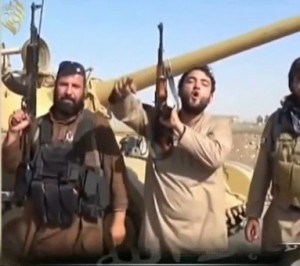
ISIS Militants. Photo: Screenshot, Fox News Sunday
“The IDF is deeply concerned with the fact that IS’s videos affect the Palestinian public which is very frustrated with its leadership; we are following this potential phenomenon closely,” the senior official said.
**************
The Israel Security Agency (Shin Bet) and the IDF in November busted what it revealed Sunday was a three-member Islamic State (IS) terror cell in Hebron, Israel’s Walla News reported, as the army said it has ratcheted up surveillance of the growing regional threat.
Officials said they suspected the trio of planning to carry out attacks in Israel including bombings against the IDF. One of the detainees admitted to planning to kill a local Jewish resident at nearby “Abraham’s Well.”
Ahmed Wadeh Salah Shehadeh, 22, Muhammad Fayyad Abd al-Qader, 21, and Ktzai Ibrahim Dib Maswadeh, 23 admitted to interrogators that they had established the military cell, constructed several bombs, and plotted to kill an Israeli soldier and use his weapons and uniform in a shooting attack.
The cell had actually set off to perpetrate the attack, but did not follow through for reasons not detailed in the report.
Their cases were transferred to court in recent days for indictment on offenses of membership and activity in an unlawful association, and other, unspecified charges.
Also on Sunday, Israel’s Channel 2 News reported that army intelligence recently dedicated a separate force to exclusively focus on IS activities, particularly across social media.
“We have made adjustments inside the IDF’s intelligence-collecting units because we came to the understanding that IS is breaking historic boundaries,” the commander of the “Hatzav,” intelligence unit said.
“Most of the information we gather comes from the internet; IS does not belong to a particular region in which we may have sources,” he noted.
Previously, the IDF primarily tracked IS via its division in charge of Syria. However, senior officials soon began to understand that the organization was a unique phenomena.
“Once we saw the first beheading videos we understood IS was something new, never seen before,” according to the unit commander.
“The IDF is deeply concerned with the fact that IS’s videos affect the Palestinian public which is very frustrated with its leadership; we are following this potential phenomenon closely,” the senior official said.
The recent arrests in Hebron apparently bear out that warning about the emerging threat.
Palestinian Authority President Mahmoud Abbas speaks during a press conference at the Ministry of Foreign Affairs in Algiers, December 23, 2014. (photo credit: AFP/Farouk Batiche)
UNITED NATIONS — The Palestinian leadership on Monday presented changes to a UN draft resolution on statehood that could come up for a vote at the Security Council as early as this week.
The United States again rejected the text that would pave the way to a Palestinian state by setting a 12-month deadline to reach a final peace deal and calling for Israel to withdraw to the pre-1967 lines by the end of 2017.
Arab ambassadors endorsed the text, which contains new provisions on declaring East Jerusalem the capital of a Palestinian state, settling the issue of Palestinian prisoner releases and halting Jewish settlements.
But a final decision on the timing for a vote on the draft resolution at the Security Council rests with Palestinian and Jordanian leaders.
“Both our leaderships will be discussing, to find the best way and the best timing to vote on the Security Council resolution,” Jordanian Ambassador Dina Kawar told reporters.
“Realistically, it could happen tomorrow,” added Palestinian envoy Riyad Mansour.
The draft resolution was formally presented to the council on December 17, but the United States quickly rejected the text over Palestinian insistence that deadlines be set.
The Palestinians had said they were open to negotiations on the text and Jordan began talks on a measure that could garner a consensus among the 15 council members.
But the latest push showed that prospects for a resolution that would satisfy both the Palestinians and the United States were bleak.
Discussions on the draft resolution come amid mounting international alarm over the ongoing violence and the failure to re-start negotiations.
US Secretary of State John Kerry spoke to Palestinian Authority President Mahmoud Abbas on Sunday about the latest Palestinian push at the United Nations.
“We don’t think this resolution is constructive,” said State Department spokesman Jeff Rathke. “We don’t believe this resolution (…) advances the goal of a two-state solution.
“We think it sets arbitrary deadlines for reaching a peace agreement and for Israel’s withdrawal from the West Bank, and those are more likely to curtail useful negotiations than to bring them to a successful conclusion.
“Further, we think that the resolution fails to account for Israel’s legitimate security needs, and the satisfaction of those needs, of course, integral to a sustainable settlement,” Rathke said.
It remained unclear if the Palestinians would seek a quick vote or hold off until January 1, when five new members with a pro-Palestinian stance join the Security Council.
Diplomats said it was unlikely that the resolution would garner nine votes under the current makeup of the council — a scenario that would allow the United States to avoid resorting to its veto power.
A US veto risks angering key Arab allies, including partners in the US-led coalition carrying out airstrikes against the Islamic State in Syria and Iraq.
Angola, Malaysia, New Zealand, Spain and Venezuela begin their two-year stint at the council on January 1, replacing Argentina, Australia, Luxembourg, Rwanda and South Korea.
Several European parliaments have adopted non-binding motions calling for recognition of Palestine and there are fears of a return to war unless peace efforts are revived.
The Palestinians have warned that if the bid to win support for a UN resolution fails, they are prepared to join the International Criminal Court to file suits against Israel.
They will also take action at the UN General Assembly and in other international fora to force the issue of Palestinian statehood on the agenda.
“If the Arab-Palestinian initiative submitted to the Security Council to put an end to occupation doesn’t pass, we will be forced to take the necessary political and legal decisions,” Abbas said last week.
“If it fails, we will no longer deal with the Israeli government, which will then be forced to assume its responsibilities as an occupier.”
Israel’s Prime Minister Benjamin Netanyahu has repeatedly rejected efforts to impose terms via the UN, and calls for a negotiated resolution of the conflict. However, he has refused to restart talks with the Abbas-led PA so long as it remains partnered with Hamas, the Gaza-based Islamist terror group that seeks to destroy Israel, in a Palestinian unity government.
The war against ISIS is taking a dangerous, perhaps inevitable turn. The terror organization has been keen to expand to southern Syria and the Syrian capital of Damascus. Now it says it has recruited three Syrian rebel groups operating in the south of the country in an area bordering the Israeli occupied Golan Heights — that have switched their loyalties to ISIS.
This switch means that Israel, the U.S.’s closest ally in the Middle East, could be threatened from the southwest by the Egyptian ISIS group of Ansar Bait al-Maqdis in Sinai and by ISIS in southern Syria.
The ISIS war is not going well at all for the US-led alliance in Syria. ISIS and al-Nusra Front, al-Qaeda’s branch in Syria, are still the dominant rebel groups in the country. The U.S.-backed Free Syrian Army is still not a reliable fighting force.
The three rebel groups that just joined ISIS could make that situation even worse. Two of the groups are small in number, but the Yarmouk Martyrs Brigade has hundreds of fighters. The Yarmouk Brigades has been at odds with al-Nusra Front and switched now to join what leaders of all thrwee groups believe is the future of Islam.
“If Israel was attacked by ISIS, America would expect a proportionate response by Israel, which is militarily capable of defending itself,” said Geoffrey Levin, a professor at New York University. “America would counsel against sustained Israeli involvement because it could threaten the tacit alliance between America, Iran, Turkey, and several Arab states against ISIS.”
“More recent reports indicated a closer alliance with [the Islamic State] due to tensions with JN [al-Nusra Front],” said Jasmine Opperman, a researcher at Terrorism Research & Analysis Consortium (TRAC). She said al-Nusra attacked the headquarters of the Yarmouk Brigade in southern Syria in early December 2014 following clashes between the two groups.
Al-Yarmuk Martyrs Brigade controlled an area near the Jordan-Israel border in March 2013. That same month, the brigade took as hostages some of the United Nations peacekeeping mission soldiers. Even so, Israel reportedly allowed the brigade to have its wounded fighters treated in Israeli hospitals.
ISIS has been known for launching surprise attacks and opening new battlefronts when it seems to be losing. ISIS also has been criticized by many Arabs and Muslims for not taking its fight to Israel and instead fighting fellow Arabs and Muslims. An attack aimed at Israel may boost ISIS’s popularity in the Arab world and refresh its recruitment and funding efforts.
On the other hand, some of ISIS’s top military commanders were former officers in Saddam Hussein’s army, and they may resort to what Saddam did in the 1991 Gulf War when he attacked Israel with mid-range rockets, hoping to drag the Israelis into a conflict that he was losing.
An Israeli retaliation in 1991 could have jeopardized the U.S-led coalition that then included Arab countries like Egypt, Syria and Saudi Arabia. The same is true now.
WHY THIS MATTERS
Despite some recent tensions between the countries, Israel remains America’s closest ally in the Middle East. Attacks on Israel by ISIS or affiliated groups could further escalate war in the region, or they could further strain ties between the Obama administration and the Israeli government.
“It would be more likely a sign of desperation, as were Saddam’s attempts to lure Israel into the 1991 war as a way of breaking the Arab coalition against him,” said NYU’s Levin. At that time, continuous pressure from the first Bush administration and the installation of the Patriot anti-rocket system convinced the Israelis to refrain from reacting to Saddam’s attack.
Israel could launch a preemptive attack to destroy or significantly damage these ISIS-affiliated units whether by air or by ground forces. Israel used its advanced air force to launch attacks in Syria several times since the beginning of Syrian civil war in 2011.
Meanwhile, Israel has recently boosted its defenses in the Golan Heights, saying its main concern was to prevent any major weapon transfer from Syria to Hezbollah, the Lebanese guerrilla organization that has engaged in several rounds of war with the Israelis since the 1980s.
This article was updated at 3 p.m. on Tuesday, Dec. 23.
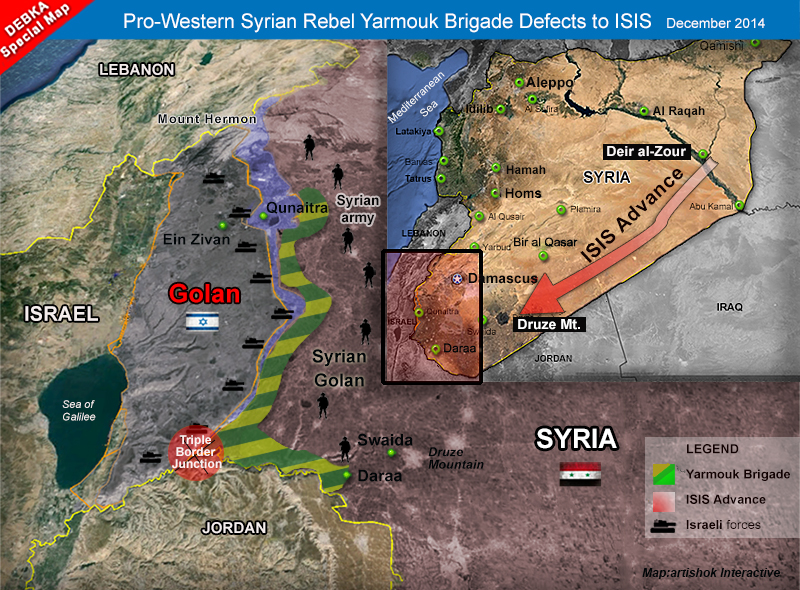
The Syrian rebel militia Al Yarmouk Shuhada Brigades, backed and trained for two years by US officers, mostly CIA experts, in Jordan, and supported by the Israeli army, has abruptly dumped these sponsors and joined up with the Islamic State in Iraq and Syria, DEBKAfile’s exclusive military and counter-terrorism sources reveal.
The sudden defection of this 2,000-strong anti-Assad force leaves IDF defense formations on the Golan, US and Jordanian deployments in the northern part of the kingdom, and pro-Western rebel conquests in southern Syria in danger of collapse.
The Brigades’ jump into the radical jihadi camp was negotiated in the last two weeks by its commander Mousab Ali Qarfan, who also goes by the name of Mousab Zaytouneh. He was in direct contact with ISIS chief Abu Baqr Al-Baghdadi, whom our sources report has recently relocated from Iraq to his northern Syrian headquarters at al-Raqqa.
Unlike the Sinai Islamists, Ansar Beit al Maqdis, the Yarmouk Brigades did not pledge allegiance to ISIS. The ir pact was forged as an operational alliance, which is just as grave a peril for the rebel militias’ abandoned allies.
For Israel, in particular, the new development is fraught with three dangers:
1. The Yarmouk Brigades are strung out along Israel’s Golan border with Syria, from the UN peacekeepers camp opposite Kibbutz Ein Zivan (see map) in the north, down to the Israeli-Syrian-Jordanian border junction in the south. The Brigades therefore sit along 45 of the total 76 kilometers of the Syrian-Israeli border. This means that a long stretch of Israel’s Golan border with Syria has fallen under the control of the Islamic State.
2. This militia also commands sections of the Syrian-Jordanian border, as well as districts of the southern Syrian town of Deraa. Therefore, the link between Jordan and southern Syria, which served American strategic interests, is now under military threat.
3. Islamic State forces are preparing to take advantage of their new asset with a buildup near the Druze Mountains (see map) for a rapid push south towards the town of Deraa, where they will join forces with their new ally.
Amb. Prosor addresses UNGA debate on the Question of Palestine”
Mr. President,I stand before the world as a proud representative of the State of Israel and the Jewish people. I stand tall before you knowing that truth and morality are on my side. And yet, I stand here knowing that today in this Assembly, truth will be turned on its head and morality cast aside.The fact of the matter is that when members of the international community speak about the Israeli-Palestinian conflict, a fog descends to cloud all logic and moral clarity. The result isn’t realpolitik, its surrealpolitik.
The world’s unrelenting focus on the Israeli-Palestinian conflict is an injustice to tens of millions of victims of tyranny and terrorism in the Middle East. As we speak, Yazidis, Bahai, Kurds, Christians and Muslims are being executed and expelled by radical extremists at a rate of 1,000 people per month.
How many resolutions did you pass last week to address this crisis? And how many special sessions did you call for? The answer is zero. What does this say about international concern for human life? Not much, but it speaks volumes about the hypocrisy of the international community.
I stand before you to speak the truth. Of the 300 million Arabs in the Middle East and North Africa, less than half a percent are truly free – and they are all citizens of Israel.
Israeli Arabs are some of the most educated Arabs in the world. They are our leading physicians and surgeons, they are elected to our parliament, and they serve as judges on our Supreme Court. Millions of men and women in the Middle East would welcome these opportunities and freedoms.
Nonetheless, nation after nation, will stand at this podium today and criticize Israel – the small island of democracy in a region plagued by tyranny and oppression.
Mr. President,
Our conflict has never been about the establishment of a Palestinian state. It has always been about the existence of the Jewish state.
Sixty seven years ago this week, on November 29, 1947, the United Nations voted to partition the land into a Jewish state and an Arab state. Simple. The Jews said yes. The Arabs said no. But they didn’t just say no. Egypt, Jordan, Syria, Iraq, Saudi Arabia and Lebanon launched a war of annihilation against our newborn state.
This is the historical truth that the Arabs are trying to distort. The Arabs’ historic mistake continues to be felt – in lives lost in war, lives lost to terrorism, and lives scarred by the Arab’s narrow political interests.
According to the United Nations, about 700,000 Palestinians were displaced in the war initiated by the Arabs themselves. At the same time, some 850,000 Jews were forced to flee from Arab countries.
Why is it, that 67 years later, the displacement of the Jews has been completely forgotten by this institution while the displacement of the Palestinians is the subject of an annual debate?
The difference is that Israel did its utmost to integrate the Jewish refugees into society. The Arabs did just the opposite.
The worst oppression of the Palestinian people takes place in Arab nations. In most of the Arab world, Palestinians are denied citizenship and are aggressively discriminated against. They are barred from owning land and prevented from entering certain professions.
And yet none – not one – of these crimes are mentioned in the resolutions before you.
If you were truly concerned about the plight of the Palestinian people there would be one, just one, resolution to address the thousands of Palestinians killed in Syria. And if you were so truly concerned about the Palestinians there would be at least one resolution to denounce the treatment of Palestinians in Lebanese refugee camps.
But there isn’t. The reason is that today’s debate is not about speaking for peace or speaking for the Palestinian people – it is about speaking against Israel. It is nothing but a hate and bashing festival against Israel.
Mr. President,
The European nations claim to stand for Liberté, Égalité, Fraternité – freedom, equality, and brotherhood – but nothing could be farther from the truth.
I often hear European leaders proclaim that Israel has the right to exist in secure borders. That’s very nice. But I have to say – it makes about as much sense as me standing here and proclaiming Sweden’s right to exist in secure borders.
When it comes to matters of security, Israel learned the hard way that we cannot rely on others – certainly not Europe.
In 1973, on Yom Kippur – the holiest day on the Jewish calendar – the surrounding Arab nations launched an attack against Israel. In the hours before the war began, Golda Meir, our Prime Minister then, made the difficult decision not to launch a preemptive strike. The Israeli Government understood that if we launched a preemptive strike, we would lose the support of the international community.
As the Arab armies advanced on every front, the situation in Israel grew dire. Our casualty count was growing and we were running dangerously low on weapons and ammunition. In this, our hour of need, President Nixon and Secretary of State Henry Kissinger, agreed to send Galaxy planes loaded with tanks and ammunition to resupply our troops. The only problem was that the Galaxy planes needed to refuel on route to Israel.
The Arab States were closing in and our very existence was threatened – and yet, Europe was not even willing to let the planes refuel. The U.S. stepped in once again and negotiated that the planes be allowed to refuel in the Azores.
The government and people of Israel will never forget that when our very existence was at stake, only one country came to our aid – the United States of America.
Israel is tired of hollow promises from European leaders. The Jewish people have a long memory. We will never ever forget that you failed us in the 1940s. You failed us in 1973. And you are failing us again today.
Every European parliament that voted to prematurely and unilaterally recognize a Palestinian state is giving the Palestinians exactly what they want – statehood without peace. By handing them a state on a silver platter, you are rewarding unilateral actions and taking away any incentive for the Palestinians to negotiate or compromise or renounce violence. You are sending the message that the Palestinian Authority can sit in a government with terrorists and incite violence against Israel without paying any price.
The first E.U. member to officially recognize a Palestinian state was Sweden. One has to wonder why the Swedish Government was so anxious to take this step. When it comes to other conflicts in our region, the Swedish Government calls for direct negotiations between the parties – but for the Palestinians, surprise, surprise, they roll out the red carpet.
State Secretary Söder may think she is here to celebrate her government’s so-called historic recognition, when in reality it’s nothing more than an historic mistake.
The Swedish Government may host the Nobel Prize ceremony, but there is nothing noble about their cynical political campaign to appease the Arabs in order to get a seat on the Security Council. Nations on the Security Council should have sense, sensitivity, and sensibility. Well, the Swedish Government has shown no sense, no sensitivity and no sensibility. Just nonsense.
Israel learned the hard way that listening to the international community can bring about devastating consequences. In 2005, we unilaterally dismantled every settlement and removed every citizen from the Gaza Strip. Did this bring us any closer to peace? Not at all. It paved the way for Iran to send its terrorist proxies to establish a terror stronghold on our doorstep.
I can assure you that we won’t make the same mistake again. When it comes to our security, we cannot and will not rely on others – Israel must be able to defend itself by itself.
Mr. President,
The State of Israel is the land of our forefathers – Abraham, Isaac, and Jacob. It is the land where Moses led the Jewish people, where David built his palace, where Solomon built the Jewish Temple, and where Isaiah saw a vision of eternal peace.
For thousands of years, Jews have lived continuously in the land of Israel. We endured through the rise and fall of the Assyrian, Babylonian, Greek and Roman Empires. And we endured through thousands of years of persecution, expulsions and crusades. The bond between the Jewish people and the Jewish land is unbreakable.
Nothing can change one simple truth – Israel is our home and Jerusalem is our eternal capital.
At the same time, we recognize that Jerusalem has special meaning for other faiths. Under Israeli sovereignty, all people – and I will repeat that, all people – regardless of religion and nationality can visit the city’s holy sites. And we intend to keep it this way. The only ones trying to change the status quo on the Temple Mount are Palestinian leaders.
President Abbas is telling his people that Jews are contaminating the Temple Mount. He has called for days of rage and urged Palestinians to prevent Jews from visiting the Temple Mount using (quote) “all means” necessary. These words are as irresponsible as they are unacceptable.
You don’t have to be Catholic to visit the Vatican, you don’t have to be Jewish to visit the Western Wall, but some Palestinians would like to see the day when only Muslims can visit the Temple Mount.
You, the international community, are lending a hand to extremists and fanatics. You, who preach tolerance and religious freedom, should be ashamed. Israel will never let this happen. We will make sure that the holy places remain open to all people of all faiths for all time.
Mr. President,
No one wants peace more than Israel. No one needs to explain the importance of peace to parents who have sent their child to defend our homeland. No one knows the stakes of success or failure better than we Israelis do. The people of Israel have shed too many tears and buried too many sons and daughters.
We are ready for peace, but we are not naïve. Israel’s security is paramount. Only a strong and secure Israel can achieve a comprehensive peace.
The past month should make it clear to anyone that Israel has immediate and pressing security needs. In recent weeks, Palestinian terrorists have shot and stabbed our citizens and twice driven their cars into crowds of pedestrians. Just a few days ago, terrorists armed with axes and a gun savagely attacked Jewish worshipers during morning prayers. We have reached the point when Israelis can’t even find sanctuary from terrorism in the sanctuary of a synagogue.
These attacks didn’t emerge out of a vacuum. They are the results of years of indoctrination and incitement. A Jewish proverb teaches: “The instruments of both death and life are in the power of the tongue.”
As a Jew and as an Israeli, I know with utter certainly that when our enemies say they want to attack us, they mean it.
Hamas’s genocidal charter calls for the destruction of Israel and the murder of Jews worldwide. For years, Hamas and other terrorist groups have sent suicide bombers into our cities, launched rockets into our towns, and sent terrorists to kidnap and murder our citizens.
And what about the Palestinian Authority? It is leading a systemic campaign of incitement. In schools, children are being taught that ‘Palestine’ will stretch from the Jordan River to the Mediterranean Sea. In mosques, religious leaders are spreading vicious libels accusing Jews of destroying Muslim holy sites. In sports stadiums, teams are named after terrorists. And in newspapers, cartoons urge Palestinians to commit terror attacks against Israelis.
Children in most of the world grow up watching cartoons of Mickey Mouse singing and dancing. Palestinian children also grow up watching Mickey Mouse, but on Palestinians national television, a twisted figure dressed as Mickey Mouse dances in an explosive belt and chants “Death to America and death to the Jews.”
I challenge you to stand up here today and do something constructive for a change. Publically denounce the violence, denounce the incitement, and denounce the culture of hate.
Most people believe that at its core, the conflict is a battle between Jews and Arabs or Israelis and Palestinians. They are wrong. The battle that we are witnessing is a battle between those who sanctify life and those who celebrate death.
Following the savage attack in a Jerusalem synagogue, celebrations erupted in Palestinian towns and villages. People were dancing in the street and distributing candy. Young men posed with axes, loudspeakers at mosques called out congratulations, and the terrorists were hailed as “martyrs” and “heroes.”
This isn’t the first time that we saw the Palestinians celebrate the murder of innocent civilians. We saw them rejoice after every terrorist attack on Israeli civilians and they even took to the streets to celebrate the September 11 attack on the World Trade Center right here in New York City.
Imagine the type of state this society would produce. Does the Middle East really need another terror-ocracy? Some members of the international community are aiding and abetting its creation.
Mr. President,
As we came into the United Nations, we passed the flags of all 193 member States. If you take the time to count, you will discover that there are 15 flags with a crescent and 25 flags with a cross. And then there is one flag with a Jewish Star of David. Amidst all the nations of the world there is one state – just one small nation state for the Jewish people.
And for some people, that is one too many.
As I stand before you today I am reminded of all the years when Jewish people paid for the world’s ignorance and indifference in blood. Those days are no more.
We will never apologize for being a free and independent people in our sovereign state. And we will never apologize for defending ourselves.
To the nations that continue to allow prejudice to prevail over truth, I say “J’accuse.”
I accuse you of hypocrisy. I accuse you of duplicity.
I accuse you of lending legitimacy to those who seek to destroy our State.
I accuse you of speaking about Israel’s right of self-defense in theory, but denying it in practice.
And I accuse you of demanding concessions from Israel, but asking nothing of the Palestinians.
In the face of these offenses, the verdict is clear. You are not for peace and you are not for the Palestinian people. You are simply against Israel.
Members of the international community have a choice to make.
You can recognize Israel as the nation-state of the Jewish people, or permit the Palestinian leadership to deny our history without consequence.
You can publically proclaim that the so-called “claim of return” is a non-starter, or you can allow this claim to remain the major obstacle to any peace agreement.
You can work to end Palestinian incitement, or stand by as hatred and extremism take root for generations to come.
You can prematurely recognize a Palestinian state, or you can encourage the Palestinian Authority to break its pact with Hamas and return to direct negotiations.
The choice is yours. You can continue to steer the Palestinians off course or pave the way to real and lasting peace.
 Israeli soldiers take part in a training exercise near the border with Syria, December 2013. (Image source: IDF)







 anneinpt
 artaxes
 danmillerinpanama
 davidking1530
 Peter Hofman
 Joseph Wouk
 Peter
Peter Louisiana Steve
 WarSclerotic
Recent Comments