Posted tagged ‘IDF’

Israeli and Syrian Druze join forces – complicating Israel’s military position vis-à-vis southern Syria

June 23, 2015

Israeli and Syrian Druze join forces – complicating Israel’s military position vis-à-vis southern Syria, DEBKAfile, June 23, 2015

Druze_celebrations_21.6.15Druze celebrate ambulance attacks

Even if Druze tempers are temporarily calmed over the fate of their Syrian brethren, the fallout from the Syrian civil war has already spilled over into Israel from an unexpected quarter. For nearly five years, Israel carefully kept its hands off the conflict raging on its northern border, restricting itself to responding ad hoc to dangers and building a quiet aid mechanism for selected Syrian rebels. But in recent months, Israel has re-channeled its military intervention into areas close to its border.

The way this involvement is disavowed by Israeli officials is seriously detrimental to the government’s military credibility.

When IDF spokesman Brig. Motti Almoz reiterated past statemants that the military does not identify or assort by organization the injured Syrian rebels reaching the Israeli Golan border for treatment, he found that the Druze serving in Israel’s armed forces and those living in Golan villages knew better. Israeli Druze and Golan villagers – many loyal to Bashar Assad – were so incensed by this and past evasions that they came together for violent action – hence the attacks Monday, June 22, on two IDF ambulances ferrying injured Syrian rebel fighters to hospital.

After the first ambulance was attacked, the second should have been much better secured. It turned out that the military police escorting it were not up to fighting a raging Druze lynch mob outside Majdal Shams on the Golan. The Syrians were badly beaten up and one died later.

Israeli and Golan Druze have found a common cause, in itself a destabilizing factor, in the conviction that Israel is aiding the Syrian Al Qaeda arm, the Nusra Front, although some of the information from South Syria is disinformation slanted by hostile elements for stirring up trouble for Israel.

The thousand-year old secretive sect is treated as heretic by jihadis, including the Nusra Front. When a rebel alliance neared Jabal Druze in Syria, Nusra leaders promised not to harm the Druze provided that they “retreat from their religious mistakes.” They then forced several hundred Druze to convert to Sunni Islam and desecrated their shrines.

Nusra Front is therefore a red flag for the Druze bull

This is just one more complicating factor in considering the ill-defined, fractious rebel alliance fighting in South Syria across from the Israeli Golan.

Israeli protestations that it doesn’t support Al Qaeda-linked rebels may hold true one day, while the next day, that same group may break up and join a jihadi faction. Some of them are constantly on the move in and out of Al Qaeda.

Saudi Arabia ran up against this phenomenon in recent weeks when it bought and armed 3,000 Nusra Front fighters on condition that they leave their group and join up under an umbrella anti-Assad rebel front called the Southern Front, or the Southern Army of Conquest.

The Saudi step relieved Israel of charges of supporting jihadi movements. But it was no means let off the hook as far as the Druze were concerned, because of the notoriously volatile nature of the rebel movement.

Most of Nusra’s commanders did indeed repudiate their allegiance to Al Qaeda to win Saudi backing, but they soon switched back after Nusra in the north spearheaded major rebel victories. Clearly, victorious groups hold a fatal attraction for the hundreds of hazy rebel factions

The Druze demand for Israel to abandon the Nusra Front is tantamount to its repudiating the Syrian rebel cause at large. For the IDF this is a non-option: Ditching its under-the-radar links with certain Syrian rebel groups is the recipe for ending the relative calm on its Golan border with Syria. And withdrawing from its cooperation with the US-Saudi-Jordanian backed rebel force would endanger their effort to capture southern Syria, in the same way as comparable forces attained control of most of the north.

At the same time, the Israeli government must persuade its up-in-arms Druze citizens that IDF actions in South Syria will not bring harm to their Syrian brethren. This is an uphill task that may not prevent further Druze violence.

The UN’s Anti-Israel Children and Armed Conflict Report

June 10, 2015

The UN’s Anti-Israel Children and Armed Conflict Report, Front Page Magazine, June 10, 2015

(Please see also, Legal Experts Slam IDF for Over-Warning Gazans. — DM)

UN_Secretary-General_Ban_Ki-moon_-_Flickr_-_The_Official_CTBTO_Photostream_13-431x350

According to the New York Times, citing unnamed diplomats, United Nations Secretary General Ban Ki-moon bowed to “unusual pressure from Israel and the United States” in deciding not to include either Israel or Hamas on a list of “armies and guerilla groups that kill and maim children in conflicts worldwide.” The list is included in an annex to an annual report by the Secretary General entitled “Children and armed conflict,” which he just released for 2015. The list, as its title states, is intended to identify specifically the entities that “recruit or use children, kill or maim children, commit rape and other forms of sexual violence against children, or engage in attacks on schools and/or hospitals in situations of armed conflict.”

Ban Ki-moon considered the recommendation of his special representative for children and armed conflict, Leila Zerrougui, to include both Israel and Hamas on this list as a reflection of their actions and the deadly consequences to children arising from the Gaza conflict last summer. The list already includes such Islamic jihad terrorist groups as the Islamic State, the al-Nusra Front, Boko Haram, the Taliban, Al Shabaaba, Al-Qaida in the Arab Peninsula and the Houthis, as well as government forces of the Syrian regime, Yemen, Sudan and Afghanistan.

While the Secretary General rejected his special representative’s recommendation, leaving both the terrorist jihadist group Hamas and Israel off the list in a display of moral equivalence, the body of the report is far more condemnatory of Israel than of Hamas or other Palestinian militants. There were more than three times as many paragraphs devoted to alleged Israeli violations of children’s rights relating to the Gaza war than devoted to the actions of Hamas or other Palestinian terrorists. When there was any criticism of Palestinian actions, it was stated in the mildest of terms. Israel, on the other hand, received the full brunt of the Secretary General’s censure:

“I am deeply alarmed at the extent of grave violations suffered by children as a result of Israeli military operations in 2014. The unprecedented and unacceptable scale of the impact on children in 2014 raises grave concerns about Israel’s compliance with international humanitarian law, notably the principles of distinction, proportionality and precaution in attack, and respect for international human rights law, particularly in relation to excessive use of force.” (Paragraph 110)

Nevertheless, Riyad Mansour, Permanent Observer of the State of Palestine to the United Nations, was not satisfied. He issued a blistering statement declaring that “It is without doubt that Israel, the occupying Power, flagrantly, systematically and grossly commits human rights violations against Palestinian children constituting grave violations that qualify it for such a listing in the annex to the Annual Report on Children and Armed Conflict. The UN’s inaction, submitting to the inordinate pressures exerted, sends a most regrettable signal that the same criteria do not apply in all situations for all children, undermining the credibility of the UN system as a whole…”

As usual, Mr. Mansour stands the truth on its head. Indeed, Ban Ki-moon should have accepted his special representative’s recommendation to include Hamas on the annex list. Hamas and its other jihadist allies, not Israel, belong on the list alongside their Islamic State and al Qaeda brethren. They use children as human shields, deliberately store weapons in schools, homes hospitals and mosques where they know children are likely to be, and recruit children for jihad including the establishment of youth military training camps. They prepare children for the glory of martyrdom, extolling the virtues of suicide bombings that kill Jews.

Ban Ki-moon properly rejected his special representative’s recommendation to include Israel on the annex list. Israel does not belong on the same list as non-state and state entities that deliberately kill children with abandon, recruit children as soldiers, abduct and rape little girls, and kill their parents before their very eyes. To the contrary, the Israeli armed forces took great pains to minimize civilian casualties. It took the unprecedented step of warning civilians in advance of impending attacks on facilities that Hamas was using as launching pads from which to fire rockets at Israeli population centers and from which they were building their terrorist tunnels to sneak their fighters into Israel for the purpose of killing Israeli civilians, including women and children.

However, putting the annex list aside, Mr. Mansour should have been happy that the Secretary General reflected the institutional bias of the United Nations against Israel in the body of his report. In a crucial paragraph urging corrective actions to remedy the report’s catalogue of alleged violation of children’s rights – mostly said to be committed by Israel – the report focused solely on what Israel should do:

“I urge Israel to take concrete and immediate steps, including by reviewing existing policies and practices, to protect children, to prevent the killing and maiming of children, and to respect the special protections afforded to schools and hospitals. An essential measure in this regard is ensuring accountability for perpetrators of alleged violations. I further urge Israel to engage in a dialogue with my Special Representative and the United Nations to ensure that there is no recurrence in grave violations against children.” (Paragraph 111)

As usual, nothing is asked of the Palestinians. They are not urged to stop storing weapons in schools and hospitals. They are not asked “to protect children, to prevent the killing and maiming of children,” which they could begin to do by not using children as human shields, and not deliberately conducting rocket attacks against Israeli civilians including children and conducting other military activities from areas where they know Palestinian children are likely to be. They are not asked to close the youth military training camps or stop the online propaganda that indoctrinates Palestinian children into believing that martyrdom through jihad against Jews is the way to paradise.

We should not be surprised. Such anti-Israel bias is par for the course at the United Nations. Its Human Rights Council passes more resolutions condemning Israel than all of the other 192 member states combined. The Human Rights Council’s agenda item 7 requires that Israel’s – and only Israel’s – record of human rights be debated at every session. Investigations launched by the Human Rights Council and the UN Secretary General of alleged human rights and other international law violations in Gaza during the repeated wars there initiated by Hamas’s terrorist attacks against Israeli civilians are blatantly one-sided against Israel.

Israel was the only country in the world to be named as a violator of “health rights” during the UN World Health Organization’s annual assembly in May 2015. Never mind about Syria, Iran, Iraq, Libya, or North Korea where basic medical care and health services are scarce, if existent at all. Israel facilitates the delivery of humanitarian aid and takes care of the sick and injured, whether they be Palestinians or not. The Syrian regime prevents humanitarian aid including medical supplies from reaching besieged civilians, including Palestinian children trapped in Yarmouk. Yet the World Health Organization chose to ignore all this and adopt a resolution focusing solely on health conditions in the occupied Palestinian territory, including East Jerusalem, and in the Golan Heights, for which Israel is held responsible.

The UN Commission on the Status of Women, whose latest annual meeting concluded on March 20, 2015, marched to the same anti-Israel tune. The only country it condemned for its women’s rights record was Israel, presumably because of its alleged treatment of Palestinian women.

“If anyone had any doubt that there was demonization of Israel at the United Nations, here is the entire truth before our eyes,” said Israel’s Ambassador to the UN, Ron Prosor. “There are 193 member states in the UN, and they include countries that butcher men and women, jail both male and female journalists, execute female oppositionists and legislate laws against women. All of these countries receive immunity in the UN. The UN Commission on the Status of Women is itself comprised of some of the worst violators of women’s rights, including Iran and Sudan, two of the more moderate members by comparison.”

Every day it seems that there is new proof of the demonization and attempts to delegitimize the Jewish state of Israel at the United Nations. Secretary General Ban Ki-moon’s report on “children and armed conflict” is but the latest example. There will certainly be more to come.

Legal Experts Slam IDF for Over-Warning Gazans

June 10, 2015

Int’l Legal Experts Slam IDF – For Over-Warning Gazans

Experts from US, Germany warn IDF ‘legal zeal’ sets dangerous precedent tying hands of democracies fighting terror.

By Ari Yashar

First Publish: 6/9/2015, 10:30 PM

via Legal Experts Slam IDF for Over-Warning Gazans – Defense/Security – News – Arutz Sheva.

The IDF went to extraordinary lengths last summer to prevent civilian casualties while fighting Hamas terrorists in Gaza, achieving a remarkable 1:1 civilian to combatant ratio, but according to international legal experts it went too far in avoiding casualties among the enemy population.

Willy Stern of Vanderbilt Law School, in an article to be published next Monday in the Weekly Standard, details what he found while spending two weeks with attorneys in the IDF’s international law department dubbed “Dabla” as well as front-line commanders, and documents the IDF’s “legal zeal” which as he notes has not stemmed the deluge of international criticism against it.

Stern listed how the IDF bombarded Gaza residents with thousands of telephone calls, leaflet drops, TV and radio messages, as well as calls to influential citizens urging them to evacuate residents, and in doing so gave the terrorist enemy detailed information about its troop movements.

“It was abundantly clear that IDF commanders had gone beyond any mandates that international law requires to avoid civilian casualties,” writes Stern. He reported how Dabla attorneys have to sign off on a “target card” for each airstrike on terror targets, with the cards enumerating all of the relevant data about the planned strike.

In contrast, the Hamas “doctrine manual” captured by the IDF in the Shejaiya neighborhood early last August documents how the terror group urges its fighters to embed themselves among civilians in hopes that the IDF will kill civilians.

“Hamas’s playbook calls for helping to kill its own civilians, while the IDF’s playbook goes to extreme​ – ​some say inappropriate​ – ​lengths to protect innocent life in war,” reads the article.

“IDF harming fight against terror”

Indeed, international legal experts quoted in the article argued that the IDF’s actions do go to inappropriate measures, and may end up harming the ability to fight terrorist organizations.

Wolff Heintschel von Heinegg, a military law expert at European University Viadrina in Frankfurt, Germany, was brought by Dabla to train IDF commanders about armed conflict laws.

Heinegg was quoted saying the IDF went to “great and noble lengths” to avoid civilian casualties, but warned the IDF is taking “many more precautions than are required.”

As a result, he expressed his fear that the IDF “is setting an unreasonable precedent for other democratic countries of the world who may also be fighting in asymmetric wars against brutal non-state actors who abuse these laws.”

Sharing his assessment was Pnina Sharvit Baruch, a senior researcher at the Institute for National Security Studies (INSS) and former Dabla chief.

She said legal advisers from other militaries around the world confront her with “recurring claims” that the IDF “is going too far in its self-imposed restrictions intended to protect civilians, and that this may cause trouble down the line for other democratic nations fighting organized armed groups.”

Michael Schmitt, director of the Stockton Center for the Study for International Law at the US Naval War College, also agreed that the IDF is creating a dangerous state of affairs that may harm the West in its fight against terrorism.

“The IDF’s warnings certainly go beyond what the law requires, but they also sometimes go beyond what would be operational good sense elsewhere,” he warned.

“People are going to start thinking that the United States and other Western democracies should follow the same examples in different types of conflict. That’s a real risk,” said Schmitt.


ISIS arrives in Gaza: Supporters of the “Islamic State of Jerusalem” sighted on Israeli border

June 1, 2015

ISIS arrives in Gaza: Supporters of the “Islamic State of Jerusalem” sighted on Israeli border, DEBKAfile, June 1, 2015

ISIS-Gaza_5.15ISIS lands in Gaza

Followers of the Islamic State of Iraq and the Levant were spotted for the first time in the Gaza Strip this week, DEBKAfile’s military sources report. Their arrival on Israel’s border was confirmed as a division-strength IDF force launched its large-scale “Turning Point 2015” exercise for repelling Islamist cross-border incursions. The Islamist group which has established a substantial anti-Hamas presence in the Gaza Strip is Ansar al Dawa al-Islamia, renamed “Supporters of the Islamic State of Jerusalem.

Israeli, Egyptian and Hamas’ military sources are all concerned to make light of this development. When asked, they say that the group’s nature and scope have not yet been evaluated. Western and Middle East governments took the same tack two years ago, when ISIS first embarked on its calamitous course in Syria.

DEBKAfile’s military sources point to eight signs of the ISIS presence in the Gaza Strip:

1. In the last 48 hours, Hamas security authorities have suddenly set up scores of roadblocks across the Strip, including Gaza City.

2. They acted after senior Hamas security officer Sabah Siam was murdered Saturday, May 30, by a gang of five gunmen sporting ISIS insignia.

Hamas tried pretending that the officer died in a bomb planted in his vehicle by a local rival faction.  But the attack was too public to be concealed. The ISIS gunmen burst into a shop owned by the officer’s family in the center of Gaza City while he was visiting. They cut him down in front of his relatives and dozens of passersby, none of whom made any move to stop them as they made off in two vehicles.

The terrorists later issued a communiqué saying: “Sabah Siam was liquidated because he was a partner in a war declared against religion and against Muslims working for the heretical government in the Gaza Strip.”
In a declaration of war, ISIS warned the Palestinian Hamas to “end its war against religion in Gaza or face the consequences.”

3. Israeli and Egyptian security services, most likely in conjunction with Hamas, set up a tight ring of bodyguards to protect German Foreign Minister Frank-Walter Steinmeier against possible assassins when he visited Gaza Monday, June 1.  He insisted on going through with his visit in the face of the internecine Islamist fighting which had erupted in the Palestinian-ruled territory.

4.  On the day of the visit, Ansar al Dawa al-Islamia posted a social media notice calling on Gazans to discontinue their cooperation with the “heretical Hamas regime.”

5.  The same group also claimed responsibility for a string of bombings outside Hamas headquarters and offices in Gaza during the month of May.

6.  On May 8, the ISIS Sinai branch Ansar Bait Maqdis shelled the Hamas facility in Khan Younis, in southern Gaza.

7.   On May 28, ISIS-Sinai threatened to “target Eilat Port in the coming days,” as a joint project with the ISIS wing in the Gaza Strip, which would also attack Hamas’s military arm, Ezz e-din Al-Qassam, and take control of the Gaza Strip.

8.  DEBKAfile’s counter-terror sources report that Ansar al Dawa is preparing to declare the Gaza Strip a province of the Islamic State of Iraq and the Levant.

Hezbollah shows off ‘advanced tunnel network’ on Israeli border

May 23, 2015

Hezbollah shows off ‘advanced tunnel network’ on Israeli border, Times of IsraelTamar Sharon and AP, May 23, 2015

(“Quick Watch” video at link.– DM)

According to the [Israeli intelligence] official, Hezbollah has an estimated 100,000 short-range rockets capable of striking northern Israel, several thousand missiles that can reach Tel Aviv and central Israel and hundreds more that can strike the entire country.

********************

Hezbollah has built a vast network of advanced tunnels along the border with Israel for us in a future war, using them to conceal tens of thousands of rockets aimed at the Jewish state, a Lebanese newspaper with ties to the Lebanese terror group reported on Friday.

In a series of articles published over the weekend, the daily As-safir examined Hezbollah’s preparations for war against Israel, painting a picture of a military force highly prepared for conflict, both in terms of equipment and of infrastructure.

It should be noted that As-safir, a mouthpiece for the Shiite organization, is neither an objective nor necessarily a credible news source. The accuracy of its claims cannot be verified.

According to the reports, based on a tour of Hezbollah facilities given to the newspaper, the group has built a sprawling underground array of tunnels, bunkers and surveillance outposts along the border with Israel, which it is manning at peak readiness for battle.

The tunnels are said to be highly-advanced, with durable concrete, a 24-hour power supply via underground generators, a ventilation system to prevent damp from damaging military equipment and a web of secondary escape shafts in case of attack. The tunnels are said to be housing tens of thousands of rockets ready for launch, themselves wrapped in protective materials in order to preserve them.

The paper reported that Hezbollah was constantly surveying the Israeli border area with electronic equipment as well as observation posts equipped with night-vision technology.

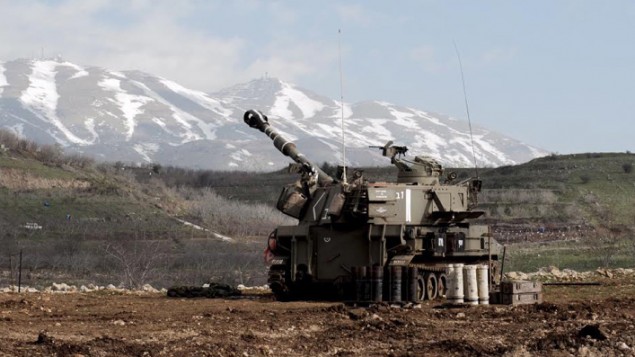
F150128IDF01-e1422508122867-635x357Israeli artillery on the Lebanon border, January 28, 2015 (Photo credit: IDF Spokesperson)

Tunnel construction was said to be continuing around the clock, using primitive means rather than advanced machinery in order to avoid detection by Israeli surveillance.

A senior Israeli intelligence official said last week that Hezbollah has built up a massive arsenal of rockets and other advanced weapons in Shi’ite villages of southern Lebanon, warning civilians would be at risk if war breaks out.

According to the official, Hezbollah has an estimated 100,000 short-range rockets capable of striking northern Israel, several thousand missiles that can reach Tel Aviv and central Israel and hundreds more that can strike the entire country.

Most of the weapons have been transferred to Lebanon through war-torn Syria, coming from Hezbollah’s key allies, the Syrian government and Iran, he said.

The official showed reporters satellite photos of what Israeli intelligence believes are Hezbollah positions in dozens of Shiite villages in southern Lebanon.

The photos were marked with dozens of red icons, signaling what are believed to be missile launchers, arms depots, underground tunnels and command posts.

The official, who spoke on condition of anonymity under military guidelines, said an estimated 200 villages have been turned into “military strongholds.”

One photo showed the village of Muhaybib, with a population of around 1,000 people and 90 buildings, of which more than a third had been marked as Hezbollah assets. In the larger village of Shaqra, with some 4,000 people, Israeli intelligence identified Hezbollah targets in around 400 out of some 1,200 buildings.

The army refused to allow publication of the images.

If war breaks out and Hezbollah fires missiles at Israel, these buildings will be targeted by Israel’s air force, the official said, adding that Israel would give civilians time to evacuate.

Israel and Hezbollah fought a month-long war in 2006 that killed some 1,200 Lebanese, including hundreds of civilians, and 160 Israelis and caused heavy damage to Lebanon’s infrastructure.

Though another Israel-Hezbollah war is always possible, analysts say the group has no interest in renewing hostilities while it is busy fighting alongside President Bashar Assad’s forces against rebels trying to topple him in Syria, including the forces of Islamic State.

Hezbollah leader Hassan Nasrallah warned Friday that the Islamic State posed an existential threat to Lebanon and said his organization may soon be required to call for a general mobilization to fight the group.

“Now is the time for everyone to enlist, anyone who can take part,” Nasrallah told senior organization commanders in a speech. “The danger that threatens us is an existential threat similar to 1982,” he added, referring to the Lebanon War and the Israeli military invasion of Lebanon.

The Hezbollah chief vowed to “use all our strength and all our capabilities to cope with extremist groups.

“In the next phase we may declare general mobilization to all people,” he said.

Iran swings behind escalated Syrian-Hizballah anti-Israel terror offensive on the Golan

May 1, 2015

Iran swings behind escalated Syrian-Hizballah anti-Israel terror offensive on the Golan, DEBKAfile, May 1, 2015

israeli_tanks_golanIsraeli tanks on the Golan

The Syrian and Hizballah military delegations visiting Tehran this week achieved their purpose: DEBKAfile’s intelligence and military sources report that in three days of talks up until Friday April 30, Syrian Defense Minister Gen. Fahad Jassim al-Freij procured from his Iranian counterpart Hussein Dehghan, approval for a stepped up terror campaign against Israeli forces and civilians on the Golan, to be executed by terrorist surrogates. Iran pledged its support for this campaign and promised to make the Revolutionary Guards and Afghani Shiite forces present in Syria available, in the event of an Israeli counter-attack.

A stamping ground, designated “the open area,” was to be provided for all terrorist militias willing to attack Israel. It would stretch from Damascus to the Golan – a distance of 60 km by road – and take in the Syrian Hermon and Lebanese Chebaa Farms. Syrian and Hizballah military intelligence services will take responsibility for coordinating their operations and providing them with arms and intelligence.

According to the plan approved in Tehran, Syria and Hizballah will establish new militias for their campaign as well as deploying existing terrorist groups.

One such framework, made up of Syrian Druzes, was set up in recent weeks. Its first attack last Sunday April 26 – an attempt to plant a bomb near an Israeli Golan border position – was a flop. All four bombers were killed in an Israeli air strike and the device did not detonate.

The commander of the new Druze militia is Samir Kuntar, a name familiar to Israelis as the murderer of the Haran family of Nahariya and two police officers, who got out of prison in 2008 after serving 36 years of a life sentence. Kuntar is a rare Lebanese Druze who joined Hizballah in his youth.

Our sources note that President Bashar Assad many times suggested setting up a special Syrian-Palestinian “resistance movement” for taking back the Golan, which Israel captured during Syria’s 1967 invasion and later annexed.

However, the terrorist attacks on Israel were left until now mostly to Palestinian squads created ad hoc for single operations. They were often drawn from Ahmed Jibril’s PFLP-General Command group or recruited in the Yarmuk refugee camp in Damascus.

But now, Assad and his Hizballah ally are set on a serious escalation by different tactics, DEBKAfile’s sources report. For a major terror offensive, they are building new frameworks with local recruits mustered in South Lebanon and the Syrian Golan. Some of those militiamen have been seen moving about in the Druze villages scattered over Jabal Druze and the Hermon up to the Chebaa farms.

Raid on Iran

April 28, 2015

Raid on Iran, Jerusalem PostHarry Moskoff, April 28, 2015

The only question now is:  when could an attack on Iran be carried out? At this point, Israel can’t afford NOT to make a strike, as the policy of the current nuclear negotiations with Iran has changed from prevention, to containment.  Indeed, all have come to agree that if the military option isn’t utilized by either the US or Israel, a nuclear Iran is simply a fait accompli.

If a preventative strike on Iran’s nuclear facilities is going to happen, it must be both before the P5+1 negotiating deadline of June 30th, and before the Russian S-300 anti-aircraft missiles are delivered and setup on Iranian soil. Indeed, if and when that eventuality comes into play, Israel may be forced to destroy that weapons convoy on route to Iran. I’m pretty sure this threat has already been issued.

**********************

As a rule, I don’t usually get involved in war scenarios, but after seeing the Israeli Air Force (IAF) jets put on their brilliant display this week for Israel Independence Day, I was inspired.  I was thinking: what if they just continued flying southwest? There’s an important point that I want to make here.

Sooner rather than later, Israel will be forced to make that raid. You know the one. It’s the BIG one. It will make the 1981 precision strike on Iraqi’s Osirak reactor, otherwise known as Operation Raid on the Sun, look like a walk in the park. Back then (just like now), when some argued that the attack would alienate both the United States and Europe, Ariel Sharon allegedly quipped “If I have a choice of being popular and dead or unpopular and alive, I choose being alive and unpopular.” Prime Minister Begin ultimately agreed and the rest of the cabinet fell in behind him. The only question now is:  when could an attack on Iran be carried out? At this point, Israel can’t afford NOT to make a strike, as the policy of the current nuclear negotiations with Iran has changed from prevention, to containment.  Indeed, all have come to agree that if the military option isn’t utilized by either the US or Israel, a nuclear Iran is simply a fait accompli.

If a preventative strike on Iran’s nuclear facilities is going to happen, it must be both before the P5+1 negotiating deadline of June 30th, and before the Russian S-300 anti-aircraft missiles are delivered and setup on Iranian soil. Indeed, if and when that eventuality comes into play, Israel may be forced to destroy that weapons convoy on route to Iran. I’m pretty sure this threat has already been issued. Effectively, we’re looking at a window of opportunity of a little over 2 months to initiate an attack that could take many hours, if not days to carry out, with hundreds or even thousands of missile strikes per day.  Simply put, if there is no attack now, Israel must prepare for the day after – a new, grim reality in the Middle East.

However, here’s an interesting point. If the arms shipment isn’t destroyed, there may be another answer to the S-300. Israel’s Defense Ministry sent a Letter of Request to Congress in 2003 asking for authorization to purchase “up to” 75 brand new, top of the line jet fighters that have significant new counter-missile capabilities. In 2010, it signed a deal with the US-based Lockheed-Martin aeronautical company for 19 F-35As, with the first few aircraft set to arrive in late 2016. The total cost of that deal was $2.75 billion, a spokesman for Lockheed-Martin said, out of which $475 million was for non-recurrent costs for the incorporation of upgraded Israeli technology. It’s interesting to note that the approximate cost of the aircrafts was (a staggering) $120 million. Each! These are stealth fighters with highly advanced radar, which will see its targets before it is seen.  Armed with the intelligence of where the surface to air missile systems are located, the IAF will then take the necessary measures to first avoid the S-300 systems, then destroy them.  What other choice is there – finding the Ark of the Covenant and using that, as in biblical times? True, the planes are insanely expensive, but obviously quite necessary!

On April 15 at Yad Vashem, and echoing his recent, now-famous address to Congress, PM Netanyahu said: “Even if we are forced to stand alone against Iran, we will not fear…”  Well folks, I dare say that we have reached that point.  Everyone knows by now that where the negotiations are concerned, the US no longer considers use of force in the cards, and quite the contrary, President Obama has indicated that even sanctions have become negotiable. People here in Israel feel that the State Dept. may even act AGAINST Israel if it unilaterally attempts a pre-emptive attack.  Besides the obvious existential threat to Israel, one of the other problems is that Iran seeks to “dominate the region” (Netanyahu’s words), and impose a Khomeini-style revolution in the Middle East.  We now see clearly that they are doing just that in places like Yemen, Syria, Lebanon, and even here in Gaza. Whether Israel sees a right-wing government emerge in the coming weeks, or even a broad-based coalition with the Left, all agree at the end of the day that it’s just a matter of time before Iran breaches their side of an already bad deal, and action will need to be taken, whether backed by the US or not.

What most Israeli’s don’t realize is that once a breach in the agreement is discovered (publicly), there is simply no way the US will neutralize Iranian capabilities with a military strike.  Obama won’t do it, and the reason why he won’t do it is because he is not prepared to cast and label Iran as an Enemy of the State. To him, those days are over and it doesn’t lie in synch with his doctrine. In fact, the US President apparently vetoed a potential Israeli attack on Iran’s nuclear facilities back in 2012. Is it so hard to see why? Back door negotiations were going on even then between the US and Iran, as Hillary Clinton recently admitted herself.  It is crystal clear that the White House CAN forcibly bring the Iranian nuclear program to a halt, it simply chooses not to do so. Will this change after, let’s say – an Iranian nuclear test?  Perhaps, but unlikely.

As such, practically speaking, can Israel attack Iran with any real success? Is it worth it? The following are some salient points to consider.

We know that Saudi Arabia has already given tacit permission for Israel to use its airspace to reach the Iranian military targets because as a Sunni Muslim state, they are considered as ‘infidels’ to Iran, who are Shiite Muslims. In fact, they have more to worry about than Israel does, and as a result of the framework agreement that was signed in Vienna, they are demanding the same rights to nuclear capabilities that Iran is apparently going to get. Credible sources state that Pakistan is now prepared to ship a nuclear package to the Saudis. As for Iran, it already has the ballistic missile capability that could hit Saudi Arabia with a warhead at the push of a button. And they know it. So does Jordan.

The truth is that Israel has sufficient nuclear and conventional power to destroy the Islamic Republic in one day in the event of any war. In this case though, we’re talking about a surprise attack (more or less). As mentioned above, Israel is believed to have a fully prepared plan to launch a strike, which by necessity, would likely involve some 80 planes, and perhaps up to several hundred aircraft according to some military experts. In reality, this has been in the planning for over 10 years. Israel possesses the advanced midair refueling capabilities required for carrying out sorties over multiple Iranian targets situated between 1,500 and 2,000 km away from home. Possible targets could include uranium-enrichment sites at Natanz and Qom, the uranium-conversion plant at Isfahan, and a heavy water reactor in Arak suspected of being used to pursue a plutonium-based nuclear arms program, as well as additional facilities. The mission would require the use of powerful, penetrating warheads, otherwise known as bunker-buster bombs, as well as possible repeated strikes to ensure success. According to a Newsweek article from September of last year, the US Congress signed and transferred 55 such bombs to Israel. Further, the attack would likely be coordinated with the assistance of Israeli intelligence satellites that could provide real time detailed images from the battle arena, as well as Airborne Warning and Control (AWAC) aircraft. It could also involve the use of a fleet of giant Heron 2 drones, which are the size of 737 commercial airliners. The UAVs form the first line of defense against an expected Iranian counterstrike, involving the launch of long-range Shihab 3 missiles, or worse.   These drones can reportedly reach Iran and hover over missile launch sites. Israel’s Arrow missile defense shield would undoubtedly also come into play to intercept missiles heading into Israeli airspace.

In terms of other forms of weaponeering capabilities, Israel maintains (at least) two elite special forces units dedicated to assisting with air strikes, one dedicated to laser target designation (Sayeret Shaldag/Unit 5101) and one to real time bomb damage assessment (Unit 5707).  These units are extremely well-trained and could potentially be infiltrated to the target zone prior to attack.  While it would be both difficult and risky to deploy these units inside Iran, they would be very useful in aiding the strike package, particularly in bad weather.

Obviously, such a strike would touch off conflict with Iran’s proxy in southern Lebanon, Hezbollah, which is armed with thousands of rockets, as well as Hamas in Gaza, and possibly with Syria. The resulting chain of events could easily lead to a major regional war and long-term instability, so much so that some senior Israeli defense figures have reportedly been rejecting the idea of attacking Iran for years.  Assuming that a military strike is issued in the near future, Israel cannot hope to destroy Iran’s entire nuclear infrastructure, as facilities are distributed across the country and there are simply too many sites to plan to attack them all.  To have a reasonable chance of success, both in the mission and in the ultimate goal of rendering Iran’s nuclear program impotent, the target set must be narrowed to concentrate on the critical nodes in Iran’s nuclear infrastructure, which seems to be growing by the day!

The main focus of an imminent strike must be to target the Natanz facility first.  Natanz is by far both the most difficult and most important target to destroy.  The main enrichment facility apparently has two large (25,000-32,000 m2) halls located 8 to 23m underground and protected by multiple layers of concrete.  The combination of large size and target hardening mean that only a very robust strike could hope to destroy or at least render unusable the centrifuges within.  In order to ensure penetration of a target with these high levels of hardening, one technique is to use the bunker busters targeted on the same aimpoint but separated slightly in release time to ‘burrow’ into the target. What happens essentially, is that one bomb hits the crater made by the previous weapon, a technique contemplated by the U.S. Air Force in the first Gulf War.  This takes advantage of the extremely high accuracy of bombs in combination with a penetrating warhead.  The IAF appears to have purchased these with this technique in mind. In fact, Gen. Eitan Ben-Eliyahu, former commander of the IAF (and a participant in the Osirak strike), commented on this method of attacking hardened facilities in Jane’s Defense Weekly: “Even if one bomb would not suffice to penetrate, we could guide other bombs directly to the hole created by the previous ones and eventually destroy any target.”

Has the point been made yet? This is just the tip of the proverbial iceberg on Israel’s military capability, and there is no doubt that the IAF can pull off an attack and get the job done. And let’s not forget about our Dolphins (nuclear subs) in the Gulf.  The factor that complicates matters so much is that, unlike in 1981 where the mission was so secret that the pilots themselves only learned of their target the day before, the US government must be notified before an attack of this magnitude.

On that note, the Obama administration has been exerting great pressure in the back halls for some time now in order to convince (even by means of veiled threats to withhold their veto power in the UN), their Israeli counterparts to refrain from issuing an attack order on Iran.  The only problem is that if Israel chooses again to wait it out and not attack, the world is bound to lie in dread of a new, powerful Iranian nuclear regime – to shake under their threat, similar to the way the world was just 70 years ago regarding the appeasement of Germany. Saudi Arabia will then look to the US for advice, and to provide an umbrella defense mechanism. Needless to say, a third world war might just emerge (heaven forbid).  This scenario is actually already depicted in the Zohar, the Midrash and other traditional Jewish texts in reference to the future world war of ‘Gog and Magog.’  Let’s pray it doesn’t come to that! In our lifetimes, or our offspring.

What bothers me the most right now though, is that even as the West is negotiating with a fanatical, expansionist Islamic regime in those posh Viennese boardrooms, the people on Tehran’s streets are chanting: “Death to the US; death to Israel” (in that order). The recent military parade echoed the same rhetoric.  HELLO…… isn’t someone paying attention over there? This is the reason why Israel shouldn’t just flex its military muscles for display to the Mullahs. It must attack. And it must attack now. This is precisely what the IDF was created for! Ben Gurion knew it. Menachem Begin knew it, and now Netanyahu knows it too. At this juncture in time, Iran cannot be trusted, and we know this to be an undeniable and unfortunately, well proven fact. Especially since, as of last week, the world discovered that Iran’s intent to destroy Israel is “non-negotiable.”  I believe that the citizens living in Israel (like myself) should, and will, accept the inevitable consequences that come with protecting our beautiful country.

A raid on Iran? My point here is:  The best defense is a good offense.

Lebanon: IDF in pre-emptive action at Shebaa Farms

April 27, 2015

Lebanon: IDF in pre-emptive action at Shebaa Farms, DEBKAfile, April 27, 2015

Israeli air and ground forces are reported by Lebanese sources Monday to be conducting preventive counter-terror action around the disputed Shabaa Farms area north of the Golan. Large IDF ground forces are scouring the area, with air force jets, drones and helicopters cruising overhead. Machine gun fire is heard occasionally. Other Lebanese sources report low-flying Israeli jets over South Lebanon.

Hizballah terror attack on Golan stokes face-off between Israel and the Syrian-Hizballah alliance

April 27, 2015

Hizballah terror attack on Golan stokes face-off between Israel and the Syrian-Hizballah alliance, DEBKAfile, April 27, 2015

Israel over SyriaAlleged Israeli air strikes over Syria

Last week, the Obama administration managed to hold back the clash threatening to blow up opposite Yemen by the US, Saudi and Egyptian navies against an Iran convoy. Washington is likely to lean hard on Israel and Tehran to make sure that the current sparring does not run out of control and explode into a military showdown.

If this happened, Tehran would likely refuse to sign the nuclear deal which is nearing conclusion with the world powers led by the US.

*********************

According to Arab media, Israeli executed its third strike against Syrian and Hizballah targets in the Qalamoun area on the Syrian Lebanese border Sunday night, April 26 – shortly after Hizballah attempted to plant an explosive device near an Israeli Golan military post.

But then, Monday morning, anonymous Israeli sources improbably attributed this air strike to possible Syrian opposition action by the Al Qaeda’s Nusra Front.

Hizballah was meanwhile identified as responsible for the thwarted bomb attack on the Israeli Sheita military post guarding the northern Golan border with Syria. “Four terrorists placed an explosive on a fence near Majdel Shams. The air force thwarted the attack, killing all four,” a military spokesman said.
On the face of it, Israel’s purported third air strike over Syrian territory in five days, this time targeting the Wadi a-Sheikh and Al Abasiya regions of the Qalamoun mountains, was in retaliation for the thwarted Hizballah attack on the Golan.

However, DEBKAfile’s military sources give the exchange of blows a different slant: It is more likely to be the onset of a systematic Israeli campaign to wipe out Syrian-Hizballah military bases repositioned on the mountain range as depots and launching-pads for firing long-range missiles into Israel from Syrian territory.

A clue to this objective was offered Sunday night by Defense Minister Moshe Ya’alon in a firm statement that Israel would not permit Iran to arm Hizballah with advanced weapons. He did not explicitly admit to the air strikes of last Wednesday and Saturday,which were reported by Arab TV stations to have hit surface-to-surface missile depots on Qalamoun. But he nearly gave the game away. He accused Iran of trying to arm Hizballah with advanced weapons by every possible route. “We will not allow the delivery of sophisticated weapons to terrorist groups, Hizballah in particular… or allow Hizballah to establish a terror infrastructure on our borders with Israel,” the minister said, adding: “We know how to lay hands on anyone who threatens Israeli citizens, along our borders or even far from them.”

In a previous report, DEBKAfile disclosed that Syrian and Hizballah forces were on the point of conducting an offensive, under Iranian Revolutionary Guards officers, to flush Syrian rebels out of their last remaining pockets on the mountain slopes in order to clear the Syrian-Lebanese highway link for troop and arms convoys between the two countries.

We also reported that Hizballah had already relocated substantial military manpower and missile stocks from northern Lebanon to an enclave it now controlled on the Syrian Qalamoun mountains.

The anonymous sources’ attribution of Sunday night’s air strike to the Nusra Front sounded more like a lame cover story than a serious supposition. The Syrian opposition has never managed to use air power against the armies of Assad and Hizballah. Nusra did capture a few fighter-bombers from the enemy, but never acquired the technical infrastructure, ordnance or trained pilots to fly them.

This improbable theory would in any case contradict the warning message Israel was clearly addressing to Damascus and Hizballah that any violations of Israel’s red lines on their part would be met with action to knock over their military set-up on their shared border, section by section – even at the risk of a showdown with Iran in the Syrian arena.

Israel’s destruction of the Qalamoun war machine would have four far-reaching ramifications:

1. It would impair the Syrian army’s capabilities and strike at the heart of the Assad regime.

2. It would give a strong leg up to the Syrian opposition, especially Al Qaeda’s Nusra Front, which is emerging as the strongest and most effective paramilitary force in the Syrian opposition camp.

3. It would curtail the transformation of the Qalamoun Mts. into Hizballah’s most important forward base of attack against Israel.

It is hard to see Tehran standing by if the sparring escalates further and Israel continues to punch away at the Islamic Republic’s two most valuable strategic assets. Direct action by Iran would not be its style. Tehran would rather put the Syrian army and Hizballah up to stepping up its campaign of terror against Israel, possibly by expanding the arena across two borders into Lebanon and Israel itself.

Last week, the Obama administration managed to hold back the clash threatening to blow up opposite Yemen by the US, Saudi and Egyptian navies against an Iran convoy. Washington is likely to lean hard on Israel and Tehran to make sure that the current sparring does not run out of control and explode into a military showdown.

If this happened, Tehran would likely refuse to sign the nuclear deal which is nearing conclusion with the world powers led by the US.

IDF Eliminates Terror Cell Planting Bomb on Syrian Border

April 26, 2015

IDF Eliminates Terror Cell Planting Bomb on Syrian Border, Israel National News, Kobi Finkler, Ari Yashar, April 26, 2016

IDF forces on Sunday night eliminated a terrorist cell as it was trying to place an explosive on the Israeli-Syrian border on the Golan Heights.

Reportedly four terrorists were killed in the incident; no IDF soldiers were wounded in the exchange.

A senior IDF source said that an army surveillance patrol located the terrorists who had arrived at the border from Syria, and tracked them as they advanced.

When they reached the border and placed an explosive on it, IAF aircraft fired missiles at them, taking out every single terrorist member of the cell.

The IDF reports that the incident took place on Israeli territory just east of the security barrier.

The last security incident involving an attempted border bombing similar to this one took place last March, when an explosive was placed on the border. As a result of the explosion, an IDF paratrooper officer was critically wounded.

Earlier on Sunday Defense Minister Moshe Ya’alon (Likud) warned that Israel will strike Iranian attempts to smuggle advanced weapons to the Hezbollah terrorist organization in Lebanon, following Arab reports that an IAF airstrike the day before took out a Scud missile depot in Syria transferring weapons to Hezbollah.

According to the reports in Arabic media, a Scud depot in the Qalamoun mountain region rife with smuggling to Hezbollah was targeted, after a weapons convoy was hit last Wednesday.

“Iran continues to try and arm Hezbollah, even in these very days, and it hopes to equip the Lebanese terrorist organization with advanced and precise weapons,” said Ya’alon. “We won’t allow Iran and Hezbollah to establish a terrorist infrastructure on our border with Syria, and we will know to put our hands on all those who threaten citizens of Israel, along all our borders and even far from them.”