Posted tagged ‘Hezbollah’

Syrian/Hizballah may call up Russian air strikes as cooperation deepens

September 18, 2017

Syrian/Hizballah may call up Russian air strikes as cooperation deepens, DEBKAfile, September 18, 2017
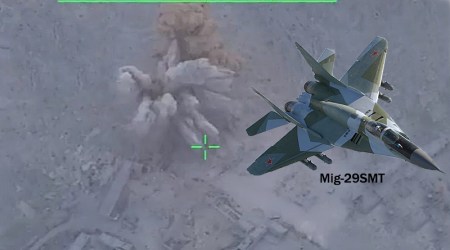
Russian air crews in Syria are under new orders to respond directly and immediately to Iranian and Syrian demands for air bombardments, without confirmation from the high commands in Latakia or Moscow.

This has enormously empowered Syrian and Hizballah officers on the ground for taking the war into their own hands. It led directly to Russian planes suddenly bombing a pro-US Syrian force in the Deir ez-Zour province of eastern Syria on Saturday, Sept. 16, and accounts for Moscow’s repudiation of the attack after its confirmation by the Pentagon.

Before the new orders, requests for Russian air cover went through command channels and were not automatically approved.

The license now awarded to Syrian and pro-Iranian Hizballah commanders to contact the operations rooms of Russian air squadrons, without going through the main Russian air base at Hmeimim in Latakia or the Syrian high command in Damascus, dramatically boosts the autonomy of Syrian, Hizballah and Iranian commanders in the field. It also gives sharp teeth to Moscow’s decision in August to place the Russian and Syrian air defense commands under unified command.

Word of this game-changer was delivered by Russian Defense Minister Sergei Shoigu, when he sat down with Syrian ruler Bashar Assad in Damascus last Thursday, Sept. 14. According to DEBKAfile’s sources, they decided the next Syrian army and Hizballah steps after crossing to the eastern bank of the Euphrates River, which were to head for the Syrian-Iraqi border and prepare to seize the towns of Abu Kamal and Mayedin from the Islamic State. The time table was established and Russian air, intelligence and logistic support laid on.

The Russian defense minister then flew to Tehran – this time in secret – to discuss Russia’s new operation plans for Syria with Iran’s Revolutionary Guards and Military leaders.

DEBKAfile’s military sources note that the actions set in train by Shoigu have radically ramped up Russia’s military cooperation in Syria with Iran, Syria and Hizballah. They were timed to take place shortly before President Donald Trump’s meeting with Israeli Prime Minister Binyamin Netanyahu at UN Center in New York on Monday, Sept. 19.

Although their conversation was generally billed as focusing on the Iranian nuclear deal, our sources expect this major turn in the Syrian crisis to figure large in their talks. Washington clearly has no practical plans for countering the assertive Russian-Iranian advances in Syria.

Their ruthlessness was demonstrated Saturday, Sept. 16, by a Russian bombardment of the US-backed Kurdish-led SDF near Deir ez-Zour. Moscow was telling Washington that the US would not be permitted to impede the Syrian-Hizballah initiative for the capture of areas east of the Euphrates and Russia was ready to confront US-backed forces on the ground if they got in the way – while ruling a clash in the air.

The Kremlin was also putting Washington on notice that, after investing massive military and financial resources in Syria, it had no intention to let pro-American forces share in the kudos of the final victory over the Islamic State in Syria, which belonged solely to the Russian-Syrian-Iranian-Hizballah war alliance.

For now, the Russian maneuver is heading for a successful outcome. The Pentagon, aside from a lame response to the Russian bombardment, has taken no counteraction.
Iran Quadruples Cash Flow to Hizballah Since Nuclear Deal

September 15, 2017

Iran Quadruples Cash Flow to Hizballah Since Nuclear Deal, Investigative Project on Terrorism, September 15, 2017

Proponents of the Iran nuclear deal, including many within the Obama administration, argued that the agreement would moderate Iran’s behavior. On the contrary, Iran immediately enhanced its support for terrorist organizations, while extremist factions within Iran gained more influence. Two years later, Iran has proved to be even more emboldened to pursue its regional hegemonic ambitions, drastically increasing financial and military support to terrorist organizations and cells worldwide.

*************************************

Iran has drastically increased financial support for its Lebanese-based terrorist proxy Hizballah since the Iran nuclear deal was signed two years ago, the Jerusalem Post reports.

Iran secured $100 billion in frozen assets and sanction relief in January 2016 as a result of the deal with the United States and European countries. Flush with cash, Iran immediately increased its support for terrorist proxies in the region and nefarious activities worldwide. Hizballah was receiving $200 million from Iran. Now, it’s $800 million.

Last month, Hamas terrorist leader Yahya Sinwar admitted that “relations with Iran are excellent and Iran is the largest supporter of the [Hamas military wing] Izz el-Deen al-Qassam Brigades with money and arms.” Iran reportedly provides Hamas with about $60-$70 million.

Both Hizballah and Hamas remain dedicated to Israel’s destruction and continue to invest considerable resources to fight the Jewish state. Iran also spends hundreds of millions of dollars for Shi’ite militias in Syria and Iraq, while increasing support for Houthi militants in Yemen.

Shortly after the July 2015 nuclear deal was signed, Iran expanded its presence in regional conflicts and even increased its own intervention in Syria’s civil war, leading to mounting Iranian Revolutionary Guard Corps (IRGC) casualties.

Iran also increased efforts to subvert its neighbors. In March, Bahrain security authorities arrested members of an Iranian-sponsored terrorist cell, accusing them of planning to assassinate senior government officials. The IRGC reportedly provided military training to several cell members.

Beyond Iran’s regional ambitions, it continues to plan terrorist attacks around the world. Earlier this year, for example, Germany accused Iran of plotting attacks on Israeli and Jewish targets.

Proponents of the Iran nuclear deal, including many within the Obama administration, argued that the agreement would moderate Iran’s behavior. On the contrary, Iran immediately enhanced its support for terrorist organizations, while extremist factions within Iran gained more influence. Two years later, Iran has proved to be even more emboldened to pursue its regional hegemonic ambitions, drastically increasing financial and military support to terrorist organizations and cells worldwide.

Shoigu in Damascus, Tehran for anti-ISIS drive

September 13, 2017

Shoigu in Damascus, Tehran for anti-ISIS drive, DEBKAfile, September 13, 2017

Our military sources point out that now, because ISIS is concentrating on battering the Syrian, Iranian and Hizballah forces and stalled their advance to the Euphrates Valley, the US-backed Syrian Democratic Forces, consisting mainly of Syrian Kurdish fighters from the YPG militia, have found that the road from Raqqa to Deir Ez-Zour is open and are overtaking the Russian-backed forces. The SDF is advancing rapidly with US helicopters providing them with fuel so their vehicles can press forward.

Ahead may be decision to commit more Russian military forces to the war against ISIS or explore a path to a breakthrough in talks with the Americans.

********************************

After a tense conversation with Bashar Assad in Damascus Tuesday, Sept. 12, DEBKAfile’s military and intelligence sources discovered the Russian Defense Minister Sergei Shoigu had flown secretly to Tehran the next day. He then proceeded directly to Sochi to brief President Vladimir Putin on his mission, which was to pull together the Russian-backed Syrian-Iranian-Hizballah operations against ISIS on the Syrian-Iraqi border.

DEBKAfile’s sources report that Shoigu’s visits capped this effort by Moscow.

The bright prospects of success in breaking the ISIS’ long siege of Deir ez-Zour announced at the beginning of the week dimmed on Tuesday and Wednesday, when the claims of a major victory proved unexpectedly premature.

As of Wednesday evening, Syrian army units were still locked in battle for control of the main road from Damascus to Deir Ez-Zour, and were still about 15km away from the city. Reports that the ISIS siege on the large Syrian airbase adjoining Deir Ez-Zour had been lifted were also premature.  On Wednesday night, ISIS forces were still attacking the base’s perimeter in an attempt to break through.

In other words, the lofty claims in recent days by senior Russian officers, President Assad and Hizballah leader Hassan Nasrallah, claiming the war was won, aside from small scattered battles, were over-hasty.

Our military sources point out that now, because ISIS is concentrating on battering the Syrian, Iranian and Hizballah forces and stalled their advance to the Euphrates Valley, the US-backed Syrian Democratic Forces, consisting mainly of Syrian Kurdish fighters from the YPG militia, have found that the road from Raqqa to Deir Ez-Zour is open and are overtaking the Russian-backed forces. The SDF is advancing rapidly with US helicopters providing them with fuel so their vehicles can press forward.

As of Wednesday evening, the SDF was just 6 km away from Deir Ez-Zour, ahead of the Russian-backed armies which were taking the brunt of ISIS attacks.

When he saw this happening, Russian President Putin sent his defense minister over to Damascus and Tehran to look for ways to break through to the next operations scheduled for attacking ISIS strongholds on the Syrian-Iraqi border. Ahead may be decision to commit more Russian military forces to the war against ISIS or explore a path to a breakthrough in talks with the Americans..

Iran buildup in S. Syria – riposte for IDF drill

September 12, 2017

Iran buildup in S. Syria – riposte for IDF drill, DEBKAfile, September 12, 2017


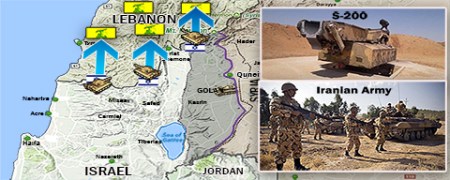
An Iranian military buildup indeed appears to be taking place on Syria’s borders with Jordan and Israel, in response to Israel’s mock thrust into Lebanon. But they are moving in on areas outside the de-escalation zones which are manned by Russian officers. Their tactic therefore is to entrench themselves in other parts of the southeastern Syria so that Russian, Iranian, Syrian and Hizballah forces form a continuous, impermeable line along Syria’s borders with Israel and Jordan.

*****************************

Lebanese sources claimed that on Monday, Syria had fired S-200 missiles against two Israeli F-15 fighter bombers flying over the southern Lebanese port town of Sidon – but missed their targets. The Syrian missiles, they claimed, had been fired from “an air defense base in southern Syria.”

This report was not confirmed by any other source. But it was accompanied by a photo on various Syrian social media, which claimed to depict the firing of these missiles and also presented a Lebanese military spokesman as saying that the Syrian missiles were fired at precisely 11.30 a.m. when the Israeli planes were over Sidon.

The Lebanese and Syrian media accounts are clearly coordinated.

If this episode actually happened, it would be a game changer, in that for the first time, Syria would have launched missiles from one of its bases against a purported Israel warplanes flying over Lebanon.

Even if the two allies were just sending a message to Jerusalem by drumming up an incident, it gains substance from its timing, i.e. five days after an Israeli air strike on Syria’s chemical and missile weapons development facility, the Scientific Studies and Research Center near Masyaf, 38 km west of the central town of Hama.

Syrian military sources are moreover reporting an onrush of Iranian officers, troops and military advisers to southern Syria. According to one official, “Many Iranians are deployed as advisers and police in southern Syria, especially in the de-escalation zones.” Another Syrian official put it more plainly. “We have seen a big increase in the number of Iranian soldiers this month.”

|DEBKAfile’s military sources confirm that these reports are partially correct. An Iranian military buildup indeed appears to be taking place on Syria’s borders with Jordan and Israel, in response to Israel’s mock thrust into Lebanon. But they are moving in on areas outside the de-escalation zones which are manned by Russian officers. Their tactic therefore is to entrench themselves in other parts of the southeastern Syria so that Russian, Iranian, Syrian and Hizballah forces form a continuous, impermeable line along Syria’s borders with Israel and Jordan.

On Sunday, Sept. 11, units of the Syrian army’s 5th Corps moved in on large sections of the Jordanian border, including parts close to Israel.

Neither the IDF nor the Jordanian army interfered with any of these potentially menacing steps. They are seen by DEBKAfile’s military sources as a combined Syrian-Iranian-Hizballah comeback for the IDF exercise, to demonstrate that, while Israel shows itself capable of invading Lebanon, the three allies have meanwhile become firmly ensconced on its northern border.

The next day, Hizballah’s leader Hassan Nasrallah boasted: “We have won the war in Syria. Our martyrs, wounded, captives and people are changing equations and writing the region’s history, not just Lebanon’s.”

US-Russian pincer for ISIS in Euphrates Valley

September 10, 2017

US-Russian pincer for ISIS in Euphrates Valley, DEBKAfile, September 10, 2017

The US and Russia have just agreed to each provide air support for a conjoined pincer movement to pin the Islamic State down in its last strongholds of Abu Kamal and Mayadin in the Euphrates Valley, DEBKAfile reports from exclusive intelligence sources.

The number of jihadists assembled there, mainly from Mosul and Raqqa, is estimated at 10,000.

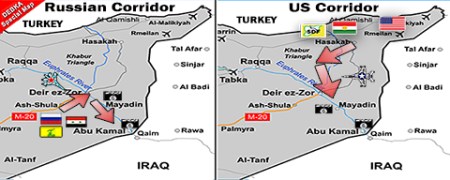
The new US-Russian understanding, our military sources say, provides a roadmap for twin offensives – one led by Syrian regime, Hizballah and pro-Iranian militia armies; the second, by the pro-US Syrian Democratic Forces (SDF),  the Kurdish YPG and the Syrian Arab Shammari Sanadid Brigade. The first will fight under Russian air cover and the second under US air support. The tribesmen are fighting with the blessing of Saudi Arabia.

The two columns will advance through two separate corridors.

The Russian-backed formation will head east from the town of Ash-Shula along the M20 highway. En route, they are tasked with completing the capture of Deir ez-Zour, after breaking through the ISIS siege last week, and mopping up ISIS fighters outside the town. After that, they will head northwest to their final destination, the border town of Abu Kamal.

The US-backed force will set out from the northern Syrian Kurdish province of Hasakeh and push on to the Khabur River, a tributary of the Euphrates. (See map.)  After crossing the Khabur, they will head along the Euphrates bank for the same destination, Abu Kamal.

Since the Russian and US air forces will both be operating in a very tight space, the US war room at the CENTCOM commander center in Baghdad and the Russian Hmeimim Air base in Syrian Latakia, will be coordinating aerial operations closely enough to prevent accidental collisions.

An agreement was reached between the US and the Syrian regime to drop references to “de-escalation zones”  and instead talk about “deconfliction.”

Although the two powers have reached an unprecedented measure of accord for working together with their respective allies and proxies for a concerted effort to wipe out the last ISIS strongholds along the Syrian-Iraqi border, nonetheless certain areas are still unresolved:

1. Which of the two will take charge of the oil fields of Deir ez-Zour? Control of this oil-rich region region is a valuable strategic prize for the winner.

2. Which of the two formations will actually lead the battles for Abu Kamal and Mayadin?

3.  And which of the two will be left in control of the Syrian-Iraqi border running through the Euphrates Valley?

Leaving any of these these points up in the air is a recipe for major clashes between the pro-Russian and pro-US forces which have banded together pro tem against the Islamic State’s last stand.

Trump-Putin deal imperils Israeli, Jordan borders

August 12, 2017

Trump-Putin deal imperils Israeli, Jordan borders, DEBKAfile, August 12, 2017

Local US-backed Syrian rebel groups disbanded without a shot, went over to the Syrian government side and handed in their US-supplied weapons to Syrian army and Hizballah fighters.

Sooner or later, the Sweida model will be replicated in Quneitra. Neither the Russian troops nor UN peacekeepers will fight to stop it happening. By then, the Syrian rebel groups, in whose support Israel invested for years as a buffer against hostile Syrian, Iranian and Hizballah forces, are already falling apart. Disowned by their Saudi backers, they are being crushed by the US-Russian “de-escalation” steamroller. Israel like Jordan will soon find three hostile forces sitting pretty just across its border, far too close for safety.

******************************

The transformation of a small, strategic wedge of land between the Syrian, Israeli, Jordanian and Iraqi borders is going forward apace without arousing much interest – even in Israel, where it should cause the most concern, DEBKAfile reports.

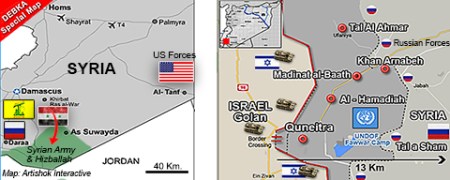
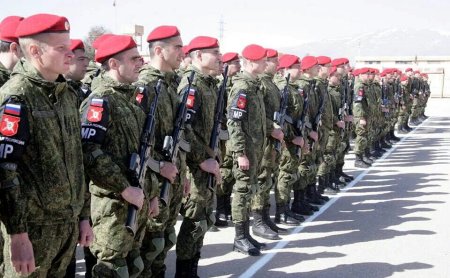
On Wednesday, Aug. 8, two Russian army companies of Ingushet troops from the northern Caucasus set up a command post in the Syrian village of Tal al-Shahm, 13km from Israel’s Golan border. Its commander, Col. Alexei Kozin, has thus taken charge of Syria’s border with Israel. As DEBKAfile reported last month, his task is to set up 10 control checkpoints along that border.

This border area was designated as one of four de-escalation zones agreed on between Presidents Donald Trump and Vladimir Putin at their meeting in Hamburg on July 7.

According to understandings reached between Washington, Moscow and Jerusalem, the UN separation force (UNDOF) will return to its Fawar base opposite Quneitra as a buffer between IDF and Russian forces. Its past history in this role between IDF and Syrian forces was never exactly impressive.

A piece of diplomacy consistent with this process was contributed by Russian foreign Minister Sergey Lavrov on Friday, Aug. 11. It was an assurance that Russia would take into account Israel’s interests in Jerusalem in the framework of Israeli-Palestinian peace talks.

It also fits in with the surprising statement from Washington on the same day, namely, that Donald Trump, although in the midst of a fearsome crisis with North Korea with military overtones, is planning to send his senior adviser, son-in-law Jared Kushner and Israel-Palestinian peace broker Jason Greenblatt, on an early visit to the Middle East to continue this mission.

To see how these disparate elements fill out the whole picture, we turn 70km east from Quneitra on the Syria Golan to the battles ongoing at Sweida in southeastern Syria opposite the Jordanian and Iraqi borders. Russian troops moved into the key town of Daraa, abutting on the Jordanian border on July 13. Like in Quneitra, a month later, they set up command posts to monitor the first de-escalation or ceasefire zone to be set up under the Hamburg accord.

The Russian troops’ assignment was to stop the fighting there and execute the withdrawal of the combatant forces, the Syrian army, Iran, and its foreign Shiite militias, including Hizballah, to a distance of 40km from the border.

But that arrangement never stood up.

Nearly four weeks later, on Wednesday night, Aug. 9, on the same night that Russian troops moved into Quneitra, the Syrian army and Hizballah launched a major offensive in Sweida province. Three days later, by Saturday, they had forced the local rebel forces to retreat into Jordan and seized 57km of Syria’s southern frontier with the Hashemite Kingdom.

Neither the Russians nor the American interfered with the Syrian-Hizballah-led push, although the Russians took responsibility for maintaining the ceasefire, and US special forces were and still are posted to the east of Sweida at Al-Tanf in the Syrian-Jordanian-Iraqi border triangle.

(See attached map)

DEBKAfile’s military sources add that the Syrian-Hizballah offensive violated the ceasefire deal. Local US-backed Syrian rebel groups disbanded without a shot, went over to the Syrian government side and handed in their US-supplied weapons to Syrian army and Hizballah fighters.

The Sweida episode demonstrated how the Syrian-Iranian-Hizballah alliance sees its way to using the Trump-Putin ceasefire zones accord as an open door for seizing control of southern Syria and grabbing the Jordanian and Israeli borders.

The Syrian rebel movement is disintegrating at an alarming rate following the “Jubeir earthquake,” as it has become known – another momentous event which Western and Israeli front pages have chosen to ignore.

Last week, Saudi Foreign Mniser Adel al-Jubeir reportedly informed a delegation of Syrian opposition leaders invited to Riyadh that his government was pulling its support from their fighting militias, in the wake of President Trump’s decision to reduce US military action in Syria solely to the war on ISIS – and therefore end US resistance to the Assad regime.

Saudi officials did not deny the report, only termed it “inaccurate.”

But meanwhile, the decisions by Riyadh and Washington to abandon the anti-Assad cause spread like wildfire among Syrian rebel groups. Many responded by laying down their arms and surrendering.

The fate of the rebel movement after six years of cruel warfare against the dictator Bashar Assad should be an object lesson to other recipients of American and Russian promises. Therefore, Lavrov’s pledge to take Israel’s interests in Jerusalem into account should be taken with a pinch of salt. He was most likely shooting a line to allay Israeli skepticism about the prospect of Russian troops keeping Syrian, Iranian and Hizballah troops at bay from its northern border – even through this pledge was underwritten by Washington.

Instead of taking the two powers at their word, Israel need only watch what is going on in the last few hours just across the border at Sweida, to appreciate the value of such promises.

Sooner or later, the Sweida model will be replicated in Quneitra. Neither the Russian troops nor UN peacekeepers will fight to stop it happening. By then, the Syrian rebel groups, in whose support Israel invested for years as a buffer against hostile Syrian, Iranian and Hizballah forces, are already falling apart. Disowned by their Saudi backers, they are being crushed by the US-Russian “de-escalation” steamroller. Israel like Jordan will soon find three hostile forces sitting pretty just across its border, far too close for safety.

Russia posts troops 8km from the Israeli Golan

July 25, 2017

Russia posts troops 8km from the Israeli Golan, DEBKAfile, July 25,2017

Most of the Russian troops were recruited in Chechnya, Dagestan and Ingushetia, republics known for their Muslim extremist activity.

DEBKAfile recalls that the Russians brought into embattled Daraa earlier this month to monitor the first ceasefire zone did not require Hizballah to withdraw. Iran’s Lebanese proxy is still there. Israel fears that Hizballah will repeat this exercise in the second ceasefire zone and establish a presence opposite the Golan without the Russians raising a finger to keep them out.

*******************************************

Russia has quietly moved troops to a point in southern Syria that is 8km from Israel’s Golan border, in the face of Israeli objections, DEBKAfile reports exclusively. Moscow used the uproar over the Temple Mount standoff and the diplomatic crisis between Israel and Jordan to cover its creeping troop deployment almost up to Syria’s borders with Israel and Jordan.

Tuesday, July 15, Prime Minister Binyamin Netanyahu, Defense Minister Avidor Lieberman and Chief of Staff Lt. Gen. Gady Eisenkott visited Bashan Division headquarters on the Golan for a rundown on the Russian deployment just opposite. (see photo)

DEBKAfile’s military sources report that some 800 Russian troops face Israel and another 400 are positioned on the border with Jordan. They have set up a roadblock east of Quneitra 8km from Israeli positions on the Golan. They have also strung an additional four to six lookout posts, some of them 13km from Israeli military positions, along the 64km Syrian-Israeli border – from Mount Hermon in the north, up to a point south of Qunetra in the south.

Most of the Russian troops were recruited in Chechnya, Dagestan and Ingushetia, republics known for their Muslim extremist activity.

Israel has repeatedly objected to the proximity of this Russian military presence, and asked the Trump administration to prevent it. But the protests from Jerusalem went unheeded in Washington and Moscow. President Donald Trump and Defense Secretary James Mattis regard the creation of US-Russian sponsored ceasefire zones in southwestern Syria as an essential component of their military cooperation in Syria and the war on ISIS.

DEBKAfile’s military sources report that, on Monday, July 24, Moscow announced the Russian deployment after the fact in messages to Washington, Jerusalem and Amman. They were all too engrossed in coping with the crises that had sprung up over Temple Mount and in relations between Jerusalem and Amman to pay much attention to this Russian fait accompli.

According to the announcement by Col.-Gen Sergey Rudskoy, Chief of the Main Operational Directorate of the Russian General Staff, the Russian units were in already in place on July 21 and 22:

“We informed our colleagues from the United States, Jordan and Israel, through military diplomatic channels in advance of the deployment of the Russian-controlled forces around the perimeter of the de-escalation zone in southern Syria,” he wrote.

DEBKAfile recalls that the Russians brought into embattled Daraa earlier this month to monitor the first ceasefire zone did not require Hizballah to withdraw. Iran’s Lebanese proxy is still there. Israel fears that Hizballah will repeat this exercise in the second ceasefire zone and establish a presence opposite the Golan without the Russians raising a finger to keep them out.

Jordan’s intel tags Hizballah for Temple Mt. terror

July 20, 2017

Jordan’s intel tags Hizballah for Temple Mt. terror, DEBKAfile, July 20, 2017

Jordanian and Saudi intelligence services have come to the conclusion that the attack was the work of a Hizballah-run cell on orders from Iran. One of Hizballah’s signatures is the absence of any claim of responsibility.

Jordanian intelligence circles suspect that the Temple Mount attack was linked to the US-Russian deal for ceasefire zones in southwest Syria right up to the borders of Jordan and Israel. Both governments have demanded the exclusion of Iranian and Hizballah forces from those zones.

Hizballah not only maintains a presence in Daraa and the Syrian Golan, but has planted terrorist networks inside Israel and Jordan. The pro-Iranian terror group has long been suspected of recruiting networks in some Israeli Arab communities. By striking Temple Mount, Iran and Hizballah targeted both Israel and Jordan, which claims religious custodianship of its mosques.

************************

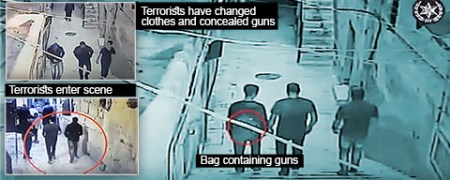
The Israeli police Thursday, July 20, released a video tape recording the movements of the terrorists heading for the murderous attack they committed on Temple Mount six days ago, when they shot dead two Israeli border guard police officers.

The film shows not three but four men who carefully stepped away from each other before entering the Al Aqsa Mosque. There, the three gunmen were handed their weapons by the fourth confederate, who made his escape among the crowds of worshippers exiting the mosque.

The police published the video Thursday ahead of Muslim Friday prayers – which brings tens of thousands of worshippers to Al Aqsa – as a reminder that the crime committed was a terrorist attack staged by Muslims at Islam’s third most sacred site – not the metal detectors Israel which installed for its safety. To drown this truth out, the Palestinians and Waqf officials have been raising a worldwide uproar over those detectors, as though nothing else happened to make them necessary.

The investigation going forward has established that the terrorists were far from amateurs. They acted coolly, with professional precision and were clearly highly trained and familiar with the terrain. It was a skilled terrorist cell that assaulted a shrine holy to three world faiths.

Even the absence of any claim of responsibility for the attack is a clue, especially since none of Israel’s investigators, be they police, security authorities or intelligence agencies, have so far thrown any light on the identity of the hand behind that cell.

However, DEBKAfile’s intelligence and counterterrorism sources report that Jordanian and Saudi intelligence services have come to the conclusion that the attack was the work of a Hizballah-run cell on orders from Iran. One of Hizballah’s signatures is the absence of any claim of responsibility.

On July 18, 2012, a suicide bomber blew himself up on a bus carrying Israeli tourists at the Bulgarian resort of Burgas, killing five Israelis and the Bulgarian driver and injuring 32. No organization has ever claimed this attack. Israeli intelligence uncovered evidence that it was orchestrated by Hizballah, but was never able to lay hands on the perpetrators.

The difference this time was that the three gunmen on Temple Mount had no intention of committing suicide. They did not expect the Israel police detail to react quickly enough to gun them down, but had meant to elude pursuit by fleeing to safety into Al Aqsa mosque. There they planned either to escape through ancient subterranean tunnels leading outside the Old City walls, or barricade themselves inside the cavernous mosque for a long shootout with Israel police.

Jordanian intelligence circles suspect that the Temple Mount attack was linked to the US-Russian deal for ceasefire zones in southwest Syria right up to the borders of Jordan and Israel. Both governments have demanded the exclusion of Iranian and Hizballah forces from those zones.

Tehran found an answer to this demand by demonstrating that its Lebanese proxy is capable of reaching deep inside Israel without recourse to external territory, because Hizballah not only maintains a presence in Daraa and the Syrian Golan, but has planted terrorist networks inside Israel and Jordan. The pro-Iranian terror group has long been suspected of recruiting networks in some Israeli Arab communities. By striking Temple Mount, Iran and Hizballah targeted both Israel and Jordan, which claims religious custodianship of its mosques.

Russians enter Daraa, Syrians/Hizballah move out

July 12, 2017

Russians enter Daraa, Syrians/Hizballah move out, DEBKAfile, July 12, 2017

Israel has so far objected to any Russian military presence along its borders with Syria, even in the capacity of ceasefire monitors, preferring Americans to police the truce in the Qunetra region. If that proved unfeasible, then Israel would leave the Syrian rebels controlling this area in place.

**********************************

Russian troops stepped into southern Syria for the first time Wednesday, July 13, when they entered the embattled town of Daraa to start enforcing the partial ceasefire agreed by Presidents Donald Trump and Vladimir Putin in Hamburg on July 7.  DEBKAfile’s military sources report this exclusively.

The Russians, including military police and Chechen paratroopers, were sighted getting out of the vehicles of their convoy and taking up positions in the center of Daraa. As they moved into the town, our sources report that tank units of the pro-regime Syrian army’s 5th Armored Division were seen driving out, along with Hizballah.

Their withdrawal cut short the Syrian military’s Operation Big Dawn against the Syrian rebels in Daraa, which breached the ceasefire Monday, July 11 – less then 24 hours after it went into force.

The Russian deployment in a southern Syrian border town Wednesday was the first step in their posting along Syria’s Israeli and Jordanian borders, as agreed between Washington and Moscow. President Trump had assented to this arrangement to bolster the first stage of the Syrian ceasefire going into effect in the de-confliction zone of the southwest.

Jordan also assented, in the interests of de-escalating tensions on its border with Syria.

The Russian troops and Chechens in Russian military police uniforms were armed only with light weapons. On July 5, Putin’s special envoy for Syrian affairs, Alexander Levrentiev, said that the Russian troops deployed in Syrian ceasefire zones would be lightly armed for self-defense. Most would consist of Russian military police. This description was intended to cover the presence of Chechen paratroops, who were seconded to the Russian police force for this mission.

Israel has so far objected to any Russian military presence along its borders with Syria, even in the capacity of ceasefire monitors, preferring Americans to police the truce in the Qunetra region. If that proved unfeasible, then Israel would leave the Syrian rebels controlling this area in place.

But our sources predict that, after the arrival of Russian troops in Daraa to preserve the ceasefire, both Washington and Moscow will lean hard on Jerusalem to accept Russian troops at Quneitra too, that is, opposite the Golan.

New Syrian-Hizballah offensive defies ceasefire

July 10, 2017

New Syrian-Hizballah offensive defies ceasefire, DEBKAfile, July 10, 2017

The Assad regime, for its part, felt free to resume combat because the Trump-Putin ceasefire deal had not set out demarcation lines as dividers between the opposing armies, leaving that task to US and Russian officers on the ground to take up.

**************************************

Less than 24 hours after the US-Russian sponsored ceasefire went into force in southwest Syria, it broke down early Monday, July 10, when large-scale Syrian army and Hizballah forces launched a general offensive on Syrian rebel forces in the Al Suweida province. This region was listed with Quneitra and Daraa as one of three demilitarized locations to be covered by the truce.

DEBKAfile’s military sources report that the Syrian’s army’s 5th Armored Division led the offensive which the Syrian army’s general command designated “Operation Big Dawn,” to mark it as the opening of a new phase in the war in southern Syria.

Our military sources described the attack as focusing on the northern rural areas of Al Suweida province to provide the Syrians and Hizballah with a pretext for claiming they are not part of the town and therefore not part of the ceasefire agreement reached by Presidents Donald Trump and Vladimir Putin in Hamburg last Friday, July 7.

In the early hours of their drive forward, Syrian and Hizballah troops captured 11 villages and small towns, including Tal Asfar and Al-Qasr, which lie 33km from the town of Suweida, 70km from Daraa on the Jordanian border and 78km east of Quneitra and the Israeli Golan border.

They forced the rebels defending them to retreat; most belonging to the Syrian Democratic Forces, who were trained and armed by the US and Jordan.

According to our sources, Damascus decided to terminate another short-lived ceasefire in the six-year Syrian war when the Jordanian army and intelligence took advantage of the pause in fighting to transfer large quantities of weapons and military equipment to allied Syrian rebel forces defending Daraa. Under no illusions about the sustainability of the US-Russian ceasefire deal, Jordan moved fast to bolster its Syrian allies for the next round of fighting.

The Assad regime, for its part, felt free to resume combat because the Trump-Putin ceasefire deal had not set out demarcation lines as dividers between the opposing armies, leaving that task to US and Russian officers on the ground to take up.