Posted tagged ‘Hamas’

Why Europe Must Not Be Trusted to Monitor Hamas

September 2, 2014

Why Europe Must Not Be Trusted to Monitor Hamas, The Gatestone InstituteSoeren Kern, September 2, 2014

Hamas would likely resort to violence to thwart any attempts to disarm the group. It is therefore highly unlikely the Europeans would confront Hamas in any meaningful way.

Spanish intelligence agents met secretly with Hezbollah operatives, who agreed to provide “escorts” to protect Spanish UNIFIL patrols. The quid pro quo was that Spanish troops would look the other way while Hezbollah was allowed to rearm for its next war with Israel. Hezbollah’s message to Spain was: mind your own business.

If the European experience with Hezbollah in Lebanon is any indication, not only will Hamas not be disarmed, it will be rearmed as European monitors look on and do nothing.

What is clear is that European leaders have never been committed to honoring either the letter or the spirit of UN Resolutions 1559, 1680 and 1701, all of which were aimed at preventing Hezbollah from rearming.

European leaders are calling for a greater European role in enforcing the cease-fire in the Gaza Strip. They say their focus should be not only on rebuilding Gaza, but also on monitoring the demilitarization of Hamas and helping to secure the border crossings between the Gaza and Egypt to ensure that Hamas cannot be rearmed.

But if the European experience with Hezbollah in Lebanon is any indication, not only will Hamas not be disarmed, it will be rearmed as European monitors look on and do nothing.

French President François Holland, in a major foreign policy speech in Paris on August 28, said Europe should play a greater role in Gaza. “Since 2002, Europe has done a lot to rebuild and develop Palestine […] but it cannot simply be a cashier used to heal the wounds after a recurring conflict,” he said.

Referring to a nascent proposal for creating a Gaza observer mission under the auspices of the European Union, Hollande added: “Gaza can no longer be an army base for Hamas, or an open-air prison for its inhabitants. We have to go towards a progressive lifting of the blockade and the demilitarization of the territory.”

The EU observer mission—which is being promoted by Britain, France and Germany and would be established by a United Nations Security Council resolution—would be based at the Rafah border crossing, the main crossing between the Gaza Strip and Egypt. The mission would be charged with preventing the smuggling of weapons into Gaza and ensuring that building supplies such as cement and metal products are used for civilian reconstruction projects and not for building tunnels and rockets.

According to German media reports, the mission would be “more political than military,” which implies it would not be tasked with disarming Hamas.

The Israeli government has insisted that the reconstruction of Gaza must be linked to its demilitarization. “The process of preventing the arming of terror organizations must be part of any solution, and the international community must demand this aggressively,” Israeli Prime Minister Benyamin Netanyahu said on July 28.

This demand has been repeated by Israeli Foreign Minister Avigdor Lieberman. In an article entitled, “Take Away Their Guns—Then We’ll Talk,” published by Foreign Policy magazine on August 27, Lieberman wrote: “It should thus be entirely obvious that unless Hamas is disarmed and its only tools of control removed, there can be no peace and security.” He continued:

Any discussion on opening up entry points into Gaza, increasing access to the sea for Gazans, or any steps necessary for the revitalization of the Strip and its inhabitants cannot take place while it is occupied and terrorized by Hamas.

Israel fully supports a broad international effort to provide all the necessary means to rebuild the civilian infrastructure and economy in Gaza, provided there is a concerted parallel effort to prevent Hamas from rearming itself with weapons systems and rebuilding its terrorist infrastructure. Hamas cannot be allowed to rebuild its military force and prevent the essential international aid being directed to the Palestinian residents.

Lieberman also pointed out that the disarmament of Hamas and other Palestinian terrorist groups has been an essential element of a long list of agreements and understandings between Israel and the Palestinians. These include the Oslo II Accord signed in 1995, the Wye River Memorandum negotiated in 1998, and the so-called Road Map accepted by the Palestinian Authority in 2003.

But the exiled leader of Hamas, Khaled Meshaal, has vowed that the group will never disarm. “The weapons of the resistance are sacred and we will not accept that they be on the agenda” of future negotiations with Israel, he said on August 29. “The issue is not up for negotiations. No one can disarm Hamas and its resistance.”

Meshaal also said the conflict between Israel and Hamas is not over. “This is not the end. This is just a milestone to reaching our objective [of destroying Israel], we know that Israel is strong and is aided by the international community,” he said. “We will not restrict our dreams or make compromises to our demands.”

Hamas—an Islamist group whose raison d’être is the destruction of Israel—would probably resort to violence to thwart any attempts to disarm the group. It is therefore highly unlikely the Europeans would confront Hamas in any meaningful way.

The reluctance to disarm Hamas has much in common with the failure to disarm Hezbollah.

In September 2004, the UN Security Council passed Resolution 1559, which, among other demands, called for the disarmament and disbanding of Lebanese and non-Lebanese militias.

Hezbollah Secretary-General Hassan Nasrallah has flatly rejected Resolution 1559; he says he considers his organization to be a “resistance movement.” Nasrallah has said:

We do not consider ourselves a militia. The Lebanese government does not consider us a militia, the parliament does not consider us a militia, and most of the Lebanese people do not consider us a militia. Therefore the resolution does not apply to us.

In May 2006, the Security Council adopted Resolution 1680, which reiterated the “call for the full implementation of all requirements of Resolution 1559 […] and called for further efforts to disband and disarm all Lebanese and non-Lebanese militias and to restore fully the Lebanese Government’s control over all Lebanese territory.”

In August 2006, the UN Security Council passed Resolution 1701, which ended the 34-day war that began when Hezbollah captured two Israeli soldiers in a cross-border raid into Israel. During the war, Hezbollah fired more than 4,000 rockets and missiles against Israel, killing 44 civilians. The resolution called for the disarmament of all armed groups in Lebanon, including Hezbollah. It also called for the:

full implementation of the relevant provisions of the Taif Accords, and of resolutions 1559 (2004) and 1680 (2006), that require the disarmament of all armed groups in Lebanon, so that, pursuant to the Lebanese cabinet decision of July 27, 2006, there will be no weapons or authority in Lebanon other than that of the Lebanese state.

Then—as now—world leaders seemed more concerned about preventing Israel from defending itself, than about disarming the Islamic terrorist groups that initiated the fighting in the first place by attacking Israel.

While visiting Haifa in July 2006, then French Foreign Minister Philippe Douste-Blazy had to take cover from Hezbollah-launched Katyusha rockets. At the time, Douste-Blazy said: “The first condition for a cease-fire is of course the disarming of Hezbollah.”

Then French President Jacques Chirac also warned against a continued Hezbollah armed presence in southern Lebanon. “It is absolutely normal to have a current which expresses politically what the Hezbollah part of Lebanese public opinion thinks,” Chirac said in a radio interview in Paris. “What is unacceptable is to express it by the use of force, with armed militias. No country accepts that part of its territory be controlled by armed militias.”

Chirac’s defense minister, Michèle Alliot-Marie, promised that French peacekeepers would be operating with “strong rules of engagement” so that the United Nations Interim Force in Lebanon [UNIFIL] could act “with rigor and strongly if it is necessary.” She said: “These are the conditions necessary for the Force to be credible and dissuasive.”

But as soon as France assumed command of an “enhanced” UNIFIL, one that included a new contingent of 7,000 European troops, the disarmament of Hezbollah was no longer on the agenda. Apparently, French officials became afraid that Nasrallah might activate Hezbollah sleeper cells in the cities of France.

“The disarmament of Hezbollah is not the business of UNIFIL,” the French commander of UNIFIL, Major General Alain Pelligrini, said in September 2006. “This is a strictly Lebanese affair, which should be resolved at a national level.”

Several days later, France became Hezbollah’s chief protector, as French Air Force jets were reportedly patrolling the skies over Beirut during Hassan Nasrallah’s victory speech. The French were apparently seeking to protect Nasrallah from Israeli assassins.

In late September, four UNIFIL tanks manned by French soldiers shielded Hezbollah terrorists by blocking Israeli tanks trying to stop the firing of mortar shells into Israel. A few weeks later, commanders of the French contingent in UNIFIL warned that they would open fire on Israeli warplanes if they continued their reconnaissance flights over Lebanon to search for clandestine shipments of arms to Hezbollah.

Meanwhile, the UN Secretary General at the time, Kofi Annan, also disclaimed responsibility for disarming Hezbollah. “UNIFIL troops are not going in there to disarm, let’s be clear,” he said. “The understanding was that it would be the Lebanese who would disarm Hezbollah,” he said, knowing full well that the Lebanese government—outmanned and outgunned by Hezbollah—lacked the power to do so on its own.

UNIFIL not only did nothing to disarm Hezbollah. UNIFIL also did nothing to prevent the group from rearming, even after Hezbollah’s representative in Iran, Muhammad Abdullah Sif al-Din, bragged that Nasrallah had a new strategic plan to rearm ahead of the “next round against Israel.”
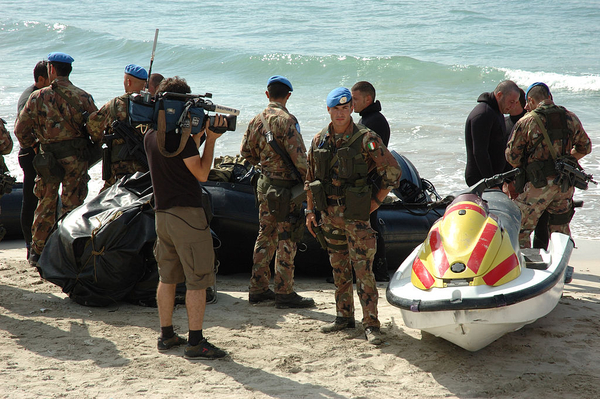
667Italian UNIFIL soldiers on the beach in Lebanon, September 2006. (Image source: Julien Harneis/Wikimedia Commons)

As early as October 2006, Terje Roed-Larsen, the special UN envoy for Lebanon, reported that “there have been arms coming across the border into Lebanon.” In April 2007, Walid Jumblatt, a senior Lebanese politician, told Al-Jazeera television that Lebanese security agents were helping Hezbollah guerrillas smuggle weapons across the porous border with Syria. In June of that year, Roed-Larsen warned the Security Council of an “alarming and deeply disturbing picture” of “a steady flow of weapons and armed elements across the border from Syria.”

At the same time, Hezbollah began to push back hard against UNIFIL. In June 2007, for example, six Spanish troops were killed by a car bomb, just days after Spanish peacekeepers discovered a secret Hezbollah weapons depot in southern Lebanon. Hezbollah’s message to Spain was: mind your own business.

Less than a month after those killings, it emerged that Spanish intelligence agents had met secretly with Hezbollah operatives, who agreed to provide “escorts” to protect Spanish UNIFIL patrols. The quid pro quo was that Spanish troops would look the other way while Hezbollah was allowed to rearm for its next war against Israel.

In November 2009, Israel’s Navy intercepted a ship carrying 500 tons of Iranian weapons, rockets and missiles intended for Hezbollah. In April 2010, former US Secretary of Defense Robert Gates said that Hezbollah “has more missiles than most governments in the world.” In March 2011, an IDF intelligence report revealed that Hezbollah had built close to 1,000 military facilities throughout Southern Lebanon. The installations included more than 550 weapons bunkers and 300 underground facilities.

Meanwhile, Hezbollah stepped up its attacks against European peacekeepers in southern Lebanon. In May 2011, six Italian peacekeepers were wounded by a roadside bomb in the southern city of Sidon. In July, five French troops were wounded by a bomb in the same area. In December, five French peacekeepers werewounded by a roadside bomb in the southern coastal city of Tyre.

Rather than confront Hezbollah over the attacks, however, the governments of France, Italy and Spain cowered and announced the withdrawal of significant numbers of their troops from Lebanon.

In January 2012, UN Secretary General Ban Ki-Moon demanded that Hezbollah be disarmed. “I am deeply concerned about the military capacity of Hezbollah and the lack of progress in disarmament,” he said. “All these arms outside of the authorized state authority, it’s not acceptable,” he declared.

Nasrallah responded with mockery and contempt: “Your concern, secretary-general, reassures us and pleases us. What matters to us is that you are worried, and that America and Israel are worried with you,” he said.

In July 2013, the European Union announced that it would place part of Hezbollah on its terrorism blacklist, ostensibly to cut off the Shiite militant group’s sources of funding inside Europe. But in a classic European fudge, EU governments agreed only to blacklist the “military” wing of Hezbollah, thus maintaining the politically expedient fiction that a clear distinction can be drawn between Hezbollah terrorists and those members of the group’s “political” wing.

Following the EU’s decision, the editor of the pro-Hezbollah newspaper Al-Akhbar, Ibrahim al-Amin, issued thinly-veiled threats of “military” consequences for UNIFIL’s European members, whom Amin said were now “operating behind enemy lines.”

All the while, Hezbollah has continued to build an arsenal of ever-more powerful weapons that can reach deeper into Israel than ever before. According to the Israel Defense Force (IDF), Hezbollah has obtained sophisticated long-range surface-to-air missiles from Syria. The group has also acquired advanced guided-missile systems in preparation for its next conflict with Israel.

According to Brigadier General Itay Baron, director of military intelligence research for the IDF, Hezbollah now has around 65,000 rockets and missiles, many times the number it had on the eve of the 2006 war. Nasrallah hinted at this rearmament when he proclaimed that a future Hezbollah assault on Israel would “turn the lives of thousands of Zionists into a living hell.”

During the past eight years of European leadership of UNIFIL, Hezbollah has more than fully rearmed itself while European soldiers have stood by and done nothing. What is clear is that European leaders have never been committed to honoring either the letter or the spirit of UN Resolutions 1559, 1680 and 1701, which were all aimed at preventing Hezbollah from rearming. So why would anyone now trust the Europeans to ensure that Hamas is disarmed or not rearmed?

Poll: Hamas Would Rule Judea and Samaria in New Elections

September 2, 2014

Hamas won the war in political terms, but that won’t stop Kerry.

By: Tzvi Ben-GedalyahuPublished: September 2nd, 2014

via The Jewish Press » » Poll: Hamas Would Rule Judea and Samaria in New Elections.


Hamas’ Ismail Haniyeh would replace Abbas chairman of the Palestinian Authority if elections were held today.
Photo Credit: Abed Rahim Khatib / Flash 90


Hamas would win election in Judea and Samaria and well as Gaza and Ismail Haniyeh would defeat Mahmoud Abbas if elections were held today, according to a new poll conducted by the Palestinian Center for Policy and Survey Research.

Before the war in Gaza, Abbas had a 12 point margin over Haniyeh, 53 percent against 41 percent.

The new survey was carried out on the last day of the war and during the first four days of last week’s cease-fire. If elections were held today, Haniyeh would trounce Abbas by a 2-1 margin, with 61 percent support of the voters as opposed to only 32 percent for Abbas.

The pollster, Khalil Shikaki, said that Abbas probably will recoup some of his losses because Hamas’ popularity previously fell after battles after mini-wars with Israel, but a 2-1 gap will be hard to overcome.

More worrisome, the poll revealed that 86 percent of the respondents think that Hamas should resume rocket attacks on Israel if the partial blockade is not completely lifted, and only 15 percent think that Hamas should be dis-armed after all sanctions are lifted.

In addition, 72 percent of Arabs in Judea, Gaza and Samaria support the Hamas strategy of using arms to attack Israelis in Judea and Samaria.

An overwhelming majority of 79 percent believe that Hamas won the war.

Hamas has not enjoyed such high support in Judea and Samaria since 2006, shortly after it ousted Abbas’ Fatah faction from Gaza in a bloody terrorist militia war.


To a certain extent, Abbas’ propaganda machine is directly responsible for Hamas’ overwhelming support. Years of demonizing Israel and Jews in the school system and in Palestinian Authority media has produced the desired effect of widespread hate and distrust of Israel and Jews.

False, malicious and twisted reporting have convinced Arabs in Judea and Samaria that the “occupation” is the cause of all or their problems, and a recent on-the-street survey by a Canadian living in Israel discovered that most Arabs that Israel carried out a “holocaust” in Gaza. Most of those interviewed also are ignorant of the Holocaust or think that the numbers of those butchered by the Nazi was grossly exaggerated, as seen in the video below.

Last month, the Israel Security Agency (Shin Bet) announced that a Hamas network, directed from Turkey, was planning a coup to overthrow Abbas. Haaretz reported Tuesday that a partial transcript of the investigation revealed that the plan actually was to wait for the Palestinian Authority to collapse and then take over power.

However, Hamas propaganda has consistently tried to undermine the Abbas regime, and every terrorist attack in Judea and Samaria weakens Abbas’ image that he is able to provide security.

Abbas has made a Frankenstein out of the “Peace Process,” demanding everything and accepting no compromise. The longer he cannot come up with the goods, the more his popularity falls. His only hope to force Israel to agree to impossible demands, such as allowing mass immigration of millions of so-called “refugees” and giving up land to connect Gaza with Judea and Samaria, is to go to the United Nations and the International Court. That process, which would provide doubtful result but in any case could take years, and the Arab street has lost its patience.

If U.S. Secretary of State John Kerry still thinks he can fall out of the clouds with his precious peace process, which has proved to be a war process, he will have a hard time pretending that Hamas is not in the picture.

Nipping terrorism in the bud

August 29, 2014

Nipping terrorism in the bud, Israel Hayom, Avi Dichter, August 29, 2014

As time zones go, Israel is one hour ahead of Europe and seven hours ahead of the eastern U.S. But when it comes to understanding the magnitude of the threat posed by Hamas, Israel is years ahead of both. Israel does not have the luxury of waiting for the rest of the world to wake up. We have to act now and make sure the world acts as well — before hostilities resume.

***********

The next round of violence involving Israel and Hamas is just a matter of time, and Israel would be wise to take the initiative on the matter. The timing should by [sic] convenient for the political and military echelons, and it must be based on quality intelligence.

Israel should be the one to surprise Hamas, instead of waiting for rocket fire of any scale. Israel should not be the one left to mount a response. The days of Israel being dragged into a fight by Hamas are over.

In its seven years in power, Hamas has plunged Gaza into chaos, which should remain inside the Strip, instead of affecting the kibbutzim near the Israel-Gaza Strip border and cities nationwide.

Hamas’ brutality is growing. It is oppressing the people of Gaza and doing everything within its power to ensure Gaza does not become Westernized. Hamas favors maintaining a “Wild West” in the Gaza Strip, so that it can continue to dictate who can and cannot pull the trigger in Gaza, and how.

Several hours after arch-terrorist Mohammed Deif, commander of the Izzedine al-Qassam Brigades, and three other senior Hamas officials were killed by an Israeli Air Force strike in Khan Younis, thanks to accurate intelligence provided by the Shin Bet security agency (although officially, Deif’s fate remains unknown), Hamas proved that it could do what the Islamic State group (ISIS) does: Men and women suspected of collaborating with Israel were dragged out of their homes, and in some cases their jail cells, and marched to a public square, while a masked gunman used the Great Mosque of Gaza loudspeaker to urge the masses to attend their execution.

The masses obeyed, and eager to see the victims suffer, demanded they be hanged. But the masked terrorist told the crowd that if ISIS dispensed justice by sword, Hamas would dispense it via gunfire.

The bullet-riddled bodies of the 28 “traitors” were meant to send a message: The IAF may control the skies, but Hamas is well in control on the ground. Gaza’s rulers thus demonstrated that their brutality was not reserved solely for Jews or Christians — innocent Muslims were not safe from it either.

Thanks to Iran, Hamas has twice the power ISIS does. Tehran has made sure Hamas is well armed, well trained and has much better logistical, financial and command infrastructures. So why is it that the terror Hamas has subjected Israel to has failed to convince the world in general, and particularly the United States, of the need to destroy its infrastructures?

Why is it that the U.S.’s firepower is directed at the Islamic State group — which is no danger to its borders or citizens — and not at Hamas, which is a known Iranian proxy? And if the U.S. prefers to act indirectly, why has it failed to endorse the Israel Defense Forces’ operations?

Hamas is more calculating than ISIS. It prevents the true scope of its atrocities from being revealed, mainly because it is wary of the wrath of the families of murdered Gazans. It has no qualms about harming women and children if it suspects one of their relatives might be a collaborator, but takes great care to conceal it.

Had Hamas been able to realize its tunnels conspiracy, infiltrate one of the communities near the border and abduct Israeli men, women and children, then Israel, the U.S. and the EU would have understood the true nature of Hamas’ cruelty.

Luckily for us, while Hamas is stronger than ISIS, the IDF is significantly stronger than the Iraqi Army. The 2007 military coup Hamas staged in Gaza Strip included throwing Fatah officials from the rooftops. Hamas’ fantasy that they could do the same to Jews, will remain just that — a fantasy the IDF has ruined.

World must wake up

The notion of the Islamic caliphate is a principle shared by Hamas and ISIS. This future caliphate, regardless of whose product it is, would be free of any geographic border, and it would be subjected solely to Shariah and Islamic laws.

Hamas and ISIS seek to recapture the grand history and the legacy of the Islamic caliphate created by Saladin. Given the rise of Islam in Europe they have reason to believe the future is promising, and they believe that when the radical Muslims from East and West join forces, the time would come for the resurrection of Saladin’s caliphate.

Israel cannot afford to follow in the Western world’s footsteps when it comes to the way Hamas should be handled, and cannot afford to be complacent or indifferent. As the Jewish state we have a duty to wake the rest of the world up and ensure that the world’s nations see Hamas for what it really is.

As time zones go, Israel is one hour ahead of Europe and seven hours ahead of the eastern U.S. But when it comes to understanding the magnitude of the threat posed by Hamas, Israel is years ahead of both. Israel does not have the luxury of waiting for the rest of the world to wake up. We have to act now and make sure the world acts as well — before hostilities resume.

Iran Begins Arming Palestinian Terrorists

August 29, 2014

Iran Begins Arming Palestinian Terrorists

Promises ‘the annihilation of the Zionist regime’

BY:
August 28, 2014 6:20 pm

via Iran Begins Arming Palestinian Terrorists | Washington Free Beacon.


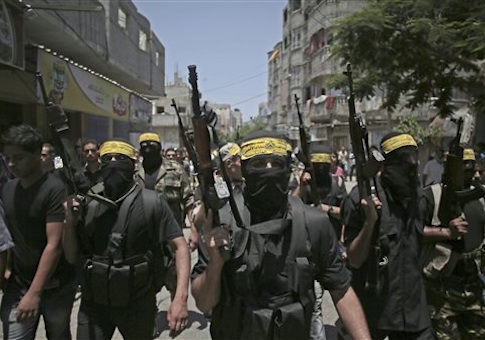
Masked Palestinian militants march with guns / AP

 Iranian military leaders say that they have begun weapons deliveries to Palestinian terrorists in the West Bank and elsewhere in the region after months of promising increased military support for Israel’s enemies, according to regional reports.

A top Iranian military commander confirmed that weapon shipments to the West Bank have already begun and that more will be sent to other “Palestinian resistance groups.”

“Arming the West Bank has started and weapons will be supplied to the people of this region,” Brigadier General Mohammad Reza Naqdi, the commander of Iran’s volunteer Basij force told the state-run Fars News Agency on Wednesday.

The announcement was made after weeks of inflammatory statements from Iranian leaders threatening war on Israel and promising to rearm Palestinian militants such as Hamas so that they can continue their war on the Jewish state.

The military leader also confirmed what has long been suspected by Israeli intelligence agencies: That Iran is responsible for training and arming Hamas with highly advanced rockets that were used to penetrate deep into Israeli territory during the most recent conflict.

Much of the arms Hamas deployed “were the products of the Islamic Republic of Iran,” Fars reported Naqdi as saying.

Iran is arming terrorists in the more moderate West Bank of Israel—as opposed to the Hamas-run Gaza Strip—because attacks on Israel from this area will ensure “the annihilation of the Zionist regime.”

“The Zionists should know that the next war won’t be confined to the present borders and the Mujahedeen will push them back,” Naqdi said.

An Iranian General this week vowed to launch a surprise attack on Israel in retaliation for an Israeli drone that was reportedly shot down near an Iranian nuclear site.

Anger at the incident has also prompted Tehran to step up its military support for Palestinian terrorists.

“We will accelerate arming the West Bank and we think that we are entitled to give any response (to the recent aggression) which we deem appropriate,” Brigadier General Amir Ali Hajizadeh, commander of Iran’s Revolutionary Guards Corps’ (IRGC) Aerospace Force, was quoted as saying on Monday.

Iran also is considering military force, according to Hajizadeh.

The IRGC claims to have shot down the Israeli drone with a surface to air missile. It lashed out at Israel in vitriolic terms in a statement issued earlier in the week.

“This mischievous attempt once again made the adventurous nature of the Zionist regime more evident and added another black page to the dark record of this fake and warmongering regime, which is full of crimes and wickedness,” the IRGC said in its statement.

Iran has been promising to arm Palestinian terrorist for weeks as the most recent conflict between Israel and Hamas escalated.

“The West Bank must be armed like Gaza,” Iranian Supreme Leader Ayatollah Ali Khamenei said in late July. He echoed these comments on Twitter.

Iran also has boasted of its past arming of Hamas terrorists.

“Today, the fighters in Gaza have good capabilities and can meet their own needs for weapons,” an Iranian lawmaker reportedly stated on television in July. “But once upon a time, they needed the arms manufacture know-how and we gave it to them.”

Mashaal Vows Cease-Fire a Step to New ‘Resistance’ War against Israel

August 29, 2014

By: Tzvi Ben-Gedalyahu

Published: August 28th, 2014

via The Jewish Press » » Mashaal Vows Cease-Fire a Step to New ‘Resistance’ War against Israel.


Hamas chief Khalid Mashaal rallies supporters in Gaza (archive).
Photo Credit: Screenshot

Hamas’ supreme leader Khaled Mashaal dashed any hopes of long-term peace with Israel in a speech in Qatar on Thursday in which he shot from the hip at Israel and also at his terrorist organization’s new partner, the rival Fatah movement headed by Palestinian Authority chairman Mahmoud Abbas.

His lengthy speech in Qatar, which has financed Hamas terror and which fought Egyptian cease-fire proposals, followed by one day a “victory” speech by Ismail Haniyeh, the senior Hamas political leader in Gaza. Mashaal’s silence while Haniyeh accepted the cease-fire is a clear sign of a fierce power struggle between Hamas in Gaza and between Mashaal and Qatar, which holds the purse strings.

Mashaal also claimed victory, with lies that Hamas missiles hit the Ben Gurion Airport, which is not true, and that more than 5 million Israelis hid in bomb shelters, a gross exaggeration. However, there is no doubt that Hamas succeeded in scaring the daylight out of millions of Israelis, interrupting a few flights and generally turning half of Israel into sitting ducks.

And this won’t be the last time, regardless of a cease-fire, he warned.

“Whatever happened [in Gaza] is not the end to this story, and this is not the last operation to free Palestine. It was an important stop on the way to victory,” Mashaal declared.

His speech threw every obstacle possible on the road to negotiations with Israel. The talks are supposed to begin in a month, leaving open the possibility, or probability, that Prime Minister Binyamin Netanyahu is carrying on secret negotiations that will be formalized in 30 days.

The Prime Minister suffered another blow to any trust that Israelis may have for him with a report on Thursday that he met secretly with Jordanian King Abdullah, and perhaps Abbas, prior to the cease-fire, circumstantial evidence that Israel negotiated under fire, contrary to Netanyahu’s promise.

If Mashaal gets his way, there won’t be any talks because one of the new powers in Gaza is slated to be Abbas, whose security forces would patrol Gaza borders, according to the Egyptian proposal. That would provide Cairo with another tactic to get rid of Hamas.

Mashaal nailed Abbas to the wall in his speech, accusing him of throwing cold water on the resumption of the intifada during the war by allowing his security forces to limit protests.

“The next operation needs to use all of the Palestinian capabilities, not just part of them,” Mashaal said. “The resistance is holy and weapons are holy. There is no such thing as a country without weapons.”

A country or not, Gaza still has at least 2,000 rockets as well as anti-tank rockets and presumably anti-aircraft missiles. It still has rocket factories, one of which was filmed in production by Hamas during one of the failed cease-fires during the war.

Netanyahu had demanded that any halt in violence would be accompanied by disarming Hamas, but this week’s cease-fire only left the issue to be put on the negotiating table, along with Hamas’s demands for a deep-sea port and an airport.

Mashaal’s speech was full of hate and crude accusations that Israel inflicted a “Holocaust” on Gaza by “destroying schools and hospitals,” which all but the most extreme anti-Israel media now know were used by Hamas as rocket launching and terrorist command centers.

“We are against what Hitler did to the Jews, and Israel committed a second Holocaust in Gaza. Israel is an embarrassment to Jews and to the entire world,” according to Mashaal.

His rhetoric was aimed at Abbas as well as Israel. If and when negotiations begin, Egypt and the United States will be on the side of Abbas, who despite his unity government with Hamas has proved politically smart by a patient and single-minded tactic of using international support to slowly but surely win concession after concession from Israel until there is nothing left to negotiate.

Including Gaza as part of the Palestinian Authority works to Abbas’ benefit because it will solidify position that a Palestinian Authority state needs to on contiguous territory, meaning that Sderot residents can start packing up and leaving their homes as well as their bomb shelters, which would save Hamas lots of time and money when digging terror tunnels from the Western Negev to Ashdod.

Mashaal’s aim is the same as Mashaal, but his strategy is different When Mashaal says that there will be another war to “free Palestine,” he is referring to all of Israel, from Kiryat Shmona in the north to Eilat in the south, and from the Dead Sea in the east to the Mediterranean Sea on the west.

Abbas talks about a “two-state solution,” the magic phrase that sends U.S. Secretary of State John Kerry into hallucinations and hypnotizes the foreign media into pretending that the Palestinian Authority’s maps of “Palestine” don’t include the existence of Israel.

But Mashaal reminded everyone in his speech that he has people on his side.

He thanked his sponsors for terror, namely Qatar, Turkey, Yemen and Algeria, and he thanked South Africa and Latin American countries for boycotting Israel.

Turkey Hosting at Least 12 Hamas Operatives

August 28, 2014

Turkey Hosting at Least 12 Hamas Operatives

Becoming ‘a very hospitable environment’ for Hamas

BY:
August 28, 2014 5:00 am

via Turkey Hosting at Least 12 Hamas Operatives | Washington Free Beacon.


Protesters burn an Israeli flag during a protest rally outside the Israeli consulate in Istanbul, Turkey / AP


At least 12 Hamas operatives, including a senior leader and others convicted of murder, have enjoyed safe haven in Turkey, a country that regional experts say is quickly becoming “a very hospitable environment” for Hamas terrorists to plan operations.

Turkey’s ties to Hamas have come under scrutiny in recent weeks after it came to light that a senior Hamas leader accused of planning the kidnapping of three Israeli teens is being sheltered in the country with the government’s knowledge.

In addition to top Hamas official Saleh Al-Arouri, Turkey has provided shelter to at least 11 other Hamas militants, two of whom have murdered Israelis and are known to the Turkish authorities, according to data published by the Palestinian National Information Center.

While Turkey’s support for Hamas has attracted concern in prominent foreign policy circles, the State Department has not expressed concern about the developments and is going forward with weapons shipments to Ankara.

Jonathan Schanzer, a former terrorism finance analyst at the U.S. Treasury Department, warned that Turkey and Hamas are only growing closer.

“It appears that there are at least two convicted murderers running around Turkey right now with the full acknowledgment of the government in Ankara. But because their victims were Israelis, there does not appear to be a lot of concern about a possible threat to public safety,” said Schanzer, who recently exposed the full list of Hamas operatives believed to be residing in Turkey.

“It is entirely unclear how many Hamas figures are based in Turkey right now, but it is clear that the country has become a very hospitable environment for leaders such as Saleh Arouri, but also some of the rank-and-file,” warned Schanzer, the vice president for research at the Foundation for Defense of Democracies.

Israel released into Turkey 10 Hamas militants as part of its 2011 deal to free kidnapped soldier Gilad Shalit. Others were released to Syria and Qatar, Hamas’ chief financier.

Since that time, Hamas members have enjoyed unfettered access to Turkey, where members such as Al-Arouri have hatched terror plots to overthrow the Palestinian government in the West Bank and replace it with Hamas terrorists.

In the time since the Shalit deal, “Hamas men have come and gone” from Turkey, Schanzer wrote in Foreign Policy. “But one thing is clear:The Hamas members who remain in Turkey are active. They attend local universities, join Turkish organizations, and play a role in its politics, and also appear to travel freely into and out of the country.”

Other seasoned Hamas terrorists resident in Turkey include Mahmoud Attoun, who was sentenced to life in prison for kidnapping a 29-year-old Israeli father before he was released during the 2011 Shalit deal.

Attoun, who publicly acknowledges that he lives in Turkey, is now “a rising star within Hamas,” according to Schanzer, who noted in his piece that Attoun “advocates for Hamas around the region” and has appeared on television to honor Hamas terrorists.

“Attoun is also actively involved with the Hikmet Bilim Dostluk ve Yardimlasma Dernegi (HIKMET), a Turkish NGO associated with the Muslim Brotherhood, and has spoken at one of their events,” Schanzer wrote in his report.

Taysir Suleiman, another Hamas militant now residing in Turkey, was sentenced to life in prison for murdering an Israeli soldier in 1993. He also was set free under the 2011 prisoner release.

“Today, he openly notes on his Facebook profile that he lives in Istanbul, and he appeared alongside Hamas political bureau leader Khaled Meshaal in a video dated March 2012 in the city,” according to Schanzer.

“That same summer, he traveled to Southeast Asia and Tunisia, where he presented slide shows to students about the al-Qassam Brigades,” he wrote. “In October 2013, Suleiman was featured in an hour-long special on the al-Quds TV station celebrating his release from Israeli prison.”

Officials at the Turkish Embassy in Washington said they had no information on the issue and therefore could not comment.

Turkey has been criticized in the past for acting as a leading hub for terrorists and has made moves to strengthen its alliance with Iran.

Turkey and Iran were found to be engaging in a scheme to skirt U.S. sanctions on Tehran by trading gold for oil.


PA to tell UN: Force Israel out of W. Bank, or we’ll seek war crimes charges in The Hague

August 28, 2014

PA to tell UN: Force Israel out of W. Bank, or we’ll seek war crimes charges in The Hague

By YASSER OKBI/ MAARIV HASHAVUA 08/28/2014 14:39

The Palestinians also intend to form a permanent unit government that has the complete backing of Hamas in hopes that such a government would expedite the rehabilitation of the Gaza Strip.

via PA to tell UN: Force Israel out of W. Bank, or we’ll seek war crimes charges in The Hague | JPost | Israel News.


Fatah official Nabil Shaath (L) and Hamas deputy political bureau chief Ismail Haniyeh. Photo: REUTERS


Fatah official Nabil Shaath (L) and Hamas deputy political bureau chief Ismail Haniyeh. Photo: REUTERS

A senior Fatah official said on Thursday that the Palestinians will seek UN Security Council approval for a specific timetable mandating Israel’s withdrawal from the disputed territories which it captured in the Six-Day War.

The official, Nabil Shaath, told the Ma’an news agency that “if our demand is not accepted, Fatah will ask the International Criminal Court in The Hague to try Prime Minister Binyamin Netanyahu, Defense Minister Moshe Ya’alon, and other senior officials over the military offensive against the Gaza Strip.”

The Palestinians also intend to form a permanent unity government that has the complete backing of Hamas in hopes that such a government would expedite the rehabilitation of the Gaza Strip.

“In cease-fire discussions, Israel was forced to give up on its demand that Hamas decommission its weapons, and this was due to American pressure,” Shaath told Ma’an.

Netanyahu and Palestinian Authority President Mahmoud Abbas met secretly in Amman prior to the announcement Tuesday of the cease-fire which ended 50 days of fighting between Israel and armed factions in Gaza, Jordanian daily Al-Ghad reported on Wednesday.

The paper quoted diplomatic sources as saying that the meeting of senior Israeli and Palestinian officials that  is believed to have included Netanyahu and Abbas took place a few days before the cease-fire.

The Palestinian Authority is expected to have a major role in rebuilding Gaza after Operation Protective Edge, as is outlined in the parameters of the cease-fire deal.

The PA will lead coordination of the reconstruction effort in Gaza with international donors, including the European Union, Qatar, Turkey and Norway. Saudi Arabia is also likely to be a major donor, with the expectation in Jerusalem being that unlike Qatar, it will take pains to ensure that its funds will not be directed to Hamas, but rather to build up the PA.

Channel 2 reported that a three-person committee made up of Maj.-Gen. Yoav Mordechai, the coordinator of government activities in the territories, UN Mideast envoy Robert Serry and PA Prime Minister Rami Hamdallah will supervise the process and determine what goods are allowed in.

Asked if he felt that Abbas was a partner for peace, Netanyahu said in his first press conference following the ceae-fire on Wednesday that the Palestinian leader “needs to choose what side he is on.”

Netanyahu said he hopes Abbas will continue to want a diplomatic process with Israel and an eventual agreement, and if he did then Israel would want him and his forces in control of Gaza.

JPost.com Staff contributed to this report.


I add this

Hamas Terrorists Hide Rocket Launchers in Hospital

August 25, 2014

Watch: Hamas Terrorists Embed Rocket Launchers in Hospital

Video shows Hamas fire on central Israel from hospital, located next to schools used as shelters, and IAF airstrike on launchers.

By Arutz Sheva Staff First Publish: 8/25/2014, 8:06

PMFurther irrefutable evidence of Hamas’s usage of hospitals to launch rockets at Israeli civilian centers has been provided by the IDF in new filmed footage.

via Hamas Terrorists Hide Rocket Launchers in Hospital – Defense/Security – News – Arutz Sheva.

In the video, concealed rocket launchers are indicated by a yellow triangle. They are located directly adjacent to a medical center, which is highlighted in red.

Other nearby sites marked in blue include the Salah Halaf and Ibn Sina schools, where displaced Gazans are staying, and on the other side a soccer field and a Hamas courthouse.

The video captures a rocket being fired from within the medical center, followed by another from the same compound. Both rockets, fired on Saturday, targeted the Shfela central region of Israel located between Jerusalem and the coast.

The launchers were taken out in pinpoint IAF airstrikes on Sunday after the buildings were warned so as to clear civilians. Several rockets, encircled in red, can be seen exploding due to the blast, further proving that rockets were embedded there.

Qatar’s ties with US deterring Israel from all-out diplomatic offensive, official says

August 25, 2014

Qatar’s ties with US deterring Israel from all-out diplomatic offensive, official says

By HERB KEINON 08/25/2014 18:14

The Israeli official’s comments came a day after the “New York Times” published an op-ed piece by Israel’s ambassador to the UN calling Qatar the “Club Med for Terrorists.”

via Qatar’s ties with US deterring Israel from all-out diplomatic offensive, official says | JPost | Israel News.

 A MUST READ !

President Mahmoud Abbas, Emir of Qatar Sheikh Tamim bin Hamad al-Thani and exiled Hamas leader Khaled Mashaal arrive for a meeting in Doha. Photo: REUTERS
 Israel has not launched a full-court diplomatic campaign against Qatar for aiding and abetting terrorism because of concern that the closeness of US-Qatar ties would render such a campaign futile, according to a senior diplomatic official.

The official’s comments came a day after the New York Times published an op-ed piece by Israel’s ambassador to the UN calling Qatar the “Club Med for Terrorists.”

“In recent years, the sheikhs of Doha, Qatar’s capital, have funneled hundreds of millions of dollars to Gaza,” Prosor wrote. “Every one of Hamas’s tunnels and rockets might as well have had a sign that read ‘Made possible through a kind donation from the emir of Qatar’.”

Even though that is the case, and even as Prime Minister Binyamin Netanyahu continues to raise Qatar’s negative role in private meetings with US Congressman and world leaders, the senior diplomatic official said that there is no concerted campaign that has been accompanied by directives to Israel’s representatives abroad to underline Qatar’s singularly negative role in supporting terrorism and in the Gaza crisis.

Prosor’s piece, he said, was the envoy’s own “improvisation” and not part of a bigger Israeli diplomatic push against the Persian Gulf country.

Qatar is too big an ally of the US and the West, the official said, and any such campaign would be tantamount to “banging our heads on the wall.” He said Jerusalem is not interested in going “toe-to-toe “with Washington over the issue.

Qatar is the home of the US Central Command’s Forward Headquarters and the Combined Air Operations Center, and is the location of three US air bases, including its largest one in the Middle East. It also recently signed contracts to purchase some $11 billion in US arms and weapons systems.

Nevertheless, Netanyahu – in a meeting last week with US Rep. Darrell Issa (R-California) – did raise the subject of Qatar’s support of Hamas. As chairman of the House Oversight and Government Reform Committee, Issa is in a prime position to put Qatar’s role high on the agenda in Washington.

However, Foreign Minister Avigdor Liberman, in an interview earlier this month with The Post, cautioned against exaggerating the leverage Qatar has over the terrorist organization.

Qatar was hosting Hamas and other terrorist organizations in Doha, and funding them handsomely, to ensure that they only operate outside Qatar, Liberman said. He characterized this as Qatar paying “protection money” to the terrorist organization.

“It is paying protection money in order to ensure security and quiet and calm inside Qatar, so they would work only outside,” he said. “I don’t know how much they are able to influence Hamas. I think Hamas has more influence on Qatar, than Qatar does on Hamas.”

Prosor, known for his sarcasm, wrote in the Times, after mentioning the tiny country’s petrol billions, that “it is time for the world to wake up and smell the gas fumes. Qatar has spared no cost to dress up its country as a liberal, progressive society, yet at its core, the micro monarchy is aggressively financing radical Islamist movements.”

He said that the “petite petrol kingdom” needed to be isolated internationally.

“In light of the emirate’s unabashed support for terrorism, one has to question FIFA’s decision to reward Qatar with the 2022 World Cup,” he said, stopping just short of launching a campaign to strip Qatar of the right to host the marquee soccer event.

Given Qatar’s alliances and influence, Prosor wrote, the prospect for many western countries of isolating Qatar is “uncomfortable.” Yet, he added, “they must recognize that Qatar is not a part of the solution but a significant part of the problem. To bring about a sustained calm, the message to Qatar should be clear: Stop financing Hamas.”

IDF Strikes Al-Qaeda-linked Gaza Terror Cell

August 25, 2014

lBy: Hana Levi JulianPublished: August 25th, 2014

via The Jewish Press » » IDF Strikes Al-Qaeda-linked Gaza Terror Cell.


IAF aircraft targeted numerous terror targets in Gaza over the past 24 hours as rockets continue to rain down on Israel.
Photo Credit: IDF Spokesperson’s OFfice
 

Israeli fighter pilots bombed operatives in Gaza from the Jaish Al-Islam terrorist organization on Monday afternoon.

The air strike, which resulted from a joint Shin Bet – IDF operation, eliminated a terror cell that was planning an attack on Israel in the near future, according to security sources.

The IDF also targeted a concealed rocket launcher placed within a school in the Shujaiyya neighborhood in Gaza City, used to fire missiles at Israel earlier in the day.

Jaish al-Islam, also known as the ‘Army of Islam’ terrorist organization, is called the ‘Tawhid and Jihad Brigades’ as well — the name used by the Doghmush clan in Gaza. The Salafi Muslim terror group appears on the official United States list of Foreign Terrorist Organizations. Its base is located in the Tzabra neighborhood at the very heart of Gaza, in the center of the region.

The Army of Islam is best known for having led the abduction of former IDF soldier Gilad Shalit in June 2006.

The group also kidnapped BBC journalist Alan Johnston in March 2007, and held him hostage until July of that year, when he was handed to rival Hamas officials in exchange for the release of captured Jaish al-Islam spokesman.

Although the group once challenged Hamas for control over the region, Hamas is now working closer together with Jaish al-Islam and is offering financial and other support to the group, Israeli intelligence sources said Monday.

Since midnight, nearly 90 rockets and missiles have been fired at Israel; a total of 823 projectiles have been launched at civilians in the Jewish State since Hamas violated the most recent temporary cease-fire eight hours before it was due to expire.


