Posted tagged ‘Hamas’

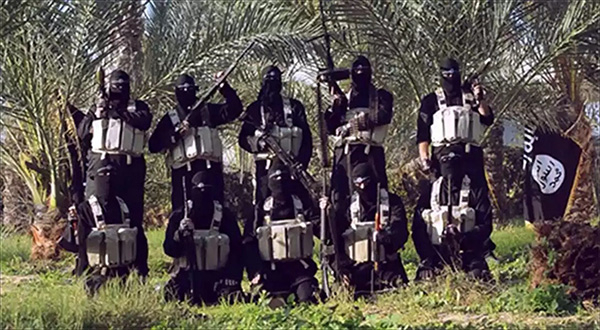
ISIS posts a new forward command group to Egyptian Sinai – at Israel’s back door

December 10, 2014

ISIS posts a new forward command group to Egyptian Sinai – at Israel’s back door, DEBKAfile, December 10, 2014

Abu_Bakr_al-Baghdadi_speaks_at_a_mosque_in_Mosul_2014Abu Bakr al-Baghdadi speaking at a mosque in Mosul

On arrival in Sinai, Islamic State commanders announced their movement’s mission had been overhauled and redirected from Egypt alone to the “Egyptian-Zionist alliance.”

******************

A group of at least ten ISIS operations and intelligence officers, led by a senior commander, has arrived in Sinai and taken charge of the local Ansar Beit al-Maqdas jihadis, thereby opening up a dangerous new front against Egypt and Israel, in proximity to the Suez Canal, the Gaza Strip and the West Bank, DEBKAfile’s exclusive counter-terror sources report.

Their identities are not known, but their relocation from Iraq to the Egyptian peninsula was carefully arranged. They came posing as tourists coming for a holiday at the Sinai resort of Sharm el-Sheikh, arriving on charter flights from Middle East and European locations on fake passports. This enabled them to evade the strict security checks at Cairo international airport.

By assuming command of the local Ansar Beit al-Maqdas terrorist group, which last month pledged allegiance to the Islamic State, Abu Bakr al-Baghdadi has moved to add Sinai as a new province to the caliphate he established in parts of Iraq and Syria.

In recent weeks, our counter-terror sources reveal, Islamic State tacticians have provided the Sinai outfit in with a strategic reserve by posting 300 combatants from Iraq to eastern Libya. This group also supplies the Egyptian contingent with arms.

Egypt therefore finds itself encircled by IS forces on its western border from Libya and deeply threatened from the northeast in Sinai; whereas Israel faces the same jihadi menace in the southwest from Sinai and in the north from Syria.

On arrival in Sinai, Islamic State commanders announced their movement’s mission had been overhauled and redirected from Egypt alone to the “Egyptian-Zionist alliance.”

One of their first tasks will be to counteract recent Egyptian military successes in broadening their penetration of the peninsula’s Bedouin tribes and so inflicting heavy losses on Ansar Beit al Maqdas.

Israel finds itself outflanked by the new IS deployment in Sinai. The IDF heavily built up its northern strength to meet any Al Qaeda menace from Syria to the Golan, creating the Bashan Division to fight off jihadist incursions. In the event, the IS’s Syrian units have given the Israeli border a wide berth and are focusing on fighting in northern and eastern Syria.

And so, while preparing to tackle Islamist encroachment from the north, Israel finds them cropping up along its southern border, where no comparable military buildup is in place.

Abu Bakr’s Sinai move contradicts the claims of senior US commanders that IS is on the run in Iraq after being badly hurt by US and coalition air strikes. (Last week there were no more than 31 air raids over Iraq and 15 in Syria.) All that the light US-led air campaign has achieved so far is to induce the Islamic State’s leaders to shift ground tactically from territorial expansion to defense and entrenchment.

Poll: Most Palestinian Arabs Support Recent Terror Wave

December 10, 2014

Poll: Most Palestinian Arabs Support Recent Terror Wave, Israel National News, Ben Ariel, December 10, 2014

The poll found 86 percent of respondents believe the Al-Aqsa mosque is in “grave danger” from Israel. It said 80 percent supported individual attacks by Arabs who have stabbed Israelis or rammed cars into crowded train stations.

****************

An overwhelming majority of Palestinian Arabs support the recent spate of terrorist attacks against Israelis, an opinion poll released Tuesday finds, according to The Associated Press (AP).

The poll also found that more than half of Palestinian Arabs support a new “intifada” (uprising) against Israel, and that Hamas would win presidential elections if they were held today.

Palestinian Arab pollster Khalil Shikaki said the results reflected anger over Israeli statements about Jerusalem, as well as a loss of hope following the collapse of U.S.-brokered peace talks and Israel’s recent war with Hamas in Gaza.

Shikaki heads the Palestinian Center for Policy and Survey Research, which interviewed 1,270 people in the Palestinian Authority-assigned areas of Judea and Samaria and Gaza last week. The poll had an error margin of 3 percentage points.

“There is an environment in which violence is becoming a dominant issue,” Shikaki told AP. “This seems to be one of the most important driving forces.”

There has been a spate of attacks in Jerusalem over the past month and a half, at a time of rising tensions over the Temple Mount. The wave of attacks has come to be known as the “silent intifada”.

The poll found 86 percent of respondents believe the Al-Aqsa mosque is in “grave danger” from Israel. It said 80 percent supported individual attacks by Arabs who have stabbed Israelis or rammed cars into crowded train stations.

Islamists have been regularly clashing with Israeli police on the Temple Mount and escalated a campaign of harassment against Jewish visitors, who are already under severe restrictions due to Muslim pressure. The violence reached a peak with the recent attempted murder of prominent Jewish Temple Mount activist Yehuda Glick.

Palestinian Authority (PA) Chairman Mahmoud Abbas has blamed Israelfor the ongoing tensions in Jerusalem.

Netanyahu’s epic understandings with Egyptian, Saudi and UAE rulers – a potential campaign weapon

December 6, 2014

Netanyahu’s epic understandings with Egyptian, Saudi and UAE rulers – a potential campaign weapon, DEBKAfile, December 6, 2014

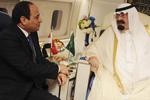
Abdullah-al_sisiEgyptian and Saudi rulers take charge of Arab affairs

Netanyahu may or may not opt to brandish Israel’s diplomatic breakthrough to the Arab world as campaign fodder to boost his run for re-election.  Whatever he decides, the rulers of Saudi Arabia, the Arab emirates and Egypt are turning out to have acquired an interest in maintaining him in office as head of the Israeli government, in direct opposition to President Obama’s ambition to unseat him.

******************

The six Gulf Cooperation Council (GCC) rulers meet in the Qatari capital of Doha next week amid high suspense across the Arab world. Its agenda is topped by moves to finally unravel the 2010 Arab Spring policy championed by US President Barack Obama, moves that also bear the imprint of extensive cooperation maintained on the quiet between Israel and key Arab rulers.

DEBKAfile reports that the Doha parley is designed to restore Egypt under the rule of President Abdel Fatteh El-Sisi to the lead role it occupied before the decline of Hosni Mubarak. Another is to root out the Muslim Brotherhood by inducing their champion, the young Qatari ruler, Emir Tamim bin Hamad Al Thani, to drop his government’s support.

At talks taking place in Riyadh ahead of the summit, Qatari officials appeared ready to discontinue the flow of weapons, funds and intelligence maintained since 2011 to the Brothers and their affiliates across the Arab world (Libya, Egypt, Syria, Jordan and Hamas-ruled Gaza), as well shutting down the El Jazeera TV network – or at least stopping the channel’s use as the Brotherhood’s main propaganda platform.

The Doha summit is designed to crown a historic effort led by Saudi King Abdullah, UAE ruler Sheikh Mohammed bin Zayed and President El-Sisi to undo the effects of the Obama administration’s support for elements dedicated to the removal of conservative Arab rulers, such as the Brotherhood.

They have found a key ally in this drive in Israel’s Prime Minister Binyamin Netanyahu, who took advantage of the chance of an epic breakthrough in relations with the leading bloc of Arab nations, with immediate and far-reaching effect on Israeli security and its standing in the region.

Yet at the same time, Netanyahu has kept this feat under his hat – even while smarting under a vicious assault by his detractors – ex-finance minister Yair Lapid and opposition leader Yakov Herzog of Labor – on his personal authority and leadership credibility (“everything is stuck,” “he’s out of touch.”) and obliged to cut short the life of his government for a general election on March 17.

He faces the voter with the secret still in his pocket of having achieved close coordination with the most important Arab leaders – not just on the Iranian nuclear issue and the Syrian conflict, but also the Palestinian question, which has throughout Israel’s history bedeviled its ties with the Arab world.

When Yair Lapid, whom Netanyahu sacked this week, boasted, “I am talking to the Americans” while accusing the prime minister of messing up ties with Washington, he meant he was talking to the Americans close to Barack Obama, whom Egypt, Saudi Arabia and Abu Dhabi, hand in hand with Netanyahu, have judged adverse to their regimes.

This Arab-Israeli collaboration encompasses too many areas to keep completely hidden. Its fruits have begun breaking surface in a string of events.

This week, Israel apparently out of the blue, quietly agreed to Egypt deploying 13 army battalions in Sinai (demilitarized under their 1979 peace treaty), including tanks, and flying fighter jets over terrorist targets.

A joint Saudi-Israeli diplomatic operation was instrumental in obstructing a US-Iran deal on Tehran’s nuclear program.

Another key arena of cooperation is Jerusalem.

Friday, Dec. 5, Jordan announced the appointment of 75 new guards for the Al Aqsa Mosque compound on Temple Mount. The director of the mosque, Sheikh Omar al-Kiswani, said they will begin work in the coming days.

This was the outcome of Jordanian King Abdullah’s talks with the Egyptian president in Cairo Sunday, Nov. 30, in which they agreed that the Muslim Waqf Authority on Temple Mount must change its mode of conduct and replace with new staff the violent elements from Hamas, the Al Tahrir movement and Israeli Arab Islamists, which had taken charge of “security.”.

The Moslem attacks from the Mount on Jewish worshippers praying at the Western Wall below and Israeli police have accordingly ceased in the two weeks since Israel lifted its age restrictions on Muslim worshippers attending Friday prayers at Al Aqsa. Israel groups advocating the right to Jewish prayer on Temple Mount were discreetly advised to cool their public campaign.

The Palestinian riots plaguing Jerusalem for months have died down, except for isolated instances, since, as DEBKAfile revealed, Saudi and Gulf funds were funneled to pacify the city’s restive Palestinian neighborhoods.

Cairo and the Gulf emirates have used their influence with Palestinian Authority Chairman Mahmoud Abbas to get him to moderate his invective against Israel and its prime minister, and slow his applications for Palestinian membership of international bodies as platforms for campaigning against the Jewish state.

Concerned by the way the mainstream Arab world was marginalizing the Palestinian question, Hamas leader Khaled Meshaal chose his moment Friday – ahead of the White House meeting between the Jordanian monarch and President Obama – to try and re-ignite the flames of violence in Jerusalem. He went unheeded.

Netanyahu may or may not opt to brandish Israel’s diplomatic breakthrough to the Arab world as campaign fodder to boost his run for re-election.  Whatever he decides, the rulers of Saudi Arabia, the Arab emirates and Egypt are turning out to have acquired an interest in maintaining him in office as head of the Israeli government, in direct opposition to President Obama’s ambition to unseat him.

Can President Obama Pass Disraeli’s Test?

December 5, 2014

Can President Obama Pass Disraeli’s Test? American ThinkerKen Blackwell and Bob Morrison, December 5, 2014

(Please see also Reports: Obama Mulling Sanctions on Israel. — DM)

Applying the Disraeli Test to this administration, President Obama’s policies fail on every count. No wonder our present foreign policy seems to stray so far from true American principles and interests.

***************

British Prime Minister Benjamin Disraeli famously said: “The Lord deals with the nations as the nations deal with the Jews.” Winston Churchill was an avid student of Disraeli’s “Tory Democracy” and passed Disraeli’s test easily, as Steven Hayward wrote recently in the Weekly Standard.

This raises a most interesting question: How would President Obama fare on a Disraeli test? His policy toward the Jewish State of Israel leads us to question whether this outstanding student, this graduate of Columbia University and Harvard Law School, could pass a simple, three-question test suggested by one of the Nineteenth Century’s leading statesmen.

President Obama made it a point to skirt around Israel during the entire four years of his first term, while making it his point to go to Turkey, Egypt, and Saudi Arabia in those years.

First, what about Turkey? In 2009, President Obama congratulated that secular republic on its commitment to democratic rule. Turkey is the only member of NATO with a Muslim majority. As such, Turkey’s 50-year alliance with the U.S. and its longtime support for Israel — the only Muslim land in the Near East to give such support — were certainly an important factor worthy of consideration in U.S. foreign policy. But under President Recep Tayyip Erdogan, Turkey has moved farther and farther away from the United States and closer to Russia.

As to Israel, Turkey has become a leading sympathizer of the Hamas terrorist-led regime in Gaza, attempting to run the Israeli blockade of Gaza and charging Israel with violating the human rights of the Arabs of Palestine. Interestingly, while Israel formally supports the idea of statehood for Palestinian Arabs, Turkey denies statehood for its hugeKurdish minority of 20 million. In fact, the Kurds are by far the largest ethnic group in the Mideast denied a state.

Does President Obama hold the Turks to the same standard that he applies to the Israelis? Not at all. He has not begun to press the Turks on Kurdish rights. Until 2000, it was illegal for a person holding Turkish citizenship to identify himself as a Kurd. Contrast this with Israel, where Arabs not only can so identify, they actually sit in the Israeli parliament, the Knesset, as Arabs and form legal Arab political parties.

Now, what of this administration’s view of Egypt? President Obama speedily recognized the Muslim Brotherhood-dominated government in Egypt headed by Mohamed Morsi. Morsi — educated in the U.S. but strongly rejecting American principles of religious liberty and constitutional government — quickly brought Egypt to the brink of chaos. Morsi planned a visit to the U.S. — one eagerly anticipated by the Obama administration — even though Morsi announced he would press the White House to pardon a terrorist.

Morsi wanted Obama to release Sheikh Omar Abdul Rahman, in prison for his part in the first terrorist attack on the World Trade Center. That attack killed seven Americans in 1993.

National Review’s Andrew C. McCarthy provided this stunning profile of Mr. Obama’s obeisance to the Muslim Brotherhood in Egypt.

Reports that the State Department was discussing a transfer of the Blind Sheikh back to Egypt surfaced months ago, in the context of a potential swap for democracy activists the Supreme Council of the Armed Forces was then detaining. The administration then issued a visa to Hani Nour Eldin, a member of the Islamic Group — the Blind Sheikh’s terrorist organization, to which it is a felony to provide material assistance. The purpose was to invite Eldin to, yes, the White House, for consultations with top American national-security officials on prospective relations between the United States and the new, Islamist Egypt. As the administration had to know he would do, he pressed his top agenda item: The United States must return the Blind Sheikh as a “gift to the revolution.”

Fully willing to give hundreds of millions in U.S. aid to Morsi, Mr. Obama promptly yanked that aid when Egypt’s military finally pulled the plug on the Muslim Brotherhood’s misrule in Egypt.

That leaves Saudi Arabia as the final question in Mr. Obama’s “Disraeli Test.” It is illegal for a Jew to live in Saudi Arabia. Any Saudi national who converts to Judaism is beheaded for apostasy. In February, 1945, President Roosevelt appealed to Saudi Arabia’s founding monarch, Abdulazziz, for the Jewish survivors of the Holocaust. Even then, the Saudis were unyielding. FDR, hoping to touch the desert despot’s heart, told him that three million Jews had been murdered in Poland. It was one of the first confirmations by a world statesman of the plight of European Jewry. Abdulazziz’s reaction to this horrific news? There was obviously no need for a Jewish state in the Mideast since there would now be plenty of room for Europe’s surviving Jews — in Poland!

Despite this history of no peace with Israel, no recognition of Israel, no compromise with Israel, President Obama shamefully bowed to the King of Saudi Arabia. No American president had ever bowed to anyone before.

Applying the Disraeli Test to this administration, President Obama’s policies fail on every count. No wonder our present foreign policy seems to stray so far from true American principles and interests.


ISIS in Gaza

December 5, 2014

ISIS in Gaza, Gatestone InstituteKhaled Abu Toameh, December 5, 2014

When One Radical Group Believes Another Is Not Radical Enough

Now almost everyone is talking about the Islamic State threats in Gaza against poets, writers and women. The leaflets mention the poets and writers by name — a move that has created panic. The leaflets also include an ultimatum to Palestinian women to abide by Islamic attire or face the Islamic State style of punishment — presumably being stoned to death.

Of course, all this is taking place while Hamas continues to insist that that the Islamic State is not operating in Gaza. Those who are taking the threats seriously are the writers and women whose names appeared in the leaflets.

Islamic State flags can already be seen at football stadiums, on windshields of vehicles, mosques, educational centers and wedding invitations.

It is also clear that if and when the Hamas regime collapses, the Gaza Strip will not fall into the lands of the less-radical Palestinians.

It is important to keep in mind that the counties in Europe now voting for a Palestinian state may effectively be paving the way for a takeover by Islamic State.

It is always dreamlike to see one Islamist terror group accuse the other of being too “lenient” when it comes to enforcing sharia laws. But it is not dreamlike when a terrorist group starts threatening writers and women.

That is what is happening these days in the Gaza Strip, where supporters of the Islamic State are accusing Hamas of failing to impose strict Islamic laws on the Palestinian population — as if Hamas has thus far endorsed a liberal and open-minded approach toward those who violate sharia laws.

825Members of Islamic State, in Gaza. (Image source: Islamic State YouTube video)

Until this week, the only topic Palestinians in the Gaza Strip were talking about was how to rebuild homes and buildings that were destroyed during the last war between Hamas and Israel.

Now, however, almost everyone is talking about the Islamic State threats against poets, writers and women.

It is no secret that the Islamic State has a presence in the Gaza Strip. According to sources there, many disgruntled members of Hamas and other radical salafi-jihadi groups have already joined the Islamic State, with some fighting together with ISIS groups in Syria and Iraq.

Earlier this year, it was revealed here that Islamic State has already begun operating inside the Gaza Strip — much to the dismay of Hamas.

Hamas, nevertheless, continues to deny any presence of Islamic State inside the Gaza Strip. “There are no members of Islamic State in the Gaza Strip,” said Eyad al-Bazam, spokesman for the Hamas-run Interior Ministry.

Many Palestinians, however, do not seem to take Hamas’s denials seriously, and remain unconvinced.

Over the past few days, two separate leaflets signed by Islamic State threatened to target Palestinian poets and writers for their “wantonness” and “atheism.” The leaflets mention the poets and writers by name — a move that created panic among many Palestinians in the Gaza Strip.

The leaflets also included an ultimatum to Palestinian women to abide by Islamic attire or face the Islamic State style of punishment — presumably being stoned to death. The threat leaves one with the false impression that, under Hamas, women can wear swimming suits at the beach and walk around the streets of Gaza City in mini-skirts.

But this is what happens when one fundamentalist group believes that the other is not radical enough.

“We warn the writers and poets of their wanton sayings and atheist deeds,” one of the leafletsread. “We give the apostates three days to retract their apostasy and wantonness and enter the religion of Islam anew.”

The threats issued by Islamic State have drawn strong condemnations from many Palestinians. This is the first time that such threats have been made against poets and writers or women.

Although Hamas has denied any connection to the threats, Fatah officials in the West Bank were quick to accuse the Islamist movement — which has been in control of the Gaza Strip since 2007 — of being behind the leaflets.

Palestinian political analyst Naji Sharab explained that any attempt to deny the presence of Islamic State terrorists in the Gaza Strip was “unrealistic.”

“There’s no denying that Islamic State exists [in the Gaza Strip] as a small group or as individuals,” he said. “The leaflets that were distributed this week could not have come from any Palestinian organization.”

Palestinians point out that the two leaflets were not the only sign of the presence of Islamic State inside the Gaza Strip. They say that Islamic State flags can be seen in many parts of the Gaza Strip, especially at football stadiums and public buildings. In addition, Islamic State stickers can be seen on the windshields of many vehicles.

More recently, Palestinians say, families have begun attaching the Islamic State emblem to wedding invitations sent out to friends and relatives. Photos of Palestinians who were killed while fighting with Islamic State in Iraq and Syria appear in many places, especially mosques and educational centers.

Of course, all of this is taking place while Hamas continues to insist that the Islamic State is not operating in Gaza.

Those who are taking the threats seriously are the women and writers whose names appeared in the leaflets.

Amal Hamad, a member of the Palestinian Women’s Union, expressed deep concern about the threats made by Islamic State. “We are headed toward the worst in the Gaza Strip,” she complained. “We hold the Hamas security forces responsible for the leaflets of intimidation and terror.” She and a large group of women in the Gaza Strip held an emergency meeting to discuss the repercussions of the threats.

Judging from reactions, it is clear that many Palestinians — including Hamas — are extremely worried about Islamic State’s presence in the Gaza Strip. Even if the terror group still does not have many fighters in the Gaza Strip, it already has countless followers and admirers.

It is also clear that if and when the Hamas regime collapses, the Gaza Strip will not fall into the hands of less-radical Palestinians.

The Gaza Strip has already been turned into an “Islamist Emirate” that is run by Hamas and other radical groups such as Islamic Jihad.

While Islamic State may have succeeded in infiltrating the Gaza Strip, its chances of entering the West Bank are zero. This is thanks to the presence of the Israel Defense Forces [IDF] in the West Bank. The Palestinian Authority and its President Mahmoud Abbas are well aware that without the Israeli security presence in the West Bank, the area would easily fall into the hands of Hamas or Islamic State.

It is important to keep in mind that the countries in Europe now voting for a Palestinian state may effectively be paving the way for a takeover by Islamic State

Sisi is not Mubarak

December 4, 2014

Sisi is not Mubarak, Canada Free Press, Caroline Glick, December 4, 2014
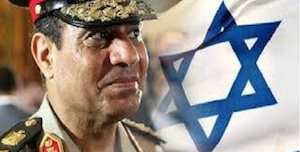
Sisi1

Due to the events that propelled him to power, Sisi has adopted a strategic posture far different from Mubarak’s. As Sisi sees things, Sunni jihadist forces and their Iranian-led Shi’ite allies are existential threats to the Egyptian state even when their primary target is Israel. Sisi accepts that Israel’s fight against them directly impacts Egypt.

He recognized that when Israel is successful in defeating them, Egypt is more secure. When Israel is weak, the threat to Egypt rises.

The government must take every possible action, in economic and military spheres, to ensure that Sisi benefits from his actions. 

******************

The Egyptian court’s decision last Saturday to acquit former president Hosni Mubarak, his sons and associates of all remaining charges against them caused most commentators to proclaim that current Egyptian President Abdel Fattah Sisi has turned back the clock. Under his leadership, they say, Egypt has restored Mubarak’s authoritarian regime under a new dictator.

While this may be how things appear on the surface, the fact of the matter is that at least as far as Israel is concerned, nothing could be further from the truth.

During his 30-year rule, Mubarak always assessed that threats against Israel were unrelated to threats against Egypt. Due to this view, despite continuous complaints from Jerusalem, Mubarak enabled jihadists to take root in Sinai. He allowed Egypt to be used as the major path for terrorist personnel and armaments to enter Gaza. He took only minor, sporadic action against the smuggling tunnels connecting Gaza to Sinai.

By 2005, it became apparent that forces from Hamas, Hezbollah, Iran and al-Qaida were operating in the Sinai and cooperating with one another.

Despite warnings from Israel, Mubarak took no effective action to break up the emerging alliance and convergence of forces.

It was due to Mubarak’s refusal to act that the Palestinians in Gaza were able to begin and massively expand their projectile war of mortars, rockets and missiles against Israel. From the first such attacks, carried out 14 years ago, the Palestinian projectile campaigns could never have happened without Egypt’s effective collaboration.

On countless occasions, Palestinian terrorist commanders were able to escape to Sinai and avoid arrest by Israeli forces, only to return to Gaza from Sinai and continue their operations.

Mubarak believed that Israel was his safety valve.

Mubarak: Facilitating jihadist operations against Israel from Egyptian territory

By facilitating jihadist operations against Israel from Egyptian territory, he assumed that he was securing Egypt from them. As he saw things, the Muslim Brotherhood, Hamas, Hezbollah and Iran would be so satisfied with his cooperation in their jihad against the Jews that they would leave him alone.

It was only in 2009, when Egypt announced the unraveling of a terrorist ring in Sinai comprised of Iranian Revolutionary Guards, Hamas and Hezbollah operatives planning attacks against Israel and Egypt, and seeking the overthrow of the regime, that Mubarak began signaling he may have misjudged the situation. But even then, his actions against those forces were sporadic and half-hearted.

Hamas’s continued assaults against Israel in the years that followed, and the build-up of Muslim Brotherhood and al-Qaida forces in Sinai, were a clear sign that Mubarak was unwilling to contend with the unpleasant reality that the very forces attacking Israel were also seeking to overthrow his regime and destroy the Egyptian state.

In stark contrast, Sisi rose to power as those selfsame forces were poised to destroy the Egyptian state. The Muslim Brotherhood’s rise to power owed in part to the support it received from Hamas.

Sisi and his generals overthrew the Muslim Brotherhood with Saudi and UAE support in order to prevent Egypt from dissolving into a Sunni jihadist axis i

During the January 2011 rebellions against Mubarak, Hamas operatives played a key role in storming Egyptian prisons in Sinai and freeing Muslim Brotherhood leaders – including Muslim Brotherhood president Mohammed Morsi – from prison. In 2012 and 2013, Hamas forces reportedly served as shock troops to quell protests against the Muslim Brotherhood regime. Those protests arose in opposition to Morsi’s moves to seize dictatorial powers Mubarak never dreamed of exercising, and his constitutional machinations aimed at transforming Egypt into an Islamic state and hub of a future global caliphate.

Sisi and his generals overthrew the Muslim Brotherhood with Saudi and UAE support in order to prevent Egypt from dissolving into a Sunni jihadist axis in which Hamas, al-Qaida and other jihadist movements were key players, and Iran and Hezbollah were allied forces.

Due to the events that propelled him to power, Sisi has adopted a strategic posture far different from Mubarak’s. As Sisi sees things, Sunni jihadist forces and their Iranian-led Shi’ite allies are existential threats to the Egyptian state even when their primary target is Israel. Sisi accepts that Israel’s fight against them directly impacts Egypt.

He recognized that when Israel is successful in defeating them, Egypt is more secure. When Israel is weak, the threat to Egypt rises.

Like Israel, Sisi acknowledges that the ideology of the Muslim Brotherhood, which is shared by Hamas, al-Qaida and all other significant Sunni jihadist groups renders all of these groups threats to Egypt. And because of this acknowledgment, Sisi has abandoned Mubarak’s policy of enabling their war against Israel.

Not only has he abandoned Mubarak’s policy of enabling them, Sisi has acted in alliance with Israel in combating them. This is nowhere more evident than in his actions against Hamas in Gaza.

After seizing power in July 2013, Sisi immediately ordered the Egyptian military to take action to secure the border between Gaza and Sinai. To this end, for the first time, Egypt took effective, continuous steps to block the smuggling of arms and people between the two areas. These steps had a profound impact on Hamas’s regime. Hamas went to war against Israel this past summer in a bid to force Egypt and Israel to open their borders with Gaza in support of the Hamas regime and its jihadist allies.

Hamas was certain that footage of suffering in Gaza would force Egypt to oppose Israel, and so open its border with Gaza. It would also lead to US-led pressure on Israel that would make Israel succumb to Hamas’s demands.

Against all expectations, and previous precedents of Egyptian behavior under both Mubarak and Morsi, Sisi supported Israel against Hamas. Moreover, he brought both Saudi Arabia and the UAE into the unofficial alliance with Israel. The bloc he formed was powerful enough to surmount US pressure to end the war by bowing to Hamas’s demands and opening Gaza’s borders with Egypt and Israel.

Since the cease-fire came into force three months ago, Sisi has continued to seal the border. As a consequence, he has denied Hamas the ability to rebuild Gaza’s terror infrastructure. In its reduced state, Hamas is less able to facilitate the operations of its jihadist brethren in Sinai that are primarily involved in waging an insurgency against the Egyptian state.

To be sure, the most significant strategic development in recent years is the US’s strategic realignment under President Barack Obama. Under Obama the US has switched sides, supporting Iran and its allies, satellites and assets, including the Muslim Brotherhood and Hamas, against America’s Sunni allies and Israel.

But the alliance that emerged this summer between Israel and Egypt, with the participation of Saudi Arabia and the UAE , is also a highly significant strategic development. For the first time, a major regional power is basing its strategic posture on its understanding that the threats against itself and against Israel stem from the same sources and as a consequence, that the war against Israel is a war against it.

Israelis have argued this case for years to their Arab neighbors as well as to the Americans and other Western states. But for multiple reasons, no one has ever been willing to accept this basic, obvious reality.

As a consequence, everyone from the Americans to the Europeans to the Saudis long supported policies that empower jihadist forces against Israel.

Sisi became the first major leader to break with this consensus, as a result of actions Hamas took before and since his rise to power. He has brought Saudi Arabia and the UAE along on his intellectual journey.

And this reassessment has had a profound impact on regional realities generally and on Israel’s strategic posture specifically.

From Israel’s perspective, this is a watershed event.

The government must take every possible action, in economic and military spheres, to ensure that Sisi benefits from his actions.

Egypt uncovers 82 new Gaza-Sinai smuggling tunnels

December 3, 2014

Egypt uncovers 82 new Gaza-Sinai smuggling tunnels, DEBKAfile, December 3, 2014

The Egyptian army this week unearthed a total of 82 new smuggling tunnels running from Sinai to the Hamas-ruled Gaza Strip, DEBKAfile’s military sources report. It turns out that neither Israeli nor Egyptian intelligence had caught on to the massive project. The illicit passageways were discovered by chance when Egyptian troops were working on on a new buffer zone to separate Sinai from the Palestinian enclave. Both agencies were taken aback by the speed with which Hamas had reconstituted its underground system for smuggling arms and fighting men into the Gaza Strip, after it was practically demolished by Egypt and Israel.

The new Ottoman emperor

December 3, 2014

The new Ottoman emperor, Israel Hayom, Clifford D. May, December 3, 2014

[T]here is mounting evidence that weapons and fighters are crossing from Turkey into Syria, where they are delivered to Islamic State fighters. Turkish officials are turning a blind eye, or maybe even facilitating the traffic. Stolen oil is moving in the other direction, sold to raise cash for Islamic State. Inside Turkey, as well, Schanzer and Tahiroglu write, Islamic State has “established cells for recruiting militants and other logistical operations.” Last weekend, Turkey’s main Kurdish party accused the Erdogan government of allowing Islamic State fighters to attack the Syrian Kurdish town of Kobani from within Turkey.

******************

Turkey should have been part of the solution. Instead it has become part of the problem. The problem, of course, is the spread of jihadism throughout the Middle East, North Africa and beyond.

Turkish policies have been aiding and abetting the Nusra Front, an al-Qaida affiliate; the Islamic State group, which has turned large swaths of Syria and Iraq into killing fields; the Islamic Republic of Iran, still ranked by the U.S. government as the world’s leading sponsor of terrorism and well on its way to becoming nuclear-armed; and the Muslim Brotherhood, including Hamas, the group’s Palestinian branch.

Troubling, too, is the rhetoric we’ve been hearing from Turkish leaders. Turkish Science, Industry and Technology Minister Fikri Isık claimed last week that it was Muslim scientists who first discovered that the earth is round. Two weeks earlier, Turkish President Recep Tayyip Erdogan insisted that Muslim sailors reached the Americas 300 years before Columbus — only to find that well-established Muslims in Cuba had built a beautiful mosque.

Such myth-making might be dismissed as nothing more than attempts to play to Islamic pride. Less easy to excuse is Erdogan’s increasing xenophobia. “Foreigners,” he recently observed, “love oil, gold, diamonds, and the cheap labor force of the Islamic world. They like the conflicts, fights and quarrels of the Middle East.” He added that Westerners “look like friends, but they want us dead, they like seeing our children die. How long will we stand that fact?”

If Turkey were just another tin-pot dictatorship, none of this would much matter. But Turkey is a Muslim-majority (98 percent) republic with a dynamic economy (not dependent on the extraction of petroleum), a member of NATO (making it, officially, an American ally), and a candidate for membership in the European Union (though that possibility now appears remote).

Just three years ago, U.S. President Barack Obama listed Erdogan as one of five world leaders with whom he had especially close personal ties. He regarded the Turkish leader as a moderate, his interpreter of — and bridge to — the tumultuous and confusing Islamic world.

Today, as detailed in a new report by Jonathan Schanzer and Merve Tahiroglu, my colleagues at the Foundation for Defense of Democracies, Erdogan is refusing to allow the American-led coalition formed in August to launch strikes against Islamic State from Turkish soil.

Worse, there is mounting evidence that weapons and fighters are crossing from Turkey into Syria, where they are delivered to Islamic State fighters. Turkish officials are turning a blind eye, or maybe even facilitating the traffic. Stolen oil is moving in the other direction, sold to raise cash for Islamic State. Inside Turkey, as well, Schanzer and Tahiroglu write, Islamic State has “established cells for recruiting militants and other logistical operations.” Last weekend, Turkey’s main Kurdish party accused the Erdogan government of allowing Islamic State fighters to attack the Syrian Kurdish town of Kobani from within Turkey.

The FDD report cites numerous sources alleging that Turkey also has given assistance to the Nusra Front. To be fair: The Turkish government, like the Obama administration, seeks the fall of Syrian dictator Bashar Assad, satrap of the Islamic Republic of Iran. A Turkish official is quoted as saying that Nusra fighters are essential to that effort, adding: “After Assad is gone, we know how to deal with these extremist groups.”

Do they? Hamas is an extremist group and one of its top leaders, Saleh al-Arouri, has been permitted to set up his headquarters in Turkey. In August, Israel’s Shin Bet security agency said it had thwarted a Hamas-led plot to topple Palestinian Authority President Mahmoud Abbas — and that Arouri was behind it. Arouri also claimed responsibility — in the presence of Turkey’s deputy prime minister — for the kidnapping and murder of three Israeli boys in the West Bank early last summer, an act of terrorism that led to the 50-day war between Israel and Hamas in Gaza.

There’s more: credible allegations that Turkey has helped Iran’s rulers evade sanctions; the fact that Turkey imprisons more journalists than any other country; Erdogan’s comparison of Israelis to Nazis (guess which he regards as more “barbaric”); and his pledge to “wipe out Twitter. I don’t care what the international community says. They will see the Turkish republic’s strength.”

To understand what Turkey has become, it helps to know a little about what Turkey used to be. Istanbul was once Constantinople, a Christian capital of the ancient world. In 1453, it fell to the fierce armies of the Ottoman Empire and the Islamic caliphate. Islam’s political and religious leaders soon established the Sublime Porte, the central government of their growing imperial realm.

Almost 500 years later, in the aftermath of World War I, the empire collapsed and the caliphate was dissolved. Modern Turkey arose from the ashes thanks to the leadership of Mustafa Kamal Ataturk, a visionary general who believed that progress and prosperity could be achieved only by separating mosque and state. His goal was to make Turkey a nation, one as modern and powerful as any in Europe.

A century later, the world looks rather different. There are good reasons to believe Europe is in decline and America in retreat (these are disparate phenomena). While it may be delusional to believe that Columbus encountered Muslims in the Caribbean, it is not crazy to believe that, over the decades ahead, fierce Muslim warriors will profoundly alter the world order once more.

Viewed in this light, Erdogan looks like a neo-Ottoman, one who dreams of commanding Muslims — and those who have submitted to them — in many lands. If that’s accurate, the rift between Turkey and the West can only widen.

Obama Admin Wants Hamas Ally Qatar to Remain Chief Broker in Peace Process

December 2, 2014

Obama Admin Wants Hamas Ally Qatar to Remain Chief Broker in Peace Process, Washington Free Beacon, December 1, 2014

(Please see also Hamas Declares Palestinian Unity Government Dead. According to the article republished below, “The State Department maintains that Qatar shares President Obama’s views about the Middle East peace process.” Their views have long been anti-Israel, pro-Islam. But what difference does it make nowThe “peace process” is already moribund and Qatar will administer the last rites.  — DM)

Khaled MashaalHamas chief Khaled Mashaal and Hamas Prime Minister Ismail Haniyeh / AP

Qatar promised the State Department it would not give more money to Hamas.

The State Department maintains that Qatar shares President Obama’s views about the Middle East peace process.

***********

The Obama administration is pressing for the Qatari government to remain a chief broker in the Israeli-Palestinian peace process despite the country’s longstanding financial support for the terror group Hamas, according to recent correspondence from the State Department to lawmakers on Capitol Hill.

Qatar—which has come under harsh criticism by lawmakers in recent months due to its longtime financial support for Hamas—has promised the Obama administration that it will not allow the terror group to benefit from a new $150 million cash infusion that is meant to go toward reconstruction efforts in the Gaza Strip, according to the letter.

The Obama administration will maintain its close ties with Qatar and push for it to have a key role in the tenuous peace process, despite protestations from lawmakers on Capitol Hill who say that the country cannot be trusted due to its close ties to Hamas, according to the letter sent by State Department officials late last month to Rep. Peter Roskam (R., Ill.).

Although Qatar has pledged in past years to give Hamas at least $400 million in aid, it has assured the United States that the next $150 million sent to the Palestinians will not make its way to the terror group.

“Qatar has pledged financial support that would be directed to the Palestinian people in Gaza,” Julia Frifield, an assistant secretary for legislative affairs at the State Department, informed Roskam in a Nov. 21 letter. “Qatar assured us that its assistance would not go to Hamas. We continue to interact closely with the government of Qatar and will reinforce that such assistance should not go to Hamas.”

The Obama administration in turn will continue to rely on Qatar to serve a role in the peace process and to engage with Hamas, according to the letter.

“Qatar has said it wants to help bring about a cease fire to the ongoing hostilities in Israel and Gaza,” the letter states. “The Qatari government has engaged with Hamas to this end.”

While the United States still regards Hamas as a terrorist organization, “We need countries that have leverage over the leaders of Hamas to help put a ceasefire in place,” Frifield wrote. “Qatar may be able to play that role as it has done in the past.”

Lawmakers and experts remain dubious that Qatar can be taken at its word given its robust support for Hamas in the past.

“It’s an indisputable fact that Qatar has become the chief sponsor of Hamas—an internationally recognized terrorist organization committed to the destruction of Israel,” Roskam said earlier this year after he petitioned the administration to reassess its close ties to Qatar.

“With Qatar’s financial backing, Hamas continues to indiscriminately launch thousands of rockets at our ally Israel,” Roskam said. “The Obama administration must explain its working partnership with a country that so brazenly funds terrorism right before our eyes, even going so far as turning to Qatar to help broker a ceasefire between Hamas and Israel.”

The administration cannot blindly trust Qatar to cut its close ties with Hamas, said one senior congressional aide who works on the issue.

“It appears the administration is willing to take Qatar for its word on funding some of the world’s most dangerous terrorist organizations, and the notion that Qatar can simultaneously fund Hamas and help broker and Israeli-Palestinian peace treaty is laughable,” the source said. “Congress is intent on holding the Qataris responsible for their illegal behavior and send a message that under no circumstances should the United States tolerate such brazen support for terrorism.”

The State Department maintains that Qatar shares President Obama’s views about the Middle East peace process.

“Qatar has welcomed President Obama’s commitment to a solution to the Israeli-Palestinian conflict and shares the view that such a solution would advance security, prosperity, and stability in the Middle East,” the letter states.

In addition to its role in the peace process, the administration believes that Qatar can help in the international fight against terrorism and groups such as the Islamic State (IS).

“We remain strongly committed to working with Qatar to confront ongoing terrorist financing and advance our shared regional goals,” the State Department told Roskam, noting that more than 8,500 U.S. troops are housed at the country’s Al Udeid Air Base.

“We also have a productive relationship with Qatar on key regional issues ranging from Syria to Iran,” the State Department wrote.

Hamas Declares Palestinian Unity Government Dead

December 1, 2014

Hamas Declares Palestinian Unity Government Dead, Washington Free Beacon, December 1, 2014

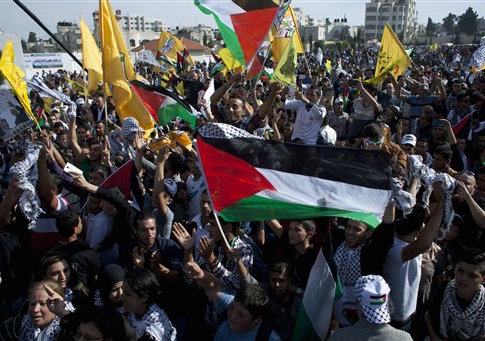
Mideast Israel PalestiniansPalestinian supporters fly Palestinian and Fatah party flags, chant slogans and dance during a ceremony marking the 10th anniversary of the late Palestinian leader Yasser Arafat’s death, at the Palestinian Authority headquarters, in the West Bank city of Ramallah / AP

Fatah claims otherwise.

***************

Leaders of the Palestinian terror group Hamas announced on Sunday that a national unity government formed earlier this year with the Fatah party had officially expired, leaving the status of the fragile political framework up in the air, according to regional reports.

The end of a tenuous six-month unity deal reached between Hamas and Fatah means that leaders from both Palestinian factions will have to meet in the coming weeks to decide whether or not to renew the governing coalition, which had united the ruling parties in the Gaza Strip and West Bank.

The expiration of the deal was announced on Sunday by Hamas Spokesman Sami Abu Zuhri during a news conference in Gaza, according to the Palestinian Ma’an News Agency. Conflicting reports about the status of the unity government emerged just hours later when a Fatah official claimed that an expiration date had never been set on the deal.

The uncertainty surrounding the unity government comes as tension in Jerusalem remains high amid a spate of violent protests by the Palestinians that have been endorsed by Fatah leaders in several cases.

Hamas Spokesman Zuhri said that the group “isn’t interested in incitement, but rather seeks to maintain national unity,” according to Ma’an.

Hamas “does not control the Gaza Strip at all,” according to Zuhri, who added, “If the national consensus government doesn’t want to take responsibility for Gaza, this doesn’t mean the government is exempted from this responsibility.”

Hamas also expressed anger at a recent crackdown on its supporters undertaken by Palestinian Authority security forces.

At least 80 Hamas-backers have been arrested in the West Bank, according to Ma’an.

“Hamas denounces the escalating violations and criminal acts by the PA security services against supporters of Hamas and the Palestinian resistance,” Zuhri was quoted as saying.

Meanwhile, Fatah leaders are claiming that the unity government was not supposed to expire.

The unity government was tasked with holding elections within a six-month time frame, but was not supposed to be dissolved if this was not completed.

“If the Hamas movement has retracted the reconciliation agreement and the termination of rivalry, that is a different case,” Fatah official Faisal Abu Shahla was quoted as telling Ma’an after Hamas’s announcement.

Shahla further stated that “reconciliation discussions were pending a response from Hamas regarding the attacks with explosives against Fatah leaders’ property in Gaza and the cancellation of a ceremony commemorating the late Palestinian leader Yasser Arafat in Gaza City in early November,” according to Ma’an.