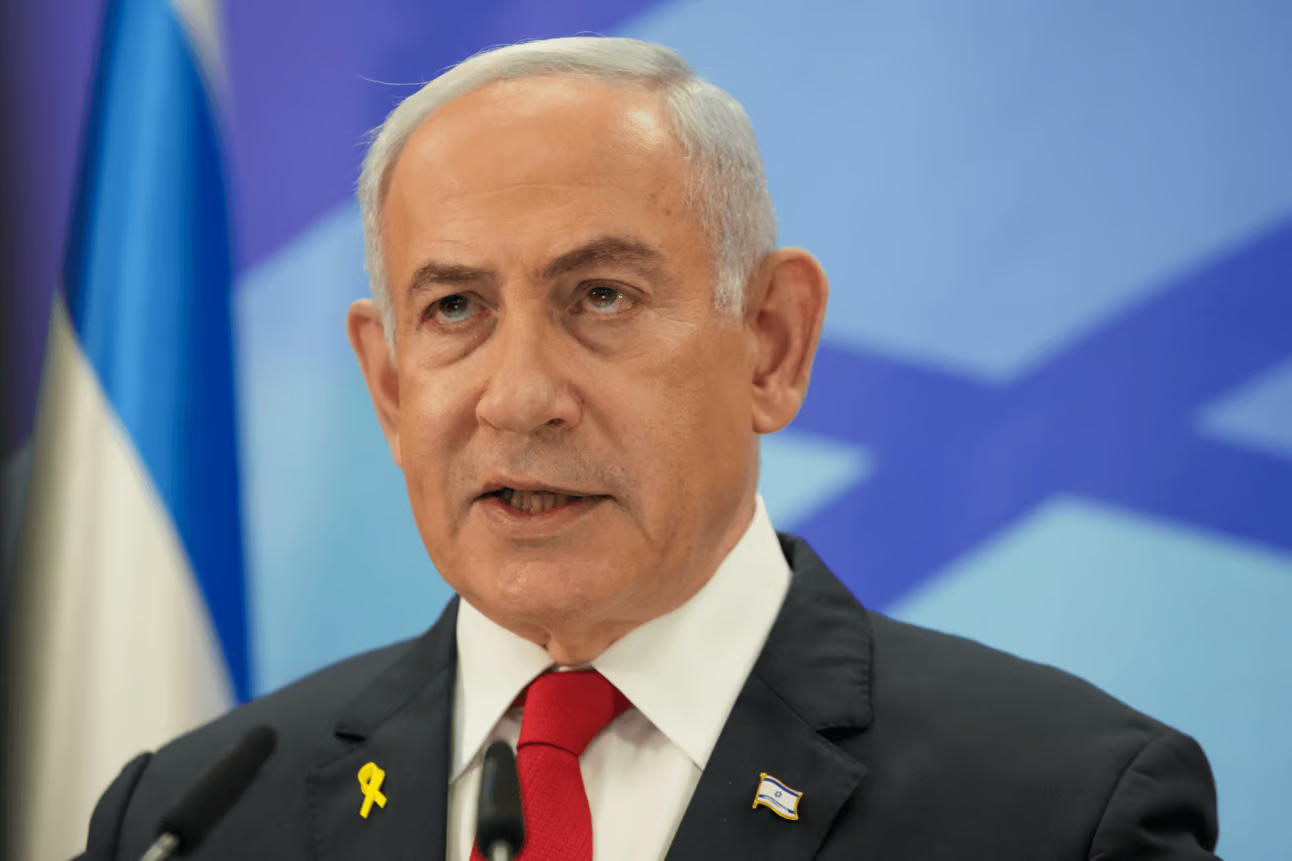
Israeli Prime Minister Benjamin Netanyahu has issued a firm warning regarding any future nuclear agreement with Iran, stating that only a Libya-style disarmament approach would be acceptable. Speaking Tuesday just before departing Washington, Netanyahu emphasized that Iran’s nuclear program must be physically dismantled and destroyed under direct American supervision.
“We agree that Iran will not have nuclear weapons,” Netanyahu declared. “This can be done by agreement, but only if this agreement is Libyan-style: They go in, blow up the installations, dismantle all of the equipment under American supervision and carried out by America this would be good.”
The remarks come ahead of renewed nuclear talks between Iran and the United States, set to begin Saturday in Muscat, Oman. While President Trump described the negotiations as “direct,” Iran insists they will be indirect, facilitated through mediators.
Trump, speaking alongside Netanyahu in the Oval Office on Monday, underscored his administration’s uncompromising stance: “Iran cannot have a nuclear weapon. If it can be done diplomatically in a full way, the way it was done in Libya, I think that would be a good thing.”
Netanyahu also highlighted several other strategic discussions held with Trump, including the ongoing war against Hamas in Gaza. He reiterated Israel’s dual objectives: “We are determined to eliminate Hamas, and at the same time, we are determined to return all of our hostages.”
Addressing critics, Netanyahu said: “The president looked at me and told the journalists who were present ‘This man is working constantly to free the hostages.’ I hope that this shatters the lie… that I don’t care. I do care, and we will be successful.”
Netanyahu also disclosed discussions on the future of the Gaza Strip, revealing that Israel is in dialogue with several countries about accepting Palestinian civilians. “In the end, this is what needs to happen,” he said.
The prime minister voiced concern about Turkey’s intentions to establish military bases in Syria, which he warned would threaten Israel. “We oppose this and are working against it,” he told Trump.
Finally, Netanyahu praised Trump’s economic diplomacy, stating that Israel would work to eliminate its trade deficit with the United States. “This is the little that we can do for the U.S. and its president, who does so much for us.”
Describing the visit as “very warm,” Netanyahu hinted that more developments are forthcoming: “There were additional things that you will hear about later.”
Yahya Sinwar spent two decades in Israeli prisons studying the country and trying to identify its weaknesses before emerging to assemble a powerful militia dedicated to toppling it.
Yahya Sinwar, the Hamas leader who was killed by Israeli forces, spent two decades in Israeli prisons studying the country and trying to identify its weaknesses before emerging to assemble a powerful militia dedicated to toppling it.
That mission culminated on Oct. 7 last year, when at his command Hamas led the deadliest attack in Israel’s more than 75-year history. It triggered a war with Israel in Gaza, and now Lebanon, that has upended the Middle East, reignited the Palestinian cause and left more than 40,000 people dead.
Israel vowed to hunt down the wiry and silver-haired Sinwar after the Oct. 7 attacks that killed 1,200 people and left 250 people held hostage, and his death fulfills one of Israel’s main goals of the Gaza war. For more than a year, he evaded the Israeli military, hiding in underground tunnels from where he directed Hamas’s war effort. On Thursday, Israeli officials announced his Wednesday death.
“I prefer to be a fighter among the army and soldiers, and I will die as a fighter,” Sinwar told a Palestinian news website in 2011.
Sinwar’s ascension, which took the group in an even more violent direction, followed a years-long internal struggle over how Hamas should achieve its political and military ambitions. A hardliner, Sinwar believed Israeli and Palestinian civilian deaths were necessary to destabilise Israel.
He launched the attacks last year in the hope that Iran and Hezbollah militants in Lebanon would join the fighting. But those allies initially offered only limited help, with Iran-backed Hezbollah firing rockets at Israel in tit-for-tat exchanges that began the day after the Hamas attacks from Gaza. In April, after the death of an Iranian general in Damascus, Iran launched around 300 missiles and drones at Israel in retaliation for the killing.
Israel this fall launched an air-and-ground campaign against U.S.-designated terrorist group Hezbollah, killing its leader Hassan Nasrallah in Lebanon as it sought to deter attacks into its north. Iran, in response, fired some 200 missiles at Israel, an assault to which Israel has promised to respond. The escalating conflict has left the region on the brink of all-out war.
Sinwar was detained by Israel in 1988, and later told Israeli interrogators that he strangled a suspected Palestinian collaborator, according to a transcript of his confession.
Later convicted, he devoted his time in prison to getting to know Israeli society. He learned Hebrew, watched Israeli news and read books on Jewish history. He was released in 2011 in a prisoner exchange in which Israel gave up more than 1,000 Palestinian prisoners for one Israeli soldier.
Sinwar once said that what Israel considers its strength – that most Israelis serve in the army and soldiers hold a special status in society – was a weakness that could be exploited. One of the goals of the Oct. 7, 2023, attacks was to capture Israeli soldiers who could be traded for Palestinian prisoners. What became clear later was that Sinwar could also use them as insurance to keep himself alive.
But he ultimately miscalculated how Israel would respond to the unprecedented attacks, as Israeli Prime Minister Benjamin Netanyahu vowed to destroy Hamas and dismantle its military. While Israel engaged in talks to free hostages, Netanyahu gave priority to a military campaign against Hamas that eventually led to Sinwar’s killing.
The war has wiped out much of Hamas’s top leadership, including Sinwar, Haniyeh and military commander Mohammed Deif in July.
Netanyahu hasn’t presented a plan for who should govern Gaza after the war. He has ruled out Washington’s proposal that the Palestinian Authority, which runs parts of the West Bank, be put in charge of the enclave.
Some Arab states have pushed for Hamas to retain a role in governing the strip to avert an insurgency by the group’s remaining fighters. Sinwar could be succeeded by his deputy in Gaza, Khalil al-Hayya, who has represented Hamas in ceasefire negotiations with Israel, or by former Hamas leader, Khaled Meshaal.
Sinwar launched the Oct. 7 attacks in part over frustration with the paralysis in the long-running Israeli-Palestinian conflict and the fading global diplomatic importance of the Palestinian cause. The atrocities in southern Israel and subsequent destruction wrought in Gaza have undoubtedly refocused attention back on the issue.
Sinwar grew up in a refugee camp in Khan Younis in Gaza, the son of refugees who fled what is now Israel during the 1948 war with Arab states. In the 1980s, Sinwar became close to the founder of Hamas, Sheikh Ahmed Yassin, and worked with his mentor to hunt Palestinian informants suspected of collaborating with Israel. The internal police force was a forerunner to Hamas’s military wing, the Izz ad-Din al-Qassam Brigades.
During a series of interrogations after his 1988 detention and charge, Sinwar explained how he rounded up a suspected Palestinian collaborator with Israel while the man was in bed with his wife, according to a transcript of his confession.
He blindfolded the Palestinian, called Ramsi, and drove him to an area with a freshly dug grave before strangling him with a scarf known as a kaffiyeh, a symbol of the Palestinian cause.
“I was sure that Ramsi knew he deserved to die for what he did,” Sinwar said in his confession.
Sinwar’s reputation as one of the founders of Hamas and as its chief enforcer immediately propelled him through the hierarchy of Hamas prison inmates.
By the mid-1990s, Sinwar was already the most important Hamas prisoner held by Israel, according to Ehud Ya’ari, an Israeli broadcast journalist who interviewed him in prison. “It was not in question at all that he was the guy in charge,” said Ya’ari.
While Sinwar had a reputation as a violent enforcer, he also had a more cerebral, academic side. He hand wrote hundreds of pages of his thoughts and conclusions upon reading Jewish and Zionist history, demonstrating a curiosity about his enemy that stunned Israelis who met him at the time, Ya’ari added.
He also penned a coming-of-age novel about life in Gaza and a nonfiction book about his experience setting up Hamas’s internal police force.
In 2004, he appeared to develop neurological problems, speaking unclearly and struggling with walking. Doctors examined him, finding an abscess in the brain, and rushed him to hospital for surgery. After a successful operation, Sinwar returned to prison and thanked the doctors for saving his life. He also spent hours in conversation with one of his jailers.
Following his exchange in 2011, Sinwar quickly rose through Hamas’s political leadership. He became Hamas’s leader in Gaza in 2017 and for a time signalled to Israel that he was seeking a long-term quiet in the conflict between the militants and the Israeli military.
“The truth is that a new war is in no one’s interest,” Sinwar told an Italian journalist writing in 2018 in an Israeli daily.
But he became increasingly frustrated with Hamas’s diplomatic isolation, and began to deepen relations with Israel’s arch-enemy Iran and its proxy Hezbollah.
In the months leading up to Oct. 7, the anti-Israel allies discussed ways that they could attack their joint enemy. But while Iran’s proxies have attacked Israel and U.S. forces in the Middle East since the start of the war in Gaza, Tehran and its allies have for the most part avoided an all-out escalation, a decision that frustrated Sinwar.
Once the war began, Sinwar knew that success for Hamas would depend on him surviving and outlasting Israel, forcing a permanent ceasefire that would leave Hamas intact.
For a time, Sinwar believed that he might emerge victorious. His messages to his Hamas colleagues and ceasefire mediators became increasingly confident, even grandiose, according to Arab ceasefire mediators. During negotiations for a temporary pause in fighting earlier in the war, he urged Hamas’s political leadership outside Gaza not to make concessions and to push for a permanent end to the war.
Sinwar believed high civilian casualties in Gaza would create worldwide pressure on Israel to stop the war, according to messages he sent to mediators. But even as the U.S. repeatedly pushed the two sides to agree to a ceasefire, Israel proposed conditions that would likely have led to Hamas’s demise, and Sinwar dug in.
At the end of July, Israel assassinated Haniyeh in Tehran, and Sinwar was officially elevated to run the broader group, his de facto role since the war began.
In September, Hamas raised the stakes, suggesting it had killed six high-profile hostages, including an Israeli-American, amid Israeli military pressure in Gaza. The group threatened to kill more hostages if Israel tried to rescue others, illustrating how much pressure Sinwar was under. The hostages were a valuable bargaining chip to force a ceasefire, but he was also willing to kill some of them as leverage over Israel’s government to force a deal.
Ultimately, Israel’s intelligence and military capabilities proved too much for Sinwar.
In a message to Hezbollah before he was killed, the Hamas leader thanked the Shia militant group for its support and invoked a 7th-century battle in Karbala, Iraq, where the grandson of the Prophet Muhammad was slain, causing a schism in Islam.
“We have to move forward on the same path we started,” Sinwar wrote to Hezbollah. “Or let it be a new Karbala.”
For more than a year, Israeli soldiers scoured the scorched earth of Gaza in search of Yahya Sinwar, who was thought to be hiding in a vast tunnel network. Then, by pure chance, they found him.
For more than a year, Israeli soldiers scoured the scorched earth of Gaza in search of the leader of Hamas, Yahya Sinwar, who was thought to be hiding in a vast tunnel network. Then, by chance, they found him.
Late on Wednesday in the southern city of Rafah, trainee Israeli troops from the 828th Battalion, a mixture of novice soldiers and reservists, spotted three suspicious figures moving “home to home on the run”, the military said.
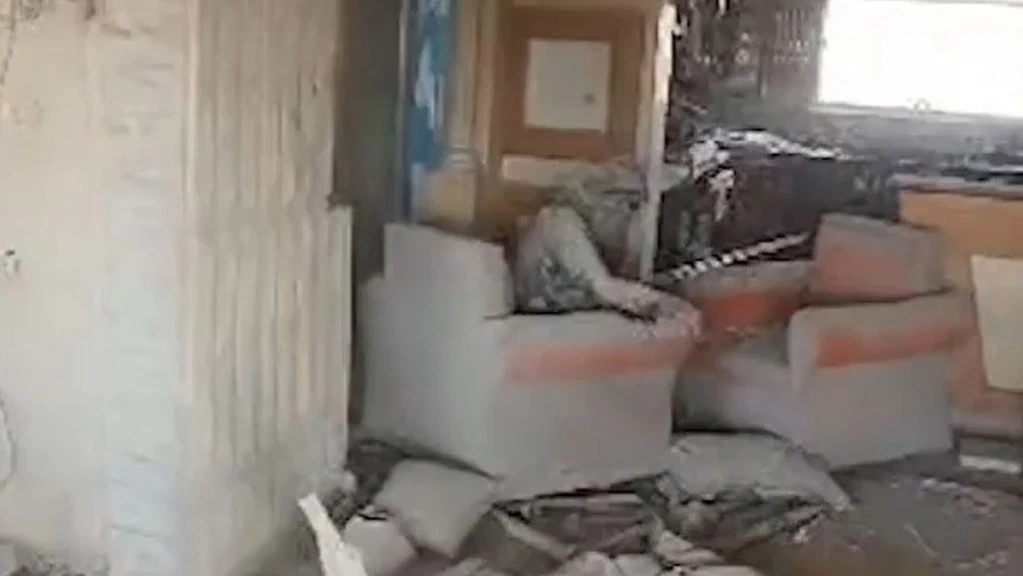
The soldiers fired on the group, apparently wounding one of them, who fled alone into a building. They sent in a small drone in pursuit, and through its camera saw a figure sitting among debris, his face covered by a scarf, who hurled a stick at it in defiance.
Deciding it was too dangerous to enter, they called in tank fire instead. The building was hit by two 120mm shells, with shrapnel scything across the upper floors.
When the trainee soldiers piloted a drone back into the wreckage, they discovered something remarkable.
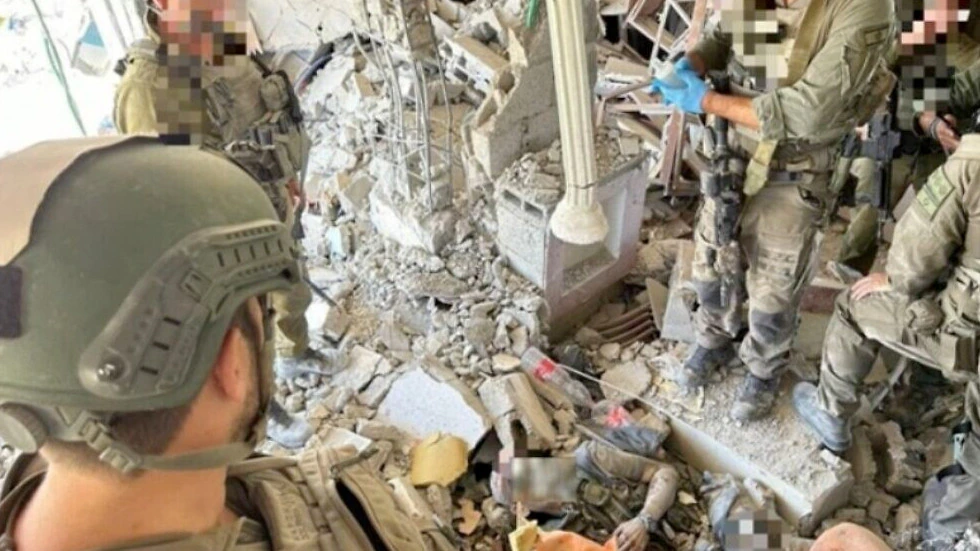
Entombed in the rubble was a body. The head was partially shattered, the face covered in ash, but the corpse was instantly recognisable: it was Israel’s No 1 enemy. His lips slightly parted in death, Sinwar, 61, was given away by his distinctive ears.
Even though it looked exactly like him, it seemed scarcely believable that the troops would stumble across the leader of Hamas in the middle of a city repeatedly cleared by the Israel Defence Forces over months of heavy fighting. Soldiers from the 450th infantry battalion were ordered to storm the building for a closer look.
Wearing gloves to protect the forensic evidence, they took pictures of the corpse, wearing combat fatigues, and sent them to the Israeli police. Specifically, they needed to get images of his yellowing teeth.
Using a wooden stick, they pushed back the man’s upper lip to reveal an identifiable gap between his front incisors. Investigators had the Hamas leader’s DNA from the 22 years he spent in Israeli jails. “We had Sinwar’s dental data on file, and the match was clear,” Aliza Raziel, head of the police’s Forensic Identification Division, said, describing it as “one of the most significant moments this year”.
The seismic discovery was quickly communicated up the chain of command until, in the skies above Israel, two of its most senior security officials held an impromptu meeting in a military helicopter to assess the information. Examining classified documents spread out on a makeshift table, Herzi Halevi, Israel’s top general, and Ronen Bar, head of Shin Bet, the domestic intelligence agency, pored over the details of Sinwar’s apparent assassination.
At the same time, grisly photos of Sinwar’s corpse were leaked online, forcing the IDF to issue a statement. By this stage they were confident enough to assert with a “high” degree of confidence that Sinwar was dead. Four hours later, the military issued a simple message on social media: “Eliminated: Yahya Sinwar.”
Unlike the planned assassination of Hassan Nasrallah, the leader of Hezbollah, in Beirut last month, it appears that Sinwar’s demise owed much more to luck than design. Releasing drone footage of Sinwar’s last moments, Rear Admiral Daniel Hagari, the IDF spokesman, confirmed the soldiers “identified him as a terrorist in a building” but did not know who it was.
“We fired on the building and went in to search. We found him with a flak jacket and a gun and 40,000 shekels [pounds 8,200],” he added.
Sinwar began terrorising the people of Gaza in the 1980s, when as head of the al-Majd, the morality police of Hamas, he was responsible for murdering suspected Palestinian collaborators and torturing those accused of supposed sins such as homosexuality or indulging in vices such as alcohol, drugs and fornication.
As rumours spread in Gaza of his demise, Palestinians expressed tentative hope that his death would mark the beginning of the end of the war, after another bloody day in which 28 people were killed in an Israeli airstrike on a school in Jabalia in the north.
Displaced from his home, Osama al-Kafarna, 43, now living in Khan Yunis, blamed both Sinwar for starting the war and Israel for its retributive, year-long campaign that has left more than 42,000 dead, according to the Hamas-run health ministry.
“Israel has always accused Sinwar of being the one who obstructs the deal, but now after his death we hope that we will not hear more lies from Israel and the war will end as soon as possible,” he said.
For Israelis and Palestinians alike, Sinwar’s death is a decisive moment. At least 97 hostages remain unaccounted for, 33 of whom are believed to be dead. And it remains unclear how Israel intends to quash the radical Sunni ideology that fuels Hamas.
“We’ve closed the account with the arch murderer Sinwar,” said Einav Zangauker, the mother of the hostage Matan Zangauker and one of the most vocal campaigners for a ceasefire, in a video statement. “But now, more than ever, the lives of my son Matan and the other hostages are in tangible danger.”
Israel had claimed that Sinwar had been hiding in tunnels under Gaza, using hostages as human shields. Hagari said he had been “running away” before he died but Hamas will try to paint him as a martyr, defiant to the last.
Binyamin Netanyahu, the Israeli prime minister, addressed the nation in a speech intended to capture the history of the moment. “Evil has been delivered a blow,” he said, before adding: “But our task is not yet complete.”
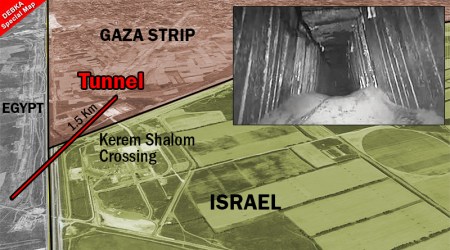
The Israel air strike Saturday night, Jan. 13, in the southern Gaza Strip was aimed at a terror tunnel running 180m into Israel that Hamas was building under the Kerem Shalom crossing through which convoys of goods pass from Israel to the Gaza Strip. It also ran into Egyptian territory under the Rafah border between Gaza and Sinai. This was disclosed early Sunday by the IDF spokesman. He noted that Israeli fighters hit the tunnel at the Gaza end. Work to finish its demolition continued Sunday. The new tunnel ran under the gas and heavy oil pipelines through which Israel supplies the Gaza Strip population with fuel.
This was the third Palestinian terror tunnel Israel had discovered and destroyed in the Gaza Strip in recent months. Hamas and the Iranian-backed Islamic Jihad were responsible for the first two.
DEBKAfile adds: Clearly the IDF has been able to develop the technology for detecting and destroying the terror tunnels, so robbing Palestinians of one of their prime weapons of terror against Israel. Hamas will also have understood that Israel gave Egypt prior warning of its air strike Saturday night. This prompted the night curfew Cairo imposed on northern Sinai including the Rafah region an hour earlier. The tunnel network is also Hamas’ main conduit for smuggling arms and combatants into and out of the Gaza Strip through Sinai. Now that the Gaza Strip is under total land blockade, the Palestinian terrorist group faces hard options: Accept Egyptian and Fatah terms for reconciliation, launch a massive rocket attack on Israel, or call on the help of its allies Iran and Hizballah for action to break the blockade and deliver funds and weapons that can overwhelm the IDF and its new anti-tunnel technology.
At a conference last week hosted by the Muslim American Society (MAS) and the Islamic Circle of North America (ICNA), Abuirshaid tried to erase Jews’ historical claim to Israel. He claimed the “Zionist Project” is a “form of apartheid” that seeks to “Judaize” Palestine. “In creating false Zionist historical and religious narratives, it’s a deliberate attempt to deny the indigenous people of Palestine, us, from their rights and their own land. And Jerusalem is the bedrock to forge and falsify the history of Palestine and Judaizing it,” he said.
That’s the kind of message that would have fit right in with any of the Palestine Committee groups. When the suit was originally filed last May, the Boims’ attorneys issued a statement explaining that Abuirshaid and the other defendants “directed and controlled the organizations in 1996 … that are legally obliged to pay the judgment won by the Boims.
“These defendants cannot escape their legal liability and accountability for murder by merely changing the names of their organization.
*****************************************
A Chicago federal judge on Thursday reinstated a lawsuit alleging that a virulently anti-Israel group and several of its activists are “alter egos and/or successors” of a defunct U.S. based Hamas-support network previously found liable for the murder of an American teen in a 1996 terror attack.
U.S. District Court Judge Sharon Johnson Coleman not only vacated her earlier dismissal of the case, she also authorized limited discovery in the case. “[T]his Court placed too much weight to defendants’ declarations without providing plaintiffs with the opportunity to conduct limited jurisdictional discovery on the existence of an alter ego relationship. Accordingly, this Court will vacate its previous order dismissing the case … and permit plaintiffs to conduct discovery solely to address jurisdiction.”
This is a major victory for the family of 17-year-old David Boim. He was shot dead in Israel in May 1996 by Hamas terrorists. In a historic judgment, Boim’s parents Stanley and Joyce Boim won $156 million in damages against the Islamic Association for Palestine (IAP) and other members of the U.S. Hamas support network called the “Palestine Committee.” The Committee was created by the Muslim Brotherhood to advance Hamas’ agenda politically and financially in the United States.
The IAP was the first to publish the genocidal, anti-Semitic Hamas charter in English. Its fundraisers benefited the Holy Land Foundation for Relief and Development (HLF), which – along with five former officials – was convicted in 2008 of illegally routing millions of dollars to Hamas. IAP fundraisers featured overt praise for Hamas, and skits in which Palestinians murdered Israelis.
Inside a Kansas City auditorium in 1989, a masked man stepped to a lectern and described in Arabic the “oceans of blood” spilled in Hamas’ armed attacks on Israeli soldiers and civilians.
He thanked two nonprofit organizations for being early allies: the Islamic Association for Palestine, sponsor of the conference, and the Occupied Land Fund [an early name for HLF].
An internal 1992 IAP document, “Islamic Action Plan for Palestine,” makes at least four specific references to Hamas, including its leadership role in the Palestinian intifada through “a lot of sacrifices from martyrs, detainees, wounded, injured, fugitives and deportees…”
IAP was among the first organizations the Muslim Brotherhood created in North America to specifically focus on the Palestinian cause, even preceding the Palestine Committee, the document said. Among the Palestine Committee’s tasks, “Asking the countries to increase the financial and the moral support for Hamas.”
At the time of the Boim judgment in 2004, IAP and other defendants claimed they were no longer in business and had no money to pay the damages. But that was a ruse, the Boims’ attorneys say, alleging that the defendants formed new organizations like the American Muslims for Palestine to escape their legal responsibility to pay damages. Successor groups, or alter egos, of organizations previously found liable for providing material support to Hamas need to pay the remaining judgment, the new litigation argues.
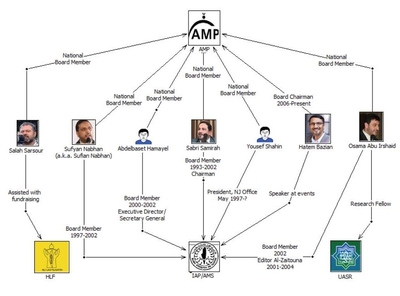
In 2015, the Investigative Project on Terrorism (IPT) first identified at least five AMP officials and speakers who worked in the Hamas-supporting “Palestine Committee.”
An April 2014 AMP-sponsored conference in Chicago, for example, featured former IAP Chairman Sabri Samirah.
“We are ready to sacrifice all we have for Palestine. Long Live Palestine,” Samirah said. “We have a mission here [in the U.S.] also to support the struggle of our people back there in order to achieve a free land in the Muslim world, without dictators and without corruption.”
The Boims’ attorneys say that AMP’s current leadership and donors are “significantly identical” to their Palestine Committee branches, including the Holy Land Foundation for Relief and Development (HLF), Islamic Association for Palestine (IAP), and the American Muslim Society (AMS) which served as another name for the IAP.
Rafeeq Jaber, a defendant in the new lawsuit, is a former IAP president and is now AMP’s registered agent in Chicago. AMP President Abdelbasset Hamayel was IAP’s secretary general. AMP’s conferences and other events are identical in their pro-Hamas message to conferences held earlier by IAP, including overlapping speakers’ lists.
AMP board member Osama Abuirshaid, a target of the current lawsuit, has close affiliations to both the IAP and the Northern Virginia think tank called the United Association for Studies and Research (UASR), a Palestine Committee branch that was headed by senior Hamas member Mousa Abu Marzook.
UASR published an academic journal that prosecutors in the HLF case say was “involved in passing Hamas communiques to the United States-based Muslim Brotherhood community and relaying messages from that community back to Hamas.”
Abuirshaid has openly expressed support for Hamas. He criticized Egyptian leader Abdel Fattah el-Sisi in a 2015 tweet for designating Hamas as a terrorist organization. Calling Egypt’s capital “Cairo Aviv,” Abuirshaid dismissed the move: “Look who’s talking!? A terrorist murder regime.”
In a 2014 article written in Arabic, he praised the “Palestinian resistance” against the “Zionist aggression” in Hamas-controlled Gaza: “The facts of the current Zionist aggression have clearly shown that the Palestinian resistance is no longer in the position of receiving slaps without the response of some of them, and even many of them responding. It also showed the creativity of the resisting Palestinian mind, consistent with the severity of its being unyielding with long-range rockets, high-explosive missiles and bombs, and unmanned aerial vehicles, most of which are domestically manufactured, being designed to attack the enemy at the doorstep of its military bases by sea, landing behind its lines through tunnels, etc. It is a slap that Israel receives from the Resistance every day, and it finds no response except through the cowardly weapon of targeting civilians with artillery, air and sea missiles to raise the human and economic costs of the Palestinians.”
Abuirshaid has also praised Hamas war tactics: “There is a difference between Hamas, whose youth renewed their adherence to their starting point determined on liberalization, and Fatah, which has grown old after deviating from the creed of liberation and resistance upon which it was established.”
“There is a difference between those who resist and those who compromise; between those who constitute an army for liberation, and those who ready battalions of lackeys; a difference between those who rise up for the blood of martyrs, and those who spill it in the wine glasses of Israel,” he added.
At a conference last week hosted by the Muslim American Society (MAS) and theIslamic Circle of North America (ICNA), Abuirshaid tried to erase Jews’ historical claim to Israel. He claimed the “Zionist Project” is a “form of apartheid” that seeks to “Judaize” Palestine. “In creating false Zionist historical and religious narratives, it’s a deliberate attempt to deny the indigenous people of Palestine, us, from their rights and their own land. And Jerusalem is the bedrock to forge and falsify the history of Palestine and Judaizing it,” he said.
That’s the kind of message that would have fit right in with any of the Palestine Committee groups. When the suit was originally filed last May, the Boims’ attorneys issued a statement explaining that Abuirshaid and the other defendants “directed and controlled the organizations in 1996 … that are legally obliged to pay the judgment won by the Boims.
“These defendants cannot escape their legal liability and accountability for murder by merely changing the names of their organizations,” they said.
American funding for UNRWA is problematic itself because the organization is inextricably intertwined with Hamas in Gaza and Hezbollah in Lebanon. This may be the right time to review the number of Palestinian “refugees” in the world and the world’s obligation to them.
Ten years ago, in a forum on Capitol Hill, then-Rep. Mark Kirk called for an international audit of UNRWA. Kirk admitted he was unsuccessful, despite such accounting anomalies as a $13 million entry for “un-earmarked expenses” in an audit conducted by UNRWA’s own board.
Palestinians are the only “refugee” group that hands the status down through generations, which is why they are governed by UNRWA; all other refugees are under the care of the UN High Commissioner for Refugees, which has a mandate to settle refugees so they can become citizens of new countries.
Palestinian refugees are a slippery population — but when 285,535 of them go missing from a small country such as Lebanon, it should raise eyebrows.
UNRWA in Lebanon reports on its website that 449,957 refugees live under its protection in 12 camps, but a survey by Lebanon’s Central Administration of Statistics, together with the Palestinian Central Bureau of Statistics, could only find 174,535. The Lebanese government said the others “left.” Okay, maybe they did — Lebanon constrained them viciously, so it would make some sense. What does NOT make sense, then, is the UN giving UNRWA a budget based on nearly half a million people when, in fact, there are far fewer than a quarter of a million. Who is paying and who is getting the money?
We are and they are.
The UNRWA website shows a budget of $2.41 billion combined for FY 2016 and 2017. The U.S. provides more than $300 million to UNRWA annually, about one-quarter of the total. In August 2017, UNRWA claimed a deficit of $126 million. A former State Department official said the budget shortfalls are chronic but that “the funds seemed eventually arrive” after pressing others for more money — some of that additional money is from the U.S.
American funding for UNRWA is problematic itself because the organization is inextricably intertwined with Hamas in Gaza and Hezbollah in Lebanon; see here, here and here. And specifically for Lebanon, the connection goes as far back as 2007. But stay with the “floating” population problem for a moment.
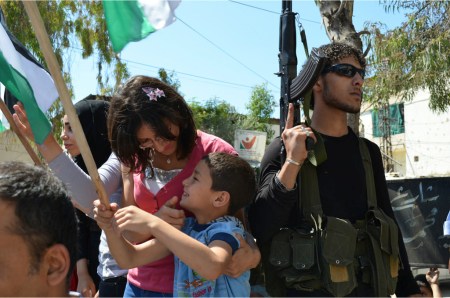
A July 2015 street celebration in Lebanon’s Ain al-Hilweh camp, which is administered by UNRWA. (Image source: Geneva Call/Flickr)
The huge discrepancy in Lebanon suggests that UNRWA may have trouble counting refugees in the West Bank, Jordan, Gaza, and Syria as well. (We’ll give them a pass on Syria for now.) The problem is not new, but that Palestinian agencies were running the census may help the United States overcome its own long-term obstinacy when it comes to counting and paying.
Ten years ago, a forum on Capitol Hill, then-Rep. Mark Kirk called for an international audit of UNRWA. Kirk admitted he was unsuccessful in generating demand among his colleagues despite such accounting anomalies as a $13 million entry for “un-earmarked expenses” in an audit conducted by UNRWA’s own board. An amendment to the 2006 Foreign Assistance Act had called for $2 million in additional funds for UNRWA, specifically for an investigation of finances, but the amendment was withdrawn at the request of the State Department.
As a Senator, Kirk offered an amendment calling for the State Department to provide two numbers to Congress: the number of Palestinians physically displaced from their homes in what became Israel in 1948, and the number of their descendants administered by the UNRWA. The State Department denounced the amendment, saying:
“This proposed amendment would be viewed around the world as the United States acting to prejudge and determine the outcome of this sensitive issue.”
Far from prejudging the outcome, a review of the number of Palestinian “refugees” in the world and the world’s obligation to them would provide an honest basis from which to make policy.
In 1950, the UN defined Palestinian “refugees” as people displaced from territory that had become Israel after having lived there for two years or more — this is distinct from every other population of refugees that must be displaced from their long-term homes. Furthermore, Palestinians are the only “refugee” group that hands the status down through generations, until there is a resolution of the status of the original group — which is why they are governed by UNRWA; all other refugees are under the care of the UN High Commissioner for Refugees (UNHCR), which has a mandate to settle refugees so they can become citizens of new countries. UNRWA, naturally, produces the only population of refugees that grows geometrically over time rather than declining as the original refugees die and their children are no longer stateless. (See Vietnamese refugee resettlement for an example of how this works for others.)
The original population of refugees was estimated at 711,000 in 1950. Today, there appear to be 30-50,000 original refugees remaining, and UNRWA claims to care for 4,950,000 of their descendants. But 285,000 of them appear to have disappeared from Lebanon.
It has long been understood that there is an undercount of deaths in UNRWA refugee camps — to admit a death means UNRWA loses that member in the accounting for the international community. It also wreaks havoc with Palestinian insistence that there are 6 million refugees (not UNRWA’s 5 million) and that a million people are not registered, but should still have a “right of return” to homes their parents, grandparents or great-grandparents claim to have had inside the borders of Israel.
The numbers game also exists with people who do not live in refugee camps. The Palestinian Authority counts as residents 400,000 Palestinians who have lived abroad for over a year, and according to Deputy Palestinian Interior Minister Hassan Illwi, more than 100,000 babies born abroad are registered as West Bank residents — both in contravention of population-counting norms. Jerusalem Palestinians are double-counted – once as Palestinian Authority residents and once as Israeli Palestinians. The PA, furthermore, claims zero net out-migration; Israeli government statistics differ.
How many Palestinians would there be in these territories if a proper census was taken? How many “refugees” would disappear from UNRWA rolls as they did in Lebanon? How might that affect the budget?
Can we please find out?
Shoshana Bryen is Senior Director of the Jewish Policy Center.
Hamas has repeatedly made use of his prayer by calling for the extermination of the Jews and Christians. Hamas’ Acting Speaker of the Palestinian Legislative Council had prayed, “Oh Allah, vanquish the Jews and their supporters. Oh Allah, vanquish the Americans and their supporters. Oh Allah, count their numbers, and kill them all, down to the very last one.”
There was no misunderstanding. No one misspoke.
Hamas and the two Islamic centers issued the same genocidal threats because they were referencing the same Islamic teachings. The Islamic Center of Jersey City and the Islamic Center of Davis were all echoing Hamas. And Hamas was echoing the classic Islamic teachings of Sahih Bukhari.
Meanwhile terror mosques continue to enjoy influence and access in America. But then there are the awkward moments when in between the interfaith sessions, the mosques get caught preaching the extermination of the Jews. The mosque leaders mumble something about a misunderstanding. There’s another interfaith session in which leftist Jewish and Christian clergy overlook the calls to genocide and commit to a common struggle against President Trump while chanting, “No Muslim Ban!”
And then on another Friday in Jersey City, Davis or somewhere else, it happens again. “Count them one by one, and kill them down to the very last one.”
**********************************
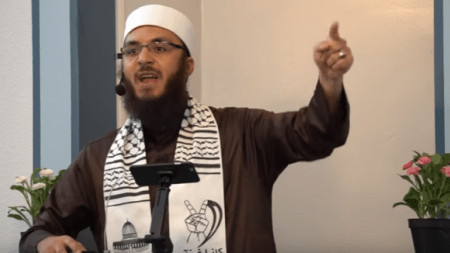
It was another Friday night in the Islamic Center of Jersey City. And its imam, Sheikh Aymen Elkasaby, had some thoughts about the Jews.
“Count them one by one, and kill them down to the very last one. Do not leave a single one on the face of the Earth.”
“Kill the Jews” is as much a standard at Friday night mosque services as Springsteen’s Born to Run is on Friday night in bars well downwind of the Islamic Center of Jersey City. But the politicians who stop by the mosques before elections have to pretend that they’re shocked at all the gambling going on.
The Islamic Center of Jersey City’s president had been a member of the New Jersey Homeland Security Interfaith Advisory Council. Senator Cory Booker had invited him as a guest to the State of the Union and praised him as an example “of how the diversity of America makes us all better.”
Was his imam calling the Jews “apes and pigs” really making us all better? And if the Islamic Center of Jersey City wasn’t making America better with its diversity, then just maybe neither was Senator Cory Booker, the Democrats and their entire Islamic immigration program.
The diversity bus had taken a wrong turn on the road to Utopia and ended up in Nazi Germany
Senator Booker demanded that the mosque disavow its imam and the mosque’s president gaslit the media by claiming that his imam had the wrong idea about Islam and had been misunderstood.
It’s a commonplace misunderstanding.
On another Friday this year, in the Islamic Center of Davis, Imam Ammar Shahin implored, “Oh Allah, liberate the Al-Aqsa Mosque from the filth of the Jews.”
“Oh Allah, count them one by one and annihilate them down to the very last one.”
The Islamic Center of Davis’s initial response was, “If the sermon was misconstrued, we sincerely apologize to anyone offended. “ Then, like the Islamic Center of Jersey City, it touted its interfaith work.
The Islamic Center of Jersey City’s boss whined that its genocidal anti-Semitic clergyman had spoken “in the heat of the moment”. The Islamic Center of Davis’s genocidal imam claimed that, “When we speak with emotion, words might not be put in the right places or understood correctly.”
Both Islamic Centers were preparing their defenses from the same script. They blamed the emotions of their murderous clerics. The actual apologies amounted to, “We’re sorry you misunderstood our death threats.” But both imams were also offering the same genocidal prayer. And that’s because they were both quoting the same Islamic hadith involving a ‘martyred’ Islamic Jihadist cursing his non-Muslim foes.
Hamas has repeatedly made use of his prayer by calling for the extermination of the Jews and Christians. Hamas’ Acting Speaker of the Palestinian Legislative Council had prayed, “Oh Allah, vanquish the Jews and their supporters. Oh Allah, vanquish the Americans and their supporters. Oh Allah, count their numbers, and kill them all, down to the very last one.”
There was no misunderstanding. No one misspoke.
Hamas and the two Islamic centers issued the same genocidal threats because they were referencing the same Islamic teachings. The Islamic Center of Jersey City and the Islamic Center of Davis were all echoing Hamas. And Hamas was echoing the classic Islamic teachings of Sahih Bukhari.
Why would an imam at the Islamic Center of Jersey City echo Hamas? For over a decade, the director of the Islamic Center had been Mohammad Al-Hanooti. Al-Hanooti was an unindicted co-conspirator in the World Trade Center bombing. The FBI’s counterterrorism director had described him as a “big supporter” of Hamas who had helped raise $6 million for the Islamic terror group.
That’s information that politicians like Senator Booker like to ignore. And then they pretend to be shocked that there’s Jihad going on at an Islamic Center formerly headed up by a Hamas fundraiser.
A few days before the failed suicide bombing in Times Square, imam Qatanani of the Islamic Center of Passaic Country had called for a new intifada and led a “blood and souls” chant in Times Square. Imam Qatanani was an accused Hamas member. His predecessor at the Islamic Center, Mohammad El-Mezai, had been convicted of funneling money to Hamas. Qatanani was able to avoid deportation because of the intervention of a roster of New Jersey pols. Including Chris Christie, who kissed him on the cheek.
Two Jersey sheriffs claimed, “I feel better as a person to be with him” and that the Hamas member “radiates peace.” Cory Booker had attended an anti-Trump protest with him.
And the Times Square Bomber’s brother prayed at the Masjid Al-Salam mosque in Jersey City. That’s the mosque where the Blind Sheikh used to preach. The Sheikh’s followers had carried out the World Trade Center bombing and plotted numerous attacks across New York City. Masjid Al-Salam was also where locals reported Muslims celebrating after 9/11.
The connections aren’t subtle. They’ve never been subtle. They’re just embarrassing to the politicians.
The Islamic Center of Jersey City isn’t firing its imam. The Islamic Center of Davis trotted out its imam for a brief apology tour.
Time will pass and it will be business as usual. Just ask Imam Qatanani.
A mosque can have persistent connections to terrorism, its leaders can be terrorists and politicians will still flock to kiss its imam on the cheek.
That is a big part of why Islamic terrorism continues to be a problem.
Under Bush, the FBI and DOJ went after the big game. Government raids struck at the heart of the Muslim Brotherhood’s operation in America. And then it all went away. Under Obama, law enforcement was retasked to fight the political opposition, whether it was monitoring returning veterans or spying on Trump officials. Counterterrorism was confined to going after lone Al Qaeda and ISIS supporters while the Muslim Brotherhood was integrated into the community policing version of counterterrorism.
Mosques with close links to the World Trade Center bombing, to 9/11 and to Hamas terror finance stayed in business. The Nazi mosques thrived. And they produced a new generation of ‘lone wolves.’
The lone wolf myth is tied to the myth of ‘internet radicalization’ that is detached from any local Islamic institution. Obama’s counterterrorism contended that the local mosque was the best defense against ‘radicalization’. Even if the corner mosque preached a certain amount of terrorism, that was okay.
The corner mosque was the methadone clinic while ISIS was the crack dealer. It would be better for the kids if they got some moderate terrorist agitprop at the local mosque instead of going full Al Qaeda. Unless the mosque was actually the gateway drug and ISIS was just the overdose.
The moderate methadone clinic philosophy is what led to the hundreds of thousands dead in the Arab Spring. What began with the Muslim Brotherhood’s “political Islam” ended in a real Islamic State with sex slaves, brutal torture and genocide. The Muslim Brotherhood’s methadone clinic isn’t how you get off the drug. It’s how you get on it. And the drug is Islamic supremacism, violence and terrorism.
Meanwhile terror mosques continue to enjoy influence and access in America. But then there are the awkward moments when in between the interfaith sessions, the mosques get caught preaching the extermination of the Jews. The mosque leaders mumble something about a misunderstanding. There’s another interfaith session in which leftist Jewish and Christian clergy overlook the calls to genocide and commit to a common struggle against President Trump while chanting, “No Muslim Ban!”
And then on another Friday in Jersey City, Davis or somewhere else, it happens again. “Count them one by one, and kill them down to the very last one.”
Almost every Palestinian protester interviewed in the past few days about the Trump announcement spoke also of the “weakness” and “cowardice” of the Arab and Islamic heads of state.
Welcome to the Palestinian mindset, where an Arab leader who talks about peace with Israel is a traitor, while an Arab leader who talks about destroying Israel or launching rockets at it, like Saddam Hussein, is a “hero.”
Meanwhile, it seems that the Palestinians are disgusted not only with the Arab leaders, but also with their own president, Abbas. A Palestinian public opinion poll published this week showed that 70% of the Palestinians want Abbas to resign. Three months ago, 67% of the Palestinians interviewed for another poll said they wanted Abbas to resign. The latest poll found that Palestinians favor more hardline leaders such as Fatah’s imprisoned leader, Marwan Barghouti, and Hamas leader Ismail Haniyeh.
*************************************
The decision to boycott a visit later this month by US Vice President Mike Pence comes in the context of absorbing the anger of the street. Abbas and his Palestinian Authority have also made it clear that they no longer consider the Trump administration an “honest” and “unbiased” broker in any peace process with Israel. As such, the Palestinian Authority leadership announced that it will reject any peace plan proposed by the Trump administration, even if the plan gains the support of Arab countries such as Saudi Arabia and Egypt.
The Palestinian strategy now is to work hard to thwart any peace plan coming from the Trump administration. The Palestinians are convinced that Crown Prince Mohammed bin Salman and other Arab leaders are cooking up a new “conspiracy” behind their backs — with the aim of “liquidating” the Palestinian cause by imposing an acceptable solution on them. This, of course, has nothing to do with Trump’s announcement on Jerusalem. This has been the Palestinian position even before Trump made his announcement, and it is unlikely to change after.
The question now is: How will the Arab regimes respond to this latest charge of fratricide leveled against them by their Palestinian brothers?
Once again, the Palestinians are disappointed with their Arab brothers.
A declaration of war on the US, in the Palestinians’ view, would have been the appropriate response to US President Donald Trump’s December 6 announcement recognizing Jerusalem as Israel’s capital.
For the Palestinians, the anti-US demonstrations that took place in some Arab countries such as Egypt, Jordan, Tunisia, Iraq and Lebanon were a welcome development.
But the protests have evidently failed to satisfy the appetite of the Palestinians, who were banking on the Arab heads of state and governments to take more drastic measures against the US.
The Palestinians are not expecting the Arab and Islamic armies to march on the White House or bomb New York and Los Angeles.
All they have gotten so far from the Arab and Islamic leaders and governments are demonstrations on the streets and statements of condemnations. Moreover, it does not look as if the Palestinians should be expecting more from their Arab and Muslim brothers.
The sense of let-down on the Palestinians’ part is large: the streets of the West Bank and Gaza Strip are rising with chants labeling the Arab and Muslim leaders and regimes as “traitors” and “puppets” in the hands of Israel and the US.
Almost every Palestinian protester interviewed in the past few days about the Trump announcement spoke also of the “weakness” and “cowardice” of the Arab and Islamic heads of state.
Welcome to the Palestinian mindset, where an Arab leader who talks about peace with Israel is a traitor, while an Arab leader who talks about destroying Israel or launching rockets at it, like Saddam Hussein, is a “hero.”
Saudi Crown Prince Mohammed bin Salman, who is rumored to be working with the Trump administration on a new peace plan to solve the Israeli-Palestinian conflict, is being dubbed a “traitor” and “collaborator” by many Palestinians. Likewise, Egypt’s President Abdel Fattah Sisi is being accused by many Palestinians of being too soft on Israel and the US and in collusion with the Trump administration.
Hassan Nasrallah, on the other hand, the secretary-general of the Iranian-backed Hezbollah, who has called for a new intifada against Israel, is being hailed as a “hero.” So are his Iranian masters.
A Bahraini Interfaith group that visited Israel with a message of peace and conciliation was met with Palestinian anger. The Palestinians accused the Bahraini delegation of promoting “normalization with the Zionist entity.”
When Palestinians heard that the members of the Bahraini group might visit the Gaza Strip, they waited for them with eggs and shoes to throw at them at the entrance to the Gaza Strip. The Bahraini delegates later denied that they had planned a visit to the Gaza Strip. However, this did not stop Palestinian protesters from condemning the Bahrainis.
Echoing the embitterment towards the Arab “impotence” and “weak” response to Trump’s announcement, Palestinian Authority (PA) President Mahmoud Abbas said that statements issued by governments and leaders were inadequate in the extreme. In a message to the Arab Parliament, Abbas expressed disappointment that the Arab and Islamic countries did not take tougher measures in response to Trump’s announcement.
For Abbas, the condemnations alone were “meaningless”. At a minimum, he stated, the Palestinians were expecting that Arabs and Muslims would throw the US ambassadors out of their countries, shut down US embassies, cut off their diplomatic relations with the US, or boycott US officials and delegations and goods.
“Rejecting or saying that the [Trump] decision is null and void is insufficient,” Abbas said. “We expect a series of measures and steps that would rise to the level of the event.”
The reaction of the Palestinian street to the Arab and Islamic “apathy” has been even stronger, especially after the meeting of the Arab League foreign ministers in Cairo to discuss the Trump announcement.
“As far as I’m concerned, all the Arabs are not worth two shekels,” commented a Palestinian interviewed in Ramallah.” Another Palestinian remarked: “There are no Arabs or Muslims left.” A third Palestinians said, “I find it strange that there are still some Arabs who expect anything good to come out of the Arab league. When will the Arabs wake up?”
“Anyone who expects the weary Arab regimes to defend Jerusalem is living under an illusion,” said Palestinian political analyst Mohammed Ismail Yassin. “All one should expect from these regimes is more failure. The Arab regimes are busy shedding the blood of their people.”
Meanwhile, it seems that the Palestinians are disgusted not only with the Arab leaders, but also with their own president, Abbas. A Palestinian public opinion poll published this week showed that 70% of the Palestinians want Abbas to resign. Three months ago, 67% of the Palestinians interviewed for another poll said they wanted Abbas to resign. The latest poll found that Palestinians favor more hardline leaders such as Fatah’s imprisoned leader, Marwan Barghouti, and Hamas leader Ismail Haniyeh.
The Palestinians are fed up with Abbas because, among other things, they believe he is not being tough enough with Israel. Many would like to see Abbas cancel the Oslo Accords with Israel and openly endorse the “armed struggle.” They also want him to halt security coordination with Israel. In an attempt to appease the Palestinian street, Abbas and his top officials have resorted to inflammatory rhetoric against Israel and the Trump administration.
The decision to boycott a visit this month by US Vice President Mike Pence comes in the context of absorbing the anger of the street. Abbas and his Palestinian Authority have also made it clear that they no longer consider the Trump administration an “honest” and “unbiased” broker in any peace process with Israel. As such, the Palestinian Authority leadership announced that it will reject any peace plan proposed by the Trump administration, even if the plan gains the support of Arab countries such as Saudi Arabia and Egypt.
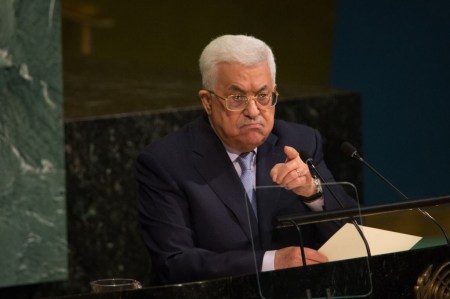
Mahmoud Abbas and his Palestinian Authority have made it clear that they will reject any peace plan proposed by the Trump administration. Pictured: Abbas speaks during the U.N. General Assembly on September 20, 2017. (Photo by Kevin Hagen/Getty Images)
The Palestinian strategy now is to work hard to thwart any peace plan coming from the Trump administration. The Palestinians are convinced that Crown Prince Mohammed bin Salman and other Arab leaders are cooking up a new “conspiracy” behind their backs — with the aim of “liquidating” the Palestinian cause by imposing an acceptable solution on them. This, of course, has nothing to do with Trump’s announcement on Jerusalem. This has been the Palestinian position even before Trump made his announcement, and it is unlikely to change after.
The Palestinians have placed themselves on a collision course not only with the US, but also with the Arab world. The question now is: How will the Arab regimes respond to this latest charge of fratricide leveled against them by their Palestinian brothers?
Khaled Abu Toameh, an award-winning journalist, is based in Jerusalem.
Tehran and the Lebanese Hizballah are eager to see Israel trapped in a rising spiral of military tension – and not just from its border with the Gaza Strip, but also at some point, emanating from new war fronts in Lebanon and Syria. At present, they are not looking for a comprehensive conflagration, but rather to subject Israel to a creeping war of attrition, like the couple of rockets which the Palestinians are firing night after night from the Gaza Strip. Like Chinese drip torture, this campaign is intended to torment Israel while gradually escalating. It doesn’t matter if they are inaccurate and fail to cause Israel casualties of damage. Indeed, one of the rockets fired Wednesday night exploded in an UNWRA school at Beit Hanoun inside the northern Gaza Strip, wrecking a schoolroom.
**************
The Palestinian rockets fired from Gaza Wednesday night, Dec. 13, were the 12th and 13th since US President Donald Trump’s Jerusalem decision on Dec.6.
DEBKAfile’s military sources report that the daily rocket assault from Gaza is turning into a war of attrition declared by three Palestinian extremist groups, Hamas, the Jihad Islami and the Popular Resistance Committees, on the orders of Gen. Qassem Soleimani, chief of the Iranian Revolutionary Guards Al Qods external terrorist arm, and supreme commander of Iranian forces in the region. Our sources reveal that the order was given Monday in a phone conversation Soleimani held with Marwan Issa, commander of the Hamas armed wing, the Ezz e-din al-Qassam. It was the first direct, phone conversation between a high-ranking Iranian general and the Hamas commander and it was deliberately overt. The Iranians wanted the Israeli and Egyptian intelligence agencies eavesdropping on incoming and outgoing phone calls to and from Gaza to hear Soleimani pledge full Iranian support for any military action conducted against Israel.
Tehran and the Lebanese Hizballah are eager to see Israel trapped in a rising spiral of military tension – and not just from its border with the Gaza Strip, but also at some point, emanating from new war fronts in Lebanon and Syria. At present, they are not looking for a comprehensive conflagration, but rather to subject Israel to a creeping war of attrition, like the couple of rockets which the Palestinians are firing night after night from the Gaza Strip. Like Chinese drip torture, this campaign is intended to torment Israel while gradually escalating. It doesn’t matter if they are inaccurate and fail to cause Israel casualties of damage. Indeed, one of the rockets fired Wednesday night exploded in an UNWRA school at Beit Hanoun inside the northern Gaza Strip, wrecking a schoolroom.
The threat by Israel generals Wednesday night of painful retaliation if the rocket fire continues is therefore ineffective. Hamas and the Jihad Islami are fully prepared for a major war escalation, in the certainty that Iran and Hizballah have their backs.
In the same week that Hamas is celebrating the 30th anniversary of its founding and Israel is marking the 30th anniversary of the start of the first intifada (1987), Hamas finds itself facing a multifaceted crisis. It has ceded government control of Gaza to the Palestinian Authority, it continues to be isolated internationally and Israel’s missile defense system has successfully neutralized 89% of the threat posed by rockets to the Israeli homefront, based on Defense Ministry figures from Protective Edge. Now the tunnels are slipping out of its hands as well. Hamas will have to reinvent itself if it wants to remain relevant. Given its current conditions and the means at its disposal, it will be especially difficult to do.
**********************************
There were no loud explosions, and no plumes of black smoke rose along Israel’s border with the Gaza Strip. The latest Hamas tunnel was discovered weeks ago using advanced technology developed by Israel. The Israel Defense Forces (IDF) kept news of the tunnel secret until completing preparations to neutralize it with innovative methods.
It is worth remembering that the last time the IDF destroyed a tunnel dug by the Palestinian Islamic Jihad movement it failed to realize that members of the terrorist group were inside it at the time. Despite efforts to extricate survivors, the demolition of the tunnel resulted in the deaths of 12 Islamic Jihad and Hamas fighters and almost led to a major conflagration. This time, the tunnel was neutralized in absolute silence.
Hamas appears to have had no idea that its strategic tunnel had been located or that it had been targeted by the IDF for weeks. Following the operation, Defense Minister Avigdor Liberman said Dec. 10, “Thanks to the joint efforts of the IDF, the Ministry of Defense and the defense industries, we have reached new technological capacities in the struggle against terrorism and the terror tunnels. I hope that over the next few months, the threat posed by the tunnels to Israelis living in localities surrounding the Gaza Strip will be a thing of the past.”
Liberman’s comments prompted a series of public statements by top Israeli officials that after investing unlimited resources and the extensive efforts of the country’s finest minds, Israel has managed to remove the threat of the tunnels, which have kept the people of the south up at night for the past few years. The truth is much more complicated, though there is no doubt that Israel is getting closer to achieving this capacity.
“It’s not like we have some machine that locates tunnels and destroys them,” a senior defense official told Al-Monitor on condition of anonymity. “This is a system based on the integration of three parallel approaches: shielding, intelligence and technology.”
As of now, this approach is effectively keeping Israel’s border with the Gaza Strip sealed. Israel estimates that in the near future it will be able to eradicate the existing tunnels entirely and make it impossible to dig new ones.
The Hamas tunnel destroyed this week was especially long, stretching several hundred meters into Israel. Israeli officials say that it was intended to allow Hamas to strike behind IDF lines in the next round of violence, just as the group attempted to do during Operation Protective Edge. Now Hamas has been denied that ability.
The movement developed its underground strategy to gain an advantage over the IDF, but that advantage is decreasing rapidly. This development is forcing Hamas to confront a strategic dilemma. Should it accept the existing situation and search for new ways to attack Israel, or should it act quickly to take advantage of whatever tunnels it may have left before it is too late to use them?
This danger is one reason the IDF did not make a big deal of the tunnel’s neutralization on Dec. 10. Apart from some warnings by the chief of the Southern Command, Eyal Zamir, to Hamas and Islamic Jihad that the tunnels would become a death trap for their fighters, the IDF has remained quiet. “There’s no need to celebrate,” one senior military official told Al-Monitor on condition of anonymity. “These are sensitive times, especially after President [Donald] Trump’s declaration concerning Jerusalem. There is no reason to help anyone who wants to bring about the deterioration [of the security situation].”
Israel’s approach to this operation was based on three components. The first, shielding, consists of a vast underground cement barrier being built along the border that should eventually encompass the entire Gaza Strip. The wall extends several dozen meters underground, and experts say that there is no way to dig tunnels beneath it. The wall is outfitted with sensors and other technologies to detect other tunnels and identify new excavation efforts.
The second component, intelligence, involves using all means at the disposal of Israel’s defense establishment — HUMINT (human intelligence), SIGINT (electronic signal intelligence) and others — to learn where and when militants are excavating tunnels. The IDF has told Al-Monitor that Israel has put together a very good picture of what is happening on the ground.
The third component, technology, includes the major innovation that enabled Israel to locate the two tunnels in the past two months. It was an integrated effort by all of Israel’s defense industries. The Defense Ministry’s Administration for the Development of Weapons and Technological Infrastructure set up a lab near the Gaza Strip for the country’s finest minds to tackle the problem.
“Each meter that we check takes a lot of time and serious investments,” a senior Israeli military official told Al-Monitor on condition of anonymity, “but we are getting results.”
Despite remarks by a number of Israeli leaders this week, the country’s ability to identify and destroy the tunnels and to seal its border with the Gaza Strip has yet to be perfected. “We are making progress. Our capacity will improve, and we will reach a stage in which we can announce that there are zero tunnels and that the threat has been neutralized,” one senior Israeli security official said on condition of anonymity. “But we’re not there yet.”
In the same week that Hamas is celebrating the 30th anniversary of its founding and Israel is marking the 30th anniversary of the start of the first intifada (1987), Hamas finds itself facing a multifaceted crisis. It has ceded government control of Gaza to the Palestinian Authority, it continues to be isolated internationally and Israel’s missile defense system has successfully neutralized 89% of the threat posed by rockets to the Israeli homefront, based on Defense Ministry figures from Protective Edge. Now the tunnels are slipping out of its hands as well. Hamas will have to reinvent itself if it wants to remain relevant. Given its current conditions and the means at its disposal, it will be especially difficult to do.






 anneinpt
 artaxes
 danmillerinpanama
 davidking1530
 Peter Hofman
 Joseph Wouk
 Peter
Peter Louisiana Steve
 WarSclerotic
Recent Comments