The US War Against ISIS Is Barely Degrading, Certainly Not Destroying The Militants, International Business Times, Erin Banco , October 24, 2014
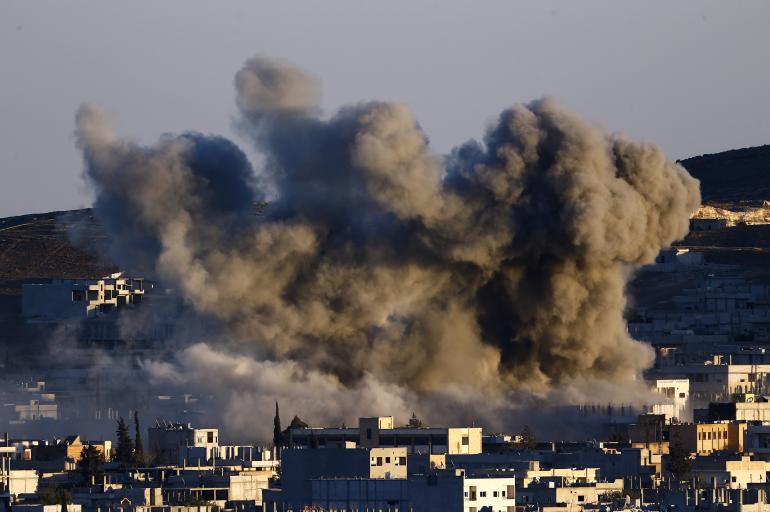 Smoke rises over Syrian town of Kobani after an airstrike, as seen from the Mursitpinar crossing on the Turkish border, Oct. 21, 2014. Reuters/Kai Pfaffenbach
The U.S.-led air campaign in Syria has killed 521 Islamic State fighters in the past month, according to the Syrian Observatory for Human Rights, a group monitoring the civil war. But the heavy death toll does not mean the United States is winning its fight to “degrade and destroy” the Sunni extremist group. Experts say that won’t happen until the group also known as ISIS loses support and its fighters begin defecting.
“Until that happens, we will not see a quantum shift in the war in Iraq and Syria,” said Wayne White, a former deputy director of the State Department’s Bureau of Intelligence and Research’s Office of Analysis for the Near East and South Asia.
Since June, ISIS has gained control of large swaths of land that stretch from Kobani on the Syrian-Turkish border to the outskirts of Baghdad. The group is currently waging campaigns in several different areas of both countries, but has focused its forces in recent weeks on capturing the Kurdish city of Kobani. As a result, the U.S.-led air campaign has targeted several ISIS convoys and strongholds in Kobani and is air-dropping weapons and other resources to the Syrian Kurds fighting there.
“Like many aerial campaigns you can cite from history, it is a gradual process,” White said. “ISIS has a finite number of heavy weapons, and they are being picked off. And ISIS is losing a lot of combatants that are not easily replaced. ISIS is driven to expand its domain, and every time it tries to expand it is putting its fighters out in the open where they can be taken out. The question is: How long will the degrading take until you get to the destruction … a long time.”
Witnesses on the ground in Kobani told International Business Times that ISIS had been pushed back from the center of the city, but that the fighting was still raging on the outskirts. Meanwhile, ISIS is making gains in other parts of Syria and in Baghdad. According to the Syrian Observatory, ISIS fighters seized Tal Shaer, a town just west of Kobani, this week. And in Baghdad, the Sunni militant group has claimed responsibility for several car and suicide bomb attacks that have killed dozens of people in the last two weeks.
The uptick in ISIS attacks since June in Iraq has not only caused hundreds of civilian deaths, but has also infiltrated the psyche of the Iraqi people, especially those living in the capital, Noof Assi, a woman from Baghdad, told the International Business Times.
At the beginning of the ISIS campaign, “Baghdad looked like a ghost city,” Assi said. “People were staying at home or fleeing, saving food and fuel.”
Now, she said, people in Baghdad are used to the ISIS insurgency. Discussions in shops, cafes and restaurants have shifted. No longer are Iraqis talking about the destruction that ISIS is inflicting on the country. Now, people are talking about how many people are beginning to support the militant group.
“There are people talking about people of Mosul,” she said of the big northern city. “Some people are saying that they betrayed Iraq and welcomed ISIS.”
The State Department and White House have both confirmed that part of the U.S. strategy to fight ISIS is to undercut its propaganda and recruitment, especially on social media. So far, though, the U.S. has not launched a successful countercampaign.
In September, the State Department produced and distributed a graphic mock Islamic State propaganda video via social media. The video, “Welcome to ISIS Land,” was published by the State Department’s Center for Strategic Counterterrorism Communications.
The mock video showed graphic images of the militant group committing war crimes that have been widely reported over the past two months and that are now being investigated by the United Nations. The video looks similar to those ISIS promotes on social media like Twitter and YouTube. Despite the counterpropaganda drive, ISIS continues to expand on social media, and more and more Western fighters, as well as Iraqi and Syrian civilians, are joining up.
While some experts say the only way the U.S. will defeat ISIS is by sending in ground troops, others say more credit should be given to the Syrian Kurdish fighters — who now seems to be only force on the ground in Iraq and Syria that is regaining territory ISIS took over in prior months.
“They are the only boots on the ground in the entire Iraqi-Syrian theater capable of standing up to ISIS,” White said. “They are absolutely fierce fighters. The Iraqi Kurds are not.”





 anneinpt
 artaxes
 danmillerinpanama
 davidking1530
 Peter Hofman
 Joseph Wouk
 Peter
Peter Louisiana Steve
 WarSclerotic
Recent Comments