Posted tagged ‘Golan’

Iran’s Foreign Legion in Syria

June 12, 2017

Iran’s Foreign Legion in Syria, Front Page MagazineJoseph Puder, June 12, 2017

(Please see also, Syrian-Hizballah massacre in Daraa: 140 dead. — DM)

The Iranian strategy, it appears, is to consolidate is forces in southwestern Syria facing the Druze area of Dar’aa, and gradually move their commanded forces toward the Israeli border in the Golan.  Iran has sought for a long time now to establish its proxies, including Hezbollah units in the Golan facing Israel.  Israel however, was able to dislodge these Iranian efforts.  Nevertheless, the Iranian cooperation with Russia in Syria, and the lucrative arms deals between them, may persuade Russia to consider the Iranian efforts.

Iran is the leading state-sponsor of international terrorism, and the IS attack has given Tehran a taste of its own deadly medicine.  The oppression of Sunnis in Shiite Iran is likely to drive Sunni Baluch and Ahwazi Arabs into doing the IS’s bidding, translated into acts of terror in the heart of Tehran.  It demonstrates a hard truth – that Sunni jihadists can assemble a foreign legion, just as the Iranian jihadists have done in Syria.
******************************

Arab News reported (6/7/2017) that “Suicide bombers and gunmen attacked the parliament building and the Mausoleum of Ayatollah Khomeini in the Iranian capital.  Islamic State (IS) claimed responsibility and released a video purporting to show gunmen inside the parliament.”  The twin attacks on Wednesday killed 12 Iranians, and embarrassed the radical Islamist regime by showing its vulnerability at home.  IS terrorists hit the most potent symbols of Iran’s Islamic Republic on Wednesday.  It has brought into sharp focus the high cost of Tehran’s involvement in Syria, which according to the powerful Islamic Revolutionary Guards Corps (IRGC) leadership, was meant to ward off terrorist attacks at the home front.  With an economy that has barely recovered from sanctions imposed on it by the international community, the Iranian regime of Ayatollah Ali Khamenei can hardly justify the huge cost to the treasury of exporting its revolution and backing Assad in Syria with Iranian cash, if not in blood.

Given the Sunni-Shiite conflict engulfing the Middle East, it was inevitable that IS will ultimately strike at Iran – the patrons of Shiite-Islam.  The antecedents of IS in Iraq proved that the Sunnis who ruled in Iraq albeit, as a minority with a Shiite majority, won’t easily allow Shiites to disenfranchise them.  In Syria however, the Sunnis are the majority, and have been ruled for almost 50 years by the Alawite (Shiite) clan of the Assads.  It was never a question of whether or if IS will strike at Iran but rather when.  The array of Shiite militias fighting IS, and non-Islamist Sunni militias, under the command of Maj. General Qasem Soleimani, the head of the Quds Division of the IRGC, is clear enough reason why Iran is, and will continue to be a target.

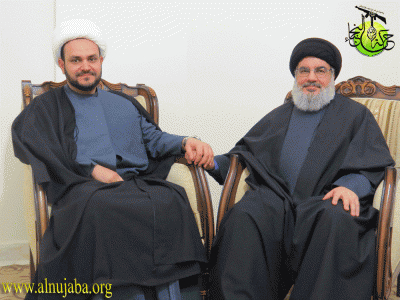
To expand its influence throughout the Middle East region, and extend the Shiite Crescent, the Ayatollahs’ regime in Tehran has devoted huge resources to protect its turf in Syria, and maintain it as a bridge to Lebanon and the Mediterranean Sea.  In essence, it means the preservation of the Bashar Assad, Alawi-led (Alawites are an offshoot of Shiite Islam) regime.  The Syrian dictator who has now earned the moniker “the butcher of Damascus” can count on the Iranian ‘Foreign Legion’ made up of Shiite fighters from Lebanon (Hezbollah), Iraq, Afghanistan, Pakistan, and Yemen. They provide the manpower that serves the Iranian agenda in Syria.  Besides Hezbollah, there is the Afghan “Fatimiyoun and Khadem  el-‘Aqila Brigades; the Pakistani Zainebiyoun Brigade; Yemeni Houtis “Liwa Al-Saada Brigade, the Iraqi Shiite militia Al-Nujaba Movement.  The Iraqi Shiite contingent is the largest force engaged in the defense of the Assad regime.  It is estimated to number around 40,000 fighters.

According to the Qatari based outlet, Al-Jazeera (1/22/2016), “Some 20,000 Afghan Shia fighters alone are said to be fighting alongside Iran to help save the government of the Syrian President Assad.”  Iran, the publication pointed out, recruited tens of thousands of Afghan Shiite fighters, offering them salaries to join the fight to save President Bashar Assad.  The Afghan Shiites are refugees from the ongoing war in Afghanistan between the government of Ashraf Ghani and the Taliban.  They escaped to Iran due to economic and political hardship, and sought asylum there.  Given the inability of young Afghanis to find work in Iran, they are easily manipulated into being cannon-fodder for the Iranians.  Unlike an Iranian fighter, an Afghan illegal migrant killed in action would not be a burden on the Iranian treasury.  Moreover, its foreign mercenaries provide Iran with deniability with regards to their intervention in Syria.

Captured Afghan Shiite fighters revealed that they are attracted to Syria by the promise of a financial reward.  The Iranian regime paid recruits supposedly between $500 and $1,000 a month.  Some Afghans claimed that they joined the fighting brigades as a way to escape prison sentences or even the death penalty for drug trafficking, one of the few outlets for Afghan refugees in Iran. Anas al-Abdah, the secretary of the opposition Syrian Coalition committee told Al-Jazeera that “Iran considers itself the one and only reference point for all Shia people in the whole world.  It organizes them into political, social and military organizations, both in their local communities and abroad…This is part of the main mission of the Iranian regime in terms of exporting the revolution.  Iran recruits, motivates, organizes, finances, and trains Shias from all over the world to help support Bashar al-Assad’s regime from collapsing.”

In Israel, there is particular attention being paid to the Al Nujaba group.  Israeli Col. (retired) Dr. Jacques Neriah, suggested that at “The end of February, 2017, the leader of Al-Nujaba’, Akram el-Q’aabi, declared in an unprecedented announcement that his forces were to fight together with the Syrian army to ‘liberate’ the Golan.  El-Q’aabi justified his position by stating that the terrorism of ISIS is but a part of a grand plan designed by the Zionists, supervised by the Americans with Turkish-Gulf implementation. Therefore, it was time to decapitate the head of the Zionist snake.”  Neriah added, “The Brigade announced in March, 2017 the creation of “The Liberation of the Golan Brigade” (Liwa’ Tahrir el-Jolan). The Brigade whose members have fought in Lebanon, Syria, and Iraq will have one mission: to assist the Syrian army in liberating its “stolen lands.” According to the spokesman of the Al-Nujaba, ‘The creation of this Brigade was but a step toward liberating the holy places in occupied Palestine.”

The Iranian strategy, it appears, is to consolidate is forces in southwestern Syria facing the Druze area of Dar’aa, and gradually move their commanded forces toward the Israeli border in the Golan.  Iran has sought for a long time now to establish its proxies, including Hezbollah units in the Golan facing Israel.  Israel however, was able to dislodge these Iranian efforts.  Nevertheless, the Iranian cooperation with Russia in Syria, and the lucrative arms deals between them, may persuade Russia to consider the Iranian efforts.

As a result of the IS twin attacks in Tehran, the Golan front is a secondary priority for now. The IRGC, whose position in Iran has strengthened, despite the overwhelming reelection victory of the more “moderate” President Hassan Rouhani in the recent elections, will now increase its operations in Syria and Iraq, and more Iranian resources will be spent there.  Iranian President Rouhani will now find it more difficult to reduce spending on foreign arenas such as Syria, as he has promised to do in his election campaign.

Iran is the leading state-sponsor of international terrorism, and the IS attack has given Tehran a taste of its own deadly medicine.  The oppression of Sunnis in Shiite Iran is likely to drive Sunni Baluch and Ahwazi Arabs into doing the IS’s bidding, translated into acts of terror in the heart of Tehran.  It demonstrates a hard truth – that Sunni jihadists can assemble a foreign legion, just as the Iranian jihadists have done in Syria.

One missile takes out ISIS command on Golan edge

June 8, 2017

One missile takes out ISIS command on Golan edge, DEBKAfile, June 8, 2017

DEBKAfile’s military sources report concerns in the US military commend lest Iranian general Qassem Soleimani decides to drop a division of Iranian special forces by helicopter, in order to catch the garrison off guard and capture the border crossing.

This concern increased after the Islamic State conducted a surprise bombing-cum-shooting attack on prize Iranian regime targets in Tehran on June 7. The Revolutionary Guards are bent on revenge and looking for an outstanding military success to cover this humiliation.

The US commanders are also under pressure on another score: the Iranians and Syrians have sent secret messages to Moscow complaining bitterly about the US air strike. They both made it clear that they command sufficient air and artillery fire power to overwhelm and wipe the ground with the American force in Syria.  Both Damascus and Tehran appear to be spoiling for a major showdown between their armies, using Hizballah and other Shiite proxies, and the US-led contingent.

***********************

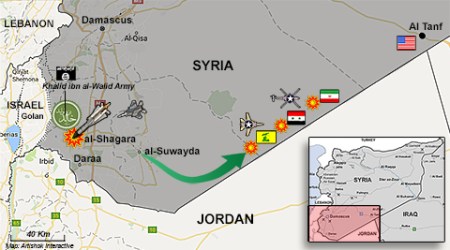
A single mystery missile, which could have been fired from the ground or the air early Wednesday morning, June 7, wiped out the entire top Islamic State command on the Syrian Golan, DEBKAfile’s military and intelligence sources report. All 16 officers of the 2,000-strong Khaled Ibn al Waleed army, the ISIS operations arm on the Syrian Golan, were present in the targeted building in the town of al-Shagara, located in the triangle where the Israeli, Syrian and Jordanian borders meet opposite the Sea of Galilee in northern Israel.

The unidentified missile blew up in the middle of a hall where the top command echelon were gathered to break their daily fast during the month of Ramadan and draw up plans. None of them survived.

Among them were the group’s chief, Gen. Abu Mohammed al-Makdessi; commander of operations, Gen. Abu Udai al-Homsi; and the group’s explosives expert who doubled as its religious leader, Abu Ali Shabat.

They operated under these aliases to conceal their real identities as former high Iraqi army officers who served in the late Saddam Hussein’s armed forces. They were also in senior command positions at the ISIS Syrian command center in Raqqa, when ISIS leader Abu Bakr al-Baghdadi decided to transfer them to the Syrian Golan to spearhead attacks that were planned to take place inside Israel and Jordan.

It took Al-Baghdad just a few hours to replace Magdessi as Khaled Ibn al-Waleed chief with a new man, Mohamed al-Refaei-Abu Hshem al-Askari.

On Tuesday, June 6, the day before the mysterious missile decapitated the Islamic State’s Golan force, US warplanes acted on another front to bomb a convoy of Iranian, Syrian and Hizballah forces that were traveling eastward from the southern town of Derra in the direction of the Al-Tanf border crossing.

Al Tanf, where US and Jordanian special forces units have established a garrison, is located in the triangle where the Syrian, Jordanian and Iraqi borders converge. The US planes destroyed several tanks, troop carriers, artillery pieces and antiaircraft systems, causing also fatalities and injuries, and so halted the convoy’s advance on the strategic crossing.

This was the second US air strike in three weeks on a similar target. The first was on May 18.

DEBKAfile’s military sources report concerns in the US military commend lest Iranian general Qassem Soleimani decides to drop a division of Iranian special forces by helicopter, in order to catch the garrison off guard and capture the border crossing.

This concern increased after the Islamic State conducted a surprise bombing-cum-shooting attack on prize Iranian regime targets in Tehran on June 7. The Revolutionary Guards are bent on revenge and looking for an outstanding military success to cover this humiliation.

The US commanders are also under pressure on another score: the Iranians and Syrians have sent secret messages to Moscow complaining bitterly about the US air strike. They both made it clear that they command sufficient air and artillery fire power to overwhelm and wipe the ground with the American force in Syria.  Both Damascus and Tehran appear to be spoiling for a major showdown between their armies, using Hizballah and other Shiite proxies, and the US-led contingent.

Russian monitors for Syrian Golan – not Iranians

May 11, 2017

Russian monitors for Syrian Golan – not Iranians, DEBKAfile, May 11, 2017

The issue came up during Russian Foreign Minister Sergey Lavrov’s talks with US President Donald Trump and Secretary of State Rex Tillerson in Washington on May 11, and a day earlier, in a telephone conversation between Russian President Vladimir Putin and Israeli Prime Minister Binyamin Netanyahu.

****************************

Moscow this week responded to Israel’s concerns about posting Iranian and Turkish officers on its borders to monitor the potential “de-escalation” zones Russia is proposing for Syria. In respect of those concerns, DEBKAfile’s military and intelligence sources reveal that Russia agreed in high-level contacts in the last few days to replace them with Russian military officers in the Mt. Hermon region and the areas where Israeli, Lebanese and Syrian borders meet. The proposal also calls for the expansion of the UN Disengagement Observer Force (UNDOF), which supervises the cease-fire between Israel and Syria on the Golan.

(DEBKAfile was the first publication to reveal Israel’s concerns on May 3 and May 5.)

The Russian military are preparing to establish four ceasefire safe zones in Syria. The southernmost would be located along Syria’s borders with Israel and Jordan. The issue came up during Russian Foreign Minister Sergey Lavrov’s talks with US President Donald Trump and Secretary of State Rex Tillerson in Washington on May 11, and a day earlier, in a telephone conversation between Russian President Vladimir Putin and Israeli Prime Minister Binyamin Netanyahu.

The chairman of the US Joint Chiefs of Staff, Gen. Joseph Dunford, was also involved in the exchanges on the ceasefire zones between Washington, Moscow and Jerusalem during his visit to Israel this week as the guest of the Israeli chief of staff, Lieut. Gen. Gady Eisenkott. On Tuesday, May 9, Dunford said that “Israel is concerned about the possibility of having Iranian or Iranian-backed forces, such as Hizballah, so close to its border.” Both Putin and Lavrov promised that neither Iranian, pro-Iranian, nor Turkish officers would be placed in areas close to the Israeli border.

Our military sources report that during talks between Washington, Moscow and Jerusalem on Thursday, May 11, the three sides agreed to continue to discuss the Russian proposal.

Another issue raised among them was who will deal with the ISIS forces in the Yarmouk area near the Israel-Jordan and Israel-Syria borders, including the bases established by the Khaled bin al-Walid army, which has sworn allegiance to ISIS.

The coming DEBKA Weekly out Friday, May 12, also reveals positive US-Russian dialogue on more Syrian issues.  If you are not already a subscriber, click here.

Putin & Trump discuss Iranians on Israel’s border

May 3, 2017

Putin & Trump discuss Iranians on Israel’s border, DEBKAfile, May 3, 2017

(President Trump’s influence with Putin seems to have diminished substantially in the absence of General Flynn. — DM)

Israel was seriously dismayed Wednesday, May 3, when first reports reached Jerusalem about the telephone conversation between Presidents Donald Trump and Vladimir Putin Tuesday, during which Trump agreed to consider Putin’s plan for “de-escalation zones” in Syria, in place of the American security zones proposal. The Russian president’s plan includes the posting of Iranian military officers as co-monitors for those zones, one of which is to be located on the Syrian-Israeli border.

President Trump described the conversation as “Very good.”

The four “de-escalation zones” proposed would be situated at:

1. The northwestern province of Idlib up to the Turkish border;

2. The central Syrian province of Homs (where also the Al-Shariat air base hit by US Tomahawks last month is located);

3. The East Ghouta suburb of Damascus (including also a big military airfield);

4. The Southern region along Syria’s borders with Jordan and Syria.

The Russian president explained that the “guarantor countries” – i.e. Russia, Turkey and Iran – would appoint the monitors for the de-escalation zones.

DEBKAfile’s military and intelligence sources report that Israel was deeply concerned to discover that President Trump had nodded to Putin going forward with his plan, despite Iran’s active involvement. He was even ready to send a US official for the first time to the fourth round of the Syrian peace talks between the Syrian government and opposition in Astana Wednesday, although this process is jointly sponsored by Russia, Turkey and Iran. Stuart Jones, acting assistant Secretary of State, was sent to attend the meeting in the Kazakh capital as an observer, thereby elevating the former American representation from ambassador..

This development caused Israeli disquiet on a number of grounds:

a) The Iranian monitors for the new zones will sit directly opposite the Israeli border. Notice has gone out to Washington and Moscow that the Israeli government will on no account countenance an Iran military presence along its border.

b)  Israel also eyes with mistrust the possible deployment of Russian and Turkish offices along its border with Syria.

c)  Declaring eastern Damascus a protected zone would obstruct Israel aerial operations for keeping Iranian air shipments of advanced weapons via Syria out of Hizballah’s hands. Iran would be able to renew its shipments under full protection.

You can read more about the Russian and American “zones” for Syria in the coming issue of DEBKA Weekly out Friday, May 5. To subscribe to this publication, click here.

d)  There were also some misgivings in Israel about the way National Security Adviser H.R. McMaster characterized President Trump’s approach to foreign policy, shortly before Palestinian leader Mahmoud Abbas arrived at the White House on Wednesday.

“The president is not a super-patient man,” he said. He does not have time to “debate over doctrine, and instead seeks to challenge failed policies of the past with a businessman’s results-oriented approach,” McMaster said.

The trouble is that Middle East issues, such as the Syrian conflict and Israeli security, demand patience and rather more than a businessman’s results-oriented approach, else they may lead to such potentially disastrous consequences as an Iranian military presence that is far too near and dangerous for Israel to countenance.

Golan tension: Pro-Iran troops move on Quneitra

April 27, 2017

Golan tension: Pro-Iran troops move on Quneitra, DEBKAfile, April 27, 2017

(Please see also, Massive Explosion Reported Near Damascus International Airport Following Israeli Airstrikes. — DM)

There is no word yet on whether the warning issued by the defense minister from Moscow has produced a direct Israeli response to the provocation. Very possibly the five explosions and ball of fire they set off at Damascus international airport Thursday morning may prove to be connected to that response.

***************************

Early Thursday, April 26, a mixed Syrian-Iranian-Hizballah force embarked on a general offensive in southern Syria ready for a leap on Israel’s Golan border. They moved forward in the face of Israeli warnings that were relayed from Moscow to Tehran and Hizballah.

This latest warning was issued by Defense Minister Avigdor Lieberman, who is visiting the Russian capital this week to attend an international security conference. After meeting Russian Foreign Minister Sergey Lavrov and Defense Minister Gen. Sergey Shogun, the Israeli minister stated clearly on Wednesday: “Israel will not allow the concentration of Iranian and Hizballah forces on its Golan border.”

By Thursday morning, it was evident that a decision had been taken in Moscow, Tehran, Damascus and Beirut to ignore Lieberman’s warning.

DEBKAfile’s military sources report that early Thursday, Shiite militias under the command of Iranian Revolutionary Guards officers, alongside Hizballah troops, organized as the Southern Shield Brigade, launched their offensive at Mt. Hermon southwest of Damascus, on their way to the Syrian-Israeli Golan border in the region of Quneitra. The Syrian contingents taking part in this push are the Syrian army’s elite 42nd Brigade and elements of the 4th Mechanized Division.

Their first objective is to capture a string of villages held by Syrian rebel groups in the region of Hadar on the Hermon slopes. They are advancing towards the Golan along the Beit Jinn route.

There is no word yet on whether the warning issued by the defense minister from Moscow has produced a direct Israeli response to the provocation. Very possibly the five explosions and ball of fire they set off at Damascus international airport Thursday morning may prove to be connected to that response.

Hezbollah Sure Sounds Like it’s Afraid of an Israeli Attack

April 21, 2017

Hezbollah Sure Sounds Like it’s Afraid of an Israeli Attack, Front Page Magazine (The Point), Daniel Greenfield, April 21, 2017

Hezbollah has been bleeding rather badly in Syria. And the casualties are bad enough that many of its Jihadists don’t want to report for duty. Hezbollah has a paper force. People are listed who won’t actually fight. Because their opponents aren’t going to be afraid of their human shields or will pull back when the UN and the State Department barks. 

**********************

You don’t have to be a great student of human psychology to pick up on it.

A Hezbollah commander on Thursday guided a group of journalists on a tour of the Israel-Lebanon border, according to media reports.

“We’re not afraid of war,” Israel’s Channel 2 quoted him as saying. “The enemy understands this. We are firm in our positions…We will not hesitate to go to war and are even expecting it. We will fight when we are compelled to and we will win.”

We’re not afraid to fight! And we won’t hesitate to fight… if we have to fight. So you better not fight us because we’re not at all afraid to fight you. Really. And it would be foolish of you to fight us.

 Israel has been deterred by Hezbollah and it would be “foolish and reckless” for the Jewish state to launch a military campaign on its northern border, the Lebanese terror group’s deputy leader claimed on Thursday.

Qassem also expressed confidence regarding the terror organization’s readiness and capabilities in any future conflict with Israel, saying, “The level of Hezbollah’s readiness enables it to withstand any possible war, both numerically and in terms of means and goals.”

Sure.

Hezbollah has been bleeding rather badly in Syria. And the casualties are bad enough that many of its Jihadists don’t want to report for duty. Hezbollah has a paper force. People are listed who won’t actually fight. Because their opponents aren’t going to be afraid of their human shields or will pull back when the UN and the State Department barks.

Fighting fellow Islamic terrorists is much less fun than fighting Israel. But Hezbollah’s manpower is badly overextended in an Islamic civil war against enemies as cruel and treacherous as themselves.

Iran Sponsored Shi’a Militia Launches Terror Group to Fight Israel

April 5, 2017

Iran Sponsored Shi’a Militia Launches Terror Group to Fight Israel, Investigative Project on Terrorism, April 5, 2017

Israel is very concerned with the establishment of Iranian-led terrorist bases in the Golan Heights. Hizballah openly seeks to consolidate its presence in the region and launch attacks against Israel from a new front in a future war.

**************************

An Iranian supported Shi’a militia, Al-Nujaba, says it formed the “Golan Liberation Army” to fight Israel, the Middle East Media Research Institute (MEMRI) reports.

“This army has been trained and has detailed plans. If the Syria regime asks us to, we are ready to act to liberate the Golan [from Israel] along with our allies,” Al-Nujaba spokesman Hashem Al-Mousawi said in a March 8 interview with Iran’s Tasnim news agency.

Al-Mousawi also admitted that the new militant group is “part of the PMU [Popular Mobilization Units],” an Iraqi-backed umbrella organization comprised of numerous Shi’a militias, including some with close ties to Iran. The Golan Liberation Army emerged from the Iranian led “resistance” axis and consists of “special forces who have received training and equipment,” he said.

“Iran is the only country that has helped us,” Al-Mousawi said, “and sent us its military advisors, led by Qassem Soleimani.”

Soleimani, the commander of the Iranian Revolutionary Guards Corps’ (IRGC) Quds Force, is tasked with advancing Iran’s regional expansion and terrorist networks. Since September 2015, Iran increased its forces in Syria from hundreds to thousands to support Hizballah terrorists acting at Iran’s behest in propping up the Bashar al-Assad regime.

Despite Iran’s commitment to Syria, the Islamic Republic is establishing terrorist networks in the Golan Heights, using Hizballah, Druze, and Palestinian Islamic Jihad (PIJ) operatives to target Israel. The new Golan Liberation Army shows that Iran is now diverting Iraqi militia assets from fighting ISIS to confront the Jewish state.

Soleimani’s Quds Force financed most of the Iraqi-Shi’ite militias and provided them with weapons specifically to target American soldiers. With Hizballah’s assistance, the Quds Force supplied terrorists with powerful explosive devices that killed numerous American and coalition troops in Iraq.

Israel is very concerned with the establishment of Iranian-led terrorist bases in the Golan Heights. Hizballah openly seeks to consolidate its presence in the region and launch attacks against Israel from a new front in a future war.

IRGC-controlled Iraqi militia forms ‘Golan Liberation Brigade’

March 13, 2017

IRGC-controlled Iraqi militia forms ‘Golan Liberation Brigade’, Long War Journal, , March 12, 2017

(Please see also, Iran’s Islamic Revolutionary Guards now opposite Israeli troops on 1967 ceasefire line in Golan Heights — DM)

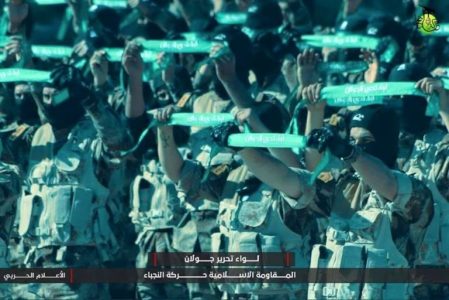
Photo 1: Harakat al Nujaba Golan Liberation Brigade, as portrayed in propaganda video.

The IRGC’s goals in southern Syria are to crush Syrian opposition forces, and build the capability to open another front against Israel. The IRGC hopes a viable Golan foothold would serve as deterrence against Israel and US, and that it could activate in a future conflict, such as another Israel-Hezbollah war. For now, the IDF’s fortified posture in the Golan remains a difficult, if not futile, target for the Guard and its allies. The IRGC nevertheless intends to project steadfast commitment to ideological principles and defiance of adversaries.

*****************************

The Iranian-controlled Iraqi militia Harakat al Nujaba this week announced the formation of its “Golan Liberation Brigade.” While it is not uncommon for entities to name themselves after areas they aim to “liberate,” the militia’s spokesman has said that the unit could assist the Syrian regime in taking the Golan Heights, a region in the Levant that has been controlled by Israel since the 1967 Six-Day War.

If true, the unit would likely participate in a future offensive to capture territory from Syrian opposition in the part of the Golan Heights still controlled by Syria, before moving on to the much taller order of dislodging the Israelis across the border. This week’s announcement reflects Tehran’s priorities in southern Syria since finally taking the fiercely contested city of Aleppo late last year: crush Syrian opposition, and pose military threat to Israel from the Golan Heights. While the Islamic Republic is incapable of credibly challenging the Jewish state’s fortress in the Golan, reaffirming ideological commitment to fighting Israel signals defiance to a global audience amid a reportedly converging American-Arab-Israeli military alliance against Tehran.

Harakat al Nujaba, or Movement of the Noble, has sustained operations in the Syrian and Iraqi combat zones. An offshoot of the Iranian-backed militias Asaib Ahl al Haq and the Hezbollah Brigades, Harakat al Nujaba was formed in 2013 to fight in the Syrian Civil War as part of Iranian-led Iraqi expeditionary forces. The militia joined the Popular Mobilization Forces, the umbrella organization of Iraqi militia, the following year, after the Islamic State incursion into Iraq. Operating as one of the largest Iraqi-Shiite militia contingents in Syria, the militia has claimed to field 10,000 forces. Harakat al Nujaba played an important role in assisting Iran’s Islamic Revolutionary Guard Corps (IRGC) and pro-Syrian regime forces conquer Aleppo late last year.

The Iraqi militia functions as an extension of the Islamic Republic. Having sworn full allegiance to Iran’s Supreme Leader, Ayatollah Ali Khamenei, the militia promotes velayat-e faqih (guardianship of jurisprudence), the Islamic Republic’s founding ideology. Harakat al Nujaba takes direct orders from Major General Qassem Soleimani, the chief of the IRGC extraterritorial branch the Qods Force. Last year, the Iraqi militia, which is also known as Harakat Hezbollah al Nujaba, proclaimed that it and Lebanese Hezbollah, Iran’s most powerful foreign militia, were “the twins of resistance.”

The militia leader Akram al Kabi is close to the top Iranian leadership, including the supreme leader. A co-founder of the Asaib Ahl al Haq – itself an offshoot of the Mahdi Army – Kabi was designated in September 2008 by the US Treasury as a terrorist for aiding Iraqi insurgents. In 2015, he openly said he would depose the Iraqi government if Khamenei issued the order. Last year, top Iranian officials close to Khamenei gave Kabi a highly publicized reception in Tehran, unprecedented in scope and scale for a militia leader. This past December, Harakat al Nujaba publicized Kabi’s meeting with Khamenei on the sidelines of a conference in Tehran.

Harakat al Nujaba has divulged some details about the Golan Liberation Brigade. The commander of the militia’s forces in Syria released a statement declaring the unit to be a synthesis of combat experiences gained in Lebanon, Syria and Iraq. The militia’s official spokesman confirmed the event as a press conference March 8 in Tehran at the IRGC-affiliated Tasnim News Agency, saying the unit was formed following “recent victories” (an implicit reference to Aleppo). He claimed the Golan unit is comprised of “special” forces.

“Should the Syrian government make the request, we are ready to participate in the liberation of occupied Golan with our allies,” the spokesman said. “We will not permit the soil of Arab countries to remain in the grasps of occupiers.”

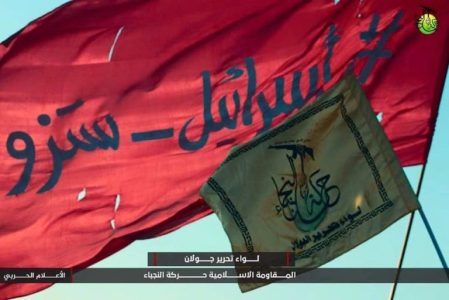
Harakat al Nujaba also released a video promoting the Golan unit that showed fighters marching in columns and carrying a banner reading, “Israel will be destroyed.”

(The video is at the link. — DM)

Tehran’s goal of establishing a foothold in the Golan Heights is not a secret. Last year, the head of the Israeli foreign and defense legislative committee revealed without divulging details that Israel had repelled several Iran-directed attempts to move forces into Syrian Golan Heights.

Senior Iranian military commanders are known to operate in Syrian Golan. Last July, the then-commander of the IRGC Basij paramilitary publicized an inspection of Quneitra by the Israel border. In January 2015, an Israeli strike in the area killed several high-value targets including IRGC Brigadier General Mohammad Ali Allah-Dadi and multiple Hezbollah operatives.

A chasm remains between the capabilities and ambitions of Harakat al Nujaba and the IRGC to retake the Golan from Israel. The combined forces of the Syrian regime and IRGC-led militias are no match for the Israel Defense Forces (IDF), and this disparity is expected to hold for the foreseeable future. Israel could also adopt a more proactive approach in Syria to foil IRGC encroachment by the Golan, for example coordinating with Syrian rebels positioned in the area. Syrian Golan’s flat geography furthermore denies the IRGC suitable terrain to replicate the southern Lebanon model of concealing rocket launch sites dispersed across a widespread area, making it easier for the IDF to search and destroy weapons systems. For years, the IDF has been fortifying positions in the rocky plateau of Golan to face greater capabilities than the IRGC and its allies can muster.

Yet the claim to retake Israeli Golan underscores Harakat al Nujaba’s ideological commitment to the IRGC’s and Khamenei’s declared goal of destroying Israel. Khamenei and his top Guard generals have frequently spoken that that the divine hand would aid the faithful who take steps towards “divine-inspired” ideological principles.

Brandishing the formation of the Golan unit also challenges Arab countries on the Palestinian issue, as the Tehran has accused them of abandoning the cause in service of Israel. The Islamic Republic has slammed reported Arab-Israeli rapprochement and talks to form a US-brokered military coalition with the goal of countering Tehran, as covered in The Wall Street Journal. Last month, top Iranian government officials hosted another round of the Support of Palestinian Intifada Conference in a show of unity and defiance. This past week, Tehran’s interim Friday prayer leader this week excoriated “some leaders in Islamic countries who are with Zionists,” calling them “not human.” Suffering from loss of legitimacy over support of Syrian President Bashar al Assad against a Sunni-Arab uprising and nervous over a converging Israeli-Arab alliance, the Islamic Republic is projecting to the globe and “sell-out”Arab leaders a defiant commitment to fighting Israel.

The Iraqi militia’s Golan unit and IRGC-led expeditionary forces could help pro-Syrian regime forces take opposition-held areas in the south. In February 2015, IRGC-led forces launched a failed campaign in the Daraa and Quneitra in the south. Since conquering Aleppo last year, the IRGC-led expeditionary forces and other pro-Syrian regime forces have been able to redirect their dwindling assets to several fronts in north, central, and south Syria. Pro-regime forces backed by Russian air power have been pounding Daraa in the south for more than a month to slow an opposition offensive, and have recently launched a new bid to capture it. An IRGC colonel was also killed last month in the area. A pro-Syrian regime propaganda outlet late last month reaffirmed the government’s intention to retake all of Daraa and open a major border crossing with Jordan. Meanwhile, pro-regime forces have made progress in the northern pocket of Quneitra Governorate, located in the Syrian-controlled part of the Golan.

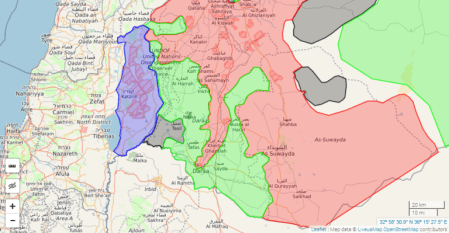
Map 1: southern Syria front, March 2017. Red: pro-Syrian regime forces. Green: rebel forces including Free Syrian Army and al Qaeda-affiliate Jabhat Fath al Sham. Black: Islamic State affiliates. Credit: Liveuamap.

The IRGC’s goals in southern Syria are to crush Syrian opposition forces, and build the capability to open another front against Israel. The IRGC hopes a viable Golan foothold would serve as deterrence against Israel and US, and that it could activate in a future conflict, such as another Israel-Hezbollah war. For now, the IDF’s fortified posture in the Golan remains a difficult, if not futile, target for the Guard and its allies. The IRGC nevertheless intends to  project steadfast commitment to ideological principles and defiance of adversaries.

Photo 2.
Photo 3: Harakat al Nujaba Golan Liberation Brigade flag at front, and “Israel will burn” banner in the back.

Amir Toumaj is a Research Analyst at Foundation for Defense of Democracies.

Israel’s inaction in Syria may open Golan to Iran

February 7, 2017

Israel’s inaction in Syria may open Golan to Iran, DEBKAfile, February 6, 2017

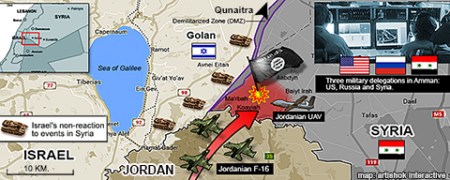
jordanisraelsyria480en

Prime Minister Binyamin Netanyahu has given “diplomatic priority” to stressing the perils posed by Iranian-sponsored terrorism and its nuclear-capable ballistic weapons, and placed them at the top of his talks with British premier Theresa May in London Monday, Feb. 6, and with President Donald Trump in Washington on Feb. 15.

But it stands to reason that their national security and intelligence experts have advised the US president and the British premier that Netanyahu has been firmly advised up to the present day to stay clear of military involvement in the Syrian conflict by the IDF high command and his past and present defense ministers, Avigdor Lieberman and Moshe Ya’alon.

Israel therefore stands to be excluded from the practical deliberations ongoing for Syria’s future. Jordan in contrast has stepped forward as the key Middle East player in the pacts and military understandings shaping up between the US, Russia and Turkey for throwing Iran out of Syria.

Jordan’s King Abdullah swallowed his pride and took the initiative of flying to Washington last Thursday, Feb. 2, to buttonhole President Trump. From their brief conversation, he became the first Middle East ruler to win a green light from the US for an air strike against the ISIS ally, the Khalid Ibn al-Walid Army, which occupies the triangle formed by the Syrian, Jordanian and Israeli borders. Israel has never attacked this force in the five years since it moved into that part of southern Syria.

DEBKAfile”s military and intelligence sources disclose that Abdullah informed Trump that the air strike would take place under the supervision of the US, Russian and Syrian commands, making it the first instance of US-Russian support for a Middle East army’s action against ISIS in Syria.

And so, on Saturday, Feb. 4, six Royal Jordanian Air Force F-15 fighters and five drones bombed seven Khalid Ibn al-Walid positions. This air strike most probably heralded more bombardments to come. Jordanian commando units are also likely to mount raids, in concert with the Syrian rebel militias they have trained, to seize the ground occupied by ISIS’ offshoot.

And on the diplomatic front, the US President authorized Jordan’s attendance at the Syrian peace talks that are ongoing under Russian sponsorship at the Kazakh capital of Astana. The Jordanian delegation was deputized to act on America’s behalf to monitor the process for determining the future of Syria.

This move came a week after the British prime minister was urged by Trump to fly straight to Ankara after their talks in Washington in search of a military collaboration deal for Syria between the UK and Turkey.

The onset of Jordan’s military action in Syria has pumped up to seven the number of foreign armies involved in that country’s conflict: Russia, Iranian Revolutionary Guards, pro-Iranian Shiite militias from Iraq, Afghanistan and Pakistan, the Lebanese Hizballah, US forces, the Turkish Army and now Jordan.

Synchronously with the Jordanian air strike in southern Syria, President Bashar Assad announced that its launch makes it possible for Syrian civilians who fled from the Islamists to start returning to their homes, starting with the Quneitra region of the Syrian Golan. He was talking about 30,000 refugees.

It is obvious to anyone familiar with the Syrian scene that this population shift is an open invitation for thousands of Iranian Revolutionary Guards Corps members and Hizballah terrorists to take the opportunity of stealing into the Golan, in the guise of returning refugees.

Israel, aside from providing an intelligence service on Syria to coalition forces, finds itself left out of any say in the currently evolving peace process. While ISIS may be rooted out of this border area at some point, the Netanyahu government’s military inaction risks exposing the Golan to another attempted incursion by Iranian and Hizballah forces by covert means.

The diplomatic prioritization of the Iranian threat, coupled with talks with US president Trump and deals with Russian President Putin, amount to a policy that has gone bankrupt for Netanyahu and his security chiefs. The powers who will determine what happens next in Syria are bound by military cooperation and action. Because Netanyahu’s rhetoric about the perils posed by Iran is not backed by military action, Israel has no influence on coming events, and faces the very real risk of being faced with an Iranian presence on its northern doorstep.

Trump-Putin safe zones deal ousts Iran from Syria

January 26, 2017

Trump-Putin safe zones deal ousts Iran from Syria, DEBKAfile, January 26, 2017

syria_safezones

Russia had originally planned to deploy Syrian military, pro-Iranian Shiite militia and Hizballah forces in battles for the capture of land around the cities of Derra and Quneitra on the Syrian side of the Golan. That plan has been dropped and will be superseded by the deployment in southern Syria of US troops accompanied by Jordanian special forces and Syrian rebels, trained by American instructors in Jordanian military camps.

Israelis will breathe a sigh of relief over the removal of the threat of Iranian and Hizballah forces being deployed along their northern border with Syria.

**************************

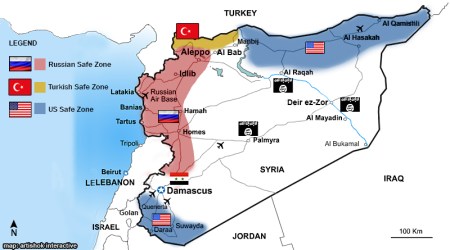
Syria stands on the threshold of dramatic changes that will directly impact on the strategic and military situation along the Syrian borders with Israel and Jordan, DEBKAfile reports exclusively. They derive from a deal struck this week by US President Donald Trump and Russian President Vladimir Putin to establish US, Russian and Turkish security zones in Syria. This scheme will transfer military control of the country to those three powers. Each of them will be responsible for a zone whose borders will be defined and agreed upon by Washington, Moscow  and Ankara.

As part of this arrangement, all forces from the Iranian military, the pro-Iranian Shiite militias and Hizballah will be required to leave Syria.

The US military is to have two security zones – one covering the entire area east of the Euphrates River up to the Iraqi border including Kurdish areas (see attached map). This arrangement will partly resurrect the accord reached in late 2015 by US President Barack Obama and Putin, for the division of Syria into areas of influence. All territory east of the Euphrates was allocated to the US, with Russia taking responsibility for all areas west of the river until the Mediterranean coast.

Under the new deal, the Turkish area is to stretch about 650 kilometers along the entire Syria-Turkey border and extend between 35 and 50 kilometers into Syrian territory up to Al-Bab, the town where the Turkish military is engaged in its third straight month of fighting for its capture from ISIS.

DEBKAfile’s military and intelligence sources report that the overriding change on the ground will be the establishment of a second US security zone adjacent to Syria’s borders with Israel and Jordan. It means that the approximately 7,500 US special operations forces troops currently in Jordan will be shifted northward into southern Syria.

Russia had originally planned to deploy Syrian military, pro-Iranian Shiite militia and Hizballah forces in battles for the capture of land around the cities of Derra and Quneitra on the Syrian side of the Golan. That plan has been dropped and will be superseded by the deployment in southern Syria of US troops accompanied by Jordanian special forces and Syrian rebels, trained by American instructors in Jordanian military camps.

Israelis will breathe a sigh of relief over the removal of the threat of Iranian and Hizballah forces being deployed along their northern border with Syria.

The Trump-Putin deal for Syria and its ramifications are explored in the coming issue of DEBKA Weekly (for subscribers) out Friday, with especially attention to the way it leaves Iran and Hizballah high and dry.

If you are not yet a subscriber, click here to sign on.