Posted tagged ‘Funding terrorism’

Bring Back the Bush Doctrine—with One Addition

March 1, 2015

Bring Back the Bush Doctrine—with One Addition, National Review Online, Andrew C. McCarthy, February 28, 2015

Our enemies are not driven by American foreign policy, our friendship with Israel, our detention of jihadists at Gitmo, or the supposed “arrogance” our current president likes to apologize for. Those are all pretexts for aggression.

Our enemies are driven by an ideology, Islamic supremacism, that is rooted in a classical interpretation of sharia — Islamic law. Islamic supremacism is rabidly anti-American, anti-Western, and anti-Semitic. It rejects the fundamental premise of our liberty: that people are free to govern themselves, rather than be ruled by a totalitarian legal code that suffocates liberty and brutally discriminates against non-Muslims and apostates. And sharia is an actual war on women — denying them equal rights under the law, subjecting them to unthinkable abuse, and reducing them in many ways to chattel.

****************

There is a path to victory in the fight against radical Islam, and our next president should embrace it.

What should be our strategy against ISIS? We ask the question without ever considering Iran. What concessions about centrifuges and spent fuel should we demand to prevent Iran from becoming a nuclear power? We ask the question never linking the mullahs’ weapons ambitions with its sponsorship of the global jihad . . . the only reason we dread a nuclear Iran. What should be the national-defense strategy of the United States against radical Islam, the most immediate and thoroughgoing security and cultural threat we face today?

I had the good fortune to be asked to participate in a CPAC panel Friday on defending America against rogue states. With 2016 hopefuls crowding the halls, it got me to thinking: What should we hope to hear from Republicans who want to be the party’s standard-bearer?

It is often said that we lack a strategy for defeating our enemies. Actually, we have had a strategy for 14 years, ever since the fleeting moment of clarity right after the 9/11 attacks.

That strategy is called the Bush Doctrine, and it remains the only one that has any chance of working . . . at least if we add a small but crucial addendum — one that should have been obvious enough back in 2001, and that hard lessons of history have now made inescapable.

The Bush Doctrine has become the source of copious rebuke. On the left, that’s because of that four-letter word (hint: It’s not “Doctrine”). On the right, there have been plenty of catcalls, too. The reaction, however, has been against what the Bush Doctrine evolved into, not against the Bush Doctrine as it was first announced.

The unadorned Bush Doctrine had two straightforward parts. First, because violent jihadists launch attacks against the United States when they have safe havens from which to plot and train, we must hunt down those terrorists wherever on earth they operate. Second, the nations of the world must be put to a choice: You are with us or you are with the terrorists. Period — no middle ground. If you are with the terrorists, you will be regarded, as they are regarded, as an enemy of the United States.

Before we get to that aforementioned addendum, it is important to remember why the Bush Doctrine was so necessary. For the nine years before it, we were living with the Clinton Doctrine.

That is the doctrine President Obama came to office promising to move us back to — and has he ever. It is the doctrine under which the enemy strikes us with bombs and weaponized jumbo jets, and we respond with subpoenas and indictments. It is the doctrine under which our enemies say, “allahu akbar! Death to America!” and we respond, “Gee, you know America has been arrogant. We can see why you’re so upset.”

The Clinton Doctrine — the one the Democrats will be running on in 2016, perhaps with its namesake leading the way — is the one that gave us a series of ever more audacious attacks through the 1990s: the 1993 World Trade Center bombing; a plot to bomb New York City landmarks such as the Lincoln and Holland Tunnels; a plot to blow American airliners out of the sky over the Pacific; the 1996 Khobar Towers bombing, in which Iran and al-Qaeda teamed up to kill 19 American airmen; the 1998 bombings of our embassies in Kenya and Tanzania that killed over 200 innocent people; detonating a bomb next to our destroyer, the U.S.S. Cole, in October 2000, killing 17 members of the U.S. Navy; and finally, the 9/11 atrocities, killing nearly 3,000 of our citizens.

And what has gradually restoring the Clinton Doctrine gotten us? While President Obama pleads for a deal that will inevitably make Iran a nuclear power, the mullahs continue to back anti-American terrorists and conduct military exercises in which they practice blowing up American ships. The Iraq so many Americans gave their lives for is now an extension of Iran. Afghanistan is being returned to the Taliban, which the president empowers by releasing its commanders. Libya is now a failed state where jihadists murder Americans with impunity and frolic in the former American embassy. Al-Qaeda is expanding through northern Africa, now a bigger, more potent threat than it was on the eve of 9/11. And yet it may pale compared with its breakaway faction, the Islamic State, which now controls more territory than Great Britain, as it decapitates, incinerates, and rapes its way to a global caliphate.

But Obama tells us there’s good news: Yemen is a success . . . or at least it was until it was recently overrun by an Iran-backed militia — oops. Well, we have indicted exactly one of the scores of terrorists who attacked our embassy at Benghazi. He got his Miranda warnings, of course, and he’ll be getting his civilian trial any month now. Hopefully, we’ll do better than Obama’s civilian trial of Ahmed Ghailani, the bomber of our embassies who was acquitted on 284 out of 285 counts.

Is it any wonder we’re losing?

Largely, it is because we’re worried about the wrong things — like whether we can sweep the enemy off its feet with enough Islamophilic, blame-America-first rhetoric. In reality, our enemies could not care less whether we — the infidel West — think their literalist, scripturally based belief system is a “perversion” of Islam. Radical Islam hears only one message from America: strength or weakness. The Clinton Doctrine is weakness cubed.

The Bush Doctrine, by contrast, is the path to victory — if we get that one addendum right.

It is this: Our enemies are not driven by American foreign policy, our friendship with Israel, our detention of jihadists at Gitmo, or the supposed “arrogance” our current president likes to apologize for. Those are all pretexts for aggression.

Our enemies are driven by an ideology, Islamic supremacism, that is rooted in a classical interpretation of sharia — Islamic law. Islamic supremacism is rabidly anti-American, anti-Western, and anti-Semitic. It rejects the fundamental premise of our liberty: that people are free to govern themselves, rather than be ruled by a totalitarian legal code that suffocates liberty and brutally discriminates against non-Muslims and apostates. And sharia is an actual war on women — denying them equal rights under the law, subjecting them to unthinkable abuse, and reducing them in many ways to chattel.

In the “you are with us or you are with the terrorists” view of national security, any Muslim nation, organization, or individual that adheres to Islamic supremacism is on the wrong side. Failing to come to terms with that brute fact is where the Bush Doctrine went awry.

Sharia and Western democracy cannot coexist. They are antithetical to each other. So insists Sheikh Yussuf Qaradawi, the Muslim Brotherhood jurist who is the world’s most influential Islamic scholar. It may be the only thing we should agree with him about.

The Bush Doctrine was allowed to evolve from an American national-security strategy to an illusion that our national security would be strengthened by promoting a chimera — sharia democracy. We put the lives of our best young men and women in harm’s way in the service of a dubious experiment: that we could build stable Islamic democracies that would be reliable American allies against jihadist terror.

Perhaps the worst thing about this experiment is not its inevitable failure. It is the sapping of America’s will that it has caused. Defeating our jihadist enemies is going to require a will to win, because the enemy’s will is strong — the jihadists truly believe Allah has already helped them vanquish the Soviet empire, and that we are next.

The American people vigorously support military operations that are essential to our defense. They support a vigorous war to defeat violent jihadists and their support networks. They understand that we cannot cede our enemies safe havens and nuclear weapons.

They do not support the notion that promoting our national security obliges us to move into hostile Islamic countries for a decade or three to civilize them. That’s not our job. Worse, when Americans become convinced that Washington — ever more remote from the public — thinks it is our job, they will not support military action, even action that is vital to protecting our nation. They will not trust the government to defeat our enemies without becoming entangled in Islam’s endless internal strife.

Understanding Islamic supremacism so we can distinguish allies from those hostile to us will restore the Bush Doctrine. And let’s not be cowed by the critics: Nothing I’ve said means endless war, or that we have to invade or occupy every country. But it does mean we should be using all our assets — not just military but intelligence, law-enforcement, financial, and diplomatic — to undermine regimes that support sharia supremacism. Cutting off that jihadist life-line is the path to victory — just as maintaining a strong military that is allowed to show it means business, that is not hamstrung by irresponsible rules of engagement, is the best way to ensure we won’t have to use it too often.

In Iran, where sharia is the law of the land, they persecute non-Muslims and apostates just like ISIS does. In Saudi Arabia, where sharia is the law of the land, they behead their prisoners just like ISIS does. A candidate who cannot tell liberty’s friends from liberty’s enemies is not fit to be commander-in-chief.

Iran’s Expansive Role In The Middle East And Latin America, And The Nuclear Negotiations

February 28, 2015

Iran’s Expansive Role In The Middle East And Latin America, And The Nuclear Negotiations, Center for Security Policy, Nancy Menges Luis Fleischman, February 26, 2015

(Aside from everything, what’s wrong with letting Iran get and use (or keep and use) nukes?  Afer all, they are “our” partner for peace.)– DM)

333893762

As negotiations move forward on a nuclear arms agreement with the Islamic Republic of Iran, the United States along with the P5+1 appears to be oblivious to activities of Iran in the Western Hemisphere and other regions of the world.

In the Middle East, Iran has most recently supported insurgencies in both Bahrain and Yemen. The pro-Iranian Houthis just overthrew the American backed government in Yemen which we were working with on terrorism related issues.

In Syria, Iran and its proxy, Hezbollah, continue to support the Bashar Al Assad regime with Hezbollah fighting together with Assad’s forces. So far 200,000 people have been killed in Syria with millions dispersed in refugee camps in Jordan and Turkey. Hezbollah now has a perfect excuse to be involved in supporting Assad by invoking the need to defeat the bloody Islamic State. Hezbollah may think that this card could play well in the West which is trying to avoid direct intervention to defeat ISIS and would prefer that local forces to do the fighting.

In Iraq, hundreds of thousands of young Shiites are fighting as part of Iranian-backed militias, with a Shiite sectarian orientation likely to aggravate the sectarian strife prevailing in the country. These militias outnumber the Iraqi security forces, and in addition members of the Iranian revolutionary guards, the pro-Iranian Badr organization, and the pro-Iran Katain Hezbollah are heavily involved, mostly operating outside of Iraqi government control.

In Latin America ever since the election of the late Hugo Chavez to the presidency of Venezuela in 1998, Iran has become more embedded in the region in an effort to spread its influence. Several episodes and activities are illustrative of this point.

A few years ago the late Argentinean prosecutor, Alberto Nisman reported in a 500 page document the presence of Iranian and Hezbollah cells in twelve countries in South America.

For at least ten years if not longer, there have been direct airline flights from Caracas to Tehran. Though these are commercial airlines no passengers are allowed and no one seems to know the cargo they carry but it is believed that weapons and members of Hezbollah or the Iranian Revolutionary Guards might be on those flights. Hezbollah has reportedly trained Venezuelan and other guerillas and has strengthened relations with a number of revolutionary regimes in the region. Likewise, tunnels built across the Mexican-American border are akin to those built by Hezbollah along the Israeli/Lebanese border.

In 2011, U.S. Attorney General Eric Holder accused the Iranian Quds Force of plotting to assassinate the Saudi Ambassador to the United States. Though Iran vehemently denied complicity, the American government pointed to high officials in the Iranian hierarchy with having approved the plan.

Another Iranian activity that goes largely unnoticed is Iran’s outreach to several small Caribbean nations. In return for financial assistance, these nations have issued passports to Iranian citizens who wish to enter the United States but could not do so using their Iranian passports. Venezuela and a number of other countries connected directly or indirectly to ALBA countries are providing passports to Iranians. One of those holding such a passport is Moshen Rabbani, the man believed to be behind the terrorist attacks against the Argentinean Jewish Community Center (AMIA) in 1994.

Iran has also been the recipient of uranium from Venezuela.

Most recently the government of Uruguay confirmed that an Iranian diplomat left the country after Uruguayan security suspected him of collecting intelligence about the Israeli embassy in Montevideo.

The diplomat was thought to have placed an explosive device near the Israeli embassy early in January. The device was not particularly powerful but investigations carried out by Uruguayan intelligence indicated the possibility of Iran’s involvement in this serious incident. It was not clear to the authorities whether the device was intended to do harm or was just testing their ability to respond.

But what is astonishing about this story is that two months earlier another incident occurred which was intentionally kept out of the public eye by the Uruguayan government. Indeed, on November 24, somebody placed a suitcase near the building that belonged to the old Israeli embassy in Montevideo. Although the suitcase was empty, cameras located a car belonging to the Iranian embassy nearby. Inside there was a man that the police could not identify immediately but it was assumed he was an Iranian diplomat. The police concluded that the empty suitcase was aimed at testing Uruguayan security forces’ ability to respond.

The Uruguayan government apparently decided to expel the diplomat, who himself, is an appointee of the former Iranian president Mahmoud Ahmadinejad. That appointee was a vocal anti-Semite, a Holocaust denier and apparently served as a translator in the conversations between Ahmadinejad and the late Venezuelan president, Hugo Chavez. Furthermore, the man was reportedly working in Uruguay with Muslim converts that have been activists in a radical left wing party. These individuals could well have been potential candidates for terrorist recruitment; an activity Iran has been systematically performing.

Interestingly enough, Uruguay has been and is a friendly country towards Iran (without being a close ally like Venezuela and the other ALBA countries). Uruguay’s outgoing president, Jose Mujica, declared in the past that his country would pursue relations with Iran because it is good and convenient for the country. The Uruguayan foreign minister Luis Almagro was a commercial attaché in Teheran for about five years and under his watch commercial relations between the two countries flourished. Likewise, a Uruguayan parliamentary delegation visited Teheran to strengthen relations and Almagro himself defined Uruguay and Iran as “two countries that fight against injustice and oppression”. (Almagro is the most likely candidate to be the next Secretary General of the Organization of American States).

The incident in Uruguay is another instance where Iran once again displays its nature as a terrorist entity that does not hesitate in using its embassies and the good faith of the host countries to apply its lethal methods. This is what Iran did in Argentina previous to the two deadly terrorist attacks against the Israeli Embassy and the Jewish community center.

Why shouldn’t Iran be doing so if there is no demand for Iran to stop supporting and encouraging terrorism? After all, a year ago Argentina signed a memorandum with Iran where representatives from that country would be part of the investigation into a terrorist attack where Iran remains the main suspect. By the same token, the chief investigator of the terrorist attack, Mr. Nisman, is dead because he dared to investigate a suspected cover up by the Argentinean government-a government that allegedly wanted to exonerate Iran.

Furthermore, the Argentinean foreign minister Hector Timerman summoned the American and Israeli Ambassadors and asked that these two countries stop meddling in Argentinean internal affairs and stop bringing Middle East conflicts to Argentina. The irony of this statement is that Iran chose Argentina as the target of its’ own intense hatred and violence.

Iranians probably laugh at these events where they are being given a pass over and over again. So, the fact that Iranians may have considered an attack on the Israeli Embassy in a country that is friendly to them such as Uruguay shows the ruthless nature of the regime and how little relations or agreements mean to them.

The negotiations between Iran and the P 5 +1 are mainly focused on Iran’s nuclear program. Thus, Iran is treated as a partner in a negotiation over a specific issue but Iran’s terrorist and treacherous nature is not a factor being considered in this equation.

At this point the U.S. strategy could well be to try to reach an agreement with Iran where the latter would be allowed to enrich uranium at a low level. However, there could be a possibility that if Iran decides to develop nuclear weapons, it could take the Iranians a short time to develop them from the moment they make the decision to do so.

The examples of Iran’s activities show several negative signs. First, if Iran can betray friendly countries like Uruguay, why wouldn’t it betray the P5+1? Likewise, what makes us think that we can live with a terrorist subversive Iran that not only has good chances of having a dominant role in a post-ISIS Syria and Iraq but also expands its influence and activities beyond the Middle East including regions as far as Latin America (from where Iran can strike the U.S. via a terrorist attack or by placing missiles in friendly countries such as Venezuela or Nicaragua)?

Iran presents a very complex challenge. Iran’s non –nuclear, threat is not being discussed, nor considered. This possible nuclear arms agreement should not be treated, as if it were something comparable to a commercial transaction. After all, as a nation state, Iran for the last thirty five years has been the foremost exporter of terrorism.. As the United States along with the P5+1 continues with its negotiations with Iran, they might question whether as a non-nuclear power, Iran presents a threat to world peace and stability and if so how will that play out once they were to become a nuclear power.

Jury Finds Palestinian Authority Liable for Intifada Terror

February 23, 2015

Jury Finds Palestinian Authority Liable for Intifada Terror, Investigative Project on Terrorism, February 23, 2015

The judgment comes at a particularly difficult time for the Palestinian Authority, already strapped for cash and hoping to secure a place in the International Criminal Court to pursue war crimes charges against Israelis.

****************

Palestinian Authority (PA) policies, including direct financial support to employees convicted by on terrorism charges, and payments to families of those killed waging terrorist attacks, make it liable for damages in attacks which killed wounded Americans, a New York jury decided Monday.

Jurors awarded $218.5 million in damages to the victims and their families. Provisions in the U.S. Anti-Terrorism Act triple that to $655.5 million.

The jury’s award “will not bring back these families’ loved ones, nor heal the physical and psychological wounds inflicted upon them, but it truly is an important measure of justice and closure for them after their long years of tragic suffering and pain,” said Nitsana Darshan-Leitner of Israel’s Shurat HaDin law center, said after the jury award was announced. Darshan-Leitner has helped bring numerous civil cases against sponsors of terrorist attacks, saying the aim here, as in the other cases is “making the defendants pay for their terrorist crimes against innocent civilians and letting them know that there will eventually be a price to be paid for sending suicide bombers onto our buses and into our cafes.”

The judgment comes at a particularly difficult time for the Palestinian Authority, already strapped for cash and hoping to secure a place in the International Criminal Court to pursue war crimes charges against Israelis.

The jury received the case late Thursday, after about six weeks of testimony. They heard from survivors and eyewitnesses to the attacks, which included shooting sprees on Jerusalem streets, suicide bombings and the bombing of a Hebrew University cafeteria. Those attacks killed 33 people and wounded hundreds more.

Targeting civilians was “standard operating procedure” for the Palestine Liberation Organization, its Fatah military wing and the Al Aqsa Martyrs Brigade, plaintiffs’ attorney Kent Yalowitz told jurors when the trial began. Yasser Arafat, the PLO’s longtime chairman and the PA’s president, controlled all those entities.

Arafat’s handwritten consent appears on PA documents detailing the payments to the terrorists and their families that later were seized by Israeli military forces. Those records became key evidence showing the PA’s knowledge and support for the bloody wave of attacks. One 2002 report sent to the PA’s General Intelligence Service chief praised a West Bank squad for its “high quality successful attacks.”

The squad’s “men are very close to us (i.e. to the General Intelligence) and maintain with us continuous coordination and contacts,” the report said.

Many of the attackers and their accomplices were PA employees. Those who were sent to Israeli prisons remained on the PA payroll, with periodic raises depending on the length of their sentences.

Palestinian officials promise to appeal.

Defense attorneys maintained that the terrorists acted on their own and that the PA could not be responsible for the actions of all of its employees. In his closing argument, Yalowitz asked jurors to consider the outrageous nature of such communication.

“If you have a policy that says: If you commit a terrorist act, you keep your job,” gain promotions and keep your pay while serving a prison sentence, “that says something about who you are and what you believe in.”

Hero of the Middle East: Abdel Fattah el-Sisi

February 23, 2015

Hero of the Middle East: Abdel Fattah el-Sisi, The Gatestone InstituteBassam Tawil, February 23, 2015

(Please see also Obama kept reform Muslims out of summit on extremism. — DM)

The courageous, historic speech yesterday by the Grand Imam of al-Azhar University, the seat of Sunni Islam, calling for the reform of Islam, was the result of the even more courageous, historic speech delivered a few weeks ago by Egypt’s devoutly Muslim President, Abdel Fattah El-Sisi.

The Muslim Brotherhood, the current American administration’s great friend, is the poison tree whose fruit is the Islamist terrorism embodied by the ISIS, Al-Qaeda, Hamas, Palestinian Islamic Jihad, Al-Nusra Front, Boko Haram and others.

Apparently some of the Sunni Arab States have not yet realized that their own national security, and ability to withstand Iran, depend on how strong Egypt is.

It is possible, in fact, that U.S. policy is to weaken the Sunni world seeking to unite under el-Sisi’s flag of modernity. With European complicity, the U.S. Administration is trying to defraud the Arabs and turn the Israel-Palestine conflict into a center of Middle Eastern chaos, in order to hide the nuclear deal they are concocting with Iran.

The treachery of the U.S. Administration is the reason why Egypt’s faith in the United States, which is supposed to defend the Arabs against a nuclear Iran, has effectively evaporated.

And now the greatest American insanity of all time: America and Turkey are arming and training Islamist terrorist operatives in Turkey, on the ground that they are “moderates” opposed to Bashar Assad’s regime in Syria. They either ignore or are unaware that there is no such thing as a moderate Islamist terrorist. The other name of the “moderates” opposing Assad is ISIS.

The Muslim Brotherhood, in effect, runs Turkey. According to recent rumors, Turkey is also planning to build a nuclear reactor, “for research and peaceful purposes.”

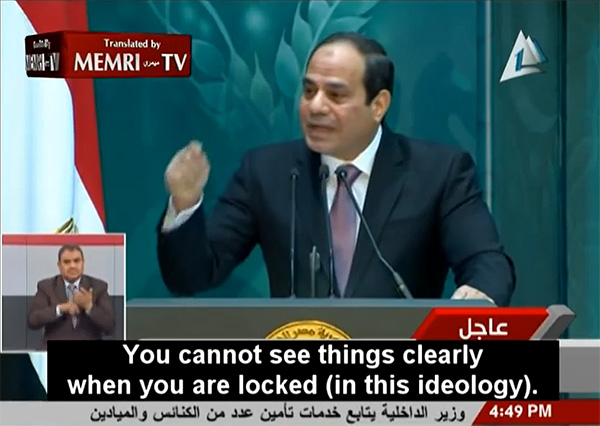
Sheikh Dr. Ahmed al-Tayyeb, the Grand Imam of Cairo’s Al-Azhar University, the seat of Sunni Islam, yesterday delivered a courageous, historic speech in Mecca, Saudi Arabia, urging reform in religious education to curb extremism in Islam. Al-Tayyeb’s address was the result of an even more courageous and historic speech, delivered a few weeks ago by Egypt’s devoutly Muslim President, Abdel Fattah el-Sisi, at Al-Azhar University.

El-Sisi’s monumental statement, truly worthy of a Nobel Prize, is having a seismic result. Al-Sisi directed his remarks, about the ills of Islam to Islamic clerics in Egypt and around the world. It was enormously brave of him. He did not single out radical Islam, but he did call on all Muslims to examine themselves, carry out a religious revolution and renew their faith.

El-Sisi, a man of monumental courage, urged Muslims not to behave according to the ancient, destructive interpretations of the Qur’an and Islam that make the rest of the world hate them, destroy Islam’s reputation and put Muslim immigrants to Western countries in the position of having to fight their hosts. He claimed that it is illogical for over a billion Muslims to aspire to conquer and subdue six billion non-Muslims.

949 (1)Egypt’s President, Abdel Fattah el-Sisi, delivered a historic speech to top Islamic scholars and clergy at Al-Azhar University in Cairo, December 28, 2014. (Image source: MEMRI)

Islam deals in depth with uniting the Muslim nation (umma) and mutual responsibility among Muslims, as though they were one entity. The Prophet Muhammad (S.A.A.W.) said that every drop of Muslim blood is more precious than the entire Kaaba. Thus the liberty ISIS took upon itself to burn alive a Jordanian pilot and 45 Egyptians, to spread terrorism throughout Syria, Iraq and Egypt and to kill other Muslims in various locations around the globe, claiming they were “infidels,” is heresy in and of itself.

The calls for the deaths of “a million shaheeds” and the killing of Jews for the sake of Al-Aqsa mosque in Jerusalem, as was done by Arafat in the past, and is being done now by his heirs in the Palestinian Authority and Hamas, are a crime; they are extremist incitement that is opposed to the forgiving and compromising spirit of Islam. The murder and terrorism carried out by terrorist organizations such as ISIS, Hamas, Palestinian Islamic Jihad [PIJ] and other Islamist organizations against Jews, Christians and other non-Muslims is contrary to the modern Islam needed in the contemporary era.

El-Sisi was correct that the Muslim Brotherhood’s Sunni ideology, which drives most of the extremist Islamist organizations around the world, preaches forced conversion of “infidels” to Islam at any price, or death. Some of the “infidels” are supposed to join Islam of their own accord(targ’ib), out of self-serving interest, and some not of their own accord (tarhib), out of fear and death threats. Such conversions are also contrary to the original Islam, which states that no one is to be forced to convert to Islam and that a calm religious dialogue should be held.

However, a few days after President el-Sisi’s speech, which attempted to unify Muslims and Christian Copts, the Muslim Brotherhood and their affiliated terrorist organizations increased their attacks on Egyptian civilians and security forces throughout Egypt and the Sinai Peninsula, as well as murdering 21 Egyptian Christian Copts in Libya. The Muslim Brotherhood knows that behind the scenes, U.S. President Obama supports the movement, especially the branch in Egypt seeking to overthrow President Sisi. This approval from the U.S. encourages the Muslim Brotherhood to be even more determined to subvert and undermine Egypt’s stability, sabotage its economic rehabilitation and destroy the el-Sisi regime.

In this atmosphere of American support, the Ansar Bayt al-Maqdis terrorist group in the Sinai Peninsula operates under Muslim Brotherhood protection. It recently changed its name to the “Sinai Province” of the Islamic State and swore allegiance to the “Caliph,” Abu Bakr al-Baghdadi. It is currently working hand-in-hand with Hamas in the Gaza Strip to weaken el-Sisi’s Egyptian forces in the Sinai Peninsula.

Other Islamist terrorist organizations also kill Egyptian civilians and security forces with bombs and assault rifles. In the name of the Muslim Brotherhood’s ideology, they indiscriminately attack people on public transport, in airports and in public places, with the intent of retaking control of Egypt.

For this reason, an Egyptian court recently designated Hamas a terrorist organization, along with its military wing, the Izz al-Din al-Qassam Brigades, and outlawed both of them. In response, Qatar, a slippery agent in the service of America but also, treacherously, in the service of Iran, allowed armed Izz al-Din al-Qassam Brigades operatives to be interviewed by its Al-Jazeera TV. The operatives called the Egyptian president a traitor to the Islamic-Arab cause and to those seeking to “liberate Palestine.”

At the same time, Qatar continues to use its Al-Jazeera TV to broadcast hate propaganda targeting the el-Sisi regime, to disseminate videos and to fabricate insulting quotes intended to cause friction between el-Sisi on one side and the leaders of the Arab world and the Gulf States on the other — and to keep them from giving hungry Egyptians economic aid.

As the date for the economic conference in Sharm el-Sheikh (in the Sinai Peninsula) nears, Al-Jazeera’s propaganda machine has moved into ever-higher gear. Apparently, some of the Sunni Arabs states have not yet realized that their own national security and ability to withstand Iran depend on how strong Egypt is.

The U.S. Administration could easily halt the subversion of Egypt, but not only does it turn a blind eye, it suffers from a peculiar form of ignorance that makes it fight ISIS while at the same time supporting the Muslim Brotherhood, the hothouse of most Islamic terrorist organizations, including ISIS. The damage done to Egypt and the cracks in the weak Sunni Muslim ranks in the Middle East will eventually harm American interests and expose the Gulf States to the increasing Iranian threat.

The Muslim Brotherhood, the current American administration’s great friend, is the poison tree whose fruit is the Islamist terrorism embodied by ISIS, Al-Qaeda, Hamas, Palestinian Islamic Jihad, Al-Nusra Front, Boko Haram and others. This linkage has become obvious to all the Arab states, while the U.S. and Europe steadfastly ignore the danger to their own survival, and refuse to outlaw them.

It is possible, in fact, that U.S. policy is to weaken the Sunni world that is seeking to unite under el-Sisi’s flag of modernity. With European complicity, the U.S. Administration is trying to defraud the Arabs and turn the Israeli-Palestinian conflict into a center of Middle Eastern chaos, in order to hide the nuclear deal they are concocting with Iran. That is why the West does not really want to rehabilitate the Palestinian refugees by settling them in the Arab states, and why the West continues to nourish false Palestinian hopes that perpetuate this conflict.

The treachery of the U.S. Administration is the reason why Egyptians’ faith in America, which is supposed to defend the Arabs against a nuclear Iran, has effectively evaporated.

In the meantime, Iran’s Houthi proxies have taken over Yemen, threatening the entire Persian Gulf from the south. The el-Sisi regime is currently in the market for new allies, such as Russian President Vladimir Putin. Putin recently paid a visit to Egypt to examine the possibilities of building a nuclear reactor, sounding the first chord of a regional nuclear arms race.

The problems of the Middle East begin in the United States: that was the claim of participants in the Al-Jazeera TV show, “From Washington.” They described American policy towards Egypt as hesitant, indecisive and undemocratic. They claimed that the U.S. Administration had not yet decided whether or not to support el-Sisi, who heralded change and the willingness to fight radical Islam (a fight America used to participate in) or to remain neutral and waffle, in view of Egypt’s presumed instability. The Americans seem to be putting their all money on the extreme Islamists, who they seem to think will eventually win the bloody conflict currently being waged in Egypt.

The Americans have forgotten that under Mubarak, the regime turned a blind eye to attacks against Israel that were carried out by the Muslim Brotherhood and their carefully fostered agents. Unfortunately, since el-Sisi was elected, Egypt itself has become a victim of radical Islamic terrorism. The U.S. Administration, however, appears clearly to hate el-Sisi, and seems to be doing its utmost to undermine him and see him thrown out.

Under ousted President Mohamed Morsi, Egypt was tolerant and patient toward the U.S. Administration’s best friends, the Muslim Brotherhood, as well as Islamist and Palestinian terrorist organizations such as Hamas, Ansar Bayt al-Maqdis, Al-Qaeda, and Palestinian Islamic Jihad, all of which set up camp in the Sinai Peninsula. These terrorist groups smuggled weapons in from Iran, Sudan, Libya and Lebanon; dug smuggling and attack tunnels; developed missiles and carried out terrorist attacks “only” against Israel, the current U.S. Administration’s other apparent enemy, even though so many American Jews foolishly voted for them.

Now those same Islamist and Palestinian terrorist organizations are striking a mortal blow to the security or Egypt, and killing its civilians and security personnel.

The Muslim Brotherhood, mindful of America’s pro-Islamist policy toward it, is deliberately indulging in a wave of terrorism in Egypt and the Sinai Peninsula. Muslim Brotherhood operatives there are targeting civilians, public transport, airports and natural gas pipelines, all to undermine Egypt’s internal security and bring down el-Sisi’s regime in favor of extremist Islamists and a nuclear-threshold Iran.

In the current international situation, the U.S. Administration has apparently finally cut a deal with Turkey — which will be flimsy and ethereal — that allows Turkey to do the only thing it really cares about: to bring down the regime of Syria’s President, Bashar al-Assad.

The U.S. is also trying to cut a deal with Qatar, which along with Turkey openly supports the Muslim Brotherhood and its terrorist proxies in Egypt, Gaza, Syria and Iraq, who in general work against Western interests.

The ironic result is that Turkey plays host to both NATO and senior Hamas figures, while it deliberately ignores the slaughter by ISIS of Kurds and other ethnic minorities in Iraq and Syria. The Muslim Brotherhood, in effect, actually rules Turkey. Turkey’s President Recep Tayyip Erdogan and his AKP party make it easy for foreign fighters to cross the Turkish border into Syria and join the ranks of ISIS. Meanwhile, the Turkish government wages a diversionary propaganda war against Israel. According to recent rumors, Turkey is also planning to build a nuclear reactor, “for research and peaceful purposes.”

Another surreal result is that Qatar hosts the U.S. military bases, while it finances and encourages terrorist organizations operating against Israel and the Egypt. It also panders to Sheikh Yusuf al-Qaradawi, the spiritual mentor of the Muslim Brotherhood, an Islamist terrorist who issues fatwas permitting the murder of civilians and approves death sentences for apostasy.

And now the greatest American insanity of all time: the U.S. and Turkey are arming and training Islamist terrorist operatives in Turkey, on the grounds that they are “moderates” opposed to Bashar Assad’s regime in Syria. They either ignore or are not aware that there is no such thing as a moderate Islamist terrorist.

The other name of the “moderates” opposing Bashar Assad is ISIS; Iran’s Supreme Leader, Ali Khamenei and Hezbollah’s Hassan Nasrallah are now even saying that the U.S. is arming ISIS.

In the meantime, the Egyptian army continues its struggle against Islamist terrorist targets in the Sinai Peninsula and Libya, unaided, and even undermined, by the U.S.

In view of the U.S. Administration’s collaboration with the Muslim Brotherhood and terrorist organizations in the Gaza Strip, I am persuaded that in the near future it will be possible to find a joint Egyptian-Israeli-Palestinian formula for eradicating the Hamas-PIJ enclave of terrorism, this time by Arabs.

Most ironically of all, in the shadow of American zigzagging, a joint Arab-Israeli front is developing against Sunni and Shi’ite radicalism, and the Palestinians can only profit from it. Thus el-Sisi, who, with towering vision and courage, dares to speak openly about the poison tree of radical Islam and its fruit, when others are afraid, is a truly great Islamic hero.

Obama kept reform Muslims out of summit on extremism

February 21, 2015

Obama kept reform Muslims out of summit on extremism, Washington ExaminerCharles Hoskinson, February 21, 2015

Some of the most prominent reformers have argued for years that the ideological and theological roots of Islamist extremism must be addressed, but administration officials carefully avoided exactly that subject during Obama’s three-day summit.

The White House is also undermining its own efforts by working with people who sympathize with the goals of violent extremist groups, if not their methods, the reformers say.

*****************

The White House excluded members of a prominent group of reformist Muslims from its terror summit this week, apparently because President Obama rejects their argument that such groups as Islamic State of Iraq and Syria are actually motivated by Islam.

A group of 23 prominent Muslim reformers signed a full-page ad in the Sunday New York Times on Jan. 11 asking “What can Muslims do to reclaim their ‘beautiful religion’?”

But Obama and officials throughout his administration deny any connection between Islam and the terrorists beheading and burning their victims in a reign of terror in the Middle East.

Muslim reformers say the administration is ignoring them because they disagree with Obama’s refusal to acknowledge the Islamic roots of the extremists’ ideology.

Some of the most prominent reformers have argued for years that the ideological and theological roots of Islamist extremism must be addressed, but administration officials carefully avoided exactly that subject during Obama’s three-day summit.

The White House is also undermining its own efforts by working with people who sympathize with the goals of violent extremist groups, if not their methods, the reformers say.

“We have to own the issue of extremist Islamic theology in order to defeat it and remove it from our world. We have to name it to tame it,” Muslim journalists Asra Nomani and Hala Arafa wrote in an essay published Friday by the Daily Beast.

“Among Muslims, stuck in face-saving, shame-based cultures, we need to own up to our extremist theology instead of always reverting to a strategy of denial, deflection and demonization.”

Nomani, a former Wall Street Journal reporter, was close friends with her colleague Daniel Pearl, who was kidnapped and beheaded by Islamist extremists in Pakistan in 2002.

At the summit, Obama and other officials insisted there is no link between Islam and the Islamist extremist groups that have been at the forefront of a dramatic spike in terrorist violence worldwide.

“Al Qaeda and [the Islamic State] and groups like it are desperate for legitimacy. They try to portray themselves as religious leaders — holy warriors in defense of Islam,” Obama said Wednesday.

“We must never accept the premise that they put forward, because it is a lie. Nor should we grant these terrorists the religious legitimacy that they seek. They are not religious leaders — they’re terrorists. And we are not at war with Islam. We are at war with people who have perverted Islam.”

The summit aimed at empowering community leaders to help Muslims resist the extremists’ message and improved strategies to communicate a more moderate message. But the administration’s refusal to identify the threat — and the exclusion of those who do from the conversation — works against meeting those goals, reformers said.

Maajid Nawaz, a former Islamist radical andone of those who signed the Times advertisement, is co-founder of the Quilliam Foundation, an anti-extremist British think-tank. The refusal of Obama and his officials to name their real enemy is referred to among reformers as the “Voldemort effect,” after the villain in the Harry Potter books whose name could not be mentioned.

Nawaz told CNN on Wednesday that refusing to address the Islamist ideology directly puts all Muslims at risk of being blamed for the actions of a tiny minority — the exact opposite effect of what Obama intended by his approach.

“When the president said there’s a poisonous ideology that needs to be refuted by Muslim clerics, the average everyday non-Muslim, the only word they know for that is the religion of Islam and they will think that the ideology we are referring to is the faith of Islam itself and thereby they would end up blaming all Muslims,” Nawaz said.

“Islam is a religion like any other with all the various sects and denominations. Islamism is a desire to impose Islam over society. And that is a very theocratic extremist desire. It can manifest itself violently. When it does, I call it jihadism. But it can also manifest itself politically. It’s still a problematic ideology because any desire to impose anyone’s faith over anyone else is inherently flawed and must be challenged,” he said.

“Al Qaeda didn’t inspire extremism. It was this extremist Islamist ideology that inspired al Qaeda. And unless and until we recognize the problem isn’t these Mafiosi-style groups that we can just take out by taking out their leaderships, but it’s the ideology that inspires them, we’ll have a new [Islamic State] tomorrow.”

The ad, by the Gatestone Institute, states, “If Islam is a religion that stands for justice and peaceful coexistence, then the quest for an Islamic state cannot be justified as sanctioned by a just and merciful creator. It is the duty of us Muslims to actively and vigorously affirm and promote universal human rights, including gender equality and freedom of conscience.”

One of the 23 signatories, Tarek Fatah, is a columnist for the Toronto Sun in Canada, and has noted the lack of response from administration officials and journalists.

“Instead of engaging with these progressive Muslims and supporting their call for reform, not only did the White House ignore them, but every media outlet I saw other than Fox News did as well,” he wrote on Feb. 3.

Instead, the White House and many in the mainstream media work with Muslim leaders who sympathize with the extremists, says Zuhdi Jasser, a doctor and former Navy officer who leads the American Islamic Foundation for Democracy.

“This is a Muslim problem that needs a Muslim solution,” he told the Washington Examiner in November. “You can’t just say it’s about violence. You need sermons that call upon America as the leading force for goodness in the world.”

Jasser’s activism against Islamist theocracy recently landed him a prominent role in what the left-wing Center for American Progress calls the “Islamophobia network.” In a report released Feb. 11, the group said Jasser “promotes conspiratorial claims that America is infiltrated by radical Muslims.”

But many so-called mainstream Muslim groups that Jasser has criticized have documented extremist ties. Sympathies with the Muslim Brotherhood, an Egypt-based Islamist movement, landed two U.S. groups, the Council on American-Islamic Relations and the Muslim American Society, on the list of terrorist organizations banned by the United Arab Emirates.

Though both groups vigorously deny extremist sympathies or ties, there is ample evidence that CAIR was founded by supporters of Hamas, the Brotherhood’s Palestinian branch and a banned terrorist organization in the United States, and that the Muslim American Society is the Brotherhood’s U.S. branch.

Aiding Islamic Terrorists Is Our Foreign Policy

February 20, 2015

Aiding Islamic Terrorists Is Our Foreign Policy, Front Page Magazine, Daniel Greenfield, February 20, 2015

s3tttf7n-14138040081-370x350

In the White House, Obama has tried to shape an Islamist future for the Middle East, favoring Islamist governments in Turkey and Islamist movements such as the Muslim Brotherhood. He saw his role as paving the way for the next generation of regional regimes that would be explicitly Islamist.Obama’s foreign policy in the region has been an elaborate exercise in trying to draw up new maps for a caliphate. The inclusion of terrorist groups in this program isn’t a mistake. It’s not naiveté or blindness. It’s the whole point of the exercise which was to transform terrorist groups into governments.

Obama’s foreign policy in the region has been an elaborate exercise in trying to draw up new maps for a caliphate. The inclusion of terrorist groups in this program isn’t a mistake. It’s not naiveté or blindness. It’s the whole point of the exercise which was to transform terrorist groups into governments.

******************

Obama says that we are not fighting a war on Islam. What he leaves out is that under his administration the United States is fighting in a civil war that is taking place within Islam.

It’s not a conflict between the proverbial moderate Muslim and the raging fanatic. That was an outdated Bush era notion. Instead Obama has brought us into a fight between Muslim governments and Muslim terrorists, not on the side of the governments we were allied with, but on the side of the terrorists.

It’s why Egypt is shopping for French planes and Russian nukes. Yemen’s government was run out of town by Obama’s new Iranian friends in a proxy war with Saudi Arabia. And the Saudis are dumping oil.

Iran and Qatar are the regional powers Obama is closest to. What these two countries have in common, is that despite their mutual hostility, they are both international state sponsors of Islamic terrorism.

Obama’s diplomats will be negotiating with the Taliban in Qatar. Among the Taliban delegation will be the terrorist leaders that Obama freed from Gitmo. And Iran gets anything it wants, from Yemen to the bomb, by using the threat of walking away in a huff from the hoax nuclear negotiations as leverage.

In Syria and Iraq, Obama is fighting ISIS alongside Islamic terrorists linked to Al Qaeda and Iran. In Libya, he overthrew a government in support of Islamic terrorists. His administration has spoken out against Egyptian air strikes against the Islamic State Jihadists in Libya who had beheaded Coptic Christians.

At the prayer breakfast where he denounced Christianity for the Crusades was the foreign minister of the Muslim Brotherhood government of Sudan that has massacred Christians. Unlike Libya, where Obama used a false claim of genocide to justify an illegal war, Sudan actually has committed genocide. And yet Obama ruled out using force against Sudan’s genocide even while he was running for office.

The United States now has a strange two-tier relationship with the Middle East. On paper we retain a number of traditional alliances with old allies such as Egypt, Israel and Saudi Arabia, complete with arms sales, foreign aid and florid speeches. But when it comes to policy, our new friends are the terrorists.

American foreign policy is no longer guided by national interests. Our allies have no input in it. It is shaped around the whims of Qatar and Iran; it’s guided by the Muslim Brotherhood and defined by the interests of state sponsors of terror. Our foreign policy is a policy of aiding Islamic terrorists.

It’s only a question of which terrorists.

Obama’s familiar argument is that ISIS and Al Qaeda fighters shouldn’t be called Islamic terrorists. Not even the politically correct sop of “Radical Islam” is acceptable. The terrorists are perverting Islam, he claims. The claim was banal even before September 11, but it bears an entirely new significance from an administration that has put Muslim Brotherhood operatives into key positions.

The administration is asserting the power to decide who is a Muslim. It’s a theological position that means it is taking sides in a Muslim civil war between Islamists.

This position is passed off as a strategy for undermining the terrorists. Refusing to call the Islamic State by its name, using the more derogatory “Daesh,” denying that the Islamic terrorists are acting in the name of Islam, is supposed to inhibit recruitment. This claim is made despite the flood of Muslims leaving the West to join ISIS. If any group should be vulnerable to our propaganda, it should be them.

But that’s not what this is really about.

According recognition to a state is a powerful diplomatic tool for shaping world politics. We refuse to recognize ISIS, as we initially refused to recognize the USSR. Obama resumed diplomatic ties with Cuba. His people negotiate and appease the Taliban even though it was in its own time just as brutal as ISIS.

Obama is not willing to recognize ISIS as Islamic, but he does recognize the Muslim Brotherhood as Islamic. Both are violent and murderous Islamists. But only one of them is “legitimate” in his eyes.

Those choices are not about terrorist recruitment, but about building a particular map of the region. Obama refuses to concede that ISIS is Islamic, not because he worries that it will bring them more followers, this is a tertiary long shot at best, but because he is supporting some of their rivals.

The White House Summit on Countering Violent Extremism has brought a covert strategy out into the spotlight. Despite its name, it’s not countering violence or extremism.

The new director of the Center for Strategic Counterterrorism Communications, the axis of Obama’s CVE strategy, is Rashad Hussain who appeared at Muslim Brotherhood front group events and defended the head of Islamic Jihad. In attendance was Salam Al-Marayati of the Muslim Public Affairs Council, yet another Muslim Brotherhood linked group, who had urged Muslims not to cooperate with the FBI and defended Hamas and Hezbollah.

In Syria, the United States is coordinating with Assad and backing the Syrian rebels, who have their own extensive ties to the Muslim Brotherhood and even Al Qaeda. This could be viewed as an “enemy of my enemy” alliance, but this administration backed the Brotherhood before it viewed ISIS as a threat. Top Democrats, including Nancy Pelosi and John Kerry, had focused on outreach to Assad under Bush.

They’re not allying with Assad and the Brotherhood to beat ISIS. They’re fighting ISIS to protect the Brotherhood and their deal with Iran.

In the White House, Obama has tried to shape an Islamist future for the Middle East, favoring Islamist governments in Turkey and Islamist movements such as the Muslim Brotherhood. He saw his role as paving the way for the next generation of regional regimes that would be explicitly Islamist.

The Arab Spring was a deceptive code name for a clean sweep that would push out the old leaders like Mubarak and replace them with the Muslim Brotherhood and other likeminded Islamists. Islamic terrorism, at least against the United States, would end because their mission had been accomplished.

Stabilizing unrest by putting the destabilizers in charge wasn’t a new idea. Carter helped make it happen in Iran. And the more violent an Islamic terrorist group is, the more important it is to find a way to stop the violence by putting them in charge. The only two criteria that matter are violence and dialogue.

So why isn’t Obama talking to ISIS? Because ISIS won’t talk back. It’s impossible to support a terrorist group that won’t engage in dialogue. If ISIS were to indicate any willingness to negotiate, diplomats would be sitting around a table with headchoppers in less time than it takes a Jordanian pilot to burn.

And that still might happen.

Obama isn’t trying to finish off ISIS. He’s keeping them on the ropes the way that he did the Taliban. Over 2,000 Americans died on the off chance that the Taliban would agree to the negotiations in Qatar. Compared to that price in blood, the Bergdahl deal was small potatoes. And if Obama is negotiating with the Taliban after all that, is there any doubt that he would negotiate to integrate ISIS into Iraq and Syria?

Obama’s foreign policy in the region has been an elaborate exercise in trying to draw up new maps for a caliphate. The inclusion of terrorist groups in this program isn’t a mistake. It’s not naiveté or blindness. It’s the whole point of the exercise which was to transform terrorist groups into governments.

Stabilizing the region by turning terrorists into governments may sound like pouring oil on a fire, but to progressives who believe in root causes, rather than winning wars, violence is a symptom of discontent. The problem isn’t the suicide bomber. It’s our power structure. Tear that down, as Obama tried to do in Cairo, and the terrorists no longer have anything to fight against because we aren’t in their way.

Bush tried to build up civil society to choke off terrorism. Obama builds civil society around terrorists.

Obama does not believe that the terrorists are the problem. He believes that we are the problem. His foreign policy is not about fighting Islamic terrorists. It is about destroying our power to stop them.

He isn’t fighting terrorists. He’s fighting us.

Pentagon spokesman portrays Guantanamo recidivism as a good thing

February 12, 2015

Pentagon spokesman portrays Guantanamo recidivism as a good thing, Long War Journal, Bill Roggio, February 11, 2015

Rear Admiral Kirby is not trying to be satirical. Or is he?– DM)

Yesterday, Pentagon Press Secretary Rear Admiral John Kirby cast a positive light on jihadists from the Taliban and al Qaeda who have been released from Guantanamo and have returned to wage jihad. The topic came up in the discussion of an airstrike that killed Mullah Abdul Rauf Khadim, a senior Taliban commander who was detained at Guantanamo from 2001 to 2007, released to Afghan custody and freed in 2009, and returned to the Taliban shortly afterward to assume the role of a senior military commander up until his defection to the Islamic State earlier this year. Below is the exchange, from the Pentagon’s transcript:

Q: Why was he released?REAR ADM. KIRBY: Joe, I don’t have the records on this guy from — from Guantanamo Bay.

Yes, he was a detainee. He was released in 2007. He was released to Kabul.

The other thing that we’ve said — and this is another great example, because we had a long, you know, discussion not too long ago about the — the recidivism and particularly the issue of this — this one individual who reengaged there in Qatar, and we said that they return to the battlefield and to the fight at their own peril. Mr. Kadim is proof of that.

Kirby’s statement that Khadim’s death should be viewed as a positive is cold comfort to the hundreds of Afghans, Americans, and Coalition personnel who were killed while Khadim commanded forces in southern Afghanistan. The jihadist was able to operate for more than six years as a top level Taliban commander and has the blood of thousands on his hands.

Khadim and Mullah Zakir, another Guantanamo alum (who is still alive; he “resigned due to ill health,” according to the Taliban) were responsible for implementing the Taliban’s counter-surge strategy. While the the jihadist group failed to halt Coalition and Afghan forces’ gains in the south from 2009 to 2011 (gains which are now melting away), at least 875 Coalition members were killed during the fighting in Kandahar (273 killed) and Helmand (602 killed) during that time period, according to iCasualties (note, data on Coalition members killed by province after 2011 is not available on the iCasualties website). The number of Afghan security personnel and civilians killed in Kandahar and Helmand by the Taliban during that timeframe is not available, but is likely in the thousands.

Despite this, Kirby doubles down and says Guantanamo should be closed, which means even more jihadists will be freed.

Q: After seeing such example, like former Guantanamo detainee who was released and went back to the — to work with the Taliban, is the Pentagon still convinced that Guantanamo should be closed?REAR ADM. KIRBY: Yes. The Pentagon’s position is that the detainee facility should be closed. Secretary Hagel has made that clear on any number of occasions. There’s no change to that.


Ben Carson on Obama: ‘Doesn’t Understand What A Basic School Child Might’

February 11, 2015

Ben Carson on Obama: ‘Doesn’t Understand What A Basic School Child Might’, Truth Revolt via You Tube, February 10, 2015


Houthi Yemen coup moves Iran’s Middle East hegemonic ambitions forward – upheld by Washington

February 9, 2015

Houthi Yemen coup moves Iran’s Middle East hegemonic ambitions forward – upheld by Washington, DEBKAfile, February 8, 2015

Houthi_fighters_downtown_Sanaa_5.2.15Victorious Houthi fighters in downtown Sanaa

It is hard for those governments to make up their minds where to look for the most acute menace to their national security – the US-Iranian nuclear deal taking shape, or the give-and-take between Washington and Tehran in Yemen and Iraq. 

******************

The strings of the pro-Iranian Houthi rebels’ coup which toppled the Yemeni government in Sanaa were pulled from Tehran and Washington. US intelligence and shared US-Iranian support helped the Houthis reach their goal, which is confined for now to parts of central Yemen and all of the North.

Friday, Feb. 6, the rebels dissolved parliament and seized power in the country of 24 million. They propose to rule by a revolutionary council. President Abed Rabbo Mansour Hadi and his cabinet who were forced to resign last month are under house arrest.

DEBKAfile’s Saudi intelligence sources reveal that the dominant figure of the uprising was none other than Ali Abdullah Saleh, president of Yemen from 1990 until he was ousted in 2012.

A member of the Zaydi branch of Shiite Islam like the Houthis, he led them to power with the same enthusiasm with which he fought their insurgency during his years in power. By rallying his supporters in the army, intelligence and security services, he enabled the rebels to take over these departments of government and overpower the Hadi regime with only minimal resistance.

They were also able to commandeer $400 million worth of modern American munitions.

The Houthis secretly call themselves “Ansar Allah” and have adopted the “Death to America, Death to Israel” slogans routinely heard in government-sponsored parades and demonstrations on the streets and squares of revolutionary Tehran.

Amid the political turmoil in Sanaa, the US Sunday resumed drone strikes against AQAP.

The six Arab countries of the Gulf Cooperation Council, led by Sunni-ruled Saudi Arabia and the United Arab Emirates, issued a statement Saturday, Feb. 7, calling for the UN Security Council to “put an end to this coup, an escalation that cannot be accepted under any circumstances.”

The Iranian-US gambit has resulted in different parts of Yemen falling under the sway of two anti-American radical forces – the pro-Tehran Houthis and Al Qaeda in the Arabian Peninsula (AQAP).

The new Saudi King Salman starts his reign with a double-barreled threat facing the kingdom from its southern neighbor, Yemen – posed by an Iranian pawn and a proactive branch of Al Qaeda.

Ten days ago, when US President Barack Obama visited Riyadh, the Saudi monarch voiced his concern about the alarming situation developing Yemen. However, Obama replied noncommittally with general remarks.

In Washington, administration spokesmen Saturday tried pouring oil on the troubled waters roiled by US support for the Iranian maneuver in Sanaa and the return of Abdullah Saleh to the Yemeni scene.

“We’re talking with everybody,” one US official said, explaining that the United States was ready to talk to any Yemeni factions willing to fight Al Qaeda.

His colleagues tried to downplay Tehran’s hand in the Houthi coup. “The Houthis get support from Iran, but they’re not controlled by Iran,” said another official in Washington.

Our military and intelligence sources report that Yemen is not the only Middle East platform of the joint US-Iranian military, intelligence and strategic performance. The second act is unfolding in Iraq.

Saudi Arabia, the Gulf emirates, Jordan and Israel are therefore watching the evolving US-Iranian cooperation in fighting al Qaeda’s various affiliates in the region with deep forebodings, lest it is merely a façade for the Obama administration’s espousal of Tehran’s regional ambitions.

It is hard for those governments to make up their minds where to look for the most acute menace to their national security – the US-Iranian nuclear deal taking shape, or the give-and-take between Washington and Tehran in Yemen and Iraq.

Iran president cheers nuclear talks, says deal is getting closer

February 4, 2015

Iran president cheers nuclear talks, says deal is getting closer, Hot Air, Ed Morrossey, February 4, 2015

This deal is a surrender, not just in Iran but throughout the entire region. The only thing missing is the little piece of paper and the declaration of peace in our time.

********************

Hassan Rouhani has plenty of reasons to feel cheerful, as the US attempts to deal its way out of a four-decade standoff with Iran. Secretary of State John Kerry has loosened up billions of dollars to rescue the Iranian economy in exchange for nothing but talk, for one thing. Now, though, it appears that Kerry will cut a deal that not only allows Iran to keep all of its centrifuges, but also grants them de facto hegemony over the Middle East and Afghanistan to boot — and does so behind the backs of our European Union allies.

Smart power:

With time for negotiations running short, the U.S and Iran are discussing a compromise that would let Iran keep much of its uranium-enriching technology but reduce its potential to make nuclear weapons, two diplomats tell The Associated Press.

Such a compromise could break the decade-long deadlock on attempts to limit Iranian activities that could be used to make such arms: Tehran refuses to meet U.S.-led demands for deep cuts in the number of centrifuges it uses to enrich uranium, a process that can create material for anything from chemotherapy to the core of an atomic bomb.

So what’s the solution that Kerry’s offering? A pledge from Iran to, er, not spin the centrifuges really fast. No, that’s actually what this compromise is:

The possible compromise under consideration, according to the AP, would see most of the 10,000 centrifuges in operation left in place but reconfigured so that they would be less productive. One way of doing that would be to spin the centrifuges more slowly. Other measures would be agreed upon to reassure the west that Iran could not make a warhead quickly, such as reducing its stockpile of uranium hexafluoride gas – the form in which uranium can be enriched by centrifuge.

Both the Guardian and the AP note that any change in either centrifuge speed or stocking of uranium hexafluoride gas would be immediately reported by the IAEA to the rest of the world. That, however, ignores the fact that Iran kept its nuclear-weapons program hidden successfully from the IAEA for most of a decade. Pardon us for not exactly considering that a fail-safe.

It also assumes that such a violation would return us to the status quo ante. It wouldn’t, on two levels. First, such a violation would occur when Iran builds its bomb, so by the time word got out, the bomb would almost certainly exists. Second, the current coalition would be very unlikely to reform to oppose Iran’s nuclear-weapons ambitions. It’s fraying at the edges already, or was until oil prices collapsed, and pressures in Ukraine have all but severed Russia from any interest in assisting the West. Cutting a bad deal now would end the effective opposition to Iranian nukes, and Iran knows it.

And what does Iran get for this fig leaf of a concession? Regional domination (via Jeff Dunetz):

According to EU officials, US Secretary of State John Kerry and his Iranian counterpart, Mohammad Javad Zarif, have discussed increasing the number of centrifuges which Iran would be permitted to keep. In exchange, the Iranians would undertake an obligation to bring their influence to bear in order to ensure quiet in Iraq, Afghanistan, and Syria.

European diplomats are quoted by Israeli officials as saying that the US in recent weeks has made significant concessions in its talks with Iran, so much so that it is willing to permit Tehran to operate 6,500 centrifuges while lifting sanctions that have hurt its economy this past decade.

The Europeans have told the Israelis that these concessions were offered in exchange for Iranian promises to maintain regional stability. According to Army Radio, the EU is opposed to the proposed linkage between the nuclear issue and other geopolitical matters. In fact, the Europeans suspect that Washington is operating behind Brussels’ back and that Kerry has not bothered to keep them in the loop in his talks with Zarif.

In other words, the US is about to rubber-stamp Tehran’s domination in Syria, less than two years after Barack Obama wanted to bomb their ally Bashar al-Assad for fighting against the Sunni uprising there. While we’re trying to woo Sunni tribes away from ISIS in Iraq — and working with a coalition of Sunni Arab states to fight them, instead of going there ourselves — Kerry wants to hand off Iraq to Iranian domination. And suddenly we’re ceding our authority in Afghanistan to the mullahs in Tehran, to boot.

Jeff pulls out the Chamberlain umbrella to explain the inexplicable:

A nuclear Iran is not only a threat to Israel but thanks to a missile deal with Russia, a threat to  Europe and the US mainland.  Beyond the threat from Iran directly, as one of the largest supporter of terrorism in the world Iran may very well share a nuclear weapon with Hezbollah, ISIS,  its on -again buddy Hamas, or one of the other terrorist groups it supports.

President Obama is willing to sacrifice our safety and the safety of much of the world to give him a legacy of being a peacemaker, but it is more likely that like Neville Chamberlain before him, this President’s legacy will be as an appeaser who created many more deaths than he tried to save.

This deal is a surrender, not just in Iran but throughout the entire region. The only thing missing is the little piece of paper and the declaration of peace in our time.