Posted tagged ‘Foreign Policy’

Why ‘Operation: Decisive Storm’ is Iran’s worst nightmare

March 29, 2015

Why ‘Operation: Decisive Storm’ is Iran’s worst nightmare, Al ArabiyaMajid Rafizadeh, March 28, 2015

(Al Arabiya is Saudi owned. — DM)

[B]y the U.S. being so concentrated on a nuclear deal and President Obama being so focused on leaving behind a historic legacy regarding a nuclear deal with Iran, the unintended consequences of such an inefficient foreign policy are being ignored and overshadowed. Although the U.S. has military bases in the region, it has evidently chosen to ignore Iran’s military expansion.

********************

Often, scholars and politicians have made the argument that regional powers in the Middle East are opposed to a nuclear deal between Iran and the six world powers due to the nuclear technicalities of the deal or restoring relationships between Tehran and the U.S. Nevertheless, this premise fails to shed light on the underlying concerns, nuances and intricacies of such a nuclear deal as well as Iran’s multi-front role in the region.

The underlying regional concerns are not primarily linked to the potential reaching of a final nuclear deal with the Islamic Republic or easing of ties between the West and Tehran. At the end of the day, regional powers would welcome and be satisfied with a nuclear deal that can ratchet down regional tension, eliminate the possibility of the Islamic Republic to become a nuclear state, and prevent a nuclear arms race.

But what is most worrying is the expanding empire of the Islamic Republic across the Arab world from Beirut to Baghdad, and from Sanaa to Damascus, as the nuclear talks reach the final stages and as no political will exists among the world powers to cease Iran’s military expansion.

Establishing another proxy in Yemen

Iran’s Quds forces have long being linked to the Houthis. The Islamic Republic continues to fund and provide military support to the Houthis (by smuggling weapons such as AK-47s, surface-to-air missiles as well as rocket-propelled grenades) in order to establish another proxy in the Arab world.

Iran’s long-term strategic and geopolitical objectives in Yemen are clear. The Islamic Republic’s attempt to have a robust foothold near the border of Saudi Arabia, as well as in the Gulf Peninsula, will tip the balance of power in favor of Tehran.

By empowering the Houthis, Tehran would ensure that Saudi Arabia is experiencing grave national security concerns, the possibility of conflict spill-over, and internal instability. In addition, by influencing Yemeni politics through the Houthis, Iranian leaders can pressure Saudi Arabia to accept Iran’s political, strategic and economic dominance in Iraq, Syria, and Lebanon as well.

The latest advancement of the Houthis supported the interests of the Islamic Republic until recently. There was a need for robust action against Iran’s hegemonic ambitions. Nevertheless, the West was resistant to act.

From geopolitical, strategic and humanitarian perspective, the robust military action, Operation Decisive Storm, is a calculated and intelligent move to send a strong signal to the Islamic Republic that its interference in another Arab state will not be overlooked. In other words, Arab states do not have to wait for the West to act against Iran’s covert activities and support for Shiite loyalist-militias in the region.

The tightening grip over another Arab capital

As the nuclear talks between Britain, China, France, Russia and the United States – the five permanent members of the Security Council – plus Germany (P5+1) and the Islamic Republic appear to show progress towards a final agreement to curb Iran’s nuclear ambitions, the world powers (specifically the United States) have chosen to turn a blind eye on Iran’s military expansion in the Arab states, and particularly in Yemen.

Iran’s long term strategic and geopolitical agenda should not be overlooked. Iranian leaders’ hegemonic ambition is to consolidate and strengthen its grip on the Arab states, and to have control over Arab capitals from Beirut to Baghdad and from Sanaa to Damascus.

The Islamic Republic’s ambitions to expand its empire during the nuclear talks and regional insecurities are carried out through several platforms. Central figures, such as Quds Force commander General Qassem Soleimani, hardliners such as Ali Reza Zakani, Tehran’s representative in the Iranian parliament and a close figure to the Iranian supreme Leader Ayatollah Ali Khamenei, and the Supreme Leader himself, play a crucial role in fulfilling Iran’s regional hegemonic ambitions.

Iranian leaders are not even concerned about repercussions from boasting about their grip over Arab capitals. Zakani recently bragged about having control over Arab capitals, “Three Arab capitals have today ended up in the hands of Iran and belong to the Islamic Iranian revolution”. He added that Sanaa will soon be under the grip on the Islamic Republic as well. According to him, most of Yemen’s territories will soon be under the power of the Shiite group, the Houthis, supported by the Islamic Republic.

The second platform that the Islamic Republic utilizes is sponsoring, financing, equipping, training and advising loyalist and heterodox Shiite groups across the region. The number of these militia groups is on the rise and they operate as a pawn to serve the geopolitical, strategic, economic, ideological and national interests of the ruling clerics.

America’s lack of political willingness to act

As the Islamic Republic creates such Shiite groups across the region to “protect” Arab capitals, Tehran centralizes its power across the region. In addition, after the creation of new Shiite groups, the elimination of these proxies will not be a simple task, for they will be ingrained in the socio-political and socio-economic fabric of the society.

In addition, these loyalist militia groups are game changers in the region, tipping the balance of power further in favor of the Islamic Republic and its regional hegemonic ambitions.

The expansion of Iran’s military and loyalist-militia groups in the region transcends Tehran’s political ambitions. The ideological tenet of this expansion and of Tehran’s overall growing regional empire (under the banner of Popular Mobilization Forces: an umbrella institution of Shiite armed groups) are crucial facets to analyze.

More fundamentally, as the final nuclear deal approaches, and as Tehran witnesses the weakness of Washington and other powers when deciding to overlook Iran’s militaristic and imperialistic activities in the region, Tehran has become more emboldened and vocal when it comes to its military expansion.

Iranian leaders boast about their role in Arab states projecting Tehran as a savior for the Arab world. As Zakani stated, according to Iran’s Rasa new agency “had Hajj Qassem Soleimani not intervened in Iraq, Baghdad would have fallen, and the same applies to Syria; without the will of Iran, Syria would have fallen”.

Nevertheless, by the U.S. being so concentrated on a nuclear deal and President Obama being so focused on leaving behind a historic legacy regarding a nuclear deal with Iran, the unintended consequences of such an inefficient foreign policy are being ignored and overshadowed. Although the U.S. has military bases in the region, it has evidently chosen to ignore Iran’s military expansion.

The concerns of regional countries about the nuclear deal is not solely linked to the nuclear technicalities of the deal or Iran-West rapprochement, but are primarily related to Iran’s growing empire as well as the consequences of such a nuclear deal leading Tehran to apply more assertive and expansionist foreign policy in the region.

Regional robust actions such as Operation Decisive Storm are sometimes required in order to set limits to Iran’s hegemonic, imperialistic objectives, and interference in other Arab states’ affairs, as well as in order to prevent the destabilizing effects emanating from the growing militia rebels sponsored by the Islamic Republic.

US surrender on breakout time to a bomb leads to breakthrough on a nuclear deal

March 29, 2015

US surrender on breakout time to a bomb leads to breakthrough on a nuclear deal, DEBKAfile, March 29, 2015

Kerry-0bama_IranObama and Kerry hash over nuclear deal with Iran

President Barack Obama and John Kerry promised that the nuclear deal to be signed with Iran in Switzerland this week will give the world powers a year’s warning after the Islamic Republic’s breakout up to an operational weapon. DEBKAfile’s intelligence sources disclose that, to clinch the framework deal in Lausanne, even this concession, which imperils Israel, the Gulf and the Middle East at large, was not enough. In a further surrender, the president authorized the US delegation to fall back again on the space granted the world powers for reacting to breakthrough, dropping it from a year to six or seven months:

Our nuclear experts explain why even that grim arithmetic does not do full justice to the advantages Iran has gained for its push to a nuke:

1.  Because Iran is permitted to continue running up to 6,500 elderly IR-1 centrifuges for enriching uranium to a low 3.5 percent grade, even if it is permitted to keep only 500 kilos of its stock of 7.5-8 –tons, Tehran would still be able to build a bomb in 7-8 months, i.e. a lot faster than Obama and Kerry have promised.
2.  But if Tehran activates secret facilities undetected by US intelligence, it can produce a larger quantity of enriched uranium and so shrink the time between breakout and bomb to three, at most, four months, totally insufficient for the world powers to detect, step in and abort the bomb’s manufacture, in view of the following considerations:

— To obtain proof that Iran is cheating on its accord with the world powers, “environmental” samples would have to be obtained and tested in laboratories outside Iran. Results would be available only after two months, further slashing the time line for stopping Iran building a weapon. But that is not all.
— If Iran is shown by the first round of tests to be in violation of the accord and enriching uranium to a higher grade than 3.5, a second batch of “environmental” samples must be collected to analyze the exact quantities of uranium illicitly enriched and grade of purity.

There goes another month of valuable time for action, cutting it down to 10-12 weeks.

3. And, finally, the US President, Secretary of State and International Atomic Energy leaders have affirmed Iran’s faithful compliance with the first interim nuclear accord – known as the Joint Plan of Action – JPOA – that was signed in Geneva November 2013.

That information is equally false.

It is a fact which is known to intelligence agencies that Iran never complied with its commitment to reduce its UF6 stocks below 7.5 tons and convert added amounts to harmless oxides. Indeed, they estimate that Iran has enlarged its approved amount of stock to 8.5 tons or more, by means of the “creep-out” strategyit has repeatedly pursued in the past to conceal its nefarious nuclear activities.

3.  A final concession which Iran has managed to wring out of the six world powers led by Washington allows Tehran to keep an extra 9,000 IR-1 centrifuges Tehran idle – though not dismantled – and permission to continue research and development on high-speed IR-8 or IR-5 centrifuges.

This mans thatn the Islamic Republic will not only keep its nuclear infrastructure under the accord the six powers plan to sign, but add improvements along with the freedom to shorten at will the critical time lapse between breakout and bomb.

The tons of spoken and printed verbiage poured out on the Iranian nuclear issue and ongoing diplomacy year after year have exposed, rather than disguised, President Obama’s willingness to sign a nuclear deal with Iran – however bad and whatever the price.

The inescapable conclusion is that the US president has come around to accepting the reality of a nuclear-armed Iran. As seen from Washington, America never stopped India, Pakistan and North Korea from becoming nuclear powers, and has therefore decided it can live with a fourth – Iran.

Iranian Defector: ‘U.S. Negotiating Team Mainly There to Speak on Iran’s Behalf’

March 29, 2015

Iranian Defector: ‘U.S. Negotiating Team Mainly There to Speak on Iran’s Behalf’, Weekly StandardDaniel Halper, March 28, 2015

(If the report is accurate, it explains quite a lot about the direction in which the “negotiations” have been going. — DM)

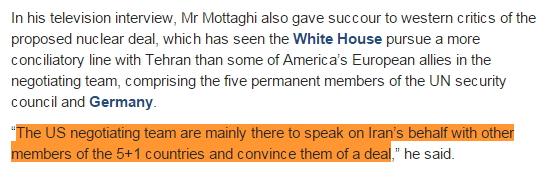
An Iranian journalist writing about the nuclear negotiations between the United States and Iran has defected. In an interview Amir Hossein Motaghi, has some harsh words for his native Iran. He also has a damning indictment of America’s role in the nuclear negotiations.

“The U.S. negotiating team are mainly there to speak on Iran’s behalf with other members of the 5+1 countries and convince them of a deal,” Motaghi told a TV station after just defecting from the Iranian delegation while abroad for the nuclear talks. The P 5 + 1 is made up of United States, United Kingdom, Russia, China, France, plus Germany.

CBNkmdFVIAADMpl
CBNk6T0WsAAEI1T

Abbas Calls on Arab States to Attack Hamas

March 28, 2015

Abbas Calls on Arab States to Attack Hamas, Israel National News,  Ari Yashar, March 28, 2015

(Unlikely, but what would Obama say? — DM)

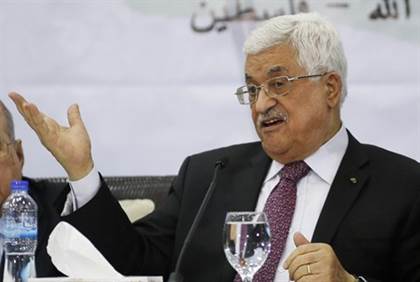
574415Mahmoud Abbas Reuters

Abbas urges ‘same policy’ of Yemen airstrikes to be used by Arab League in ‘Palestine,’ after his adviser calls for ‘iron’ blow to Hamas.

Palestinian Authority (PA) Chairman Mahmoud Abbas used the platform of the Arab League summit in Sharm el-Shekh, Egypt, this Saturday to attack his “unity partner” Hamas, making a subtle call for the Arab states to take military action against the Gaza-based Muslim Brotherhood offshoot.

Speaking at the 26th summit in the southern Sinai peninsula, Abbas made reference to the campaign of airstrikes launched last Thursday by Saudi Arabia and other Arab countries against Iran-backed Shi’ite Houthi rebelsin Yemen – the Houthis have overthrown the government while rapidly expanding their control.

“I hope that the Arab countries will take the same policy they employed in Yemen for all Arab countries suffering from internal conflict – like Palestine, Syria, Libya and Iraq,” Abbas said according to Yedioth Aharonot, in an open jab at Hamas in Gaza.

Making Abbas’s comments calling for military intervention in “Palestine” all the more pointed is the fact that just two days earlier, Abbas’s adviser on Religious and Islamic Affairs Mahmoud Al-Habbash, who also serves as PA Supreme Sharia (Islamic law) Judge, made similar remarks.

Al-Habbash urged the Arab countries to take action and strike Hamas with an “iron fist,” in an open call for military intervention.

Hamas and the PA signed a unity deal last April, which has done little to damper the enmity raging between the rivals ever since Hamas violently seized control of Gaza in 2007 – the most obvious example of the how the deal has not changed tensions was when Hamas tried to stage a coup against the PA in Judea and Samaria last year.

Responding to Al-Habbash, Hamas said the comment is “a dangerous and not nationalist call.”

Abbas’s call for Arab intervention comes after Arab foreign ministers meeting in Egypt last Thursday declared the establishment of a joint Arab military force, reportedly meant to rapidly respond to security threats to Arab nations.

Arab League secretary-general Nabil al-Arabi was assigned with coordinating the details with the chiefs of staff of the various Arab armies within one month, so as to work out the logistics of establishing the new force.

NBC’s Engel: Officials Say Allies: Simply Don’t Trust” U.S. Under Obama Admin – The Five

March 28, 2015

NBC’s Engel: Officials Say Allies: Simply Don’t Trust” U.S. Under Obama Admin – The Five, Fox News via You Tube, March 27, 2015

(In other breaking news, today is Saturday, unexpectedly. Please see also, Iranian general in Sanaa to organize Yemen rebel counter-offensive for Saudi-led attacks.  — DM)


US continues to insist airstrikes support Iraqi forces, not Shiite militias

March 26, 2015

US continues to insist airstrikes support Iraqi forces, not Shiite militias, Long War Journal, Bill Roggio, March 26, 2015

(Perhaps it’s just Obama’s unrequited love for Iran and his need to get any nuke deal that Iran will give him. — DM)

US government officials and top military commanders are so eager to destroy the Islamic State that they are crawling into bed with the flip side of the jihadist coin: the fanatical Shiite militias backed by Iran that are terrorist organizations and ultimate destabilizers of Iraq in their own right.

*****************

Combined Joint Task Force-Operation Inherent Resolve (CJTF-OIR), the US-led Coalition that is launching airstrikes against the Islamic State in Iraq and Syria, announced that it conducted 17 strikes against Islamic State fighters entrenched in Tikrit. US commanders continue to insist that they are supporting Iraqi security forces, and not the Iranian-backed Shiite militias who make up more than two-thirds of the fighting force in the Tikrit offensive.

The 17 airstrikes targeted “an ISIL [Islamic State] building, two ISIL bridges, three ISIL checkpoints, two ISIL staging areas, two ISIL berms, an ISIL roadblock and an ISIL controlled command and control facility,” according to a press release. The US military continues to refer to Islamic State as ISIL, the outdated acronym for the Islamic State of Iraq and the Levant (Syria).

The airstrikes launched “in support of Iraqi Security Forces in Tikrit commenced last night after a request from the Government of Iraq,” CJTF-OIR stated. The 17 targets hit in the last 24 hours were “approved by the Iraqi Ministry of Defense.”

US military officials have previously said that support for the Tikrit offensive was being withheld because of the massive presence of the Iranian-backed militias and Iranian military units and advisers.

Despite this previous acknowledgment, Lieutenant General James Terry, the commander of CJTF-OIR, skips over the presence of Shiite militias in the Tikrit operation [emphasis mine] in the latest statement.

“The ongoing Iraqi and Coalition air strikes are setting the conditions for offensive action to be conducted by Iraqi forces currently surrounding Tikrit,” said Lt. Gen. James Terry. “Iraqi Security Forcessupported by the Coalition will continue to gain territory from Daesh [a vaguely pejorative Arabic acronym for the Islamic State].” [Emphasis in original — DM]

Pretending that US airpower isn’t supporting the Iranian-backed Shiite militias obviously doesn’t make it so.

US military officials’ denials that they are serving as the air force for Iranian-backed Shiite militias that are responsible for killing hundreds of American soldiers before US forces withdrew from Iraq in December 2011 becomes even more perplexing once you understand that many of the top leaders of these militias have been designated by the US as terrorists. And one of these militias (Hezbollah Brigades) is listed as a Foreign Terrorist Organization. [See LWJ report, US begins airstrikes against Islamic State in Tikrit, supports Shiite militias.]

US government officials and top military commanders are so eager to destroy the Islamic State that they are crawling into bed with the flip side of the jihadist coin: the fanatical Shiite militias backed by Iran that are terrorist organizations and ultimate destabilizers of Iraq in their own right.

Saudi Arabia puppet of US, Israel: Houthi leader

March 26, 2015

Saudi Arabia puppet of US, Israel: Houthi leader, Press TV (Iranian), March 26, 2015

(The positions of Obama’s friends in Iran. How soon will he bow, apologize and make more concessions to Iran to atone for his sins? — DM)

bbc72135-d3b0-4924-91b3-4c85d14cbc21Tribal gunmen loyal to the Houthis Ansarullah shout slogans against Saudi Arabia during a gathering in the capital Sana’a on March 26, 2015.

The leader of Yemen’s Houthi fighters has heaped scorn on Saudi Arabia for conducing unjust and heinous attacks on Yemeni people, saying the Arab kingdom is serving as a puppet for the United States and the Israeli regime.

Abdul-Malik al-Houthi made the remarks in a televised address on Thursday in reaction to Saudi Arabia’s “unjustified” deadly attacks targeting Yemeni people in the capital, Sana’a.

Saudi Arabia is a puppet at the disposal of superpowers, the Houthi leader said, adding that Riyadh is putting in action the US-Israeli conspiracy in Yemen.

He noted that the US-Israeli plot in Yemen aims to break up the chaotic country and deprive people of security and freedom.

Al-Houthi said the Saudi invasion of Yemen came after their agents, including al-Qaeda terrorists and the ISIL Takfiri terrorists, failed to execute their plots in Yemen.

He said the “criminal” attacks uncovered the “tyrannical” nature of the Saudi regime.

Al-Houthi warned that Saudi Arabia would face consequences should it push ahead with its aggression against Yemen, saying, “We will confront the criminal forces and their tools in the country.”

“You think you can kill Yemeni people, but this is because of your stupidity,” he said. “This unjustified aggression shows the hostility and arrogance of this regime. The attacks are reflecting the inhumanity of the aggressor.”

Al-Houthi said the “aggressors” should keep in mind that the Yemeni people are “committed to defending their country and revolution” by relying on God.

On Thursday, Saudi warplanes carried out fresh airstrikes against Yemen, hitting the northern cities of Sa’ada and Ta’izz in the south.

Airstrikes also targeted arms depots in the Malaheez region in Sa’ada near the border with Saudi Arabia.

Saudi warplanes started bombing the positions of the Ansarullah fighters and launched attacks against the Sana’a International Airport and the Dulaimi airbase early on Thursday.

Despite Riyadh’s claims that it is attacking Ansarullah positions, Saudi warplanes have flattened a number of homes near the Sana’a airport. Based on early reports, the Saudi airstrikes on Yemen have so far claimed the lives of 18 civilians with more deaths feared, Yemeni sources said.

The Saudi invasion of Yemen has drawn condemnation from many countries such as Iran, Russia, Iraq and Syria, as well as the Lebanese resistance movement, Hezbollah.

The blatant invasion of Yemen’s sovereignty by the Saudi government comes against a backdrop of total silence on the part of international bodies, especially the United Nations. The world body has so far failed to show any reaction whatsoever to the violation of the sovereignty of one of its members by Riyadh.

Daylight: The Story of Obama and Israel

March 26, 2015

Daylight: The Story of Obama and IsraelEmergCmteForIsrael via YouTube, March 3, 2012

(A flashback to Obama’s 2009 candidacy — Israel is good and great and I support her completely — through March of 2012. Obama’s animosity toward Israel has increased dramatically since then. Now, Israel has more support from many Arab nations than does Obama.  Hat tip to Joop klepzeiker.– DM)


Gulf states, abandoned against Iran

March 26, 2015

Gulf states, abandoned against Iran, Israel Hayom, Dr. Reuven Berko, March 26, 2015

(At least the Gulf States are awakening. That’s a good start. — DM)

The West’s weakness and apathy toward Iran and the perilous predicament it has created in Yemen again prove the flimsy nature of those security and defense treaties. This lesson justifies Israel’s approach, which is based on the ability to defend itself on its own. In the meantime, following the Houthi takeover, Saudi Arabia has decided to deploy a massive military force along the border with Yemen. The first shot is in the chamber and the finger is already on the trigger.

**********************

Shiite Iran’s increasing involvement in Iraq, Syria and Lebanon, while exploiting the Shiite elements of the population in those target countries, is causing a great deal of concern among leaders of Arab Gulf states. The trauma of Iran’s attempt to topple the regime in Bahrain, where most of the population is Shiite, under the claim that Bahrain is Iran’s 14th province, is still fresh in their minds. The Iranian goal of using Bahrain as a bridgehead from which to spread across the Arabian Peninsula is still in play, despite Iran’s first effort being blocked in March 2011, when some 1,000 Saudi troops and 500 policemen from the United Arab Emirates entered Bahrain to save its regime.

Ever since Saddam Hussein’s sudden invasion of Kuwait, the Gulf states — Saudi Arabia, Oman, Kuwait, Qatar, Bahrain and the UAE — realized the need for a type of “Al Jazeera defense force” to pose a strategic deterrent against Iranian machinations on the peninsula. Their effort has not been a success. Through its latest intervention, via the mobilization of Shiite Houthi tribesmen to capture key targets in Yemen, including the primary port cities and airports in the south of the country leading to control of the Gulf of Aden, Iran is clearly reiterating its ambition of acquiring the straits of Hormuz and Bab el-Mandeb, which will allow Iran to paralyze the Red Sea and Persian Gulf waterways.

Arab stagnation combined with the West turning a blind eye to this Iranian aggression, alongside the willingness of Western powers to sign a deal allowing Iran to acquire a nuclear bomb, is causing sleepless nights among those Arab leaders who are again pushing the need to upgrade the capabilities of the “Al Jazeera defense force.”

Considering the lack of trust in the West and Yemen’s expected fall to the Houthis, the leaders of the Arab Gulf states are again working, feverishly, to build the military capability to curb Iran. As early as December 2009, with the goal of protecting the integrity of Arab territories situated in the Arabian Peninsula, the Arab League decided to establish a massive, unified, heavily funded, rapid-reaction military force comprising hundreds of thousands of troops and naval capabilities, capable of posing a deterrent and striking a decisive blow on the battlefield. Morocco and Jordan were also added to this coalition, as strategic depth, but the initiative ultimately failed to gain traction.

The recent gathering of these partner states in Riyadh gave birth to a multitude of agreements, including support and aid to Egypt, which is considered the strongest true military force in the Sunni Arab Middle East. Additionally, Saudi Arabia has lobbied for Pakistani support in the aftermath of Yemen’s inevitable fall, or worse, when Iran completes its nuclearization with American consent.

As the West falls victim to the fraud peddled by Mohammad Javad Zarif, Iran’s foreign minister, the Arabs (and Israel) have no illusions about Iran’s true intentions. Even as the Bahrain crisis was unfolding, the threats issued by many of Iran’s highest-ranking defense establishment officials — whether in the regime, the military or the Shura (parliament) — reflected the hostile nature of Iran’s foreign policy, and removed any doubt in the minds of neighboring Arab leaders.

Many of the Gulf states with signed security and defense pacts with the West, namely the United States, are currently feeling abandoned. Ever since the events in Bahrain, and to a greater degree following the recent developments in Yemen, the realization is growing in the Gulf that Iran’s aggressive goals and ambitions regarding the Arabian Peninsula have not changed and that they must take care of themselves.

The Arabs have recently come to the realization that not only will they not receive aid from the West in their hour of need, but that the West is forging a deal with Iran at their expense — a deal that will pose the greatest threat to their security. The situation that has been created provides an opportunity for Israel, even if clandestinely, to play a part in the geostrategic plans being formulated by states in the region, and which could help lead to an agreeable deal on the Palestinian issue — which is rather secondary in the current pan-Arab context.

The West’s weakness and apathy toward Iran and the perilous predicament it has created in Yemen again prove the flimsy nature of those security and defense treaties. This lesson justifies Israel’s approach, which is based on the ability to defend itself on its own. In the meantime, following the Houthi takeover, Saudi Arabia has decided to deploy a massive military force along the border with Yemen. The first shot is in the chamber and the finger is already on the trigger.

Obama’s Kabuki dance with Iran fueling mullahs’ hegemony in Middle East

March 26, 2015

Obama’s Kabuki dance with Iran fueling mullahs’ hegemony in Middle East, BreitbartJames Lyons, March 25, 2015

(The present House of Representatives, despite a Republican majority, is very unlikely to bring a bill of impeachment. If it did the present Senate, despite a modest Republican majority, would not convict; that would require a two-thirds majority of the Senators present. We are stuck with Obama at least until January of 2017– DM)

ap_ap-photo681-640x426The Associated Press

The current Kabuki dance ongoing in Geneva between Secretary of State John Kerry and Iranian Foreign Minister Mohammad Jamad Zarif regarding an agreement on Iran’s nuclear weapons program is a sham. Its outcome was pre-ordained many years ago by President Obama in his secret communications with the Iranian mullahs in 2008– at least according to one report.

These secret communications were exposed in a August 29, 2014 article written by Michael Ledeen in PJ Media and drew little attention then, but now must be addressed. According to Ledeen, shortly after Barack Obama clinched the Democratic nomination for president on June 3, 2008, he also opened a secret communication channel to the Iranian mullahs.  The message was that they should not sign any nuclear agreement with the Bush administration on preventing Iran from achieving a nuclear weapon capability. He informed them that he would be much easier to deal with once he assumed the presidency. He further assured the mullahs that he was a “friend” of the Iranian theocracy and that they would be very happy with his policies.

Today, Iran is the world’s leading state sponsor of terrorism that has been “at war” with the United States since the 1979 takeover of our Tehran U.S. Embassy. Since then, Iran has directed many “acts of war” against the United States that have cost the loss of thousands of American lives. Most importantly, Iran provided the key material and training support to the 9/11 hijackers, which cost the lives of 3,000 innocent Americans.

The secret channel was conducted through Ambassador William G. Miller, who previously served in Iran during the Shah’s reign. The Ambassador confirmed to Ledeen the aforementioned communications he personally held with the Iranian mullahs on behalf of candidate Obama during the 2008 campaign. The Iranian mullahs apparently believed the message since on July 20, 2oo8, the New York Times reported “Nuclear Talks with Iran End on a Deadlock.”  The main reason was that Iran would not address the “international demands that it stop enriching uranium.”  What a surprise!

The shocking fact is that candidate Obama secretly told the Iranian mullahs not to make a deal until he assumed the presidency, according to Ledeen’s report. They would then be able to make a much better agreement with him – and that’s exactly what’s happening. Some would consider what candidate Obama did was treason.

President Obama abandoned the requirement that Iran stop enriching uranium.  The result has been that Iran’s nuclear program has been greatly expanded with more secret underground facilities and expanded capability during the course of the long, drawn out negotiations. When the interim agreement, called the “Joint Plan of Action,” was announced in late 2013, the Iranian president openly bragged that the West had finally acknowledged Iran’s right to its uranium enrichment program.

Iran’s chief negotiator, Foreign Minister Zarif, furthermore bragged that Iran “did not agree to dismantle anything; not its centrifuges; not its ballistic missile program; not its nuclear programs.”  It also did not give up its role as the leading state sponsor of terrorism. By his cooperation with Iran in combatting the Islamic State, he is actually sanctioning de facto Iranian hegemony throughout the Persian Gulf region.

Andy McCarthy, in his book Faithless Execution, lays out a very detailed and logical case for President Obama’s impeachment. Even Liberal law professors are now talking about Obama’s many abuses of power, too many to list here.  A summary of President Obama’s extensive violations of law and dereliction of duty are covered on pages 11-26 of Faithless Execution. President Obama’s use and abuse of power is clearly out of control. We are in a Constitutional crisis.

The Constitution vests in the House of Representatives “the sole power of impeachment.”  With a Republican controlled House of Representatives, a simple House Majority can vote out articles of impeachment. However, successfully impeaching a president means removing him from office. Removal requires the president’s conviction on articles of impeachment by a two-thirds vote of the Senate. Even with a Republican controlled Senate, this will require much work.

Clearly the Speaker of the House of Representatives must start the process. If the current Speaker is unable to find the courage to start the impeachment proceedings, then he should resign. The House members should elect a new Speaker who is prepared to live up to his Oath of Office and protect the Constitution. The survival of America as we know it, as the shining city on the hill, must come first before any party politics.