Posted tagged ‘Foreign Policy’

Obama’s Foreign Policy of Empty Words

September 9, 2014

Obama’s Foreign Policy of Empty Words, Front Page Magazine, September 9, 2014

(Obama’s words have rarely contained substance, even facially. 

Suppose Obama were to surprise the world with words not empty but full of apparent substance. His words, at times, appeared to be substantively meaningful but turned out not to have been. Might it be too late for him to sway the decreasingly free and democratic world now, regardless of what he might say? Perhaps we will find out on Wednesday, when he makes a speech about dealing with the Islamic State. — DM)
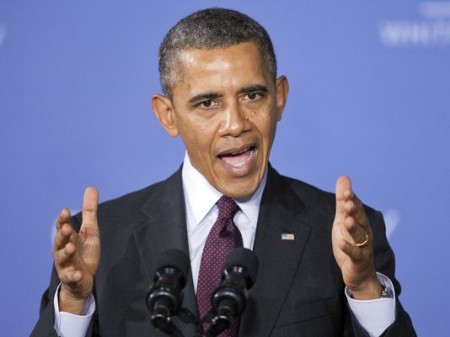
Obama's empty words

To paraphrase Demosthenes, the greater this administration’s ready tongue, the greater distrust it inspires in our allies, and the greater boldness it creates in our enemies. Or to put it in my old man’s more earthy terms when I smarted off, “Don’t let your mouth write checks your ass can’t cash.” Obama has been bouncing foreign policy checks from Ukraine to the South China Sea, and most points in between.

**************************

That line from John Ford’s classic The Man Who Shot Liberty Valance contains wisdom everyone from peasant to king knew before our modern age and its smug illusions. Go back 2,400 years, and you can hear it from the Athenian orator Demosthenes as he chastises his fellow citizens for responding to Macedonian aggression by “forever debating the question and never making any progress” and issuing “empty decrees.” “All words, apart from action,” Demosthenes warned, “seem vain and idle, especially from Athenian lips: for the greater our reputation for a ready tongue, the greater the distrust it inspires in all men.” We’ve had several years now of watching Obama and his foreign policy team prove this eternal truth as they have feebly and fecklessly responded to crisis after crisis in Ukraine, Syria, and a dozen other venues.

Just in the last few weeks we have heard a lot of bluster about Islamic State, the rampaging jihadists in northern Iraq who have left in their wake a trail of traditional Muslim mayhem–- sectarian cleansing, forced conversion, slaving, rape, torture, slaughter, and Koran-inspired beheadings, including two American journalists. In response to these decisive deeds, Obama has thundered that he will “degrade and destroy” the “cancer.” In an op-ed co-written with British Prime Minister David Cameron, he has vowed that the allies “will not be cowed by barbaric killers.” His vice president Joe Biden, with his usual trite hyperbole, has threatened, “We will follow them to the gate of hell until they are brought to justice.” And Secretary of State John Kerry, after the beheading of journalist James Foley, has warned, “The world must know that the United States of America will never back down in the face of such evil. ISIL and the wickedness it represents must be destroyed, and those responsible for this heinous, vicious atrocity will be held accountable.” “By whom” is the question the passive voice artfully leaves unanswered.

To paraphrase Demosthenes, the greater this administration’s ready tongue, the greater distrust it inspires in our allies, and the greater boldness it creates in our enemies. Or to put it in my old man’s more earthy terms when I smarted off, “Don’t let your mouth write checks your ass can’t cash.” Obama has been bouncing foreign policy checks from Ukraine to the South China Sea, and most points in between.

Indeed, the deeds necessary to back these loud boasts have been few. That should not surprise us, since Obama has said and done much to tell the world that we will not act decisively, relying instead on verbal processes and gestures of force like bombing some trucks to create a telegenic illusion of action. He started his presidency with the “apology tour,” on which he called the U.S. “arrogant, dismissive, derisive,” confessed that we are “still working through some of our own darker periods in our history,” proclaimed that we “will be willing to acknowledge past errors where those errors have been made,” confessed that “too often we set [our] principles aside as luxuries that we could no longer afford” and so “we went off course,” and promised that we “are working to improve our democracy.” How could such a tainted and flawed state have the moral authority to act with the confidence and decisiveness that his recent rhetoric implies?

Likewise his domestic deeds have undercut the capacity to enforce his tough foreign policy words. Because of cuts to the military budget––inspired in part by his desire to reduce the U.S. to merely one unexceptional member of an international coalition that supposedly can maintain global order and create collective security––our military capacity is destined “to be an increasingly hollow force,” as Bret Stephens writes, “with the Army as small as it was in 1940, before conscription; a Navy the size it was in 1917, before our entry into World War I; an Air Force flying the oldest—and smallest—fleet of planes in its history; and a nuclear arsenal no larger than it was during the Truman administration.”

Commensurate with this undercutting of America’s armed forces have been Obama’s empty bluster and careless language, something dangerous coming from the Commander-in-Chief of the greatest military power in history. “Leading from behind” in Libya, the vanishing “red line” in Syria, the juvenile scolding of Putin “that in the 21st century, the borders of Europe cannot be redrawn with force, that international law matters,” the “no strategy” gaffe about the “jayvee” jihadists of the Islamic State–– all were instantly refuted and discredited by facts on the ground created by hard men of brutal action. Libya is not a democracy, but the jihadist version of Road Warrior. Syria’s Bashar al Assad is winning in Syria by slaughtering close to 200,000 men, women, and children. The Islamic State still controls northern Iraq and Syria, and still sits at the gates of Baghdad. And Putin has snatched Crimea and is closing in on eastern Ukraine. Throw in Obama’s penchant for berating allies like Israel, ignoring the interests of others like Jordan, Egypt, and Saudi Arabia, undercutting vulnerable states like Poland and the Czech Republic, and appeasing genocidal mullahs in Iran, and is it any surprise that his words “inspire greater distrust” in everyone except our enemies?

Of course, Obama’s habit of using words to substitute for politically risky deeds is universal in the West. We just saw a NATO confab in which a lot of big talk for the reporters end up so much smoke when the details are parsed. NATO leaders have agreed “to establish a so-called spearhead force of several thousand troops designed to move into trouble spots at short notice,” as The Wall Street Journal reported. Talk about closing the barn door after the Russian bear has got loose. I’m sure Putin is trembling over the thought of “several thousand” NATO troops that someday might materialize to stop his adventurism. If NATO isn’t acting now, what makes anyone think this special “spearhead force” will act in the future, even if NATO members do create it? As Charles Krauthammer writes, the force “is a feeble half-measure. Not only will troops have to be assembled, dispatched, transported and armed as the fire bell is ringing, but the very sending will require some affirmative and immediate decision by NATO. Try getting that done. The alliance is famous for its reluctant, slow and fractured decision-making.”

And haven’t we heard this sort of braggadocio before from Europe? Remember the 60,000-man “rapid reaction force” the EU was going to create so that they could avoid any further embarrassment of having “cowboy” Americans pull their foreign policy irons out of the fire, as happened in Bosnia and Kosovo? Given that only three European NATO members honor the 2% of GDP minimum for military spending, it’s unlikely that the money for creating this alleged “deterrent” will ever be budgeted, not with EU economies in the doldrums, and widespread grumbling over “austerity” budgets. No wonder that, as the Journal reports, “most details of the force . . . remained to be settled.” But don’t worry, NATO leaders have “committed” to spending the 2% on defense they “committed” to in 2002 and subsequently ignored. Better read the fine print: the commitment is non-binding and will be implemented over a 10-year period. Who knows how much more of the old Soviet Empire Vladimir will have taken back by then.

“Word, words, words,” as Hamlet says. But words useful for politicians who want to avoid the risk and uncertainty of action, and don’t want to face disgruntled voters at the polls. And when this perennial calculus is joined to the progressive belief that an exploitative, racist, neo-imperialist America is disqualified by its sins from being the guarantor of global order and stability, you get the world we are rapidly becoming––a Darwinian jungle of feral violence, illiberal hegemons, thug-nations, and nuclear-armed terrorist states.

Qatar’s ties with US deterring Israel from all-out diplomatic offensive, official says

August 25, 2014

Qatar’s ties with US deterring Israel from all-out diplomatic offensive, official says

By HERB KEINON 08/25/2014 18:14

The Israeli official’s comments came a day after the “New York Times” published an op-ed piece by Israel’s ambassador to the UN calling Qatar the “Club Med for Terrorists.”

via Qatar’s ties with US deterring Israel from all-out diplomatic offensive, official says | JPost | Israel News.

 A MUST READ !

President Mahmoud Abbas, Emir of Qatar Sheikh Tamim bin Hamad al-Thani and exiled Hamas leader Khaled Mashaal arrive for a meeting in Doha. Photo: REUTERS
 Israel has not launched a full-court diplomatic campaign against Qatar for aiding and abetting terrorism because of concern that the closeness of US-Qatar ties would render such a campaign futile, according to a senior diplomatic official.

The official’s comments came a day after the New York Times published an op-ed piece by Israel’s ambassador to the UN calling Qatar the “Club Med for Terrorists.”

“In recent years, the sheikhs of Doha, Qatar’s capital, have funneled hundreds of millions of dollars to Gaza,” Prosor wrote. “Every one of Hamas’s tunnels and rockets might as well have had a sign that read ‘Made possible through a kind donation from the emir of Qatar’.”

Even though that is the case, and even as Prime Minister Binyamin Netanyahu continues to raise Qatar’s negative role in private meetings with US Congressman and world leaders, the senior diplomatic official said that there is no concerted campaign that has been accompanied by directives to Israel’s representatives abroad to underline Qatar’s singularly negative role in supporting terrorism and in the Gaza crisis.

Prosor’s piece, he said, was the envoy’s own “improvisation” and not part of a bigger Israeli diplomatic push against the Persian Gulf country.

Qatar is too big an ally of the US and the West, the official said, and any such campaign would be tantamount to “banging our heads on the wall.” He said Jerusalem is not interested in going “toe-to-toe “with Washington over the issue.

Qatar is the home of the US Central Command’s Forward Headquarters and the Combined Air Operations Center, and is the location of three US air bases, including its largest one in the Middle East. It also recently signed contracts to purchase some $11 billion in US arms and weapons systems.

Nevertheless, Netanyahu – in a meeting last week with US Rep. Darrell Issa (R-California) – did raise the subject of Qatar’s support of Hamas. As chairman of the House Oversight and Government Reform Committee, Issa is in a prime position to put Qatar’s role high on the agenda in Washington.

However, Foreign Minister Avigdor Liberman, in an interview earlier this month with The Post, cautioned against exaggerating the leverage Qatar has over the terrorist organization.

Qatar was hosting Hamas and other terrorist organizations in Doha, and funding them handsomely, to ensure that they only operate outside Qatar, Liberman said. He characterized this as Qatar paying “protection money” to the terrorist organization.

“It is paying protection money in order to ensure security and quiet and calm inside Qatar, so they would work only outside,” he said. “I don’t know how much they are able to influence Hamas. I think Hamas has more influence on Qatar, than Qatar does on Hamas.”

Prosor, known for his sarcasm, wrote in the Times, after mentioning the tiny country’s petrol billions, that “it is time for the world to wake up and smell the gas fumes. Qatar has spared no cost to dress up its country as a liberal, progressive society, yet at its core, the micro monarchy is aggressively financing radical Islamist movements.”

He said that the “petite petrol kingdom” needed to be isolated internationally.

“In light of the emirate’s unabashed support for terrorism, one has to question FIFA’s decision to reward Qatar with the 2022 World Cup,” he said, stopping just short of launching a campaign to strip Qatar of the right to host the marquee soccer event.

Given Qatar’s alliances and influence, Prosor wrote, the prospect for many western countries of isolating Qatar is “uncomfortable.” Yet, he added, “they must recognize that Qatar is not a part of the solution but a significant part of the problem. To bring about a sustained calm, the message to Qatar should be clear: Stop financing Hamas.”

Obama’s Hubris is His Undoing

August 18, 2014

Contentions Obama’s Hubris is His Undoing

Jonathan S. Tobin | @tobincommentary 08.17.2014 – 8:00 PM

via Obama’s Hubris is His Undoing « Commentary Magazine.


Historians will have the rest of the century to unravel the mess that is the Barack Obama presidency. While they can explore these years of foreign policy disaster and domestic malaise at leisure, the rest of us have 29 more months to see just how awful things can get before he slides off to a lucrative retirement. But those who want to start the post-mortem on this historic presidency would do well to read Jackson Diehl’s most recent Washington Post column in which he identifies Obama’s hubris as the key element in his undoing.

As our Pete Wehner wrote earlier today, the president’s reactions to what even Chuck Hagel, his less-than-brilliant secretary of defense, has rightly called a world that is “exploding all over” by blaming it all on forces that he is powerless to control. As Pete correctly pointed out, no one is arguing that the president of the United States is all-powerful and has the capacity to fix everything in the world that is out of order. But the problem is not so much the steep odds against which the administration is currently struggling, as its utter incapacity to look honestly at the mistakes it has made in the past five and half years and to come to the conclusion that sometimes you’ve got to change course in order to avoid catastrophes.

As has been pointed out several times here at COMMENTARY in the last month and is again highlighted by Diehl in his column, Obama’s efforts to absolve himself of all responsibility for the collapse in Iraq is completely disingenuous. The man who spent the last few years bragging about how he “ended the war in Iraq” now professes to have no responsibility for the fact that the U.S. pulled out all of its troops from the conflict.

Nor is he willing to second guess his dithering over intervention in Syria. The administration spent the last week pushing back hard against Hillary Clinton’s correct, if transparently insincere, criticisms of the administration in which she served, for having stood by and watched helplessly there instead of taking the limited actions that might well have prevented much of that country — and much of Iraq — from falling into the hands of ISIS terrorists.

The same lack of honesty characterizes the administration’s approach to the Israel-Palestinian conflict and the nuclear negotiations with Iran, two topics that Diehl chose not to highlight in his piece.

Obama wasted much of his first term pointlessly quarreling with Israel’s government and then resumed that feud this year after an intermission for a re-election year Jewish charm offensive. This distancing from Israel and the reckless pursuit of an agreement when none was possible helped set up this summer’s fighting. The result is not only an alliance that is at its low point since the presidency of the elder George Bush but a situation in which the U.S. now finds itself pushing the Israelis to make concessions to Hamas as well as the Palestinian Authority, a state of affairs that guarantees more fighting in the future and a further diminishment of U.S. interests in the region.

On Iran, Obama wasted years on feckless engagement efforts before finally accepting the need for tough sanctions on that nation to stop its nuclear threat. But the president tossed the advantage he worked so hard to build by foolishly pursuing détente with Tehran and loosening sanctions just at the moment when the Iranians looked to be in trouble.

On both the Palestinian and the Iranian front, an improvement in the current grim prospects for U.S. strategy is not impossible. But, as with the situation in Iraq, it will require the kind of grim soul-searching that, as Diehl points out, George W. Bush underwent in 2006 before changing both strategy and personnel in order to pursue the surge that changed the course of the Iraq War. Sadly, Obama threw away the victory he inherited from Bush. If he is to recover in this final two years in office the way Bush did, it will require the same sort of honesty and introspection.

But, unfortunately, that seems to be exactly the qualities that are absent from this otherwise brilliant politician. Obama is a great campaigner — a talent that is still on display every time he takes to the road to blame Republicans for the problems he created — and is still personally liked by much of the electorate (even if his charms are largely lost on conservative critics such as myself). But he seems incapable of ever admitting error, especially on big issues. At the heart of this problem is a self-regard and a contempt for critics that is so great that it renders him incapable of focusing his otherwise formidable intellect on the shortcomings in his own thinking or challenging the premises on which he has based his policies.

Saying you’re wrong is not easy for any of us and has to be especially hard for a man who has been celebrated as a groundbreaking transformational figure in our history. But that is exactly what is required if the exploding world that Obama has helped set in motion is to be kept from careening even further out of control before his presidency ends. The president may think he’s just having an unlucky streak that he can’t do a thing about. While it is true that America’s options are now limited (largely due to his mistakes) in Syria and Iraq, there is plenty he can do to prevent things from getting worse there. It is also largely up to him whether Iran gets a nuclear weapon or Hamas is able to launch yet another war in the near future rather than being isolated. But in order to do the right things on these fronts, he will have to first admit that his previous decisions were wrong. Until he shed the hubris that prevents him from doing so, it will be impossible.

EU ministers in search for united front on arming Iraq

August 15, 2014

EU ministers in search for united front on arming Iraq Conference of European foreign ministers in Brussels also to include discussion of situation in the Gaza Strip

By Alex Pigman August 15, 2014, 2:08 pm

via EU ministers in search for united front on arming Iraq | The Times of Israel.


Flags outside the European Union in Brussels (photo credit: Flickr/BY 2.0/motiqua )
 

russels (AFP) — EU ministers convened in Brussels on Friday in a rare summertime meeting to seek unanimous approval for the shipment of arms to Iraqi Kurds fighting Islamic State jihadists.

France and Britain have already moved ahead with plans to provide weapons to beleaguered Iraqi forces, but French Foreign Minister Laurent Fabius pushed for the talks to mobilize an EU-wide response to the crisis in Iraq.

“I asked for this meeting so that all of Europe mobilizes and helps the Iraqis and Kurds,” Fabius said as he arrived for the talks.

Italy, which currently holds the EU’s rotating leadership and whose foreign minister Federica Mogherini is shortlisted to become the next EU foreign affairs chief, also called for talks.

“The Kurds need our support,” she said as she arrived at the meeting.

“It is important for us that there be a European agreement,” she added.

Defense matters are strictly the purview of member states and the push for an EU stance to send arms to a conflict zone is a rare one.

But alarming images of Iraqi minorities, including Christians, under siege by jihadists have struck chords in European capitals.

EU governments are also alarmed by the Islamic State’s ability to attract radicals from Europe who then return home to the West battle-hardened.

Ahead of Friday’s meeting, support for a strong message on arming Iraq was growing, even from member states historically less inclined to back military adventures abroad.

Usually cautious Germany this week pledged to work “full-speed” on the supply of “non-lethal” equipment such as armored vehicles, helmets and flak jackets to Iraq.

Germany is a major arms manufacturer and going into the meeting, Foreign Minister Frank-Walter Steinmeier seemed ready to boost German action, despite national restrictions limiting arms exports to raging conflicts.

“Europeans must not limit themselves to praising the courageous fight of the Kurdish security forces. We also need to do something first of all to meet basic needs,” he said.

Sweden, which is usually reluctant to participate in military missions, stressed, however, that the EU’s “great power is in its humanitarian response.”

“Other countries have power to do other things,” said Swedish Foreign Minister Carl Bildt.

Current EU foreign policy chief Catherine Ashton, who officially convened the meeting, had been criticized earlier in the week for the bloc’s slow response to the unfurling crisis in Iraq.

But a senior European official, speaking in the run-up to the talks on Thursday, deplored the “distorted” view of a shut-down EU in August.

This was “at best unfair,” he said. The European Union “is not on holiday.”

Earlier this week, the European Commission announced it would boost humanitarian aid to Iraq to 17 million euros ($22 million), and gave the green light for special emergency measures to meet the crisis.

But Humanitarian Affairs Commissioner Kristalina Georgieva, who is also attending the meeting, said the real challenge in helping civilians was access, not funding.

Also on the agenda will be the crises in Ukraine and the Gaza Strip and a request by Spain to address the Ebola outbreak in West Africa.

FRIEDMAN: As The Middle East Burns, The UN Simply Blames Jews

August 14, 2014

FRIEDMAN: As The Middle East Burns, The UN Simply Blames JewsBoth the media and the United Nations are willing to legitimize Hamas while reprimanding Israel for defending herself against an existential threat

.8.14.2014 Israel Revolt Truth Revolt

via FRIEDMAN: As The Middle East Burns, The UN Simply Blames Jews | Truth Revolt.


Yesterday, Hamas broke yet another cease-fire, only hours after Israel had agreed to extend the lull in the fighting. On Monday, the United Nations announced the creation of a special three-person Human Rights Council panel that will review allegations of human rights and international law violations occurring in the current Israel-Gaza conflict. One of the members of this panel has openly stated that Prime Minister Benjamin Netanyahu would be his favorite person to have tried in the International Criminal Court. This council is supposed to be unbiased and impartial. While the United Nations was busy focusing all its energy on these allegations, they forgot to discuss a few other crises occurring in the Middle East.

In Iraq:

Over the last year and a half, the terrorist organization known as the Islamic State of Iraq and Syria, an Al-Qaeda splinter cell, has taken control of large swaths of territory via violent means. At a glance:

Over 13,300: is the number of civilians killed by ISIS since the beginning of 2013

6,000: is the number of Iraqi civilians butchered by ISIS this year

500: is the number of Yazidis (a Kurdish Iraqi minority) killed by ISIS, some of which were buried alive

0: is the number of practicing Christians left in Mosul, a city that is now controlled by ISIS; ISIS has made Christianity punishable by death, thus forcing all Christians to either convert or flee.

As ISIS is carrying out targeted killings against minority groups and Iraqi Christians, it is safe to say that they are successfully carrying out genocide in Iraq. Unlike the Israel-Gaza conflict, this crisis has gone almost unmentioned for the last year and a half, even though scores of more people have been killed in Iraq than in the current Israel-Gaza conflict.

In Syria:

More than 170,000: is the number of people killed since start of the civil war

More than 54,000: is a conservative estimate of the number of civilians killed in the Syrian Civil War

More than 14,100: is the number of women and children killed in the Syrian Civil War

More than 1800: is the number of Palestinian-Arabs killed in the Syrian Civil War

The media scarcely reports on the ongoing civil war that is still raging in Syria; this past July was one of the deadliest months of the conflict thus far. It is of note that the United Nations has stopped updating its count of the Syrian death toll; it claims it cannot verify the sources behind the numbers. Essentially, they refuse to take the time to verify the sources and keep track of the death toll.

Last but not least, for the sake of comparison, Israel:

Approximately 87,000: is the number of Palestinian-Arabs killed in the Israeli-Arab conflict since 1948. More people have died in the last three years alone in the Syrian Civil War, but these victims have largely been forgotten by the international community.

More than 3500: is the number of rockets launched at Israel since the start of Protective Edge, each one of which constitutes an attempt to murder Israeli civilians. This is a war crime.

Approximately 1900: is the number of Palestinian Arabs killed since the start of Protective Edge.

Approximately 900-1300: is the estimated number of Palestinian-Arabs civilians killed amongst the 1900 total. The lower number is that estimated by the IDF, while the higher number is that estimated by Palestinian sources, many of which are run by Hamas. There are varying other estimates that fall between these numbers.

Recently, reports have surfaced that disprove the claim that the majority of the people killed in this conflict have been Palestinian civilians. In fact, research done by both the BBC as well as an Israeli research group indicates that the numbers of civilians and militants killed may be closer to equal. This is not a means to justify the number of civilians killed, because loss of innocent life is terrible. However, it is unfair and unjust to inflate figures merely to claim that one party’s response is disproportionate to the other’s actions. If the validity of war were judged based on the number of casualties on each side, then the Allies would bear the blame for World War II.

As for the allegations Israel of committing war crimes, indiscriminately ordering strikes within Gaza and violating human rights:

4,762: is the number of terror targets the IDF struck between July 8 and August 5. Again, without trying to justify loss of civilian life and using the larger estimates for the number of civilian casualties, this works out to one civilian killed for every 3.6 strikes. If Israel were truly indiscriminately targeting Palestinian civilians, the number of civilians killed in each strike would be much higher.

Additionally, the mainstream media often states that the Gaza Strip is one of the most densely populated areas on Earth, and Hamas only fires from civilian areas because of this fact. This is a distortion of the truth.

Here is the salient point:

Information recently released by the Gatestone Institute indicates that while the city centers of Gaza are very densely populated, there are many emptier areas of Gaza. Mainstream media outlets never show these areas because there is scarcely fighting there. Additionally, maps that show the origin of rocket attacks show that almost none of the attacks originate in these empty areas. This begs the question, if Hamas were concerned with Gaza’s civilians, why not fire rockets from these emptier areas? Why fire them from some of the most populated areas in the world? The answer is that as a terrorist organization, Hamas has no regard for civilians of any kind.

Up to this point I have refrained from addressing the claim that Hamas uses the civilians of Gaza as human shields. There is real and jarring evidence to support this claim. Hamas hides behind the civilians of Gaza by choosing to launch rocket attacks from densely populated areas and leaves the IDF no choice but to carry out strikes in these areas. Hamas does this knowing that images of deceased civilians will flood TV screens throughout the world, and that the international community will cry out in rage against Israel. Hamas has the option to set up their headquarters in empty areas of Gaza instead of in hospitals and homes, but has repeatedly choose the latter. By making this choice, Hamas bears the blame for the loss of civilian life and is committing war crimes.

Lastly, during Operation Protective Edge, Israel provided the following supplies to Gaza:

40,550: is the number of tons of supplies transferred to Gaza

37,178: is the number of tons of food transferred to Gaza

1,694: is the number of tons of humanitarian goods transferred to Gaza

1,029: is the number of tons of medicine and medical supplies transferred to Gaza

1,856: is the number of trucks needed to carry these supplies

Many of these supplies were delivered via the Kerem Shalom crossing, which has been repeatedly attacked with barrages of Hamas rockets in order to prevent these aid shipments from entering the Gaza Strip. So even though Israel has been more than willing to give assistance to the people of Gaza, Hamas will not allow them to have it.

Given the force with which the United States carried out its strikes against terrorists in Afghanistan and Iraq, there is no doubt that they would have responded in the same manner to a barrage of rockets raining down on the United States homeland. Additionally, the United States has renewed airstrikes against ISIS in Iraq and is being credited not only with further securing the homeland, but with saving the lives of civilians in Northern Iraq. These airstrikes serve the same purpose to the people of the Iraq as Operation Protective Edge does to the people of Israel: to protect the lives of civilians against terrorist attacks. Throughout history, there have been numerous cases of countries striking back at terrorists in order to secure the safety of their people. In the larger majority of these instances, civilians have died, as war is mayhem. No other country in the world is forced to live under the constant fear that Israel lives with day in and day out, and yet no other country in the world has faced the amount of backlash that Israel continues to receive in the name of self-defense.

When the mainstream media reports on ISIS, they waste no time calling them a dangerous terrorist organization that must be stopped. ISIS and Hamas are incredibly similar; they are both extremist groups perverting the beliefs of a peace-loving religion to further their cause. It is truly mind-boggling that the mainstream media is willing to ignore this fact, as is the United Nations. Both the media and the United Nations are willing to legitimize Hamas while reprimanding Israel for defending herself against an existential threat. At the end of the day, all Israel wants is to live in peace with her neighbors; this operation must continue so that Israel is able to do just that.

Ashley Friedman is a 2014 graduate of the University of Miami with a Bachelor of Science in Biology. She is a proud Zionist and dual Israeli-American citizen.

Verdict on UN Security Council Emergency Session? Not Terrible.

July 19, 2014

Verdict on UN Security Council Emergency Session?

Not Terrible.Friday’s emergency session of the UN Security Council ended with the news that Secretary General Ban Ki-Moon will fly to the region in an effort to broker a ceasefire.

By: Lori Lowenthal MarcusPublished: July 19th, 2014

via The Jewish Press » » Verdict on UN Security Council Emergency Session? Not Terrible..


U.N. Secretary-General Ban Ki-moon Photo Credit: VOA
 

The United Nation Security Council held an emergency session on Friday to address the escalation of violence between Gaza and Israel.

U.N. Undersecretary Jeffrey Feltman spoke at the beginning of the session. He announced that U.N. Secretary General Ban Ki-Moon will be arriving in the region tomorrow, Saturday, July 20, in an attempt to help rein in the hostilities.

Feltman also mentioned several points raised by acting leader of the Palestinian Authority, Mahmoud Abbas. He said Abbas believes the PA should be ensuring security along the Philadelphi corrider, and that there has to be one entity in charge of both all Palestinian Arabs, including those in Gaza.

At the conclusion of his statement, Feltman waxed rhapsodic about the holy grail of the “peace process:” the creation of a Palestinian State so that the “Two State Solution” can herald the dawning of the era of peace and harmony.

And then, as if cynics were writing the script instead of people who actually believe this malarky, the U.N. ambassador from “Palestine” spoke, making it crystal clear that the Palestinian Arabs have no interest in anything like peace with Israel.

The representative from “Palestine,” Riyad Mansour, launched into an invective-filled diatribe accusing Israel of intentionally causing the murder of Arab babies, and insisting that the brutal occupation by the savage Israelis is the root cause of every problem in the region.

Mansour even stated that Israel “cynically used the deaths of three Israeli teenagers” as an excuse to restart its war machine in order to inflict the greatest harm possible on the poor Gazans who are in a stranglehold due to the illegal embargo and closure of its borders.

Not content to use every bloodthirsty adjective to describe Israel, Mansour also spent a good portion of his speaking time reading names and ages of children he claimed have been killed by Israel.

For his part, Israeli Ambassador to the U.N. Ron Prosor seized the opportunity to engage in rhetorical warfare, although of a far more subtle type.

“Hamas lives by violence and celebrates death. I want to be clear, our forces are fighting in Gaza, but they are not fighting the people of Gaza,” Prosor said.

Prosor also took the opportunity to castigate the nearly immediate, nearly universal international support for the Palestinian unity government. He said that simply allowed a fig leaf for Hamas to continue its violence and reign of terror against Israelis.

Neither of the parties’ spokespeople struck a surprising note. Perhaps the biggest surprise to wary observers was the statement made by U.S. ambassador to the U.N. Samantha Power.

Power’s brief statement was emphatic about the need to de-escalate the violence. However, she did not spin any fairy tales about how it is only the lack of a Palestinian State which is blocking the peace train from rolling through the region. Nor did Power equate the two parties to the conflict. Power said the indiscriminate rocket fire from Gaza into Israel had to stop, and she called on both parties to try their utmost to reduce civilian casualties.

At least at this point, given that there were no marches in the aisles of the U.N. demanding Israel cease so that Hamas can continue firing (a joke Prosor employed during his remarks), it was not an altogether terrible day for Israel at the United Nations.

As Israel prepares wider campaign on Gaza, US signals limited support

July 8, 2014

As Israel prepares wider campaign on Gaza, US signals limited support

By MICHAEL WILNER07/07/2014 23:08

Amid onslaught of rocket fire from Gaza, State Department condemns “deliberate targeting of civilians by terrorist organizations” while urging restraint from government in Jerusalem.

via As Israel prepares wider campaign on Gaza, US signals limited support | JPost | Israel News.


Rocket from Gaza lands in Lachish region. Photo: POLICE SPOKESPERSON’S UNIT
 

WASHINGTON – The United States issued a message of support for Israel on Monday amid an onslaught of rockets on its south, condemning “the deliberate targeting of civilians by terrorist organizations” in the Gaza Strip.

“We support Israel’s right to defend itself against these attacks,” State Department spokeswoman Jen Psaki told reporters, while calling for restraint from the government in Jerusalem.

The focus of the call “was on reiterating our concern about escalating tensions,” Psaki said, adding that “more needs to be done” on both sides to calm the crisis.

But the message, consistent with previous US responses after rocket barrages from either Lebanon or Gaza, was coupled with a strong urge of restraint against escalating the conflict. The Obama administration fears a wider Israeli military campaign against Hamas in Gaza might destabilize political control in the Palestinian Authority, with riots in the West Bank reminding many of past intifadas.

US Secretary of State John Kerry spoke with Prime Minister Binyamin Netanyahu this weekend, reiterating Washington’s concern over an escalation in the conflict – exacerbated by the murders of Israeli and Palestinian teenagers in the West Bank and East Jerusalem.

Since that weekend call, more than 90 projectiles have been fired from the coastal Palestinian territory into Israeli towns. One Israeli has been reported injured.

“We look to both the government of Israel and the Palestinian Authority to take all necessary steps to prevent acts of violence, bring perpetrators to justice, and protect the innocent,” State Department spokesman Edgar Vasquez added. “We are concerned about the safety and security of civilians on both sides – in Israel and in Gaza – and urge the protection of civilians.”

Bolton: U.S. Withdrawal Means Disorder Around the World

July 7, 2014

Bolton: U.S. Withdrawal Means Disorder Around the World, You Tube, July 6, 2014

(Wouldn’t the world situation be even worse were President Obama to assert himself more vigorously? — DM)


