Posted tagged ‘Fatah’

Palestinian song glorifies terror trend of driving into crowds

November 11, 2014

Palestinian song glorifies terror trend of driving into crowds, Fox News, November 11, 2014

(Why won’t “apartheid” Israel be reasonable, as Obama demands, and commit suicide? — DM)

palpic2Images in Palestinian media glorify terrorists who drive their cars into crowds of innocent Israelis. (PalWatch.org)

The disturbing Palestinian trend of driving into crowds – dubbed “vehicular terrorism” by the Israeli government – has been celebrated in a twisted new hit song called “Run Over the Settler.”

The car attacks, coupled with random stabbings that have occurred with frightening frequency in recent weeks, have sparked fears of a new “intifada,” or uprising, in Israel. But in the Palestinian territories of Gaza and the West Bank, the attacks are being glorified in song, and in the words of leaders.

“Run them over, burn the next in line,” goes the song, sung by Anas Garadat and Muhammad Abu Al-Kayed and translated by Palestinian Media Watch. “Don’t leave a single settler. Wait for them at the intersection. Let the settler drown in red blood.”

The car attacks began on Oct. 22, when a Palestinian named Abd Al-Rahman Al-Shaloudi slammed his car into a crowded train station in Jerusalem in an apparently intentional act that killed a 3-month-old Israeli-American baby and an Ecuadorian woman. Last Thursday, Palestinian and known Hamas operative Ibrahim Al-Akari rammed a van into a group of pedestrians in Jerusalem, killing a police officer, and on Monday morning, two terrorist attacks occurred hours apart, leaving one woman dead and several others injured. The attacker in the second incident, who stabbed three people at a bus station, had originally intended to use his vehicle as a weapon, according to reports.

In the song, the apparently accidental death of a 2-month-old Palestinian girl is used as justification for the intentional attacks. In that case, the Israeli driver reportedly even called for an ambulance for the stricken child and her brother.

Israeli Police spokesman Mickey Rosenfeld said the attacks have prompted extra measures to safeguard the public.

“Extra police units have been mobilized in different areas with the emphasis on Judea and Samaria [the West Bank], Jerusalem and Tel Aviv, following yesterday’s attack there,” Rosenfeld told FoxNews.com. “We have also stepped up Border Police operations around Palestinian areas such as Nablus, Bethlehem, and Hebron, and there is increased security being implemented on a ground level, including regular patrols and road blocks.”

But stopping Palestinian terrorists from suddenly veering onto sidewalks and striking with easily concealed knives is a daunting task, Rosenfeld acknowledged.

“We’re working both on an intelligence level and an operational level,” Rosenfeld said. “The intelligence level consists of finding potential suspects before they manage to reach the streets, and on an operational level we have larger numbers of undercover officers in public places ahead of time, that can immediately respond and react when necessary.”

He also confirmed that despite the violence of the last few weeks, regular co-operation is continuing between Israeli and Palestinian police.

Not so with Palestinian media and cultural institutions, however. Local newspapers and television programs have used cartoon images to laud the killings, adding fuel to an already combustible situation.

On Monday, the Hamas-supported Al Quds University in Jerusalem proudly unveiled an exhibit glorifying Mutaz Hijazi, who attempted to assassinate the controversial Rabbi Yehuda Glick at the Begin Center in Jerusalem on Oct. 29.

Glick, who was shot four times at close range, had been in the forefront of calls for Jews to be allowed to pray freely on the Temple Mount, site of the Golden Dome and Al Aqsa Mosque, and previously of the Second Jewish Temple. Their demands, supported by only a handful of extreme right-wing politicians who have come in for heavy criticism in the Israeli mainstream for inflaming religious tensions, seek to change the status quo at the religious site that has existed since Israel gained control of Jerusalem in 1967.

Glick is recovering from his injuries, but Hijazi, a long-standing member of Islamic Jihad, was tracked down by Israeli security services and killed. He is being hailed as a heroic martyr by Palestinian media and by some Palestinian politicians who, in contrast to their Israeli counterparts, appear to be doing little publicly to ease the spiraling situation.

But while Israeli leaders have called for Glick to stifle demands to pray at the sacred site, Palestinian leaders continue to praise violent terrorists. A spokesman for Palestinian Authority President Mahmoud Abbas recently referred to terrorist killers as “heroic martyrs… saturating the land of the homeland with their pure blood and igniting the flames of rage.”

Israel’s Security and Unintended Consequences

October 23, 2014

Israel’s Security and Unintended Consequences, Gatestone InstituteRichard Kemp, October 26, 2014

(Please see also Terror attack by vehicle in Jerusalem – 3-month old baby killed — DM)

Would General Allen — or any other general today — recommend contracting out his country’s defenses if it were his country at stake? Of course not.

The Iranian regime remains dedicated to undermining and ultimately destroying the State of Israel. The Islamic State also has Israel in its sights and would certainly use the West Bank as a point from which to attack, if it were open to them.

There can be no two-state solution and no sovereign Palestinian Arab state west of the Jordan, however desirable those things might be. The stark military reality is that Israel cannot withdraw its forces from the West Bank.

Fatah leaders ally themselves with the terrorists of Hamas, and, like Hamas, they continue to reject the every existence of the State of Israel.

If Western leaders actually want to help, they should use all diplomatic and economic means to make it clear to the Palestinians that they will never achieve an independent and sovereign state while they remain set on the destruction of the State of Israel.

When in 1942 American General Douglas MacArthur took command of the defense of Australia against imminent Japanese invasion, one of the plans he rejected was to withdraw and fight behind the Brisbane line, a move that would have given large swathes of territory to the Japanese.

Instead, he adopted a policy of forward defense: advancing northwards out of Australia to attack the Japanese on the island of New Guinea. MacArthur then went on to play a pivotal role in the defeat of the Japanese empire.

At the end of last year, during the Israeli-Palestinian negotiations involving U.S. Secretary of State John Kerry, another extremely able and widely respected American General, John Allen, drew up a plan progressively to withdraw Israeli forces from the West Bank and hand over Israel’s forward defense to a combination of Palestinian Arab forces, international monitors and technology.

Given the range of existential threats emanating from, or through, the West Bank today, known and unknown threats that will develop tomorrow, and the exceptional geographical vulnerability of the State of Israel, such a proposal is blatantly untenable. No other country would take risks with the lives of its people and the integrity of its territory by contracting out their defenses in this way — nor should it.

753General Douglas MacArthur (left) strongly believed in forward defense. General John Allen (right) also believes in forward defense — but for U.S. forces only, not for the Israel’s military defending its borders.

Britain, for example, where no such existential threats exist, even refuses to adopt the EU’s Schengen arrangements, which would hand over the security of UK borders to Poland, Slovakia, Hungary, Spain, Italy and its other European neighbors. It is a long-standing opt-out that looks wiser by the day as international jihadist aggression against the West increases.

General MacArthur would never have recommended the “Allen Plan.” MacArthur, however, was not then under the same political pressure as General Allen. If he had been, he would have repulsed it. In 1934, as Army Chief of Staff, he argued against President Franklin D. Roosevelt’s intention to cut drastically the Army’s budget with such vehemence that he vomited on the steps of the White House as he was leaving.

Would General Allen – or any other general today – recommend a similar plan to his own president, if it were not Israel’s security, but the security of the United States, that was at stake? Of course he would not.

Indeed, U.S. generals unsuccessfully argued the opposite course of action when U.S. President Barack Obama decided on a total withdrawal of US forces from Iraq in 2011, a move that made inevitable the resurgence of large-scale violent jihad.

General Allen is now leading the American and allied forward defensive operations against the Islamic State in Syria and Iraq [ISIS]. In the face of what he has defined as a “clear and present danger to the US,” he is not recommending withdrawal of American forces back into the continental United States and reliance on Arab forces, peacekeepers and technology to protect U.S. interests. The reverse, in fact, is true.

The reverse is also true for the forward defensive operations of the U.S. and its Western allies against violent jihad in Yemen, Pakistan, Afghanistan, Mali, Somalia and elsewhere. All are significant threats to the West, yet none is as immediate and dangerous as the threat to Israel from an undefended West Bank.

Despite the determination of so many in the West erroneously to view the Israel-Palestine conflict as a mere territorial dispute that could be settled if only the so-called “occupation” ended, the forward defensive measures necessary for other Western nations are necessary for Israel as well. The stark military reality is that Israel cannot withdraw its forces from the West Bank — either now or at any point in the foreseeable future.

For those willing to see with clarity and speak with honesty, that conclusion has been obvious for many years. It is even more obvious, perhaps, for leaders with direct responsibility — such as General MacArthur had in Australia in 1942 — than for those who do not have to live with the consequences of their actions — such as General Allen in Israel in 2013.

Recent events have made this reality even more certain. Through incessant rocket fire and the construction of a sophisticated tunnel system to abduct and massacre Israeli civilians on a large scale, Hamas has just delivered another powerful object lesson in the consequences of IDF withdrawal.

Fatah leaders may take a somewhat different stance for international consumption, but they ally themselves with the proscribed terrorists of Hamas. And, like Hamas, in reality they continue to reject the very existence of the State of Israel. They apparently continue to want only a one-state solution: Arab rule from the river to the sea, with the ethnic cleansing of the Jews that would follow.

They are consistently encouraged in this intent, both wittingly and unwittingly, by Western nations, particularly in Europe. Not least by Sweden’s commitment in September to support a unilateral Palestinian state, the UK Parliament’s recent vote for the same thing, and similar moves across Europe that are likely in the coming weeks and months.

Especially with such encouragement, there is no possibility that Palestinian Arab political leaders’ rejection of the Jewish State will modify in the foreseeable future. The launch pad that an IDF-free West Bank would provide for attacks against Israel is so dangerous it makes even Gaza look about as threatening as Switzerland.

The external threats are at least as serious as those from within the West Bank. Despite the wishful thinking of many Western leaders and the alluring grins from Tehran, the Iranian regime remains dedicated to undermining and ultimately destroying the State of Israel. By funding and fomenting violence, Iran’s leadership will continue to exploit the Palestinian Arab populations in both Gaza and the West Bank to these ends.

Those who are currently arguing for Israeli military withdrawal from the West Bank and the establishment of a sovereign state must have missed the war General Allen is fighting against the Islamic State [IS] and their jihadist bedfellows across the border in Syria. The Islamic State also has Israel in its sights and would certainly use the West Bank as a point from which to attack, if it were open to them. In the hands of international monitors and Palestinian Arab forces, the West Bank would be wide open to them.

We have only to look at the reaction to aggression of almost all international peacekeepers over the decades to know they would not last five minutes. And we have only to look at the performance of the battle-hardened Syrian and Iraqi armies when confronted by Islamic State fighters to know how long Palestinian Arab forces would withstand such aggression, whether by infiltration or frontal assault.

Whatever happens to the Islamic State in the future, this resurgent Islamist belligerence is not a flash in the pan. On the contrary, it has been building for decades, and President Obama, UK Prime Minister David Cameron and other world leaders acknowledge it as a generational struggle.

This means that for Israel, as far as the West Bank is concerned, both the enemy within and the enemy without are here to stay. And if the IDF has no choice but to remain in the West Bank to defend Israel, there can be no two state solution and no sovereign Palestinian Arab state west of the Jordan, however desirable those things might be.

Nor can there be a one-state solution with democratic rights for all because that would spell the end of the one and only democratic and Jewish state and the beginning of a new autocracy and the next exodus of the Jews.

For those who do not want that to happen, the harsh reality is continuation of the status quo. But the status quo can be significantly improved, by gradual and progressive increases to PA autonomy in the West Bank, to the point where a state exists in virtually all aspects other than military security. That progress can only be achieved through low-key bilateral negotiations with concessions from both sides. It cannot be achieved by Kerry-like peace processes that demand big sweeping strokes to deliver groundbreaking, legacy-delivering announcements.

Nor can such progress be achieved in the face of a Western world that reflexively condemns every move Israel makes and encourages the Palestinian Arabs to believe that the fantasy of a two-state solution or a one-state solution on their terms can become a reality in the foreseeable future.

As so often in the paradoxical world of geopolitics, the well-meaning actions and words of national leaders and international organizations have unintended consequences. For the Israel-Palestine situation, the unintended consequences of Western actions are to deprive Palestinian Arabs of increased freedom and prosperity and to undermine the security of the only stable, liberal democratic state in the Middle East. If the West actually wants to help, its leaders need to face up to this unpalatable truth rather than continue to delude the Palestinian people as well as themselves.

Instead, Western leaders should use all available diplomatic and economic means to make it clear to the Palestinians that they will never achieve an independent and sovereign state while they remain set on the destruction of the State of Israel and while they continue to brainwash future generations to believe in that goal.

Fatah’s Gaza Branch Making Rockets to Use before Next Cease-Fire [video]

September 25, 2014

Hamas is making new rockets while Israel demands disarmament

By: Palestinian Media Watch

Published: September 24th, 2014

via The Jewish Press » » Fatah’s Gaza Branch Making Rockets to Use before Next Cease-Fire .

Fatah Al Aqsa terrorists shows off “cease-fire” rocket production.


Gaza’s branch of Fatah, Hamas’ rival terrorist party headed by Palestinian Authority chairman Mahmoud Abbas, showed off its continuing rocket-manufacturing capabilities for visiting Russian journalists, Palestinian Media Watch (PMW) reported.

Fatah invited Russian TV (RT) last week to a rocket production facility to witness and film the actual production of new rockets. Fatah’s military wing, the Al-Aqsa Martyrs’ Brigades, depleted its reserves while taking an active part in the Gaza war alongside Hamas, firing rockets at Israeli towns and cities:

“The moment the war ended, the Palestinian military wings renewed military production in order to replenish the stock, which was emptied during the war,”  according to an Arab journalist for RT, quoted by Fatah on its Facebook page.

A Fatah video, as seen below, shows Fatah members at work producing new rockets, and a masked Fatah terrorist explained, “We are preparing and developing rockets in the productions’ division of the Al-Aqsa Martyrs’ Brigades – Al-Asifa Army following the ceasefire agreement in preparation for the coming battles.”

The Palestinian Authority does not want another cease-fire unless it has plenty of rockets on hand to make sure that the truce is temporary. Terrorists in Gaza, like those in the Judea and Samaria who received thousands of rifles from Israel in the 1990s to keep the peace as part of the Oslo Accords, never store their weapons for a long period of time. Their idea of “defense” is to use them to attack Israel, whose existence is considered an offensive act.

The journalist added that Fatah is making rockets because the partial blockade imposed by Israel and Egypt interferes with efforts to smuggle weapons into Gaza.

Of course, Israel could put an end to all smuggling simply by removing the maritime blockade. Then, Fatah, Islamic Jihad, Hamas and all of the other terrorist groups simply could bring in weapons at will in response to the “humanitarian gesture” by Israel.

Fatah’s activity in the war, in which it lost 17 times more members than those identifying with Hamas, is a sign that Fatah and Hamas have achieved unity in the area of terror, if not on the diplomatic front.

A Sept. 10 Fatah post, translated and published by PMW, quoted the RT reporter as stating. “We are visiting the Al-Aqsa Brigades – Al-Asifa Army (i.e., Fatah’s military wing)… where fuel for rockets and mortar shells is being produced.”

An Al-Aqsa Martyrs’ Brigades fighter added, “We are preparing and developing rockets in the productions’ division of the Al-Aqsa Martyrs’ Brigades – Al-Asifa Army following the ceasefire agreement in preparation for the coming battles. During the last war, we fired rockets at the Zionist enemy. We have notified the enemy that we have many more [rockets]. We have also successfully developed the K-132 rocket, which is here beside me.”


Gazans Speak Out: Hamas War Crimes

September 19, 2014

Gazans Speak Out: Hamas War Crimes, Gatestone InstituteMudar Zahran, September 19, 2014

“If Hamas does not like you for any reason all they have to do now is say you are a Mossad agent and kill you.” — A., a Fatah member in Gaza.

“Hamas wanted us butchered so it could win the media war against Israel showing our dead children on TV and then get money from Qatar.” — T., former Hamas Ministry officer.

“They would fire rockets and then run away quickly, leaving us to face Israeli bombs for what they did.” — D., Gazan journalist.

“Hamas imposed a curfew: anyone walking out in the street was shot. That way peoplehad to stay in their homes, even if they were about to get bombed. Hamas held the whole Gazan population as a human shield.” — K., graduate student

“The Israeli army allows supplies to come in and Hamas steals them. It seems even the Israelis care for us more than Hamas.” — E., first-aid volunteer.

“We are under Hamas occupation, and if you ask most of us, we would rather be under Israeli occupation… We miss the days when we were able to work inside Israel and make good money. We miss the security and calm Israel provided when it was here.” — S., graduate of an American university, former Hamas sympathizer.

While the world’s media has been blaming Israel for the death of Gazan civilians during Operation Protective Edge, this correspondent decided to speak with Gazans themselves to hear what they had to say.

They spoke of Hamas atrocities and war crimes implicating Hamas in the civilian deaths of its own people.

Although Gazans, fearful of Hamas’s revenge against them, were afraid to speak to the media, friends in the West Bank offered introductions to relatives in Gaza. One, a renowned Gazan academic, who spoke on condition of anonymity, said that as soon as someone talked to a Western journalist, he was immediately questioned by Hamas and accused of “communicating with the Mossad”. “Hamas makes sure that the average Gazan will not talk to Western journalists — or actually any journalists at all,” he said, continuing:

“Hamas does not want the truth about Gaza to come out. Hamas terrorizes and kills us just like Daesh [ISIS] terrorizes kills Iraqis. Hamas is a dictatorship that kills us. The Gazans you see praising Hamas on TV are either Hamas members or too afraid to speak against Hamas. Few foreign [Western] journalists were probably able to report what Gazans think of Hamas.”

When asked what Gazans did think of Hamas, he said:

“The same as Iraqis thought of Saddam before he was toppled. He still won by 90-something percent in the presidential elections. If Hamas falls today in Gaza, people here will do what Iraqis did to Saddam’s statue after he fell. But even though Western journalists may not have been able to speak freely with Gazans, they still need a story to send to their editor by the end of the day. So it is just easier and safer for them to stick to the official line.”

“What was that,” I asked: “‘Blame Israel’?”

“I don’t know about that,” he said. “More like, ‘Never blame Hamas!’. Hamas was making a ‘statement’: Opposing Hamas Means Death. Hamas is a dictatorship that kills us.”

M., a journalist, confirmed his view. “I do not believe any of the people Hamas killed in the last weeks were Israeli spies,” he said. “Hamas has killed many people for criticizing it, and claimed they were traitors working for Israel during the war.”

That conversation took place four weeks before Hamas killed 21 alleged “Israeli Mossad agents.”

D, a store owner, said:

“There were two major protests against Hamas during the third week of the war. When Hamas fighters opened fire at the protesters in the Bait Hanoun area and the Shijaiya, five were killed instantly. I saw that with my own eyes. Many were injured. A doctor at Shifa hospital told me that 35 were killed at both protests. He went and saw their bodies at the morgue.”

To verify those reports, I spoke to a second Gazan academic, who holds a PhD. from a Western university, who stated:

“Hamas did kill protesters, no doubt about that. But we could not confirm how many were actually killed. If I have to guess, the number was more than reported. I am confident that not all of the 21 men Hamas killed on August 22 were collaborating with Israel. Hamas killed those men because it was weakened by Israel’s attacks and felt endangered. So it went on a ‘Salem Witch-Hunt.’ They arrested everyone who opposed them and had to make a few examples to scare people from standing against Hamas. Hamas’s tactic worked. Now Gazans are afraid to talk against Hamas even in front of their own family members. Gazans are probably afraid to criticize Hamas even in their sleep!”

As already reported by the award-winning journalist, Khaled Abu Toameh, Hamas killed one of its leaders, Ayman Taha, and blamed Israel for it.

Asked about Abu Toameh’s report, S., a Gazan political activist said:

“Taha was already in Hamas’s jail before Israeli operations started. Hamas imprisoned him and tortured him because he was critical of its radical policies. He had warned Hamas not to cooperate with Qatar and Iran. Eye-witnesses said they saw Hamas militants bring him alive into the yard of Shifa hospital in Gaza and shoot him dead. They kept mutilating his body in front of viewers and little children and left it on the hospital’s yard for a few hours before allowing the staff to take it to the morgue.”

A., a Fatah member in Gaza, spoke over Skype — fearful that Hamas was intercepting phone lines:

“Even before the Israeli operation began, Hamas rounded up 400 of our members and other political-opposition figures. I would not be surprised if Hamas kills them all and then claims they were killed in an Israeli bombing. Hamas already beheaded a man known for opposing its views on the 22nd day of the war, then reported on its Facebook page that he was caught sending intelligence information to Israel. If Hamas does not like you for any reason, all they have to do now is claim you are a Mossad agent and kill you.”

S. a medical worker, said:

“The Israeli army sends warnings to people [Gazans] to evacuate buildings before an attack. The Israelis either call or send a text message. Sometimes they call several times to make sure everyone has been evacuated. Hamas’s strict policy, though, was not to allow us to evacuate. Many people got killed, locked inside their homes by Hamas militants. Hamas’s official Al-Quds TV regularly issued warnings to Gazans not to evacuate their homes. Hamas militants would block the exits to the places residents were asked to evacuate. In the Shijaiya area, people received warnings from the Israelis and tried to evacuate the area, but Hamas militants blocked the exits and ordered people to return to their homes. Some of the people had no choice but to run towards the Israelis and ask for protection for their families. Hamas shot some of those people as they were running; the rest were forced to return to their homes and get bombed. This is how the Shijaiya massacre happened. More than 100 people were killed.”

Another Gazan journalist, D., said:

“Hamas fired rockets from next to homes. Hamas was running from one home to another. Hamas lied when it claimed it was shooting from non-populated areas. To make things even worse for us, Hamas would fire from the balconies of homes and try to drag the Israelis into door-to-door battles and street-to-street fights — a death sentence for all the civilians here. They would fire rockets and then run away quickly, leaving us to face Israeli bombs for what they did. They are cowards. If Hamas militants are not afraid of dying, why do they run after they fire rockets from our homes? Why don’t they stay and die with us? Are they afraid to die and go to heaven? Isn’t that what they claim they wish?”
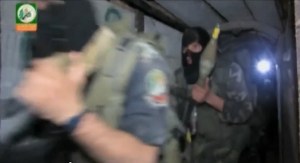
672Hamas boasted that Palestinian civilians were killed while Hamas’s terrorists remained alive, hiding in their underground bunkers and tunnels. (Image source: Hamas video screenshot)

K, another graduate student at an Egyptian university who had gone to Gaza to see his family but was unable to leave after the war started, said on July 22:

“When people stopped listening to Hamas orders not to evacuate and began leaving their homes anyway, Hamas imposed a curfew: anyone walking out in the street was shot without being asked any questions. That way Hamas made sure people had to stay in their homes even if they were about to get bombed. God will ask Hamas on judgment day for those killers’ blood.”

I asked him if Hamas used people as “human shields.” He said: “Hamas held the entire Gazan population as a human shield. My answer to you is yes.”

Palestinian Authority President Mahmoud Abbas told the press on September 6 that Hamas had killed 120 Fatah members who broke the curfew.

T., a former Hamas Ministry officer, said: “Hamas fires from civilian areas for a good reason: The Israelis call the civilians and give them ten minutes to evacuate. This gives Hamas time to fire another rocket and run away.”

Why, I asked, did Hamas not allow people to evacuate?

“Some people say Hamas wants civilians killed in order to gain global sympathy, but I believe this is not the main reason. I think the reason is that if all the people were allowed to evacuate their homes, they all would have ended up in a certain area in Gaza. If that happened, it would have made the rest of Gaza empty of civilians, and the Israelis would have been able to hit Hamas without worrying about civilians in all those empty areas. Hamas wanted civilians all over the place to confuse the Israelis and make their operations more difficult.”

S., a Gazan businessman, said:

“The cease-fire Hamas agreed to carried the same conditions the Egyptians and the Israelis offered during the second week of the war — after only 160 Gazans had been killed. Why did Hamas have to wait until 2,200 were killed, and then accept the very same offer? Hamas has blackmailed the world with the killed Gazan civilians to make itself look like a freedom fighter against an evil Israel. Hamas showed Gazans that it could not care less for their blood and their children. And why should Hamas care? Its leaders are either in mansions in Qatar or villas in Jordan. Mashaal [Khaled Mashaal, the head of Hamas] is in Qatar, Mohammad Nazzal is in Jordan and Abu Marzouk is in Cairo: why should they want a ceasefire? Everyone here in Gaza is wondering why Hamas rejected so many ceasefires. Hamas knows it will not defeat Israel’s army, so why did it continue fighting? The answer is simple: Hamas wanted us butchered so it could win the media war against Israel by showing our dead children on TV and then get money from Qatar.”

I asked S. if other Gazans shared his view. He said,

“Gazans are not stupid. We are now telling Hamas: Either you bring victory and liberate Palestine as you claim, or simply leave Gaza and maybe give it back to the Palestinian Authority or even Israel — or even Egypt! We have had enough of Hamas’s hallucinations and promises that never come true.”

O., a researcher who lives in Gaza Strip’s second largest city, Khan Younis, said:

“Most of us see Hamas as too radical and too stubborn, especially the way it was refusing ceasefires offered from Israel. They even refused a 24-hour ceasefire during the third week of the war. They denied us even 24 hours of quiet to bury the dead. Even some Hamas loyalists here are asking why Hamas refused several ceasefires and made us suffer. Hamas did this on purpose because Hamas is a slave to Qatar. Qatar wants the war to go on because it is a terrorist Islamist country, and Hamas wants more of us dead to appease its masters in Qatar. Let’s be realistic, Hamas is in a bad shape now. Israel destroyed most tunnels; that is why Hamas had to join the ceasefire talks in Cairo. Were the Israelis’ hits to Hamas not so painful, Hamas would not be negotiating in the first place. At the same time, Hamas is asking Israel for the impossible, like an open seaport and an airport. Israel would never allow that, and Hamas knows this, but Hamas might just be buying time by throwing out these demands. You have to keep in mind that Hamas is not concerned with our conditions as Gazans. After all it is our children who are dying, not the children of Hamas’s leaders. Hamas is weak now, and I believe it lost most of its tunnels. Israel’s Iron Dome destroyed so many of their rockets before they landed in Israel; that is why Hamas is being ruthless with Gazans. When Hamas locks people inside homes about to be bombed, when it kills people protesting against it and when it executes alleged traitors without even a trail, these are war crimes.”

A report by the Washington Institute, released in July, also reports that most Gazans are not happy with Hamas’s governance.

“It is true,” said A., a teacher. “I do not know a single Gazan who is pro-Hamas at the moment, except for those on its payroll. Hamas maintains its control here through a military dictatorship, just like North Korea. People will be killed if they protest. Even Gazans living abroad fear to criticize Hamas because Hamas will take revenge on their relatives who are here.”

M., a Gazan television producer, stated:

“Of course I am against Israel and I want it out of Gaza and out of the West Bank, but I still believe Hamas is more of a threat to the Palestinian people. Hamas took over Gaza by killing us [Palestinians] and throwing our young men from high buildings. That is what Hamas is about: murder and power. Hamas is also delusional. Its leaders refused the Egyptian cease-fire proposal, they got hit hard by the Israelis, and then when the war stopped, they declared victory. Even the prophet Muhammad, peace be upon him, admitted it when he lost Ohoud war [A war in which pagan Arabs defeated Muhammad’s army and in which Muhammad was almost killed]. Hamas lives in its own fantasy world. Hamas wanted the dead bodies to make Israel look ugly. The media has exerted a huge pressure on Israel for every dead Gazan. In that sense, Hamas’s tactic has worked, and we have seen more Western tolerance of Hamas, especially in Europe. Of course Hamas doesn’t care if we all die so long as it achieves its goals. We are not going to accept living under Hamas any longer. Even if there is calm, and the firing stops, we are going to still be under Hamas’s mercy, where all basic living standards are considered luxuries. Hamas is just buying time by going to the ceasefire talks. Hamas does not want a ceasefire.”

When asked why that was, he said, “Ask Qatar’s Sheikh, not me. He is Hamas’s god who gives them billions and tells them what to do. May God curse Qatar!”

A first-aid volunteer, E., said that Hamas militants had confiscated 150 truckloads of humanitarian supplies the day before. He said the supplies were donated by charities in the West Bank and that their delivery was facilitated by the IDF. He commented: “This theft angers all of us [Gazans]. The Israeli army allows supplies to come in, and Hamas steals them. It seems even the Israelis care for us more than Hamas.”

Another aid worker, A., confirmed that Hamas steals the humanitarian supplies given to Gaza. “They [Hamas] take most of it, sell it to us, and just give us the stuff they do not want.”

A Gazan mosque’s imam said that the most precious aid item Hamas stole was water. “Gazans are thirsty and Hamas is stealing the water bottles provided to us for free and selling them at 20 Israeli shekels [approximately $5] for the big bottle and 10 Israeli shekels for the small one.”

H., who did not want his profession to be mentioned, lost one of his legs in an Israeli raid. I asked him who he thought was responsible for his injury. He stated:

“Hamas was. My father received a text-message from the Israeli army warning him that our area was going to be bombed, and Hamas prevented us from leaving. They said there was a curfew. A curfew, can you believe that? I swear to God, we will take revenge on Hamas. I swear to God I will stand on my other foot and fight against Hamas. Even if Israel leaves them alone, we will not. What had my two-year-old nephew done to be killed under the rubble of our home so Khaled Mashaal [Hamas leader based in Qatar] could be happy? We want change at any cost. I am not claiming the Israelis are innocent, but I know Hamas has fired rockets from every residential spot in Gaza. If that was not hiding behind civilians, then it was stupidity and recklessness. Nobody who is normal, in his right mind, in Gaza supports Hamas. People have lost parents, children and friends, and have nothing more to lose. I believe if given the chance and the weapons, they will stand against Hamas.”

K., a Gazan school teacher agreed:

“When Hamas starts caring for our children we will start caring for Hamas. Hamas has one policy, to attack Israel; so Israel attacks back, and gets us killed and Hamas then gets more money from Arabs and Erdogan [Turkey’s president]. My son has autism; he cannot handle the sounds of rockets and bombs landing. Why would I support Hamas, which causes this suffering to him? Gazans have had enough of Hamas, any claims that we love Hamas is just propaganda. A recent poll indicates that most of us support Hamas; this is not true, except maybe in the West Bank where they have not yet lived under Hamas rule. I cannot accuse the polling center of fabricating the poll, but my safest explanation for the result is that Gazans polled are too afraid to give their true opinions of Hamas. Hamas watches everything here. Most Gazans now have to deal with the aftermath of the war. Almost 300,000 Gazans are now homeless and Hamas is not providing them with anything. So why would they or their extended families have any love for Hamas? Would there be any common sense to that? Most Gazans are angry at Hamas, and most of us would love to see them replaced by any other force.”

Despite all Hamas has done to Gazans, they do not seem to hold much love — or less hatred — for Israel.

S., a graduate of an American university and a former Hamas sympathizer, warned:

“Don’t get fooled. Gazans are not in love with Israel yet, but they do not want to fight Israel anymore. We do not want to embrace Israel; we just want to live normally without wars. We want to live and work in Israel like we used to. We are under Hamas occupation, and if you ask most of us, we would rather be under Israeli occupation, instead. I would welcome Netanyahu to rule Gaza so long as Hamas leaves, and I think most Gazans feel the same way. We miss the days when we were able to work inside Israel and make good money, we miss the security and calm Israel provided when it was here, but politically speaking, we just think of it as the better of two evils: Israel and Hamas.”

M., who lost his 11 year old daughter in an Israeli bombing said: “I will not forgive either Hamas or Israel for losing my daughter. If you ask me if I hate Israelis, my answer would be no, but do I love them? Of course not. There is too much blood between us, but I can only hope someday we both will move on and heal our wounds.”

When asked what he would do if he were in Israel’s place, being attacked non-stop by Hamas, he responded: “I do not care if both Israel and Gaza burn in hell.”

F., a Gazan physician, said:

“I wish Israel never existed, but as it does not seem to be going away, I would rather be working in Israel like I used to before the first Intifada, not fighting it. Hamas sympathizers, apologists and appeasers should be ashamed of themselves for supporting a terrorist organization that has butchered civilians, Israeli and Palestinian. Apparently a group of Israelis is working on bringing Hamas leader Khaled Mashaal to trial in the International Criminal Court. But perhaps the world should consider putting all the Hamas leaders on trial for crimes against the Gazan people.”

Related Topics:  Palestinian Authority  |  Mudar Zahran

Message From President Abbas’ Fatah Party—It’s OK To Slaughter Jews In Settlements

August 22, 2014

Message From President Abbas’ Fatah Party—It’s OK To Slaughter Jews In Settlements”Our political decision is resistance in the occupied territories in order ‎to bring an end to the occupation [using] all forms of resistance.”

8.21.2014 News Jeff Dunetz

via Message From President Abbas’ Fatah Party—It’s OK To Slaughter Jews In Settlements | Truth Revolt.


Are this the people where Israel wants to work with, like safeguarding border crossings ?


Once again proving that Palestinian leadership talks peace in English but war in Arabic, Jibril Rajoub, the Deputy Secretary of the Central Committee for President Mahmoud Abbas’ “Moderate” Fatah Party, appeared on independent Palestinian TV Station​ Awdah announcing that Fatah has made a “political decision” to support slaughtering of Jews who live in settlements.

I’m telling everyone: Fatah has decided that our relations with the Israelis are relations between enemies. There is no kind of coordination between the Israelis and us. Everyone can be certain that any form of mutual coordination ended a day after they declared war on the National Unity Government… OK, brother, ‎here is the occupation, am I stopping you from slaughtering a settlement? No one is stopping anyone. ‎Don’t lie and tell me: ‘the [PA] Security Forces and Mahmoud Abbas,’ and so on [stop you]. Drop it, ‎OK? No one is stopping anyone. Our political decision is resistance in the occupied territories in order ‎to bring an end to the occupation [using] all forms of resistance.

Source: Palwatch

Hundreds of Fatah members under Hamas house arrest in Gaza

August 17, 2014

Hundreds of Fatah members under Hamas house arrest in Gaza

Their leaders may be putting on a brave face in Cairo, but Fatah members in Gaza speak of Hamas intimidation

By Elhanan Miller August 17, 2014, 5:41 pm

via Hundreds of Fatah members under Hamas house arrest in Gaza | The Times of Israel.


Palestinians take part in a rally marking the 48th anniversary of the founding of Fatah in Gaza,
January 4, 2013 [photo credit: Abed Rahim Khatib/Flash90)

Moments after the call for evening prayer on July 28, the first day of the Islamic festival of Eid al-Fitr, Fatah activist Sami Abu Lashin heard a knock on the door of his Gaza home.

Lashin, known as Abu Hassan, opened the door to discover some 20 masked men armed with rifles. When he asked the men what they wanted, one gunman stepped out of the group and promptly fired a shot at Lashin’s right thigh, and then two more at his left thigh, shattering the bone.

“It was a very powerful and painful scene for his little children who witnessed this heinous crime,” wrote Sami Fouda of Gaza, who reported the story on the Fatah-affiliated website Fateh Voice on Saturday. “They claimed he had broken the house arrest imposed on him.”

On Sunday, a photo of Lashin reading the Koran in his bed at Shifa hospital — under a Fatah flag, surrounded by large bouquets of flowers — was posted on Fatah’s official Facebook page. “A free voice in steadfast Gaza,” read the caption, which accused Hamas of the shooting. “Shame on the criminals who shed Palestinian blood.”


Fatah member Sami Abu Lashin at Shifa Hospital in Gaza,
a photo displayed on his movement’s Facebook page,
August 17, 2014 (photo credit: Facebook image)
 

While Palestinian negotiators in Cairo strained to present a unified front in ceasefire talks with Egypt and Israel Sunday, Fatah continues to showcase stories of intimidation and physical assault against its members in Hamas-controlled Gaza.

One Fatah official, speaking on condition of anonymity for fear of reprisal against his party members in Gaza, told The Times of Israel on Sunday that as many as 250 Fatah members in the Strip have been told by Hamas to stay home throughout Operation Protective Edge, and as many as 125 were shot at by Hamas operatives when they refused to comply. Ten victims of gunshots to the legs have been transferred to hospitals in Ramallah and Nablus in the West Bank, he added.

“They [Hamas] don’t want Fatah’s voice to appear in Gaza,” the official said. “They may be afraid of a Fatah revolution.”

Having won the 2006 national elections by a large majority, Hamas violently took control of the Gaza Strip in the summer of 2007, banishing and killing Fatah members in the city. According to the International Red Cross, at least 118 Fatah members were killed and some 550 wounded during the second week of June 2007, some thrown off the rooftops of high-rise buildings. In January 2014, as part of his movement’s reconciliation efforts with Fatah, Hamas prime minister Ismail Haniyeh declared that Fatah members could return to Gaza.

On July 27, when the Israeli land operation in Gaza was already well underway, Fatah issued a statement condemning Hamas for placing “many Fatah members in various areas under house arrest.” Hamas had told Fatah that the order was carried out by individuals and would be reversed, but “as of now it is only increasing,” Fatah’s statement complained. On August 4, Fatah issued a second communique claiming the harassment was continuing unabated. It had even reached “the point of opening fire at Fatah members, causing serious injury and the tearing of bones and leg tissue.”

The Fatah official who spoke to the Times of Israel said that any Fatah member in Gaza wishing to change his address was required to notify Hamas authorities first.

“Any [Fatah member] leaving his home would have his legs shot at,” he said.

Meanwhile, a senior official in Hamas’s Internal Security Agency visited Abu Lashin at the hospital and condemned the attack, promising to bring the perpetrators to justice. But Fouda, who recounted Abu Lashin’s story, was not satisfied with Hamas’s explanations.

“I wonder who could be crazy enough to so blatantly defy the [Hamas] rulers of Gaza with such a high number of armed masked men; perpetrating such a heinous crime so calmly during the state of war and destruction experienced by the people of Gaza.”