Posted tagged ‘Executive order’

Supreme Court allows limited version of Trump’s travel ban to take effect, will consider case in fall

June 26, 2017

Supreme Court allows limited version of Trump’s travel ban to take effect, will consider case in fall, Washington PostRobert Barnes, June 26, 2017

(The Supreme Court, in granting certiorari and allowing major portions of President Trump’s executive order to take immediate effect, appears to have rejected the specious ‘Muslim ban” vs First Amendment rhetoric of the lower courts. The WaPo writer seems to favor the lower court decisions. — DM)

The Supreme Court agreed on Monday to allow a limited version of President Trump’s ban on travelers from six mostly Muslim countries to take effect, and will consider in the fall the president’s broad powers in immigration matters in a case that raised fundamental issues of national security and religious discrimination.

The court made an important exception: it said the ban “may not be enforced against foreign nationals who have a credible claim of a bona fide relationship with a person or entity in the United States.”

The court also said in the ruling that it would consider whether the case will be moot by the time it hears it; the ban is supposed to be a temporary one while the government reviews its vetting procedures.

The action means that the administration may impose a 90-day ban on travelers from Libya, Iran, Somalia, Sudan, Syria and Yemen and a 120-day ban on all refugees entering the United States, with the exceptions noted by the court.

Trump said last week the ban would go into effect 72 hours after receiving an approval from the courts.

The proposed travel ban has been a major point of contention between Trump and civil rights groups, which say it was motivated by unconstitutional discrimination against Muslims.

Trump contends the ban is necessary to protect the nation while the administration decides whether tougher vetting procedures and other measures are needed. He has railed against federal judges who have blocked the move.

Because the executive order was stopped by lower courts, travelers from those countries have been entering the U.S. following normal visa procedures. Trump first moved to implement the restrictions in January in his first week in office.

His first executive order went into effect immediately, and resulted in chaos at airports in the U.S. and abroad, as travelers from the targeted countries were either stranded or sent back to their countries.

Lawyers for challengers to the order rushed to federal courts, and the order was stayed within days. The U.S. Court of Appeals for the 9th Circuit eventually said the order could not be implemented, infuriating the president, who said he would take the case to the Supreme Court.

But instead, his administration regrouped and issued a second order in March. It added a section detailing national security concerns, removed Iraq from the list of countries affected, deleted a section that had targeted Syrian refugees and removed a provision that favored Christian immigrants.

His lawyers told courts that the new order was written to respond to the 9th Circuit’s concerns. But a new round of lawsuits were immediately filed, and federal judges once again stopped the implementation.

A federal district judge in Maryland stopped the portion of the order affecting travelers from the six countries; a judge in Hawaii froze that portion and the part affecting the refu­gee programs.

Appeals courts on both coasts upheld those decisions.

The U.S. Court of Appeals for the 4th Circuit in Richmond agreed with U.S. District Judge Theodore D. Chuang in Maryland, who sided with opponents in finding that the ban violates the Constitution by intentionally discriminating against Muslims.

In a 10-to-3 decision, the court noted Trump’s remarks before and after his election about implementing a ban on Muslims, and said the executive order “in context drips with religious intolerance, animus and discrimination.”

The president’s authority, the court said, “cannot go unchecked when, as here, the president wields it through an executive edict that stands to cause irreparable harm to individuals across this nation,” Chief Judge Roger L. Gregory wrote.

Meanwhile, a three-judge panel of the 9th Circuit said Trump had not adhered to federal law in which Congress gives the president broad power in immigration matters.

The 9th Circuit opinion did not dwell on Trump’s public comments, nor did it declare that the president had run afoul of the Constitution because his intent was to discriminate. Instead, they ruled that the travel ban lacked a sufficient national security or other justification that would make it legal, and that violated immigration law.

“There is no finding that present vetting standards are inadequate, and no finding that absent the improved vetting procedures there likely will be harm to our national interests,” the judges wrote. “These identified reasons do not support the conclusion that the entry of nationals from the six designated countries would be harmful to our national interests.”

They added that national security is not a ‘talismanic incantation’ that, once invoked, can support any and all exercise of executive power.”

In both appeals courts, a minority of conservative judges had said their colleagues were making a mistake. Judges should look only to whether the executive orders were proper on their face, they said, without trying to decide if the president had ulterior motives, and defer to national security decisions made by the executive branch.

“The Supreme Court surely will shudder at the majority’s adoption of this new rule that has no limits or bounds,”wrote dissenting 4th Circuit Judge Paul V. Niemeyer .

Trump thundered on Twitter after the judicial setbacks that the second executive order was a “watered down version” of the first. And while his lawyers in court described the action as a temporary pause in immigration and administration officials corrected reporters who called it a travel ban, Trump did not agree.

“People, the lawyers and the courts can call it whatever they want, but I am calling it what we need and what it is, a TRAVEL BAN!” he wrote.
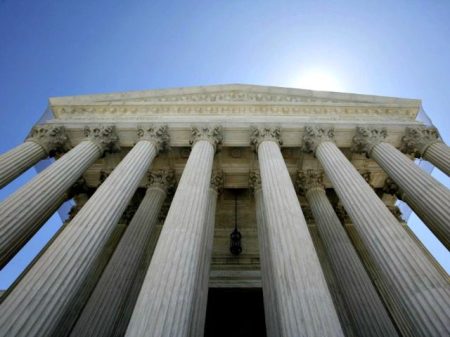
Supreme Court Expedites Trump’s Petition on Executive Order Case

June 4, 2017

Supreme Court Expedites Trump’s Petition on Executive Order Case, BreitbartKen Klukowski, June 3, 2017

Molly Riley Reuters

On Friday, the Supreme Court rapidly expedited everything. The ACLU—which represents the plaintiffs—have been ordered to file their response by 3:00 p.m. on Monday, June 12. The ACLU lawyers must also respond to DOJ’s application for a stay by that time.

The Court could conceivably then vote immediately on whether to take the case, or anytime shortly thereafter. Under a normal briefing schedule, the Court would then hear arguments in October, and issue a decision by the end of 2017.

It’s also possible that the Court could accelerate briefing on an emergency basis, then hold arguments over the summer, or possibly even in June before recessing for the summer. The Court could make clear by the week of June 12 which course it is pursuing.

***********************************

WASHINGTON, D.C.—The Supreme Court took the rare step on Friday of expediting consideration of a major case, rapidly accelerating the schedule for reviewing the Fourth Circuit’s blocking of President Donald Trump’s travel ban executive order.

President Trump issued Executive Order 13780 (EO) on March 6, Section 2(c) of which temporarily restricted travel from six Muslim-majority countries associated with terrorism while the United States developed new vetting procedures to keep the nation safe.

Immigration activists sued, along with several immigrants and their families. A liberal federal district judge in Maryland granted a preliminary injunction blocking Section 2(c) of the EO. The U.S. Court of Appeals for the Fourth Circuit then affirmed the trial court’s injunction in a 10-3 decision, ruling that the EO violated the Constitution’s Establishment Clause, and taking the almost unheard-of step of all the court’s judges hearing the case, instead of sending it to a three-judge panel.

The U.S. Department of Justice (DOJ) filed a petition for review at the Supreme Court on Thursday. Under the Court’s rules, a response from the plaintiffs would be due July 3. By that time the Court would be on recess for the summer, meaning that the justices would vote at the Court’s annual pre-Term conference, which will take place on September 25, on whether to take the case. That would typically mean hearing arguments in December or January, with a final decision coming down in early or mid-2018.

Acting Solicitor General Jeff Wall at DOJ also asked Chief Justice John Roberts (who supervises the Fourth Circuit) to stay the appellate court’s decision until the justices can decide the matter.

On Friday, the Supreme Court rapidly expedited everything. The ACLU—which represents the plaintiffs—have been ordered to file their response by 3:00 p.m. on Monday, June 12. The ACLU lawyers must also respond to DOJ’s application for a stay by that time.

The Court could conceivably then vote immediately on whether to take the case, or anytime shortly thereafter. Under a normal briefing schedule, the Court would then hear arguments in October, and issue a decision by the end of 2017.

It’s also possible that the Court could accelerate briefing on an emergency basis, then hold arguments over the summer, or possibly even in June before recessing for the summer. The Court could make clear by the week of June 12 which course it is pursuing.

The case is Trump v. International Refugee Assistance Project, No. 16-1436.

Federal Judges Invite Muslims To Veto Americans’ Elections Over Campaign Statements

May 25, 2017

Federal Judges Invite Muslims To Veto Americans’ Elections Over Campaign Statements, BreitbartNeil Munro, May 25, 2017

(In what fantasy world do the ten judges live? — DM)

Ten progressive judges in Virginia have decided that Muslims can ask judges to change the nation’s national security and immigration policies whenever prior campaign statements in democratic political elections can be described as unfair to Muslims living in America.

“To the extent that our review chills campaign promises to condemn and exclude entire religious groups, we think that a welcome restraint,” boasted the majority opinion, which was approved by 10 judges on the Richmond-based Court of Appeals for the Fourth Circuit, and announced May 25. President Donald Trump’s Executive Order on Islamic migration “speaks with vague words of national security, but in context drips with religious intolerance, animus, and discrimination” from the 2016 election campaign, the judges insisted.

However, a dissent approved by three judges highlighted the political ambitions and risks hiding behind the court’s declaration of support for the Islamic plaintiffs. “The danger of the majority’s new rule is that it will enable any court to justify its decision to strike down any executive action with which it disagrees,” says three three-judge dissent, which concluded:

Unless corrected by the Supreme Court, the majority’s new approach, which is unsupported by any Supreme Court case, will become a sword for plaintiffs to challenge facially neutral government actions, particularly those affecting regions dominated by a single religion. Government officials will avoid speaking about religion, even privately, lest a court discover statements that could be used to ascribe a religious motivation to their future actions. And, in the more immediate future, our courts will be faced with the unworkable task of determining when this President’s supposed religious motive [in the 2016 election] has sufficiently dissipated so as to allow executive action toward these or other majority Muslim countries.

The lawsuit by was brought by Muslim plaintiffs, backed up by a huge array of establishment progressive corporate lawyers, against President Trump’s Executive Order, which merely temporarily blocked or curbed Muslim immigration from six of 50-Muslim-majorityority countries around the world.

The temporary block is intended to help officials institute new safeguards against Islamic-inspired attacks by the growing inflow of Muslim immigrants, refugees, and their future American-born children, into an increasingly diverse and decreasingly unified nation.

The judges’ deference to the Muslim plaintiffs comes after 16 years of deadly, repeated and destructive attacks on Americans motivated by the Islamic religion, starting on 9/11, 2001. Since then, U.S. forces have gone to war in several majority-Muslim countries to curb terrorism, and more than 101 people named after Islam’s primary warrior/prophet have been arrested and convicted by domestic courts for various jihad and terror-related offenses.

That bloody and violent record was important to voters in the 2016 election, where the subsequently elected president, Donald Trump, gained support by promising to reduce immigration of Muslims and to step up vetting of would-be Muslim immigrants.  Trump’s position was bolstered in June 2016 when the son of Muslim immigrants murdered 49 Americans at the Pulse nightclub in Florida.

However, progressive Democrats, establishment Republicans, and business leaders strongly favor a continued inflow of cheap workers, extra consumers and likely future Democratic voters, regardless of the economic and security impact on Americans.

In the dissent authored by Circuit Judge Paul Niemeyer, the three moderate judges scoffed at the 10 judges for ignoring prior Supreme Court guidance. The logic of the 10 judges’ decision, says the dissent, is that any future court:

 need only find one [campaign] statement that contradicts the stated reasons for a subsequent executive action and thereby pronounce that reasons for the executive action are a pretext …

Moreover, the unbounded nature of the majority’s new rule will leave the President and his Administration in a clearly untenable position for future action. It is undeniable that President Trump will need to engage in foreign policy regarding majority-Muslim nations, including those designated by the Order. And yet the majority now suggests that at least some of those future actions might also be subject to the same challenges upheld today. Presumably, the majority does not intend entirely to stop the President from creating policies that address these nations, but it gives the President no guidelines for “cleansing” himself of the “taint” they have purportedly identified…

Finally, the new rule would by itself chill political speech directed at voters seeking to make their election decision. It is hard to imagine a greater or more direct chill on campaign speech than the knowledge that any statement made may be used later to support the inference of some nefarious intent when official actions are inevitably subjected to legal challenges. Indeed, the majority does not even deny that it employs an approach that will limit communication to voters. Instead, it simply opines remarkable that such chilling is “a welcome restraint.”

The Supreme Court surely will shudder at the majority’s adoption of this new rule that has no limits or bounds — one that transforms the [10-judge] majority’s criticisms of a candidate’s various campaign statements into a constitutional violation…

It engages in its own review of the national security justifications supporting the Order and concludes that protecting national security could not be the President’s “primary purpose.” As evidence, the majority points to the President’s level of consultation with national security agencies before issuing the Order; the content of internal Department of Homeland Security reports; the comments of former national security officials made in an amicus brief; and its own assessment of the national security threats described in the Order … The majority’s intense factual inquiry is particularly inappropriate where the government’s secular purpose is related to national security — a subject, as the majority recognizes, on which we owe the executive significant deference…

Unless corrected by the Supreme Court, the majority’s new approach, which is unsupported by any Supreme Court case, will become a sword for plaintiffs to challenge facially neutral government actions, particularly those affecting regions dominated by a single religion. Government officials will avoid speaking about religion, even privately, lest a court discover statements that could be used to ascribe a religious motivation to their future actions. And, in the more immediate future, our courts will be faced with the unworkable task of determining when this President’s supposed religious motive has sufficiently dissipated so as to allow executive action toward these or other majority Muslim countries. The Establishment Clause demands none of these unfortunate and unprecedented results.

Read the court decision here.

Fourth Circuit Uphold Injunction on Trump Immigration Order

May 25, 2017

Fourth Circuit Uphold Injunction on Trump Immigration Order, Jonathan Turley’s Blog, Jonathan Turley, May 25, 2017

(Please see also, Trump’s “Muslim Ban,” Obamacare and Sally Yates. Frau Merkel and Obama are probably very happy.– DM)


I am still skeptical about the weight given to campaign statements over the language of the order on its face.  I expect a number of justices are likely to have the same reservations.  Time will tell but that time is rapidly approaching.

***************************

In a stinging defeat for the Trump Administration, the United States Court of Appeals for the Fourth Circuit has upheld an injunction on the Trump Administration’s immigration order.  The Fourth Circuit is widely viewed as one of the most conservative circuits and has proven the most deferential to national security powers by the Executive Branch. Indeed, the government often openly forum shops in pushing national security cases through the Eastern District of Virginia and ultimately the Fourth Circuit.  The 10-3 vote is an impressive victory for the challengers and now sets the case for the long-awaiting petition to the Supreme Court.

The oral arguments were held on May 8th and I thought the Justice Department did a much better job than the first round leading to the losses in California.  The United States Court of Appeals for the Ninth Circuit will also rule on the second order.

I still believe that the law favors the Trump Administration.  However, Trump himself has proven the greatest liability as challengers repeatedly quoted Trump’s anti-Muslim campaign comments and references to a Muslim ban.

However, the response of the Fourth Circuit clearly a bad omen for the Administration.  This is not a court that can be dismissed as some cabal of liberals.  Ten judges ruled en banc that “We remain unconvinced [the ban] has more to do with national security than it does with effectuating the President’s promised Muslim ban.” Chief Justice Roger L. Gregory added that “Congress granted the president broad power to deny entry to aliens, but that power is not absolute. It cannot go unchecked when, as here, the president wields it through an executive edict that stands to cause irreparable harm to individuals across this nation.”

I am still skeptical about the weight given to campaign statements over the language of the order on its face.  I expect a number of justices are likely to have the same reservations.  Time will tell but that time is rapidly approaching.

Here is the opinion: Immigration decision


Judicial Watch Sues Justice Department for Sally Yates’ Emails While She Served as Trump Acting Attorney General

May 9, 2017

Judicial Watch Sues Justice Department for Sally Yates’ Emails While She Served as Trump Acting Attorney General, Judicial Watch, May 8, 2017

“Between her involvement in the Russian surveillance scandal and her lawless effort to thwart President Trump’s immigration executive order, Sally Yates’ short tenure as the acting Attorney General was remarkably troubling,” said Judicial Watch President Tom Fitton. “Her email traffic might provide a window into how the anti-Trump ‘deep state’ abused the Justice Department.”

**************************

(Washington, DC) – Judicial Watch announced today that it has filed a Freedom of Information Act (FOIA) lawsuit against the U.S. Department of Justice for emails of former Acting Attorney General Sally Yates from her government account.  The lawsuit was filed in the U.S. District Court for the District of Columbia (Judicial Watch v. U.S. Department of Justice (No. 1:17-cv-00832)).

The suit was filed after the Justice Department failed to respond to a February 1, 2017, FOIA request seeking access to her emails between January 21, 2017, and January 31, 2017.

Yates was appointed by President Obama as U.S. Attorney in northern Georgia and was later confirmed as Deputy Attorney General. In January 2017 she became acting Attorney General for President Trump.

Ms. Yates was involved in the controversy concerning Gen. Michael Flynn, allegedly warning the Trump White House in early January about General Flynn’s contacts with the Russian ambassador, Sergei Kislyak.  (Judicial Watch is separately suing for records concerning the surveillance and subsequent leaks regarding General Flynn.)

On January 30, Yates ordered the Justice Department not to defend President Trump’s January 27 executive order seeking a travel ban from seven Middle Eastern countries.  That same day, President Trump fired her for refusing to defend the action.

“Between her involvement in the Russian surveillance scandal and her lawless effort to thwart President Trump’s immigration executive order, Sally Yates’ short tenure as the acting Attorney General was remarkably troubling,” said Judicial Watch President Tom Fitton. “Her email traffic might provide a window into how the anti-Trump ‘deep state’ abused the Justice Department.”


Does Judge Orrick Think President Obama ‘Fundamentally Transformed’ Executive Orders?

April 28, 2017

Does Judge Orrick Think President Obama ‘Fundamentally Transformed’ Executive Orders? PJ MediaAndrew C. McCarthy, April 28, 2017

Protesters hold up signs outside a courthouse where a federal judge will hear arguments in the first lawsuit challenging President Donald Trump’s executive order to withhold funding from communities that limit cooperation with immigration authorities Friday, April 14, 2017, in San Francisco. U.S. District Court Judge William Orrick has scheduled a hearing on Friday on San Francisco’s request for a court order blocking the Trump administration from cutting off funds to any of the nation’s so-called sanctuary cities. (AP Photo/Haven Daley)

William H. Orrick III is a Democrat campaign bundler and left-wing political activist. He has been known as “Judge Orrick” since 2013, when President Obama managed to get him on the federal bench — with the assistance of Republicans Senators Jeff Flake (Arizona), Lisa Murkowski (Alaska), and Susan Collins (Maine). All other Republicans opposed Orrick’s nomination, except Bob Corker (Tennessee) who failed to vote.

It was as Judge Orrick that the San Francisco-based social justice warrior issued a 49-page decision this week. His decision purported to invalidate President Trump’s executive order (EO) on federal funding for “sanctuary” jurisdictions — cities, counties and other municipal subdivisions that refuse to cooperate in federal immigration-law enforcement.

I say “purported” because Orrick’s screed is a ruling about nothing. The Trump Justice Department had argued that the EO did nothing to alter pre-existing law. Though Orrick tendentiously disputed this construction of the EO, he admitted that his opinion “does nothing more than implement” the Justice Department’s view. He further conceded that his ruling had no effect on the administration’s power to enforce conditions Congress has placed on federal funding (i.e., the very conditions Trump incorporated in the EO by telling his subordinates they could only act “to the extent consistent with law”). Meanwhile, the administration has not endeavored to strip any federal funding from any sanctuary jurisdictions.

So, in effect (or should we say, non-effect?), nothing has happened and nothing has changed. The ruling’s sole achievement is a fleeting star turn for its author. Actually, make that another star turn: In 2015, Judge Orrick thrilled the Democrat-media complex by carrying water for the National Abortion Federation, which wanted an injunction against a whistleblower’s release of videos showing Planned Parenthood officials selling baby parts — oh, sorry, I mean “fetal tissue.”

The ruling is instructive, though, as a measure of how politicized the judiciary has become. Consider the matter of executive orders.

Orrick’s opinion includes the following remarkable passage (at p. 16):

Government counsel explained that the [Executive] Order is an example of the President’s use of the bully pulpit and, even if read narrowly to have no legal effect, serves the purpose of highlighting the President’s focus on immigration enforcement. While the President is entitled to highlight his policy priorities, an Executive Order carries the force of law. Adopting the Government’s proposed reading would transform an Order that purports to create real legal obligations into a mere policy statement[.] [Emphasis added.]

Can it be that, after eight years of Obama’s usurpation of legislative power, judges have forgotten what proper executive orders are?

Contrary to Obama’s practice and Orrick’s apparent belief, executive orders do not carry the force of law — at least not presumptively. They are supposed to be policy statements that give presidential guidance to subordinate executive officials. That is because the president has no unilateral authority to decree law — it is for Congress to write the laws; the executive branch just enforces them.

Now, we have to qualify these principles with caveats like “presumptively” and “unilateral” because there are special situations in which executive orders may have the force of law. These occur when Congress delegates legislative authority to the president — a dubious practice but, alas, a familiar one.

Take, for example, the International Emergency Economic Powers Act. Under the IEEPA (which is codified in sections 1701 et seq. of Title 50, U.S. Code), the president is empowered to declare a national emergency due to a foreign threat to the United States, and to decree regulations and prohibitions on financial transactions pertinent to the threat, particularly transactions between Americans and hostile foreign powers.

But absent congressional authorization, presidents may not make pronouncements that have the force of law. In general, executive orders do not “create real legal obligations.” They can be said to create duties only in the sense that subordinate officials are supposed to obey directives from a superior. But that is a chain-of-command obligation, not a legal duty. Cabinet secretaries get fired if they defy presidential orders; they do not get prosecuted or sued. Legally, such defiance does not trigger a presidential obligation to terminate a subordinate – the president may fire executive branch officials for any reason, or no reason, for they serve at the president’s pleasure. Consequently, the president’s executive orders do not have the “force of law” even with respect to the subordinate government officials the president is legally authorized to direct. As for the rest of us, the president has no authority to impose legal obligations on us; only Congress may do that.

Judge Orrick seemed mystified by the notion that an executive order could be “a mere policy statement,” or a hortatory rendering of a president’s “policy priorities.” When the Justice Department’s lawyers explained — as if explanation were needed — that these were, in fact, the purposes of the EO, Orrick strangely claimed that Justice was reading the EO “narrowly.” (Apparently, “narrowly” is Ninth Circuit-speak for “accurately.”) Orrick then suggested that this “narrow” reading couldn’t possibly be what was intended by the president — i.e., that there was no way the EO could possibly mean what it says. Why? Because if it was just about announcing policy, the judge theorized, there would be no reason to issue an EO. From this asinine premise, Orrick leapt to the conclusion that Trump must instead be up to something sinister: a sweeping withdrawal of federal funding from sanctuary jurisdictions, heedless of any conditions Congress has attached to funding programs.

To the contrary, stating policy preferences and priorities is one of the basic and desirable reasons for issuing executive orders. It is an effective, transparent manner of communicating administration objectives to the executive branch and the public. It is not enough to say that Donald Trump is not the first president to use EOs this way. This is what EOs are for.

How have we gotten to the point where courts presume bad faith from the proper use of executive orders, and simultaneously imply that a normal executive order would have the force of law?

Of course, we are dealing with a “progressive” partisan here, so throw logic out the window. Can there be any doubt that, if Donald Trump were to issue an executive order that actually purported to create legal benefits and duties (like Obama administration directives on immigration did), Judge Orrick would write an equally indignant opinion about how executive orders must not have the force of law?

The irony is that Judge Orrick essentially did what he falsely accused President Trump of doing. Trump did not use his constitutional authority to issue executive orders as a pretext for usurping congressional power; but Orrick did use his constitutional authority to issue judicial opinions as a pretext for usurping executive power.

Jeff Sessions Meets with Mayors as Court Blocks President Trump’s Order on ‘Sanctuary Cities’

April 26, 2017

Jeff Sessions Meets with Mayors as Court Blocks President Trump’s Order on ‘Sanctuary Cities’, BreitbartIan Mason, April 25, 2017

The ruling may not, however, effect Sessions’s demands for compliance. The DOJ grants he is threatening to withdraw already had their own provisions preventing them from being dispensed to jurisdictions that fail to comply with 8 U.S.C. 1373 before President Trump’s executive order.

*********************

The mayors of 15 large American cities, including some from so-called “sanctuary” jurisdictions, met with Attorney General Jeff Sessions in Washington Tuesday to discuss the DOJ’s efforts to cut funding from cities that frustrate federal immigration enforcement.

Session’s Justice Department sent a letter to eight sanctuary cities and the “sanctuary state” of California last week demanding they show compliance with federal immigration laws or lose law enforcement grant money. In a statement issued after Tuesday’s meeting, Sessions clarified what he expects from cities in states in the fight against illegal alien crime:

 The Department of Justice will fulfill our responsibility to uphold and enforce our nation’s immigration laws, including 8 U.S.C. 1373.  Under the Obama administration, the Department of Justice required certain grantees to certify compliance with federal law, including 8 U.S.C. 1373, as a condition for receiving grant funding.

8 U.S.C. 1373 prohibits local jurisdictions from preventing the Immigration and Naturalization Service from getting immigration status information on people they detain.

At least two leaders from such jurisdictions attended the morning meeting with the Attorney General, Mayor Mitch Landrieu of New Orleans, and Mayor Steve Adler of Austin. The Associated Press reported the mayors saying the legal definition of that term “sanctuary cities” was clarified at the meeting.

Cutting funding from sanctuary cities has been a centerpiece of Session’s new policy at DOJ and a major effort of the Trump administration. The meeting with mayors was to serve as an opportunity to explain these efforts to city leaders, beginning with the already announced plan to withhold law enforcement grants. In his statement, Sessions explained:

We are pleased that the mayors who met with us today assured us they want to be in compliance with the law.  The vast majority of state and local jurisdictions are in compliance and want to work with federal law enforcement to keep their communities safe.  Of course, compliance with 8 U.S.C. 1373 is the minimum the American people should expect.  We want all jurisdictions to enthusiastically support the laws of the United States that require the removal of criminal aliens, as many jurisdictions already do.

A U.S. district court ruling, handed down only hours after Sessions met with the mayors, frustrates wider efforts by the administration to stop grant money flowing to jurisdictions that refuse to comply with 8 U.S.C. 1373. The ruling, by Judge William Orrick of the San Francisco-based U.S. District Court for the District of Northern California, blocks a section of President Donald Trump’s February executive order authorizing the withdrawal of all federal funds from such jurisdictions. That authority will now be suspended while the lawsuit, launched by a group of California sanctuary cities, works its way through the courts.

The ruling may not, however, effect Sessions’s demands for compliance. The DOJ grants he is threatening to withdraw already had their own provisions preventing them from being dispensed to jurisdictions that fail to comply with 8 U.S.C. 1373 before President Trump’s executive order.

Leaked DHS Document is Another Democratic Party Scandal

March 29, 2017

Leaked DHS Document is Another Democratic Party Scandal, Power LineJohn Hinderaker, March 28, 2017

The document is here. It says:

DHS I&A assesses that country of citizenship is unlikely to be a reliable indicator of potential terrorist activity.

The two judges who issued orders blocking implementation of the president’s travel ban relied explicitly on the AP story and the leaked DHS document.

So it appears that what happened here is that Democratic Party activists in the Department of Homeland Security either created a bogus document or dug up a poorly-researched draft document that had never been issued, and fed it to Democratic Party activists at the Associated Press. The Democratic Party activists at the AP published a story based on the anonymous document, which two Democratic Party activists on the bench used as a pretext for orders enjoining the president’s travel order.

***************************

At Breitbart.com, Michael Patrick Leahy has what strikes me as an explosive story: “Mystery Surrounds Leaked Leaked Draft DHS Document at Center of Controversial Travel Ban Decisions by Two Federal Judges.” Actually, though, it doesn’t seem to be much of a mystery.

On February 24, AP reporters Vivian Salama and Alicia Caldwell published an AP “exclusive”: “DHS report disputes threat from banned nations.” The story was based on an anonymous draft Department of Homeland Services document that was leaked to the Associated Press, presumably by someone at DHS. The document seemed to have been created for the express purpose of undermining President Trump’s travel order. Indeed, it likely was created for that purpose.

The document is here. It says:

DHS I&A assesses that country of citizenship is unlikely to be a reliable indicator of potential terrorist activity.

The two judges who issued orders blocking implementation of the president’s travel ban relied explicitly on the AP story and the leaked DHS document. Judge Chuang, the federal district court judge in Maryland, wrote:

Among other points, they note that the Second Executive Order does not identify examples of foreign nationals from Iran, Libya, Sudan, Syria, or Yemen who engaged in terrorist activity in the United States. They also note that a report from the Department of Homeland Security, Office of Intelligence and Analysis, concluded that “country of citizenship is unlikely to be a reliable indicator of potential terrorist activity” and that “few of the impacted countries have terrorist groups that threaten the West.” l.R. 158.

Emphasis added. The Hawaii judge, Derrick Watson, wrote:

The February 24, 2017 draft report states that citizenship is an “unlikely indicator” of terrorism threats against the United States and that very few individuals from the seven countries included in Executive Order No. 13,769 had carried out or attempted to carry out terrorism activities in the United States. …

According to Plaintiffs, this and other evidence demonstrates the Administration’s pretextual justification for the Executive Order.

Judge Watson was in error: the draft report, which was never approved or finalized by DHS, is neither dated nor signed. February 24 was the date of the AP story based on the leaked document. No one at DHS has taken responsibility for writing it.

The judges were wrong to base their decisions in part on the leaked document. President Trump had clear constitutional and statutory authority to issue the travel order, and whether the judges, or some anonymous person at DHS, agreed with his judgment is irrelevant.

But Leahy skillfully unpacks what happened here. The draft report came from DHS’s Office of Intelligence and Analysis, which was headed by David Grannis, an Obama holdover bureaucrat. Grannis is a partisan Democrat who previously worked as a staffer for Democrats Dianne Feinstein and Jane Harman. A DHS spokesman “would neither confirm nor deny that Grannis was the author of, or had reviewed, the leaked document….”

How about the reporters? It pretty much goes without saying that AP reporters are Democrats. But Leahy also points out that Vivian Salama formerly worked for Rolling Stone, where she wrote that Yemen–one of the countries covered by the travel order–“holds a special place in my heart.” She has bitterly denounced U.S. drone strikes in Yemen.

So it appears that what happened here is that Democratic Party activists in the Department of Homeland Security either created a bogus document or dug up a poorly-researched draft document that had never been issued, and fed it to Democratic Party activists at the Associated Press. The Democratic Party activists at the AP published a story based on the anonymous document, which two Democratic Party activists on the bench used as a pretext for orders enjoining the president’s travel order.

Those orders should be viewed as purely political acts that have no basis in any valid judicial reasoning or authority.

Dershowitz: Revised travel order should have been upheld

March 18, 2017

Dershowitz: Revised travel order should have been upheld, Fox News via YouTube, March 18, 2017

( In the last minutes of the video, Prof. Dershowitz articulates his hopes for the Democrat Party. Has he allowed his hopes to override reality? — DM)


10 Points You Won’t Hear About Trump’s Revised Travel Restrictions

March 7, 2017

10 Points You Won’t Hear About Trump’s Revised Travel Restrictions, Clarion ProjectRYAN MAURO, March 7, 2017

(Please see also, Unsatisfied Critics of Trump Immigration Order: This is ‘Muslim Ban 2.0’ for a catalog of the groups opposing the new executive order and the alleged bases for their opposition. The text of the executive order is available here.– DM)

Syrian refugees arrive in the U.S. after spending five years in a refugee camp in Turkey (Illustrative Photo: Scott Olson/Getty Images)

President Trump has issued an executive order modifying his controversial travel restrictions which have been incorrectly derided as a “Muslim ban.”

Of course, despite major changes, groups like the Council on American-Islamic Relations (CAIR) are still calling it a “Muslim ban” and are committed to retaining the issue’s divisiveness so they can endlessly bash Trump as a bigot and raise their own profile in the process.

“This executive order, like the last order, is at its core a Muslim ban, which is discriminatory and unconstitutional,” said the executive-director of CAIR, Nihad Awad, who nonetheless touted the revisions as a “partial victory.”

Below are 10 points about the revised executive order that you’re unlikely to hear from media outlets and politically-driven organizations who have are dependent upon continued controversy:


1. As previously, it is not a “Muslim ban.” 

As explained by Clarion Project advisory board member and leader of the Council for Muslims Facing Tomorrow in this video (see below), the restrictions are based on an intersection of geography and security risks. They are limited to 6 of 50 Muslim-majority countries and impact non-Muslims as well. And, just as before, the restrictions are a pause rather than a ban.

The order is for between 90 to 120 days, depending on whether the person is a visitor or a refugee. As we’ll discuss, the exceptions are so wide that even describing this order as a “pause” is a bit of an overstatement.


2. Iraq is removed from the list, bringing the list of impacted countries down to 5.

Including Iraq (and especially the autonomous Iraqi Kurdistan) was a mistake from the beginning. That is now fixed. The executive order implies that this change is due to the fact that the Iraqi government agreed to improved intelligence-gathering and security measures.

Those conversations with the Iraqis obviously took place after the initial executive order, which shows the Trump Administration can be influenced by constructive criticism.


3. The executive order justifies the inclusion of the other five countries.

The order explains why the president chose these five countries, which is a scaling back of Trump’s campaign pledge to ban immigration from all terror-prone countries (which in itself is a scaling back of his initial pledge to ban all Muslim immigration).

Iran, Syria and Sudan are designated as State Sponsors of Terrorism and  the former two are explicit enemies of the U.S. Libya and Yemen are failed states with inadequate counter-terrorism abilities and so much chaos that the U.S. doesn’t even have operating embassies in these locations. Somalia is similarly unstable and contains a major Al-Qaeda foothold. In addition, the Somali community in the U.S. is known for its high rate of radicalism.


4. The five countries were chosen based on the Obama Administration’s determination.

The executive order explains that these five countries were selected based on the Obama Administration considering them to be “countries of particular concern” that could not participate in the visa waiver program.

It was the Obama Administration that stated that persons coming to the U.S. from these countries pose a greater security risk than those from other countries. Everyone who argues that there’s no reason to treat these countries as unique risks is arguing with Trump and Obama. Where were the condemnations of President Obama’s “Islamophobia” for identifying these Muslim-majority countries as posing a special danger?


5. Three hundred refugees are currently under FBI investigation.

 It is true that refugees undergo a lengthy screening process, unlike typical visa applicants. Opponents of the travel restrictions point to how only a small percentage of refugees have been convicted of terrorism-related offenses. The Senate Judiciary Committee said only about 40 had been convicted, representing about 7 percent of the total of 580 since the 9/11 attacks.

The executive order points out that 300 people who were admitted into the U.S. as refugees are now under FBI counter-terrorism investigations; a much higher number than the previous figures used for gauging the risk.

However, in fairness, a Department of Homeland Security report says most refugees who become terrorists are radicalized years after arriving in the U.S., so we don’t know if this figure necessarily proves there’s a major gap in the refugee vetting process. We also don’t know how many of the 300 refugees are from the five affected countries.


6. There is a 10-day advance notice.

The previous executive order went into effect immediately, catching airlines and governments off-guard. This one goes into effect in 10 days, giving time for preparation.


7. The new executive order explicitly does not apply to current visa and green card holders.

Permanent residents and current visa-holders are not affected this time. The original executive order’s unclear language has been fixed.


8. Syrian refugees are no longer singled out.

The original executive order suspended refugee admission for 120 days but singled out Syrian refugees for indefinite exclusion “until such time” that the government determines that they can be safely admitted. The singling out was unnecessary, as that’s the same standard for allowing refugees from other places, but the original language emphasized that Trump was delivering on a campaign promise to reject Syrian refugees.

That language is no longer. A refugee of Syrian nationality is not viewed as inherently more objectionable than a refugee of another nationality.


9. There are very wide exceptions.

This executive order uses clearer language to allow for major exceptions even within the 120-day refugee pause and the 90-day pause on visitors from the five countries.

Far from a wholesale treatment, it emphasizes that each applicant will be handled on a “case-by-case basis” in case they qualify for a waiver. There are waivers for when the applicant’s entry into the U.S. is in our “national interest” or rejection of the person would cause them “undue hardship.”

The order gives various examples of what qualifies as “undue hardship,” for example people who have worked in the U.S. and are seeking re-entry; those coming to reside with a family member; those with a significant network of contacts in the U.S.; those with business or professional obligations here; children; those in need of medical attention; those previously or currently employed by the U.S. government, and other situations where rejection would cause an “undue hardship.”

These are the reasons most people from these countries are coming to the U.S. How many other situations are left where a waiver isn’t suitable?

Of course, some biased critics aren’t paying attention to these very important facts. Right after the executive order was released, Grace Meng of Human Rights Watch was uncritically quoted in an article on Politico as saying that the new executive order is “going to harm people fleeing gender-based violence” like women trying to escape rapists.

Actually, such women would obviously qualify for the “undue hardship” exception. But readers of that article wouldn’t know that because Politico unquestionably posted her quote.


10. The type of vetting that is being proposed is in alignment with the Founding Fathers’ opinions on immigration.

Joshua Charles, an expert on the Founding Fathers, collected some of the founders’ most insightful quotes on immigration in an article he wrote in January. They explained the U.S. is more than a piece of land with opportunities for wealth. Rather, it is a country held together by foundational beliefs that are unique and not inherently understood and embraced by all persons upon birth.

The executive orders emphasize improving the overall vetting process to screen for hostile ideologies. It’s not just about discovering covert terrorists and criminals; it’s about separating those who support the U.S.’ secular-democratic values from those views are incompatible with that, such as (but not limited to) Islamist extremists.

Opponents of Trump and this policy have a choice to make: They can emphasize (or lie about) the parts they continue to disagree with, elongating a cycle of divisiveness, or they pair their criticism with positive reinforcement that acknowledges the improvements that have been made.

Decreasing the sound of the alarm is not in the best interest of hyper-partisan commentators or Islamist activists like CAIR who are enjoying the limelight and seeking increased donations, but it is in the best interest of the country.