Posted tagged ‘Erdogan’

Will Anyone Help the Kurds?

July 19, 2015

Will Anyone Help the Kurds?, Gatestone InstituteUzay Bulut, July 19, 2015

  • What does the Turkish army — this flamboyant member of the NATO — want from the small Kurdish village of Roboski?
  • The West should apply pressure on Turkey to act humanely, morally and responsibly towards Kurds and other minorities. We all know that the Obama administration will never do that. But there are thousands of activists, academics, and universities who just turn a blind to the plight of Kurds as if their maltreatment is perfectly normal.
  • There are many “activists” like that. Their universities are filled with events bashing Israel. But if you ask them, they do not even know what is done to Kurds by their Turkish rulers. These activists are either ignorant or hypocritical. Their activism has nothing to do with caring about human beings; it is just about hating the Jews. When Turkey condemns Israel for “committing massacres,” Israelis should start lecturing Turkey about tens of thousands of dead Kurds and about how Turkey still treats them.

During Turkey’s elections on June 7, the pro-Kurdish Peoples’ Democratic Party (HDP) won a great victory by securing 13% of the vote, which allowed its candidates to occupy 80 seats in the 550-seat parliament of Turkey — not all of them are Kurdish, some are Turkish or of other ethnic groups. In any normal country, this would be welcomed by state authorities as a potential way to resolve a huge national issue in a non-violent manner for the benefit of both peoples, Kurds and Turks.

Sadly, Turkey does not seem to be about to do so. The recent incidents in which Ferhat Encu, a Kurdish deputy from the HDP, was threatened, insulted and beaten by Turkish soldiers in the Kurdish village of Roboski (Uludere) in the Kurdish-majority province of Sirnak are another manifestation of that. (Video of the incident: here and here, and here.)

For four months, the Turkish army has blockaded the plateaus in Roboski and banned the villagers from going to those places, Ferhat Encu told Gatestone Institute.

Heavy military reinforcements have also been sent to the village, which borders Iraq’s Kurdistan Regional Government, and this has created tension in the village, said Encu.

In 2011, Turkey’s air force killed 34 innocent civilians, including 17 children, in an airstrike on Roboski. Ferhat Encu lost 11 relatives in the massacre, including his brother Serhat Encu.

Between the 2011 massacre and his election to parliament in June 2015, Ferhat Encu had been detained by the police six times under to various pretexts, and then released.

On June 7, Encu travelled to Roboski, his hometown, to observe what was going on and try to ease tensions.

“Roboski is like an open prison,” he said later. “On 6 July, local people started a 2-day protest to end the ban on travel to the plateaus and stop the military reinforcements to the region. But soldiers shot their long barreled weapons [rifles] at the villagers.

“On July 7, about 20 soldiers intercepted us and threw [tear] gas bombs at our car. Then, a reporter from the newspaper Cumhuriyet, Mahmut Oral, got out of his car, introduced himself and asked them not to throw gas bombs, but they threatened him.

“Then, I got out of the car and I told them I am a [parliamentary] deputy. There were about 5 meters between the soldiers and me. At that moment, a few soldiers started shooting their guns randomly.”

Perhaps, they fired their guns up in the air. They may have done this just to scare him and the journalists, not to kill them. Even if they had killed them, they would have never been held accountable for that. There are lots of gunshots in the video.

Encu said that he told the soldiers they were not being resisted, and asked them to stop shooting.

“But they responded: ‘You are not our deputy. You are the deputy of terrorists, traitors, and marauders. And we represent the honor of the state.’

“Then the commander told me to buzz off and walked up to me — I tried to stop him from hitting me. Then soldiers started shooting their guns again while others battered me.”

Mahmut Oral, a reporter from the newspaper Cumhuriyet, who was present during the confrontation, wrote:

“When we got out of the car, saying that we are journalists, we were manhandled by soldiers and threatened with guns. When the situation got more serious, Encu got out the car but soldiers seized him by the collar and surrounded him. The soldiers told Encu that ‘we are the state here. What deputy? You are a terrorist and marauder.’… They kept insulting the journalists who tried to intervene between Encu and the soldiers… They threatened us with breaking our cameras and shooting us if we do not get back on the car.”

The 2011 Roboski Massacre

On December 28, 2011, Turkish F-16 fighter-bombers launched a five-hour long airstrike on Roboski, killing 34 civilians, including 17 children, some of whom were as young as 12.

The victims had been transporting cheap cigarettes, diesel oil and the similar items into Turkey when the bombing started. The bodies of some of the victims were burned beyond recognition or dismembered.

The AKP government has not provided any written or verbal apology for the massacre. Instead, on December 30, 2011, Erdogan, then prime minister, thanked the Turkish general staff for “their sensitivity towards the issue despite the media.”

Some of the victims froze to death, according to a report by human rights activists, doctors and lawyers; after the massacre, aid was not provided for hours and even ambulances were not allowed to enter the area.

878The funeral procession for the victims of the 2011 Roboski massacre in Turkey.

In May 2012, Prime Minister Erdogan said that whoever was trying to keep the Roboski massacre on the agenda was “the terrorist organization and its extensions.”

In June 2012, when families of the victims and representatives of NGOs came out to commemorate the dead, the police turned water cannons on them.

At first, public prosecutors from Diyarbakir were responsible for the investigation on the Roboski killings. But then, in June 2013, they announced that they were not going to deal with the case due to “lack of jurisdiction,” and forwarded the file to military prosecutors.

In January 2014, the Turkish military prosecutor’s office dismissed the investigation into the Roboski airstrike. The 16-page ruling said that “the staff of the Turkish armed forces acted in accordance with the decisions of the Turkish parliament and council of ministers and with the approval of the general staff.” The ruling also stated that Necdet Ozel, chief of the Turkish military’s general staff, gave the order for the airstrike from his home.

Veli Encu, Ferhat Encu’s brother, said that receiving the ruling by the military prosecutors was like having the 34 victims killed all over again:

“We struggled for two years to bring the perpetrators of the massacre to court, but the state officials did not even send the ruling to our lawyers. We learnt it from TV,” he said. “None of those responsible for the massacre have been removed from their posts. The perpetrators of the massacre are rewarded instead of being punished.”

He added that the government is trying to ban villagers from entering the location of the massacre.

“I and my four friends took a writer to the border as she was going to write a book on the massacre. On our way back, the military officers stopped us. They had about 30 dogs with them. They detained us even though we had not crossed the border. And they gave us a fine of 2,000 Turkish liras for border violation.”

Relatives, including children aged 12 and 13, who tried to go to the site to lay flowers to mark 500 days after the attack, were stopped, given fines or asked to report to the police station for “violating the passport law”.

Zeki Tosun, who lost his son in the massacre, said, “We went there to lay 34 cloves. But they gave us a fine of 3000 Turkish liras for each clove. … Here is like a cage. Every step we take is followed [by the Turkish army]. We are already in custody.”

The victims’ relatives were then brought to trial in court, but acquitted in August 2014.

Meanwhile, no perpetrator of the killings has yet been brought to trial, even as a criminal investigation was carried out against the survivors of the massacre, Davut Encu, Servet Encu and Haci Encu. They were interrogated in January 2012.

* * *

Attacks against this small village continue.

In June 2015, Ferhat Encu told the Bianet News Agency that soldiers had attacked people in Roboski for two days and that people were afraid to go outside.

“Soldiers broke into houses and battered women, detained four people and insulted people. A citizen was injured and the vehicle carrying him had an accident. When soldiers departed, everything calmed down.

“In this morning at 5 o’clock, without a warning, soldiers opened fire and killed villagers’ five mules. If people had been outside at that moment, they would have been killed.”

“I cannot comprehend this savageness. What do they want from Roboski?”

That is the question: What does the Turkish army — this flamboyant NATO member — want from this small Kurdish village?

The answer is that the dehumanization of Kurds in Turkey is so intense and widespread that state authorities cannot stand anything related to the Kurdish existence. Not only a Kurdish election victory — even if this election was for the parliament of Turkey, not of Kurdistan — but also Kurds’ demanding punishment for the perpetrators of a massacre is intolerable to them.

Kurds are not to be members of parliament, not to mention patriotic MPs that struggle for national rights. They are to be assimilated into “Turkishness” or be invisible, and if possible, dead. As the infamous saying of Turkish racists goes, “The best Kurd is a dead Kurd.”

Experience has taught us that in the 21st century, there are two ways of dealing with a national problem.

First, there is the right way — the moral, civilized and democratic way — in which you treat peoples under your rule with respect. When an indigenous people say that they are suffering or that they have complaints about or demands from you, you listen to them, try to understand and come terms with them because you regard them as your equals and you know that this indigenous people have been living in their ancient lands for centuries. Actually, you do not treat them as if they are less than fully human in the first place. And you do not put them through huge grievances.

But even then, a disagreement might emerge. On such on occasion, you also clarify your expectations and want that group to recognize your right to life and liberty, as well. And as civilized parties, you might decide to go separate ways and become good neighbors. But if you want to keep that people inside your borders, you at least recognize the national existence of that people. Whatever political and cultural rights you have, you grant those things to them. This is how political leaders with moral considerations would behave.

But then, there is the traditional Turkish-Islamic or Middle Eastern way: In such a political culture, when indigenous peoples or minority groups have complaints or demands, you instantly crush them with your army. You murder them en masse, deny their existence, torture them as you wish, insult them daily and then call them “terrorists”, “traitors” and “marauders”. And you commit all those atrocities based on one thing: your military power. For that is the only “value” you have.

Kurds entering the Turkish parliament by getting so many votes was a huge victory, and should be cherished as an opportunity for achieving democratic peace in the region.

And Kurds have made it clear many times that they wish to live in peace. Before the elections, Selahattin Demirtas, the co-president of the pro-Kurdish Peoples’ Democratic Party (HDP), said that “whether the HDP enters the parliament or not, we will defend peace.”

But if even becoming MPs and demanding a legal way to resolve the Kurdish issue through dialogue and negotiations cannot provide Kurds with political recognition and national rights, what else are they supposed to do?

Is it not high time that the international community heard of the plight of Kurds and supported them? The US helped to liberate Kosovo. The West should now apply pressure on Turkey to act humanely, morally and responsibly towards Kurds and other minorities.

We all know that the Obama administration would never do that. But there are individuals and organizations outside of Turkey. There are thousands of activists, academics, universities who just turn a blind to the plight of Kurds as if their maltreatment is perfectly normal.

If they are ignorant and unaware of the Kurds and other minorities in the region, we need to educate them, and hope that after they learn the truth, they will “act.” If they still do not care, then they are hypocrites. There are many “activists” like that. Their universities are filled with events bashing Israel. But if you ask them, they do not even know what is going on in Kurdistan and what is done to Kurds by their Turkish rulers. These activists are either ignorant or hypocritical. Their activism has nothing to do with caring about human beings; it is just about hating the Jews. When Turkey condemns Israel for “committing massacres,” Israelis should start lecturing Turkey about tens of thousands of dead Kurds and about how Turkey still treats them.
Turkey: “An End to an Era of Oppression”

June 8, 2015

Turkey: “An End to an Era of Oppression,” The Gatestone InstituteBurak Bekdil, June 8, 2015

  • “We, through democratic means, have brought an end to an era of oppression.” — Kemal Kilicdaroglu, leader of the main opposition, Republican People’s Party (CHP).
  • Erdogan is now the lonely sultan in his $615 million, 1150-room presidential palace. For the first time since 2002, the opposition has more seats in the parliament than the AKP.

For the first time since his Islamist party won its first election victory in 2002, Turkish President Recep Tayyip Erdogan was nowhere to be seen on the night of June 7. He did not make a victory speech. He did not, in fact, make any speech.

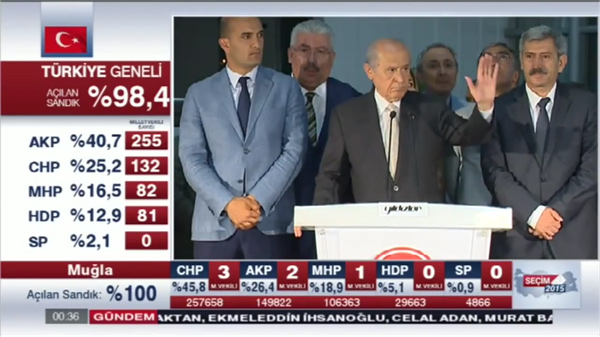
Not only failing to win the two-thirds majority they desired to change the constitution, the AKP lost its parliamentary majority and the ability to form a single-party government. It won 40.8% of the national vote and 258 seats, 19 short of the simple majority requirement of 276. Erdogan is now the lonely sultan at his $615 million, 1150-room presidential palace. For the first time since 2002, the opposition has more seats in parliament than the AKP: 292 seats to 258.

“The debate over presidency, over dictatorship in Turkey is now over,” said a cheerful Selahattin Demirtas after the preliminary poll results. Demirtas, a Kurdish politician whose Peoples’ Democracy Party [HDP] entered parliament as a party for the first time, apparently with support from secular, leftist and marginal Turks, is the charismatic man who destroyed Erdogan’s dreams of an elected sultanate. Echoing a similar view, the social democrat, Kemal Kilicdaroglu, leader of the main opposition Republican People’s Party [CHP], commented on the early results in plain language: “We, through democratic means, have brought an end to an era of oppression.”

What lies ahead is less clear. Theoretically, the AKP can sign a coalition deal with the third biggest party, the right-wing Nationalist Movement Party [MHP], although during the campaign, MHP leader Devlet Bahceli slammed Erdogan harshly for the embarrassing corruption allegations against the president. At the same time, a CHP-MHP-HDP coalition is unlikely, as it must bring together the otherwise arch-enemies MHP and HDP.

1098Turkey’s Nationalist Movement Party leader Devlet Bahceli addresses supporters after the release of preliminary election results, June 7, 2015. (Image source: MHP video screenshot)

The AKP management may be planning for snap, or early, polls but there are hardly any rational reasons for it except to risk another ballot box defeat. Parliament may try a minority government, supported by one of the parties from outside government benches, but this can only create a temporary government.

Two outcomes, however, look almost certain: 1) The AKP is in an undeniable decline; the voters have forced it into compromise politics rather than permitting it to run a one-man show, with in-house bickering even more likely than peace, and new conservative Muslims challenging the incumbent leadership. 2) Erdogan’s ambitions for a too-powerful, too-authoritarian, Islamist executive presidency, “a la sultan,” will have to go into the political wasteland at least in the years ahead.

The AKP appeared polled in first place on June 7. But that day may mark the beginning of the end for it. How ironic; the AKP came to power with 34.4% of the national vote in 2002, winning 66% of the seats in parliament. Nearly 13 years later, thanks to the undemocratic features of an electoral law it has fiercely defended, it won 40.8% of the vote and only 47% of the seats in parliament, blocking it from even forming a simple majority.

Erdogan’s Egyptian Nightmare

December 30, 2014

Erdogan’s Egyptian Nightmare, The Gatestone InstituteBurak Bekdil, December 30,2014

Erdogan was happy. At least until a few days ago….

Erdogan probably did not know the Emir of Qatar’s next move on the Middle Eastern chessboard.

Turkey aspires to be a regional leader with no, little or problematic dialogue with about a dozen countries in its region.

Back in 2011, everything ostensibly was coming up roses between Turkey and Egypt. In a speech that year, then-Turkish President Abdullah Gul mentioned “…an axis of democracy of the two biggest nations in our region [Turkey and Egypt], from the north to the south, from the Black Sea down to the Nile Valley…”

In September 2011, then-Prime Minister [now President] Recep Tayyip Erdogan found an emotional hero’s welcome at Cairo’s Tahrir Square. Tens of thousands of Egyptians had flocked to the Cairo airport to welcome him. Streets were decorated with posters of Erdogan.

In early 2012, a survey by TESEV, a Turkish think-tank, found that Turkey was the most popular country for the residents of seven Arab countries, including Egypt.

But against that glittering backdrop, this author wrote in June 2011: “For Ankara, Cairo can be the new Damascus until another capital becomes the new Cairo. At that time, Syrian President Bashar al-Assad, Erdogan’s one-time best regional ally, had already become his worst regional nemesis.

The Turkish-Egyptian love affair would, in fact, be quite short-lived.

In August 2013, about a month after General Abdel Fattah el-Sisi in Egypt toppled the Muslim Brotherhood rule of President Mohammed Morsi, Erdogan appeared on TV, reading — in an unusually soft voice — a letter by the Muslim Brotherhood’s Mohamed al-Beltagy. The letter was written to Beltagy’s daughter Asmaa, a 17-year-old girl, who had been killed in Cairo when security forces stormed two protest camps occupied by supporters of the deposed president. Poor Asmaa had been shot in the chest and back.

“I believe you have been loyal to your commitment to God, and He has been to you,” her father wrote in the letter. “Otherwise, He would not have called you to His presence before me.” Erdogan’s tears were visible.

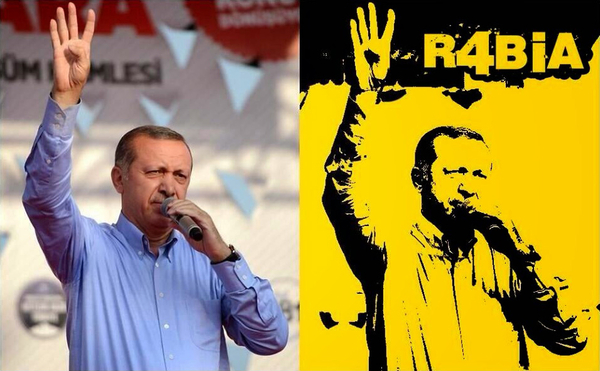
Later, Asmaa became another symbol for Turkish Islamists; Erdogan cheered party fans with the four-finger “Rabia” sign, in reference to his solidarity with the Muslim Brotherhood, and as a sign of his endearment for the unfortunate girl. Even on the playing field, a few footballers made the same sign after scoring.

859In this image, widely circulated in social media, Turkey’s then-Prime Minister [now President] Recep Tayyip Erdogan flashes the Egyptian Muslim Brotherhood’s four-fingered “Rabia” sign.

After the coup in Egypt, when el-Sisi ran for president and won the elections, Turkey’s Erdogan declared them “null and void.” And not just that. Erdogan also said that he did not view el-Sisi as “president of Egypt.” At another time, he said, “Turkey would not recognize the coup regime in Egypt.” Last July, he called el-Sisi “an illegitimate tyrant” and a “coup-maker.”

Meanwhile, neither was Erdogan a “rock star” in Cairo nor was Turkey “the most popular country.” Egyptian non-governmental organizations [NGOs] called on Egyptians and Arabs to boycott Turkish goods and soap operas. Egypt’s intellectuals, writers and businessmen were recommending a break in Egypt’s relations with Turkey because “they were disappointed.” Egypt unilaterally cancelled both visa-free travel for Turkish citizens and a transit agreement for Turkish trucks.

In the anti-el-Sisi campaign, Turkey was not alone. Its only regional ally, Qatar, fully supported Turkey against Egypt’s elected “coup leader.” Erdogan was happy. At least until a few days ago….

In Ankara, Erdogan was all smiles when he offered a red-carpet ceremony to the visiting Qatari Emir Sheikh Tamim bin Hamad al-Thani. Happy to have his best ally as a guest, Erdogan probably did not know the Emir’s next move on the Middle Eastern chessboard.

A few days after al-Thani’s merry visit to Ankara, Qatar announced its determination to thaw ties with Egypt, ending its alliance with Turkey over “Egypt’s illegitimate tyrant.”

“The security of Egypt is important for the security of Qatar … the two countries are linked by deep and fraternal ties,” ran a statement from the office of al-Thani on Dec. 21. It was a real cold shower on Ankara — and Erdogan. The statement had come one day after el-Sisi met in Cairo with a Qatari envoy, suggesting a possible thaw in relations. After the meeting, el-Sisi’s office issued a statement saying, “Egypt looks forward to a new era that ends past disagreements.” Apparently, the Egyptian-Qatari reconciliation had been brokered by Saudi Arabia and, once again, Turkey was the odd one out.

In its immediate vicinity, Turkey does not have diplomatic relations with three countries — Armenia, Cyprus and Syria — and has deeply problematic diplomatic relations with two countries: Israel and Egypt. This situation is not sustainable.

Even Deputy Prime Minister Bulent Arinc has said that Turkey should repair its relations with Egypt. But this is not an easy task. In the unlikely event of a reconciliation, Erdogan’s previous big words on el-Sisi the coup-maker will make him look like a leader shaking hands with an “illegitimate tyrant.”

On Dec. 24, Turkey’s foreign ministry spokesman said that bilateral ties with Egypt could “normalize if the country properly returns to democracy, if the Egyptian people’s free will is reflected in politics and social life.” Meaning, no normalization. The spokesman would not comment on Qatar’s policy change on Egypt.

Turkey aspires to be a regional leader with no, little or problematic dialogue with about a dozen countries in its region. Erdogan’s top advisors have found a nice euphemism for this situation: “precious loneliness.” In reality, it is rather a blend of miscalculation and over self-confidence.

Erdogan slams US on Syria again, days after Biden visit

December 1, 2014

Erdogan slams US on Syria again, days after Biden visit, Al-Monitor, Week in Review, November 30, 2014

U.S. VP Biden meets with Turkey's President Erdogan in IstanbulUS Vice President Joe Biden (L) meets with Turkey’s President Recep Tayyip Erdogan at Beylerbeyi Palace in Istanbul, Nov. 22, 2014. (photo by REUTERS/Murad Sezer)

Turkish President Recep Tayyip Erdogan calls US “impertinent” on Syria, says West likes seeing Muslim children die; Israel considers extension of Iran nuclear talks as better than a bad deal.

*********************

Turkish President Recep Tayyip Erdogan said on Nov. 26 that he is “against impertinence, recklessness and endless demands” coming from “12,000 kilometers away” (7,456 miles), his latest not-so-veiled rebuke of US policy toward Syria.

Erdogan’s outburst came four days after US Vice President Joe Biden departed Turkey. Biden, the latest in a seemingly endless stream of senior US official visitors to Ankara, spoke of the “depth” of the US-Turkish relationship and how the United States “needs” Turkey. The US vice president praised Turkey’s turnaround, for now, in its ties with Iraq, as reported this week by Semih Idiz, and Turkey’s handling of close to 1.6 million Syrian refugees (the UN High Commissioner for Refugees puts the number at approximately 1.1 million).

Despite the predictable deadening public platitudes, Biden’s visit, like those of other senior US officials, was a flop for the anti-Islamic State (IS) coalition. Erdogan prefers to hold his support against IS as ransom for a US-backed buffer or no-fly zone inside Syria. Not that the Turkish president, or others hawking such a plan, present any “day after” strategies for Syria; explain how a buffer zone or “doubling down” on the Syrian opposition would do anything more than prolong the war and wreck what remains of the Syrian state; lay out how the United States can avoid another Libya or another Iraq (that is, a failed state or a prolonged occupation) if it pursues regime change in Syria; identify where a post-transition stabilization force may come from given the limitations of Syrian rebel forces; or explain why the jihadists would not gain the upper hand in a divided post-Assad Syria with such a weak and fragmented opposition.

Turkey’s unwillingness to combat IS and other terrorist groups stands in contrast with US allies Saudi Arabia, United Arab Emirates, Jordan and Bahrain, as well as Iran, all of whom have concerns about US policy but are nonetheless engaged in combat operations against terrorists in Syria and Iraq.

Bruce Riedel explains how Saudi Arabia, which uncovered an IS-linked cell operating in the kingdom this week, is struggling with managing the threat from IS and its regional rivalry with Iran, but is nonetheless playing a leading role in the anti-IS coalition. Hossein Mousavian points out that among the “ground forces” combating IS, besides US-supported Syrian rebel forces, are the Iraqi and Syrian armies and Hezbollah, which are all backed by Iran. According to Mousavian, Tehran could be ready to do more if a nuclear deal is reached. Ali Hashem reports this week on Hezbollah’s role in Iraq, and Ali Mamouri chronicles the higher profile role that Iran Quds Force leader Qasem Soleimani is playing with Iraqi forces battling IS. Iraqi Kurdistan Region President Massoud Barzani, whose forces are also on the frontlines of the battle against IS, praised Iran’s role, saying in August that “Iran was the first country to provide us with weapons and ammunition” to confront the IS advance toward Erbil. Syrian government warplanes bombed Raqqa, an IS stronghold, on Nov. 25, although the United States accused Syria of killing many civilians in the process. US-led coalition forces also conducted airstrikes against IS forces in Raqqa this week.

Erdogan appears to be the odd man out in the coalition, compared with the actions of the other regional powers, and his policies and statements should raise broader questions about the direction of Turkish foreign policy, including what it means for Turkey’s membership bid in the EU and its role in NATO. Idiz writes that Erdogan appears to be turning his back on Turkey’s EU membership bid. On Nov. 28, the eve of Pope Francis’ visit to Turkey, Erdogan offered the following about Western countries: “Believe me, they don’t like us,” AFP reported him as saying. “They look like friends, but they want us dead — they like seeing our children die. How long will we stand that fact?”

The United States might soon tire of the all-pain, no-gain appeals to Turkey and simply ask Erdogan to pick a side in the US war against terrorists, making clear, as US President Barack Obama recently said, that the United States is not planning to remove Syrian President Bashar al-Assad at this time. Turkey is a critical US ally that must play a constructive role in Syria and the region, but the trends are becoming alarming. The United States, for its part, does not “need” Turkish bases to train anti-IS or anti-Assad rebels, does not “need” Turkish troops in Syria, and certainly does not “need” a buffer or no-fly zone, unless Washington is longing for a quagmire. What the coalition “needs” is for Turkey to crack down, hard, on the terrorist transit, trade and financial networks operating through Turkey into Syria, which have contributed to the rise of these groups over the past three years. Turkey’s intensified efforts at border security and counterterrorism cooperation would be a major contribution to the coalition. It does not seem to be an unreasonable ask, even if Ankara disagrees with the US approach to Assad.

As this column wrote on Nov. 16, it is the prospect of a nuclear deal with Iran, and the potential for regional cooperation with Iran, that is the key to a settlement of many of the region’s problems, including a political settlement in Syria and whether Assad stays or goes: “US interests in both defeating IS and securing a political settlement to end the Syria war depend on Iran’s good offices in Damascus. The United States cannot deal with Assad, but Iran can. Iran, like Washington’s regional allies, has a high tolerance for the spilling of Syrian blood. If the United States wants to deal Iran out in Syria, especially in the context of a bid to oust Assad, then Iran’s card will be to make the awful situation in Syria go from bad to worse. Iran is not necessarily immovable on Assad’s survival. Iran’s four-point plan for Syria includes a decentralization of power away from the Syrian presidency. Iranian officials privately signal that Assad may not be untouchable, under the right conditions, but such conversations — if they are to bear fruit — can only occur with Iran in a spirit of collaboration, not confrontation. Otherwise, Iran will simply hunker down, and the war will go on.”

Israel OK with extension of Iran nuclear talks

The seven-month extension of the P5+1 nuclear talks with Iran has sparked reactions across the region. Laura Rozen reports from Vienna that progress was made as the Nov. 24 deadline approached but observers are still divided on whether this can be turned into a finished deal in the upcoming months.

Ben Caspit writes of the furious diplomatic effort by Israel to fend off what it would consider a bad deal: “Israel has invested enormous amounts of energy in this. Over the past few months, and especially in the last few weeks, Minister of Intelligence Yuval Steinitz, who has coordinated these efforts, has become a ‘frequent flyer,’ plowing through the relevant capitals right and left. And Steinitz wasn’t alone in this. Senior Israeli intelligence officials also made frequent trips abroad to present their colleagues in different relevant capitals with intelligence documents, intelligence per se, and plenty of new information obtained by the Mossad and other Israeli intelligence agencies about the dangers inherent in that ‘bad agreement.’

“As the deadline approached this week, Steinitz intensified his activities, making two more quick visits, to London and to Paris, and meeting with German Foreign Minister Frank-Walter Steinmeier. Steinitz’s message, backed as always with intelligence reports, expert assessments and various analyses: ‘The agreement under discussion is a terrible agreement. It leaves room for huge potential breaches, which means that it is propped up on weak foundations. If those gaps are not sealed, it would be preferable to avoid reaching any agreement whatsoever than to sign the current one.’”

Retired Israel Defense Forces Gen. Michael Herzog writes that Israel views the extension of the talks as the least of all possible evils, “The truth is that Israel’s ability to influence the relationship between Iran and the West has reduced considerably. The credibility of its military option (which still exists) has decreased in the eyes of the United States and Iran, and its tense relationship with US President Barack Obama’s administration makes it difficult to engage in open dialogue between the two country’s top leaders. At this stage, as long as Iran is not hurtling toward the critical nuclear threshold, all that is left for Israel to do is to maintain the hope that Iran will continue to be intransigent, and that the US Congress will continue to play tough.”


Talking Turkey with an Islamist academician

August 29, 2014

Talking Turkey with an Islamist academician, The Washington Times, Daniel Pipes, August 27, 2014

As Turkey’s 26th prime minister, Mr. Davutoglu faces a bubble economy perilously near collapse, a breakdown in the rule of law, a country inflamed by Mr. Erdogan’s divisive rule, a hostile Gulen movement, and a divided AKP, all converging within an increasingly Islamist (and therefore uncivil) country. Moreover, the foreign-policy problems that Mr. Davutoglu himself created still continue, especially the Islamic State hostage emergency in Mosul.

The unfortunate Mr. Davutoglu brings to mind a cleanup crew arriving at the party at 4 a.m., facing a mess created by now-departed revelers. Happily, the contentious and autocratic Mr. Erdogan no longer holds Turkey’s key governmental position, but his placing the country in the unsteady hands of a loyalist of proven incompetence brings many new concerns for the Turks, their neighbors and all who wish the country well.

**********

As Recep Tayyip Erdogan ascends Thursday to the presidency of Turkey, his hand-picked successor, Ahmet Davutoglu, simultaneously assumes Mr. Erdogan’s old job of prime minister. What do these changes portend for Turkey and its foreign policy? In two words: nothing good.

In June 2005, when Mr. Davutoglu served as chief foreign policy adviser to Mr. Erdogan, I spoke with him for an hour in Ankara. Two topics from that conversation remain vivid.

He asked me about the neoconservative movement in the United States, then at the height of its fame and supposed influence. I began by expressing doubts that I was a member of this elite group, as Mr. Davutoglu assumed, and went on to note that none of the key decision-makers in the George W. Bush administration (the president, vice president, secretaries of state and defense, or the national security adviser) was a neoconservative, a fact that made me skeptical of its vaunted power. Mr. Davutoglu responded with a subtle form of anti-Semitism, insisting that neoconservatives were far more powerful than I acknowledged because they worked together in a secret network based on religious ties. (He had the good grace not to mention which religion that might be.)

In turn, I asked him about the goals of Turkish foreign policy in the Middle East in the era of the Justice and Development Party (AKP) that had begun in 2002, noting Ankara’s new ambitions in a region it had long disdained. He conceded this change, then took me on a quick tour d’horizon from Afghanistan to Morocco, noting Turkey’s special ties with many countries. These included the presence of Turkic-speakers (e.g., in Iraq), the legacy of Ottoman rule (Lebanon), economic symbiosis (Syria), Islamic ties (Saudi Arabia), and diplomatic mediation (Iran).

What struck me most was the boastful optimism and complete self-assurance of Mr. Davutoglu, former professor of international relations and an Islamist ideologue. He not only implied that Turkey had waited breathlessly for him and his grand vision, but he also displayed an unconcealed delight at finding himself in a position to apply his academic theories to the great canvas of international politics. (This privilege occurs surprisingly rarely.) In sum, that conversation inspired neither my confidence nor my admiration.

While Mr. Davutoglu has done remarkably well for himself in the intervening years, he did so exclusively as consigliere to his sole patron, Mr. Erdogan. His record, by contrast, has been one of inconsistent policy and consistent failure, a failure so abject it borders on fiasco. Under Mr. Davutoglu’s stewardship, Ankara’s relations with Western countries have almost universally soured, while those with Iran, Iraq, Syria, Israel, Egypt and Libya, among other Middle Eastern states, have plummeted.

Symbolically, Turkey is slipping away from the NATO alliance of democracies and toward the shoddy Sino-Russian grouplet known as the Shanghai Cooperation Organization. As Kemal Kilicdaroglu, leader of the opposition, sadly notes, “Turkey has grown lonely in the world.”

Having failed as foreign minister, Mr. Davutoglu now — in an application of the Dilbert Principle — ascends to a heady but subservient leadership of both the AKP and the government. He faces two major challenges:

As AKP leader, he is tasked with producing a great victory in the June 2015 parliamentary elections to modify the constitution and turn the semi-ceremonial position of president into the elected sultanate Mr. Erdogan lusts for. Can Mr. Davutoglu deliver the votes? Color me skeptical. I expect that Mr. Erdogan will rue the day he relinquished his prime ministry to become president, as he finds himself ignored and bored living in the sprawling presidential “campus.”

As Turkey’s 26th prime minister, Mr. Davutoglu faces a bubble economy perilously near collapse, a breakdown in the rule of law, a country inflamed by Mr. Erdogan’s divisive rule, a hostile Gulen movement, and a divided AKP, all converging within an increasingly Islamist (and therefore uncivil) country. Moreover, the foreign-policy problems that Mr. Davutoglu himself created still continue, especially the Islamic State hostage emergency in Mosul.

The unfortunate Mr. Davutoglu brings to mind a cleanup crew arriving at the party at 4 a.m., facing a mess created by now-departed revelers. Happily, the contentious and autocratic Mr. Erdogan no longer holds Turkey’s key governmental position, but his placing the country in the unsteady hands of a loyalist of proven incompetence brings many new concerns for the Turks, their neighbors and all who wish the country well.


