Posted tagged ‘Egypt’

Can President Obama Pass Disraeli’s Test?

December 5, 2014

Can President Obama Pass Disraeli’s Test? American ThinkerKen Blackwell and Bob Morrison, December 5, 2014

(Please see also Reports: Obama Mulling Sanctions on Israel. — DM)

Applying the Disraeli Test to this administration, President Obama’s policies fail on every count. No wonder our present foreign policy seems to stray so far from true American principles and interests.

***************

British Prime Minister Benjamin Disraeli famously said: “The Lord deals with the nations as the nations deal with the Jews.” Winston Churchill was an avid student of Disraeli’s “Tory Democracy” and passed Disraeli’s test easily, as Steven Hayward wrote recently in the Weekly Standard.

This raises a most interesting question: How would President Obama fare on a Disraeli test? His policy toward the Jewish State of Israel leads us to question whether this outstanding student, this graduate of Columbia University and Harvard Law School, could pass a simple, three-question test suggested by one of the Nineteenth Century’s leading statesmen.

President Obama made it a point to skirt around Israel during the entire four years of his first term, while making it his point to go to Turkey, Egypt, and Saudi Arabia in those years.

First, what about Turkey? In 2009, President Obama congratulated that secular republic on its commitment to democratic rule. Turkey is the only member of NATO with a Muslim majority. As such, Turkey’s 50-year alliance with the U.S. and its longtime support for Israel — the only Muslim land in the Near East to give such support — were certainly an important factor worthy of consideration in U.S. foreign policy. But under President Recep Tayyip Erdogan, Turkey has moved farther and farther away from the United States and closer to Russia.

As to Israel, Turkey has become a leading sympathizer of the Hamas terrorist-led regime in Gaza, attempting to run the Israeli blockade of Gaza and charging Israel with violating the human rights of the Arabs of Palestine. Interestingly, while Israel formally supports the idea of statehood for Palestinian Arabs, Turkey denies statehood for its hugeKurdish minority of 20 million. In fact, the Kurds are by far the largest ethnic group in the Mideast denied a state.

Does President Obama hold the Turks to the same standard that he applies to the Israelis? Not at all. He has not begun to press the Turks on Kurdish rights. Until 2000, it was illegal for a person holding Turkish citizenship to identify himself as a Kurd. Contrast this with Israel, where Arabs not only can so identify, they actually sit in the Israeli parliament, the Knesset, as Arabs and form legal Arab political parties.

Now, what of this administration’s view of Egypt? President Obama speedily recognized the Muslim Brotherhood-dominated government in Egypt headed by Mohamed Morsi. Morsi — educated in the U.S. but strongly rejecting American principles of religious liberty and constitutional government — quickly brought Egypt to the brink of chaos. Morsi planned a visit to the U.S. — one eagerly anticipated by the Obama administration — even though Morsi announced he would press the White House to pardon a terrorist.

Morsi wanted Obama to release Sheikh Omar Abdul Rahman, in prison for his part in the first terrorist attack on the World Trade Center. That attack killed seven Americans in 1993.

National Review’s Andrew C. McCarthy provided this stunning profile of Mr. Obama’s obeisance to the Muslim Brotherhood in Egypt.

Reports that the State Department was discussing a transfer of the Blind Sheikh back to Egypt surfaced months ago, in the context of a potential swap for democracy activists the Supreme Council of the Armed Forces was then detaining. The administration then issued a visa to Hani Nour Eldin, a member of the Islamic Group — the Blind Sheikh’s terrorist organization, to which it is a felony to provide material assistance. The purpose was to invite Eldin to, yes, the White House, for consultations with top American national-security officials on prospective relations between the United States and the new, Islamist Egypt. As the administration had to know he would do, he pressed his top agenda item: The United States must return the Blind Sheikh as a “gift to the revolution.”

Fully willing to give hundreds of millions in U.S. aid to Morsi, Mr. Obama promptly yanked that aid when Egypt’s military finally pulled the plug on the Muslim Brotherhood’s misrule in Egypt.

That leaves Saudi Arabia as the final question in Mr. Obama’s “Disraeli Test.” It is illegal for a Jew to live in Saudi Arabia. Any Saudi national who converts to Judaism is beheaded for apostasy. In February, 1945, President Roosevelt appealed to Saudi Arabia’s founding monarch, Abdulazziz, for the Jewish survivors of the Holocaust. Even then, the Saudis were unyielding. FDR, hoping to touch the desert despot’s heart, told him that three million Jews had been murdered in Poland. It was one of the first confirmations by a world statesman of the plight of European Jewry. Abdulazziz’s reaction to this horrific news? There was obviously no need for a Jewish state in the Mideast since there would now be plenty of room for Europe’s surviving Jews — in Poland!

Despite this history of no peace with Israel, no recognition of Israel, no compromise with Israel, President Obama shamefully bowed to the King of Saudi Arabia. No American president had ever bowed to anyone before.

Applying the Disraeli Test to this administration, President Obama’s policies fail on every count. No wonder our present foreign policy seems to stray so far from true American principles and interests.


Sisi is not Mubarak

December 4, 2014

Sisi is not Mubarak, Canada Free Press, Caroline Glick, December 4, 2014

Sisi1

Due to the events that propelled him to power, Sisi has adopted a strategic posture far different from Mubarak’s. As Sisi sees things, Sunni jihadist forces and their Iranian-led Shi’ite allies are existential threats to the Egyptian state even when their primary target is Israel. Sisi accepts that Israel’s fight against them directly impacts Egypt.

He recognized that when Israel is successful in defeating them, Egypt is more secure. When Israel is weak, the threat to Egypt rises.

The government must take every possible action, in economic and military spheres, to ensure that Sisi benefits from his actions. 

******************

The Egyptian court’s decision last Saturday to acquit former president Hosni Mubarak, his sons and associates of all remaining charges against them caused most commentators to proclaim that current Egyptian President Abdel Fattah Sisi has turned back the clock. Under his leadership, they say, Egypt has restored Mubarak’s authoritarian regime under a new dictator.

While this may be how things appear on the surface, the fact of the matter is that at least as far as Israel is concerned, nothing could be further from the truth.

During his 30-year rule, Mubarak always assessed that threats against Israel were unrelated to threats against Egypt. Due to this view, despite continuous complaints from Jerusalem, Mubarak enabled jihadists to take root in Sinai. He allowed Egypt to be used as the major path for terrorist personnel and armaments to enter Gaza. He took only minor, sporadic action against the smuggling tunnels connecting Gaza to Sinai.

By 2005, it became apparent that forces from Hamas, Hezbollah, Iran and al-Qaida were operating in the Sinai and cooperating with one another.

Despite warnings from Israel, Mubarak took no effective action to break up the emerging alliance and convergence of forces.

It was due to Mubarak’s refusal to act that the Palestinians in Gaza were able to begin and massively expand their projectile war of mortars, rockets and missiles against Israel. From the first such attacks, carried out 14 years ago, the Palestinian projectile campaigns could never have happened without Egypt’s effective collaboration.

On countless occasions, Palestinian terrorist commanders were able to escape to Sinai and avoid arrest by Israeli forces, only to return to Gaza from Sinai and continue their operations.

Mubarak believed that Israel was his safety valve.

Mubarak: Facilitating jihadist operations against Israel from Egyptian territory

By facilitating jihadist operations against Israel from Egyptian territory, he assumed that he was securing Egypt from them. As he saw things, the Muslim Brotherhood, Hamas, Hezbollah and Iran would be so satisfied with his cooperation in their jihad against the Jews that they would leave him alone.

It was only in 2009, when Egypt announced the unraveling of a terrorist ring in Sinai comprised of Iranian Revolutionary Guards, Hamas and Hezbollah operatives planning attacks against Israel and Egypt, and seeking the overthrow of the regime, that Mubarak began signaling he may have misjudged the situation. But even then, his actions against those forces were sporadic and half-hearted.

Hamas’s continued assaults against Israel in the years that followed, and the build-up of Muslim Brotherhood and al-Qaida forces in Sinai, were a clear sign that Mubarak was unwilling to contend with the unpleasant reality that the very forces attacking Israel were also seeking to overthrow his regime and destroy the Egyptian state.

In stark contrast, Sisi rose to power as those selfsame forces were poised to destroy the Egyptian state. The Muslim Brotherhood’s rise to power owed in part to the support it received from Hamas.

Sisi and his generals overthrew the Muslim Brotherhood with Saudi and UAE support in order to prevent Egypt from dissolving into a Sunni jihadist axis i

During the January 2011 rebellions against Mubarak, Hamas operatives played a key role in storming Egyptian prisons in Sinai and freeing Muslim Brotherhood leaders – including Muslim Brotherhood president Mohammed Morsi – from prison. In 2012 and 2013, Hamas forces reportedly served as shock troops to quell protests against the Muslim Brotherhood regime. Those protests arose in opposition to Morsi’s moves to seize dictatorial powers Mubarak never dreamed of exercising, and his constitutional machinations aimed at transforming Egypt into an Islamic state and hub of a future global caliphate.

Sisi and his generals overthrew the Muslim Brotherhood with Saudi and UAE support in order to prevent Egypt from dissolving into a Sunni jihadist axis in which Hamas, al-Qaida and other jihadist movements were key players, and Iran and Hezbollah were allied forces.

Due to the events that propelled him to power, Sisi has adopted a strategic posture far different from Mubarak’s. As Sisi sees things, Sunni jihadist forces and their Iranian-led Shi’ite allies are existential threats to the Egyptian state even when their primary target is Israel. Sisi accepts that Israel’s fight against them directly impacts Egypt.

He recognized that when Israel is successful in defeating them, Egypt is more secure. When Israel is weak, the threat to Egypt rises.

Like Israel, Sisi acknowledges that the ideology of the Muslim Brotherhood, which is shared by Hamas, al-Qaida and all other significant Sunni jihadist groups renders all of these groups threats to Egypt. And because of this acknowledgment, Sisi has abandoned Mubarak’s policy of enabling their war against Israel.

Not only has he abandoned Mubarak’s policy of enabling them, Sisi has acted in alliance with Israel in combating them. This is nowhere more evident than in his actions against Hamas in Gaza.

After seizing power in July 2013, Sisi immediately ordered the Egyptian military to take action to secure the border between Gaza and Sinai. To this end, for the first time, Egypt took effective, continuous steps to block the smuggling of arms and people between the two areas. These steps had a profound impact on Hamas’s regime. Hamas went to war against Israel this past summer in a bid to force Egypt and Israel to open their borders with Gaza in support of the Hamas regime and its jihadist allies.

Hamas was certain that footage of suffering in Gaza would force Egypt to oppose Israel, and so open its border with Gaza. It would also lead to US-led pressure on Israel that would make Israel succumb to Hamas’s demands.

Against all expectations, and previous precedents of Egyptian behavior under both Mubarak and Morsi, Sisi supported Israel against Hamas. Moreover, he brought both Saudi Arabia and the UAE into the unofficial alliance with Israel. The bloc he formed was powerful enough to surmount US pressure to end the war by bowing to Hamas’s demands and opening Gaza’s borders with Egypt and Israel.

Since the cease-fire came into force three months ago, Sisi has continued to seal the border. As a consequence, he has denied Hamas the ability to rebuild Gaza’s terror infrastructure. In its reduced state, Hamas is less able to facilitate the operations of its jihadist brethren in Sinai that are primarily involved in waging an insurgency against the Egyptian state.

To be sure, the most significant strategic development in recent years is the US’s strategic realignment under President Barack Obama. Under Obama the US has switched sides, supporting Iran and its allies, satellites and assets, including the Muslim Brotherhood and Hamas, against America’s Sunni allies and Israel.

But the alliance that emerged this summer between Israel and Egypt, with the participation of Saudi Arabia and the UAE , is also a highly significant strategic development. For the first time, a major regional power is basing its strategic posture on its understanding that the threats against itself and against Israel stem from the same sources and as a consequence, that the war against Israel is a war against it.

Israelis have argued this case for years to their Arab neighbors as well as to the Americans and other Western states. But for multiple reasons, no one has ever been willing to accept this basic, obvious reality.

As a consequence, everyone from the Americans to the Europeans to the Saudis long supported policies that empower jihadist forces against Israel.

Sisi became the first major leader to break with this consensus, as a result of actions Hamas took before and since his rise to power. He has brought Saudi Arabia and the UAE along on his intellectual journey.

And this reassessment has had a profound impact on regional realities generally and on Israel’s strategic posture specifically.

From Israel’s perspective, this is a watershed event.

The government must take every possible action, in economic and military spheres, to ensure that Sisi benefits from his actions.

Egypt uncovers 82 new Gaza-Sinai smuggling tunnels

December 3, 2014

Egypt uncovers 82 new Gaza-Sinai smuggling tunnels, DEBKAfile, December 3, 2014

The Egyptian army this week unearthed a total of 82 new smuggling tunnels running from Sinai to the Hamas-ruled Gaza Strip, DEBKAfile’s military sources report. It turns out that neither Israeli nor Egyptian intelligence had caught on to the massive project. The illicit passageways were discovered by chance when Egyptian troops were working on on a new buffer zone to separate Sinai from the Palestinian enclave. Both agencies were taken aback by the speed with which Hamas had reconstituted its underground system for smuggling arms and fighting men into the Gaza Strip, after it was practically demolished by Egypt and Israel.

US on Demolishing Homes: No in Israel, Yes in Egypt

November 16, 2014

US on Demolishing Homes: No in Israel, Yes in Egypt, The Jewish PressTzvi Ben-Gedalyahu, November 15, 2014

egypt-destroys-homes-in-Rafah-screenshot-press-tvUS has no problem with Egypt’s bombing hundreds of homes of Gaza civilians but can’t stand to see Israel destroy a terrorist’s home. Photo Credit: Screenshot

(Please see also Abbas aide: Execute Palestinians who sell land to Israelis. Oh, well.  — DM)

Psaki is explicitly saying that Egypt has the right to tear down not one home, and not dozens of homes but hundreds of homes of civilians – not terrorists – in Sinai because it is an act of self-defense. In Israel it is “counterproductive.”

****************

The same U.S. State Dept. that is condemning Israel’s policy of demolishing Palestinian Authority terrorists’ homes sanctions the same destruction by Egypt of hundreds of civilians’ homes in the Sinai.

State Dept. spokeswoman Jen Psaki on Thursday said it was “counterproductive” for Israel to demolish the homes of terrorists.

When asked Friday about Egypt’s al-Sisi regime’s demolitions of Sinai homes, whose owners’ only crime was living in an area that Egypt wants as a buffer zone with Gaza, she condoned Egypt’s action.

“There have been some serious security challenges in the Sinai,” Psaki said. “We respect Egypt’s concern about their security in the area and support its right to self-defense. We also expect that they will ensure the rights of those being displaced are respected and that they are adequately compensated. That continues to be what we have conveyed to the Egyptians.”

And how about Israel’s right to self-defense?

“So you don’t regard that as being counterproductive to the cause of peace or fighting extremism, these home demolitions?” in the Sinai, asked Associated Press reporter Matt Lee. “You would not argue that – I mean, you say that there are serious security problems in the Sinai for the Egyptians. Are there not also serious security concerns and security problems for the Israelis?…”It’s not okay for the Israelis to demolish homes, but it’s okay for the Egyptians to demolish homes?”

Psaki dug up the expired “borders’ argument, to wit:

“Well, it’s an entirely different scenario, Matt. Egypt is not predetermining what borders would be by taking these steps. It’s a different scenario….We believe it’s counterproductive to their stated goals. In Egypt, we understand their concerns about their security. We’ve seen recent threats to that in the Sinai, as you all have reported on. I think I’m going to leave it at that. They’re different scenarios.”

No, no, Madame Psaki, you may not leave it at that.

She is explicitly saying that since the Obama administration backs the Palestinian Authority claim that half of Jerusalem belongs to a country that does not exist, Israel does not have the right to try to deter terror by tearing down the homes of a terrorist who killed an American-Israeli baby in a vehicle terror attack at a Jerusalem light rail station last month.

She is saying Israel may not send a warning to future terrorists by destroying the home of the attempted murderer who last month shot at point-blank range Rabbi Yehuda Glick for wanting the right for Jews to pray on the Temple Mount.

Psaki is explicitly saying that Egypt has the right to tear down not one home, and not dozens of homes but hundreds of homes of civilians – not terrorists – in Sinai because it is an act of self-defense. In Israel it is “counterproductive.”

Thousands of people on the Egyptian side of Rafah were displaced three weeks ago when the Egyptian army dynamited their homes to create the buffer zone that Egypt hopes will help put a stop to the surge of weapons and terrorists into the Sinai from Hamas-controlled Gaza.

The difference between Israel and Egypt, according to the Obama administration, is that Israel has no right to deter terror if terrorists are killing Jews because of the assumed motive of securing borders for the Palestinian Authority and which Washington has pre-determined and which preclude negotiations that the same Obama administration tries to make believe exist.

A Turkish Quest to “Liberate” Jerusalem

November 13, 2014

A Turkish Quest to “Liberate” Jerusalem, Gatestone InstituteBurak Bekdil, November 13, 2014

Both Turkey’s President Erdogan and its Prime Minister Davutoglu have declared countess times that Gaza and Jerusalem (in addition to Syria, Iraq, Egypt, Somalia, and the Maghreb) are Turkey’s “domestic affairs.”

In truth, there is no mention of any city’s name in the Qur’an.

Turks have a different understanding of what constitutes an occupation and a conquest of a city. The Turkish rule is very simple: The capture of a foreign city by force is an occupation if that city is Turkish (or Muslim) and the capture of a city by force is conquest if the city belongs to a foreign nation (or non-Muslims).

For instance, Turks still think the capture of Istanbul in 1453 was not occupation; it was conquest.

In a 2012 speech, President Recep Tayyip Erdogan (then Prime Minister) said: “Just like Mecca, Cairo and Istanbul are cities of the Qur’an.” In truth, there is no mention of any city’s name in the Qur’an. Never mind.

“Conquest,” Turkey’s top Muslim cleric, Professor Mehmet Gormez, declared in 2012, “is not to occupy lands or destroy cities and castles. Conquest is the conquest of hearts!” That is why, the top Turkish cleric said, “In our history there has never been occupation.” Instead, Professor Gormez said, “in our history, there has always been conquest.” He further explained that one pillar of conquest is to “open up minds to Islam, and hearts to the Qur’an.”

It is in this religious justification that most Turkish Islamists think they have an Allah-given right to take infidel lands by the force of sword — ironically, not much different from what the tougher Islamists have been doing in large parts of Syria and Iraq. Ask any commander in the Islamic State and he would tell you what the jihadists are doing there is “opening up minds to Islam, and hearts to the Qur’an.”

Both President Erdogan and Prime Minister Ahmet Davutoglu have declared countless times that Gaza and Jerusalem (in addition to Syria, Iraq, Egypt, Somalia and the Maghreb) are Turkey’s “domestic affairs.”

This author wrote in this journal on Oct. 30:

In reality, with or without the normalization of diplomatic relations between Ankara and Jerusalem, the Turks have never hidden their broader goals in the Arab-Israeli dispute: that Jerusalem should be the capital of a Palestinian state; and that Israel should be pushed back to its pre-1967 borders. Until then, it will be ‘halal’ [permitted in Islam] for Erdogan to blame Israel for global warming, the Ebola virus, starvation in Africa and every other misfortune the world faces.

As if to confirm this whimsical view, Deputy Prime Minister Yalcin Akdogan has blamed Israel for democratic failings in the Arab world. “Israel works with [undemocratic] regimes and keeps its ship afloat.” So, it is because of Israel that Arab nations have never established democratic culture — before or after 1948; or before or after the Arab Spring revolts. But fortunately, Palestinians have a new “protector.”

From Prime Minister Davutoglu’s public speech on November 7:

Al-Aqsa [mosque in Jerusalem] will one day be liberated. The Israelis should know that the oppressed Syrians have a protector. The oppressed Palestinians too have a protector. That protector is Turkey. Just as Bursa [the Turkish city where he spoke] ended its occupation, the honorable Palestinians, honorable Muslims will end the [Israeli] occupation. Just as Osman Gazi [a sepulchre in Bursa] was liberated, al-Aqsa too will be liberated. Al-Quds [Jerusalem] is both our first prayer direction and has been entrusted with us by history. It has been entrusted with us by Hazrat Omar. The last freedom seen in Jerusalem was under our [Ottoman] rule. Al-Quds is our cause. It is the occupying, oppressive Israeli government that has turned the Middle East into a quagmire.

Echoing that view, President Erdogan said that protecting Islamic sites in the Holy Land is a sacred mission (for his government), and bluntly warned that any attack against the al-Aqsa mosque is no different than an attack on the Kaaba in the holy city of Mecca.

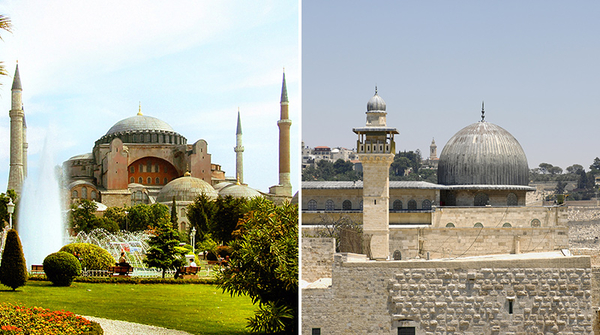
792Spot the difference: In the eyes of Turkey’s political and religious leadership, Istanbul and its Hagia Sophia (once a Greek Orthodox Basilica) were legitimately “conquered” by the Muslim Ottomans, while Jerusalem and its al-Aqsa mosque (built atop the ruins of the Jewish Temples) are illegally “occupied” by Israel. (Images source: Wikimedia Commons)

No doubt, after Gaza, al-Aqsa (and Jerusalem) has become a powerful Turkish obsession, and a treasure-trove of votes, especially in view of Turkey’s parliamentary elections next June. And do not expect the Turkish leadership only to corrupt facts. Plain fabrication is a more favored method. All the same, someone, sometimes, would unwillingly reveal the truth often when trying to corrupt other facts.

Since Davutoglu claimed that “Jerusalem has been entrusted with the Turks by Hazrat Omar,” it may be useful to refresh memories. Hazrat Omar is Omar bin Al-Khattab (579-644), one of the most powerful and influential Muslim caliphs in history. Within the context of “conquest vs. occupation,” he was referenced by the top cleric, Professor Gormez in a 2012 speech:

After Hazrat Omar conquered al-Quds [Jerusalem], he was invited to pray at a church [as there were no mosques yet in Jerusalem]. But he politely refused because he was worried that the [conquering] Muslims could turn the church into a mosque after he prayed there.

Since medieval historical facts cannot have changed over the past two years, the top Turkish ulama [religious scholar], referencing a most powerful Muslim caliph, is best witness that when the Muslims had first arrived in Jerusalem there was not a single mosque in the city. Why? Because Jerusalem was not a Muslim city. Why, then, do Turkish Islamists claim that it is Muslim? Because it once had been “conquered.” Would the same Turks surrender Istanbul to the occupying forces that took the city after World War I because its capture in 1920 made it a non-Turkish city? No, that was not conquest, that was occupation!

Had Messrs Erdogan and Davutoglu been schoolchildren, such reasoning might have been called bullying and cheating.

Who is the Real Chickenshit?

November 4, 2014

Who is the Real Chickenshit? Gatestone InstituteBassam Tawil, November 4, 2014

(Are attempts to spawn a new Islamic Caliphate more grounded in fantasy than Obama-Kerry perceptions of the Islamic State, grounded in their ill-formed perceptions of fact and ideology? Or less? — DM)

Judging by their actions, most Arab leaders do not want to create yet another terrorist Islamist state, dedicated to the Muslim Brotherhood’s ideology and to toppling their regimes. We do want a Palestinian state, but please, only one that will provide responsible governance.

According to the “Arab street,” it is the Americans and Europeans who are cowards, afraid to take significant steps against Iran, and terrified of the Islamic ghettoes in their cities, which have been exporting terrorists to fight for the Islamic State, and providing housing to the seasoned fighters who return.

To Arabs, the ultimate irony is that America is paying Qatar to have its airbase there, while Qatar is paying terrorists to kill Americans.

When John Kerry claimed it was the unresolved Palestinian issue that caused a ripple effect that crated ISIS, he simply inspired the Palestinians to use Al-Aqsa mosque as a religious trigger for future bloodshed.

There is a civil war currently under way between radical Islam — motivated by imperialist fantasies of restoring the Islamic Caliphate — and the more moderate secular Muslim regimes that are seeking the path to modernization and progress.

At the same time, Sunni Islam is in the midst of an increasingly violent crisis in its dealings with Shi’ite Iran, which looks as if it is about to be granted nuclear weapons capability, and which for decades quietly has been eyeing neighboring Arab oil fields.

Into the middle of this explosive disarray, U.S. Secretary of State John Kerry and his supporters have thrown the accusation that it was actually Israel’s so-called refusal to reach a peace agreement that was responsible for the ripple effect that led to the creation of ISIS. This incorrect diagnosis of the situation merely postpones the West’s efforts to find a real, workable solution for the Palestinian issue.
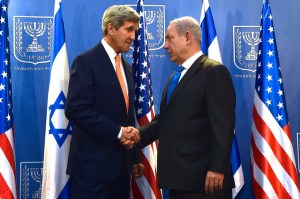
774Does Kerry really blame Israel for ISIS? Above, U.S. Secretary of State John Kerry meets with Israeli Prime Minister Benjamin Netanyahu in Tel Aviv, Israel, on July 23, 2014. (Image source: U.S. State Department)

It is easy for the leaders of the Arab world to latch onto Kerry’s accusation and use it justify their weakness and unwillingness to enter into a direct battle against terrorism; to let America do the dirty work, and conveniently to relieve the Arab world of having to recognize Israel and establish a Palestinian state.

They would also be able to avoid dealing with Israel’s demand for the Palestinian territories to be disarmed and the Palestinians’ demands for concessions from Israel.

Judging by their actions, most Arab leaders have no desire to see the Palestinian issue resolved. They seem to prefer preserving the status quo. They blame Israel for refusing to make concessions to the Palestinians and hope that this refusal will weaken Israel, even though Israel is their strategic defense against Iran.

Most Arab leaders do not want to create what is bound soon to become yet another terrorist Islamist state, dedicated to the Muslim Brotherhood’s ideology and to toppling their regimes. The Arab leaders already have to contend with ISIS, Al-Qaeda and the Al-Nusra Front in Syria, Iraq, Libya and Yemen, which are enough for them, to say nothing of Africa from Nigeria to Somalia and everything in between.

But if Israel can be blamed for another of world’s ills, with Kerry’s blessing, why waste the opportunity?

When Jordan’s King Abdullah called the current Islamic civil war a cry of distress, he was not speaking randomly. There is a genuine problem.

No examples are better than Turkey, Qatar and Iran. Turkey, led by its president, Recep Tayyip Erdogan, hosts Hamas’s overseas command center; is supported by Qatar and would apparently like to take control of more Sunni territory by subverting the Sunni Arab monarchies. Such a move would enable Erdogan to realize his outspoken dream of recreating an Ottoman Empire and Caliphate.

Turkey and Qatar, its partner in plotting the return of the Caliphate, have left their fingerprints on most of the terrorist attacks and catastrophes currently visited upon the Middle East, especially in the fields of subversion, incitement to terrorism, and the arming and training of terrorists.

The Middle Eastern Sunni Islamist terrorist organizations, meanwhile, are being incited and indoctrinated by Al-Jazeera TV, a Muslim Brotherhood megaphone that belongs to Qatar’s ruling al-Thani family. It was Al Jazeera’s Arabic channel that created the “Arab Spring” by taking the story of a fruit-seller who merely wanted a permit, and whipping it up, non-stop, until it grew into a revolution that brought down Tunisia’s government.

The Middle East’s terrorist gangs are now armed and trained with funding from Qatar. Recently, in yet another savored irony, Turkey agreed to help train Syrian rebels and allow the U.S. to use its military bases — but for Turkey, the plan is probably to bring down Syria’s non-Sunni President, Bashar Al-Assad, and not, as the U.S. might imagine, to bring down ISIS.

In the past, Persian Gulf states such as Saudi Arabia joined in training Islamic terrorist cadres, but currently, as the Arab proverb goes, “The magic spell boomeranged,” and Saudi Arabia and its Gulf allies have to defend themselves from the very groups they helped create.

Terrorist organizations are now generously funded by Qatar and NATO-member Turkey, which inspire them to attack the regimes of Egypt, Syria, Iraq and Jordan, and various regimes in the Persian Gulf and Africa. Of course, they are all also inspired to attack Israel, as Hamas has done.

Turkey and Qatar are also exploiting the naiveté of the Western world, encouraging ISIS operatives to make preparations to attack Europe and the United States. Preachers of “political Islam” incite susceptible Islamic youths in the West and prepare them for a terrorist campaign. They use the West’s political correctness, free speech and support for “pluralism,” all the while insisting they are not preaching terrorism.

Turkey and Qatar, along with Iran — which does its utmost to export the Ayatollah Khomeini’s Islamic Revolution throughout both North and South America, as well as Syria, Lebanon, Iraq and Yemen — are aided by a mechanism known as the da’wah, or “outreach,” Da’wah, technically the preaching of Islam, is used by political Islam for indoctrinating, enlisting and handling Islamist terrorists worldwide. Perfected for terrorist purposes by the Muslim Brotherhood, its mouthpiece is Sheikh Yusuf al-Qaradawi, who, like Hamas’s leader, Khaled Mashaal, is based in Qatar.

While Iran’s rivals, the Sunni states, conduct their civil wars, Iran only becomes stronger. Not only is it turning itself into a nuclear power, it is also strengthening all its outposts in the Middle East and around the world. It supports the Shi’ite regime in Iraq against ISIS; it arms and funds the Houthis in Yemen and the Hezbollah in Lebanon; and it supports the Syrian Alawite regime against its Sunni opponents.

When it comes to terrorism, Iran does not draw partisan lines. It also supports the Sunni groups Hamas and Palestinian Islamic Jihad, both of which seek to destroy Israel and attack the Egyptians in the Sinai Peninsula.

In response to the colossal threat of radical Islam, the whimpering voice of the West can barely be heard. The U.S. administration targeted Israel for condemnation. A “senior official,” most likely the current White House Chief of Staff Denis McDonough, called Israel’s Prime Minister Benjamin Netanyahu a “chickenshit,” for being afraid to make peace with the Palestinians.

According to the “Arab street,” including the Palestinian street, it is the Americans and Europeans who are cowards, afraid to take significant steps against Iran, and terrified of the Islamic ghettoes in their cities, which have been exporting terrorists to fight for the Islamic State, and providing housing to the seasoned fighters who return.

The Sunni states under Shi’ite threat cannot even reach an agreement among themselves about what is to be done; and the Palestinians, in their folly, have chosen the worst possible moment to ignite violence in Jerusalem and the Al-Aqsa mosque. The Palestinians seem not to understand that the Arab regimes that might support them are currently busy fighting for their own survival, and have no desire to fall prey to Palestinian provocations about what they realize all too well are fictional threats to Jerusalem.

Given the current situation, Turkey’s regional political actions are dangerous, underhanded and hypocritical. To achieve their ends, Turkey’s leaders seem to have no qualms about sacrificing their minorities, such as Christians and the Kurds (most of whom are Sunni). Turkey’s leaders were the first to cry “humanitarian crisis” when Israel imposed a closure on the Gaza Strip to prevent Iran from sending Hamas arms. Turkey sent the Mavi Marmara flotilla to protect the Gazans, who were never in any danger in the first place. Turkey’s leaders then weakened Palestinian Authority President Mahmoud Abbas, who, at least at that time, showed himself willing to reach a peace agreement with the Israelis. But when Syria’s Kurds are being killed in Kobani on a daily basis, the Turks are silent, perhaps secretly comfortable seeing a group that wants a state of its own apart from Turkey, being attacked.

Thus, when John Kerry claimed that it was the unresolved Palestinian issue that caused a ripple effect that created ISIS, he simply inspired the Palestinians to use Al-Aqsa mosque as a religious trigger for future bloodshed. The idea is not new; it was used in 1929 by the Grand Mufti of Jerusalem and led to anti-Jewish riots and the massacre of the Jews in Hebron. It was used again by PLO Chairman Yasser Arafat in 2000, to incite the Palestinians to the second intifada, which killed untold numbers of Jews and Arabs. Today, Mahmoud Abbas and Hamas’s Khaled Mashaal are doing the same thing to incite a jihad that this time will truly be religious and not based on real estate.

The more Kerry accuses Israel of having had a hand in creating ISIS, the more the Palestinians will use Al-Aqsa mosque to stir the fire burning under the bubbling cauldron of the Middle East.

The Palestinians’ religious incitement campaign is currently being waged primarily by Mahmoud Abbas, the man who stood in front of the UN and accused Israel of fomenting a religious war. This is the same Mahmoud Abbas who calls on Palestinians to use every means available to fight Israel, while at the same time denying that he is doing so.

Meanwhile, Qatar lurks in the background, instructing Al-Jazeera TV to incite the Palestinians against Israel, Egypt and Jordan, and encouraging terrorist attacks that lead only to justified Israeli reprisals.

Qatar’s royal family hides behind the security of having a major U.S. airbase on its soil, while supporting Hamas, the Islamic Movement in Israel and the terrorist organizations in the Sinai Peninsula. To Arabs, the ultimate irony is that Americans are paying Qatar to have an airbase there, while Qatar is paying terrorists to kill Americans.

Qatar also still finds time nonsensically to accuse the wakf in Jordan, responsible for Al-Aqsa mosque, of collaborating with Israel to eradicate all signs of Muslim presence on the Temple Mount. Qatar’s only plan with that at the moment, however, is to cause riots in Jordan to oust Jordan’s king.

Inspired by Western accusations against Israel and the West’s enthusiastic recognition of a Palestinian state — without requiring the direct negotiations with Israel, as obligated by international treaties — the Palestinian leadership has become more radicalized.

Mahmoud Abbas has gone so far as to abandon his pretense of moderation: if the Israelis can be accused of creating the ISIS with no mention made of the culpability of Hamas, whose ideology is the same as ISIS’s, Mahmoud Abbas has been freed of any commitment to peace and can actively pursue the unilateral declaration of a Palestinian state.

In addition, witnessing Russia’s abrogation of its 1994 Budapest Memorandum with the Ukraine, with virtually no adverse consequences, must have seemed a precedent too tempting to ignore. Thus, the Palestinian Authority and Hamas do truly speak with one voice, but it is the voice of Hamas.

Khaled Mashaal, head of Hamas’s political bureau, called on all the Palestinians to take up arms to defend Al-Aqsa mosque in Jerusalem. The mosque, he said, justifies jihad and the sacrificing of shaheeds [martyrs] to liberate it, and, as in the Hamas charter, that “resistance” is the only solution for the problems of the Palestinian people.

Mashaal was echoed by Mahmoud Abbas at the 14th Fatah conference. Abbas said that under no condition were Jews to be allowed into Al-Aqsa mosque or the Church of the Holy Sepulcher, because any Jewish presence would defile them. On whose authority did he take possession of the Christian holy sites? A short time earlier, Abbas had even claimed that he had no intention of inciting a third intifada against Israel.

Somehow, John Kerry has managed to link to Israel the Shi’ite-Sunni civil wars, radical Islam’s Muslim Brotherhood-inspired global plot and the creation of ISIS. Then he linked the failure of the Palestinian issue to have been resolved to Israel’s Prime Minister Benjamin Netanyahu.

The unpopular and inconvenient truth is: if there is to be peace, Hamas has to be disarmed, the Palestinian Authority and the Gaza Strip have to be demilitarized, Mahmoud Abbas has to recognize the State of Israel as the homeland of the Jews, and Netanyahu has to recognize the Palestinians state. Israel will then compensate the Palestinians with land in return for the land on which the three large blocks of settlements stand, as has already been agreed.

It is not Israel but the Palestinians who are trying to avoid negotiating a final agreement. They see themselves, with the backing of the UN and Secretary Kerry — and in a final breakdown of any trust in future international agreements — as able to achieve their desired result without having to make any concessions.

People who repeat infamies, as Kerry has done, not only encourage radicalism, they are just delaying the establishment of a Palestinian state. We do want a Palestinian state, but please only one that will provide responsible governance.

Behind the lines: The Jihadi connection between Sinai, Gaza and Islamic State

November 2, 2014

Behind the lines: The Jihadi connection between Sinai, Gaza and Islamic State, Jerusalem PostJonathan Spyer, November 1, 2014

Islamist fighterA militant Islamist fighter films his fellow fighters taking part in a military parade to celebrate their declaration of an Islamic caliphate. (photo credit:REUTERS)

Islamists in the Sinai Peninsula have formed ties with ISIS and, closer to home, with Hamas and salfist groups in the Gaza Strip.

********************

What kind of relations do the jihadists of northern Sinai and Gaza have with Islamic State, and with Hamas? Egyptian President Abdel Fattah al-Sisi declared a three-month national emergency this week, following the killing of over 31 Egyptian soldiers in a suicide car bombing carried out by jihadists in northern Sinai.

No organization has issued an authoritative claim of responsibility for the bombing, but it comes amid a state of open insurgency in northern Sinai, as Egyptian security forces battle a number of jihadist organizations. Most prominent among these groups are Ansar Bayt al-Maqdis and Majlis Shura al-Mujahideen; the attack on the Sinai military base came a few days after an Egyptian court sentenced seven members of Ansar Beit al-Maqdis to death for carrying out previous attacks on the army.

In subsequent days, Egyptian officials pointed an accusing finger at the Hamas rulers of Gaza, asserting there is “no doubt that elements belonging to Palestinian factions were directly involved in the attack.” Cairo is now set to build a new barrier separating the Strip from northern Sinai.

In a number of Arabic media outlets, unnamed Egyptian government sources openly accused Hamas members of aiding the assault, assisting with planning, funding and weapons supply.

Are the Egyptian claims credible? Are there links between Hamas or smaller jihadist movements in the Gaza Strip and the insurgents in northern Sinai? And no less importantly, is the armed campaign in northern Sinai linked to Islamic State? First, it is important to understand that jihadist activity in northern Sinai is not a new development. Long before the military coup of July 3, 2013, and indeed before the downfall of president Hosni Mubarak in February 2011, this area had become a lawless zone in which jihadists and Beduin smugglers of people and goods carried out their activities.

Ansar Bayt al-Maqdis emerged from this already existing jihadist milieu in the period following Mubarak’s ouster.

At this time, Egyptian security measures in the area sharply declined.

Ansar Bayt al-Maqdis has not confined its activities to the Sinai area; rather, it has directly engaged in attacks on Israeli targets. Recently, the group beheaded four Sinai locals who it accused of being “spies for the Mossad,” also carrying out two rocket attacks on Eilat this past January.

The claim of links between Hamas and Ansar Bayt al-Maqdis has been raised in the past. In September, Egyptian security forces claimed to have found uniforms and weaponry identifiable as belonging to Hamas’s Izzadin Kassam brigades.

It is worth remembering that the current Egyptian government has, since its inception, sought to link salafi jihadist terrorism with the Muslim Brotherhood in Egypt, as part of its strategy of marginalizing and criminalizing the Brotherhood.

The current statements seeking to link Hamas directly to Ansar Bayt al-Maqdis may form part of this larger strategy.

For its part, Hamas indignantly denies any link to this week’s bombing.

But what can be said with greater confidence is there is, without doubt, a burgeoning and violent salafi jihadist subculture which encompasses northern Sinai and southern Gaza – with various organizations possessing members and infrastructure on both sides of the border.

Ansar Bayt al-Maqdis itself and Majlis Shura al-Mujahideen both have members in Sinai and Gaza. Working tunnels smuggling goods and weapons exist between Gaza and northern Sinai, despite Egyptian attempts to destroy them.

It is also a fact that Hamas is aware of these tunnels and makes no attempt to act against them, benefiting economically from their presence.

From this standpoint, Hamas authorities in Gaza are guilty by omission of failing to act against the infrastructure supplying and supporting salafi guerrillas in northern Sinai, whether or not the less verifiable claims of direct Hamas links with them have a basis.

Given this reality, it is also not hard to understand the Egyptian determination to build an effective physical barrier between the Strip and Egyptian territory.

What of the issue of support for Islamic State? Should these jihadist groups be seen as a southern manifestation of the Sunni jihadist wave now sweeping across Iraq, Syria and increasingly, Lebanon? From an ideological point of view, certainly yes.

From an organizational point of view, the situation is more complex.

According to Aymenn Jawad al-Tamimi, an expert on jihadist groups currently based at the Interdisciplinary Center Herzliya and the Middle East Forum, neither Ansar Bayt al-Maqdis nor Majlis Shura al-Mujahideen have formally pledged their allegiance to the caliphate established by Islamic State in parts of Iraq and Syria.

Nevertheless, Tamimi confirmed, both organizations have expressed “support” for Islamic State and its objectives, while not subordinating themselves to it through a pledge of allegiance.

Ansar Bayt al-Maqdis is known to maintain contacts with Islamic State, which has advised it on the mechanics of carrying out operations. Islamic State, meanwhile, has publicly declared its support for the jihadists in northern Sinai, without singling out any specific group for public support.

Tamimi further notes the existence of two smaller and more obscure groups in Gaza with more direct links to Islamic State.

These are Jamaat Ansar al-Dawla al-Islamiya fi Bayt al-Maqdis (The Group of Helpers/ Supporters of the Islamic State in Bayt al-Maqdis), which carries out propaganda activities from Gaza and helps funnel volunteers to Syria and Iraq, and the Sheikh Abu al-Nur al-Maqdisi Battalion, a Gazan contingent fighting with Islamic State in these countries.

So, a number of conclusions can be drawn: Firstly, Hamas, in its tolerance of and engagement with smuggling tunnels between Gaza and Sinai, at least indirectly permits the jihadists networks operating these tunnels to wage their insurgency against Egypt – even if the claims of a direct Hamas link to violent activities in Sinai have not yet been conclusively proven.

Secondly, the most important organizations engaged in this insurgency support Islamic State, and are supported by them, though the former have not yet pledged allegiance and become directly subordinate to the latter.

Islamic State is not yet in northern Sinai, but its close allies are. Their activities are tolerated by the Hamas rulers of the Gaza Strip – as long as they are directed outward, against Egypt and Israel.

Israel’s allies and enemies – which is which?

October 28, 2014

Israel’s allies and enemies – which is which? | Anne’s Opinions, 27th October 2014

The looking-glass world of international relations in the Middle East during the Obama Administration.– AP)

Lately I have been feeling that, like Alice in Wonderland, we have stepped through the looking glass and are living in an alternative universe. Our old allies have turned against us whilst our old enemies are now siding with us and even doing our dirty work for us.

Case in point: It has been documented several times recently how petty and thin skinned is the US Administration. Last week they demonstrated this nasty characteristic once again with their juvenile and petty behaviour against Israeli Defence Minister Moshe (Bogie) Yaalon.

One meeting which did take place: Moshe Yaalon meets US Defence Secretary Chuck Hagel


The Administration refused to arrange a meeting between Yaalon and Vice President Biden and other US officials because of their annoyance at Yaalon’s criticism of John Kerry and the US appeasement of Iran:

The Obama administration this week refused Israel defense minister’s requests to meet several top national security aides, still miffed over negative comments he made about Secretary of State John Kerry’s Mideast peace efforts and nuclear negotiations with Iran, US officials said Friday.

While Defense Minister Moshe Ya’alon did see Defense Secretary Chuck Hagel and US Ambassador to the United Nations Samantha Power, the officials said the White House and State Department rejected Israeli proposals for meetings with Vice President Joe Biden, national security adviser Susan Rice and Kerry on his five-day trip to the United States. The administration had sought to stop Ya’alon from seeing Power but the objections were made too late to cancel the meeting, according to the officials.The officials spoke on condition of anonymity because they were not authorized to speak publicly about the snubs, which were first reported by several Israeli media outlets.

Earlier this year, Ya’alon infuriated officials in Washington with comments accusing the administration of being weak on Iran and questioning the U.S. commitment to Israel’s security. That followed reports that Ya’alon had criticized Kerry for being unrealistic and naive in trying to forge an Israeli-Palestinian peace deal.

The blogger Abu Yehuda has more on the pettiness of the US Administration and their stupidity in thinking that the Muslim terrorists are not out to get them too.

In another example of American duplicity, the Administration was rather upset at the killing of a Palestinian-American teenager who was shot by the IDF as he was throwing firebombs at Israeli cars. The US has demanded a full investigation. However I did not see them demand a full investigation of the Palestinian American who drove his car into a crowd of commuters, killing baby Chaya Zissel Braun.

The blogger Edgar Davidson chronicles the American hypocrisy:

Israeli security forces killed a Palestinian who was throwing Molotov cocktails at them. And the US Government really did issue the following statement:

The United States expresses its deepest condolences to the family of a US citizen minor (Orwah Hammad) who was killed by the Israeli Defence Forces during clashes in Silwad on October 24. We demand a speedy and transparent investigation into his killing.

This came just two days after the US government initially refused to condemn the Palestinian terror attack that killed 3-month old American-Israeli baby girl Chaya Zisel Baron, and injured many others – an attack that had not only been incited by the rhetoric of PA President Abbas but was wildly celebrated by both Hamas and the PA. The US government – which insists Israel must make concessions to Hamas and the PA – did eventually issue a half-hearted condemnation but in the same statement demanded that Israel “show restraint”. The US Government has also desperately tried to cover up the fact that Chaya (and several of the other injured victims) were US citizens. This is especially strange since we are now seeing a trend whereby the US Government is very keen to announce that Palestinian terrorists ‘victims’ are ‘US citizens’.

So now it seems that any Palestinian terrorist can not only be a hero martyr to Hamas and the PA, but can also be considered an American citizen, thereby gaining the protection of the US government in addition to the UN.

All this while Israeli Jewish Americans receive little to no support from the US Administration they so sensibly left behind.

Karen Yemima Muscara HY’D, murdered in the Palestinian terrorist attack by car


Tragically the death toll from that attack has gone up as another victim died yesterday. Karen Yemima Muscara, a new immigrant from Ecuador who had converted to Judaism, was buried last night in Jerusalem.

Outrageously, her funeral had to be delayed so as to avoid riots as her terrorist murderer was buried nearby. Isn’t it amazing that when Jews are murdered and buried, they don’t go on rampages and riots?

Hundreds attended the funeral early on Monday of a woman killed in last week’s terrorist attack on a Jerusalem light rail station, including Jerusalem Mayor Nir Barkat and the Ecuadorian ambassador to Israel.

Karen Yemima Muscara was an Ecuadorian citizen in her 20s, had come to Israel to convert to Judaism after discovering she was descended from Conversos, Spanish Jews who were forcibly converted to Catholicism after 1492.

The funeral was postponed so as not to coincide with that of Abdel Rahman al-Shaludi, the man who drove his car into the Ammunition Hill light rail station, killing Muscara and a three-month-old baby and injuring seven others. Police shot Shaludi as he attempted to flee the scene on foot and he later died; he was buried Sunday night in the Muslim cemetery outside Jerusalem’s Old City.

Jerusalem Mayor Nir Barkat eulogized Muscara saying that she was “a delicate soul and guardian of peace who fought to be a Jew,” the NRG news site quoted him saying.

“Like many before her, she also fell in love with Jerusalem. Seven months ago she joined us and tonight, with unbelievable pain, she is parted from us,” Barkat said. “As mayor of Jerusalem I say that the situation won’t continue. It’s unacceptable that those whose live their whole lives for peace fall victim to those who glorify death.” He vowed once again to restore calm to Jerusalem.

Israel’s Foreign Ministry on Thursday flew in Muscara’s parents after she suffered head wounds and was seriously injured in the attack. Her mother said Sunday that her daughter’s dream had been to come to Israel and build her life here, but her life was cut short.

May Karen Yemima’s memory be for a blessing and may her parents, family and friends be comforted amongst the mourners of Zion and Jerusalem.

Egyptian President Abdel Fattah El-Sisi

Meanwhile our erstwhile enemy, and often very cold peace partner Egypt is acting more forcefully against Hamas than we could ever hope to do without world condemnation. After a deadly car bombing by Jihadi terrorists against Egyptian forces in the Sinai, killing 28 soldiers, Egypt has cancelled its attempts at reviving Israeli-Hamas peace talks, has closed down the Rafah crossing and is planning building a wall to close off Gaza:

After a terror attack on Friday killed at least 30 Egyptian soldiers in the northern Sinai, Cairo has declared a state of emergency in the area, closed down the Rafah crossing from Gaza, canceled indirect cease-fire talks between Israel and Hamas, and now says it will build a wall to block smuggling with the coastal enclave, Israel’s NRG News reported.

On Friday, militants mounted a complex, combined attack at an Egyptian base using what appeared to be a suicide car bomber, rocket-propelled grenades and roadside charges. Despite Hamas denying involvement, Egyptian security officials charged that attackers utilized smuggling tunnels from Gaza in perpetrating the attack, leading to the breakdown in relations.

Hamas is closely tied to the Muslim Brotherhood, which, under the rule of Mohammed Morsi, was deposed last year.

Hamas leaders warned that the strip was on the verge of an “explosion” if the passage with Egypt remained closed. Israel, meanwhile, has continued allowing humanitarian aid and construction material to enter the enclave.

One would expect that Palestinian “President” Mahmoud Abbas would be outraged at this move by the Egyptians. One would be wrong. In another topsy-turvy turn of events, Mahmoud Abbas is supporting the Egyptian move, as the Elder of Ziyon reports:

Now, this means that Egypt will once again be enforcing a blockade on Gaza. People will not be able to leave Gaza for medical, educational or professional reasons. This is what would be characterized as “collective punishment” if done by Israel..

Egypt, by any yardstick, is treating Palestinians in Gaza worse than Israel is. Israel has not closed the Erez crossings and hundred of truckloads of materials go to Gaza every weekday from Israel.

But how does Mahmoud Abbas respond to Egypt’s latest moves to enforce a crippling siege on Gaza?

He supports them!

After Sisi’s speech, Abbas said “We stand by Egypt’s leadership, government and people, and we support all measures to be taken by the Egyptian leadership in order to maintain security and stability in Egypt in the face of terrorism in the Sinai and all the Egyptian territories, because of the service of the Palestinian cause and the Arab national security.”

Abbas praised the Egyptian position as being “courageous in the face of terrorism,” saying he has great confidence that Egypt will overcome the enemy.

How’s that for hypocrisy?

He probably learned the hypocrisy from the Americans. Or taught it to them.

Flag of Azerbaijan


In another subject of interest regarding Israel’s changing alliances, the Algemeiner has a report from the Muslim world is that Azerbaijan is becoming one of Israel’s emerging Muslim-majority allies in place of Turkey which has become one of our fiercest opponents:

But now, along comes Azerbaijan—the world’s first Muslim-majority democracy, which is fast taking the place of Turkey in becoming a crucial ally of Israel in the Muslim world. It’s no surprise that of all Muslim-majority countries, Azerbaijan would fill the void. Like Turkey before Erdoğan, Azerbaijan has proudly and sometimes aggressively reinforced its secular society, banning the hijab (veil) in schools.

In a gathering with the Jewish community held in the Washington, D.C. area last month, Azerbaijan’s ambassador to the United States, Elin Suleymanov, recoiled from the criticism his country received from the U.S. and others for its tough line on maintaining its secularism. “We are criticized because our girls are not forced to wear the hijab, and this is the worst problem in the Middle East?” he said.

To date, Israel’s relationship with Azerbaijan has taken an almost identical trajectory as its early ties to Turkey. As it had with Ankara, Israel has steadily ratcheted up defense ties with Baku. Last month, Israeli Defense Minister Moshe Ya’alon visited Azerbaijan, one of a number of such recent defense-oriented visits.

As it had with Turkey, Israel has established a vital economic lifeline to Azerbaijan, which provides the Jewish state with 40 percent of its imported oil.

As with Israeli-Turkish relations, bilateral ties between the two countries signal Azerbaijan’s desire to strengthen its connections to the U.S. and the West. The country has become an invaluable NATO supply line to Afghanistan and has joined NATO war efforts.

When much of the rest of the world interrupted flights to Israel during the conflict with Hamas last summer, Azerbaijan continued flying.

Undoubtedly, Israel sees the tremendous potential in its relationship with Azerbaijan, as does Azerbaijan with Israel. American supporters of Israel must do their part to reinforce that relationship in Washington. As was discovered with Turkey, Muslim-majority allies don’t grow on trees.

Indeed. And not only Muslim-majority allies. It seems that Western liberal democratic allies not only do not grow on trees, the ones that have grown seem to be dying and falling like shrivelled leaves.

Israel needs to focus on its own interests and if an ally turns against us, we must learn to stand on our own two feet, besides finding other allies.

A good example of coping with negative fallout: It turns out that during Operation Protective Edge the Americans really did block not only shipments of Hellfire missiles to Israel, but a lot more than that:

The Obama administration stopped shipping to Israel all defense items – and not just Hellfire missiles as previously reported – for a short time in the middle of the war against Hamas, reported Israel Defense’s Amir Rappaport, the well-informed and highly credibly editor of the website.

Makor Rishon added to that report that the US actually cut off all communications with Israel’s Ministry of Defense purchasing offices in the US for days.

In response, Israel is now looking to produce its own weapons so as not to be reliant on fair-weather friends in the future:

The Defense Ministry, now realizing it cannot always depend on the Obama administration in a time of crisis, already has decided under a “veil of secrecy,” according to Israel Defense, to manufacture a highly sensitive weapon in Israel instead of buying it from the United States.

The change in policy is a major step that would wean Israel away from dependence on the United States and which also would be a significant change in the policy of buying American-made weapons with most financial assistance from the United States.

American aid to countries, including Israel, usually is conditioned on a majority of the money being poured back into the American military-industrial complex.

“The Israeli defense establishment will reduce the production of weapon systems in the USA in the context of joint Israeli-American projects, and will rely more heavily on Israeli-made products” as a result of the punitive action taken by President Barack Obama, Rappaport wrote.

The ministry also is examining the possibility of using Israel-made precision guided air-to-surface munition to replace Hellfire missiles, a project that is worth hundreds of millions of dollars, if not billions.

The American decision is cutting off their nose to spite their face, since their military aid to Israel is spent mostly in the US itself, providing jobs and income. But if that’s how they want to play it, Israel too can play the game.

Except that for us it’s not a game. It’s an existential matter of life and death.

Smuggling between Sinai and Gaza still thriving

August 22, 2014

Smuggling between Sinai and Gaza still thriving

Bedouin guide claims there are 500 tunnels that can shuttle weapons, goods, building materials and people into Strip

By Spencer Ho August 22, 2014, 9:26 am

via Smuggling between Sinai and Gaza still thriving | The Times of Israel.


A Palestinian worker inside a smuggling tunnel, beneath the Egyptian-Gaza border
in the southern Gaza Strip, in February 2013 (photo credit: Abed Rahim Khatib/Flash90)
 

ith Israel’s attention focused on Hamas’s cross-border attack tunnels into Israel, the smuggling of arms and goods from the Sinai Peninsula has continued and gained a boost from the flare-up of hostilities in the Gaza strip, according to Egyptian and Bedouin sources.

“During the Gaza war, business has flourished,” a Bedouin guide, who requested anonymity, told Reuters.

The fighting and humanitarian crisis has increased the demand for weapons and humanitarian supplies that only skilled smugglers can provide. However, while their business is still thriving, it is not what it used to be just two years ago, the report said.

The crackdown on smuggling came amid accusations by Egypt that Hamas had colluded with the Muslim Brotherhood in carrying out “terror attacks” on its territory in the past few years.

In March of this year, Egypt’s military said that it had destroyed 1,370 smuggling tunnels under its border with the Gaza Strip. Coupled with the frequent closure of the Rafah border and Israel’s effective security blockade, the destruction of so many of the tunnels has left the Hamas-run coastal enclave almost completely isolated.

“The situation is much more controlled,” a senior Egyptian official told Reuters, noting that since mid-2012 the army had managed to seriously curtail the smuggling of weapons, fuel, food and drugs. “It’s not 100 percent, but we are trying to reach this percentage.”

For their part, the Bedouin smugglers acknowledge that the Egyptian crackdown has forced them to think smaller. The massive tunnels that used to accommodate cars and trucks have been destroyed, but many of the one- to two-meter-wide corridors have survived. One Bedouin guide told Reuters that smugglers had built up to 200 more such tunnels in the last two years, bringing the total of working tunnels up to 500. Comparatively, before the crackdown, there were some 1,500.

“Each day, about three or four people cross with weapons, and each one carries about six or seven guns,” the guide said, without specifying what type of arms were being transported.

A peek into a derelict house in Egypt where a tunnel opening is located — concealed only by a shower curtain — offers a glimpse into how the system works.

“This tunnel is a partnership between us,” the Egyptian tunnel owner said, referring to his Palestinian counterpart on the Gaza side. “Building it cost us $300,000. He paid half and I paid half. The profit is split between us 50-50.”

On average, the two men net about $200 per day by charging varying rates for different supplies, according to the owner. For instance, a one-square-meter crate of medicine or food would cost $12, while weapons, building supplies, or fuel might cost as much as $150.

When Egypt cracked down on smuggling between its territory and Gaza in 2012, it charged that militant forces were using the tunnels to shuttle weapons and fighters to the groups that were frequently attacking its military forces and causing unrest amongst the population in Sinai. While its campaign may have struck a blow to the enterprise, this tunnel operation proves that the threat still exists.

Much like goods, people can also pass, with the price starting at $50 per person; extra if they are carrying weapons.

“If someone is passing with one or two guns, we charge $60 to $70. But if someone has more weapons, it’s a special operation and might cost as much as $1,000 or $2,000 depending on the type of weapon,” the Egyptian was quoted by Reuters as saying, adding that he has no interest in who they are or their intentions, as long as his Palestinian partner says they are alright.

“As long as they give me $50, I let them through, he said. “I just deliver the weapons and take the money. I’m not concerned with where they’re going.”

Is it Israel vs Hamas, or Egypt vs Qatar?

August 20, 2014

Is it Israel vs Hamas, or Egypt vs Qatar?

Wednesday, August 20, 2014 | Ryan Jones

via Is it Israel vs Hamas, or Egypt vs Qatar? – Israel Today | Israel News.


he ongoing Gaza war is presumably a localized conflict between Israel and the Palestinian terror group Hamas. But contentious truce talks in Cairo reveal that the violence that is costing so many their security and lives is rooted further afield.

When Hamas predictably broke the tenuous ceasefire on Tuesday, most assumed it was simply doing what terrorist organizations do. Palestinian Authority officials involved in the Cairo talks said that in reality, Hamas’ patrons in Qatar were pulling the strings.

A senior member of the ruling Palestinian faction Fatah told the pan-Arabic newspaper Al-Hayat that Qatar had coerced Hamas into resuming the war so that the Gulf state could “teach a lesson” to its rivals in the Egyptian regime.

Qatar has long been a sponsor of the Muslim Brotherhood, and is currently playing host to Hamas leader Khaled Mashaal (Hamas is a direct descendant of the Muslim Brotherhood). Egypt recently ousted its own Muslim Brotherhood rulers, and has no love for the movement or anyone connected to it.

According to Al-Hayat, when Hamas demanded that Qatar be party to the truce talks, Egypt flatly refused, much to the satisfaction of Israel, which was flabbergasted late last month when US Secretary of State John Kerry consulted with Qatar in formulating his own Gaza ceasefire proposal.


Qatar, in turn, put the screws on Hamas, threatening to expel Mashaal if the group agreed to anything tabled by Egypt. An Israeli security source told Walla News that it was only hours later that Mashaal bypassed the local Hamas leadership in Gaza and ordered militant cells to resume fire on Israel.

The Muslim Brotherhood hijacking of the “Arab Spring” and the subsequent advance of the Islamic State have redrawn regional alliances, bringing some Arab states like Egypt and Saudi Arabia much closer to Israel as they face down a common enemy with global aspirations.

In reality, the Gaza conflagration is merely a minor sideshow of a much wider and more serious struggle.


Veiled Palestinian women demonstrate in Gaza while holding the Qatari flag.