Posted tagged ‘Egypt’

It’s Not Just Islam, It’s the Tribal Mentality

March 12, 2015

It’s Not Just Islam, It’s the Tribal Mentality, Front Page Magazine, March 12, 2015

fft-450x253

Islam in part is the “theologizing” of the tribal mentality. Islam’s important innovation was to redefine the “tribe” as the whole umma of believers, creating in effect a “super tribe” that transcends mere blood as the bonding agent. But the tribal warrior ethos persists–– in the doctrine of jihad, tribal atrocities in contemporary terror and its gruesome videos, the privileging of men in polygamy, honor killings, and social restrictions on women, the disdain for the infidel “other” in the Koranic belief that Muslims are the “best of nations,” the betrayal of alliances in the religious sanction of lying to infidels (taqiyya), and the obsession with “honor” that today we find in violent Muslim reactions to “blasphemy” against Mohammed or the Koran.

Ignoring the tribal mentality is as dangerous for our foreign policy as downplaying Islamic doctrine.

The Obama administration’s serial appeasement of Iran––currently the “strongest tribe” spreading its influence throughout the region–– has damaged our prestige among allies like Jordan, Saudi Arabia, and Egypt, who are already shopping around for a more reliable and forceful partner. If we want to destroy the jihadists, check Iran’s nuclear ambitions, and protect our interests, we must again become the “strongest tribe.”

********************

The “nothing to do with Islam” mantra took a hit recently in one of the premier organs of liberal received wisdom, The Atlantic. Many have greeted as a revelation Graeme Wood’s article on the Islamic doctrines behind ISIS’s atrocities. Regular readers of FrontPage and Jihad Watch will not be as impressed. For years they have understood the link between jihadism and Islam. In 1994 Andy McCarthy made this connection when he prosecuted the perpetrators of the first World Trade Center bombing the previous year, a connection that the FBI ignored or discounted at the time––a failure, by the way, that has become a pernicious tradition for those charged with protecting our nation’s security and interests. For everyone else who has been paying attention to the rise of modern jihadism, Wood’s article is a dog bites man story.

One can hope that perhaps now, with the truth revealed by one of the Acela corridor’s oracles, the jihad deniers will wise up, though I wouldn’t bet on it. Unexamined opinions comprise the bulk of the progressive mind, and are notoriously resistant to empirical evidence and sound argument. But the current mess in the Middle East results from more than just Islam and its traditional belligerence, supremacist pretensions, and illiberal religious laws and doctrines. These characteristics reflect variations on the mentality of the tribe, one antithetical to modernity and the principles of liberal democracy, and still powerful in the Middle East, the region once described as “tribes with flags.”

For all the differences among tribal peoples, the components of this mentality are consistent, from the ancient Gauls and Germans Caesar conquered and the Vikings terrorizing much of Europe, to the American Indians the U.S. Cavalry fought and the jihadist gangs rampaging in the Middle East.

First, there is little notion of a common humanity that transcends ethnicity or culture. Universal principles are scarce, and personal identity is found solely in the collective customs and traditions of the tribe. Outsiders are to be distrusted, plundered, or conquered when possible. Loyalty is not to principle, but to blood. Most tribal peoples consider their tribe the acme of humanity, the only genuine humans. Hence their word for “human” is usually identical to the name of their tribe. They are literally ethnocentric.

Second, violence, particularly against outsiders, is an acceptable instrument for resolving conflict and asserting tribal superiority. Not just the violence of war, but also the cruel torture and slaughter of outsiders, including women and children, are legitimate for serving the interests of the tribe. Indeed, what we call terrorism was a tactic of tribal warfare to prevent a full-scale war by so terrorizing enemies that they would give up without a fight, a phenomenon common in the various Indian wars of American history. Hence the scary face-paint, tattoos, war cries, bizarre hairstyles, tortures like scalping, mutilation of enemies, or slaughter of their women and children, all of which are meant to frighten and demoralize the enemy. The same intent explains the blustering threats, braggadocio, and insults typical of tribal warfare and diplomacy. These practices can be documented in tribal societies from the Iroquois to the ancient Gauls.

Next, loyalty in tribal societies counts only for those within the tribe. Alliances with other tribes or peoples are ad hoc and contingent on the immediate interests of the tribe. They can be abandoned or betrayed if circumstances or perceptions change. Moreover, respect for others beyond the tribe is based solely on their capacity to inflict violence on their enemies. The “strongest tribe,” a status based on its effectiveness and success in conflict, will attract allies, who will abandon the hegemon once it loses that perception of its strength. Thus during Caesar’s wars in Gaul various Gallic and Germanic tribes would ally with the Romans when they appeared dominant, and betray them in an instant if they thought them weak. Likewise during the U.S. Cavalry’s wars against the Plains Indians, many tribes victimized by the Sioux or Apache or Cheyenne would ally with the Americans if they seemed to be winning, then switch sides the moment they seemed weak.

Finally, tribal societies are centered on the male warrior and his honor. Forget the Women’s Studies fantasies of matriarchal tribal societies. Tribal cultures privilege males, for men fight, and the survival and honor of the tribe depends on martial valor. Women bear children and work, as the skeletons of pre-contact American Indian remains demonstrate. Female bones show much more damage from hard physical labor than do male. This doesn’t mean that women had no status within the tribe, or did not enjoy somewhat more equality than women in more sophisticated civilizations. But warrior males still dominated, and culture in the main centered on men and their prowess in war, which earned honor, what we call prestige, for the whole tribe.

Sound familiar? It should, for Islam in part is the “theologizing” of the tribal mentality. Islam’s important innovation was to redefine the “tribe” as the whole umma of believers, creating in effect a “super tribe” that transcends mere blood as the bonding agent. But the tribal warrior ethos persists–– in the doctrine of jihad, tribal atrocities in contemporary terror and its gruesome videos, the privileging of men in polygamy, honor killings, and social restrictions on women, the disdain for the infidel “other” in the Koranic belief that Muslims are the “best of nations,” the betrayal of alliances in the religious sanction of lying to infidels (taqiyya), and the obsession with “honor” that today we find in violent Muslim reactions to “blasphemy” against Mohammed or the Koran.

Ignoring the tribal mentality is as dangerous for our foreign policy as downplaying Islamic doctrine. The chronic disorder in northern Iraq today is not just about the Sunni-Shi’a divide, or ISIS’s dream of a caliphate. It also reflects the bewildering number of tribes and clans in the region, whose complex alliances and enmities continually shift depending on circumstances and the perceptions of which tribe is the stronger. Our ally today can instantly become our enemy tomorrow. Factions that appear “moderate” today can become jihadist terrorists tomorrow. Our “friends” will tell us what we want to hear today, and then betray their words tomorrow. Most important, anything we do that creates the perception of weakness––especially concessions, or failure to inflict revenge, or acts of mercy––will also damage our prestige as the “strongest tribe” and invite tribes to abandon us.

These tribal practices defined most peoples, including Europeans, before the advent of modernity. They have survived among Middle Eastern Muslims because they were encoded in religious doctrines that promise global power for the tribe of the faithful in this life, and paradise in the next, especially for jihadist warriors. This amalgamation in part explains the spectacular success of Muslim warriors for a 1000 years, a record of martial achievement the memory of which today fuels the resentment and anger of those Muslims who wish to restore that lost honor. It also contributes to the difficulty of many Muslim societies to reconcile with modernity, particularly liberal democracy and its cargo of human rights, confessional tolerance, and equality for women and those of other faiths.

Of course, worldwide millions of Muslims have managed to transcend tribalism and adjust their faith to modernity. But millions more haven’t, and it is they who are fomenting most of the mayhem and murder on every continent except Antarctica. Our tactics and strategies in confronting this threat must indeed be based on a correct understanding of the spiritual imperatives that motivate the jihadists. But they also must take into account the tribal mentalities that respect force and honor the strong.

The Obama administration’s serial appeasement of Iran––currently the “strongest tribe” spreading its influence throughout the region–– has damaged our prestige among allies like Jordan, Saudi Arabia, and Egypt, who are already shopping around for a more reliable and forceful partner. If we want to destroy the jihadists, check Iran’s nuclear ambitions, and protect our interests, we must again become the “strongest tribe.”

Obama Gives Sisi the Netanyahu Treatment

March 12, 2015

Obama Gives Sisi the Netanyahu Treatment, Commentary Magazine, March 11, 2015

[O]ne of the major changes that took place on President Obama’s watch was a conscious decision to downgrade relations with Cairo, a nation that his predecessors of both parties had recognized as a lynchpin of U.S. interests in the region. The current weapons supply squeeze is not only a blow to the efforts of a nation that is actually willing to fight ISIS and other Islamist terrorists; it’s a statement about what it means to be an American ally in the age of Obama.

******************************

In a Middle East where Islamist terror groups and the Iranian regime and its allies have been on the offensive in recent years, the one bright spot for the West in the region (other, that is, than Israel) is the way Egypt has returned to its old role as a bulwark of moderation and opposition to extremism. The current government led by former general Abdel Fattah el-Sisi has clamped down on Hamas terrorists and has been willing to deploy its armed forces to fight ISIS in Libya while also clamping down on a Muslim Brotherhood movement that seeks to transform Egypt into another Islamist state. Yet despite this, the Obama administration is unhappy with Egypt. Much to Cairo’s consternation, the United States is squeezing its government on the military aid it needs to fight ISIS in Libya and Sinai terrorists. As the Israeli government has already learned to its sorrow, the Egyptians now understand that being an ally of the United States is a lot less comfortable position than to be a foe like Iran.

The ostensible reason for the holdup in aid is that the Egyptian government is a human-rights violator. Those concerns are accurate. Sisi’s government has been ruthless in cracking down on the same Muslim Brotherhood faction that was running the country until a popular coup brought it down in the summer of 2013. But contrary to the illusions of an Obama administration that hastened the fall of Hosni Mubarak and then foolishly embraced his Muslim Brotherhood successors, democracy was never one of the available options in Egypt.

The choice in Egypt remains stark. It’s either going to be run by Islamists bent on taking the most populous Arab country down the dark road of extremism or by a military regime that will keep that from happening. The obvious Western choice must be the latter, and Sisi has turned out to be an even better ally than Washington could have dreamed of, as he ensured that the Brotherhood would not return to power, took on Hamas in Gaza, and even made public calls for Muslims to turn against religious extremists.

But rather than that endearing him to the administration, this outstanding record has earned Sisi the Netanyahu treatment. Indeed, like other moderate Arab leaders in the Middle East, Sisi understands that President Obama has no great love for his country’s allies. Besotted as he is by the idea of bringing Iran in from the cold, the American government has allied itself with Tehran in the conflicts in both Iraq and Syria. He also understands that both of those ongoing wars were made far worse by the president’s dithering for years, a stance that may well have been motivated by a desire to avoid antagonizing Iran by seeking to topple their Syrian ally.

But those issues notwithstanding, one of the major changes that took place on President Obama’s watch was a conscious decision to downgrade relations with Cairo, a nation that his predecessors of both parties had recognized as a lynchpin of U.S. interests in the region. The current weapons supply squeeze is not only a blow to the efforts of a nation that is actually willing to fight ISIS and other Islamist terrorists; it’s a statement about what it means to be an American ally in the age of Obama.

As the Times of Israel reported:

On Monday Sisi was asked what he and the other Arab allies thought of U.S. leadership in the region. It is hard to put his response in words, mainly due to his prolonged silence.

“Difficult question,” he said after some moments, while his body language expressed contempt and disgust. “The suspending of US equipment and arms was an indicator for the public that the United States is not standing by the Egyptians.”

It turns out that although the American administration recently agreed to provide the Egyptian Air Force with Apache attack helicopters; it has been making it increasingly difficult for Cairo to make additional military purchases.

For example, the U.S. is delaying the shipment of tanks, spare parts and other weapons that the army desperately needs in its war against Islamic State.

This development raises serious questions not only about U.S.-Egyptian relations but the administration’s vision for the region.

This is, after all, a time when the administration is going all out to make common cause with Iran, an open enemy that is currently the leading state sponsor of terrorism in the world. President Obama is pursuing a diplomatic arrangement that will strengthen the Iranian regime and guarantee the survival of a nuclear program that moderate Arabs see as being as much of a threat to them as it is to Israel or the West.

The Egyptians understand that Washington isn’t interested in their friendship. Nor is the administration particularly supportive of Cairo’s efforts to rein in Hamas or to fight ISIS. Indeed, the Egyptians are now experiencing the same sort of treatment that has heretofore been reserved for the Israelis. That’s especially true in light of the arms resupply cutoff against Israel Obama ordered during last summer’s war in Gaza.

Despite flirting with Russia, Egypt may, like Israel, have no real alternative to the United States as an ally. Perhaps that’s why Obama takes it for granted. But if the U.S. is serious about fighting ISIS as opposed to just talking about it, Washington will have to start treating Egypt and its military as a priority rather than an embarrassment.

Islamic State’s Actions Against Jordan And Egypt Reveal Its Overall Plan

March 11, 2015

Islamic State’s Actions Against Jordan And Egypt Reveal Its Overall Plan

By Missing Peace

via Islamic State’s Actions Against Jordan And Egypt Reveal Its Overall Plan | Missing Peace | missingpeace.eu | EN.

Ansar Bayt al-Maqdis squad in Sinai desert

Ansar Bayt al-Maqdis squad in Sinai desert


Egypt responded swiftly to Islamic State’s beheading of 21 Egyptian Christian Coptic men in Libya on Sunday. President Abdel Fatah al-Sisi ordered his airforce to bomb the Islamic State stronghold Derna in eastern Libya. The airstrikes were directed at Islamic State camps, training sites, and weapon depots where as many as 50 Islamic State terrorists were killed. Libya’s air force also participated.

Egyptian state television aired footage of fighter planes leaving the hangar with “Long live Egypt” emblazoned on their tails. This was followed by night-vision aerial footage showing explosions. The Egyptian government requested targeting support from the U.S. to no avail.

The Egyptian Coptic Christian victims were among thousands of unemployed Egyptians who had been forced to seek employment in Libya. Unemployment in Egypt had risen from 8.9 percent to 13 percent since the ouster of President Mubarak in 2011.

Islamic State released a video that showed the gruesome killings. The Coptic Christians were marched to a beach, forced to kneel, and then beheaded.

One of the terrorists stood with a knife in his hand and said: “Safety for you crusaders is something you can only wish for; we will conquer Rome, by the will of Allah.”

Israeli and international media reported after the strike that Egypt has now joined the fight against Islamic State and that Egypt has become a target for Islamic State.

In fact, as Western Journalism reported on February 5th, Egypt has been waging war on the Islamic State since December 2014, when Al Qaeda affiliate Ansar Bayt al-Maqdis in Sinai pledged allegiance to Islamic State and changed its name to Wilayat Sinai (Sinai Province). Shortly afterward, violence in Sinai escalated significantly; and scores of Egyptian security personnel were killed in well-organized terrorist attacks. In one of these attacks, an army helicopter was downed by a surface-to-air missile that had been smuggled into Sinai from Libya.

The new Islamic State Branch also uses beheadings to intimidate Egyptian security personnel. Last year, the group beheaded four citizens who were accused of spying for the Mossad.

Islamic State has obviously decided to attack Egypt in an attempt to further destabilize the country. By baiting Egypt at its weakest point – the porous border with Libya – Islamic State compels President al-Sisi to move forces, diluting the effectiveness of the whole.

This aggravates the situation because Egypt is already challenged by keeping Sinai in check and safeguarding the crucial Nile Delta.

The security situation in Sinai has deteriorated significantly since the army removed the Muslim Brotherhood from power. Tourists traveling from Taba in Sinai to Eilat in Israel told Western Journalism that free traffic has become impossible in the Sinai Peninsula. The army only allows tourists to visit the coastal plain and Jebel Musa, the mountain Christians believe is the spot where the Ten Commandments were given to the people of Israel. Cars are only allowed to travel in convoys accompanied by army vehicles.

Israeli tourism to Sinai has nearly come to a complete standstill, Israeli security officers told Western Journalism. Israeli tourists now stay in Taba just over the border with Israel.

Islamic State is not strong enough yet to take over Egypt, but that’s not the goal of its latest actions. The group is clearly trying to destabilize Jordan and Egypt. The latest IS campaign started with the provocation of Jordan. King Abdullah decided to start Jordan’s own air campaign against Islamic State after Jordanian pilot Moaz al-Kasasbeh was burned alive. Egypt has now been similarly drawn in.

The Jihadist group is trying to destabilize both countries and to inspire the Muslim Brotherhood to rise up against the regimes in both Jordan and Egypt. Both countries face huge economic problems and struggle to contain the rise of Islamism.

Experts fear the air campaign against Islamic State will be answered by a sharp increase in terrorist attacks in both Jordan and Egypt. When Egypt and Jordan descend into chaos, it will be easier for Islamic State to expand its power base and to enlarge its territory. This clearly echoes the situation that developed in Syria and Iraq.

The group has a clear vision of what the end game will be. What is happening in Egypt and Jordan has everything to do with the ultimate goal of destroying the State of Israel. The group has already set up camp in Sinai close to Israel’s southern border. Islamic State’s presence along the long western border with Jordan would be a huge challenge for the IDF and would inspire Palestinian terrorist groups.

Expanding Islamic State presence in Libya serves another goal of the organization: The group wants to expand its influence in North Africa and to use Libya as a gateway to Europe. Islamic State operatives have already taken control of two important Libyan cities and a large part of the Mediterranean coast. They are moving toward oil facilities and are slowly infiltrating the capital, Tripoli.

The British newspaper The Telegraph reported that Islamic State plans to send its forces to North Africa, where they will try to sail across the Mediterranean posing as refugees. To oversee Islamic State operations in Libya and North Africa, the IS leadership has appointed an emir for Tripoli, the Tunisian Abu Talha, and one for west Libya, the Yemeni Abu al-Barra el-Azdi.

The recent terror attacks in France and Denmark are also connected to Islamic State’s plan for Europe. Both attacks revealed the goals of the organization in Europe. The first goal is to undermine European society to the point that they will lose the resolve to fight to uphold Western values and will accept Islamic domination. The second goal is to chase the Jews out of Europe.

It would be a mistake not to take the stated threats and goals of Islamic State seriously. Although the group does not have the means to conquer Israel and southern Europe at this moment, the organization has proven that it acts with a strategic purpose and can advance its goals.

The recent actions against Egypt and Jordan should serve as another warning to the West: Airstrikes alone are not sufficient to defeat Islamic State. It is highly doubtful, however, that this warning will be heeded. In an interview with MSNBC, State Department, Spokeswoman Marie Harf said “ The U.S. cannot win the war with Islamic State by killing them. We cannot kill our way out of this war”, she said. Harf also claimed that Muslims are attracted to Jihad because of poverty and a lack of jobs.

This article first appeared on Western Journalism in the United States

Intelligence: Broken Arrow

March 11, 2015

Intelligence: Broken Arrow

By G. Murphy Donovan

March 11, 2015

via Articles: Intelligence: Broken Arrow.

Policy is a worldview. Intelligence is the real world, a wilderness of untidy facts that may or may not influence policy. When Intelligence fails to provide a true and defensible estimate, a clear picture of threat, policy becomes a rat’s nest of personal and political agendas where asserted conclusions and political correctness become the loudest voices in the room.  The policymaker thinks he knows the answer. The intelligence officer has the much tougher tasks of confirming or changing minds.

American national security analysis has been poisoned by such toxins. An Intelligence report these days might be any estimate that supports the politics of the moment. Truth today is an afterthought at best and an orphan at worst.

Alas, corrupt Intelligence is the midwife of strategic fiasco. Four contemporary failures provide illustrations: revolutionary theocracy, the Islam bomb, imperial Islamism, and the new Cold War.

Back to Theocracy

The Persian revolution of 1979 was arguably the most significant strategic surprise of the last half of the 20th Century. Yes, more significant than the fall of Soviet Communism. (The precipitous fall of the Soviet Bloc, to be sure, was another bellwether event unanticipated by Intelligence analysis.) The successful religious coup in Iran, heretofore an American client regime, now provides a model for all Muslim states where the default setting among tribal autocracies is now theocracy not democracy. In the wake of the Communist collapse, Francis Fukuyama argued that the democratic ideal was triumphant, an end of history as we knew it, the evolutionary consequence of progressive dialects. Fukuyama was wrong, tragically wrong. History is a two-way street that runs forward as well as backwards.

The fall of the Soviet monolith was not the end of anything. It was the beginning of profound regression, an era of religious irredentism. Worrisome as the Cold War was, the relationship with Moscow was fairly well managed. Who can argue today that East Europe or the Muslim world is more stable or peaceful than it was three decades ago?

The Persian revolution of 1979 not only reversed the vector of Muslim politics, but the triumph of Shia imperialism blew new life into the Shia/Sunni sectarian fire, a conflict that had been smoldering for more than a thousand years. The theocratic victory in Tehran also raised the ante for Israel too, now confronted by state sponsored Shia and Sunni antagonists, Hezb’allah, Fatah, and Hamas.

Shia Hezb’allah calls itself the party of God! Those in the Intelligence Community who continue to insist that religion is not part of the mix have yet to explain why God is part of the conversation only on the Islamic side of the equation.

Global Islamic terror is now metastasizing at an alarming rate. More ominous is the ascent of the Shia clergy, apocalyptic ayatollahs, bringing a lowering of the nuclear threshold in the Middle East. Sunni ISIS by comparison is just another tactical terror symptom on the Sunni side — and yet another strategic warning failure too.

Tehran is in the cat bird’s seat, on the cusp of becoming a nuclear superpower. Nuclear Iran changes every strategic dynamic: with Israel, with Arabia, and also with NATO. A Shia bomb is the shortcut to checkmate the more numerous Sunni. Iran will not be “talked out” of the most potent tool in imperial Shia kit — and the related quest for parity with Arabian apostates.

The Islam Bomb

The Islam bomb has been with us for years, in Sunni Pakistan, although you might never know that if you followed the small wars follies in South Asia. The enemy, as represented by American analysis, is atomized, a cast of bit players on the subcontinent. First, America was fighting a proxy war with the Soviets. When the Russians departed, the enemy became the murderous Taliban followed by al Qaeda. Both now make common cause with almost every stripe of mujahedeen today. In the 25 years since the Soviet withdrawal, Afghanistan has been reduced now to a rubble of narco-terror and tribalism. If we can believe bulletins from the Pentagon or the Oval Office, America is headed for the Afghan exit in the next two years — maybe. Throughout, the real threat in South Asia remains unheralded — and unmolested.

Nuclear Pakistan is one car bomb, or one AK-47 clip, away from another Taliban theocracy. This is not the kind of alarm that has been raised by the Intelligence Community. Hindu India probably understands the threat, Shia Persia surely understands the Sunni threat, and just as surely, Israel understands that a Sunni bomb is the raison d’etre for a more proximate Shia bomb. Who would argue that the Sunni Saudis need nuclear “power”? Nonetheless, Riyadh is now in the game too.  The most unstable corner of the globe is now host to a nuclear power pull.

The American national security establishment seems to be clueless on all of this. Indeed, when a unique democracy like Israel tries to illuminate a portion of the nuclear threat before the American Congress, the Israeli prime minister is stiff-armed by the Oval Office. If Washington failed with Pakistan and North Korea, why would anyone, let alone the Israelis, believe that Wendy Sherman is a match for the nuclear pipedreams of apocalyptic Shia priests.

Alas, the motive force behind a Shia bomb is not Israeli capabilities or intentions. Israel is a stable democracy where any territorial ambitions are limited to the traditional Jewish homeland. Israel is no threat to Persia or Arabia.  Pakistan, in contrast, is like much of the Sunni world today, another internecine tribal or sectarian wildfire waiting for a match.

The advent of the Islam bomb in Asia was not just a strategic surprise, but the step-child of strategic apathy. The folly of taking sides with the Sunni has now come home to roost. Iran is about to go for the atomic brass ring too, with the Saudis in trail, and there’s not much that America can/will do except mutter about secret diplomacy and toothless sanctions. Of course, there’s always the option of blaming Jews when appeasement fails.

Imperial Islam

The Ummah problem, the Muslim world, has now replaced the Soviet empire, as Churchill would have put it, as the “riddle wrapped in a mystery inside an enigma.” There are four dimensions to the Islamic conundrum: the Shia/Sunni rift, intramural secular/religious conflicts, kinetic antipathy towards Israel and the West writ large, and the failure of analysis, especially strategic Intelligence, to unwrap the Muslim onion in any useful way. Imperial Islam, dare we say Islamofascism, now threatens secular autocracy and democracy on all points of the compass.

Islam in London

Islamic imperialism is a decentralized global movement. Nonetheless, the various theaters are united by tactics, strategy, ideology, and objectives. The tactics are jihad, small wars, and terror. The strategy is the imposition of Shariah Law. The ideology is the Koran and the Hadith. And the objective is a Shia or Sunni Islamic Caliphate — for infidels, a distinction without difference.

Muslim religious proselytizers and jihad generals in the field make no secret of any of this. The problem isn’t that some Muslims dissent from this agenda, the problem is that the West, especially national security analysts, cannot/will not believe or accept what Islamic imperialists say aloud, about themselves. The enemy is hiding in plain sight, yet the Intelligence Community doesn’t have the integrity or courage to make a clear call.

Noted British criminal psychiatrist Theodore Dalrymple captures the bizarre logic of appeasement:

“Racial, religious and cultural identity are morally important in politics, precisely what so many people would like to deny because it can so easily unleash the vilest political passions. Something that is true, say our people of goodwill to themselves, could have nasty consequences; therefore it is not true.”

Propaganda provides many of the strategic “tells” in any conflict. The Nemstov murder in the shadow of the Kremlin provides an example. The knee-jerk reaction of politicians and pundits in America was to implicate Russian culture, the Kremlin, or Vladimir Putin.

Contrast the Nemstov blame game with any or every recent Islamist atrocity and the nuclear race in the Ummah. With these, the knee-jerk reaction is to defend Islam, more concern for Islamism and the religious equivalence shibboleth than the nuclear threat or Jewish, Christian, and apostate heads that are now literally rolling on a global scale. In a recent US State Department brief, we are told by State Department spokesman Marie Harf that Islamic terrorism might be attributed to “unemployment” (sic).

Cold War Redux

The West can no longer take yes for an answer. The deliberate resuscitation of the Cold War amidst a host of tactical defeats in the Ummah is probably one of the worst foreign policy choices on record.

The old Soviet Union: took down the Berlin Wall, relinquished former satellites, dismantled the Warsaw Pact military alliance, and purged East Europe of nuclear weapons. In response, America and the EU dismantled Yugoslavia, taking the Muslim side we might add, and aggressively expanded NATO up to the traditional Russian border. The “End of (totalitarian) History” as we knew it wasn’t enough. Any vestigial associations with Moscow were relentlessly undermined. The American sponsored coup, orchestrated by Victoria Nuland at the US State Department, with likely help from the CIA, in Ukraine is the best and most recent example.

The “regime change” strategy in Europe has degenerated into some petulant version of nuclear chicken with the Russians. The American embassies in Moscow and Kiev regularly host anti-Putin dissidents in Ukraine and Russia

Regime change folly has lowered the nuclear threshold in South Asia, the Mideast, and now East Europe. Sevastopol and Kiev are side shows. The real target for Brussels and Washington is Moscow — and the Putin regime. The idea that the Kremlin or Russians can be undone or manipulated by: black operations, cyber war, sanctions, propaganda, or provocations is naïve and reckless. Putin is not a Pahlavi, Gadhafi, Assad, or Yanukovych.

Russians were very helpful in ridding Syria of chemical weapons and clearing the Ukraine of nuclear weapons.  Moscow and Putin have the potential also to be very useful against terror, nuclear proliferation, and resolving the Levant lunacy too.

The House minority leader recently lamented losing the “public relations” war with Russia. The American Secretary of State responded that Russian Television (RT) was responsible (sic). The more believable narrative spun by the Kremlin might be closer to the mark. Truth is a powerful ally, especially when it’s coupled with skillful propaganda.

The origin of the new Cold War may have domestic origins. Neither major American political party has a clue as what to do with the metastasizing Muslim problem. Indeed, both sides gag on words like Islam, Muslim, or Mohammed. As 2016 approaches, both parties desperately need to change the subject and find a foreign policy to run on. Regime change in Russia seems to be the consensus choice for American demagogues, Right and Left.

The idea that domestic “politics stops at the border” was always honored more in the breach than anywhere else. The politics of personal destruction is a time honored tradition in America, especially on the Left. That standard has now been folded into the foreign relations bag of tricks. Henry Kissinger claims that “demonization” is not policy. That may be true in any real politic sense, but the Putin bogyman is an ideal straw man for the next American presidential election. Proxy war abroad seems to be the safe sex of domestic politics.

What Now?

The American Intelligence Community is now the largest (17 agencies and uncountable contractors) and most expensive data collection and processing complex in history. Unfortunately, this gold-plated leviathan is undone by inferior analysis, indeed, estimates and reports that are more political than prudent. Withal, existential functions like strategic warning may be in freefall.

The obvious solution would be to take the strategic warning and national estimative functions out from under the IC, and the Executive Branch, and give those tasks to some apolitical body, assuming of course that an impartial forum might be sustained beyond the control of any branch of government. Realistically, it’s hard to believe that any American political party would sponsor an independent and uncontrollable voice of candor or objectivity.

Nonetheless, there are small things that might be done to make a huge difference. During the Cold War, USAF Intelligence ran a service of common concern for the IC called “Soviet Awareness.” The purpose of that program at Bolling AFB was to educate novice intelligence officers and FBI agents about the Soviet threat. The program included Russian history, the rise and spread of Communism, Marxist ideology, and Soviet military capabilities.

Ironically, the inter-agency program that answered the question “why we fight” was discontinued by James Clapper when he became the USAF Assistant Chief of Staff for Intelligence.


Clapper is now the Director of National Intelligence. The Soviet Awareness resources were reallocated to the information processing function. Today there is no awareness program of common concern on Russian, Islamist, or any other threats.

Clapper threw the threat baby out with the Soviet bathwater. Indeed, in most service schools, discussing Islamic ideology or religion is off limits. If any soldier or Intelligence officer were to ask: “Why do we fight?” the answer today would have to be, “Trust me.”

The real tragedy of Intelligence failure today is the burden born by American veterans, servicemen and women: the dead, crippled, and maimed.  “Why we fight?” is a leadership deficit, the forgotten readiness issue. Troops don’t have a clear picture of the enemy or the ideology in play in places like Iraq, Afghanistan, Arabia, the Philippines, and Africa. They will know even less about the rationale for serving in East Europe should another conflict be engineered with Russia.

Indeed, the Pentagon and the Oval Office throw lives at small wars that generals and politicians have no intention of declaring, justifying, or winning — by their own admission.  The Commander-in-Chief says the he seeks outcomes where there are no victors or vanquished. Indeed!

Traditionally, we like to think of collection and associated clandestine operations as the sharp end of the Intelligence spear. In fact, analysis is the cutting edge. Unfortunately, that edge is gone today. You could do worse than think of Intelligence analysis as the Broken Arrow in the national security quiver.

We may not know why we fight today, but there is little mystery anymore about why we fail.

The importance of information is seldom self-evident. Even if significance were obvious, information is still not knowledge. And clearly knowledge is not wisdom. Just as surely, only conscience allows an analyst to know the difference. All key judgments must be accompanied by courage and conviction too; courage to communicate to policy mandarins, or voters, with enough force to prompt action. Repetition is often the midwife of acceptance.

Good data and good analysis might be necessary, but never sufficient. Bridging the gap between analysis and acceptance is often a bridge too far for the timid. The national security continuum is a perilous enterprise. The messenger is always in danger of being shot. Alas, truth is an equal opportunity offender. It doesn’t care who gets hurt.

Nonetheless, changing minds is the object of any good Intelligence. Policy and action is only stimulated by an altered consciousness about the subject at hand. Prudent policy is a function of correct data, honest analysis, moral certainty, and rhetorical skill — written or spoken.

Alas, none of these self-evident, common sense observations, with the possible exception of abundant evidence, play much of a role in American threat analysis these days. A very expensive and growing intelligence Community (IC) is now the weak link in the national security chain. Any speculations about the catastrophic failures of American foreign policy in the past fifty years should begin with the “wilderness of mirrors,” James Angleton’s metaphor for Intelligence praxis.

G. Murphy Donovan was the last Director of Research and Russian (nee Soviet) Studies at USAF Intelligence, the directorate that staffed the associated Soviet Awareness Program.  He served under General James Clapper.

Abdel Fattah el-Sisi Fox News. Egypt’s president discusses America’s role in fighting terror

March 10, 2015

Abdel Fattah el-Sisi Fox News. Egypt’s president discusses America’s role in fighting terror, March 9, 2015


Sisi’s religious revolution gets underway

March 8, 2015

Sisi’s religious revolution gets underway, American ThinkerMichele Antaki, March 8, 2015

In light of the apocalyptic convulsions shaking our world, never had the reform of the Islamic religious discourse been of more consequence and urgency than now. Sisi warned this would take time. One can see why, but he is to be applauded for keeping the pressure on in order to remove resistance to his initiative. The reform, which had known several false starts in the past, is now firmly underway.

*******************

Last week, the news spread across the web that Egypt’s President Al-Sisi had “cancelled Islamic education” in all of Egypt. Was it in fulfillment of his New Year call for a religious revolution?  Was that dramatic announcement for real or a just a wild rumor?

Bonjour Egypte, a French-language online publication, announced on February 20th that Al-Sisi’s Ministry of Education had “published a manual of values and ethics, for all levels of education, after canceling the program of Islamic education.” It added: “The decision is explained by the lack of moral values in the Egyptian street. Sissi, a champion of secularism and an enemy of the Muslim Brotherhood, has canceled the teaching of Islam in the schools of Egypt.”

The same word-for-word announcement had already been made by a different publication on 26 June 2014, only to be denied as a fake in an online forum one day later.

On February 22, in the Saudi holy city of Mecca where a counter-terrorism conference was held in the aftermath of the slaughter of 21 Copts by the Islamic State, Grand Imam Ahmed Tayyeb called for a radical reform of religious education to prevent the misinterpretation of the Quran by extremists. “The only hope for Muslim nations to restore their unity is to deal with this Takfiri trend [accusing other Muslims of being unbelievers] in our schools and universities.” He offered no indication whether this reform had been effected in Egypt and to what extent.

When Sisi called for a religious revolution on January 1st, 2015 before an assembly of ulema and clerics at prestigious Al-Azhar University, the world caught its breath. Could it be that the leader of a great Muslim nation, seat of the foremost Sunni Islamic learning center, was truly intent on carrying out such a historic and unprecedented reform?

Sisi knew that in requesting the revisiting of the “corpus of texts and ideas” that had been “sacralized over the years” and were “antagonizing the entire world,” he was taking enormous risks and not endearing himself to the radical fringes of his people. And indeed, voices calling out for his death were quickly heard on programs broadcast by Turkey-based Muslim Brotherhood channels: “Anyone who kills Egyptian President Abdel Al-Fattah Al-Sisi and the journalists who support him would be doing a good deed,” said Salama Abdel Al-Qawi on Rabea TV.  On Misr Alaan TV, Wagdi Ghoneim clamored that “whoever can bring us the head of one of these dogs and Hell-dwellers” would be “rewarded by Allah.”

In calling for a ‘religious revolution,’ Sisi also knew that he was up against tremendous odds, owing to Al-Azhar’s educational curricula that had been promoting a radical Salafist and Wahhabist brand of Islam for quite some time.

On Jan 4, the popular satellite TV host Ibrahim Issa showed, with book in hand, that what Al-Azhar taught in its curricula was exactly what Daesh [ISIS] practiced. To wit, that “all adult, free and able men” were to “kill infidels,” and do so “without so much as a prior notice or even an invitation to embrace Islam.” Issa, in his characteristically refreshing and funny style, chided his audience for being so deeply in denial. “So you find Daesh horrible, don’t you? Oh dear, oh dear! But why, when Daesh does exactly what Al-Azhar teaches?” He added that there was “no hope that Al-Azhar would ever lead the “religious revolution’” requested by Sisi, unless Al-Azhar was first willing to “reform itself.”  For how could an entity that was “part of the problem be also part of the solution?”

As Sisi had done, Issa made the distinction between religion/doctrine/belief (deen/ akida) on the one hand, and the thinking/ideology (fikr) on the other. He further explained that what was meant by the latter was the body of interpretative and non-core texts — such as Bukhari’s Hadith, for example, which narrated violent episodes taken from the lives of the Prophet’s companions. Those were amenable to re-interpretation in terms of contextual relevance.

In an earlier, Dec.14 program, Al-Azhar refused to consider the Islamic State as an apostate. On Dec.11, Al-Azhar had called the Islamic State criminal while insisting that “No believer can be declared an apostate, regardless of his sins.”  Nonsense, opined Issa. Apostasy had been declared many times against believers. The real reason for the reluctance was simply that ISIS’s practices were based on Al-Azhar’s teachings,[i] which had been allowed to stand for decades with the regrettable connivance and complicity of the State. Consequently, if ISIS was now declared an apostate, so should Al-Azhar.

Issa’s views echoed those of Sheikh Mohammed Abdallah Nasr, a former Al-Azhar student and a leading figure of the “Azhariyyun” Civil State Front, which is opposed to political Islam. “Although many consider Al-Azhar a representative of moderate Islam, its curricula incite hatred, discrimination and intolerance, and are a doctrinal reference for the Islamic State,” he said to MCN direct.

It is to be remembered that soon after his New Year’s bombshell, Sisi had created another commotion on Jan.7, by becoming the first Egyptian leader ever to visit the Coptic Orthodox Cathedral during mass, to wish his Christian compatriots a Merry Christmas. His overtures towards the Copts were a bold gesture that went against conventional wisdom. As stated by Ibrahim Issa, religious radicalism and supremacism were “deeply embedded in the minds of some Egyptians contaminated by pollutants inherent in the Brotherhood’s ideology.” The contamination “endured despite Egypt’s massive rejection of the MB rule in 2013,” he believed. Those people would not take kindly to Sisi’s move.

And sure enough, a leading Takfiri Salafist by the name of Yahia Rifai Suroor launched into inflammatory rhetoric that spread across Facebook and was also reported by Copts Today. Suroor posted that unless Christians clearly renounced “the war waged by the Church on Islam,” shedding their blood would be “a religious duty.” As for Muslims who were “Sisi’s supporters,” they were automatically “renegades” and their blood was also fair game.

A few days later at Davos, however, Sisi appeared to have taken a step back in his carefully worded address where he described Islamic terrorism as the action of a “minority” that “distorted religion,” instead of his previous strong language on the need for a “religious revolution.”

But his speech was delivered in the aftermath of the Paris terror attacks and subsequent violent protests that had swept the Muslim world; the timing was probably not right for him to come down too hard on Islam.

On Jan. 31, he was back on track when a wave of deadly attacks rocked the Egyptian Sinai Peninsula. Responsibility was claimed by a group of extremists previously called “Beit al-Maqdis,” who had pledged allegiance to the Islamic State and morphed into the “Province of Sinai.” The new terror acts presented Sisi with an opportunity to forecefullyrenew his commitment to fighting terrorism and to also tackle its root cause, religious extremism. He reiterated his undertaking on Feb.1st before a huge gathering of leaders of the Armed Forces, Islamic and Coptic clerics, and government members.  He said he was aware of how sensitive the subject of religion was, yet he had to confront it head on because he would be “accountable before God” for his stewardship of the country. In a dramatic tone, he added that he was ready to “lay down his life” for the completion of his mission — perhaps a veiled allusion to the fate of late assasinated President Sadat. He reminded the assembly that Egyptians had mandated him to lead their fight against the enemy [the Muslim Brotherhood, which he never named other than by “them”], adding that “they” had declared armed jihad on Egypt on their official website as of that very day. Therefore, it was war and Egyptians needed to brace themselves for it. This said, he emphasized he would not lead them against their will because he had to respect their freedom of choice.

This freedom, he said, extended to the religious sphere, for freedom was God-given gift to the human species. There were three aspects to religious freedom, which he enumerated. “First, the freedom to embrace a religion or none at all. Second, the freedom to choose which religion. Third, the freedom to do the right thing based on the teachings of that religion or to stray away from the path of righteousness.” Fourteen minutes into his address, Sisi called moderate Sheikh  Ali al-Jifri in the assembly, and pleaded with him half-jokingly: “Sheikh Ali al-Jifri, the world is so tired of us…Can we please, please have some tolerance and moderation?” Turning next to Grand Imam Ahmed al-Tayyeb, he assured him that he would not interfere with the technical aspect of the reform process entrusted to him, adding that the the religious problem as a whole was indeed a shared concern for all Egyptians. Both statements drew a round of applause.

On 3 Feb, Egypt’s Imams came out in a massive show of support for the President, chanting pro-Sisi and anti-Muslim Brothers slogans.

The Feb.15 massacre of 21 Egyptian Copts that took place in Libya at the hands of ISIS was a further test of Sisi’s resolve. At Christmas mass on Jan.7, he had told the Coptic Christian congregation that all of them were “Egyptians, without distinction.” And he proved true to his word by immediately launching punitive strikes against ISIS’s positions in the wake of the mass slaughter, in coordination with the Libyan government.

Sisi returned to the Coptic cathedral to present his condolences in person to the congregation and decreed 7 days of national mourning for the victims. This went far beyond what governments of Christian-majority Western countries ever did to honor their own nationals targeted by terrorist attacks. He also acknowledged to all 21 Copts the status of “martyrs,” an unprecedented move in a country that previously denied its victimized Copts such recognition — deemed incompatible with the uncertainty on whether they would end up in hell or paradise, owing to their condition of  “kufar.”  He finally granted a generous financial compensation to the victims’ families — bereaved and deprived of their breadwinner — both as one-time cash payments and yearly income.

In doing so, Sisi did not fear arousing again the ire of the “Ikhwan” [Muslim Brotherhood].  And sure enough, ex-Muslim Brother Wagdy Ghoneim started his ranting against Copts from his exile in Turkey. He justified their killing by arguing that they behaved as though they owned the country. On his public Facebook page, he also lashed out at those who had expressed condemnation for the beheadings, including the Church.

In a statement uploaded to his personal YouTube channel on February 19, he accused the Coptic Pope of having “staged a coup” for the removal of former MB President Morsi in 2013, saying that “treachery run in the blood of Copts.”

Ibrahim Issa held another episode of his 25/30 TV program on that same day, where he blamed the religious education infused with a Wahhabi and Salafist ideology — taught in schools and at Al-Azhar University — for the radicalization that boomeranged now against Egypt. He said that Egypt was only reaping what it had sewn for  30/40 years by allowing its students to be poisoned by notions of religious supremacy and hatred of non-Muslims.  It was sheer hypocrisy to feign being scandalized by the slaughter of these 21 Christians, knowing that ISIS’s legal and religious justifications for their killings found their origins in the teachings of Al-Azhar.

On a more positive note, the Copts’ massacre was perhaps the catalyst that allowed Grand Imam Ahmed Tayyeb to be persuaded to modify his stance on religious education. Previously, his position had been that the teachings dispensed at Al-Azhar reflected the true and immutable word of God — as he stated in his closing remarks at the Al-Azhar meeting of Jan.1st, 2015.

Ibrahim Issa had analyzed them as meaning that Sisi’s initiative of a “religious revolution” was doomed to be indefinitely shelved. In Issa’s opinion, those remarks by the Grand Imam effectively closed the door on exegesis or ijtihad [also called intellectual jihad].

Yet, in a dramatic turnabout after the Copts’ massacre, it was the same Grand Imam who called for a radical reform of religious education while speaking at a Mecca conference on “Islam and counter-terrorism.”

Just as one was wondering where Egypt stood exactly with this on-again, off-again reform of the religious discourse and education, the “cancelation of religious education” reported by Bonjour Egypte appeared to have been misstated. On Feb. 23, Dar al-Akhbar reported not a cancelation, but a revision, was stillo worked on. The media representative of the Education Ministry, Omar Turk, said that efforts, focused on “generating a spirit of tolerance,” were part of “a 3-year strategy for intellectual security established in response to Sisi’s repeated calls for a religious revolution.”

Some people on social media expressed doubts the revision would ever take place. But as the project seemed pushed back to a distant future — if not downright taken off the table — an article suddenly appeared last Monday in the Egyptian publication Youm7 showing the first amendments made to Al-Azhar’s educational manuals. It was immediately shared and profusely commented upon on Facebook’s public pages. Jihad was not abrogated — because it could “merge with the protection of the homeland” — but postponed to the last 3 years of high school (ages 15-18 years); the crime of “terrorism” replaced that of “spreading [moral] corruption on earth,” perhaps to prevent the latter expression from covering atheism or “polytheism” [Christianity].  And the distribution of war booty among the victors was suppressed as being incompatible with modern warfare.

Last but not least, a former license to cannibalise enemies was also removed as being incompatible with modern mentalities. Comments under the Facebook post revealed readers’ genuine outrage and disbelief at discovering what had been taught for all these years under their nose — with the exception of a minority who attempted to find excuses.

A special Nov. 26, 2014 Youm7 investigative report predating the start of the reform analyzed the main contents of Al-Azhar’s educational books in some detail.  It revealed that late Grand Imam Mohammed Tantawi was very much aware of how “catastrophic” the Al-Azhar curricula were, and that is why he had removed certain texts deemed ill-adapted to our day and age. But his successor, current Grand Imam Ahmed al-Tayyeb, yielding to pressure by some groups, had reinstated them.

The report added that Al-Azhar had always professed to promote an “Islam for all times and places,” truly “in the service of mankind,” as was “the purpose of all revealed religions.”

Al-Azhar, touted as a “bastion of moderation in the Muslim world,” had clearly not walked the talk, said the report. In deciding to sponsor archaic texts, revolting for modern minds, it had instead produced a generation of  “extremists” who also suffered from “psychological and behavioral troubles, and a sense of alienation from others,” as confirmed by the interviewed psychologists and sociologists.

These texts “could have been studied as part of a ‘history of religion’ curriculum without any problem, but not as a source of 21st century doctrine,” the report went on to say, least of all in an embattled country “fighting for its prosperity, and against terrorism and extremism.”  It was important, concluded the report, to make proposals “in a dispassionate spirit,” for “the substitution of all articles inciting violence and hatred against non-Muslims and against women, for others reflecting true Islam.”

Recent examples of horrific acts probably inspired by Al-Azhar’s anachronistic teachings come to mind. Such as the video of an FSA fighter, showing him eating the heart of an Assad loyalist back in 2013. Or this week’s repulsive story of a mother fed the flesh of her kidnapped son when she came to enquire about him with ISIS members.

In light of the apocalyptic convulsions shaking our world, never had the reform of the Islamic religious discourse been of more consequence and urgency than now. Sisi warned this would take time. One can see why, but he is to be applauded for keeping the pressure on in order to remove resistance to his initiative. The reform, which had known several false starts in the past, is now firmly underway.

Michele Antaki was raised in Egypt and France. LLM of Law – France. PG Diploma of Conference Interpretation – UK. She was a UN interpreter in NY for 27 years in 4 languages – Arabic, English, French, Spanish.


[i] “All infidels inside the country and everywhere else are killed without exception or excuse, to get them to convert. If they refuse, both to convert and to pay the jizya (protection money conferring the status of dhimmi – protected, second-class citizen), death is their fate, “including by immolation.” Infidels slated to be killed have “their weapons, clothes and horses confiscated, their lands burned. If the Imam entered a town by force, he could decide to distribute the booty among the looters [his men]. He could also decide to kill or enslave prisoners.  Those allowed to pay the jizya, have first to be subdued and humiliated.”


White House pushing Israel to recall ambassador?

March 5, 2015

White House pushing Israel to recall ambassador? Hot Air, Ed Morrissey, March 5, 2015

Yesterday, the Washington Post and former Obama adviser and Middle East envoy Dennis Ross urged Barack Obama to provide a serious response to the “strong case” presented by Benjamin Netanyahu to a joint session of Congress against the administration’s Iran deal. The left-leaning Israeli paper Ha’aretz reports that the “serious response” has been to treat Israeli ambassador Ron Dermer as an unwelcome guest to the party. Dermer created the embarrassment of Barack Obama this week, as Ha’aretz reports the White House’s thinking, and Dermer has to go if Netanyahu wants to do business over the next two years:

“We are not the ones who created this crisis,” said a senior administration official. “President Obama has another two years in office and we wish to go back to a reality where you can work together despite the differences. The prime minister of Israel is the one who needs to find a way to fix this.”

Although White House officials don’t say so explicitly, they seem to imply that one way to repair the relations between Netanyahu and Obama would be to replace Israel’s ambassador to Washington, Ron Dermer. The latter is seen as an instigator who concocted Netanyahu’s Congress speech behind Obama’s back with John Boehner, the Republican speaker of the House of Representatives.

In his speech to AIPAC, Netanyahu praised Dermer for standing firm and taking the heat in Washington. If Netanyahu wins the election and continues to back Dermer, the ambassador will find himself isolated in the American capital. As long as Obama is in the White House, nobody in the administration will work with him.

Ha’aretz reporter Barak Ravid reports this in a matter-of-fact manner, which misses the irony in this passage:

Over the past six years, there have been more than a few ups and downs in the Netanyahu-Obama relationship – tensions, crises, public recriminations and wrangling before the cameras. Senior U.S. officials say that to date, ongoing relations between the two countries continue to function despite these strains. But this time, they stressed, there was the feeling that Netanyahu was using these differences – in fact, highlighting and intensifying them – for his own political needs.

“Historians can probably find examples of times when there were similar crises in the U.S.-Israel relations in the past,” said a senior U.S. official. “In the last six years we had big differences over the peace process and on other issues, but the situation now is extremely difficult and feels more politically charged than ever before.”

Ahem. When Hamas opened fire on Israel last summer, which country went to Qatar to legitimize the terrorist group in negotiations in order to push Israel into recognizing them? That came just after the Bowe Bergdahl swap sent five high-ranking Taliban commanders to Doha, and the Obama administration needed to show that Qatar could be trusted, and to allow Qatar to curry favor in the region. It took Egypt Abdel Fatah al-Sisi to bigfoot John Kerry out of that particular folly.

Don’t think for a moment that the Obama administration hasn’t been playing politics with Iran all along, too. Which country in this equation has a foreign-policy track record so poor that it has desperately glommed onto the idea of a rapprochement with the largest state sponsor of terrorism in the world? For this White House to accuse another government, especially an ally as beleaguered as Israel, of playing politics with foreign policy and alliances is the height of hypocrisy. Obama’s entire policy in the region has been predicated on playing footsie with Iran since he first took office, either in a sham “containment” relationship or a fully endorsed policy of regional hegemony.

As for Dermer, he’s clearly not the problem. However, as one former US ambassador to Israel says, ambassadors are “an expendable lot,” and Netanyahu may need to find another envoy if he wins another term as Prime Minister. That won’t change the trajectory of this administration’s folly on Iran, though, nor the chronic ineptitude of Obama’s State Department on Israel and the region.

Update on the Update below: That story was from last year, actually, as Gabriel Malor pointed out later on Twitter. We both missed that. I’ve changed the headline to remove the red headline and wanted to post this above the link. My apologies for the confusion, even though it’s still a pretty good reminder of the threat Iran poses to Israel and the region.

Update: Here’s a timely reminder that Netanyahu accurately warned that Iranian support for terrorism was a direct threat to Israel (via Gabriel Malor):

The Israel Navy intercepted a ship early on Wednesday that Iran was using to smuggle dozens of long-range rockets to Gaza.

The IDF’s “Operation Discovery” took place in the Red Sea, 1,500 kilometers away from Israel and some 160 kilometers from Port Sudan. IDF Chief of Staff Lt.-Gen. Benny Gantz oversaw the raid.

Missile ships and navy commandos from the Flotilla 13 unit, backed by the air force, raided the Klos-C cargo ship, which was carrying Syrian- manufactured M-302 rockets.

The ship’s crew is in Israeli custody, and the navy is towing the vessel to Eilat, where it is expected to arrive in the coming days.

The rockets originated in Syria, according to Military Intelligence assessments. Iran reportedly flew the rockets from Syria to an Iranian airfield, trucked them to the seaport of Bander Abbas, and shipped them to Iraq, where they were hidden in cement sacks. The ship then set sail for Port Sudan, near the Sudanese-Eritrean border, on a journey that was expected to last some 10 days.

Hey, but I’m sure the Tehran mullahcracy will be totally trustworthy with those thousands of uranium centrifuges!


Egypt goes to war on ISIS, masses troops against Islamist Libyan stronghold at Darnah

February 28, 2015

Egypt goes to war on ISIS, masses troops against Islamist Libyan stronghold at Darnah, DEBKAfile, February 28, 2015

(Perhaps the Congress should invite President al-Sisi to address it on fighting the Non-Islamic Islamic State and its cohorts. How would Obama react?– DM)

The Egyptian president was stirred into action by the barbaric beheading on Feb. 15 of 21 Egyptian Coptic Christians who had found work in Libya.

*********************

Egyptian President Abdel-Fatteh El-Sisi has deployed his troops for all-out war on ISIS strongholds in Libya, the first Arab ruler to challenge the Islamists in a fellow Arab country, DEBKAfile’s military sources report.

His intiative dramatizes the spillover of the Islamist State’s threat across the Middle East, and the fading impetus of the US-led coalition effort to reverse Islamic State gains in Iraq and Syria.

Our Washington sources report that the Obama administration’s planned spring campaign to free Iraqi Mosul from the Islamic State’s occupation is stuck in the sand. Democratic and Republican lawmakers alike accuse the president of having no clear war strategy and of holding back from the US-led coalition the fighting manpower necessary for a successful operation.

Answering questions in the Senate Wednesday, Feb. 25, the coalition commander, retired Gen. John Allen, said he had no hard-and-fast timeline for the war. The influential Democratic Senator Barbara Boxer of California responded angrily: Your answers show one thing about the timeline defined by the White House as an enduring ground operation: “There is none.”

Jihadi John, who was filmed beheading ISIS victims, was revealed Thursday, Feb. 26, as a northwest Londoner of Kuwaiti descent called Mohammed Emwaz, who had been known to British intelligence. This was leaked by US sources to signal Washington’s aggravation over the relatively passive British role in the war on the Islamic State.

Also released was a video showing Islamic barbarians smashing priceless Assyrian artifacts in a Mosul museum – following which Friday, four ISIS members were burned alive for refusing to join the savage spree to vandalize the relics of an ancient world civilization.

Even so, US-led air strikes against ISIS targets in Syria and Iraq remain sporadic, no better than pinpricks.

The Egyptian president was stirred into action by the barbaric beheading on Feb. 15 of 21 Egyptian Coptic Christians who had found work in Libya.

El-Sisi first launched a series of air strikes against ISIS and allied Islamist militias in one of their Libyan strongholds in Darnah, following which he has now ordered Egyptian commando and marine forces to prepare for sea landings to seize the town and destroy the terrorist elements there, another landmark operation in the war on Islamist terror. .

Part of the Libyan terrorist movement and one of ISIS’s closest allies is the Ansar al-Sharia militia, which in September 2012 burned down the US consulate in Benghazi and murdered the US ambassador and three other American officials.

Cairo’s Darnah operation is believed to be days away. It is scheduled to take place at the same time as another anti-terrorist operation, which El-Sisi is planning to launch on Egypt’s longest-running front against the Islamist threat in Sinai, 2,000 kilometers east of Darnah. There, Egyptian and ground forces will go into action against the ISIS affiliate’s hideouts.

He is also considering aerial bombardments of the Gaza Strip to target Hamas’ military arm whose active collaboration with the jihadis has been confirmed by intelligence.

Some of the militias which have divided Darnah, a town of app. 50,000, among themselves, have declared their territories provinces of Abu Bakr Al-Baghdadi’s Islamic Caliphate.

According to our military sources, Egyptian forces will be assigned to attack the town from the north after a beach landing. They plan to link up with allied Libyan militias commanded by the former Qaddafi regime general Khalifa Hifter, who will come from Benghazi to strike the town from the south. Khalif and his armed men have been pursuing a relentless war on the inroads made by al Qaeda in Libya, as well as the Muslim Brotherhood, with quiet backing from Cairo.

The London-based Arabic Alquds Alarabi, which is known for its solid sources in the Middle East, reported this week that Gen. Hafter had recently paid at least two secret visits to Cairo to collect the weapons he needs for his part in the Darnah offensive and coordination.

After one of those trips, the paper reports, Hafter set out for Jordan where he had meetings with Israeli military and intelligence officials.

Hero of the Middle East: Abdel Fattah el-Sisi

February 23, 2015

Hero of the Middle East: Abdel Fattah el-Sisi, The Gatestone InstituteBassam Tawil, February 23, 2015

(Please see also Obama kept reform Muslims out of summit on extremism. — DM)

The courageous, historic speech yesterday by the Grand Imam of al-Azhar University, the seat of Sunni Islam, calling for the reform of Islam, was the result of the even more courageous, historic speech delivered a few weeks ago by Egypt’s devoutly Muslim President, Abdel Fattah El-Sisi.

The Muslim Brotherhood, the current American administration’s great friend, is the poison tree whose fruit is the Islamist terrorism embodied by the ISIS, Al-Qaeda, Hamas, Palestinian Islamic Jihad, Al-Nusra Front, Boko Haram and others.

Apparently some of the Sunni Arab States have not yet realized that their own national security, and ability to withstand Iran, depend on how strong Egypt is.

It is possible, in fact, that U.S. policy is to weaken the Sunni world seeking to unite under el-Sisi’s flag of modernity. With European complicity, the U.S. Administration is trying to defraud the Arabs and turn the Israel-Palestine conflict into a center of Middle Eastern chaos, in order to hide the nuclear deal they are concocting with Iran.

The treachery of the U.S. Administration is the reason why Egypt’s faith in the United States, which is supposed to defend the Arabs against a nuclear Iran, has effectively evaporated.

And now the greatest American insanity of all time: America and Turkey are arming and training Islamist terrorist operatives in Turkey, on the ground that they are “moderates” opposed to Bashar Assad’s regime in Syria. They either ignore or are unaware that there is no such thing as a moderate Islamist terrorist. The other name of the “moderates” opposing Assad is ISIS.

The Muslim Brotherhood, in effect, runs Turkey. According to recent rumors, Turkey is also planning to build a nuclear reactor, “for research and peaceful purposes.”

Sheikh Dr. Ahmed al-Tayyeb, the Grand Imam of Cairo’s Al-Azhar University, the seat of Sunni Islam, yesterday delivered a courageous, historic speech in Mecca, Saudi Arabia, urging reform in religious education to curb extremism in Islam. Al-Tayyeb’s address was the result of an even more courageous and historic speech, delivered a few weeks ago by Egypt’s devoutly Muslim President, Abdel Fattah el-Sisi, at Al-Azhar University.

El-Sisi’s monumental statement, truly worthy of a Nobel Prize, is having a seismic result. Al-Sisi directed his remarks, about the ills of Islam to Islamic clerics in Egypt and around the world. It was enormously brave of him. He did not single out radical Islam, but he did call on all Muslims to examine themselves, carry out a religious revolution and renew their faith.

El-Sisi, a man of monumental courage, urged Muslims not to behave according to the ancient, destructive interpretations of the Qur’an and Islam that make the rest of the world hate them, destroy Islam’s reputation and put Muslim immigrants to Western countries in the position of having to fight their hosts. He claimed that it is illogical for over a billion Muslims to aspire to conquer and subdue six billion non-Muslims.

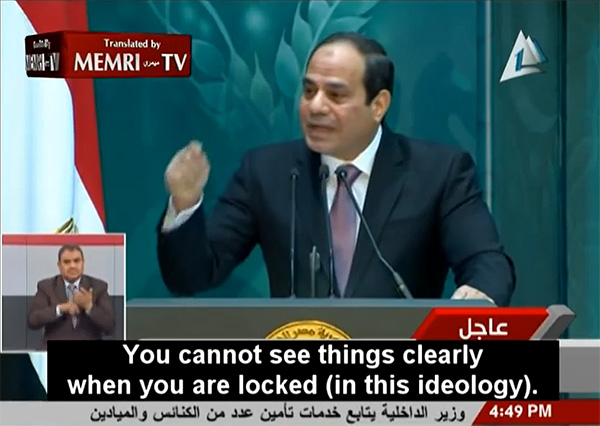
949 (1)Egypt’s President, Abdel Fattah el-Sisi, delivered a historic speech to top Islamic scholars and clergy at Al-Azhar University in Cairo, December 28, 2014. (Image source: MEMRI)

Islam deals in depth with uniting the Muslim nation (umma) and mutual responsibility among Muslims, as though they were one entity. The Prophet Muhammad (S.A.A.W.) said that every drop of Muslim blood is more precious than the entire Kaaba. Thus the liberty ISIS took upon itself to burn alive a Jordanian pilot and 45 Egyptians, to spread terrorism throughout Syria, Iraq and Egypt and to kill other Muslims in various locations around the globe, claiming they were “infidels,” is heresy in and of itself.

The calls for the deaths of “a million shaheeds” and the killing of Jews for the sake of Al-Aqsa mosque in Jerusalem, as was done by Arafat in the past, and is being done now by his heirs in the Palestinian Authority and Hamas, are a crime; they are extremist incitement that is opposed to the forgiving and compromising spirit of Islam. The murder and terrorism carried out by terrorist organizations such as ISIS, Hamas, Palestinian Islamic Jihad [PIJ] and other Islamist organizations against Jews, Christians and other non-Muslims is contrary to the modern Islam needed in the contemporary era.

El-Sisi was correct that the Muslim Brotherhood’s Sunni ideology, which drives most of the extremist Islamist organizations around the world, preaches forced conversion of “infidels” to Islam at any price, or death. Some of the “infidels” are supposed to join Islam of their own accord(targ’ib), out of self-serving interest, and some not of their own accord (tarhib), out of fear and death threats. Such conversions are also contrary to the original Islam, which states that no one is to be forced to convert to Islam and that a calm religious dialogue should be held.

However, a few days after President el-Sisi’s speech, which attempted to unify Muslims and Christian Copts, the Muslim Brotherhood and their affiliated terrorist organizations increased their attacks on Egyptian civilians and security forces throughout Egypt and the Sinai Peninsula, as well as murdering 21 Egyptian Christian Copts in Libya. The Muslim Brotherhood knows that behind the scenes, U.S. President Obama supports the movement, especially the branch in Egypt seeking to overthrow President Sisi. This approval from the U.S. encourages the Muslim Brotherhood to be even more determined to subvert and undermine Egypt’s stability, sabotage its economic rehabilitation and destroy the el-Sisi regime.

In this atmosphere of American support, the Ansar Bayt al-Maqdis terrorist group in the Sinai Peninsula operates under Muslim Brotherhood protection. It recently changed its name to the “Sinai Province” of the Islamic State and swore allegiance to the “Caliph,” Abu Bakr al-Baghdadi. It is currently working hand-in-hand with Hamas in the Gaza Strip to weaken el-Sisi’s Egyptian forces in the Sinai Peninsula.

Other Islamist terrorist organizations also kill Egyptian civilians and security forces with bombs and assault rifles. In the name of the Muslim Brotherhood’s ideology, they indiscriminately attack people on public transport, in airports and in public places, with the intent of retaking control of Egypt.

For this reason, an Egyptian court recently designated Hamas a terrorist organization, along with its military wing, the Izz al-Din al-Qassam Brigades, and outlawed both of them. In response, Qatar, a slippery agent in the service of America but also, treacherously, in the service of Iran, allowed armed Izz al-Din al-Qassam Brigades operatives to be interviewed by its Al-Jazeera TV. The operatives called the Egyptian president a traitor to the Islamic-Arab cause and to those seeking to “liberate Palestine.”

At the same time, Qatar continues to use its Al-Jazeera TV to broadcast hate propaganda targeting the el-Sisi regime, to disseminate videos and to fabricate insulting quotes intended to cause friction between el-Sisi on one side and the leaders of the Arab world and the Gulf States on the other — and to keep them from giving hungry Egyptians economic aid.

As the date for the economic conference in Sharm el-Sheikh (in the Sinai Peninsula) nears, Al-Jazeera’s propaganda machine has moved into ever-higher gear. Apparently, some of the Sunni Arabs states have not yet realized that their own national security and ability to withstand Iran depend on how strong Egypt is.

The U.S. Administration could easily halt the subversion of Egypt, but not only does it turn a blind eye, it suffers from a peculiar form of ignorance that makes it fight ISIS while at the same time supporting the Muslim Brotherhood, the hothouse of most Islamic terrorist organizations, including ISIS. The damage done to Egypt and the cracks in the weak Sunni Muslim ranks in the Middle East will eventually harm American interests and expose the Gulf States to the increasing Iranian threat.

The Muslim Brotherhood, the current American administration’s great friend, is the poison tree whose fruit is the Islamist terrorism embodied by ISIS, Al-Qaeda, Hamas, Palestinian Islamic Jihad, Al-Nusra Front, Boko Haram and others. This linkage has become obvious to all the Arab states, while the U.S. and Europe steadfastly ignore the danger to their own survival, and refuse to outlaw them.

It is possible, in fact, that U.S. policy is to weaken the Sunni world that is seeking to unite under el-Sisi’s flag of modernity. With European complicity, the U.S. Administration is trying to defraud the Arabs and turn the Israeli-Palestinian conflict into a center of Middle Eastern chaos, in order to hide the nuclear deal they are concocting with Iran. That is why the West does not really want to rehabilitate the Palestinian refugees by settling them in the Arab states, and why the West continues to nourish false Palestinian hopes that perpetuate this conflict.

The treachery of the U.S. Administration is the reason why Egyptians’ faith in America, which is supposed to defend the Arabs against a nuclear Iran, has effectively evaporated.

In the meantime, Iran’s Houthi proxies have taken over Yemen, threatening the entire Persian Gulf from the south. The el-Sisi regime is currently in the market for new allies, such as Russian President Vladimir Putin. Putin recently paid a visit to Egypt to examine the possibilities of building a nuclear reactor, sounding the first chord of a regional nuclear arms race.

The problems of the Middle East begin in the United States: that was the claim of participants in the Al-Jazeera TV show, “From Washington.” They described American policy towards Egypt as hesitant, indecisive and undemocratic. They claimed that the U.S. Administration had not yet decided whether or not to support el-Sisi, who heralded change and the willingness to fight radical Islam (a fight America used to participate in) or to remain neutral and waffle, in view of Egypt’s presumed instability. The Americans seem to be putting their all money on the extreme Islamists, who they seem to think will eventually win the bloody conflict currently being waged in Egypt.

The Americans have forgotten that under Mubarak, the regime turned a blind eye to attacks against Israel that were carried out by the Muslim Brotherhood and their carefully fostered agents. Unfortunately, since el-Sisi was elected, Egypt itself has become a victim of radical Islamic terrorism. The U.S. Administration, however, appears clearly to hate el-Sisi, and seems to be doing its utmost to undermine him and see him thrown out.

Under ousted President Mohamed Morsi, Egypt was tolerant and patient toward the U.S. Administration’s best friends, the Muslim Brotherhood, as well as Islamist and Palestinian terrorist organizations such as Hamas, Ansar Bayt al-Maqdis, Al-Qaeda, and Palestinian Islamic Jihad, all of which set up camp in the Sinai Peninsula. These terrorist groups smuggled weapons in from Iran, Sudan, Libya and Lebanon; dug smuggling and attack tunnels; developed missiles and carried out terrorist attacks “only” against Israel, the current U.S. Administration’s other apparent enemy, even though so many American Jews foolishly voted for them.

Now those same Islamist and Palestinian terrorist organizations are striking a mortal blow to the security or Egypt, and killing its civilians and security personnel.

The Muslim Brotherhood, mindful of America’s pro-Islamist policy toward it, is deliberately indulging in a wave of terrorism in Egypt and the Sinai Peninsula. Muslim Brotherhood operatives there are targeting civilians, public transport, airports and natural gas pipelines, all to undermine Egypt’s internal security and bring down el-Sisi’s regime in favor of extremist Islamists and a nuclear-threshold Iran.

In the current international situation, the U.S. Administration has apparently finally cut a deal with Turkey — which will be flimsy and ethereal — that allows Turkey to do the only thing it really cares about: to bring down the regime of Syria’s President, Bashar al-Assad.

The U.S. is also trying to cut a deal with Qatar, which along with Turkey openly supports the Muslim Brotherhood and its terrorist proxies in Egypt, Gaza, Syria and Iraq, who in general work against Western interests.

The ironic result is that Turkey plays host to both NATO and senior Hamas figures, while it deliberately ignores the slaughter by ISIS of Kurds and other ethnic minorities in Iraq and Syria. The Muslim Brotherhood, in effect, actually rules Turkey. Turkey’s President Recep Tayyip Erdogan and his AKP party make it easy for foreign fighters to cross the Turkish border into Syria and join the ranks of ISIS. Meanwhile, the Turkish government wages a diversionary propaganda war against Israel. According to recent rumors, Turkey is also planning to build a nuclear reactor, “for research and peaceful purposes.”

Another surreal result is that Qatar hosts the U.S. military bases, while it finances and encourages terrorist organizations operating against Israel and the Egypt. It also panders to Sheikh Yusuf al-Qaradawi, the spiritual mentor of the Muslim Brotherhood, an Islamist terrorist who issues fatwas permitting the murder of civilians and approves death sentences for apostasy.

And now the greatest American insanity of all time: the U.S. and Turkey are arming and training Islamist terrorist operatives in Turkey, on the grounds that they are “moderates” opposed to Bashar Assad’s regime in Syria. They either ignore or are not aware that there is no such thing as a moderate Islamist terrorist.

The other name of the “moderates” opposing Bashar Assad is ISIS; Iran’s Supreme Leader, Ali Khamenei and Hezbollah’s Hassan Nasrallah are now even saying that the U.S. is arming ISIS.

In the meantime, the Egyptian army continues its struggle against Islamist terrorist targets in the Sinai Peninsula and Libya, unaided, and even undermined, by the U.S.

In view of the U.S. Administration’s collaboration with the Muslim Brotherhood and terrorist organizations in the Gaza Strip, I am persuaded that in the near future it will be possible to find a joint Egyptian-Israeli-Palestinian formula for eradicating the Hamas-PIJ enclave of terrorism, this time by Arabs.

Most ironically of all, in the shadow of American zigzagging, a joint Arab-Israeli front is developing against Sunni and Shi’ite radicalism, and the Palestinians can only profit from it. Thus el-Sisi, who, with towering vision and courage, dares to speak openly about the poison tree of radical Islam and its fruit, when others are afraid, is a truly great Islamic hero.

The Muslim Brotherhood-ISIS Connection

February 19, 2015

The Muslim Brotherhood-ISIS Connection

February 18, 2015 by Arnold Ahlert

via The Muslim Brotherhood-ISIS Connection | FrontPage Magazine.


President Obama’s ongoing antipathy towards Egypt is no accident. Our feckless president has long had a soft spot in his heart for the Muslim Brotherhood (MB), and Egypt’s removal of the terror group from the corridors of power has rankled the administration. So what is it the Egyptians understand and our president denies? The Egyptian Minister of Religious Endowments insists that ISIS was birthed by the MB.

Dr. Mohamed Mokhtar Gomaa and other Egyptian scholars have explained that while ISIS is publicly hostile to the MB, they share identical goals. Last August, the Ministry illuminated those goals. “They are both waging a war against their homelands with vandalism, destruction and murder—murder on behalf of the enemies of the state who fund them,” read a published statement. Other similarities include the exploitation of women to further their agenda, and the reality that both groups use “lying and deception in the name of religion,” and both have “ignorant and lying” leaders who “use religion to play with the minds of the public,” the statement explained. “The main commonality between the two groups is their terrorist acts,” it added.

A month later, Egyptian President Abdel Fattah Al Sisi, who pledged to support the Obama administration’s war against ISIS, urged the president to recognize the bigger picture of Islamic extremism that extends beyond the borders of Iraq and Syria. He cited terrorist threats in Libya, Sudan, Yemen and the Sinai Peninsula as examples of identical danger posed by ISIS. “We can’t reduce the danger lurking in the region to ISIL (ISIS). We have to bear in mind all the pieces of the puzzle,” he insisted. “We can’t just limit the confrontation to checking and destroying the Islamic State.”

Unfortunately for his nation, Al Sisi’s prescience proved correct: 21 Egyptian Christians were beheaded by ISIS in Libya, where they have established another presence. Such an opportunity was made possible by the Obama administration’s determination to topple Muammar Gaddafi—followed by its refusal to help the new U.S.-backed Libyan government train their police and military. As a result Libya is in complete chaos. Moreover the administration’s political pettiness has allegedly reached a new low: according to Oliver North, Obama denied both Egypt and Jordan targeting information on ISIS in Libya and Syria, despite the decapitation of the Egyptian Christians and the incineration of Jordanian pilot Muath al-Kaseasbeh.

The administration’s behavior in this context runs completely counter to the reality illuminated by Egyptian Foreign Minister Sameh Shukr. “Ultimately this extremist ideology is shared by all terrorist groups. We detect ties of cooperation between them and see a danger as it crosses borders,” he explained.

Part of that mix includes includes Hamas, also spawned by the MB. Writing for the Times of Israel, Ryan Mauro, National Security Analyst for the Clarion Project, wonders why the world agrees that ISIS is morally repugnant even as Hamas gets a pass. “Both implement sharia governance, deliberately target civilians, have genocidal beliefs and seek the establishment of a caliphate,” he writes. He further explains that ISIS’s determination to exterminate Iraq’s Yazidi population is “no more egregious” than Hamas’s determination to eliminate millions of Jews. And the only difference between the MB, Hamas and ISIS is in regard to their method of achieving the same goal. The MB and Hamas wish to establish a Muslim caliphate incrementally, while ISIS is willing to do anything and everything to bring one about as quickly as possible.

Moreover, the MB’s and Hamas’s desire to eliminate the Jews is nothing new. The MB was established in 1928 by Hasan al-Banna, who admired Hitler and wrote to him expressing his desire to collaborate with the Nazi Party. During World War II, the MB made good on that desire. Its members spied for Hitler in the Middle East and formed two Muslim Waffen-SS Handschar Divisions to fight for the Nazis. Following the war, the MB was supported by the West, who saw them as a counterweight to the Soviet Union’s Middle East aspirations. And while some MB members eschewed violence and built schools and medical clinics, others continued to promote violence that included two failed assassination attempts against Egyptian President Gamal Abdel Nasser. Hamas was spawned in 1987 by the MB in Israel.

Two years later, the MB’s Mujahedeen army repelled the Soviets from Afghanistan and then split into two groups—one of which was Al Qaeda. And as Americans are now fully aware, MB-educated Osama bin Laden became their leader. Both groups, along with other Sunni Islamists, were inspired by al-Banna’s successor Sayyid Qutb. In his 1964 manifesto, Milestones, he insisted that governments not based on Sharia Law are apostate, making them legitimate targets of jihad.

ISIS has ideological roots that trace all the way back to the Wahhabist strain of Islam founded by Muhammad ibn ʿAbd al-Wahhab during the 16th century in Saudi Arabia. Like ISIS, al-Wahhab believed in a strict and conformist form of Islam. Those who dissented were to be killed, their property confiscated, and their wives and daughters violated. The essential rift between the two groups arises from Wahhabism’s “One Ruler, One Authority, One Mosque” doctrine that refers to the Saudi king, the absolute authority of Wahhabism, and its control of the mosques and their teachings. ISIS rejects this doctrine, which explains why Saudi Arabia feels as threatened as anyone else by their rise, even as much of the kingdom still embraces Wahhabism. With the rise of Saudi oil wealth, the West preferred to look at the kingdom’s modernization, even as they ignored the Wahhabist part of the equation.

ISIS’s modern roots can be traced to Abu Musab al-Zarqawi, a Jordanian street thug who arrived in Afghanistan too late to fight the Soviets. After a return to Jordan, he went back to Afghanistan a decade later, meeting bin Laden in 1999, but refusing to join al Qaeda. When the Taliban fell in 2001 he fled to Iraq, and in 2003 he set up ISIS’s precursor, Jama’at al-Tawhid w’al-Jihad (the Party of Monotheism and Jihad). It was comprised mostly of non-Iraqis, and al-Zarqawi’s primary targets were Iraq’s Shi’ite Muslim majority. By 2004 his campaign of suicide bombings in that nation made him a jihadist superstar, earning Bin Laden’s endorsement in the process. Al-Zarqawi returned the favor by rebranding his group al-Qaeda in Iraq (AQI).

Yet by 2005, al Qaeda began to have misgivings about AQI’s brutality towards civilians. The American troop surge, coupled with Sunni Iraq’s own disenchantment with Zarqawi’s strict sharia rules gave birth to the “Awakening” that allowed the U.S. to prevail in Iraq—until the deadly combination of a Shi’ite-dominated Maliki government looking for payback after years of Sunni Ba’athist domination, coupled with the Obama administration’s precipitous troop withdrawal in 2011, laid the groundwork for ISIS’s current rise.

In 2011, AQI was being run by current ISIS leader Abu Bakr al-Baghdadi and had become a largely Iraqi organization. Another rebranding took place as these “Sons of Iraq” became ISI, until their ranks were swelled by former commanders and soldiers in Saddam’s military. With the addition of new troops, Baghdadi opened a second front in Syria, once again targeting Shi’ite Muslims and their Shia sub-sect Alawite rulers led by Bashar Assad. When Syrian became part of the equation, ISI became ISIS.

And while all of this was occurring, Obama not only ignored the metastasizing threat, but used his 2012 presidential campaign to assure the American public that al Qaeda had been “decimated” and terror was “on the run.” More accurately, ISIS has been on a roll, seizing large swaths of both Iraq and Syria, along with billions of dollars, courtesy of bank seizures and oil revenue that make them the richest terrorist organization in the history of the world.

Moreover despite the “conventional wisdom” that al Qaeda and ISIS are enemies, the terrorist attack on Charlie Hebdo indicates there was at least some indication that al Qaeda on the Arabian Peninsula (AQAP) and ISIS worked together to perpetrate that atrocity.

On 25 December, Egypt declared the MB a terrorist organization, with the Egyptian courts dissolving nearly all of its institutions, organizations and charities. By contrast on Feb. 4, Obama hosted a meeting at the White House with 14 Muslim leaders, including Azhar Azeez, President of the Islamic Society of North America (ISNA), and Hoda Elshishtawy of the Muslim Public Affairs Council (MPAC).

Both groups were founded by members of the MB.

Former congressman Pete Hoekstra was incensed. The Michigan Republican  insisted it was “absolutely outrageous” for Obama to invite “the Muslim Brotherhood into our government to meet with the White House.” “These are people who are committed to destroying our way of life,” the Michigan Republican warned. “The policy failures go on and on and on, and that’s how we need to be addressing this president and challenging him that his policies are just not working.”

Such challenges will have to overcome that complicity, as well as the grim determination by this administration not to link terror with Islam. Both challenges are epitomized by the Summit on Countering Violent Extremism beginning today. As the AP explains, the Summit will “highlight domestic and international efforts to prevent extremists and their supporters from radicalizing, recruiting and inspiring others, particularly disaffected young people.”

The words “Islamist” or “terror?” Nowhere to be found. As for complicity, one of the Summit’s attendees is the Islamic Society of Boston (ISB) an organization with extensive ties to terror, including former Cambridge mosque worshipper Ahmad Abousamra who is currently ISIS’s top propagandist, as well as the Tsarnaev brothers who carried out the Boston Marathon bombing.  The Cambridge mosque, ISB’s first house of worship was founded in 1982 by Abdulrahman Alamoudi, currently serving a 23-year prison term for his conviction as an al Qaeda fundraiser. Yusuf Qaradawi, the spiritual leader of the Muslim Brotherhood, was a founding trustee at the ISB’s second mosque in Roxbury.

One of the Obama administration’s ostensible ideas for preventing recruitment and radicalization? State Department spokesperson Marie Harf, epitomized their enduring recklessness, insisting we cannot “kill” our way to victory against ISIS. “We need, in the longer term, medium and longer term, to go after the root causes that lead people to join these groups, whether it’s lack of opportunity for jobs,” she declared.

Jobs? Twenty-one Egyptian Christians went to Libya in search of jobs. ISIS decapitated every one of them.

The Obama administration is morally bankrupt. And as the history of the MB-ISIS connections presented here suggests, it is only a matter of time before Americans pay an unconscionable price for that bankruptcy.