Posted tagged ‘Egypt in Siani’

Did a Muslim Brothers armed cell or ISIS massacre 55 Egyptian policemen?

October 21, 2017

Did a Muslim Brothers armed cell or ISIS massacre 55 Egyptian policemen? DEBKAfile, October 21, 2017
If the oasis ambush was also the work of ISIS, it would indicate that these jihadists were not only terrorizing Sinai, but had also penetrated deep into the Egyptian mainland.


************************

An armed group of Egypt’s banned Muslim Brotherhood was reported to have waylaid an Egyptian convoy heading for its oasis hideout on Friday and murdered 55 policemen. The only survivors were 14 injured men.

But some of the evidence also points to the Islamic State as the perpetrators.

The police convoy was attacked while driving on the El-Wahat Highway from Cairo to Giza on its way to raid a secret hideout of the banned Muslim Brotherhood’s armed underground (Hasm) at the El-Bahariya Oasis in the Western Desert, 135 southwest of the capital.

The disaster, together with a string of deadly Islamist attacks in Sinai in recent weeks, raised tough questions about Egypt’s capacity to deal with the extremist terrorism plaguing the country. President Abdul-Fatteh El-Sisi immediately set up a commission of inquiry to find out how the casualty of Egyptian servicemen came to be so high – a well-tried device used by governments for keeping the details of a mishap dark until the immediate hue and cry dies down.

DEBKAfile’s counterterrorism sources have gleaned information that points to a merciless massacre, most likely at the hands of the Brotherhood’s armed activists. According to first reports, the policemen were killed in a shootout with the extremists during a raid of their hideout in the oasis.

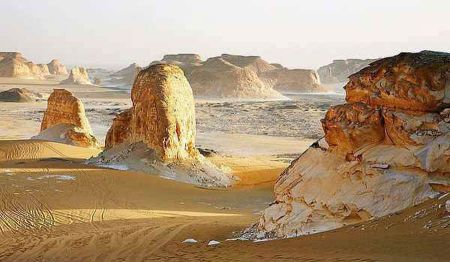
The wild beauty of this vast oasis – over 2,000sq.km – makes it an attraction for visitors to Cairo especially since it is just a short drive from the capital. Its sparse inhabitants are mostly Bedouin tribes with kinship ties across the border in eastern Libya, a region where the Islamic State and Al Qaeda maintain strong footholds. Because it is only visited occasionally by foreign visitors on night-time jaunts, the Brotherhood felt the oasis was far from the long arm of Egypt’s anti-terrorist forces.

After intelligence agents discovered their location, the Brotherhood cell was ready for the raid. They set up an ambush and before the police convoy of four SUVs reached the hideout, dozens of wanted terrorists opened up with heavy machine guns, recoilless grenades and mortars, and detonated roadside bombs. The carnage was devastating.

Their tactics, involving ruthless massacre, strongly resembled the most recent Islamic State strikes against Egyptian forces in northern Sinai. On Sept. 11, 18 Egyptian troops were killed near Sheikh Zuweid.

In both these outrages, the Egyptian air force was not brought in.

If the oasis ambush was also the work of ISIS, it would indicate that these jihadists were not only terrorizing Sinai, but had also penetrated deep into the Egyptian mainland.

Egypt caught off guard

August 29, 2017

Egypt caught off guard, Israel Hayom, Dr. Shaul Shay, August 29, 2017

(The decision and its timing raise “questions as to whether everyone in the U.S. administration is in fact on the same page.” Are they even reading the same book? — DM)

The timing of the decision, on the eve of a meeting between a delegation of senior U.S. officials and el-Sissi in Cairo aimed at promoting a peace process between Israel and the Palestinians, and just weeks ahead of a large-scale joint military exercise between U.S. and Egyptian forces, raises questions as to whether everyone in the U.S. administration is in fact on the same page. Trump even called el-Sissi shortly after the cuts to financial aid were reported in the media to assure him that he would work to bolster U.S. relations with Egypt.

************************

Egypt was caught off guard by the United States’ decision this week to freeze $300 million in financial and military aid to the country. The U.S. administration took these steps following reports that Egypt was not doing enough to improve human rights in the state.

Ever since signing the peace treaty with Israel in 1978, Egypt has benefited from $1.3 billion in U.S. military aid and $250 million in annual civilian financial support. Former U.S. President Barack Obama’s administration expressed its disapproval of Egyptian President Mohammed Morsi’s removal from office in 2013 by freezing weapons deliveries to Egypt. Although they have improved following Abdel- Fattah el-Sissi’s election in 2014, bilateral ties between the countries remain chilly. The freeze on weapons deliveries has convinced el-Sissi that Egypt must consolidate a strategy for diversifying its weapons resources and increase security ties with Russia and France.

The regime in Egypt faces a difficult struggle against an array of radical Islamic organizations that threaten that country’s security and stability, including the Muslim Brotherhood, Islamic State proxies that operate in the Sinai Peninsula and neighboring Libya as well as smaller Islamic terrorist groups. To contend with Islamic radicalization and terrorism, the Egyptian regime has been forced to take a series of operational, administrative and legal steps, some of which are perceived in the U.S. and Europe as infringing on human rights. Since the Arab Spring in 2011, Egypt has been subject to a financial crisis and ongoing terror attacks that make it difficult for that country to rehabilitate its economy. This is especially true for its tourism industry and foreign investments in the country.

The U.S. administration’s decision was a double surprise for Egypt: For one thing, Egypt had believed that with the election of Donald Trump, someone who is less sensitive to issues of human rights and prioritizes the war on Islamic terror, ties between the countries would improve and the U.S. would be more empathetic to the Egyptian regime’s troubles at home. For another thing, news of the decision was relayed to the Egyptians mere hours before it was reported in the American media.

The timing of the decision, on the eve of a meeting between a delegation of senior U.S. officials and el-Sissi in Cairo aimed at promoting a peace process between Israel and the Palestinians, and just weeks ahead of a large-scale joint military exercise between U.S. and Egyptian forces, raises questions as to whether everyone in the U.S. administration is in fact on the same page. Trump even called el-Sissi shortly after the cuts to financial aid were reported in the media to assure him that he would work to bolster U.S. relations with Egypt.

In a chaotic Middle East, Egypt is a vital ally to the U.S. and its moderate Sunni allies. Maintaining the 1979 peace deal with Egypt and the security ties forged with it in recent years are a vital strategic interest for Israel. Israel must therefore work to find a solution to the issues under dispute between the U.S. and Egypt so that they do not harm the stability of the regime in Cairo and ensure Egypt remains a fundamental component in the moderate Sunni coalition in the Middle East in light of all the threats the region faces, which in large part stem from Iran and the Shiite axis following Islamic State’s defeat in Iraq and Syria.

Dr. Shaul Shay is a lecturer at the Interdisciplinary Center Herzliya.