On Saturday, April 9, Colorado had an “election” without voters. Delegates were chosen on behalf of a presidential nominee, yet the people of Colorado were not able to cast their ballots to say which nominee they preferred.
A planned vote had been canceled. And one million Republicans in Colorado were sidelined.
In recent days, something all too predictable has happened: Politicians furiously defended the system. “These are the rules,” we were told over and over again. If the “rules” can be used to block Coloradans from voting on whether they want better trade deals, or stronger borders, or an end to special-interest vote-buying in Congress—well, that’s just the system and we should embrace it.
Let me ask America a question: How has the “system” been working out for you and your family?
I, for one, am not interested in defending a system that for decades has served the interest of political parties at the expense of the people. Members of the club—the consultants, the pollsters, the politicians, the pundits and the special interests—grow rich and powerful while the American people grow poorer and more isolated.
No one forced anyone to cancel the vote in Colorado. Political insiders made a choice to cancel it. And it was the wrong choice.
Responsible leaders should be shocked by the idea that party officials can simply cancel elections in America if they don’t like what the voters may decide.
The only antidote to decades of ruinous rule by a small handful of elites is a bold infusion of popular will. On every major issue affecting this country, the people are right and the governing elite are wrong. The elites are wrong on taxes, on the size of government, on trade, on immigration, on foreign policy.
Why should we trust the people who have made every wrong decision to substitute their will for America’s will in this presidential election?
Mr. Cruz has toured the country bragging about his voterless victory in Colorado. For a man who styles himself as a warrior against the establishment (you wouldn’t know it from his list of donors and endorsers), you’d think he would be demanding a vote for Coloradans. Instead, Mr. Cruz is celebrating their disenfranchisement.
Likewise, Mr. Cruz loudly boasts every time party insiders disenfranchise voters in a congressional district by appointing delegates who will vote the opposite of the expressed will of the people who live in that district.
That’s because Mr. Cruz has no democratic path to the nomination. He has been mathematically eliminated by the voters.
While I am self-funding, Mr. Cruz rakes in millions from special interests. Yet despite his financial advantage, Mr. Cruz has won only three primaries outside his home state and trails me by two million votes—a gap that will soon explode even wider. Mr. Cruz loses when people actually get to cast ballots. Voter disenfranchisement is not merely part of the Cruz strategy—it is the Cruz strategy.
The great irony of this campaign is that the “Washington cartel” that Mr. Cruz rails against is the very group he is relying upon in his voter-nullification scheme.
My campaign strategy is to win with the voters. Ted Cruz’s campaign strategy is to win despite them.
What we are seeing now is not a proper use of the rules, but a flagrant abuse of the rules. Delegates are supposed to reflect the decisions of voters, but the system is being rigged by party operatives with “double-agent” delegates who reject the decision of voters.
The American people can have no faith in such a system. It must be reformed.
Just as I have said that I will reform our unfair trade, immigration and economic policies that have also been rigged against Americans, so too will I work closely with the chairman of the Republican National Committee and top GOP officials to reform our election policies. Together, we will restore the faith—and the franchise—of the American people.
We must leave no doubt that voters, not donors, choose the nominee.
How have we gotten to the point where politicians defend a rigged delegate-selection process with more passion than they have ever defended America’s borders?
Perhaps it is because politicians care more about securing their private club than about securing their country.
My campaign will, of course, battle for every last delegate. We will work within the system that exists now, while fighting to have it reformed in the future. But we will do it the right way. My campaign will seek maximum transparency, maximum representation and maximum voter participation.
We will run a campaign based on empowering voters, not sidelining them.
Let us take inspiration from patriotic Colorado citizens who have banded together in protest. Let us make Colorado a rallying cry on behalf of all the forgotten people whose desperate pleas have for decades fallen on the deaf ears and closed eyes of our rulers in Washington, D.C.
The political insiders have had their way for a long time. Let 2016 be remembered as the year the American people finally got theirs.
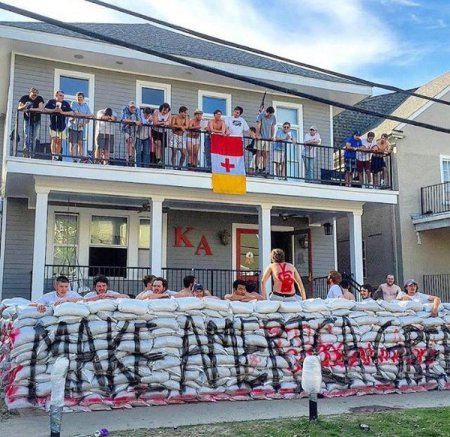
It appears that the building of a wall is the local chapter’s annual tradition before its “Old South” formal ball. This time the students added the language as either a joke or implied support but student groups denounced the language as “filled with connotations of hate and ignorance.” Even if this were serious support for Trump, that is not hate speech. It would be pure political speech — just as students are free to support Bernie Sanders, as many do.
On the video below, student appear to be tearing down the wall and tossing the sandbags into the street as frat members object that “this is private property.” Students like Ana De Santiago seemed to miss the point of violently preventing the speech of other students because you disagree with them. She insisted that “By writing Trump in large, red letters across the ‘wall,’ . . . KA changed what was a tradition of building a wall into a tradition of constructing a border, symbolizing separation and xenophobia.” Or they could simply be supporting Trump and his view of immigration reform. I doubt seriously that De Santiago would take kindly to the frat tearing down signs in support of her presidential candidate or immigration policies.
The hypocritical position of these students reflects the growing intolerance for free speech on our campuses. These students believe that they have a right, even an obligation, to silence students with opposing views.
University spokesman Mike Strecker said frat members used Trump’s name and slogan as satire. But it really does not matter. The University should be investigating the students who engaged in a violent act to stop the speech of other students . . . whether satire or serious. Moreover, the University seemed to blame the students for engaging in free speech, saying that while it encourages the “free exchange of ideas and opinions”, the local chapter’s actions “sparked a visceral reaction in the context of a very heated and divisive political season.” That does not appear very supportive of free speech to blame the victims of an attack on free speech. Students and faculty are allowed to “spark a visceral reaction in the context of a very heated and divisive political season.” Indeed, we should want passionate debate on the candidates and their ideas. It was the students tearing down the wall who were bringing violence and intolerance to the debate. They should be the focus of the ire of the university.
Recently, I’ve been corresponding with a friend on the ever-contentious subject of Donald Trump, a man whom my interlocutor finds objectionable on both political and personal grounds. Political positions can be discussed and debated even if they do not produce agreement or compromise, but a personal animadversion cannot be met with argument. My correspondent considers Trump an unreconstructed vulgarian, loud, ill-mannered and abrasive, all of which apparently render him unfit for office. He simply cannot vote for a man he dislikes.
Personal liking is one of the least reliable criteria for voting. The election of Barack Obama to the presidency is surely proof positive that affection for a political figure—the love affair with Obama was a national phenomenon—can result in unmitigated disaster. The same is true of personal dislike, which may often lead to the rejection of thebest, orleast worst, candidates for political office.
In Canada’s recent federal election, former PM Stephen Harper was vilified in the press and held in contempt by the majority of the electorate as a dangerous and unsavory character. He was rumoured to harbor a “secret agenda,” though nobody could say what it was. He was denounced as a brooding egotist and a control freak. He was viewed as unsympathetic to the marginalized and disadvantaged, stingy with entitlements, unimpressed by the claims of the arts community for ever greater government largesse, and generally hostile to Canada’s growing and increasingly clamorous Islamic community.
The fact that he steered the country safely through the market crash of 2008, signed lucrative international trade deals, kept taxes down, reduced the GST (Goods and Services Tax) and provided the country with a balanced budget plainly counted for nothing. His emendation of citizenship protocols in an effort to check the spread of culturally barbaric practices, chiefly associated with Islam, counted against him. At the end of the day, he was simply unlikeable, he was “Harperman,” and he had to go.
Instead, Canadians fell in love with Justin Trudeau, easily the most unqualified prime ministerial candidate since Confederation (there have been many duds, eccentrics and charlatans, but Trudeau is in a category of his own). He was young, personable, wavy-haired, utterly innocuous and adroit at spouting platitudes. Women found him attractive, millennials recognized one of their own, and he embraced all the feel-good big-spending fads and sophistries of welfare socialism. In short, people found him immensely likeable, the polar opposite of the straitlaced, parsimonious Harper.
The consequences were not long in coming. Trudeau has been in office for half a year, more than enough time to engineer the rapid deterioration of a once-prosperous and relatively secure nation. He has brought in 25,000 “Syrians” and is aiming for many thousands more, all living off the public dole and no doubted salted with aspiring jihadists. He intends to build mosques (which he calls “religious centers”) on military bases and is re-accrediting Muslim terror-affiliated organizations that Harper defunded. He inherited Harper’s balanced budget and in just a few short months was busy at work racking up a $29.4 billion deficit. Not to worry, since Trudeau is on record saying that budgets balance themselves. Magic is afoot. All one need do is continue believing in the Ministry of Silly Walks and the nation will stride ever forward.
(Here’s the silly walks video. I was unable to restrain myself. — DM)
According to a March 18, 2016 Ipsos poll, 66 per cent of Canadians approve of his performance. A boilerplate article by Jake Horowitz for Policy.Mic represents the general attitude of appreciation. In his meeting with Barack Obama, Horowitz writes, “it was Trudeau’s tone of optimism, and his embrace of a style of politics marked by positivity, inclusion and equality, that truly shined [sic] through. Practically everything about his values comes in stark contrast to what we’ve heard from Republican front-runner Donald Trump, who has dominated the 2016 election cycle with divisiveness, anger and fear-mongering.”
Often commentators will seek to buttress their personal liking or disliking on the basis of presumed intellectual substance. Despite his success in business, his knowledge of practical economics and international finance, and his instinctive recognition of what is needed in a country beset by astronomical deficits, trade imbalances and catastrophic immigration problems, Trump is frequently dismissed as an ignoramus. “Trump doesn’t read,” says David Goldman. “He brags about his own ignorance. Journalist Michael d’Antonio interviewed Trump at his New York home and told a German newspaper: ‘What I noticed immediately in my first visit was that there were no books… huge palace and not a single book.’”
On the other hand, we are told that Justin Trudeau reads. According to Jonathan Kay, formerly letters editor at The National Post and currently editor of The Walrus, who assisted Trudeau in writing the Canadian Prime Minister’s memoir Common Ground, “I can report that Trudeau is very much an un-boob. Several of our interviews took place in his home study, which is lined with thousands of books…We spoke at length about the Greek classics his father had foisted upon him as a child…and the policy-oriented fare he now reads as part of his life in politics…Trudeau probably reads more than any other politician I know.”
Kay never mentions that this intellectual giant failed to complete the two university degrees for which he had enrolled, earned his chops as a substitute instructor at the high school level, and inherited a formidable financial estate from his famous father, former Canadian PM Pierre Trudeau. He has done nothing with his life except preen and posture for the public—a “shiny pony,” as journalist Ezra Levant has dubbed him. Trump on the other hand received an inheritance and turned it into one of the world’s major fortunes. As New English Review editor Rebecca Bynum points out, “the businessman from Queens understands the American working people better than the Harvard man from Texas or the mailman’s son from Ohio. He speaks in plain English to describe the incompetence, and yes, the stupidity of those currently in power, who could not have harmed our country any more if they had had outright malicious intent.”
The Harper case was anomalous. He was an evidently accomplished man, trained in economics (unlike Trudeau, he completed his university program), a stalwart Canadian who wrote a book on our national sport, A Great Game: The Forgotten Leafs & the Rise of Professional Hockey, (unlike Trudeau’s memoir, there was no Kay-like ectoplasm to assist in its composition) and was deeply interested in the Franklin Expedition and the lore of the Canadian North. And he was a reader. Nevertheless, Canadian novelist Yann Martel mocked Harper in a series of letters collected into a book, 101 Letters to a Prime Minister, condescendingly lecturing Harper on what he should read, with the implication (sometimes explicit) that Harper saw nothing but the financial bottom line and was a man without imagination, heart or a vision for the country larger than trade deals and tax policy. (Martel is evidently a prehensile reader, having discovered an obscure novella by the Argentine writer Moacyr Scliar, Max and the Cats, which arguably formed the plagiarized occasion for his own Life of Pi. Not the man to instruct the PM.) In any event, under a relentless media barrage the public came to see Harper as a rigid martinet. In the 2015 election, he never had a chance.
Harper was regarded by the press and a plurality of Canadians pretty much as Trump is currently viewed by establishment Republicans, sanctimonious conservatives and a partisan media, for whom The Donald has become politically non grata, a “reptile” in Andrew Klavan’s distemperate rhetoric. Trump’s dilemma is that he has refused to be housebroken. He is certainly a flawed human being, but I have never known one who wasn’t.
So let us now compare. Trump has pledged to set the U.S. on a sound economic footing, prevent the flow of illegal migrants across the southwestern border, limit Islamic immigration into the country, and restore America’s diminished prestige and might on the international stage. But he is, we are told, a boor, a plebeian, a crass opportunist, a know-nothing who doesn’t read. “Donald Trump may not be perfect,” Bynum agrees, “but at least he will clean house.” All the more reason, it appears, for the virulence and disparagement with which he has been met. The bien pensants dislike him with a vehemence that does them little honor.
On the other hand, Trudeau, as we’ve seen, has plunged his country into deficit, has imported thousands of Muslims who will swell the welfare rolls and generate social unrest, as is inevitable wherever Muslims begin to multiply, withdrawn Canadian forces from the campaign against ISIS, and filled his cabinet with highly questionable personnel—women simply because they are women, such as the lamentably dense Chrystia Freeland, Minister of International Trade (who disgraced herself on the Bill Maher show), and doddering retreads like Immigration Minister John McCallum. But Trudeau is suave, telegenic, blandly inoffensive—and he reads. People like him with a passion that also does them little honor.
Would any sane person choose a Trudeau-type figure over a Harper or a Trump to lead their country into a problematic future? The larger issue is whether any reasonable person should predicate his voting preference on personal liking or disliking. Trudeau is intellectually vapid, has the wrong instincts, and is unlearnable. But he is liked. As for Trump, I am not suggesting that he would be a better choice than Cruz may be or Rubio may have been, though I suspect he might. He still has much to learn about the intricacies and priorities of governing and about looking “presidential.” What matters is that a candidate for political office is smart, has the right instincts, and is willing to learn. I believe Trump qualifies in these respects. Disliking him is beside the point.
Writing for The Federalist, Timm Amundson acknowledges that Trump can be rude, arrogant and reckless, and asks: “How can a principled, pragmatic, deliberate conservative be drawn to such a candidate?” And answers: “It is because I believe conservatism doesn’t stand a chance in this country without first delivering a very heavy dose of populism,” that is, “a platform built largely on the principle of economic nationalism…focus[ing] on three primary policy areas: trade, defense, and immigration.” This is Trump’s bailiwick.
To approve or disapprove of a candidate on the basis of his or her social and economic platform is wholly legitimate, is at least theoretically open to debate and constitutes a sensible basis for choice. If you believe, as Amundson does, that the core populist platform is the surest way “for America to begin rebuilding her neglected middle class and restoring her sovereignty,” then cast your ballot appropriately. The Overton Window is closing fast.







 anneinpt
 artaxes
 danmillerinpanama
 davidking1530
 Peter Hofman
 Joseph Wouk
 Peter
Peter Louisiana Steve
 WarSclerotic
Recent Comments