Posted tagged ‘Disputed Territory’

Abu Mazen: “Set a Deadline for Israel to Withdraw from the West Bank”

August 25, 2014

Abu Mazen: “Set a Deadline for Israel to Withdraw from the West Bank”

Abu Mazen’s political program was revealed. In an interview provided to the Associated Press, Abu Mazen stated that he intends to contact political leaders in the west and the UN Security Council to compel Israel to give up the West Bank.

Aug 25, 2014, 03:00PM | Rivka Salomon

via Israel News – Abu Mazen: “Set a Deadline for Israel to Withdraw from the West Bank” – JerusalemOnline.


Abu Mazen at the UN Photo Credit: AP He can not find his hart.
 

Palestinian Authority Chairman Abu Mazen claimed that he has a surprising solution to the Palestinian-Israeli conflict and now, the AP released their first details about it. According to sources close to him, he intends to appeal to the international community to place a deadline on Israel to withdraw to the 1967 Armistice Lines so that an independent Palestinian state can be established in the area.

Abu Mazen’s aid claimed that he intends to present the program shortly after the fighting during Operation Protective Edge ends. Abu Mazen is expected to officially present the program in a meeting with various leaders next Tuesday. The senior level officials refused to reveal the names in the framework of the interview with AP.

According to one of them, Abu Mazen “lost all illusions after over two decades of efforts to reach peace via negotiations that failed.” The Palestinian Authority Chairman is interested, according to the reports, in a prearranged date for Israel to leave the settlements in the West Bank. “This should occur through a mechanism that will compel Israel to end the occupation,” he stated.

In the background of the continued fighting in Gaza, which has claimed over 2,000 Palestinian lives, Abu Mazen started to look for other ways to get recognized by the international community, one that will allow him to make unilateral steps. In an interview he provided to Egyptian television over the weekend, he intends to present his political program to American and European leaders. According to his assistant, the program will include a UN Security Council resolution that will compel Israel to cease its control over the Palestinian Authority territory.

Message From President Abbas’ Fatah Party—It’s OK To Slaughter Jews In Settlements

August 22, 2014

Message From President Abbas’ Fatah Party—It’s OK To Slaughter Jews In Settlements”Our political decision is resistance in the occupied territories in order ‎to bring an end to the occupation [using] all forms of resistance.”

8.21.2014 News Jeff Dunetz

via Message From President Abbas’ Fatah Party—It’s OK To Slaughter Jews In Settlements | Truth Revolt.


Are this the people where Israel wants to work with, like safeguarding border crossings ?


Once again proving that Palestinian leadership talks peace in English but war in Arabic, Jibril Rajoub, the Deputy Secretary of the Central Committee for President Mahmoud Abbas’ “Moderate” Fatah Party, appeared on independent Palestinian TV Station​ Awdah announcing that Fatah has made a “political decision” to support slaughtering of Jews who live in settlements.

I’m telling everyone: Fatah has decided that our relations with the Israelis are relations between enemies. There is no kind of coordination between the Israelis and us. Everyone can be certain that any form of mutual coordination ended a day after they declared war on the National Unity Government… OK, brother, ‎here is the occupation, am I stopping you from slaughtering a settlement? No one is stopping anyone. ‎Don’t lie and tell me: ‘the [PA] Security Forces and Mahmoud Abbas,’ and so on [stop you]. Drop it, ‎OK? No one is stopping anyone. Our political decision is resistance in the occupied territories in order ‎to bring an end to the occupation [using] all forms of resistance.

Source: Palwatch

Clashes ongoing as East Jerusalem seethes over killed teen

July 2, 2014

Three mortars hit southern

Day after three slain Israeli teens laid to rest, Israelis mourn and tensions flare in the capital;
Temple Mount closed for fear of violent clashes

By Yifa Yaakov July 2, 2014, 10:34 am

via The Times of Israel | News from Israel, the Middle East and the Jewish World.


A day after slain Israeli teens Gil-ad Shaar, Naftali Fraenkel and Eyal Yifrach were laid to rest, Jewish-Arab tensions are flaring. Meanwhile, in Jerusalem, the government is weighing further responses to the killings. Stay with The Times of Israel for live coverage throughout the day.


16:02
Three mortars hit southern Israel

Three mortars fired from Gaza hit the Eshkol regional council in southern Israel.

This brings the total number of rockets fired since midnight to five.

No injuries or damage reported.
15:49
UK Jewish community to hold vigil outside Israeli embassy

The UK Jewish community plans to hold a candlelight vigil this evening outside the Israeli embassy in London to show solidarity with the families of Gilad Shaar, Eyal Yifrach and Naftali Fraenkel.

The leadership of the community, which will gather outside the embassy building in Kensington at 6:45 p.m. London time, invites the British Jewish community and friends of Israel to join in expressing “solidarity with the families, loved ones and the Israeli public for the three innocent teenagers who were murdered in cold blood after being abducted more than two weeks ago.”

The vigil will also be attended by representatives of the embassy and communal organizations, including the Board of Deputies of British Jews, the Jewish Leadership Council, United Jewish Israel Appeal, the Zionist Federation, We Believe in Israel and the Union of Jewish Students.

UK Chief Rabbi Ephraim Mirvis and Senior Rabbi to the Movement for Reform Judaism Laura Janner Klausner are slated to speak at the gathering.

In other news, a spokesman the Board of Deputies of British Jews “unequivocally” condemns the “deplorable” killing of Mohammad Abu Khdeir.

“Whatever the motive for this killing, it is utterly deplorable and we condemn it unequivocally. At this fragile time — in aftermath of the killings of the three Israeli teenagers — we all have a responsibility to promote an atmosphere in which peace and justice, rather than violence and aggression, can prevail. We all need to see the humanity in one another; this region does not need any more grieving mothers.”
15:27
UN special envoy denounces killing of Arab teen

Robert Serry, UN special envoy to the Middle East, “strongly condemns” the death of 16-year-old Muhammad Hussein Abu Khdeir.

“I recall the Secretary-General’s message: there can be no justification for the deliberate killing of civilians – any civilians. The perpetrators of such heinous acts must be brought to justice. I repeat my call on all sides to do everything they can not to further exacerbate an already tense atmosphere. Our thoughts are with the bereaved family,” he writes in a statement.
15:20
Kidnappers heard whooping, singing in full emergency call recording

The full recording of the call made by one of the kidnapped youths to the emergency police hotline is released, less than a day after police lifted the gag order on a 49-second clip from it.

In the full recording, the kidnappers can be heard singing in Arabic and whooping after what are presumably shots ring out in the car.

In the 49-second recording released by police yesterday, one of the teens, identified by Bat-Galim and Ofir Shaar as their son Gilad, can be heard whispering “They’ve kidnapped me” to the operator before the kidnappers shout at him in Arabic-accented Hebrew, “Keep your heads down.”

The operator tries to interact with the caller, said to have been Gil-ad Shaar, but receives no answer. Seconds later, several loud noises, which might be gunshots, are heard. Someone in the car is heard groaning.

The shorter recording ends with the sound of a Hebrew radio interview blaring in the car.

In the full recording, which is over two minutes long, the sound of the radio is interrupted by a voice on the phone — a different operator, this time a policewoman, who asks the caller where he is.

However, this operator, too, receives no answer. Instead, more loud noises — presumably gunshots — are heard.

When the noises die down, one of the kidnappers shouts “Three!” in Arabic. He and his accomplice can then be heard singing happily in Arabic and whooping, before the recording ends.
15:12
Rocks, firebombs, pipe bomb flung at police

Rioters hurl stones, Molotov cocktails, and a pipe bomb — which did not explode — at security forces in Beit Hanina as protests against the death of the Arab teen continue, the Ynet news website reports.

Police respond with riot dispersal methods. The area has been sealed off, and police ask residents to steer clear.


Palestinians clash with Israeli border police in the East Jerusalem neighborhood of Shuafat after the body of a Palestinian teen from East Jerusalem is found in the Jerusalem Forest, Wednesday, July 2, 2014. (photo credit: Hadas Parush/Flash90)
 
A lot more here


http://www.timesofisrael.com/riots-in-east-jerusalem-after-body-of-arab-teen-found/

‘New reality requires security fence on Jordan border’

June 30, 2014

New reality requires security fence on Jordan border'”

The Sykes-Picot Agreement that shaped the borders around us almost 100 years ago has run its course,” PM Benjamin Netanyahu says •

Netanyahu says Israel needs to support international efforts to strengthen Jordan and support Kurdish independence

Shlomo Cesana, Eli Leon and Israel Hayom Staff

via Israel Hayom | ‘New reality requires security fence on Jordan border’.


Prime Minister Benjamin Netanyahu at the Institute for National Security Studies conference in Tel Aviv, Sunday|
Photo credit: Yehoshua Yosef
 

In light of recent changes in the Middle East, Israel is going to have to construct a security fence along the length of its border with Jordan, Prime Minister Benjamin Netanyahu said Sunday.

Speaking at the Institute for National Security Studies conference in Tel Aviv, Netanyahu said that in any future peace deal with the Palestinians, the Israel Defense Forces would be the entity protecting Israel in Judea and Samaria, including the Jordan Valley.

Israel “must stabilize the region west of the security line in Jordan,” Netanyahu said, adding that the territory of a future Palestinian state, up to the Jordan River, would have to remain under full Israeli security control for many years.

Netanyahu said he was updating his 2009 Bar-Ilan University address, in which he called for a two-state solution. The prime minister said he now advocates the notion that the Palestinians should have “political and economic control in the territories they control, but simultaneously there must be a continuation of Israeli security operations in these territories to ensure the disarmament of terrorist groups.”

“A withdrawal of our forces would likely bring about the fall of the Palestinian Authority, and the rise of Islamist extremists, like in the Gaza Strip, which would pose a serious danger for Israel,” Netanyahu said.

He cited four challenges ahead for Israel: defending its borders, stabilizing the region between the security border with Jordan and the population centers, regional cooperation to stop the spread of Islamist extremism, and preventing Iran from becoming a nuclear threshold state.

“The Middle East is witnessing a historic change, one with serious implications for Israel’s and the world’s safety. The Sykes-Picot Agreement that shaped the borders around us almost 100 years ago has run its course,” Netanyahu said.

With regards to developments in Jordan, and the looming threat of jihadist fighters from the Islamic State of Iraq and the Levant, Netanyahu said Israel needs to “support international efforts to strengthen Jordan and support the Kurdish aspiration for independence.”

“Jordan is a stable country, moderate, has a powerful military and knows how to protect itself, which is in fact why international efforts to support it are worthy,” Netanyahu said.

“Regarding the Kurds, they are a fighting people that have proved their political commitment, political moderation, and deserve political independence,” Netanyahu continued.

Meanwhile, the deputy chairman of Turkey’s ruling party indicated last week that Turkey was willing to accept a Kurdish state in Iraq.

“The Kurds in Iraq can decide for themselves the name and type of state that they want to live in,” Justice and Development Party (AKP) Deputy Chairman Huseyin Celik said.

The statements mark a change of rhetoric for Turkey, which had until now opposed Kurdish independence in Iraq, in fear it would bolster nationalistic aspirations of the Turkish Kurds who make up more than 15 percent of its population

Liberman urges ‘regional agreement’ with moderate Arabs

June 26, 2014

Liberman urges ‘regional agreement’ with moderate Arabs

Current Mideast situation makes separate peace deal with Palestinians impossible, foreign minister tells John Kerry

By Raphael Ahren June 26, 2014, 4:06 pm

via Liberman urges ‘regional agreement’ with moderate Arabs | The Times of Israel.


John Kerry, left, and Avigdor Liberman in Paris Thursday, June 26, 2014. (photo credit: Erez Lichtenfeld)
 

Foreign Minister Avigdor Liberman called on Thursday for a “new political structure in the Middle East” that would entail a coalition of Israel and the moderate Arab states uniting to face the common threat of Islamist extremism.

Current circumstances in the Middle East make a separate peace agreement between Israel and the Palestinians impossible, Liberman told US Secretary of State John Kerry during a meeting in Paris. Rather, “we must reach an overall regional agreement,” Liberman said. “Israel’s longstanding conflict is not only with the Palestinians but with the Arab world of which the Palestinians are a part. Therefore, we must reach an agreement that will include the moderate Arab states, the Palestinians and the Israeli Arabs.”

This is the first time that “a strategic consensus of interests has been created between the moderate elements in the Arab world and Israel,” the foreign minister said, “as both must contend with the Iranian threats, worldwide jihad and al-Qaeda, as well as the overflow of the conflict in Syria and Iraq to neighboring states.”

The Arab Peace Initiative, launched in 2002 by Saudi Arabia and since adopted by the entire Arab and Muslim world, offers “full diplomatic and normal relations” with Israel in exchange for a “comprehensive peace agreement” with the Palestinians. Liberman is now trying to turn this offer around: first a comprehensive agreement with the wider Arab world, followed by peace deal with the Palestinians later on.

The conditions prevailing in the region today have created the basis for the “creation of a new political structure in the Middle East,” Liberman said, according to a statement released by his office. Any kind of peace agreement must “include the Arab states and Israeli Arabs,” he insisted, referring to his controversial plan to redraw Israel’s borders in order to annex Israeli settlements and leave major Arab population centers on the Palestinian side of the border.

The Israeli minister also spoke about the current security situation in Iraq. The country is “dissolving before our eyes,” he said, adding that the establishment of an independent Kurdish state is “probably inevitable.” The Islamic State of Iraq and the Levant (ISIL) and other extremists factions will try to undermine the stability of the entire Gulf area, Liberman said, “and Israel can provide support and assistance to the moderate Arab states against the extremists of the Arab world.”

He also thanked Kerry for Washington’s “firm position” regarding the gravity of the kidnapping of three Israeli teenagers earlier this month, and told him that the teens’ parents wished to meet with him.

In Paris, Liberman was also set to meet with his French counterpart, Laurent Fabius.

New Palestinian Poll Shows Hardline Views, But Some Pragmatism Too

June 26, 2014

New Palestinian Poll Shows Hardline Views, But Some Pragmatism TooDavid PollockJune 25, 2014

via New Palestinian Poll Shows Hardline Views, But Some Pragmatism Too – The Washington Institute for Near East Policy.


New survey results show that violence is not a popular option among Palestinians and that Hamas is not benefiting from the current troubles, giving U.S. policymakers some breathing room to concentrate on more urgent crises in Iraq and Syria while backing practical steps to cool tensions.

A reliable new West Bank/Gaza public opinion survey conducted on June 15-17 — the only such poll since the current kidnapping crisis began — shows that Palestinian popular attitudes have hardened considerably on long-term issues of peace with Israel. Commissioned by The Washington Institute and conducted by a leading Palestinian pollster, the poll comprised face-to-face interviews with a standard random geographic probability sample of 1,200 adult Palestinians, yielding results with a 3% statistical margin of error. The responses indicate that fewer than 30% of Palestinians now support a “two-state solution”: a West Bank/Gaza Palestinian state in lasting peace with Israel. At the same time, some surprising signs of short-term pragmatism emerged — especially, and even more surprisingly, in Gaza.

Download a slideshow of poll data (PDF)

https://farm3.staticflickr.com/2924/14503134701_9184a57080_z.jpg


TWO-STATE SOLUTION SUDDENLY A MINORITY POSITION

Regarding the longer-term, fundamental issue of a two-state solution, Palestinian public opinion has clearly taken a maximalist turn. Other recent polls, even after the collapse of the latest peace talks, showed a majority or plurality still favoring the goal of an independent Palestinian state in the West Bank and Gaza, alongside Israel (though the numbers were gradually declining). But now, a clear majority (60% overall, including 55% in the West Bank and 68% in Gaza) say that the five-year goal “should be to work toward reclaiming all of historic Palestine, from the river to the sea.”

On this key question, just 31% of West Bankers and 22% of Gazans would opt instead “to end the occupation of the West Bank and Gaza to achieve a two-state solution.” And even fewer, contrary to other recent findings, pick a “one-state solution,” in which “Arabs and Jews will have equal rights in one country, from the river to the sea.” That is the preferred option of a mere 11% in the West Bank and 8% in Gaza.

This pattern is confirmed by other questions in the survey. For example, just one-third said that a two-state solution “should be the end of the conflict.” Nearly two-thirds said “resistance should continue until all of historic Palestine is liberated.” And only a third said that “it might be necessary to give up some of our claims so that our people and our children can have a better life.

Similarly, only a third said that a two-state solution would be their leadership’s final goal. Instead, almost two-thirds said it would be “part of a ‘program of stages,’ to liberate all of historic Palestine later.” This remarkable finding helps explain how a plurality or more of Palestinians can support President Mahmoud Abbas and reject a two-state solution at the same time.

BUT THE PUBLIC WANTS “POPULAR RESISTANCE,” NOT VIOLENCE

Despite continuing tensions over the June 12 kidnapping of three Israeli teenagers in the West Bank and Israel’s resulting intensive searches and arrests, the Palestinian public is not turning toward large-scale violence. Rather, on tactical questions of relations with Israel, respondents broadly supported a nonviolent approach. The survey did not ask specifically about the latest kidnapping, which does appear fairly popular among Palestinians judging from traditional and social media content and anecdotal evidence.

In this survey, when asked whether Hamas “should maintain a ceasefire with Israel in both Gaza and the West Bank,” a majority (56%) of West Bank respondents and a remarkable 70% of Gazans said yes. Similarly, asked if Hamas should accept Abbas’s position that the new unity government renounce violence against Israel, West Bankers were evenly divided, but a majority (57%) of Gazans answered in the affirmative.

Nevertheless, “popular resistance against the occupation” — such as demonstrations, strikes, marches, mass refusals to cooperate with Israel, and the like — was seen as having a positive impact by most respondents in both territories: 62% in the West Bank and 73% in Gaza. And in the week since the survey was completed, Israel’s shooting of several Palestinians and arrest of hundreds more in the course of searching for the kidnap victims may be turning the Palestinian public in a more actively hostile direction.

Both the kidnapping and a Palestinian hunger strike in Israeli jails have also maintained public attention on the prisoner issue. Asked what Israel could do “to convince Palestinians that it really wants peace,” a large plurality picked “release more Palestinian prisoners.” That option far outranked the others, each in the 15-20% range: “share Jerusalem as a joint capital,” “stop building in settlements beyond the security barrier,” or “grant Palestinians greater freedom of movement and crack down on settler attacks.”

HAMAS IS NOT GAINING POLITICAL GROUND FROM THE CRISIS

Most striking, and contrary to common misperception, Hamas is not gaining politically from the kidnapping. Asked who should be the president of Palestine in the next two years, a solid plurality in both the West Bank and Gaza named Abbas (30%) or other Fatah-affiliated leaders: Marwan Barghouti (12%), Muhammad Dahlan (10%), Rami Hamdallah (6%), Mustafa Barghouti (4%), Salam Fayyad (2%), or Mahmoud al-Aloul (1%). These findings strongly suggest that the Palestinian public as a whole has little or no desire to carry out any threats to “dissolve” the Palestinian Authority.

In stark contrast, Hamas leaders Ismail Haniyeh and Khaled Mashal rated a combined total of just 9% support in the West Bank and 15% in Gaza. Another intriguing finding is that Dahlan has significant popular support among Gazans, at 20%. Also notable is that not one of the other old-guard Fatah figures, such as Abu Ala, Nabil Shaath, or Jibril Rajoub, attracted even 1% support in either the West Bank or Gaza.

MAJORITY WANT ISRAEL TO OFFER JOB OPPORTUNITIES

Some additional and unexpected signs of short-term pragmatism showed up concerning bread-and-butter issues. Over 80% said they would “definitely” or “probably” want Israel to allow more Palestinians to work there. Around half said they would personally take “a good, high-paying job” inside Israel.

Moreover, despite narrow majority support for boycotting Israel, a larger majority said they would also like Israeli firms to offer more jobs inside the West Bank and Gaza. Nearly half said they would take such a position if available. This kind of pragmatism was particularly pronounced among the younger generation of adult Palestinians, those in the 18-to-35-year-old cohort. In a similar vein, among West Bankers in that group, more than three-quarters said they would like a new north-south highway bypassing Israeli checkpoints around Jerusalem. Among older West Bankers, that figure was somewhat lower, at around two-thirds.

DECRYING ISRAELI PRESSURE, BUT ALSO LOCAL CRIME AND CORRUPTION

As Israel continues its search for the kidnap victims, Palestinian respondents voiced widespread concern about Israeli behavior in the territories — but also about unrelated Palestinian behavior. In the West Bank, three-quarters see a “significant problem” with “threats and intimidation from Israeli soldiers and border guards,” and with “delays and restrictions at checkpoints.” Somewhat fewer West Bankers, but still a majority (63%), see “threats and intimidation from Jewish settlers” as a significant problem. These figures were all a bit lower in Gaza, where Israel’s presence on the ground is much less intrusive.

Yet putting those numbers in perspective is the widespread negative perception of some Palestinian behavior. Among West Bankers, 72% view “corruption by Palestinian government officials” as a major problem; among Gazans, the proportion is 66%. Similarly, 77% of West Bankers and 71% of Gazans see local crime as a significant problem.

POLICY IMPLICATIONS

These counterintuitive findings — demonstrating that violence is not a popular option among Palestinians, and that Hamas is not benefiting from current troubles — should give U.S. policymakers some needed breathing space to let the dust settle in this arena while concentrating on more urgent crises in Iraq and Syria. Indeed, the unexpected combination of short-term Palestinian popular pragmatism and long-term maximalism revealed by this survey suggests that U.S. policy should seriously consider abandoning all hope of a near-term, permanent Israeli-Palestinian peace deal. In its place, Washington should focus on immediate steps to lower tensions, improve practical conditions, and perhaps set the stage for more moderate attitudes and more fruitful diplomatic discussions at some later date.

David Pollock is the Kaufman Fellow at The Washington Institute and director of Fikra Forum.


Palestinian terrorist government – good. Israeli housing – bad

June 6, 2014

Palestinian terrorist government – good. Israeli housing – bad, Anne’s Opinions, June 6, 2014

[W]ho came in galloping like a knight on a white horse to save the day for Israel? Our new best friend, Australia, who (along with Canada, our other very staunch friend) has recently been stepping up to the plate to defend Israel in international forums.

Arab and JewOffensive Jewish housing (a golden oldie that’s as relevant as ever)

In response to the formation of the Fatah-Hamas unity government, Israel announced yesterday the approval for building 1,500 (possibly up to 3,000) housing units in Judea, Samaria and Jerusalem:

The Ministry of Housing and Construction has announced it will approve the construction of 1500-3000 new housing units in Jerusalem’s Ramat Shlomo and Givat Ze’ev neighborhoods, as well as the town’s of Efrat, Beitar Ilit, Adam and other settlements.

These are all in areas “over the Green Line” – in other words areas which are considered by the nations of the world as“verboten” for Jews to build there. After all, Heaven forfend that a Jew should be allowed to build a home in his own homeland.

Well, judging from the outraged squawks emanating from the four corners of the world, one would have thought that… well… that Israel maybe brought a terrorist organization into its government.

The US – never backwards in coming forwards (as we saw with their over-eager rush to recognize the new terrorist Palestinian government) – were the first to condemn Israel’s housing plans:

“We oppose settlement construction in the West Bank as well as announcements regarding such construction,” Dan Shapiro told Army Radio. “We would do so with or without this disputed case of a new Palestinian transitional government.”

This is true, but that makes the American position only worse. They cannot find it in themselves to condemn a Palestinian government comprising a proscribed terrorist group, but Jewish housing on disputed territory deserves an immediate condemnation. This is not even a double standard. It is a stand-alone hypocrisy of the highest order.

A similar harsh condemnation was issued by the French and the EU, followed closely by – who else? – the UN.

The Palestinians, playing the part of the robbed Cossack, threatened an unprecedented response to Israel’s housing plans – as if creating a terrorist governing body isn’t bad enough, although, as Dan Miller points out:

The “unprecedented” Palestinian response is also unspecified. However, complaining to the U.S. and/or the U.N. would hardly be “unprecedented.” Nor, for that matter, would increased terrorist activity be “unprecedented.” What “unprecedented response” do they have in mind?

So far so unexpected.

But then, who came in galloping like a knight on a white horse to save the day for Israel? Our new best friend, Australia, who (along with Canada, our other very staunch friend) has recently been stepping up to the plate to defend Israel in international forums.

George_BrandisAustralian Attorney-General George Brandis

Australia’s Attorney-General George Brandis boldly stated that Australia will not be using the term “occupied territory” any more in regards to Israeli-held “East” Jerusalem:

In a dramatic change of policy, the Australian government on Wednesday declared that it does not consider East Jerusalem to be occupied territory.

The statement was made by Attorney-General George Brandeis during a Senate hearing after Greens Senator Lee Rhiannon referred to East Jerusalem as occupied territory several times. Brandeis reportedly dismissed the use of the term “occupied” and said that labeling it as such would predetermine an issue that is subject of negotiations between Israelis and Palestinians.

“The tendentious description that Senator Rhiannon is using is not the descriptor that the government uses,” he said. ”I don’t profess view on this matter. I’m merely correcting the use of a term.”

Brandeis initially refused to answer when several senators demanded that he specify what the government’s opinion on East Jerusalem is, but several hours later read a written statement that said the government does not define East Jerusalem as occupied.

The statement said that ”The description of East Jerusalem as ‘Occupied East Jerusalem’ is a term freighted with pejorative implications, which is neither appropriate nor useful.”

The statement went on to say that Australia supports a peaceful solution to the “dispute” between Israel and the Palestinian people, which “recognizes the right of Israel to exist peacefully within secure borders and also recognizes the aspiration to statehood of the Palestinian people.”

”The description of areas which are subject to negotiations in the course of the peace process by reference to historical events is unhelpful,” the statement read.

I feel like standing up and applauding, although we have reached a  sad state of affairs if such a statement of plain truth by the Australians is considered so controversial and so courageous in today’s extreme politically-correct climate.

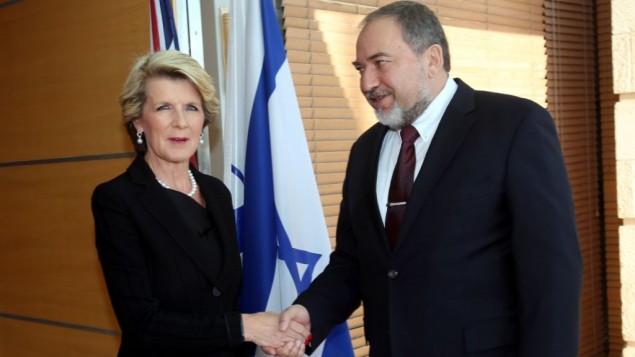
croppedjulie-bishop-and-lieberman-13.1.14-635x357Australian and Israeli Foreign Ministers Julie Bishop and Avigdor Liberman

This is not the first time that Australia has come to Israel’s defence regarding the settlements. In January, Foreign Minister Julie Bishop pointedly asked which precise law the settlements were violating.

Sadly, Australia’s stance runs counter to what some in Israel’s own Knesset declare!

Backing up Australia’s (and Israel’s) reasoned opinion that the “disputed territories” and East Jerusalem are not occupied, here is Eli E. Herz at Myths and Facts:

The term “occupied territory,” which appears in the Fourth Geneva Convention, originated as a result of the Nazi occupation of Europe. Though it has become common parlance to describe the West Bank and Gaza as “occupied territories,” there is no legal basis for using this term in connection to the Arab-Israeli conflict.

Professor Julius Stone, a leading authority on the Law of Nations, categorically rejected the use of the term “occupied territory” to describe the territories controlled by Israel on the following counts:

(1) Article 49 relates to the invasion of sovereign states and is inapplicable because the West Bank did not and does not belong to any other state.

(2) The drafting history of Article 49 [Protection of Civilian Persons in Time of War] – that is, preventing “genocidal objectives” must be taken into account. Those conditions do not exist in Israel’s case.

(3) Settlement of Jews in the West Bank is voluntary and does not displace local inhabitants. Moreover, Stone asserted: that “no serious dilution (much less extinction) of native populations” [exists]; rather “a dramatic improvement in the economic situation of the [local Palestinian] inhabitants since 1967 [has occurred].”

Be that as it may, given the hostile climate towards Israel in international forums, we must applaud Australia’s brave and principled stance, and pray that more nations join her in defending Israel’s basic and inalienable rights to settle its own land. We should also not be afraid to condemn and criticise those, like the US and EU, who condemn and criticise us for no wrong-doing while giving a free pass to terrorists.