Posted tagged ‘Damascus’

Russian embassy in Damascus shelled from terrorist-controlled area of Syria

October 4, 2016

Russian embassy in Damascus shelled from terrorist-controlled area of Syria

Published time: 4 Oct, 2016 10:26 Edited time: 4 Oct, 2016 12:33

Source: Russian embassy in Damascus shelled from terrorist-controlled area of Syria — RT News

The Russian embassy in Damascus came under fire on Tuesday from a neighborhood controlled by militant groups, including Al-Nusra Front, the Russian Foreign Ministry reports.
Read more

Al Qaeda-linked Nusra Front fighters © Stringer

One of the mortar shells fired at the embassy complex hit the residential area, while two others landed near the embassy building, the ministry said in a statement. Nobody was injured by the explosions.

“According to reports, the shelling came from the Jobar neighborhood of Damascus, which is under control of the terrorist groups Jabhat Fateh al-Sham and Failak ar-Rahman,” the ministry said.

Jabhat Fateh al-Sham is the new name taken by Al-Nusra Front, the Al-Qaeda offshoot universally considered a terrorist organization. Failak ar-Rahman is a lesser-known Islamist group.

Moscow said the shelling is “result of the actions of those who, like the US and some of its allies, provoke the continued bloodshed in Syria and flirt with militants and extremists of all flavors.”

The ministry said Russia would take “all necessary measures” to return peace and security to Syria.

READ MORE: 30 killed, scores injured in suicide bombing at Kurdish wedding in Syria

The Russian embassy in Damascus has come under militant fire on several occasions. The Syrian capital remains under threat despite the efforts of the army to fend off armed groups.

Over 20 blasts in Damascus as ‘terrorists shell residential areas’

February 28, 2016

Over 20 blasts in Damascus as ‘terrorists shell residential areas’ – Russian military

Published time: 27 Feb, 2016 16:41 Edited time: 27 Feb, 2016 18:30

Source: Over 20 blasts in Damascus as ‘terrorists shell residential areas’ – Russian military — RT News

The Syria truce coordinating center has detected shelling of residential areas in Damascus carried out by terror groups, said Sergey Kuralenko, the head of the center launched by Moscow at Khemim airbase earlier in the week.

Over 20 blasts were registered earlier Saturday over a period of five hours, Kuralenko said.

The information on the shelling was immediately passed to the US coordination center in Amman, the military said, RIA Novosti reported.

READ MORE: Russia suspends all Syria airstrikes on areas & armed groups included in ceasefire – General Staff

There were no immediate reports of any casualties, according to SANA news agency.

The Syrian capital came under shelling just a few hours after a nationwide ceasefire was introduced. The deal on “cessation of hostilities” came into effect at midnight Damascus time. Outlined by the US and Russia, it was unanimously adopted by the United Nations Security Council earlier Friday and obliged all parties involved in the conflict to abide by it.

The exceptions are Islamic State group (IS, formerly ISIS/ISIL), Al-Nusra, and other terrorist organizations as designated by the UN Security Council.

The news of the cessation in hostilities was met with mixed reactions in the Syrian capital.

“Do you think people are happy to see blood, devastation and ruins? People should have a rest and get back to normal life,” a woman told RT.

“It’s impossible to introduce a ceasefire. Terrorists and their supporters are going to use this time to obtain more weapons, and then the battles with the Syrian army will go on,” a man said.

During their Saturday phone call, Russian Foreign Minister Sergey Lavrov and US Secretary of State John Kerry welcomed the ceasefire and agreed on more intensive military cooperation between the two countries on regular basis.

Syria’s warring parties are expected to sit down to negotiating table again on March 7. However, the peace talks will be canceled if hostilities go on, UN Special Envoy Staffan de Mistura said.

Officials: CIA-backed Syrian rebels under Russian blitz

October 11, 2015

Officials: CIA-backed Syrian rebels under Russian blitz

By KEN DILANIAN Oct. 10, 2015 11:13 AM EDT

Source: Officials: CIA-backed Syrian rebels under Russian blitz


WASHINGTON (AP) — CIA-backed rebels in Syria, who had begun to put serious pressure on President Bashar Assad’s forces, are now under Russian bombardment with little prospect of rescue by their American patrons, U.S. officials say.

Over the past week, Russia has directed parts of its air campaign against U.S.-funded groups and other moderate opposition in a concerted effort to weaken them, the officials say. The Obama administration has few options to defend those it had secretly armed and trained.

The Russians “know their targets, and they have a sophisticated capacity to understand the battlefield situation,” said Rep. Mike Pompeo, R-Kan., who serves on the House Intelligence Committee and was careful not to confirm a classified program. “They are bombing in locations that are not connected to the Islamic State” group.

Other U.S. officials interviewed spoke on condition of anonymity because they were not authorized to discuss the matter publicly.

The CIA began a covert operation in 2013 to arm, fund and train a moderate opposition to Assad. Over that time, the CIA has trained an estimated 10,000 fighters, although the number still fighting with so-called moderate forces is unclear.

The effort was separate from the one run by the military, which trained militants willing to promise to take on IS exclusively. That program was widely considered a failure, and on Friday, the Defense Department announced it was abandoning the goal of a U.S.-trained Syrian force, instead opting to equip established groups to fight IS.

For years, the CIA effort had foundered — so much so that over the summer, some in Congress proposed cutting its budget. Some CIA-supported rebels had been captured; others had defected to extremist groups. The secret CIA program is the only way the U.S. is taking on Assad militarily. In public, the United States has focused its efforts on fighting IS and urging Assad to leave office voluntarily.

“Probably 60 to 80 percent of the arms that America shoveled in have gone to al-Qaida and its affiliates,” said Joshua Landis, a Syria expert at the University of Oklahoma.

But in recent months, CIA-backed groups, fighting alongside more extremist factions, began to make progress in Syria’s south and northwest, American officials say. In July and August, U.S.-supported rebels seized territory on the al-Ghab plain, in northwest Syria’s Idlib and Hama governorates. The plain is a natural barrier between areas controlled by Sunni Muslims and the Alawite sect to which Assad and his loyalists belong. The capture of the al-Ghab plain was seen as a breakthrough toward weakening the Alawites.

Those and other gains put Damascus, the capital, at risk, officials say.

But in recent days, Russian airstrikes have hit groups in the area, according to the Institute for the Study of War, a Washington think tank that closely tracks the situation. Russian bombs and missiles have hit specific buildings associated with the moderate Syrian opposition, according to a U.S. official briefed on the intelligence.

Russian officials have insisted they are bombing Islamic State militants and other terrorists.

U.S. intelligence officials see many factors motivating Russia’s intervention: Moscow’s reasserting its primacy as a great power, propping up Assad and wanting to deal a blow to the United States, which has insisted that Assad must go to end Syria’s civil war.

Russia is also interested in containing IS, an organization that includes thousands of Chechen fighters who may pose a threat to Russia, officials say.

But in the short term, “my conclusion is that the timing of their intervention was driven by Assad really going critical,” said Rep. Jim Himes, D-Conn., also a House Intelligence Committee member.

The administration is scrambling to come up with a response to Russia’s moves, but few believe the U.S. can protect its secret rebel allies. The administration has all but ruled out providing CIA-backed groups with surface-to-air missiles that can down aircraft, fearing such weapons would end up in the wrong hands, officials say.

Rep. Adam Schiff, the top Democrat on the committee, says the U.S. should consider establishing a no-fly zone that allows rebels a safe place from which to operate, and shooting down Syrian helicopters that are bombing civilians. He said the U.S. also should provide arms to the Ukrainian government fighting Russian-backed separatists.

A no-fly zone would require the U.S. military to be ready to engage in air battles with the Syrian government, something it is not prepared to do.

The administration “is debating the merits of taking further action or whether they are better off letting Putin hang himself,” he said, referring to Russian President Vladimir Putin.

“Our options are much narrower than they were two weeks ago,” said Sen. Angus King, I-Maine, who serves on the Intelligence and Armed Services committees. “I don’t think there is any simple answer. … Further air involvement has become very problematic because of the Russian engagement.”

Iranian Soldiers Deployed to Protect Damascus

June 4, 2015

Iranian Soldiers Deployed to Protect Damascus as Rebels Advance

Iranian, Iraqi fighters sent to guard against rebel attack on Syrian capital, amid concerns Assad regime is failing.

By Arutz Sheva Staff

First Publish: 6/3/2015, 4:44 PM

via Iranian Soldiers Deployed to Protect Damascus – Middle East – News – Arutz Sheva.


Fighters from Al Qaeda’s Nusra Front in Idlib, Syria Reuters

Thousands of Iranian and Iraqi fighters have been deployed in Syria in past weeks to bolster the defenses of Damascus and its surroundings, a Syrian security source told AFP on Wednesday.

“Around 7,000 Iranian and Iraqi fighters have arrived in Syria over the past few weeks and their first priority is the defense of the capital. The larger contingent is Iraqi,” the source said on condition of anonymity.

“The goal is to reach 10,000 men to support the Syrian army and pro-government militias, firstly in Damascus, and then to retake Jisr al-Shughur because it is key to the Mediterranean coast and the Hama region” in central Syria, he added.

Syria’s government lost control of Jisr al-Shughur in northwestern Idlib province on April 25, as a coalition of opposition forces including Al-Qaeda affiliate Al-Nusra Front swept through the region.

Yesterday, Iran’s official news agency IRNA quoted elite Revolutionary Guards General Qassem Soleimani as saying “in the coming days the world will be surprised by what we are preparing, in cooperation with Syrian military leaders.”

The agency cautioned however that it “takes no responsibility for the information.”

Iran is a key ally of the Syrian government, and it has provided Damascus with financial and military support throughout the conflict that began in March 2011 with anti-regime protests.

That support has included raising a Syrian pro-government militia known as the National Defense Force (NDF) to supplement the badly-stretched regular Syrian army, as well as sending battalions of fighters from the Hezbollah terrorist group, Tehran’s most important and powerful proxies.

Iran had also coordinated the training, arming and mobilization of Iraqi Shia Islamist militias to fight alongside Syrian government forces as well – though since the Islamic State’s lightening offensive through Iraq last summer most have returned home from Syria to fight ISIS there.

Iran has also sent an unknown number of soldiers and commanders from its own elite Revolutionary Guard corps to battle Syrian rebels.

But despite all that aid, in recent months the Syrian government has lost territory in several parts of the country to both an alliance of largely Islamist groups including Al-Nusra, and to the Islamic State (ISIS) jihadist group. In the south of the country as well, a more moderate rebel alliance has been making steady gains.

The rapid succession of defeats have led many to speculate the Assad regime may be nearing its demise, although other analysts have warned it is far too early to write it off yet.

Faced with those setbacks, the government has appealed to Tehran and ally Russia to step up support, a Syrian political figure close to the regime told AFP.

A diplomatic source in Damascus said Iran had been critical of the regime’s failure to achieve the last major offensive operation it undertook – a February bid to cut rebel supply lines to the northern city of Aleppo.

Tehran had opposed the operation, citing lack of preparation, the source said, and subsequently insisted that Syria change its strategy to focus on holding less territory more securely.

Analysts and observers have said the Syrian government now appears ready to accept the de facto partition of the country, focusing on the defense of strategically important areas and leaving others to rebels or jihadists.

According to one source close to the regime, it considers the coast, the central cities of Hama and Homs, and the capital Damascus as vital.

It also regards the Damascus-Beirut and Damascus-Homs highways as “red lines”, the source said.

More than 220,000 people have been killed in Syria’s civil war.

AFP contributed to this report.

Islamist State plots terror attacks inside Tehran. Hizballah high-up killed in Damascus bus blast

February 2, 2015

Islamist State plots terror attacks inside Tehran. Hizballah high-up killed in Damascus bus blast, DEBKAfile, February 2, 2015

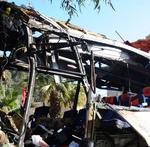
Shiite_Bus_in_Damascus_1.2.15Shiite pilgrim bus explosion in Damascus

The Islamic State of Iraq and the Levant has launched a new terror offensive against Iranians, their followers and other Shiites.  It was kicked off Sunday, Feb. 2 with an attack on a Damascus bus carrying Lebanese Shiite pilgrims to shrines in Syria. Nine people were killed and at least 20 injured. ISIS has set its sights next on the Muslim Shiite heartland, Iran and its cities – especially the capital Tehran.

The Damascus bus attack is ascribed by some sources to a Saudi suicide bomber by the name of Abu al-Ezz al-Ansari. The claim that the Syrian rebel Jabhat al-Nusra was the perpetrator was false, say DEBKAfile’s intelligence and counter-terrorism sources. This group does not go in for Saudi recruits and certainly not suicide bombers of that ilk.

ISIS fingered Nusra to conceal its own responsibility for the attack and its real target. Our sources reveal that the Islamic State attacked the Shiite pilgrims in order to get at a high-ranking officer of Hizballah’s armed wing, who was on the bus.

Hizballah headquarters in Beirut has imposed deep hush on his death and identity. But because they could not pretend the bus explosion did not happen, they pinned it Monday on “takfir [infidel] groups” which they say collaborate with Israel.

This attack revealed most significantly that Hizballah has begun covering the tracks in Syria of its top Hizballah men by inserting them among Shiite pilgrims traveling by bus from Lebanon to Damascus. They are camouflaging the movements of their top men in Syria by an elaborate security net, ever since an Israeli air strike on Jan. 18, killed around nine Hizballah and Iranian officers, including the Iranian general, Ali Allah Dadi.

Still, ISIS agents were able to find the bus and blow it up, indicating deep hostile penetration of the Iranian and HIzballah forces assigned to Syria to fight for Bashar Assad.

Conscious of the Islamic State’s next plans, the Iranian Al Qods Brigades commander, Gen. Qassem Soleimani, paid an unscheduled visit to Beirut last Thursday, Jan. 29, for urgent talks with Hizballah leader Hassan Nasrallah and briefings for the organization’s military council members. Their most pressing concern was the detailed ISIS program, which is ready to go, for a broad new campaign of terror against Iranian and pro-Iranian targets in Lebanon, Syria, Iraq and the Iranian homeland.