Posted tagged ‘Clinton’

Hillary Clinton is the X-factor for the Iranian nuclear deal’s congressional survival

July 13, 2015

Hillary Clinton is the X-factor for the Iranian nuclear deal’s congressional survival, DEBKAfile, July 13, 2015

Clinton_7.15Hillary Clinton faces tough decision

“A parade of concessions to Iran,” was Israeli Prime Minister Binyamin Netanyahu’s comment on the nuclear accord expected to be announced and fully revealed later on Monday July 13 in Vienna. He underscored his point by playing back President Bill Clinton’s words upon signing the nuclear deal with North Korea 21 years ago: “North Korea will freeze and then dismantle its nuclear program,” Clinton announced then. “South Korea and our other allies will be better protected. The entire world will be safer as we slow the spread of nuclear weapons.”

Despite Bill Clinton’s pledge of carefully monitoring, Pyongyang broke through to a nuclear bomb in October 2006, twelve years later. By comparison; a ten-year limit on the period during which Iran is allowed to develop a bomb is believed to be incorporated in the Vienna accord. Its full text of100 pages plus is still to be fully disclosed.

By playing back the Clinton clip, Netanyahu aimed to place high on Washington’s agenda, the leverage in the hands of his wife, Hillary Clinton, in determining whether the deal survives the US Congress, which will have 60 days to review it.

Hillary is currently rated by the polls with a 62 percent lead in her run for the Democratic nomination in the 2016 presidential election. She tops the lists of alll declared Democratic and Republic contenders combined.

In the first week of July, she is quoted as supporting Obama’s relentless drive for a deal when she said: “I so hope that we are able to get a deal in the next week that puts a lid on Iran’s nuclear weapons program because that’s going to be a singular step in the right direction.”

Before that, she echoed Obama’s words that “no deal is better than a bad deal.”

Now that the accord is in its last stage, she has held back from judging whether it is good or bad – only in private conversations with wealthy Jewish contributors to her campaign, she has promised to be “a better friend to Israel than President Barack Obama.”

But once the final accord is in the bag – expected in the coming hours – Clinton will have to come out in the open, because she holds the key to a Senate majority for blocking it. The 54 Republican senators are committed to voting against it: Senate Majority leader Mitch McConnell told Fox News Sunday: “I think it’s going to be a very hard sell, if it’s completed, in Congress. We already know it’s going to leave Iran as a threshold nuclear state. It appears as if the administration’s approach to this was to reach whatever agreement the Iranians are willing to enter into,” he said.

But the 44 Democratic senators are wobbling between being loyal to the president and their profound misgivings about the deal with Iran. It would take 13 Democrats to cross the floor and join the Republicans to achieve the necessary majority for annulling the promised presidential veto of a negative vote.

A Clinton declaration against the deal could swing those 13 senators against the accord – so painfully crafted in 13 months of agonizing bargaining led by Secretary of State John Kerry – and leave Obama in the position of a lame duck president.

Iran’s leaders, after reading the map in Washington, took the precaution of submitting to the Majlis a motion that would require a parliamentary review every few months of the US performance in complying with the accord with the power to annul it if this performance was judged unsatisfactory.

This pits the Iranian parliament against the US Senate and, by implication, puts Hillary Clinton in the driving seat in Washington versus Ayatollah Ali Khamenei in Tehran.

Whatever she decides now – whether for or against the Iranian deal – will have consequences for her campaign for president. That campaign has almost a year and a half to run before the November 2016 election. If she backs the deal and lets the Democratic senators refrain from voting against it, she will be held accountable – not only by Jewish campaign donors, but, up to a point, the American voter too. Israeli and Saudi intelligence will certainly use a microscope to discover the tiniest particles of evidence of Iran’s non-compliance. They will be thrown in her face.

Republican rivals will certainly fuel their campaigns with allegations of the total surrender to Iran by Obama and Kerry – with consequences for the prospects of Obama’s former secretary of state, Hillary Clinton.
Backing Obama would therefore cast a shadow over her presidential hopes, whereas taking the lead of a   Democratic senatorial mutiny against it may well undo the deal before the year is out.  Either way, Clinton faces one of her toughest decisions since she decided to run as the first American woman president.

Documents: Feds Knew Benghazi Attack Planned in Advance

May 19, 2015

Documents: Feds Knew Benghazi Attack Planned in Advance, Washington Free Beacon, May 18, 2015

(Please see also, Arab military chiefs approve Egyptian-led intervention in Libya — DM)


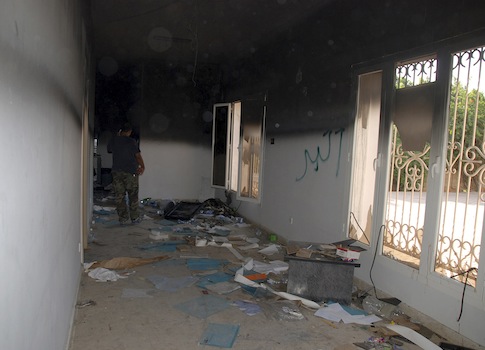
Gutted U.S. consulate in Libya / AP

Documents obtained by Judicial Watch from their May 2014 Freedom of Information Act (FOIA) lawsuits filed against the State Department and the Department of Defense revealed that the Obama administration knew about the attacks on the U.S. Consulate in Benghazi at least 10 days before the attack.

The documents also revealed that the DOD immediately reported the attacks on the consulate.

The documents included an August 2012 analysis predicting the failure of President Obama’s policy of a regime change in Syria as well as a warning about the rise of the Islamic State. The documents also included a confirmation that United States was aware of an arms shipment from Benghazi to Syria.

One of the documents from the DOD’s Defense Intelligence Agency dated September 12, 2012, the day after the attacks in Benghazi, lays out the details of the attack on the consulate and assesses that it was carefully planned by the terrorist group “Brigades of the Captive Omar Abdul Rahman.”

The group is known to have connections to the Muslim Brotherhood as well as  to al Qaeda. Rahman is serving a life sentence in prison for his role in the 1993 bombing of the World Trade Center.

The group’s goal was to “kill as many Americans as possible,” according to the documents, which were sent to Secretary of State Hillary Clinton, Defense Secretary Leon Panetta, the Joint Chiefs of Staff, and the National Security Council.

An October 2012 DOD document contained the first official document that the Obama administration knew of the shipment of weapons from the Benghazi to rebel forces in Syria.

Weapons from the former Libya military stockpiles were shipped from the port of Benghazi, Libya to the Port of Banias and the Port of Borj Islam, Syria. The weapons shipped during late-August 2012 were Sniper rifles, RPG’s, and 125 mm and 155 mm howitzers missiles.

During the immediate aftermath of, and following the uncertainty caused by, the downfall of the (Qaddafi) regime in October 2011 and up until early September of 2012, weapons from the former Libya military stockpiles located in Benghazi, Libya were shipped from the port of Benghazi, Libya to the ports of Banias and the Port of Borj Islam, Syria. The Syrian ports were chosen due to the small amount of cargo traffic transiting these two ports. The ships used to transport the weapons were medium-sized and able to hold 10 or less shipping containers of cargo.

The heavily redacted document did not reveal which weapons were sent to Syria

The DIA consistently warned of the deterioration of the situation in Iraq and warned that it creates an ideal situation for Al Qaeda to return to Mosul and Ramadi, according to an August 2012 report. During this time the U.S. was monitoring weapons flows from Libya to Syria. The agency warned of dire consequences but blocked out what most of what those consequences were.

The State Department produced a single document from a separate lawsuit that Judicial Watch had filed against the department. The document was created by Hillary Clinton’s office the morning after the attacks on the consulate in Benghazi and was sent throughout the State Department.

Neither the State Department nor Hillary Clinton have turned over any documents in regards to Benghazi or her personal email account that was used during her as well as other top aides during her time as Secretary of State.

Judicial Watch has filed multiple FOIA requests and has waited over two years for the documents that they have received.

“These documents show that the Benghazi cover-up has continued for years and is only unraveling through our independent lawsuits,” said Tom Fitton, president of Judicial Watch. “The Benghazi scandal just got a whole lot worse for Barack Obama and Hillary Clinton.”

Bring Back the Bush Doctrine—with One Addition

March 1, 2015

Bring Back the Bush Doctrine—with One Addition, National Review Online, Andrew C. McCarthy, February 28, 2015

Our enemies are not driven by American foreign policy, our friendship with Israel, our detention of jihadists at Gitmo, or the supposed “arrogance” our current president likes to apologize for. Those are all pretexts for aggression.

Our enemies are driven by an ideology, Islamic supremacism, that is rooted in a classical interpretation of sharia — Islamic law. Islamic supremacism is rabidly anti-American, anti-Western, and anti-Semitic. It rejects the fundamental premise of our liberty: that people are free to govern themselves, rather than be ruled by a totalitarian legal code that suffocates liberty and brutally discriminates against non-Muslims and apostates. And sharia is an actual war on women — denying them equal rights under the law, subjecting them to unthinkable abuse, and reducing them in many ways to chattel.

****************

There is a path to victory in the fight against radical Islam, and our next president should embrace it.

What should be our strategy against ISIS? We ask the question without ever considering Iran. What concessions about centrifuges and spent fuel should we demand to prevent Iran from becoming a nuclear power? We ask the question never linking the mullahs’ weapons ambitions with its sponsorship of the global jihad . . . the only reason we dread a nuclear Iran. What should be the national-defense strategy of the United States against radical Islam, the most immediate and thoroughgoing security and cultural threat we face today?

I had the good fortune to be asked to participate in a CPAC panel Friday on defending America against rogue states. With 2016 hopefuls crowding the halls, it got me to thinking: What should we hope to hear from Republicans who want to be the party’s standard-bearer?

It is often said that we lack a strategy for defeating our enemies. Actually, we have had a strategy for 14 years, ever since the fleeting moment of clarity right after the 9/11 attacks.

That strategy is called the Bush Doctrine, and it remains the only one that has any chance of working . . . at least if we add a small but crucial addendum — one that should have been obvious enough back in 2001, and that hard lessons of history have now made inescapable.

The Bush Doctrine has become the source of copious rebuke. On the left, that’s because of that four-letter word (hint: It’s not “Doctrine”). On the right, there have been plenty of catcalls, too. The reaction, however, has been against what the Bush Doctrine evolved into, not against the Bush Doctrine as it was first announced.

The unadorned Bush Doctrine had two straightforward parts. First, because violent jihadists launch attacks against the United States when they have safe havens from which to plot and train, we must hunt down those terrorists wherever on earth they operate. Second, the nations of the world must be put to a choice: You are with us or you are with the terrorists. Period — no middle ground. If you are with the terrorists, you will be regarded, as they are regarded, as an enemy of the United States.

Before we get to that aforementioned addendum, it is important to remember why the Bush Doctrine was so necessary. For the nine years before it, we were living with the Clinton Doctrine.

That is the doctrine President Obama came to office promising to move us back to — and has he ever. It is the doctrine under which the enemy strikes us with bombs and weaponized jumbo jets, and we respond with subpoenas and indictments. It is the doctrine under which our enemies say, “allahu akbar! Death to America!” and we respond, “Gee, you know America has been arrogant. We can see why you’re so upset.”

The Clinton Doctrine — the one the Democrats will be running on in 2016, perhaps with its namesake leading the way — is the one that gave us a series of ever more audacious attacks through the 1990s: the 1993 World Trade Center bombing; a plot to bomb New York City landmarks such as the Lincoln and Holland Tunnels; a plot to blow American airliners out of the sky over the Pacific; the 1996 Khobar Towers bombing, in which Iran and al-Qaeda teamed up to kill 19 American airmen; the 1998 bombings of our embassies in Kenya and Tanzania that killed over 200 innocent people; detonating a bomb next to our destroyer, the U.S.S. Cole, in October 2000, killing 17 members of the U.S. Navy; and finally, the 9/11 atrocities, killing nearly 3,000 of our citizens.

And what has gradually restoring the Clinton Doctrine gotten us? While President Obama pleads for a deal that will inevitably make Iran a nuclear power, the mullahs continue to back anti-American terrorists and conduct military exercises in which they practice blowing up American ships. The Iraq so many Americans gave their lives for is now an extension of Iran. Afghanistan is being returned to the Taliban, which the president empowers by releasing its commanders. Libya is now a failed state where jihadists murder Americans with impunity and frolic in the former American embassy. Al-Qaeda is expanding through northern Africa, now a bigger, more potent threat than it was on the eve of 9/11. And yet it may pale compared with its breakaway faction, the Islamic State, which now controls more territory than Great Britain, as it decapitates, incinerates, and rapes its way to a global caliphate.

But Obama tells us there’s good news: Yemen is a success . . . or at least it was until it was recently overrun by an Iran-backed militia — oops. Well, we have indicted exactly one of the scores of terrorists who attacked our embassy at Benghazi. He got his Miranda warnings, of course, and he’ll be getting his civilian trial any month now. Hopefully, we’ll do better than Obama’s civilian trial of Ahmed Ghailani, the bomber of our embassies who was acquitted on 284 out of 285 counts.

Is it any wonder we’re losing?

Largely, it is because we’re worried about the wrong things — like whether we can sweep the enemy off its feet with enough Islamophilic, blame-America-first rhetoric. In reality, our enemies could not care less whether we — the infidel West — think their literalist, scripturally based belief system is a “perversion” of Islam. Radical Islam hears only one message from America: strength or weakness. The Clinton Doctrine is weakness cubed.

The Bush Doctrine, by contrast, is the path to victory — if we get that one addendum right.

It is this: Our enemies are not driven by American foreign policy, our friendship with Israel, our detention of jihadists at Gitmo, or the supposed “arrogance” our current president likes to apologize for. Those are all pretexts for aggression.

Our enemies are driven by an ideology, Islamic supremacism, that is rooted in a classical interpretation of sharia — Islamic law. Islamic supremacism is rabidly anti-American, anti-Western, and anti-Semitic. It rejects the fundamental premise of our liberty: that people are free to govern themselves, rather than be ruled by a totalitarian legal code that suffocates liberty and brutally discriminates against non-Muslims and apostates. And sharia is an actual war on women — denying them equal rights under the law, subjecting them to unthinkable abuse, and reducing them in many ways to chattel.

In the “you are with us or you are with the terrorists” view of national security, any Muslim nation, organization, or individual that adheres to Islamic supremacism is on the wrong side. Failing to come to terms with that brute fact is where the Bush Doctrine went awry.

Sharia and Western democracy cannot coexist. They are antithetical to each other. So insists Sheikh Yussuf Qaradawi, the Muslim Brotherhood jurist who is the world’s most influential Islamic scholar. It may be the only thing we should agree with him about.

The Bush Doctrine was allowed to evolve from an American national-security strategy to an illusion that our national security would be strengthened by promoting a chimera — sharia democracy. We put the lives of our best young men and women in harm’s way in the service of a dubious experiment: that we could build stable Islamic democracies that would be reliable American allies against jihadist terror.

Perhaps the worst thing about this experiment is not its inevitable failure. It is the sapping of America’s will that it has caused. Defeating our jihadist enemies is going to require a will to win, because the enemy’s will is strong — the jihadists truly believe Allah has already helped them vanquish the Soviet empire, and that we are next.

The American people vigorously support military operations that are essential to our defense. They support a vigorous war to defeat violent jihadists and their support networks. They understand that we cannot cede our enemies safe havens and nuclear weapons.

They do not support the notion that promoting our national security obliges us to move into hostile Islamic countries for a decade or three to civilize them. That’s not our job. Worse, when Americans become convinced that Washington — ever more remote from the public — thinks it is our job, they will not support military action, even action that is vital to protecting our nation. They will not trust the government to defeat our enemies without becoming entangled in Islam’s endless internal strife.

Understanding Islamic supremacism so we can distinguish allies from those hostile to us will restore the Bush Doctrine. And let’s not be cowed by the critics: Nothing I’ve said means endless war, or that we have to invade or occupy every country. But it does mean we should be using all our assets — not just military but intelligence, law-enforcement, financial, and diplomatic — to undermine regimes that support sharia supremacism. Cutting off that jihadist life-line is the path to victory — just as maintaining a strong military that is allowed to show it means business, that is not hamstrung by irresponsible rules of engagement, is the best way to ensure we won’t have to use it too often.

In Iran, where sharia is the law of the land, they persecute non-Muslims and apostates just like ISIS does. In Saudi Arabia, where sharia is the law of the land, they behead their prisoners just like ISIS does. A candidate who cannot tell liberty’s friends from liberty’s enemies is not fit to be commander-in-chief.

Obama Must Explain Why the Iran Deal Isn’t North Korea Redux

March 1, 2015

Obama Must Explain Why the Iran Deal Isn’t North Korea Redux, Commentary Magazine, March 1, 2015

(There are additional parallels. North Korea and Iran have comparable views of human rights, both make loud and frequent noises about obliterating their perceived enemies and both have allies willing if not anxious to sneak around sanctions. There are also differences. Iran is far more powerful than North Korea was or is and Iran’s intention to dominate the Middle East transcends North Korea’s desire to “unify” with South Korea on North Korea’s terms. Iranian governance is based on Islam, an unfortunately powerful world religion seeking world domination. North Korean governance is based on the “religion of Kim,” supreme internally but otherwise of little significance elsewhere. Iran also presents a greater danger to the U.S. than North Korea did. However, Obama won’t explain why the Iran deal isn’t “North Korea redux” because he quite likely neither knows nor cares and because it is. — DM)

The State Department has never conducted a lessons learned exercise about what went wrong with the North Korea deal. Perhaps it’s time. Diplomatic responsibility and national security demand it.

**********************

As the Obama administration rushes into a nuclear deal with Iran, it pays to remember the last time the United States struck a deal with a rogue regime in order to constrain that state’s nuclear program and the aftermath of that supposed success.

Bill Clinton had been president barely a month when North Korea announced that it would no longer allow International Atomic Energy Agency (IAEA) inspections, followed shortly thereafter by an announcement that it would withdraw from the NPT altogether within a matter of months. If Kim Il-sung expected Washington to flinch, he was right. The State Department aimed to keep North Korea within the NPT at almost any price. Chief U.S. negotiator Robert Gallucci and his aides explained in their book Going Critical, “If North Korea could walk away from the treaty’s obligations with impunity at the very moment its nuclear program appeared poised for weapons production, it would have dealt a devastating blow from which the treaty might never recover.” Unwilling to take any path that could lead to military action, Clinton’s team sought to talk Pyongyang away from nuclear defiance, no matter that talking and the inevitable concessions that followed legitimized Pyongyang’s brinkmanship.

As with President Obama relieving Iran of the burden of six United Nations Security Council resolutions which demanded a complete cessation of enrichment, Clinton’s willingness to negotiate North Korea’s nuclear compliance was itself a concession. After all, the 1953 Armistice required Pyongyang to reveal all military facilities and, in case of dispute, enable the Military Armistice Commission to determine the purpose of suspect facilities. By making weaker frameworks the new baseline, Clinton let North Korea off the hook before talks even began.

Just as Israeli (and Saudi and Emirati and Egyptian and Kuwaiti and Bahraini) leaders express frustration with the Obama administration regarding its naiveté and unwillingness to consult, so too did South Korea at the time chafe at Clinton’s arrogance. South Korean President Kim Young Sam complained to journalists that North Korea was leading America on and manipulating negotiators “to buy time.” And in a pattern that repeats today with regard to Iran, the IAEA held firmer to the demand that North Korea submit to real inspections than did Washington. The issue came to a head in September 1993 after the State Department pressured the IAEA to compromise on limited inspections.

In the face of Pyongyang’s defiance, Clinton was also wary that coercion could be a slippery slope to war. Just as President Obama and Secretary of Defense Chuck Hagel instructed U.S. forces in the Persian Gulf not to stand firm but rather to retreat if probed or pushed by Iran, Clinton sought to mollify Pyongyang, for example cancelling the joint U.S.–South Korea military exercise in 1994. Adding insult to injury, the Clinton administration criticized the South Korean government for being unwilling to compromise. Indeed, everything the Obama administration has done with regard to Israel over the past year—with the exception, perhaps, of the classless chickensh-t comment—was ripped right from the Clinton playbook two decades before when the White House sought to silence Seoul.

There followed months of baseless optimism in Washington, followed by disappointment quickly supplanted by denial. At one point, when it looked like Kim Il-sung’s intransigence might actually lead to war, former President Jimmy Carter visited Pyongyang and, whether cleared to or not, made concessions which diffused the situation. It was the diplomatic equivalent of Obama’s voided redlines. Nightlinehost Ted Koppel observed on May 18, 1994, “this administration is becoming notorious … for making threats and then backing down.”

On July 8, 1994, a heart attack felled Kim Il-sung. Kim Jong-il, his eldest son, took over. Negotiations progressed quickly. Gallucci and his team promised an escalating series of incentives—reactors, fuel oil, and other economic assistance. They kicked inspections of North Korea’s suspect plutonium sites years down the line.

What had begun as North Korean intransigence had netted Pyongyang billions of dollars in aid; it would go down in history as the largest reward for cheating and reneging on agreements until Obama granted Iran $11 billion in sanctions relief just for coming to the table. Columnist William Safire traced the steps of concessions on North Korea. “Mr. Clinton’s opening position was that untrustworthy North Korea must not be allowed to become a nuclear power,” he observed, but Clinton “soon trimmed that to say it must not possess nuclear bombs, and stoutly threatened sanctions if North Korea did not permit inspections of nuclear facilities at Yongbyon, where the CIA and KGB agree nuclear devices have been developed. But as a result of Clinton’s Very Good Deal Indeed, IAEA inspectors are denied entry to those plants for five years.” And Sen. John McCain, for his part, lamented that Clinton “has extended carrot after carrot, concession after concession, and pursued a policy of appeasement based … on the ill-founded belief that North Koreans really just wanted to be part of the community of nations.” Again, the parallels between Clinton’s and Obama’s assumptions about the desire of enemies to reform were consistent.

Clinton wasn’t going to broker any criticism of what he believed was a legacy-defining diplomatic triumph, all the more so when the criticism came from abroad. On October 7, 1994, South Korean President Kim Young Sam blasted Clinton’s deal with the North, saying, “If the United States wants to settle with a half-baked compromise and the media wants to describe it as a good agreement, they can. But I think it would bring more danger and peril.” There was nothing wrong with trying to resolve the problem through dialogue, he acknowledged, but the South Koreans knew very well how the North operated. “We have spoken with North Korea more than 400 times. It didn’t get us anywhere. They are not sincere,” Kim said. His outburst drew Clinton’s ire. He became the Netanyahu of his day. Meanwhile, the U.S. and North Korea signed the Agreed Framework. Gallucci and his team were “exhilarated.” They later bragged they “had overcome numerous obstacles in the negotiations with the North; survived the intense, sometimes strained collaboration with Seoul and the International Atomic Energy Agency; and marshaled and sustained an often unwieldy international coalition in opposition to the nuclear challenge, all under close and often critical scrutiny at home.”

Today, by some estimates, North Korea is well on its way to having 100 nuclear weapons and is steadily developing the ballistic capability to deliver them. Iran’s nuclear negotiators have cited North Korea’s negotiating strategy as a model to emulate rather than an example to condemn. Meanwhile, Obama has relied on many of the same negotiators to advance his deal with Iran.

The State Department has never conducted a lessons learned exercise about what went wrong with the North Korea deal. Perhaps it’s time. Diplomatic responsibility and national security demand it.

Obama, Iran and the Late William Buckley

February 16, 2015

Obama, Iran and the Late William Buckley, Huffington Post, February 15, 2015

(This is from left-“leaning” Huffington Post. William Buckley, the CIA agent mentioned in the article, was not National Review’s William F. Buckley, Jr. The comments following the article are interesting.– DM)

President Obama seems determined to move forward on a nuclear agreement with the regime that tortured and murdered William Buckley. He should reflect on how this dedicated CIA agent must have felt, abandoned by his government and alone with his Iranian torturers, enduring a hellish nightmare in the basement of the Iranian foreign ministry. Is the nation William Buckley died for now about to be abandoned, for the sake of a presidential legacy?

***************

There are growing indications that the Obama administration will sign a nuclear agreement with Iran that will allow Tehran to become a nuclear-threshold state. It seems the only issue being contested at present is the extent of the cosmetic and temporary concessions the Iranians will grant so that Iran does not fully emerge as a nuclear weapons state until after the expiration of the Obama presidency. The disarming body language and genuine warmth that characterizes the public interaction between U.S. Secretary of State John Kerry and Iran’s Minster of Foreign Affairs Mohammad Javad Zarif seems to point in that direction, belying the fact that these two nations have not had diplomatic relations for 35 years because the government of one of those states ordered its armed thugs to attack and seize the embassy of the other nation, in the most flagrant violation of international law, holding its diplomats hostage for 444 days.

Of course, Barack Obama has promised on more than one occasion that he would never permit Iran to become a nuclear armed state. Then again, this is the same President Obama who warned Syria’s president not to use poison gas on his own people, or there would be consequences for crossing that red line. And let us not forget the President’s assurances that the war in Iraq was over and it was safe to withdraw all U.S. forces, or that the emerging Islamic State was nothing more than a “jayvee team” or that Yemen was a great success story for America’s anti-terrorism strategy — the same Yemen where Washington was recently forced to close its embassy after a coup in that country staged by anti-American rebels loyal to Iran.

The consequences involved in permitting Iran to become a nuclear weapons state are, obviously, far more consequential. Barack Obama is not the first president confronting a rogue regime about to acquire nuclear weapons capability. In the early 1990s, evidence mounted that North Korea was embarking on a nuclear weapons program. As with President Obama, then President Clinton pledged to the American people that the North Korean regime would never be permitted to obtain nuclear weapons. Then former President Jimmy Carter came to the rescue. He flew to North Korea, met with the reigning dictator and laid the groundwork for what became the 1994 Agreed Framework treaty, which supposedly froze North Korea’s attempt to develop atomic weapons through plutonium production in exchange for U.S. economic aid. However, the treaty collapsed after Clinton left office when U.S. intelligence learned that North Korea had cheated on the agreement by secretly developing a uranium enrichment program as an alternative path towards developing nuclear bombs. In 2006, North Korea conducted its first test detonation of a nuclear bomb.

It appears that the Obama administration is following in the path originally set by President Clinton. In addition to tolerating a vast nuclear enrichment facility, much of it underground, that can only have been established for the eventual mass production of nuclear bombs to mate with Tehran’s increasingly powerful and longer-range ballistic missiles, the current administration has been passive in the face of Iran’s growing hegemony in the Middle East, as witnessed by Tehran’s virtual occupation of Lebanon through its proxy militia, its massive intervention in the Syrian civil war on the side of Basher Assad, and increasing military involvement and control in Iraq and the recent pro-Iranian coup in Yemen. This passivity is inexplicable, considering the potential and dire strategic and economic consequences for the United States.

What about the character of the regime that President Obama and his national security team seem about to trust with the most destructive weapons on earth? Amid the long list of Iranian terrorist attacks against the U.S. and its interests aboard unleashed by Tehran since 1979, there is one which, more than any other, defines the essence of the regime of the Ayatollahs and its contempt for the United States.

In 1984, the CIA station chief in Beirut, William Buckley, was kidnapped by the Iranian controlled Hezbollah militia. The fate of William Buckley was disclosed byWashington Post columnist Jack Anderson in an article published the following year. According to Anderson, who based his account on confidential sources within the U.S. intelligence community, Buckley was smuggled into Iran, and subjected to numerous bouts of brutal interrogation under barbaric torture in the basement of the Iranian foreign ministry, the same building being presided over today by John Kerry’s Iranian counterpart, Zarif. The barbarous torture eventually induced a heart attack, leading to the death of Buckley. As Jack Anderson stated in his article, Iran was responsible for the horrific murder under torture of an American patriot.

President Obama seems determined to move forward on a nuclear agreement with the regime that tortured and murdered William Buckley. He should reflect on how this dedicated CIA agent must have felt, abandoned by his government and alone with his Iranian torturers, enduring a hellish nightmare in the basement of the Iranian foreign ministry. Is the nation William Buckley died for now about to be abandoned, for the sake of a presidential legacy?

Hillary ‘Leaving No Daylight’ Between Herself and Israel

August 11, 2014

Hillary ‘Leaving No Daylight’ Between Herself and Israel

Hillary defends Israel, distances herself from Obama’s foreign policy “failure”

8.11.2014 Israel Revolt Bradford Thomas

via Hillary ‘Leaving No Daylight’ Between Herself and Israel | Truth Revolt.


In an interview with The Atlantic’s Jeffrey Goldberg, Hillary Clinton attempted to leave “no daylight between the Israelis and herself.” Despite her frequent criticism of Israeli PM Benjamin Netanyahu during her time as secretary of state, Clinton declared her adamant support of Israel’s Gaza campaign, as the rift between the country and the Obama administration grows.

On her support of Israel:

I think Israel did what it had to do to respond to the rockets. Israel has a right to defend itself. The steps Hamas has taken to embed rockets and command-and-control facilities and tunnel entrances in civilian areas, this makes a response by Israel difficult.

On whether Israel has done enough to prevent the deaths of innocent Gazans:

[J]ust as we try to do in the United States and be as careful as possible in going after targets to avoid civilians [mistakes are made.] We’ve made them. I don’t know a nation, no matter what its values are—and I think that democratic nations have demonstrably better values in a conflict position—that hasn’t made errors, but ultimately the responsibility rests with Hamas.

As Goldberg states, Clinton’s “vociferous defense” of Israel is noteworthy because when she was serving as secretary of state “she spent a lot of time yelling at Netanyahu on the administration’s behalf over Israel’s West Bank settlement policy.” Now, Clinton is “leaving no daylight at all between the Israelis and herself.”

Her statements on Israel were part of a larger trend in the discussion with Goldberg in which she deliberately distanced herself from President Obama in terms more dramatic than any of her previous statements, including highlighting Obama’s foreign policy “failure” in Syria and his culpability in allowing the rise of ISIS in Iraq.

On Obama’s foreign policy “failure” in the Middle East:

The failure to help build up a credible fighting force of the people who were the originators of the protests against Assad—there were Islamists, there were secularists, there was everything in the middle—the failure to do that left a big vacuum, which the jihadists have now filled. […]

One of the reasons why I worry about what’s happening in the Middle East right now is because of the breakout capacity of jihadist groups that can affect Europe, can affect the United States. Jihadist groups are governing territory. They will never stay there, though. They are driven to expand. Their raison d’etre is to be against the West, against the Crusaders, against the fill-in-the-blank—and we all fit into one of these categories. How do we try to contain that? I’m thinking a lot about containment, deterrence, and defeat.

On Obama’s “Don’t do stupid sh*t” foreign policy slogan:

Great nations need organizing principles, and “Don’t do stupid stuff” is not an organizing principle.

At one moment in the interview, Clinton basically told Goldberg that she was going to run in 2016, saying about whether her optimistic views of America were too “old-fashioned,” “I’m about to find out, in more ways than one.”