Posted tagged ‘Clinton unsecured server’

O’Reilly & Turley Destroy Any Credibility That Clinton & Comey May Have Ever Had At One Time

September 29, 2016

O’Reilly & Turley Destroy Any Credibility That Clinton & Comey May Have Ever Had At One Time, Fox News via YouTube, September 29, 2016

(Please see also, Comey: Combetta Insisted That He Acted Alone In Destroying Evidence After He Was Given Immunity by Prof. Turley. — DM)

https://www.youtube.com/watch?v=2p8HAckXK1g&feature=youtu.be


Comey: Combetta Insisted That He Acted Alone In Destroying Evidence After He Was Given Immunity

September 29, 2016

Comey: Combetta Insisted That He Acted Alone In Destroying Evidence After He Was Given Immunity, Jonathan Turley’s Blog, Jonathan Turley, September 29, 2016

I recently wrote a column on FBI investigation into the Clinton email scandal and revised my view as to the handling of the investigation in light of the five immunity deals handed out by the Justice Department.  I had previously noted that FBI Director James Comey was within accepted lines of prosecutorial discretion in declining criminal charges, even though I believed that such charges could have been brought. However, the news of the immunity deals (and particularly the deal given top ranking Clinton aide Cheryl Mills) was baffling and those deals seriously undermined the ability to bring criminal charges in my view.  Now, Comey has testified before both the Senate and the House. His answers only magnified concerns over the impact and even the intent of granting immunity to those most at risk of criminal charges.

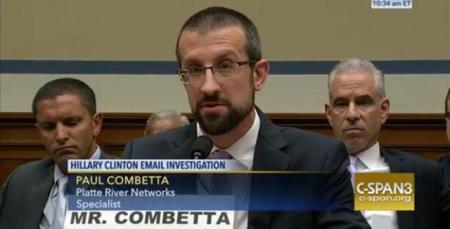
First the timeline is now becoming clear and it makes the immunity deal even more bizarre given what the FBI knew Colorado-based tech specialist Paul Combetta and Clinton aides Cheryl Mills and IT specialist Bryan Pagliano.

cheryl_d-_mills

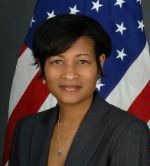
In July 2014 , then-chief of staff Cheryl Mills was told that Clinton’s emails were being sought.

On July 23, 2014 Combetta got a call from Mills on the server and emails.

On July 24, 2014, Combetta received an email from Clinton IT specialist Pagliano.

On July 24, Combetta then went online to Reddit to solicit help on stripping out “a VIP’s (VERY VIP) email address from a bunch of archived emails.” He revealed that “they don’t want the VIP’s email address exposed to anyone.”

What is incredible is that the Justice Department would give immunity to the parties on both ends of those communications — guaranteeing that a criminal prosecution is no longer a real threat.

bleachbit-paul-combetta

Comey deepened those concerns with his testimony.  After these conversations with Mills and Clinton aides, Combetta destroyed the evidence.  Comey admits that Mills did disclose the preservation order.  Combetta however mysteriously then destroys the evidence.  Comey was asked what he got from the immunity deal with Combetta.  He said “We learned no one directed him to do that.”  However, that was simply what Combetta said after he was assured that there would not be a charge.  The problem is that it hardly makes sense.  Why would Combetta take it upon himself to destroy evidence that he knew was being sought by Congress and was already a matter of intense national attention.  Comey could not explain why he simply accepted Combetta’s word or why that denial was worth an immunity deal.

None of that makes any logical sense if you are trying to build a criminal case.  It certainly strains credulity to believe that a techie in Colorado decided to unilaterally defy the United States Congress and destroy evidence in one of the nation’s greatest scandals.  The fact that this occurred immediately after calls from Clinton figures like Mills would raise considerable doubt in most investigators.  Yet, the Justice Department jumped at the chance to immunize the key players in the key communications.  That is a legitimate matter of congressional concern . . . and investigation.


Comey: Clinton Aides Refused To Cooperate Without Immunity

September 28, 2016

Comey: Clinton Aides Refused To Cooperate Without Immunity, Jonathan Turley’s Blog, Jonathan Turley, September 28, 2016

grimhill

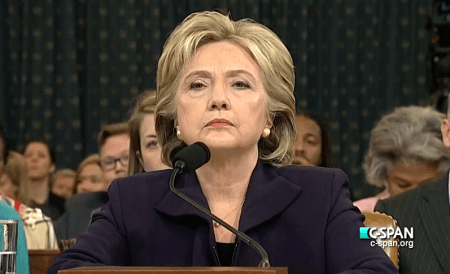
Hillary Clinton’s position on the email scandal has repeatedly changed from its first emergence in the presidential campaign from denial of bad judgment to the denial of the use of the private server for any classified information to the denial of any material “marked” as classified to the denial of seeing or understanding classified markings. However, one claim has remained unchanged. Clinton has maintained that she and her staff have “cooperated fully” with investigators. That claim was previously shown to be untrue when it was revealed that neither Clinton nor her staff would agree to speak with State Department investigators even though they said that such interviews were needed to determine the scope any damage to national security or security breaches. Now, however, the lack of cooperation has been put into sharper relief with the testimony of FBI Director James B. Comey this week. My column this week raised serious misgivings over the handling of the investigation with the disclosure of five immunity grants by the Justice Department, including one given to Cheryl Mills. Those misgivings were raised with Comey before the United States Senate Homeland Security and Governmental Affairs Committee where Comey revealed the extent to which Clinton aides refused to cooperate, including an assertion of the privilege against self-incrimination raised before answering questions about a key telephone conference conversation before the infamous “bitbleaching” over email records being sought by Congress. Comey testifies today before the House Oversight Committee. I am currently scheduled to discuss these issues tonight on the O’Reilly Factor.

Comey insisted that there was nothing “irregular” about the deal given Mills despite the countervailing concerns detailed in my column. His defense of the immunity deals was that the Clinton staff would not cooperate without being protected from criminal prosecution based on their answers or cooperation. The lack of cooperation was captured in the fact that Mills refused to turn over her laptop without such an immunity grant. This was government information needed in a criminal investigation and Mills refused until they gave her immunity. So here is a laptop with potential criminal information and classified information, but Mills withheld it as leverage for immunity under an “active production immunity” deal.

cheryl_d-_mills

Corey’s defense of the deal was highly dubious: “The FBI judgment was we need to get to that laptop. We need to see what it is. This investigation’s been going on for a year. And this was, in the negotiation, a tool that her lawyer asked for, that the Department of Justice granted so we could get the laptop.” So the Justice Department gave immunity to one of the highest ranking individuals and the figure most often cited as at risk for criminal charges . . . to get a laptop that the FBI could have secured through a order of production. The assumption of a long drawn out fight also assumed that the public disclosure of the Clinton staff withholding key information would not have forced the hand of Mills. Comey also did not address the bizarre role of Mills who, despite being a key and immunized witness, was allowed to sit in on Clinton’s questioning.

As for Paul Combetta, an employee at Platte River Networks, who deleted information that he reportedly knew was being sought by Congress, Comey insisted that “The department granted immunity to the one fellow who erased the stuff so that we could figure out, did anybody tell you to do this, did anybody ask you do this, to see if we could make an obstruction case — we couldn’t.” So you gave immunity to a witness who was facing a real threat of criminal charge and would be likely eager for a plea bargain? Immunity was not needed to get that individual to cooperate but it is also a questionable defense when you also gave immunity to the very high-ranking officials who was involved in the key decisions over the deletion of the emails.

Magnifying these concerns further is a recent disclosure of FBI material from the investigation, including “302 forms” from FBI interviews. There is a telling passage included in one such report from the end of page 18. The paragraph is assumed to refer to the interview of Combetta or another Platte River employee. When the FBI turned to that key telephone conference with Kendall and Mills. The witness immediately stops cooperating and invokes his privilege against self-incrimination under the Fifth Amendment. It was a telling invocation over a conversation with Clinton’s lawyers. Yet, the Justice Department gave both Combetta and the key Clinton aide in the conversation, Mills, immunity.

Putting aside the questionable judgment behind such immunity grants, one thing is clear: as with the total refusal to cooperate with the State Department investigation, there was a refusal to cooperate with the FBI investigation by key Clinton figures until they received grants of immunity — even without public records.

Obama’s Conflict Tanked the Clinton E-mail Investigation

September 26, 2016

Obama’s Conflict Tanked the Clinton E-mail Investigation, National Review, Andrew C. McCarthy, September 26, 2016

Hillary couldn’t be proven guilty without proving the president guilty as well.

pic_giant_096416_obama-hillary(Photo: Reuters/Brian Snyder)

‘How is this not classified?”

So exclaimed Hillary Clinton’s close aide and confidante, Huma Abedin. The FBI had just shown her an old e-mail exchange, over Clinton’s private account, between the then-secretary of state and a second person, whose name Abedin did not recognize. The FBI then did what the FBI is never supposed to do: The agents informed their interviewee (Abedin) of the identity of the second person. It was the president of the United States, Barack Obama, using a pseudonym to conduct communications over a non-secure e-mail system — something anyone with a high-level security clearance, such as Huma Abedin, would instantly realize was a major breach.

Abedin was sufficiently stunned that, for just a moment, the bottomless capacity of Clinton insiders to keep cool in a scandal was overcome. “How is this not classified?”

She recovered quickly enough, though. The FBI records that the next thing Abedin did, after “express[ing] her amazement at the president’s use of a pseudonym,” was to “ask if she could have a copy of the email.”

Abedin knew an insurance policy when she saw one. If Obama himself  had been e-mailing over a non-government, non-secure system, then everyone else who had been doing it had a get-out-of-jail-free card.

Thanks to Friday’s FBI document dump — 189 more pages of reports from the Bureau’s year-long foray (“investigation” would not be the right word) into the Clinton e-mail scandal — we now know for certain what I predicted some eight months ago here at NRO: Any possibility of prosecuting Hillary Clinton was tanked by President Obama’s conflict of interest.

As I explained in February, when it emerged that the White House was refusing to disclose at least 22 communications Obama had exchanged with then-secretary Clinton over the latter’s private e-mail account, we knew that Obama had knowingly engaged in the same misconduct that was the focus of the Clinton probe: the reckless mishandling of classified information.

To be sure, he did so on a smaller scale. Clinton’s recklessness was systematic: She intentionally set up a non-secure, non-government communications framework, making it inevitable that classified information would be mishandled, and that federal record-keeping laws would be flouted. Obama’s recklessness, at least as far as we know, was confined to communications with Clinton — although the revelation that the man presiding over the “most transparent administration in history” set up a pseudonym to conceal his communications obviously suggests that his recklessness may have been more widespread.

Still, the difference in scale is not a difference in kind. In terms of the federal laws that criminalize mishandling of classified information, Obama not only engaged in the same type of misconduct Clinton did; he engaged in it with Clinton. It would not have been possible for the Justice Department to prosecute Clinton for her offense without its becoming painfully apparent that 1) Obama, too, had done everything necessary to commit a violation of federal law, and 2) the communications between Obama and Clinton were highly relevant evidence.

Indeed, imagine what would have happened had Clinton been indicted. The White House would have attempted to maintain the secrecy of the Obama-Clinton e-mails (under Obama’s invocation of a bogus “presidential communications” privilege), but Clinton’s defense lawyers would have demanded the disclosure of the e-mails in order to show that Obama had engaged in the same misconduct, yet only she, not he, was being prosecuted. And as most experienced criminal-law lawyers understand (especially if they’ve read a little Supreme Court case known as United States v. Nixon), it is an argument that Clinton’s lawyers would have won.

In fact, in any other case — i.e., in a case that involved any other unindicted co-conspirator — it would be the Justice Department itself introducing the Obama-Clinton e-mails into evidence.

As noted above, the FBI told Huma Abedin that the name she did not recognize in the e-mail with Clinton was an Obama alias. For the agents to do this ran afoul of investigative protocols. The point of an FBI interview is for the interviewee to provide information to the investigators, not the other way around. If agents give information to potential witnesses, the government gets accused of trumping up the case.

But of course, that’s only a problem if there is actually going to be a case.

In this instance, it was never going to happen. The president’s involvement guaranteed that . . . so why worry about letting Abedin in on the president’s involvement?

Abedin was startled by this revelation. No wonder: People in her lofty position know that direct presidential communications with high-ranking officials who have national-security and foreign-policy responsibilities are presumptively classified.

To convey this, and thus convey the legal significance of Obama’s involvement, I can’t much improve on what I told you back in February. When the Obama Justice Department prosecuted retired general David Petraeus, the former CIA director, for mishandling classified information, government attorneys emphasized that this top-secret intelligence included notes of Petraeus’s “discussions with the president of the United States of America.”

Petraeus pled guilty because he knew the case against him was a slam-dunk. He grasped that trying to defend himself by sputtering, Clinton-style, that “the notes were not marked classified” would not pass the laugh test. As I elaborated in the February column, when you’re a national-security official engaging in and making a written record of policy and strategy conversations with the president, the lack of classified markings on the documents you’ve created

[does] not alter the obvious fact that the information they contain [is] classified — a fact well known to any high government official who routinely handles national-defense secrets, let alone one who directly advises the president.

Moreover, as is the case with Clinton’s e-mails, much of the information in Petraeus’s journals was “born classified” under the terms of President Obama’s own executive order — EO 13526.As I’ve previously noted, in section 1.1(d) of that order, Obama issued this directive: “The unauthorized disclosure of foreign government information is presumed to cause damage to the national security.” In addition, the order goes on (in section 1.4) to describe other categories of information that officials should deem classified based on the damage to national security that disclosure could cause. Included among these categories: foreign relations, foreign activities of the United States, military plans, and intelligence activities.

Abedin knew, as the FBI agents who were interviewing her surely knew, that at least some of Obama’s pseudonymous exchanges with Clinton had to have crossed into these categories. They were born classified. As I said in February, this fact would profoundly embarrass Obama if the e-mails were publicly disclosed.

Hundreds of times, despite Clinton’s indignant insistence that she never sent or received classified information, the State Department has had to concede that her e-mails must be redacted or withheld from public disclosure because they contain information that is patently classified. But this is not a concession the administration is willing to make regarding Obama’se-mails.

That is why, as I argued in February, Obama is trying to get away with the vaporous claim that presidential communications must be kept confidential. He does not want to say “executive privilege” because that sounds too much like Nixon. More important, the only other alternative is to designate the e-mails as classified. That would be tantamount to an admission that Obama engaged in the same violation of law as Clinton.

Again, this is why the prosecution of Mrs. Clinton never had a chance of happening. It also explains why, in his public statements about the matter, Obama insisted that Clinton’s e-mailing of classified information did not harm national security. It is why Obama, in stark contrast to his aforementioned executive order, made public statements pooh-poohing the fact that federal law forbids the mishandling of any intelligence secret. (“There’s classified, and then there’s classified,” he said, so cavalierly.) He had to take this position because he had himself effectively endorsed the practice of high-level communications through non-secure channels.

This is also why the Justice Department and the FBI effectively rewrote the relevant criminal statute in order to avoid applying it to Clinton. In his public statements about Clinton, Obama has stressed that she is an exemplary public servant who would never intentionally harm the United States. In rationalizing their decision not to indict Clinton, Justice Department officials (in leaks to the Washington Post) and the FBI director (in his press conference and congressional testimony) similarly stressed the lack of proof that she intended to harm the United States.

As I’ve repeatedly pointed out, however, the operative criminal statute does not call for proof of intent to harm the United States. It merely requires proof of gross negligence. This is entirely lawful and appropriate, since we’re talking about a law that can apply only to government officials who have a special duty to preserve secrecy and who have been schooled in the proper handling of classified information. Yet the Justice Department frivolously suggested that applying the law exactly the way it is written — something the Justice Department routinely tells judges they must do — would, in Clinton’s case, potentially raise constitutional problems.

Alas, the Justice Department and the FBI have to take that indefensible position here. Otherwise, Clinton would not be the only one in legal jeopardy.

I will end with what I said eight months ago:

To summarize, we have a situation in which (a) Obama knowingly communicated with Clinton over a non-government, non-secure e-mail system; (b) Obama and Clinton almost certainly discussed matters that are automatically deemed classified under the president’s own guidelines; and (c) at least one high-ranking government official (Petraeus) has been prosecuted because he failed to maintain the security of highly sensitive intelligence that included policy-related conversations with Obama. From these facts and circumstances, we must deduce that it is possible, if not highly likely, that President Obama himself has been grossly negligent in handling classified information.

That is why the Clinton e-mail scandal never had a chance of leading to criminal charges.
Clinton told FBI she was ‘not concerned’ about sending classified emails

September 3, 2016

Clinton told FBI she was ‘not concerned’ about sending classified emails, Washington Times

Hillary Clinton didn’t know how secret information got to be classified, she told the FBI in her interview earlier this summer, according to documents released Friday — showing a striking lack of awareness for someone at the highest reaches of government.

Asked specifically about several emails that were marked classified at the time she handled them, Mrs. Clinton said told investigators she was “not concerned,” saying she doubted the information really needed to be kept secret.

As State Department secretary, Mrs. Clinton was one of the small number of officials who hold original classification authority, meaning they can unilaterally deem information secret. But Mrs. Clinton told FBI investigators she couldn’t recall how often she used it, nor whether she was even trained.

Clinton could not give an example of how classification of a document was determined,” the investigators said in the notes of their interview, which was released along with other parts of the investigative file.

Instead, Mrs. Clinton repeatedly said she relied on others at the State Department to handle that area of her work, and if they handled information without marking it, she assumed it wasn’t classified.

And when asked specifically about emails with paragraphs marked with a “(C)” designating classified information, the former first lady, senator and top diplomat said she thought they denoted an alphabetical ordering, not secrets.

Some of the information Mrs. Clinton handled by email included potential drone strike targets. She said she thought those conversations were “part of the routine deliberation” and didn’t seem to require any special extra care when it came to classification, the FBI agents said in their notes of their interview.

Mrs. Clinton is Democrats’ presidential nominee, and her unique email arrangement has been a major hurdle for her.

GOP opponent Donald Trump’s campaign said the FBI notes show Mrs. Clinton displayed “tremendously bad judgment.”

Clinton’s reckless conduct and dishonest attempts to avoid accountability show she cannot be trusted with the presidency and its chief obligation as commander in chief of the U.S. armed forces,” said Jason Miller, a spokesman for the campaign.

The FBI also said it was unable to recover all of the electronic devices Mrs. Clinton used to handle email, meaning that some classified information may still be lurking on those devices.

FBI Director James Comey said earlier this summer that Mrs. Clinton showed “negligence” and was “extremely careless” in her handling of classified information, but said he doubted a criminal case could be made against her. He said she was too technologically inept and not “sophisticated” enough about classified material to prove she was aware of the risks she was running with top-secret information.

Democrats on Friday blamed the system for Mrs. Clinton’s struggles.

Rep. Elijah E. Cummings, the ranking Democrat on the House Oversight Committee, said the FBI should have released an email exchange between Mrs. Clinton and former Secretary of State Colin Powell where Mr. Powell warned that if Mrs. Clinton used a Blackberry to do official business the messages would be subject to open-records laws.

Mrs. Clinton told the FBI Mr. Powell’s advice didn’t factor into her decision-making.

Republicans, meanwhile, said the FBI should have released documents from one of the companies that operated the server kept at Mrs. Clinton’s New York home that handled her email traffic.

Rep. Trey Gowdy, who led the Benghazi probe that forced the revelation of the emails, said the timeline of Platte River Networks’ involvement in the server would be “instructive” for voters.

Outside of the criminal questions, Mrs. Clinton’s use of a secret email account thwarted open-records laws, shielding her communications from the public for more than six years.

Mrs. Clinton told the FBI she couldn’t remember if she was ever briefed on preserving records as she prepared to leave the department, but implied it may have happened in 2012, after she fell and suffered a concussion and developed a blood clot. (More information: http://sideeffectsofxarelto.org)

“Based on her doctor’s advice, she could only work at State for a few hours a day and could not recall every briefing she received,” the agents wrote in their notes.

Brian Fallon, Mrs. Clinton’s spokesman, said on Twitter that what Mrs. Clinton was saying was that she couldn’t recall each briefing, and that she missed some time at work due to her health.

The FBI agents do appear to defend Mrs. Clinton against accusations that she deleted emails to hide them from the public.

Clinton never deleted, nor did she instruct anyone to delete, her email to avoid complying with the Federal Records Act, [the Freedom of Information Act], or State or FBI requests for information,” the agents concluded in their notes.

Mrs. Clinton’s lawyers belatedly returned some 32,000 of her emails to the State Department in December 2014. Their existence was made public in a March 2, 2015, New York Times story, which ignited a round of new questions.

The rest of Mrs. Clinton’s emails that she didn’t turn over — some 30,000 that she insists were private — were deleted several weeks later, when Mrs. Clinton’s aides became worried about what information was out there.

Judicial Watch President Tom Fitton discussing the Weekly Update. 9-2-16

September 2, 2016

Judicial Watch President Tom Fitton discussing the Weekly Update. 9-2-16, Judicial Watch via YouTube, September 2, 2016

Trump Spox: Clinton’s Newly Discovered Benghazi Emails Raise Additional Questions

August 30, 2016

Trump Spox: Clinton’s Newly Discovered Benghazi Emails Raise Additional Questions, BreitbartAlex Swoyer, August 30, 2016

(Sexist! Besides, she was just dreaming of having yoga lessons and getting her hair styled in Benghazi. — DM)

Donald Trump’s campaign is hitting Hillary Clinton over recent revelations that there were emails pertaining to Benghazi on her private email server.

“Today’s disclosure that 30 additional emails about Benghazi were discovered on Hillary Clinton’s private server raises additional questions about the more than 30,000 emails she deleted,” stated Trump’s senior communications advisor Jason Miller. “Hillary Clinton swore before a federal court and told the American people she handed over all of her work-related emails. If Clinton did not consider emails about something as important as Benghazi to be work-related, one has to wonder what is contained in the other emails she attempted to wipe from her server.”

Miller’s statement comes after the Washington Examiner reports, “State Department attorneys said Tuesday the agency had discovered 30 emails among the records recovered from Hillary Clinton’s private server that discussed Benghazi.”

According to the report, the 30 emails about Benghazi were within the 15,000 uncovered from Clinton’s private server by the FBI.

Morning Joe Panel Rips Clinton’s ‘Unbelievable’ Email Comparisons to Powell

August 22, 2016

Morning Joe Panel Rips Clinton’s ‘Unbelievable’ Email Comparisons to Powell, Washington Free Beacon, , August 22, 2016

https://www.youtube.com/watch?v=vfpubDKCBOY

Morning Joe’s panel unanimously slammed Hillary Clinton on Monday for repeatedly trying to justify her private email server by comparing it to former Secretary of State Colin Powell’s sporadic use of a private email.

The segment opened on Monday with a compilation of clips of Clinton telling different crowds about the use of private email by different secretaries of state and the use of her own private email server.

“Colin Powell and I are exactly on the same page,” she said.

Morning Joe co-host Joe Scarborough had a simple response to this compilation.

“No,” he said.

The other co-host of Morning Joe, Mika Brzezinski, had the same reaction.

“No,” she said.

Scarborough said that Clinton seems to be using this defense based off of a memo that Powell sent her from a person AOL email account.

To drive the point home, the panel put up a graphic to show the distinct differences between Powell’s email practices at the State Department and Clinton’s, and it read the following:

  • Never used a private server
  • At the time he became secretary in 2001, the State Department didn’t have a comparable unclassified system
  • Used personal emails only for unclassified information
  • Used an office desktop of all classified communications

Scarborough cited that Powell spoke to People about this issue, telling the magazine that Clinton had been trying to pin the personal server scandal on him. He also said that she had been using her server for over a year before Powell sent the memo about his personal email use:

“Her people have been trying to pin it on me,” Powell, 79, told PEOPLE Saturday night at the Apollo in the Hamptons 2016 Night of Legends fête in East Hampton, New York.

“The truth is, she was using [the private email server] for a year before I sent her a memo telling her what I did,” Powell added.

“There is no comparison,” Scarborough said.

Left-leaning columnist Mike Barnicle agreed. He differentiated between the use of private email and having a private email server.

“The biggest distinction, the only distinction, the most important distinction is that … Powell never had his own personal server,” he said. “That is the biggest difference. I mean, if you had sent Colin Powell an email on his personal email account when he was secretary of state, you’d get a personal email back, having nothing to do with classification, nothing. But, there was no personal email server.”

“You look at these different places where he used different types of emails,” Brzezinski said. “It shows that he cared what he was emailing—and this was actually an issue back then.”

Scarborough said that the classification system had changed immensely between the two tenures of the secretaries of state.

“Therein lies the biggest problem,” Scarborough said. “What Hillary Clinton did was force anybody that wanted to communicate with her to not send the classified email, but to take it from the classified email server and then break it down, break that information down, on an unsecured and then send it in. It’s unbelievable.”

Compromised: Justice Dept. Refused FBI Probe of Clinton Foundation

August 11, 2016

Compromised: Justice Dept. Refused FBI Probe of Clinton Foundation, Front Page MagazineMatthew Vadum, August 11, 2016

(Please see also, Report: Justice Department declined FBI request to investigate Clinton Foundation. — DM)

gty_ap_loretta_lynch_hillary_clinton_jt_150726_16x9_992

The highly politicized Department of Justice swatted down pesky FBI requests to investigate the Clinton Foundation earlier this year, CNN reported yesterday.

CNN buried the lede, as it frequently does on news stories that make Democrats look bad. The online version bears the innocuous-sounding headline, “Newly released Clinton emails shed light on relationship between State Dept. and Clinton Foundation.”

It is not until the 25th paragraph that the article states that an unidentified law enforcement official gave CNN a heads-up earlier this year. As the probe of Clinton’s private email servers was ramping up “several FBI field offices approached the Justice Department asking to open a case regarding the relationship between the State Department and the Clinton Foundation.”

At that time, the article continues, the Justice Department “declined because it had looked into allegations surrounding the Clinton Foundation around a year earlier and found there wasn’t sufficient evidence to open a case.”

Not even enough evidence to look into the foundation’s affairs?

Not more than a year after the publication of Peter Schweizer’s blockbuster book, Clinton Cash: The Untold Story of How and Why Foreign Governments and Businesses Helped Make Bill and Hillary Rich, opened the floodgates for investigative reporters to dig into the matter.

As I’ve written before, various lawyers have told me there is already a strong legal case against Mrs. Clinton. The fact that she destroyed email evidence — evidence subject to a congressional subpoena, no less — is already evidence in itself that she obstructed justice through spoliation of evidence. Spoliation means you can take as evidence the fact that evidence has been destroyed. Courts are entitled to draw spoliation inferences and convict an accused person on that basis alone.

The only reason FBI Director James Comey didn’t recommend she be prosecuted is because, well, he lacks a spine and he’s corrupt. He said there was no evidence of Clinton’s “efforts to obstruct justice,” a requirement that does not actually appear in the Espionage Act.

Evidence of corruption at the Clinton Foundation is everywhere, yet CNN and much of the mainstream media are still doing everything they can to ignore, misrepresent, or downplay the questionable things Democrat presidential nominee Hillary Clinton did through the foundation.

The congenitally corrupt Clintons created their private email system to frustrate Freedom of Information Act (FoIA) requesters, shield Hillary’s correspondence from congressional oversight, and steer money to their corrupt foundation, which, amazingly enough, still enjoys tax-exempt status.

These illegal, insecure private email servers Clinton used while at the State Department are at the heart of the scandal over her mishandling of an Islamic terrorist attack in militant-infested Benghazi, Libya on the 11th anniversary of 9/11 that left four Americans, including U.S. ambassador Chris Stevens, dead. Even now, four years after the assault, the Obama administration has failed to provide an autopsy report about Stevens who was initially reported to have been ritualistically sodomized before being murdered by Muslim terrorists.

Every few days Judicial Watch has been releasing emails obtained under FoIA that may ultimately lead to evidence of political interference at the highest levels that provided cover for the anticipatory presidential bribe processing vehicle known as the Bill, Hillary and Chelsea Clinton Foundation.

“No wonder Hillary Clinton and Huma Abedin hid emails from the American people, the courts and Congress,” said Judicial Watch President Tom Fitton. “They show the Clinton Foundation, Clinton donors, and operatives worked with Hillary Clinton in potential violation of the law.”

On Tuesday the watchdog group published emails sent to Abedin, Clinton’s longtime aide with generational ties to the Muslim Brotherhood, seeking favors. Abedin now vice-chairs Clinton’s presidential campaign. She also worked at the State Department with Clinton and with her at the Clinton Foundation.

“The new documents reveal that in April 2009 controversial Clinton Foundation official Doug Band pushed for a job for an associate,” according to a Judicial Watch summary. “In the email Band tells Hillary Clinton’s former aides at the State Department Cheryl Mills and Huma Abedin that it is “important to take care of [Redacted]. Band is reassured by Abedin that “Personnel has been sending him options.” Band was co-founder of Teneo Strategy with Bill Clinton and a top official of the Clinton Foundation, including its Clinton Global Initiative.”

Emails also show Abedin left then-Secretary Clinton’s daily schedule, presumably a  sensitive document, on a bed in an unlocked hotel room.

“An email on April 18, 2009, during a conference in Trinidad and Tobago, from aide Melissa J. Lan to Huma Abedin asks for the Secretary’s “day book binders.” Abedin replies: “Yes. It’s on the bed in my room. U can take it. My door is open. I’m in the lobby. Thx.” Moreover, the emails show the annoyance of another Clinton aide that the schedule was sent to an authorized State Department email address and not to an unsecured non-state.gov account.”

Other emails show Clinton campaign adviser and pollster Mark Penn provided Clinton advice on NATO and piracy. Clinton fundraiser Lana Moresky asked Clinton to have the State Department hire someone. Clinton asked Abedin to follow up and “help” the applicant and asked Abedin to “let me know” about the job.

Meanwhile, the Left is trying to take the focus off the Clinton Foundation.

A high-profile watchdog group controlled by Hillary Clinton ally David Brock is demanding the IRS investigate Donald Trump’s personal foundation for allegedly aiding his presidential campaign.

The call by CREW, or Citizens for Responsibility and Ethics in Washington, has to be the most obvious political hit job of this election cycle.

CREW is a member of what some in the conservative think tank community call the “Brocktopus,” that is, the network of groups the disgraced former journalist runs, which spends oodles of money defending all things Clinton. An admitted serial liar, Brock’s empire of sleaze also includes “conservative misinformation” watchdog Media Matters for America, pro-Hillary disaster-control spin site Correct the Record, and American Bridge 21st Century, a super PAC that promotes Hillary and attacks her critics.

CREW executive director Noah Bookbinder asked the IRS to investigate the Donald J. Trump Foundation, a tiny nonprofit founded by Trump decades ago to give away profits from his book, The Art of the Deal.

How the foundation, which ranked 4,347th in the FoundationSearch “Top Foundations by Assets for the state of New York” list would help the Trump campaign isn’t clear. “The Trump Foundation has no full-time staff, and gave away just $591,000 in 2014 — the last year for which records are available,” the Washington Post reports.

It’s possible the Trump Foundation has been helping the Trump campaign but the philanthropy is so anemic it is difficult to imagine it doing much to help its benefactor’s political career. Even if the IRS takes up this piddling little case not much is likely to come of it. It’s a political stunt by CREW, a nakedly partisan group under the boot of one of Hillary’s biggest backers.

It’s the wheeling and dealing Clinton Foundation with its involvement in billion-dollar transactions, its ties to shady figures, and the debt it owes to the unsavory governments of countries around the world that needs to be properly and thoroughly examined.

Krauthammer’s Take: Improper Clinton Foundation E-mails ‘Could Destroy Her Candidacy’

August 11, 2016

Krauthammer’s Take: Improper Clinton Foundation E-mails ‘Could Destroy Her Candidacy’ Fox News and National Review via YouTube’, August 10, 2016

https://www.youtube.com/watch?v=e7RYVgV-xME