Posted tagged ‘Clinton investigation’

Justice officials warned FBI that Comey’s decision to update Congress was not consistent with department policy

October 29, 2016

Justice officials warned FBI that Comey’s decision to update Congress was not consistent with department policy, Washington PostSari Horwitz,October 29, 2016

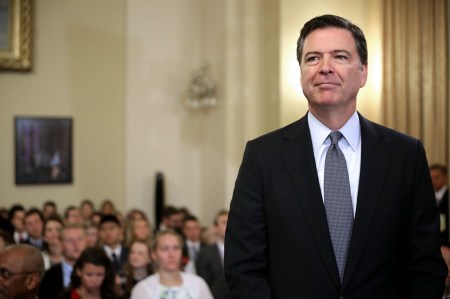
comey1

Senior Justice Department officials warned the FBI that Director James B. Comey’s decision to notify Congress about renewing the investigation into Hillary Clinton’s private email server was not consistent with long-standing practices of the department, according to officials familiar with the discussions.

Comey told Justice officials that he intended to inform lawmakers of newly discovered emails. These officials told him the department’s position “that we don’t comment on an ongoing investigation. And we don’t take steps that will be viewed as influencing an election,” said one Justice official who spoke on condition of anonymity to describe the high-level conversations.

“Director Comey understood our position. He heard it from Justice leadership,” said the official. “It was conveyed to the FBI, and Comey made an independent decision to alert the Hill. He is operating independently of the Justice Department. And he knows it.”

Comey decided to inform Congress that he would look again into Hillary Clinton’s handling of emails during her time as secretary of state for two main reasons: a sense of obligation to lawmakers and a concern that word of the new email discovery would leak to the media and raise questions of a coverup.

The rationale, described by officials close to Comey’s decision-making on the condition of anonymity, prompted the FBI director to release his brief letter to Congress on Friday and upset a presidential race less than two weeks before Election Day. It placed Comey again at the center of a highly partisan argument over whether the nation’s top law enforcement agency was unfairly influencing the campaign.

In a memo explaining his decision to FBI employees soon after he sent his letter to Congress, Comey said he felt “an obligation to do so given that I testified repeatedly in recent months that our investigation was completed.”

“Of course, we don’t ordinarily tell Congress about ongoing investigations, but here I feel I also think it would be misleading to the American people were we not to supplement the record,” Comey wrote to his employees.

The last time Comey found himself in the campaign spotlight was in July, when he announced that he had finished a months-long investigation into whether Clinton mishandled classified information through the use of a private email server during her time as secretary of state. After he did so, the denunciation was loudest from Republican nominee Donald Trump and his supporters, who accused the FBI director of bias in favor of Clinton’s candidacy. There was also grumbling within FBI ranks, with a largely conservative investigative corps complaining privately that Comey should have tried harder to make a case.

This time the loudest criticism has come from Clinton and her supporters, who said Friday that Comey had provided too little information about the nature of the new line of investigation and allowed Republicans to seize political ground as a result. The inquiry focuses on Clinton emails found on a computer used by former U.S. congressman Anthony Weiner (D-N.Y.), now under investigation for sending sexually explicit messages to a minor, and top Clinton aide Huma Abedin, who is Weiner’s wife. The couple have since separated.

“It is extraordinary that we would see something like this just 11 days out from a presidential election,” John Podesta, the chairman of Clinton’s presidential campaign, said in a statement. “The Director owes it to the American people to immediately provide the full details of what he is now examining. We are confident this will not produce any conclusions different from the one the FBI reached in July.”

Officials familiar with Comey’s thinking said the director on Thursday faced a quandary over how to proceed once the emails, which number more than 1,000 and may duplicate some of those already reviewed, were brought to his attention.

Comey had just been briefed by a team of investigators who were seeking access to the emails. The director knew he had to move quickly because the information could leak out.

The next day, Comey informed Congress that he would take additional “investigative steps” to evaluate the emails after deciding the emails were pertinent to the Clinton email investigation and that the FBI should take steps to obtain and review them.

In July, Comey had testified under oath before the House Oversight and Government Reform Committee that the FBI was finished investigating the Clinton email matter and that there would be no criminal charges. Comey was asked at the hearing whether he would review any new information the FBI came across.

“My first question is this, would you reopen the Clinton investigation if you discovered new information that was both relevant and substantial?” Rep. Lamar Smith (R-Tex.) asked Comey during the hearing.

“It’s hard for me to answer in the abstract,” Comey replied at the hearing. “We would certainly look at any new and substantial information.”

In the Friday memo to his employees, Comey acknowledged that the FBI does not yet know the import of the newly discovered emails. “Given that we don’t know the significance of this newly discovered collection of emails, I don’t want to create a misleading impression,” Comey wrote.

An official familiar with Comey’s thinking said that “he felt he had no choice.”

“What would it look like if the FBI inadvertently came across additional emails that appear to be relevant to the Clinton investigation and not at least inform the Oversight Committee that this occurred?” the official said. “What would be the criticism then? That the FBI hid it? That the FBI purposely kept this information to themselves?”

The official said the decision came down to which choice “was not as bad as the others.”

Comey’s action has been blasted by some former Justice Department officials, Clinton campaign officials and Democratic members of Congress.

“Without knowing how many emails are involved, who wrote them, when they were written or their subject matter, it’s impossible to make any informed judgment on this development,” said Sen. Dianne Feinstein (D-Calif.), who called the release “appalling.”

“However, one thing is clear: Director Comey’s announcement played right into the political campaign of Donald Trump, who is already using the letter for political purposes. And all of this just 11 days before the election,” Feinstein said.

Matthew Miller, a former Justice Department spokesman in the Obama administration, said the FBI rarely releases information about ongoing criminal investigations and does not release information about federal investigations this close to political elections.

“Comey’s behavior in this case from the beginning has been designed to protect his reputation for independence no matter the consequences to the public, to people under investigation or to the FBI’s own integrity,” Miller said.

Miller and other former officials pointed to a 2012 Justice Department memo saying that all employees have the responsibility to enforce the law in a “neutral and impartial manner,” which is “particularly important in an election year.”

Miller said he had been involved in cases related to elected officials in which the FBI waited until several days after an election to send subpoenas. “They know that if they even send a subpoena, let alone announce an investigation, that might leak and it might become public and it would unfairly influence the election when voters have no way to interpret the information,” Miller said.

Nick Ackerman, a former federal prosecutor in New York and an assistant special Watergate prosecutor, said Comey “had no business writing to Congress about supposed new emails that neither he nor anyone in the FBI has ever reviewed.”

He added: “It is not the function of the FBI director to be making public pronouncements about an investigation, never mind about an investigation based on evidence that he acknowledges may not be significant.”

In Comey’s note to employees, he seemed to anticipate that his decision would be controversial.

“In trying to strike that balance, in a brief letter and in the middle of an election season, there is significant risk of being misunderstood,” Comey wrote.


Clinton’s State Department: A RICO Enterprise

October 29, 2016

Clinton’s State Department: A RICO Enterprise, National Review, Andres C. McCarthy, October 29, 2016

hillary-clinton-corruption-foundation-was-keyClinton is sworn in as secretary of state, February 2, 2009. (Reuters photo: Jonathan Ernst)

Whatever the relevance of the new e-mails to the probe of Clinton’s classified-information transgressions and attempt to destroy thousands of emails, these offenses may pale in comparison with Hillary Clinton’s most audacious violations of law: Crimes that should still be under investigation; crimes that will, in fitting Watergate parlance, be a cancer on the presidency if she manages to win on November 8.

********************************

She appears to have used her official powers to do favors for major Clinton Foundation donors.

Felony mishandling of classified information, including our nation’s most closely guarded intelligence secrets; the misappropriation and destruction of tens of thousands of government records — these are serious criminal offenses. To this point, the Justice Department and FBI have found creative ways not to charge Hillary Clinton for them. Whether this will remain the case has yet to be seen. As we go to press, the stunning news has broken that the FBI’s investigation is being reopened. It appears, based on early reports, that in the course of examining communications devices in a separate “sexting” investigation of disgraced former congressman Anthony Weiner, the bureau stumbled on relevant e-mails — no doubt connected to Huma Abedin, Mr. Weiner’s wife and, more significantly, Mrs. Clinton’s closest confidant. According to the New York Times, the FBI has seized at least one electronic device belonging to Ms. Abedin as well. New e-mails, never before reviewed by the FBI, have been recovered.

The news is still emerging, and there will be many questions — particularly if it turns out that the bureau failed to obtain Ms. Abedin’s communications devices earlier in the investigation, a seemingly obvious step. As we await answers, we can only observe that, whatever the FBI has found, it was significant enough for director James Comey to sense the need to notify Congress, despite knowing what a bombshell this would be just days before the presidential election.

One thing, however, is already clear. Whatever the relevance of the new e-mails to the probe of Clinton’s classified-information transgressions and attempt to destroy thousands of emails, these offenses may pale in comparison with Hillary Clinton’s most audacious violations of law: Crimes that should still be under investigation; crimes that will, in fitting Watergate parlance, be a cancer on the presidency if she manages to win on November 8.

Mrs. Clinton appears to have converted the office of secretary of state into a racketeering enterprise. This would be a violation of the RICO law — the Racketeer Influenced and Corrupt Organizations Act of 1971 (codified in the U.S. penal code at sections 1961 et seq.).

Hillary and her husband, former president Bill Clinton, operated the Clinton Foundation. Ostensibly a charity, the foundation was a de facto fraud scheme to monetize Hillary’s power as secretary of state (among other aspects of the Clintons’ political influence). The scheme involved (a) the exchange of political favors, access, and influence for millions of dollars in donations; (b) the circumvention of campaign-finance laws that prohibit political donations by foreign sources; (c) a vehicle for Mrs. Clinton to shield her State Department e-mail communications from public and congressional scrutiny while she and her husband exploited the fundraising potential of her position; and (d) a means for Clinton insiders to receive private-sector compensation and explore lucrative employment opportunities while drawing taxpayer-funded government salaries.

While the foundation did perform some charitable work, this camouflaged the fact that contributions were substantially diverted to pay lavish salaries and underwrite luxury travel for Clinton insiders. Contributions skyrocketed to $126 million in 2009, the year Mrs. Clinton arrived at Foggy Bottom. Breathtaking sums were “donated” by high-rollers and foreign governments that had crucial business before the State Department. Along with those staggering donations came a spike in speaking opportunities and fees for Bill Clinton. Of course, disproportionate payments and gifts to a spouse are common ways of bribing public officials — which is why, for example, high-ranking government officeholders must reveal their spouses’ income and other asset information on their financial-disclosure forms.

While there are other egregious transactions, the most notorious corruption episode of Secretary Clinton’s tenure involves the State Department’s approval of a deal that surrendered fully one-fifth of the United States’ uranium-mining capacity to Vladimir Putin’s anti-American thugocracy in Russia.

The story, significant background of which predates Mrs. Clinton’s tenure at the State Department, has been recounted in ground-breaking reporting by the Hoover Institution’s Peter Schweizer (in his remarkable book Clinton Cash: The Untold Story of How and Why Foreign Governments and Businesses Helped Make Bill and Hillary Rich) and the New York Times. In a nutshell, in 2005, under the guise of addressing the incidence of HIV/AIDS in Kazakhstan (where the disease is nearly nonexistent), Bill Clinton helped his Canadian billionaire pal Frank Giustra to convince the ruling despot, Nursultan Nazarbayev (an infamous torturer and human-rights violator), to grant coveted uranium-mining rights to Giustra’s company, Ur-Asia Energy (notwithstanding that it had no background in the highly competitive uranium business). Uranium is a key component of nuclear power, from which the United States derives 20 percent of its total electrical power.

In the months that followed, Giustra gave an astonishing $31.3 million to the Clinton Foundation and pledged $100 million more. With the Kazakh rights secured, Ur-Asia was able to expand its holdings and attract new investors, like Ian Telfer, who also donated $2.35 million to the Clinton Foundation. Ur-Asia merged with Uranium One, a South African company, in a $3.5 billion deal — with Telfer becoming Uranium One’s chairman. The new company proceeded to buy up major uranium assets in the United States.

Meanwhile, as tends to happen in dictatorships, Nazarbayev (the Kazakh dictator) turned on the head of his state-controlled uranium agency (Kazatomprom), who was arrested for selling valuable mining rights to foreign entities like Ur-Asia/Uranium One. This was likely done at the urging of Putin, the neighborhood bully whose state-controlled atomic-energy company (Rosatom) was hoping to grab the Kazakh mines — whether by taking them outright or by taking over Uranium One.

The arrest, which happened a few months after Obama took office, sent Uranium One stock into free fall, as investors fretted that the Kazakh mining rights would be lost. Uranium One turned to Secretary Clinton’s State Department for help. As State Department cables disclosed by WikiLeaks show, Uranium One officials wanted more than a U.S. statement to the media; they pressed for written confirmation that their mining licenses were valid. Secretary Clinton’s State Department leapt into action: An energy officer from the U.S. embassy immediately held meetings with the Kazakh regime. A few days later, it was announced that Russia’s Rosatom had purchased 17 percent of Uranium One. Problem solved.

Except it became a bigger problem when the Russian company sought to acquire a controlling interest in Uranium One. That would mean a takeover not only of the Kazakh mines but of the U.S. uranium assets as well. Such a foreign grab requires approval by the Committee on Foreign Investment in the United States, a powerful government tribunal that the secretary of state sits on and heavily influences. Though she had historically postured as a hawk against foreign acquisitions of American assets with critical national-security implications, Secretary Clinton approved the Russian takeover of Uranium One. During and right after the big-bucks Russian acquisition, Telfer contributed $1.35 million to the Clinton Foundation. Other people with ties to Uranium One appear to have ponied up as much as $5.6 million in donations.

In 2009, the incoming Obama administration had been deeply concerned about the potential for corruption were Hillary to run the State Department while Bill and their family foundation were hauling in huge payments from foreign governments, businesses, and entrepreneurs. For precisely this reason, the White House required Mrs. Clinton to agree in writing that the Clinton Foundation would annually disclose its major donors and seek pre-approval from the White House before the foundation accepted foreign contributions. This agreement was repeated flouted — for example, by concealing the contributions from Telfer. Indeed, the foundation was recently forced to refile its tax returns for the years that Secretary Clinton ran the State Department after media reports that it failed to disclose foreign donations — approximately $20 million worth.

Under RICO, an “enterprise” can be any association of people, informal or formal, illegitimate or legitimate — it could be a Mafia family, an ostensibly charitable foundation, or a department of government. It is a racketeering enterprise if its affairs are conducted through “a pattern of racketeering activity.” A “pattern” means merely two or more violations of federal or state law; these violations constitute “racketeering activity” if they are included among the extensive list of felonies laid out in the statute.

Significantly for present purposes, the listed felonies include bribery, fraud, and obstruction of justice. Fraud encompasses both schemes to raise money on misleading pretexts (e.g., a charitable foundation that camouflages illegal political payoffs) and schemes to deprive Americans of their right to the honest services of a public official (e.g., quid pro quo arrangements in which official acts are performed in exchange for money). Both fraud and obstruction can be proved by false statements — whether they are public proclamations (e.g., “I turned over all work-related e-mails to the State Department”) or lies to government officials (e.g., concealing “charitable” donations from foreign sources after promising to disclose them, or claiming not to know that the “(C)” symbol in a government document means it is classified at the confidential level).

The WikiLeaks disclosures of e-mails hacked from Clinton presidential-campaign chairman John Podesta provide mounting confirmation that the Clinton Foundation was orchestrated for the purpose of enriching the Clintons personally and leveraging then-Secretary Clinton’s power to do it. Hillary and her underlings pulled this off by making access to her contingent on Clinton Foundation ties; by having top staff service Clinton Foundation donors and work on Clinton Foundation business; by systematically conducting her e-mail communications outside the government server system; by making false statements to the public, the White House, Congress, the courts, and the FBI; and by destroying thousands of e-mails — despite congressional inquiries and Freedom of Information Act demands — in order to cover up (among other things) the shocking interplay between the State Department and the Clinton Foundation.

Under federal law, that can amount to running an enterprise by a pattern of fraud, bribery, and obstruction. If so, it is a major crime. Like the major crimes involving the mishandling of classified information and destruction of government files, it cries out for a thorough and credible criminal investigation. More important, wholly apart from whether there is sufficient evidence for criminal convictions, there is overwhelming evidence of a major breach of trust that renders Mrs. Clinton unfit for any public office, let along the nation’s highest public office.

Newt Gingrich Full Interview with Sean Hannity (10/28/2016)

October 29, 2016

Newt Gingrich Full Interview with Sean Hannity (10/28/2016), Fox News via YouTube

(It’s about the re-opened FBI “investigation” of the Clinton e-mails and unsecured server. — DM)

https://www.youtube.com/watch?v=fGOFQJn5T4s

Clinton campaign responds to FBI director’s letter regarding email investigation

October 28, 2016

Clinton campaign responds to FBI director’s letter regarding email investigation, Washington Examiner, T. Becket Adams, October 28, 2016

(It’s all the fault of Trump and Republicans and it’s all old stuff anyhow! — DM)

Hillary Clinton‘s team formally responded Friday afternoon to news that the FBI had uncovered additional emails related to the private homebrew server she maintained when she worked at the State Department.

“Upon completing this investigation more than three months ago, FBIDirector Comey declared no reasonable prosecutor would move forward with a case like this and added that it was not even a close call. In the months since, Donald Trump and his Republican allies have been baselessly second-guessing the FBI and, in both public and private, browbeating the career officials there to revisit their conclusion in a desperate attempt to harm Hillary Clinton‘s presidential campaign,” the Democratic nominee’s campaign chairman, John Pdoesta, said in a statement made available to the Washington Examiner.

FBI Director Comey should immediately provide the American public more information than is contained in the letter he sent to eight Republican committee chairmen. Already, we have seen characterizations that the FBI is ‘reopening’ an investigation but Comey’s words do not match that characterization. Director Comey’s letter refers to emails that have come to light in an unrelated case, but we have no idea what those emails are and the Director himself notes they may not even be significant.

“It is extraordinary that we would see something like this just 11 days out from a presidential election,” the statement concluded. “The Director owes it to the American people to immediately provide the full details of what he is now examining. We are confident this will not produce any conclusions different from the one the FBI reached in July.”