Posted tagged ‘China’

North Korea’s Sanctions Loophole

February 29, 2016

North Korea’s Sanctions Loophole, Wall Street Journal, February 28, 2016

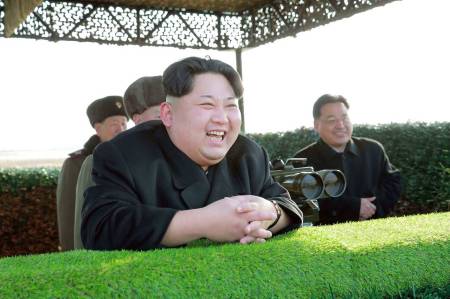
Happy KimThis undated picture released from North Korea’s official Korean Central News Agency on February 27, 2016 shows North Korean leader Kim Jong-Un smiling during the inspection of the test-fire of a newly developed anti-tank guided weapon at an undisclosed location. PHOTO: KCNA VIA KNS/AFP/GETTY IMAGES

The Obama Administration is touting the latest United Nations sanctions as a milestone against North Korea’s nuclear and missile programs. We’d like to believe it too, but a close look at the draft Security Council resolution offers many reasons to doubt.

The resolution would double the number of blacklisted North Korean individuals and state entities, adding Pyongyang’s atomic-energy and space agencies. Luxury goods banned from export to North Korea would grow to include watches, yachts and snowmobiles. A ban on sales of aviation fuel targets state-owned airline Air Koryo, while a ban on sales of rocket fuel targets Kim Jong Un’s missile program.

More significant are efforts to cut Pyongyang’s access to hard currency and smuggled weapons technology. The sanctions expand the list of banned arms and dual-use goods, and they require states to inspect all cargo transiting their territory to or from North Korea by sea, air or land. They would also squeeze North Korean mineral exports, including coal and iron ore, which in 2014 accounted for 53% of Pyongyang’s $2.8 billion in exports to China, per South Korean state figures.

Overall the blacklist of North Korean proliferators is growing by only 12 individuals and 20 entities to a total of 64; the U.N.’s former blacklist on Iran was far larger at 121. In any case, none of these matter if China won’t rigorously enforce them—which it has never done.

There are other loopholes and oversights. The nominal ban on North Korean mineral exports applies only to purchases that demonstrably fund illicit activities, rather than “livelihood purposes.” Yet money is fungible, so Chinese coal purchases excused on livelihood or humanitarian grounds will still channel hundreds of millions of dollars to the regime.

The sanctions also do nothing about the Chinese oil transfers that keep the Kim regime alive. Or Chinese purchases of textiles from mostly state-run North Korean factories that have quadrupled to $741 million a year since 2010 and recently ensnared Australian surf brand Rip Curl in a supply-chain controversy. Or the 50,000-plus North Korean laborers overseas, largely in China and Russia, earning some $230 million a year for their masters in Pyongyang.

U.S. officials say China has new incentive to back sanctions because it wants to block South Korea’s recent moves to deploy the U.S.-built Thaad missile-defense system. That may be why China wants to look cooperative, but the new sanctions aren’t enough to justify walking back on Thaad. China still views the North as a political buffer against South Korea, a thorn in the side of Japan and the U.S., and a diplomatic card to play at the U.N. So China has long played a double game of rhetorically deploring North Korea’s nuclear program while propping it up in practice.

The better way to squeeze the North is closer cooperation among Washington, Seoul and Tokyo to sanction Chinese banks that facilitate trade with Pyongyang. This worked a decade ago until the Bush Administration fell for more of China’s diplomatic promises. China won’t get serious about stopping North Korea until it sees that the U.S. and its allies are serious.

Pacific Commander Warns China Not to Impose New Air Defense Zone

February 26, 2016

Pacific Commander Warns China Not to Impose New Air Defense Zone ADIZ over South China Sea would be ‘destabilizing and provocative,’ admiral says

BY:
February 26, 2016 4:58 am

Source: Pacific Commander Warns China Not to Impose New Air Defense Zone

China’s imposition of an air defense zone over the disputed South China Sea in the future would be “destabilizing and provocative,” and will be ignored by the United States, the commander of U.S. forces in the Pacific warned on Thursday.

“With regard to ADIZ, or air defense identification zone, I am concerned about the possibility that China might declare an ADIZ,” Adm. Harry Harris told reporters at the Pentagon.

“I would find that to be destabilizing and provocative,” he said. “We would ignore it, just as we did with the ADIZ they put in place in the East China Sea.”

Harris said concerns about a new Chinese air defense zone over the South China Sea were raised by Secretary of State John Kerry, who urged China not to impose such a measure. Kerry held talks this week with Chinese Foreign Minister Wang Yi.

“So let’s give China a chance here and see if they’ll opt for a more stabilizing, less tense situation, or whether they’ll opt to be a provocative, destabilizing influence in the region,” Harris said.

Defense officials said the recent introduction of advanced HQ-9 air defense missiles on Woody Island in the Paracels, along with the arrival of a small number of J-11 and JH-7 jet fighters, along with the construction of a large radar in the region, have all stoked concerns that China is preparing to declare the air defense zone.

Harris said Chinese military bases in the sea could be removed militarily but that is an option of last resort.

China announced in November 2013 it was unilaterally imposing an air defense zone over the East China Sea and warned that all aircraft there risked being shot down unless they first sought approval from Beijing before entering the zone. That zone includes Japan’s Senkaku Islands, which China claims as its territory and calls the Diaoyu Islands.

In Beijing, a Defense Ministry spokesman did not answer directly on Thursday when asked if China is close to announcing the imposition of a South China Sea ADIZ, after building runways on islands and in response to U.S. naval patrols.

“To establish an air defense identification zone is within the sovereign rights of a country,” said Col. Wu Qian. “And whether to establish such a zone and when to establish it depends on the threat that China faces in the air and the level of such kind of threat. And various factors have to be taken into consideration.”

Wu also criticized statements by Harris before Congress that China is seeking hegemony in the South China Sea by deploying weapons and equipment on the islands.

“In China, hegemonism is a word reserved for a certain country,” he said. “That country is supposed to know well about that.”

The colonel also said Harris’ comments were aimed at obtaining more defense funds from Congress. “You have the right to do that, which we do not object, but, it is inappropriate to get more money by carelessly smearing China,” Wu said.

Wu said the United States is behind militarization in the South China Sea. “It is very necessary for China to deploy defense facilities on the islands and reefs of the South China Sea,” he added.

Harris said he views China’s island building over the past several years in the South China Sea as a scheme to set up military bases and deploy high-tech weapons that will threaten trade and freedom of navigation in the vital strategic waterway.

Following two days of congressional testimony, Adm. Harris spoke to reporters at the Pentagon as part of a world tour that included a stop in Japan and an upcoming visit to India.

The Pacific commander elaborated on his concerns about Chinese military encroachment in Asia and said he is concerned the Chinese military buildup will result in a Beijing takeover of what the United States and other regional states regard as international waters.

A total of $5.3 trillion trade transits the sea, including over $1 trillion in U.S. trade. Also, Chinese control threatens strategic undersea cables used for the Internet and other communications.

“And I think that short of war, for the United States, China will exercise de facto control of the South China Sea if they continue to outfit the bases that they have claimed there,” he said.

Harris, the most blunt-spoken commander of U.S. forces in Asia in decades, also said the U.S. military is exercising its international rights by conducting warship passages within 12 miles of disputed islands in the Paracels and Spratlys, where China is building the military facilities.

Two sail-by operations have been conducted so far, one in October and January, prompting harsh responses from Beijing calling the maneuvers a military provocation.

“We’re going to do more, and we’ll do them at some frequency… I think we have to continue to do these operations to exercise our freedom of navigation and airspace in the international space,” Harris said. “More is better.”

“We must exercise our freedom of navigation or we risk losing it, in my opinion,” he added.

Harris would not say if future warship transits would include other nations’ naval vessels, such as those from Japan or Australia.

But the admiral said he would welcome international warships to visit the region because the sea is international territory.

Harris voiced serious concerns about Chinese military activities over the past several years.

“I am of the opinion that they are militarizing the South China Sea,” he said. “And when they add their advanced fighters to Woody Island, up the Paracels and when they put their advanced missile systems on the Paracels and when they build three 10,000-foot runways in the Spratlys on bases that they’ve reclaimed, when they do all that they’re changing the operational landscape in the South China Sea. So that’s what’s changed.”

Harris said U.S. naval and air patrols over the sea have not really changed, and are part of a regular military presence.

“So I would say it’s China that’s changed it behavior.”

The aggressive behavior by China has resulted in closer alliances and security ties between other nations in the region, he noted.

On China’s opposition to the deployment of advanced U.S. air defenses in South Korea, Harris said Beijing’s protests are “preposterous.”

“THAAD is not a threat to China,” Harris said of the Terminal High-Altitude Area Defense system.

The system, if deployed, would be used to protect the Korean people and American forces in the country from North Korean missile threats.

Harris said if China wanted to exert influence to prevent THAAD from being deployed it could use its leverage against North Korea.

Earlier Thursday, Chinese Foreign Minister Wang Yi said in a speech in Washington that THAAD’s powerful X-band radar can reach into China, and thus threatens Chinese national security. He did not elaborate.

China has the world’s largest missile forces, including short-, medium- and long-range missiles.

Wang sought to play down tensions in the region, saying the South China Sea is stable. He defended “some military deployments” in the region as part of a normal development program that included civilian infrastructure such as lighthouses on the islands.

Regarding China’s economic problems, Harris said he does not believe China’s communist leaders are increasing their aggressiveness in the South China Sea to divert attention from internal Chinese domestic problems.

“It’s a possibility, we’re looking out for it, but I don’t see that today,” Harris said.

The Pacific commander urged the United States to continue with its Asia rebalancing. As part of that strategy, the Pentagon needs to modernize its forces, maintain combat readiness, and use diplomacy to influence China, he said.
Sean Hannity Full One-on-One Interview with Donald Trump (2/18/2016)

February 19, 2016

Sean Hannity Full One-on-One Interview with Donald Trump (2/18/2016), Fox News via You Tube, February 18, 2016

(Trump discusses the Israel – “Palestine” situation and the mess Obama has made beginning at 11:05 during the interview. The rest is very good too. — DM)

China Puts Advanced Missiles on Disputed Southeast Asian Island

February 17, 2016

China Puts Advanced Missiles on Disputed Southeast Asian Island Obama: U.S. military will sail, fly freely in South China Sea

BY:
February 17, 2016 5:00 am

Source: China Puts Advanced Missiles on Disputed Southeast Asian Island

President Obama defended U.S. naval and aircraft operations near disputed South China Sea islands claimed by China on Tuesday as new intelligence revealed Beijing recently placed advanced air defense missiles in the Paracels.

“Freedom of navigation must be upheld,” Obama said, adding “the United States will continue to fly, sail, and operate wherever international law allows, and we will support the right of all countries to do the same.”

The remarks followed a meeting of the Association of Southeast Asian Nations, known as ASEAN, in Sunnylands, Calif. Obama and leaders from 10 ASEAN nations agreed to defend the sea from Chinese encroachment.

“We discussed the need for tangible steps in the South China Sea to lower tensions, including a halt to further reclamation, new construction, and militarization of disputed areas,” Obama said.

The president said the United States would continue to help regional states bolster maritime capabilities and resolve disputes peacefully and legally.

Obama said “the United States will continue to stand with those across Southeast Asia who are working to advance rule of law, good governance, accountable institutions, and the universal human rights of all people.”

At the Pentagon, defense officials said recent intelligence revealed that China deployed advanced HQ-9 surface-to-air missiles on Woody Island, in the Paracel island chain in the northwestern part of the sea.

The missile deployment was detected in the past several days, said officials familiar with reports of the deployment.

The buildup of air defense missiles highlights what defense officials said is China’s continuing militarization of disputed islands in the sea.

China has demanded a halt to all U.S. warship transits through the sea, and aerial reconnaissance flights over it.

The HQ-9 is an advanced anti-aircraft system that can also shoot down short-range missiles.

The missiles are likely to heighten tensions as they could be used against U.S. reconnaissance aircraft that frequently fly over the sea.

Retired Navy Capt. Jim Fanell, a former Pacific Fleet intelligence chief, said the HQ-9 is a formidable air defense missile that can cover 125 miles.

“We should not be surprised in the least about this turn of events, as it is in keeping with the strategic trend line of China’s ‘maritime sovereignty campaign’ that has been in place since 2010,” Fanell told the Washington Free Beacon.

China’s Navy chief, Adm. Wu Shengli, announced last month that that China would determine when and how to justify the militarization of new islands. The missiles on Woody appear to be a first step, Fanell said.

“The question now remains whether or not the U.S., Japan, Australia, and the representatives of ASEAN will continue to accede to Beijing’s bullying or will they band together in a ‘unified front’ and begin conducting joint patrols within China’s unofficially asserted territorial seas,” he said. “The time to act is fleeting, each hour, each day of delay will render the situation more dangerous or untenable.”

Rick Fisher, a China military affairs analyst, said the advanced missile deployment is a major military escalation by China in the South China Sea.

“China’s deployment of up to 64 HQ-9 surface-to-air missiles to Woody Island just before the ASEAN summit in California constitutes a major slap against ASEAN and the Obama administration,” said Fisher, who is associated with the International Assessment and Strategy Center.

“It should now be clear that Obama administration diplomacy and freedom of navigation operations are useless in stopping China from militarizing its islands in the Paracel and Spratly island groups,” he said.

China’s military has said the recent passage of a warship near Triton Island in the Parcels could trigger a further military buildup.

Fisher said China could supplement the HQ-9s with long-range YJ-62 anti-ship cruise missiles or DF-21D anti-ship ballistic missiles, which have a range of 870 miles.   

“Nobody is suggesting that the U.S. attack China’s dangerous island bases, but the administration can deploy sufficient counterforce to deter China from using its bases,” Fisher said.

China deployed J-11 jet fighters to Woody Island  last October.

Two months later a U.S. B-52 bomber overflew the disputed Spratly Islands, drawing a sharp rebuke from China’s government.

The commander of the U.S. Pacific Command, Adm. Harry Harris, has rejected China’s expansive South China Sea claims. Harris said in a recent speech that the South China Sea is “no more China’s than the Gulf of Mexico is Mexico’s.”

The Pentagon has said some $5.3 trillion in international trade passes through the sea each year.

China is claiming some 90 percent of the South China Sea as its maritime domain, and has built up some 3,200 acres of new islands where military facilities, including deepwater ports and airfields, are being built.

Woody Island, called Yongxing Island by China, is located about 100 miles southeast of Triton Island, where the guided-missile destroyer USS Curtis Wilbur made a close-in passage on Jan. 30. The Pentagon said the transit was designed to demonstrate freedom of navigation to three claimants to the island, China, Vietnam, and Taiwan.

China has denied it is militarizing the sea and has criticized the United States for what it says are provocative freedom of navigation operations. In addition to the Curtis, the USS Lassen passed within 12 miles of Subi Reef in the Spratlys last October.

The HQ-9 deployment was first reported by Foxnews.com on Tuesday.

The missiles were revealed on commercial satellite imagery along a beach on Woody Island. The missiles were sent there between Feb. 3 and Feb. 14.

During a summit meeting between Obama and Chinese President Xi Jinping, the Beijing leader promised not to militarize newly-created South China Sea islands.

It is not clear if the September commitment included Woody Island, about 1 square mile in size that has had a military garrison since 2012.

The Communist Party-affiliated newspaper Global Times published a commentary Saturday criticizing U.S. military operations in the South China Sea as a serious political and military provocation.

“On the surface, Washington calls for international laws and norms, such as freedom of navigation, to be the guiding principle in the South China Sea,” wrote Zhang Tengjun, a research fellow at the China Institute of International Studies in Beijing.

“In fact, it tries to hype up China’s ‘threat’ to regional security and ASEAN’s interests so more ASEAN members will join a US-led front to counter China.”

Saudi Arabia stews in policy hell

January 4, 2016

Saudi Arabia stews in policy hell, Asia Times, January 3, 2016

Last week’s mass executions in Saudi Arabia suggest panic at the highest level of the monarchy. The action is without precedent, even by the grim standards of Saudi repression. In 1980 Riyadh killed 63 jihadists who had attacked the Grand Mosque of Mecca, but that was fresh after the event. Most of the 47 prisoners shot and beheaded on Jan. 2 had sat in Saudi jails for a decade. The decision to kill the prominent Shia cleric Nimr al-Nimr, the most prominent spokesman for restive Saudi Shia Muslims in Eastern Province, betrays fear of subversion with Iranian sponsorship.

Saudi-beheading22-300x183Official Saudi beheading

Why kill them all now? It is very hard to evaluate the scale of internal threats to the Saudi monarchy, but the broader context for its concern is clear: Saudi Arabia finds itself isolated, abandoned by its longstanding American ally, at odds with China, and pressured by Russia’s sudden preeminence in the region. The Saudi-backed Army of Conquest in Syria seems to be crumbling under Russian attack. The Saudi intervention in Yemen against Iran-backed Houthi rebels has gone poorly. And its Turkish ally-of-convenience is consumed by a low-level civil war. Nothing has gone right for Riyadh.

Worst of all, the collapse of Saudi oil revenues threatens to exhaust the kingdom’s $700 billion in financial reserves within five years, according to an October estimate by the International Monetary Fund (as I discussed here). The House of Saud relies on subsidies to buy the loyalty of the vast majority of its subjects, and its reduced spending power is the biggest threat to its rule. Last week Riyadh cut subsidies for water, electricity and gasoline. The timing of the executions may be more than coincidence: the royal family’s capacity to buy popular support is eroding just as its regional security policy has fallen apart.

For decades, Riyadh has presented itself as an ally of the West and a force for stability in the region, while providing financial support for Wahhabi fundamentalism around the world. China has been the kingdom’s largest customer as well as a provider of sophisticated weapons, including surface-to-surface missiles. But China also has lost patience with the monarchy’s support for Wahhabi Islamists in China and bordering countries.

According to a senior Chinese analyst, the Saudis are the main source of funding for Islamist madrassas in Western China, where the “East Turkistan Independence Movement” has launched several large-scale terror attacks. Although the Saudi government has reassured Beijing that it does not support the homegrown terrorists, it either can’t or won’t stop some members of the royal family from channeling funds to the local jihadis through informal financial channels. “Our biggest worry in the Middle East isn’t oil—it’s Saudi Arabia,” the analyst said.

China’s Muslims—mainly Uyghurs in Western China who speak a Turkish dialect—are Sunni rather than Shia.  Like Russia, China does not have to worry about Iranian agitation among Shia jihadis, and tends to prefer Iran to the Sunni powers. As a matter of form, Beijing wants to appear even-handed in its dealings with Iran and Saudi Arabia, for example in recent contacts between their respective navies. Chinese analysts emphasize that Beijing has sold weapons to both—more in absolute to terms to Iran but more sophisticated weapons to the Saudis.

More pertinent than public diplomacy, though, is where China is buying its oil.

Nonetheless, China’s oil import data show a significant shift away from Saudi Arabia towards Russia and Oman (which China considers part of the Iranian sphere of influence). Russia’s oil exports to China have grown fourfold since 2010 while Saudi exports have stagnated. Given the world oil glut, China can pick and choose its suppliers, and it is hard to avoid the inference that Beijing is buying more from Russia for strategic reasons.  According to Russian sources, China also has allowed Russian oil companies to delay physical delivery of oil due under existing contracts, permitting Russia to sell the oil on the open market for cash—the equivalent of a cash loan to Russia.

saudioil1-768x558

China’s interests in Syria coincide with Russia’s. Both have reason to fear the growth of ISIS as a magnet for their own jihadis.  Thousands of Chinese Uyghurs make their way into Southeast Asia via the porous southern border of Yunnan province, with financial assistance from Saudi supporters and logistical support—including passports—from local Turkish consulates. Chinese Uyghurs were implicated in the bombing of Bangkok’s Erawan Temple last August, and have linked up with ISIS supporters as far south as Indonesia. Turkey reported last month that most jihadists crossing its border into Syria to join ISIS are Chinese Muslims.

With Kurdish and allied forces gaining control of Syria’s border with Turkey, aided by Russian air support, Chinese Uyghurs may lose access to Syria. Late in December Kurdish forces crossed to the western bank of the Euphrates River and are in position to link up with Kurdish militias in northwestern Syria, eliminating Turkish hopes of a “safe zone” controlled by Turkey on the southern side of the Syrian border.  For its part, Turkey risks paralysis from a low-intensity civil war with its Kurdish population. The Kurdish-majority southeast of the country is under siege and fighting has spread to Turkey’s western provinces.

It’s an ill wind that blows nobody good, and China seems hopeful that it has contained its jihadist problem. On New Year’s Day, the Communist Party leader in China’s Xinjiang province declared that “the atmosphere for religious extremism has weakened markedly.”

China is extremely reluctant to commit military forces to overseas conflicts, and its military is ill-prepared to do so even if Beijing were to change its mind. The People’s Liberation Army lacks ground attack aircraft like the two squadrons of Russian Su-24 and Su-25 deployed in Syria. Nonetheless, Beijing is happy that Russia is reducing ISIS forces in Syria as well as Saudi- and Turkish-backed Sunni Islamists like the Army of Conquest.

It will be hard to evaluate the success of Russian bombing in Syria until the dust settles, but there is a great deal of dust in the air. According to Israeli sources, Russia is dumping vast amounts of its Cold War inventory of dumb bombs on Syrian Sunnis with devastating effect. The Russian bombing campaign makes up in volume what it lacks in sophistication, killing far more civilians than Western militaries would tolerate, but changing the situation on the ground. That explains Russian President Vladimir Putin’s newfound popularity among world leaders. He is doing their dirty work.

Saudi Arabia’s proxies in Syria are in trouble. Early in 2015, the Army of Conquest (Jaish al-Fateh), a coalition of al-Qaida and other Sunni Islamists backed by the Saudis, Turks and Qataris, had driven the Syrian army out of several key positions in Northwest Syria, threatening the Assad regime’s core Alawite heartland. The coalition began breaking up in November, however, and the Syrian Army recently retook several villages it had lost to the Army of Conquest. One of the Army of Conquest’s constituent militias, Failaq al-Sham, announced Jan. 3 that it was leaving the coalition to defend Aleppo against regime forces reinforced by Russia.

Everything seems to have gone wrong at once for Riyadh. The only consolation the monarchy has under the circumstances is that its nemesis Iran also is suffering from the collapse of oil revenues and the attrition of war. Iran began withdrawing its Revolutionary Guard forces from Syria in December, largely due to high casualties. The high cost of maintaining the war effort as Iran’s finances implode also may have been a factor. Iran’s Lebanese Shia proxy, Hezbollah, has suffered extremely high casualties, virtually neutralizing its whole first echelon of combat troops. And Russia has shown no interest in interfering with Israeli air strikes against Hezbollah.

The oil price collapse turns the competition between Saudi Arabia and Iran into a race to the bottom. But the monarchy’s panicked response to its many setbacks of the past several months raises a difficult question. In the past, the West did what it could to prop up the Saudi royal family as a pillar of stability in the region, despite the Saudis’ support for jihadi terrorism. Soon the West may not be able to keep the House of Saud in power whether it wants to or not.

The Pentagon’s Groveling Apology to China for Flying Near a Contested Island

December 21, 2015

The Pentagon’s Groveling Apology to China for Flying Near a Contested Island, National Review, Tom Rogan, December 21, 2015

(Will Obama ever go away? If and when he does, will his replacement be a comparable little man upon the stair who isn’t there?

Last night I saw upon the stair,
A little man who wasn’t there,
He wasn’t there again today
Oh, how I wish he’d go away.. — William Hughes Mearns (1875–1965)

— DM)

On November 13, President Obama claimed that ISIS was “contained.” One day later, ISIS painted bloody red lines on Paris streets. The credibility of American foreign policy took another big hit.

Then came Saturday’s Wall Street Journal report that last week, “an American B-52 bomber on a routine mission over the South China Sea unintentionally flew within two nautical miles of an artificial island [Cuarteron] built by China.” This seemed like good news, suggesting that Obama was challenging — under cover of an “unintentional” foray — China’s imperial project in the East China and South China Seas. That would be welcome, because China’s project intends to subjugate U.S. allies, seize lucrative energy reserves, and dominate crucial trade routes. And Obama seems to realize this. At November’s APEC summit, he offered “shared commitment to the security of the waters of this region and to freedom of navigation.” In October, President Obama sent an American destroyer within twelve miles of another artificial Chinese island.

My hopes in the president were misplaced.

First off, it’s telling that the White House hasn’t commented on the B-52 report. This is the administration’s go-to response for a story they want to go away (if the administration likes the story, we get leaks and Hollywood movies).

But the Pentagon’s response has been equally telling. Instead of broadcasting that America will reject China’s claims in the East China and South China Seas, and instead of asserting that American forces will of course operate in international territory, the Pentagon groveled before China, offering apologies. The Journal reports that the B-52 aircrew is being investigated and that the Pentagon is hinting that “bad weather” led the crew to make a mistake. It’s Scapegoating 101.

Unfortunately, this supplication to China is also Strategic Incompetence 101. First, as evidenced by this situation, if the U.S. is unwilling to operate over international waters without qualification, those waters become Chinese. This yields the strategic initiative to China. It also contradicts the B-52 deployment in the first place. Assuming that the B-52s were flown from Guam (the closest squadron deployment), this must have been a mission focused on China. In part, that’s because B-52s have advanced oceanic-surveillance capabilities. But with Guam a significant distance away from the South China Sea — 2,200 miles — this mission clearly wasn’t for flight hours.

After all, while China carves its empire, Obama continues to claim that his China policy is successful. This success is proven, he says, by China’s pledge to try to cap its carbon emissions by 2030. It’s an unbinding, unenforceable pledge from a socialist kleptocracy.

Nevertheless, the true absurdity of Obama’s delusion is clear only in the light of history. Imagine if President Truman had allowed Stalin to seize Berlin in 1948 in return for Stalin’s pledge to try to hold free elections in 1964. On the contrary, consider how President Truman actually dealt with Stalin during the 1948–1949 Berlin crisis (in which Stalin blockaded Berlin’s western zones). Vastly outgunning U.S. forces in Germany, the Soviets threatened war. But when the question arose of whether or not the United States was going to stay in Berlin, Truman declared: “No discussion . . . we are going to stay — period.” He launched the Berlin airlift and put his faith in American deterrent power and American values. And he won the day.

Of course, today, many would castigate Truman’s blunt speak as gung-ho idiocy, unbefitting of “smart power” and nuanced American leadership in a complex world. But Truman knew that the conduct of an effective statesman isn’t just about dealing with the moment, but also about anticipating the horizon. General Clay, commanding U.S. forces in Berlin during the crisis, also understood this truth. Consider Clay’s cable to Washington at the start of the crisis: “We are convinced that our remaining in Berlin is essential to our prestige in Germany and in Europe. Whether for good or bad, it has become a symbol of the American intent.”

Truman knew that if the United States abandoned the small territory of Berlin, that action would eviscerate American credibility around the world and the Soviets would gain the strategic upper hand in the Cold War. Allies would doubt America’s word, and our adversaries would know America’s weakness. Sadly, last week’s B-52 incident proves that President Obama does not grasp that purpose and credibility are essential components of an effective foreign policy. And American enemies are taking advantage: In 2016, expect historic foes China and Russia to strengthen their alliance against us.


Leading American Scholar John Mearsheimer: The West Blew It Big Time

November 7, 2015

Leading American Scholar John Mearsheimer: The West Blew It Big Time and Irreversibly Endangered European Security

Damir Marinovich

Wed, Mar 18, 2015

Source: Leading American Scholar John Mearsheimer: The West Blew It Big Time and Irreversibly Endangered European Security

  • Round Table on “Defining a new security architecture for Europe that brings Russia in from the cold” was held in Brussels on March 2.
  • The organizer of the event was the American committee for East West Accord.
  • Three key presenters were American scholars Professor John Mearsheimer and Professor Steve Cohen, and publisher-editor of The Nation, Katrina Vanden Heuvel.
  • Q&A session was conducted by VIP guest panel which included five Members of the European Parliament from Left, Center and Right party groupings, two ambassadors and other senior diplomats from several missions, a senior member of the EU External Action Service, and Professor Richard Sakwa, author of the recently published Frontline Ukraine.
  • For more exclusive videos, please visit and subscribe to Russia Insider You Tube Channel

Professor John J. Mearsheimer is an American senior professor of political science at the University of Chicago. He is a leading international relations theorist. We owe a special thanks to Gilbert Doctorow, our invaluable RI contributor and moderator of this round table, for providing us with the video material.

The key points of Mearsheimer’s speech:

  • The best we can hope for is to return to the Status quo ante – the situation that existed in Europe before 2008. However it will be extremely difficulty to achieve this.
  • 1990-2008 was a golden period for Europe with no serious possibility of conflict between Russia ad the West.
  • This is because NATO remained intact and Americans served as a pacifier, ultimate arbiter, higher authority and NATO did not threaten Russia.
  • 2008 was a fateful year – NATO announced that both Georgia and Ukraine would become NATO member states. This was categorically unacceptable for Russians.
  • Furthermore, in May 2008, the EU announced its Eastern Partnership, thus, the EU too will be expanding to the east.
  • Not surprisingly in August 2008 there was a war between Georgia and Russia with Georgians hoping for NATO support that didn’t come.
  • Obama failed to reset the relationship with Russia because the West lead by the US continues to try to make Ukraine part of the West.
  • Democracy promotion, run by the US, actually means toppling leaders who are seen as anti-American and putting in their place leaders who are pro-American.
  • Major crises emerged with the toppling of Yanukovich and the rise of the pro-American regime.
  • The solution is to return to the situation that existed before 2008.
  • Ukraine needs to be turned into a neutral, buffer state.
  • EUis basically telling the West it has two choices: back off or we will use every means available to ensure Ukraine never joins the West.
  • NATO and EU expansion as well as “democracy promotion” must be explicitly taken off the table for Ukraine. However, it’s unlikely this will happen.
  • Western leaders are heavily invested in these post-2008 policies, and now Russia doesn’t trust the West anymore and NATO itself is in trouble since US focus moved from Europe to Asia.
  • Fundamental transformation if China continues to rise: Asia is the most important area of the world for US, Persian Gulf second and Europe only a distant third place.
  • Europe had excellent security before 2008, and we (the West) blew it big time.

The stories we tell ourselves – South China Sea.

November 6, 2015

The stories we tell ourselves, Foreign Policy Situation Report, November 6, 2015

It appeared to be a simple enough story, but over the last week, Pentagon and Obama administration officials have struggled to explain exactly what the USS Lassen did when it sailed near Subi Reef in the South China Sea. FP’s Dan De Luce and Keith Johnson have been following the ship’s wake, and have found conflicting accounts of what the ship was up to. When questioned by FP, “officials offered conflicting accounts as to whether the ship took steps to directly challenge China’s maritime claims in the strategic waterway — or whether it pulled its punches, tacitly conceding Beijing’s position,” they write.

Good idea, bad P.R. You’ll have to read the story to get a full sense of the linguistic knots the Pentagon is tying itself in, but the crux of the issue is that officials originally insisted the Lassen carried out a “freedom of navigation” operation, which could mean the vessel operated sonar, had its helicopters take off from the deck, or lingered in the area. But some officials weren’t ready to go that far, suggesting the ship might have just sailed through quietly without doing any of those things, making the trip an “innocent passage,” which carries with it the recognition of China’s territorial rights over the area. But doing so would undermine the whole point of the mission in the first place. Read the story.

Fair winds. While debate swirls around what to call the Lassen’s trip, the commanding officer of the ship has been telling reporters that the Chinese warships that shadowed his vessel for 10 days were full of nice, talkative people. Speaking aboard the the aircraft carrier USS Theodore Roosevelt during Defense Secretary Ash Carter’s visit this week, Cmdr. Robert Francis said the Chinese “were very cordial the entire time … even before and after the Spratly islands transit.” Finally, “when they left us they said, ‘Hey, we’re not going to be with you anymore. Wish you a pleasant voyage. Hope to see you again’.”

Top China paper says U.S., Russia playing Cold War game in Syria

October 16, 2015

Top China paper says U.S., Russia playing Cold War game in Syria

Tue Oct 13, 2015 12:39am EDT

Source: Top China paper says U.S., Russia playing Cold War game in Syria | Reuters

China’s top newspaper on Tuesday accused both the United States and Russia of replaying their Cold War rivalry by engaging in military action in Syria, saying they needed to realize that era is over and should instead push for peace talks.

The People’s Daily, the official paper of China’s ruling Communist Party, said in a commentary that the United States and Russia seemed to be using Syria as a proxy for diplomatic and military competition, as during the Cold War.

“The United States and the Soviet Union used all sorts of diplomatic, economic and military actions on the soil of third countries, playing tit-for-tat games to increase their influence – it’s an old scene from the Cold War,” the newspaper wrote in a commentary.

“But we’re in the 21st century now, and people need to get their heads around this!,” it added.

While China generally votes with fellow permanent United Nations Security Council member Russia on the Syria issue, it has expressed concern about interference in Syria’s internal affairs and repeatedly called for a political solution.

Russia last month began striking targets in Syria in a dramatic escalation of foreign involvement in the civil war. This has been criticized by the West as an attempt to prop up Syrian President Bashar al-Assad, rather than its purported aim of attacking Islamic State.

The United States and its allies have also been carrying out air strikes in Syria against Islamic State, and have supported opposition groups fighting Assad.

The People’s Daily said nobody should stand by while Syria becomes a proxy war, and efforts to reach a peaceful settlement to the crisis should not slacken.

“The international community, especially large countries with much influence, must fully recognize the critical, urgent necessity to reach a political solution to the Syria issue,” it said.

The commentary was published under the pen name “Zhong Sheng”, meaning “Voice of China”, often used to give views on foreign policy.

China, a low-key diplomatic player in the Middle East despite its dependence on the region for its oil, has repeatedly warned that military action cannot end the crisis.

(Reporting by Ben Blanchard; Editing by Richard Borsuk)


John McCain ‘Guaranteed’ Two Years Ago Russia Wouldn’t Act in Syria

October 16, 2015

WATCH: John McCain ‘Guaranteed’ Two Years Ago Russia Wouldn’t Act in Syria

00:38 16.10.2015(updated 01:26 16.10.2015)

Source: WATCH: John McCain ‘Guaranteed’ Two Years Ago Russia Wouldn’t Act in Syria

Not exactly known for his accurate military predictions, US Senator John McCain was once firmly convinced that Russia would never act in Syria. Oops.

 Back in 2013, Russia, China, and Iran all warned the United States of the devastating consequences that would occur if it began airstrikes in Syria. Destabilizing the legitimate government of President Bashar al-Assad would lead to the inevitable rise of terrorist groups like the self-proclaimed Islamic State.

Arizona Senator John McCain, however, could not foresee this. And he was dead wrong about the future in other ways, as well.

It doesn’t concern me in the slightest,” McCain said in 2013, when asked if he was worried about a Russian and Chinese intervention in Syria. “Because they will not act.”

“The United States is the most powerful nation in the world, and we’re not going to be intimidated by Russia and China,” he added. “We are not, so I guarantee you that they will not act.”

Flash forward two years and the United States is, indeed, being intimidated. Beijing’s construction of artificial islands in the Spratly archipelago is forcing Washington to scramble together alliances in the Pacific.

But, more importantly, Russia’s anti-terror campaign in Syria has forced the United States to completely rethink its regional strategy. Airstrikes have devastated IS militants, and since the bombing began on September 30, Russian support is already helping to stabilize a nation thoroughly wrecked by the United States and its allies.

On Thursday, reports surfaced that a Russian airstrike killed Abu Bakr al-Shishani, a prominent leader of the Ahrar ash-Sham terrorist group.

“A group of militants, including the leader of Jaish al-Sham terrorist group, Chechen native Abu Bakr al-Shishani, was eliminated on October 14 as a result of a Russian airstrike in the Homs province,” a Syrian military source told Sputnik.

McCain, at least, is not in denial. Recognizing Russia’s success, the senator wrote an op-ed for CNN on Wednesday.

“Vladimir Putin must be stopped,” he wrote.

At least he didn’t risk his reputation by writing “Putin will be stopped,” because that would be…another false prediction.


