China Files Complaint After Trump Call With Taiwan – Fox Report via YouTube, December 3, 2016
(Please see also, Trump speaks with “president” of Taiwan, harasses her sexually. — DM)
China Files Complaint After Trump Call With Taiwan – Fox Report via YouTube, December 3, 2016
(Please see also, Trump speaks with “president” of Taiwan, harasses her sexually. — DM)
Trump speaks with “president” of Taiwan, harasses her sexually, Dan Miller’s Blog, December 3, 2016
(The views expressed in this article are those of Pajama Boy’s father and do not necessarily reflect my views, those of the other editors, or Warsclerotic. — DM)
This is a guest post by a well-known political commentator, the father of Pajama Boy. He is a true “Obama patriot,” whose views should matter little after mid-day on January 20th.

Here are the thoughts of President Reject Obama:
President Elect Donald Trump violated all known rules of common decency by accepting a telephone call from Taiwanese “President” Tsai Ing-wen without My permission. Indeed, Ms. Tsai did as well by placing the call without My permission. Obviously, I would not have granted permission because it was just a trick, intended to embarrass Me and My fundamentally transformed country.
Chinese Foreign Minister Wang Yi said Saturday the call between Taiwan’s president and Trump was “just a small trick by Taiwan,” according to Hong Kong’s Phoenix TV.
Both should be ashamed and both are on the wrong side of both history and herstory. I will continue to treat the renegade Chinese province of Taiwan as an outcast from the community of well-behaved nations, while reassuring Chinese President Xi Jinping of My continued fealty. He is My good friend, the powerful leader China — and indeed our entire climate change ravaged world — needs.
Taiwan is not even a country. As noted here,
The call is widely believed to be the first between a U.S. president or president-elect and a leader of Taiwan since 1979, when diplomatic relations between the two were cut off. China regards Taiwan, a nearly 14,000 square-mile island off its coast, as a renegade province which should be returned to China ever since Gen. Chiang Kai-shek fled mainland China to Taiwan in 1949. [Emphasis added.]
The U.S. adopted a “One China” policy to help facilitate diplomacy with Beijing in 1972, and President Jimmy Carter formally recognized Beijing as the sole government of China in 1978. The U.S. embassy in Taiwan’s capital, Taipei, was closed in 1979. [Emphasis added.]
Since Ms. Tsai is merely the “president” of a rogue province of China not recognized by America, she is a make-believe president and a mere peon. It should be beneath the dignity of even a pitiful excuse for a President Elect like Trump even to consider talking with her.
Moreover, it is my understanding that Trump may well have attempted to harass her sexually, just as he does every female he encounters. Since they had “only” a telephone conversation and were probably separated by thousands of miles, it is possible that he did not attempt to grab her pussy, as he would have done had it been within reach.

Nevertheless, Trump doubtless lusted after her and “committed adultery” in what passes for his heart.
It is my sincere hope that, for as long as I am your President, America will continue to look up to, greatly admire and, in every other way possible, kowtow to the glorious People’s Republic of China, her generous leaders and her happy industrious workers. Our own workers should look up to and emulate them with great admiration, rather than childishly disparaging them and the products of their wholesome industry.
Editor’s comments
Since Taiwan is not a “real country” recognized by America, but is instead merely an estranged province of the People’s Republic of China, with no legitimate president other than Chinese President Xi Jinping, what’s the big deal? Had Trump accepted a phone call from (the ghost of) Homer Tomlinson, the self-proclaimed King of the World, would it have been seen as catastrophic?

Oh well.
President Elect Trump is committed to unraveling unfair trade deals with China and helping American businesses to compete fairly with Chinese businesses. China won’t like it, but as Pajama Boy’s father remarked a few years ago, “elections have consequences.” If that entails selling Taiwan more than we presently do, so be it.
Though the leaders of the U.S. and Taiwan in the last few decades have not been in contact, the U.S. has sold the island nation with weapons that the Chinese have perceived as an illegal act according to international law. In 2015, the U.S. sold $1.83 billion worth of weapons to Taiwan, which included anti-aircraft and anti-ship systems.
The more the merrier.
How about recognizing Taiwan as a sovereign nation, as we did until 1978 when President Carter withdrew recognition to appease China? Surely, Carter was not slighting the indigenous people of Taiwan. Was he?
“Taiwanese original inhabitants“) is the term commonly applied to the indigenous peoples of Taiwan, who number more than 530,000 and constitute nearly 2.3% of the island‘s population. Recent research suggests their ancestors may have been living on Taiwan for approximately 8,000 years before a major Hanimmigration began in the 17th century.[2]Taiwanese aborigines are Austronesian peoples, with linguistic and genetic ties to other Austronesian ethnic groups, which includes those of the Philippines, Malaysia, Indonesia, Madagascar and Oceania.[3][4] The issue of an ethnic identity unconnected to the Asian mainland has become one thread in the discourse regarding the political status of Taiwan. [Emphasis added.]
For centuries, Taiwan’s aboriginal inhabitants experienced economic competition and military conflict with a series of colonizing newcomers. Centralized government policies designed to foster language shift and cultural assimilation, as well as continued contact with the colonizers through trade, intermarriage and other intercultural processes, have resulted in varying degrees of language death and loss of original cultural identity. For example, of the approximately 26 known languages of the Taiwanese aborigines (collectively referred to as the Formosan languages), at least ten are now extinct, five are moribund,[5] and several are to some degree endangered. These languages are of unique historical significance, since most historical linguists consider Taiwan to be the original homeland of the Austronesian language family.[2] [Emphasis added]
Taiwan’s Austronesian speakers were formerly distributed over much of the island’s rugged central mountain range and were concentrated in villages along the alluvial plains. The bulk of contemporary Taiwanese aborigines now live in the mountains and in cities.
The indigenous peoples of Taiwan face economic and social barriers, including a high unemployment rate and substandard education. Since the early 1980s, many aboriginal groups have been actively seeking a higher degree of political self-determination and economic development.[6] The revival of ethnic pride is expressed in many ways by aborigines, including the incorporation of elements of their culture into commercially successful pop music. Efforts are under way in indigenous communities to revive traditional cultural practices and preserve their traditional languages. The Austronesian Cultural Festival in Taitung City is one means by which tribe members promote aboriginal culture. In addition, several aboriginal tribes have become extensively involved in the tourism and ecotourism industries with the goal of achieving increased economic self-reliance and preserving their culture.[7] [Emphasis added]
China’s dominion over Taiwan, and therefore over her indigenous people, seems likely to hasten their cultural genocide. Might that be why “The issue of an ethnic identity unconnected to the Asian mainland has become one thread in the discourse regarding the political status of Taiwan?” Where are the leftists, who loudly and routinely bemoan the ill-treatment of indigenous peoples elsewhere — except, of course, the indigenous Jews of Israel whom they seek to replace with Arabian Palestinians who want to eliminate them as part of their final solution to the “Jewish problem?”
Chinese Official Demands Donald Trump Submit to the Paris Climate Agreement, Watts up with that, Eric Worrall, November 2, 2016

A senior member of the Chinese dictatorship has demanded that Donald Trump renege on his commitment to the American People to tear up the Paris Climate Agreement, if he wins the Presidency.
China criticises Donald Trump’s plan to exit Paris climate deal
In a rare comment on a foreign election, veteran climate chief says a wise political leader should make policy in line with global trends.
China on Tuesday rejected a plan by US Republican presidential candidate Donald Trump to back out of a global climate change pact, saying a wise political leader should make policy in line with global trends, a rare comment on a foreign election.
The world is moving towards balancing environmental protection and economic growth, China’s top climate change negotiator told reporters, in response to a query on how China would work with a Trump administration on climate change.“If they resist this trend, I don’t think they’ll win the support of their people, and their country’s economic and social progress will also be affected,” Xie Zhenhua said.
“I believe a wise political leader should take policy stances that conform with global trends,” China’s veteran climate chief said.
…
Xie’s comments come as China plans to launch a national carbon trading scheme in 2017.
The scheme is on track and pilot programmes have already traded 120m carbon allowances with total transactions amounting to 3.2bn yuan ($472.29m), he added.
…
At first glance it might seem that Xie Zhenhua is being completely unreasonable, but in my opinion the person who is really to blame for the confusion which led to this outrageous Chinese demand is President Obama.
Obama did everything in his power to convince the world that his signature on the Paris Agreement meant something. But without ratification by the US Senate, President Obama’s signature on the Paris agreement is just an autograph, without legal force or standing.
Navy Chief Pushes for ‘Compromise’ to Stop ‘Problematic’ Actions in South China Sea, Washington Free Beacon, Morgan Chalfant, October 3, 2016

U.S. Chief of Naval Operations Adm. John Richardson testifies on Capitol Hill in Washington, Thursday, Sept. 15, 2016, before the Senate Armed Services Committee hearing on long-term budgetary challenges. (AP Photo/Susan Walsh)
Last week, the Navy Times reported that the White House has instructed Pentagon leaders not to use the term “competition” when discussing military challenges coming from China.
******************
The chief of U.S. naval operations underscored the need to pursue “compromise” in the South China Sea when asked to expand on the U.S. military strategy to deter “problematic” behavior like China’s island-building.
Adm. John Richardson was asked by a reporter during an event in Washington, D.C., on Monday to offer a “better understanding of what sort of pressure the Navy can bring to bear on activities which are problematic but not necessarily unlawful” in the South China Sea, such as construction on disputed features.
The U.S. Navy has repeatedly sailed warships under the rules of innocent passage close to disputed features over which Beijing claims sovereignty, in exercise of freedom of navigation. Richardson made no mention of these operations during remarks at the Center for Strategic and International Studies on Monday morning, instead focusing on the “common interests” shared by the United States, China, and other regional powers and the need to pursue compromise through peaceful means.
“With respect to options that the United States Navy can bring, with all of the partners in the region, including China, there are many areas in which we have common interests, even today. A lot of those are glossed over, but there’s an awful lot of areas where we do have common interests and we have to make sure that we pile in and reinforce those areas,” Richardson said.
“There are areas where … we don’t agree, and as we work through those disagreements towards a compromise … we want to do so in a way that mitigates the risk of some kind of a miscalculation,” the admiral added.
“We hope that we will reach that agreement that is acceptable to all players in the region including the United States, including China, and everybody else, in a way that does not involve conflict,” Richardson continued. “Certainly, we wouldn’t want to do any deliberate conflict, but we also want to make sure that we don’t do any kind of conflict that results from a miscalculation or mistake.”
Richardson’s remarks came days after Defense Secretary Ash Carter indicated that the United States will conduct more joint patrols with other nations in the Asia-Pacific to enforce freedom of navigation and overflight.
Tensions in the South China Sea have risen as Beijing has pursued reclamation efforts on disputed features in the region, which many have described as militarization. Satellite imagery indicates that China has been building air strips and reinforced hangars on some man-made islands, though Beijing has insisted it is not conducting reclamation for military purposes.
China has also rejected the July ruling by an international court that deemed Beijing’s territorial claims in the South China Sea unsubstantiated by law or history.
Richardson did not mention China’s island-building campaign or territorial claims during his remarks, nor did he reference the ruling by the arbitration tribunal at The Hague, which the United States has urged China to accept.
Richardson said that the “vast majority” of encounters he witnessed aboard the USS John C. Stennis between the U.S. and other navies, particularly the Chinese, in the Indo-Asia-Pacific satisfied the Code for Unplanned Encounters at Sea, or CUES, a set of rules established by the United States and China and signed by 21 Pacific nations in 2014 to prevent miscalculations and escalations at sea.
He said that the Navy will maintain its presence in the South China Sea and continue to “enhance these sort of rules of behavior, advocating for rules and norms of behavior to allow us to peacefully resolve differences.”
Richardson also stressed his own need to maintain a dialogue with Admiral Wu Shengli, his counterpart in the People’s Liberation Army Navy, in the “unlikely event” that conflict arises and needs to be deescalated quickly.
Richardson has previously underscored the need to cooperate with China amid increasing tensions in the South China Sea. At the same time, he said in July that the United States will continue freedom of navigation operations in the South China Sea in compliance of international law.
The Obama administration’s policy toward China has been criticized for failing to deter Beijing’s moves in the South China Sea. A panel of experts in Asia studies and maritime law told House lawmakers last month that more needs to be done both militarily and diplomatically to thwart Chinese aggression.
Dr. James Kraska, an international law professor at the U.S. Naval War College, faulted the U.S. government for not calling out China for making “unlawful claims” over territory in the South China Sea.
“We have to talk plainly about the issues,” Kraska said. “It begins even with the nomenclature that we use for China’s claims, which in the U.S. government we call them ‘excessive’ claims. I would suggest that they’re not excessive claims, they’re unlawful claims.”
“We should get rid of these euphemisms, which I think raise doubt and ambiguity and play into China’s hands,” the professor added.
Kraska also criticized the Pentagon for sailing warships near disputed territories under the rules of innocent passage, arguing that there are no lawful territorial seas around features or manmade islands claimed by China.
The Obama administration has cooperated with China on a number of matters, such as the Paris climate change accord, as Beijing has acted on aggressive territorial claims in the South and East China Seas and targeted the United States in the cyber realm.
Last week, the Navy Times reported that the White House has instructed Pentagon leaders not to use the term “competition” when discussing military challenges coming from China.
Meet the New Authoritarian Masters of the Internet
29 Sep 2016
Source: Meet the New Authoritarian Masters of the Internet – Breitbart

Getty Images
In fact, they are likely to have much more influence than America, because they will collectively push hard for a more tightly controlled Internet, and they are known for aggressively using political and economic pressure to get what they want.
Here’s a look at some of the regimes that will begin shaping the future of the Internet in just a few days, if President Obama gets his way.
China
China wrote the book on authoritarian control of online speech. The legendary “Great Firewall of China” prevents citizens of the communist state from accessing global content the Politburo disapproves of. Chinese technology companies are required by law to provide the regime with backdoor access to just about everything.
The Chinese government outright banned online news reporting in July, granting the government even tighter control over the spread of information. Websites are only permitted to post news from official government sources. Chinese online news wasn’t exactly a bastion of freedom before that, of course, but at least the government censors had to track down news stories they disliked and demand the site administrators take them down.
Unsurprisingly, the Chinese Communists aren’t big fans of independent news analysis or blogging, either. Bloggers who criticize the government are liable to be charged with “inciting subversion,” even when the writer in question is a Nobel Peace Prize winner.
Chinese citizens know better than to get cheeky on social media accounts, as well. Before online news websites were totally banned, they were forbidden from reporting news gathered from social media, without government approval. Spreading anything the government decides is “fake news” is a crime.
In a report labeling China one of the worst countries for Internet freedom in the world, Freedom House noted they’ve already been playing games with Internet registration and security verification:
The China Internet Network Information Center was found to be issuing false digital security certificates for a number of websites, including Google, exposing the sites’ users to “man in the middle” attacks.
The government strengthened its real-name registration laws for blogs, instant-messaging services, discussion forums, and comment sections of websites.
A key feature of China’s online censorship is that frightened citizens are not entirely certain what the rules are. Huge ministries work tirelessly to pump out content regulations and punish infractions. Not all of the rules are actually written down. As Foreign Policy explained:
Before posting, a Chinese web user is likely to consider basic questions about how likely a post is to travel, whether it runs counter to government priorities, and whether it calls for action or is likely to engender it. Those answers help determine whether a post can be published without incident — as it is somewhere around 84 percent or 87 percent of the time — or is instead likely to lead to a spectrum of negative consequences varying from censorship, to the deletion of a user’s account, to his or her detention, even arrest and conviction.
This was accompanied by a flowchart demonstrating “what gets you censored on the Chinese Internet.” It is not a simple flowchart.
Beijing is not even slightly self-conscious about its authoritarian control of the Internet. On the contrary, their censorship policies are trumpeted as “Internet sovereignty,” and they aggressively believe the entire world should follow their model, as the Washington Post reported in a May 2016 article entitled “China’s Scary Lesson to the World: Censoring the Internet Works.”
China already has a quarter of the planet’s Internet users locked up behind the Great Firewall. How can anyone doubt they won’t use the opportunity Obama is giving them, to pursue their openly stated desire to lock down the rest of the world?
Russia
Russia and China are already working together for a more heavily-censored Internet. Foreign Policy reported one of Russia’s main goals at an April forum was to “harness Chinese expertise in Internet management to gain further control over Russia’s internet, including foreign sites accessible there.”
Russia’s “top cop,” Alexander Bastrykin, explicitly stated Russia needs to stop “playing false democracy” and abandon “pseudo-liberal values” by following China’s lead on Internet censorship, instead of emulating the U.S. example. Like China’s censors, Russian authoritarians think “Internet freedom” is just coded language for the West imposing “cultural hegemony” on the rest of the world.
Just think what Russia and China will be able to do about troublesome foreign websites, once Obama surrenders American control of Internet domains!
Russian President Vladimir Putin has “chipped away at Internet freedom in Russia since he returned to the Kremlin in 2012,” as International Business Times put it in a 2014 article.
One of Putin’s new laws requires bloggers with over 3,000 readers to register with the government, providing their names and home addresses. As with China, Russia punishes online writers for “spreading false information,” and once the charge is leveled, it’s basically guilty-until-proven-innocent. For example, one of the “crimes” that can get a blogger prosecuted in Russia is alleging the corruption of a public official, without ironclad proof.
Human-rights group Agora estimates that Russian Internet censorship grew by 900% in 2015 alone, including both court orders and edicts from government agencies that don’t require court approval. Censorship was expected to intensify even further throughout 2016. Penalties include prison time, even for the crime of liking or sharing banned content on social media.
Putin, incidentally, has described the entire Internet as a CIA plot designed to subvert regimes like his. There will be quite a few people involved in the new multi-national Internet control agency who think purging the Web of American influence is a top priority.
The Russian government has prevailed upon Internet Service Providers to block opposition websites during times of political unrest, in addition to thousands of bans ostensibly issued for security, crime-fighting, and anti-pornography purposes.
Many governments follow the lead of Russia and China in asserting the right to shut down “extremist” or “subversive” websites. In the United States, we worry about law enforcement abusing its authority while battling outright terrorism online, arguing that privacy and freedom of speech must always be measured against security, no matter how dire the threat. In Russia, a rough majority of the population has no problem with the notion of censoring the Internet in the name of political stability, and will countenance absolutely draconian controls against perceived national security threats. This is a distressingly common view in other nations as well: stability justifies censorship and monitoring, not just physical security.
Turkey
Turkey’s crackdown on the Internet was alarming even before the aborted July coup attempt against authoritarian President Recep Tayyip Erdogan.
Turkey has banned social media sites, including temporary bans against even giants like Facebook and YouTube, for political reasons. Turkish dissidents are accustomed to such bans coming down on the eve of elections. The Turkish telecom authority can impose such bans without a court order, or a warning to offending websites.
Turkey is often seen as the world leader in blocking Twitter accounts, in addition to occasionally shutting the social media service down completely, and has over a 100,000 websites blacklisted. Criticizing the government online can result in anything from lost employment to criminal charges. And if you think social-media harassment from loyal supporters of the government in power can get pretty bad in the U.S., Turks sometimes discover that hassles from pro-regime trolls online are followed by visits from the police.
Turkish law infamously makes it a crime to insult the president, a law Erdogan has already attempted to impose beyond Turkey’s borders. One offender found himself hauled into court for creating a viral meme – the sort of thing manufactured by the thousands every hour in America – that noted Erdogan bore a certain resemblance to Gollum from Lord of the Rings. The judge in his case ordered expert testimony on whether Gollum was evil to conclusively determine whether the meme was an illegal insult to the president.
The Turkish example introduces another idea common to far too many of the countries Obama wants to give equal say over the future of the Internet: intimidation is a valid purpose for law enforcement. Many of Turkey’s censorship laws are understood to be mechanisms for intimidating dissidents, raising the cost of free speech enough to make people watch their words very carefully. “Think twice before you Tweet” might be good advice for some users, but regimes like Erdogan’s seek to impose that philosophy on everyone. This runs strongly contrary to the American understanding of the Internet as a powerful instrument that lowers the cost of speech to near-zero, the biggest quantum leap for free expression in human history. Zero-cost speech is seen as a big problem by many of the governments that will now place strong hands upon the global Internet rudder.
Turkey is very worried about “back doors” that allow citizens to circumvent official censorship, a concern they will likely bring to Internet control, along with like-minded authoritarian regimes. These governments will make the case that a free and open Internet is a direct threat to their “sovereign right” to control what their citizens read. As long as any part of the Internet remains completely free, no sector can be completely controlled.
Saudi Arabia
The Saudis aren’t too far behind China in the Internet rankings by Freedom House. Dissident online activity can bring jail sentences, plus the occasional public flogging.
This is particularly lamentable because Saudi Arabia is keenly interested in modernization, and sees the Internet as a valuable economic resource, along with a thriving social media presence. Freedom House notes the Internet “remains the least repressive space for expression in the country,” but “it is by no means free.”
“While the state focuses on combatting violent extremism and disrupting terrorist networks, it has clamped down on nonviolent liberal activists and human rights defenders with the same zeal, branding them a threat to the national order and prosecuting them in special terrorism tribunals,” Freedom House notes.
USA Today noted that as of 2014, Saudi Arabia had about 400,000 websites blocked, “including any that discuss political, social or religious topics incompatible with the Islamic beliefs of the monarchy.”
At one point the blacklist included the Huffington Post, which was banned for having the temerity to run an article suggesting the Saudi system might “implode” because of oil dependency and political repression. The best response to criticism that your government is too repressive is a blacklist!
The Saudis have a penchant for blocking messaging apps and voice-over-IP services, like Skype and Facetime. App blocking got so bad that Saudi users have been known to ask, “What’s the point of having the Internet?”
While some Saudis grumble about censorship, many others are active, enthusiastic participants in enforcement, filing hundreds of requests each day to have websites blocked. Religious figures supply many of these requests, and the government defends much of its censorship as the defense of Islamic values.
As with other censorious regimes, the Saudi monarchy worries about citizens using web services beyond its control to evade censorship, a concern that will surely be expressed loudly once America surrenders its command of Internet domains.
For the record, the Saudis’ rivals in Iran are heavy Internet censors too, with Stratfor listing them as one of the countries seeking Chinese assistance for “solutions on how best to monitor the Iranian population.”
North Korea
You can’t make a list of authoritarian nightmares without including the psychotic regime in Pyongyang, the most secretive government in the world.
North Korea is so repressive the BBC justly puts the word “Internet” in scare quotes, to describe the online environment. It doesn’t really interconnect with anything, except government propaganda and surveillance. Computers in the lone Internet cafe in Pyongyang actually boot up to a customized Linux operating system called “Red Star,” instead of Windows or Mac OS. The calendar software in Red Star measures the date from the birth of Communist founder Kim Il-sung, rather than the birth of Christ.
The “Internet” itself is a closed system called Kwangmyong, and citizens can only access it through a single state-run provider, with the exception of a few dozen privileged families that can punch into the real Internet.
Kwangmyong is often compared to the closed “intranet” system in a corporate office, with perhaps 5,000 websites available at most. Unsurprisingly, the content is mostly State-monitored messaging and State-supplied media. Contributors to these online services have reportedly been sent to re-education camps for typos. The North Koreans are so worried about outside contamination of their closed network that they banned wi-fi hotspots at foreign embassies, having noticed information-starved North Korean citizens clustering within range of those beautiful, uncensored wireless networks.
This doesn’t stop South Koreans from attempting cultural penetration of their squalid neighbor’s dismal little online network. Lately they’ve been doing it by loading banned information onto cheap memory sticks, tying them to balloons, and floating them across the border.
Sure, North Korea is the ultimate totalitarian nightmare, and since they have less than two thousand IP addresses registered in the entire country, the outlaw regime won’t be a big influence on Obama’s multi-national Internet authority, right?
Not so fast. As North Korea expert Scott Thomas Bruce told the BBC, authoritarian governments who are “looking at what is happening in the Middle East” see North Korea as a model to be emulated.
“They’re saying rather than let in Facebook, and rather than let in Twitter, what if the government created a Facebook that we could monitor and control?” Bruce explained.
Also, North Korea has expressed some interest in using the Internet as a tool for economic development, which means there would be more penetration of the actual global network into their society. They’ll be very interested in censoring and controlling that access, and they’ll need a lot more registered domains and IP addresses… the very resource Obama wants America to surrender control over.
Bottom line: contrary to left-wing cant, there is such a thing as American exceptionalism – areas in which the United States is demonstrably superior to every other nation, a leader to which the entire world should look for examples. Sadly, our society is losing its fervor for free expression, and growing more comfortable with suppressing “unacceptable” speech, but we’re still far better than anyone else in this regard.
The rest of the world, taken in total, is very interested in suppressing various forms of expression, for reasons ranging from security to political stability and religion. Those governments will never be comfortable, so long as parts of the Internet remain outside of their control. They have censorship demands they consider very reasonable, and absolutely vital. The website you are reading right now violates every single one of them, on a regular basis.
There may come a day we can safely remand control of Internet domains to an international body, but that day is most certainly not October 1, 2016.
China to Obama: America Forced Norks to get Nukes and Must Negotiate a Deal, Dan Miller’s Blog, September 20, 2016
(The views expressed in this article are mine and do not necessarily reflect those of Warsclerotic or its other editors. — DM)
In an article titled North Korean Nukes, South Korea, Japan, China and Obama, posted the day after North Korea’s most recent nuke test, September 9th, I contended that China would not honor Obama’s request to make North Korea stop developing and testing nukes. China has remained a faithful ally of North Korea since the end stage of the Korean Conflict and “sees Obama, not as the representative of the world’s greatest power, but as a joke. He has no clout internationally and is a national embarrassment.” NB: I had hoped to publish this article more than a week ago, but my internet was down or at best intermittent from September 13th until September 19th.)
I was right, but it’s a bit worse than I had thought.
On September 12th, an article was published by Xinhua titled China urges U.S. to take responsibility on Korean Peninsula nuclear issue. Xinhua is
the official press agency of the People’s Republic of China. Xinhua is the biggest and most influential media organization in China. Xinhua is a ministry-level institution subordinate to the Chinese central government. Its president is a member of theCentral Committee of China’s Communist Party.
According to Xinhua,
U.S. Defence Secretary Ashton Carter reportedly called for further pressure on the DPRK last Friday after the country carried out a new nuclear test and said China bears “responsibility” for tackling the problem. [Emphasis added.]
The essence of the Korean Peninsula nuclear issue is the conflict between the DPRK and the United States, spokesperson Hua Chunying said at a press conference. [Emphasis added.]
As a permanent member of the UN Security Council and a close neighbor of the DPRK, China has made unremitting efforts to maintain peace and stability on the Korean Peninsula and safeguard the international nuclear non-proliferation regime, Hua said.
A statement released by the Foreign Ministry of the DPRK Sunday said the United States compelled the DPRK to develop nuclear warheads, and the nuclear threat it has constantly posed to the DPRK for decades is the engine that has pushed the DPRK to this point. [Emphasis added.]
Blindly increasing the pressure and the resulting bounce-back will only make the nuclear issue on the Korean Peninsula “a firm knot,” Hua said, calling for responsibility from all relevant parties.
Hua reiterated that China will remain committed to resolving issues concerning the Peninsula through dialogue to realize long-term peace and stability.
China strongly urges all parties to speak and act cautiously with the larger picture in mind, avoid provoking each other and make genuine efforts to achieve denuclearization, peace and stability on the Korean Peninsula, Hua said.
. . . .
“We have seen the twists and turns in the situation on the Korean Peninsula since the six-party talks have stalled,” Hua said, noting that it proves that simple sanctions cannot solve the issue. [Emphasis added.]
Hua said the security concerns of parties on the Korean Peninsula must and can only be resolved in a way that serves the interests of all parties.
Any unilateral action based on one’s self-interest will lead to a dead end, and it will not help resolve one’s security concerns but will only aggravate the tension, complicate the issue, and make it more difficult to achieve relevant goals, Hua said. [Emphasis added.]
The six-party talks, involving China, the DPRK, the United States, the Republic of Korea (ROK), Russia and Japan, were a multilateral mechanism aimed at solving the Korean Peninusla nuclear issue. The talks began in 2003 and stalled in December 2008. The DPRK quit the talks in April 2009.
“Resuming the six-party talks is difficult, but we cannot give up easily ,” Hua said.
China will continue to keep close communication with relevant parties and call on them to return to the right track of solving issues related to the Korean Peninsula through dialogue and negotiation, the spokesperson said.
China clearly appears to be following the line of Kim Jong-un on why North Korea needs nukes:
The Obama administration cannot engage in successful negotiations with North Korea, for several reasons. They are, in no particular order: Obama will be gone in about four months; Kerry is Obama’s Secretary of State; The Obama-Clinton-Kerry Iran Scam gave the Islamic Republic everything it sought and, at best, left Iran on the highway to nukes. North Korea and Iran are different in at least one major respect: Iran claimed that it did not have nukes and had not tried to develop them; Supreme Leader Khamenei was claimed to have issued a fatwa against the acquisition, development and use of nukes — despite propaganda videos showing how Iran will use nukes against the “great and little Satan.” North Korea has and has tested five nukes. Kim brags about them and threatens to use them.
The nuke threat
38 North is a think tank largely devoted to obtaining and publishing reliable information about North Korea’s nuke and missile programs. An article there by Siegfried S. Hecker, published on September 12th, concludes:
What are the greatest threats from the rapidly expanding North Korean nuclear program? Left unchecked, Pyongyang will likely develop the capability to reach the continental United States with a nuclear tipped missile in a decade or so. Much more troubling for now is that its recent nuclear and missile successes may give Pyongyang a false sense of confidence and dramatically change regional security dynamics. The likely ability of the DPRK to put nuclear weapons on target anywhere in South Korea and Japan and even on some US assets in the Pacific greatly complicates the regional military picture. That situation would be exacerbated if Pyongyang decides to field tactical nuclear weapons as its arsenal expands and its confidence in its nuclear arsenal grows.
More bombs and better bombs also increase the potential of accidents and miscalculations with greater consequences as the number and sophistication of bombs increase. Rendering the nuclear enterprise safe and secure in case of internal turmoil or a chaotic transition in the North becomes more difficult. We also cannot rule out that a financially desperate leadership may risk the sale of fissile materials or other nuclear assets, perhaps to non-state actors. [Emphasis added.]
So, what to do? The latest nuclear test demonstrates conclusively that attempting to sanction the DPRK into submission and waiting for China to exert leverage over Pyongyang’s nuclear program do not work. Increasing sanctions and adding missile defenses in South Korea to that mix will also not suffice and make China even less likely to cooperate. What’s missing is diplomacy as much as Washington may find it repugnant to deal with the Kim regime.
On September 20th, North Korea announced that it had tested a new long-range rocket engine, suggesting that it “can be used for an intercontinental ballistic missile (ICBM), which is capable, in theory, of hitting targets on the U.S. mainland.” The September 9th nuke test is claimed to have involved “a miniaturized nuclear warhead that could be mounted on a ballistic missile.” How close in North Korea to being able to nuke the U.S. mainland? I don’t know and don’t want to find out by having it happen.
Can diplomacy, even if undertaken by a new administration after Obama leaves office, be successful? Continued sanctions got Iran to engage in negotiations; both Iran and Obama’s America very much wanted the sanctions lifted so that Iran would become an honorable member of the community of nations. There are few if any significant sanctions to lift on North Korea and China will not impose or enforce any; China’s role has been to help North Korea evade sanctions.
In China Won’t Stop Kim Jong-un. The U.S. Must Stand Up to Both of Them, published by Slate Magazine on September 13, Fred Kaplan had some perhaps useful suggestions:
[T]he United States should rally the same sort of campaign that revved up the pressure against Iran before those nuclear talks got underway. In other words, the international community should apply sanctions not only against North Korea but also against all institutions that do business with North Korea—an action that would affect some major Chinese banks, which provide it with energy supplies, other goods, and hard currency. [Emphasis added.]
Yes, this would stir tensions in U.S.-China relations; but so do a lot of other actions, many of them instigated by China (for instance, the dodgy territorial claims in the South China Sea), and in this case, any perceptions of American aggression would be offset, to some degree, by a realization—at least by some Chinese officials—that it’s time for Beijing to face up to its problem and reassess its strategic priorities accordingly. (Longtime China-watchers say that some of Xi’s senior comrades have been advocating tougher action against Kim.)
He also suggests that if an end is put to North Korea’s nuclear ambitions and work, America should agree to terminate its no longer necessary THAAD deployments in South Korea and Japan. Further, the next president
should take steps, especially with China, to prevent Pyongyang from deploying a nuclear missile; but if that proves fruitless, he or she should make very clear that North Korea’s use of nuclear weapons—or even a conventional invasion of South Korea (which might be accompanied by a brandishing of nukes to deter anyone from coming to Seoul’s aid)—will be regarded as an attack on the United States and will be dealt with accordingly. There should be no ambiguity about this. Kim Jong-un may be crazy, but his eccentricities have always been in the service of his survival—and he should understand that he’s putting his survival on the line. Daniel Sneider, associate director of Stanford University’s Shorenstein Asia-Pacific Research Center, thinks we should deploy more nuclear-capable aircraft on U.S. bases in Asia to drive this point home fiercely.
It seems worth noting that among the reasons to expect that a Russian-assisted attack on South Korea would be successful, which Kim Il-sung suggested to Stalin in 1950, was that Secretary of State Dean Atcheson had delivered an important address in which he listed the nations to the defense of which America would come if attacked. South Korea was not on the list. As I observed here in November of 2010,
When Kim il-Sung secretly visited Moscow between March 30 and April 25, he assured Stalin that his attack would succeed in three days: there would be an uprising by some two hundred thousand party members and he was convinced that the United States would not intervene. Secretary of State Dean Acheson’s January 12, 1950 speech was persuasive evidence. There, Secretary Acheson had omitted South Korea from a list of nations which the United States would defend if attacked. Stalin gave the go-ahead.
Conclusions
China has encouraged North Korean nuclearization and wants America and her allies, principally South Korea, to cease their “provocations” against the Kim regime. Yet Kim thrives on, and encourages his supporters by, engaging in provocations far more serious and dramatic than anything thus far done by America and South Korea. It seems likely that the North Korean nuke – missile problem will continue until Kim is (a) taken out and (b) replaced with someone less narcissistic and more interested in feeding his people than his ego. Whether such a replacement will emerge is unknown. However, if a Kim clone emerges instead, he seems likely to be more concerned than Kim about his prospects for a long and happy life, even with protection from China.
China urges U.S. to take responsibility on Korean Peninsula nuclear issue, Xinhua, September 12, 2016
(Please see also, North Korean Nukes, South Korea, Japan, China and Obama. According to China, America caused the problem and it’s up to America, not China, to fix it, peacefully.– DM)

A statement released by the Foreign Ministry of the DPRK Sunday said the United States compelled the DPRK to develop nuclear warheads, and the nuclear threat it has constantly posed to the DPRK for decades is the engine that has pushed the DPRK to this point.
***********************
BEIJING, Sept. 12 (Xinhua) — China urges the United States to take due responsibility for the Korean Peninsula nuclear issue and provide effective solutions, a Chinese Foreign Ministry spokesperson said on Monday.
U.S. Defence Secretary Ashton Carter reportedly called for further pressure on the DPRK last Friday after the country carried out a new nuclear test and said China bears “responsibility” for tackling the problem.
The essence of the Korean Peninsula nuclear issue is the conflict between the DPRK and the United States, spokesperson Hua Chunying said at a press conference.
As a permanent member of the UN Security Council and a close neighbor of the DPRK, China has made unremitting efforts to maintain peace and stability on the Korean Peninsula and safeguard the international nuclear non-proliferation regime, Hua said.
A statement released by the Foreign Ministry of the DPRK Sunday said the United States compelled the DPRK to develop nuclear warheads, and the nuclear threat it has constantly posed to the DPRK for decades is the engine that has pushed the DPRK to this point.
Blindly increasing the pressure and the resulting bounce-back will only make the nuclear issue on the Korean Peninsula “a firm knot,” Hua said, calling for responsibility from all relevant parties.
Hua reiterated that China will remain committed to resolving issues concerning the Peninsula through dialogue to realize long-term peace and stability.
China strongly urges all parties to speak and act cautiously with the larger picture in mind, avoid provoking each other and make genuine efforts to achieve denuclearization, peace and stability on the Korean Peninsula, Hua said.
Moscow condemns the DPRK’s nuclear tests but there should be more “creative” ways of responding to Pyongyang’s activities than simply sanctions, Russian Foreign Minister Sergei Lavrov said Saturday, adding that ways could be found to resume the six-party talks.
“We have seen the twists and turns in the situation on the Korean Peninsula since the six-party talks have stalled,” Hua said, noting that it proves that simple sanctions cannot solve the issue.
Hua said the security concerns of parties on the Korean Peninsula must and can only be resolved in a way that serves the interests of all parties.
Any unilateral action based on one’s self-interest will lead to a dead end, and it will not help resolve one’s security concerns but will only aggravate the tension, complicate the issue, and make it more difficult to achieve relevant goals, Hua said.
The six-party talks, involving China, the DPRK, the United States, the Republic of Korea (ROK), Russia and Japan, were a multilateral mechanism aimed at solving the Korean Peninusla nuclear issue. The talks began in 2003 and stalled in December 2008. The DPRK quit the talks in April 2009.
“Resuming the six-party talks is difficult, but we cannot give up easily ,” Hua said.
China will continue to keep close communication with relevant parties and call on them to return to the right track of solving issues related to the Korean Peninsula through dialogue and negotiation, the spokesperson said.
North Korean Nukes, South Korea, Japan, China and Obama, Dan Miller’s Blog, September 10, 2016
(The views expressed in this article are mine and do not necessarily reflect those of Warsclerotic or its other editors. — DM)
On September 9th, North Korea conducted its fifth nuke test, of its most powerful nuke thus far. Can Obama get China to help make North Korea stop developing and testing nukes? Nope. China sees Obama, not as the representative of the world’s greatest power, but as a joke. He has no clout internationally and is a national embarrassment.
China and North Korea – a very short history
Here’s a link to an article I posted on June 25, 2013 about the Korean conflict. To summarize, China and the Democratic People’s Republic of Korea (North Korea) have a long history of acting together. China views the Republic of Korea (South Korea), which borders North Korea to the south and is an American ally, as a threat. She does not want reunification of the Korean peninsula under a government favorable to America.
When, on June 25, 1950, North Korea invaded South Korea with Russian aircraft, weaponry, training and other substantial support, China did not assist North Korea. North Korean forces pushed the South Korean government, as well as the few American military advisers (then under the command of the Department of State), south to the Pusan perimeter. Following General MacArthur’s unexpected and successful Inchon invasion which began on September 15th, American and other United Nations forces pushed the North Korean forces back north: MacArthur sent his by then greatly augmented forces east to Wonson and eventually managed to push North Korean forces to the northern side of the Yalu River. However, Chinese forces struck back en masse and MacArthur’s forces were driven back to Seoul.
Ever since bringing to an end MacArthur’s successes in the Korean Conflict, China has supported North Korea. She has opposed, and has then declined to enforce, significant sanctions responsive to North Korean nuclear and missile development and testing. While China may acquiesce in weak UN resolutions condemning North Korean provocations, she rarely goes beyond that.
China, Japan and the two Koreas
China has a long memory and still resents, bitterly, the lengthy period prior to and during World War II when Japan occupied significant parts of China. Ditto South Korea, all of which was under Japanese occupation for a lengthy period prior to and during World War II. Although China has substantial trade with both South Korea and Japan, she is more hostile to Japan than is South Korea; the latter two have substantial mutual interests transcending trade.
Perhaps the most important current dispute between China on the one hand, and Japan-South Korea-America on the other, involves the plans of Japan and South Korea to defend against North Korean missiles by the installation of THAAD anti-missile weapons provided by America. China’s stated reason for opposition to the THAAD system is that it could be used against Chinese, as well as North Korean, missiles. Why does China assert this objection unless she hopes to fire missiles at one or both of them? If China fires missiles at Japan and/or South Korea, they have every right to destroy her missiles and to respond in kind with U.S. assistance if requested.
condemned Pyongyang’s fifth nuclear test today in the “strongest possible terms as a grave threat to regional security and to international peace and stability” as outraged lawmakers from both parties called for tougher action to stop North Korea’s nuclear program. [Emphasis added.]
That may well be all that Obama does — despite the warnings of Rep. Adam Smith (D-Wash.), the top Democrat on the House Armed Services Committee, that
we have to make it absolutely clear that if they engage in any military activity, they will be destroyed. We have to have a credible deterrent. That seems to be the only thing that will stop North Korea from engaging in military action… We have sanctioned them, and we should keep sanctioning them, but it’s not going to stop them from developing the nuclear weapons.” [Emphasis added.]
Obama won’t do that:
In a statement Friday, President Obama vowed to “take additional significant steps, including new sanctions, to demonstrate to North Korea that there are consequences to its unlawful and dangerous actions.”
Obama did not suggest what He might have in mind, beyond historically ineffective sanctions and condemnations “in the strongest possible terms,” to let North Korea know that there will be “consequences.”
A September 9th article at the New York Times provides an unpleasant analysis of the options Obama now has, and which His successor will have, in dealing with North Korea.
A hard embargo, in which Washington and its allies block all shipping into and out of North Korea and seek to paralyze its finances, risks confrontations that allies in Asia fear could quickly escalate into war. But restarting talks on the North’s terms would reward the defiance of its young leader, Kim Jong-un, with no guarantee that he will dismantle the nuclear program irrevocably.
For more than seven years, President Obama has sought to find a middle ground, adopting a policy of gradually escalating sanctions that the White House once called “strategic patience.” But the test on Friday — the North’s fifth and most powerful blast yet, perhaps with nearly twice the strength of its last one — eliminates any doubt that that approach has failed and that the North has mastered the basics of detonating a nuclear weapon.
Despite sanctions and technological backwardness, North Korea appears to have enjoyed a burst of progress in its missile program over the last decade, with experts warning that it is speeding toward a day when it will be able to threaten the West Coast of the United States and perhaps the entire country. [Emphasis added.]
. . . .
Mr. Obama has refused to negotiate with the North unless it agrees first that the ultimate objective of any talks would be a Korean Peninsula without nuclear arms. But Mr. Kim has demonstrated, at least for now, that time is on his side. And as he gets closer to an ability to threaten the United States with a nuclear attack, and stakes the credibility of his government on it, it may be even more difficult to persuade him to give up the program.
In a statement Friday, Mr. Obama condemned the North’s test and said it “follows an unprecedented campaign of ballistic missile launches, which North Korea claims are intended to serve as delivery vehicles intended to target the United States and our allies.”
“To be clear, the United States does not, and never will, accept North Korea as a nuclear state,” he said.
Many experts who have dealt with North Korea say the United States may have no choice but to do so. [Emphasis added.]
“It’s too late on the nuclear weapons program — that is not going to be reversed,” William Perry, the defense secretary under President Bill Clinton during the 1994 nuclear crisis with North Korea, said in August at a presentation in Kent, Conn. The only choice now, he argued, is to focus on limiting the missile program. [Emphasis added.]
Obama has taken no significant steps to limit Iran’s continuing missile development and testing program. How can He limit that of North Korea without Chinese cooperation?
Yet the latest effort to do that, an agreement between the United States and South Korea to deploy an advanced missile defense system in the South, has inflamed China, which argues the system is also aimed at its weapons. While American officials deny that, the issue has divided Washington and Beijing so sharply that it will be even more difficult now for them to come up with a joint strategy for dealing with the North. [Emphasis added.]
China has been so vocal with its displeasure over the deployment of the American system that Mr. Kim may have concluded he could afford to upset Beijing by conducting Friday’s test. [Emphasis added.]
Fueling that perception were reports that a North Korean envoy visited Beijing earlier this week.
“North Korea almost certainly sees this as an opportunity to take steps to enhance its nuclear and missile capabilities with little risk that China will do anything in response,” Evans J.R. Revere, a former State Department official and North Korea specialist, said in a speech in Seoul on Friday. [Emphasis added.]
The breach between China and the United States was evident during Mr. Obama’s meeting with President Xi Jinping last week. “I indicated to him that if the Thaad bothered him, particularly since it has no purpose other than defensive and does not change the strategic balance between the United States and China, that they need to work with us more effectively to change Pyongyang’s behavior,” Mr. Obama said, referring to the Terminal High Altitude Area Defense system, as the advanced missile defense project is known. [Emphasis added.]
North Korea and Iran
Iran and North Korea have a long history of cooperation in developing nukes and missiles with which to deliver them. In the past, Iranian scientists have been present at North Korean nuke tests, and vice versa. They have also assisted each other in the development of nukes and missiles.
Iran and North Korea have substantial reasons to cooperate: by virtue of the Iran scam, Iran now has lots of money but is at least minimally restricted in its nuke development. North Korea has little usable currency, needs whatever it can get, and no attempts to halt or even to limit its nuke development have worked.
A missile fired recently by North Korea bore a striking resemblance to an Iranian missile.
Photos released by North Korea of its launch of long-range ballistic missiles are the latest proof of the close military cooperation between Pyongyang and Tehran, an Israeli expert in the field told the news site IsraelDefense on Tuesday.
According to Tal Inbar — head of Space and UAV Research Centre at the Fisher Institute for Air & Space Strategic Studies — what was new in the photos was the shape of the warheads attached to the Nodong missiles, known in Iran as the Shahab-3.
Until now, such warheads — first detected by Inbar in Iran in 2010 — have not been seen in North Korea. At the time, Inbar dubbed them NRVs (or, “new entry vehicles”), which became their nickname among missile experts around the world. [Emphasis added.]
Inbar told IsraelDefense: “The configuration that we saw [on Tuesday] is identical to what we saw in Iran six years ago. In principle, its penetrating body (warhead) is identical to that of Scud missiles, but is mounted on the Shahab-3, and creates a more stable entity than other Shahab/Nodong warheads.”
Inbar said this was the third time that something of this nature had appeared in Iran before it did in North Korea. “But we must remember that the two countries engage in close cooperation where military and space-directed missiles are concerned,” he said. “It is thus possible that both plans and technology are being transferred regularly from one to the other.” [Emphasis added.]
Are North Korea and Iran rational? According to this New York Times analysis, North Korea is.
North Korea’s actions abroad and at home, while abhorrent, appear well within its rational self-interest, according to a 2003 study by David C. Kang, a political scientist now at the University of Southern California. At home and abroad, he found, North Korean leaders shrewdly determined their interests and acted on them. (In an email, he said his conclusions still applied.) [Emphasis added.]
“All the evidence points to their ability to make sophisticated decisions and to manage palace, domestic and international politics with extreme precision,” Mr. Kang wrote. “It is not possible to argue these were irrational leaders, unable to make means-ends calculations.” [Emphasis added.]
Victor Cha, a Georgetown University professor who served as the Asian affairs director on George W. Bush’s National Security Council, has repeatedly argued that North Korea’s leadership is rational.
I submit that the same analysis, applied to Iran, produces the same result. Iran’s leaders know what they want, and are sufficiently rational to achieve it; they did. Obama, not the leader of a dictatorial theocracy, is sufficiently irrational to believe that what he wants for the Islamic Republic of Iran is what America needs it to have. It is not.
Obama and Iran
Obama’s Iran scam would be farcical were it not potentially deadly. He did not do what would have been best for America and the free world in general — increase sanctions until Iran complied fully with UN resolutions on missile testing, ceased Uranium enrichment and disposed of the means to do it, ceased all nuke research as well as all nuke cooperation with North Korea and ceased supporting all terrorist groups, including Hezbollah and Hamas. Instead, perhaps considering Himself above such trivia, Obama sought little more than what He considered His greatest achievement — His legacy:
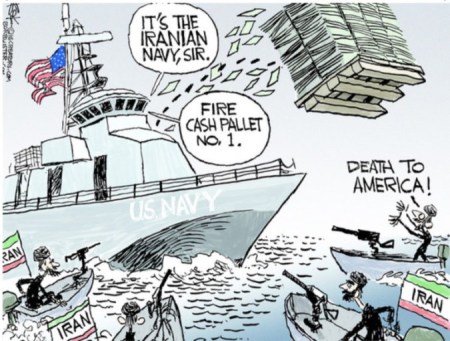
Conclusions
If Obama were viewed internationally as the powerful leader of the world’s most powerful nation, He might be able to get China to clamp down, severely and successfully, on North Korea’s nuke and missile development. Were China to reject His overtures, He could arrange for it to wish that it had acceded. That’s not who Obama is, as demonstrated by, among His other actions, entering into the Iran Scam deal with Iran.
Perhaps Kim Jong-un needs to dress like an Iranian mullah to convince Obama to give him a “deal” similar to the one He gave to Iran. He had better hurry: that won’t work with President Trump.
North Korea Nuke Test – Amb John Bolton – Stuart V, Fox News via YouTube, September 9, 2016




 anneinpt
 artaxes
 danmillerinpanama
 davidking1530
 Peter Hofman
 Joseph Wouk
 Peter
Peter Louisiana Steve
 WarSclerotic
Recent Comments