Posted tagged ‘China and North Korea’

Analysts Sound New Alarms on North Korea Missile Threat

May 31, 2017

Analysts Sound New Alarms on North Korea Missile Threat, Gatestone InstitutePeter Huessy, May 31, 2017

(What about the Iran – North Korea nexus? — DM)

The news media and independent experts have pointed out that North Korea’s ICBMs could reach Alaska, Hawaii or even the Pacific Northwest. But these missiles are said to have a range of 10,000 kilometers, which means they would hit Missouri, or 40 percent of the continental United States, said Klingner. “After they did the successful launch last year, now the estimate is probably 13,000 kilometers, which is all the way down to Miami, the entire continental U.S.”

***********************************

The North Koreans now have the range capability to strike the United States with a ballistic missile. “It is a matter of physics and math.” — USAF General John Hyten, Commander of United States Strategic Command, May 9, 2017.

“A major headache for the United States is that much of the financial and technological support for North Korea’s weapons programs comes from China.” — Joseph Bosco, Senior Fellow at the ICAS Institute for Korea-American studies.

North Korea just conducted its seventh missile test launch so far this year. No one should expect this activity to cease, and no one should be surprised by North Korea’s progressively more advanced weapons capabilities, analysts said at a recent Mitchell Institute forum on Capitol Hill, hosted by the author.

“During Kim Jung Un’s five years in power he has done twice, perhaps three times, as many launches of missiles as his father did in 18 years,” said Bruce Klingner, a senior research fellow at the Heritage Foundation.

The North Korean dictator is not showing any signs of slowing down, and he is determined to push forward the country’s program to enhance the medium and long-range missiles and nuclear warheads that now threaten the United States and its allies.

Klingner estimates that North Korea has 16 to 20 nuclear weapons. “And then, of course, the question or the debate is how far along they are,” he said. “I think it is pretty clear they’ve weaponized and miniaturized the warhead, that right now the Nodong medium-range ballistic missile is already nuclear capable.” This means U.S. allies Japan and South Korea are under a nuclear threat today, he stressed. “It is not theoretical, it is not several years in the future as some analysts or experts will tell you.”

The threats posed by North Korea are wide ranging, Klingner noted. “They’ve got, we estimate, 5,000 tons of chemical warfare agents.” And it has a sophisticated army of cyber warriors. “They are, perhaps, in the top five or top three countries in the world for cyber attack capabilities.”

Missile attacks are, it seems, what worries U.S. policy makers the most. A rising concern are submarine-launched ballistic missiles because of the immediate risk they create for South Korea. “The North Korean subs can come out on the east or west coast and threaten South Korea,” Klingner said.

North Korea successfully tested a Musudan intermediate-range ballistic missile last year, and they “flew it to an unusually high trajectory,” he said. “Had they lowered the trajectory and fired it for effect, the estimates are it could have ranged Guam. So that’s a new threat to a key node for the U.S. defense of the Pacific.”

Keeping U.S. officials up at night is the possibility of an ICBM launch. North Korea has developed several systems. One of its most advanced systems is a space launch vehicle, Klingner said. “But it’s the same technologies you would need to fire off an ICBM warhead.”

As USAF General John Hyten, Commander of United States Strategic Command, said on May 9th at a Strategic Deterrent Coalition nuclear symposium, that the North Koreans now have the range capability to strike the United States with a ballistic missile. “It is a matter of physics and math” he explained.

The news media and independent experts have pointed out that North Korea’s ICBMs could reach Alaska, Hawaii or even the Pacific Northwest. But these missiles are said to have a range of 10,000 kilometers, which means they would hit Missouri, or 40 percent of the continental United States, said Klingner. “After they did the successful launch last year, now the estimate is probably 13,000 kilometers, which is all the way down to Miami, the entire continental U.S.”

Another cause for alarm is the number of rocket engine tests, he said. “They took the first stage of a solid fuel ICBM, to see if it works.” Rocket scientists, just by looking at the photos, were able to say that they’re using two engines, which are better than the ones U.S. experts thought they were using. By the size and shape and color of the exhaust plume, analysts concluded, the North Koreans are “using a much-improved propellant than we thought.”

At the same forum, Joseph Bosco, a Senior Fellow at the ICAS Institute for Korea-American studies, noted “A major headache for the United States is that much of the financial and technological support for North Korea’s weapons programs comes from China”.

“Back in the late 1980s and early 1990s,” Bosco further explained, “North Korea began its program to develop nuclear weapons. China provided the necessary startup technology through the A.Q. Khan network in Pakistan….Today China accounts for 90% of North Korean trade with the outside world. Let’s face it, China keeps the Kim regime afloat, alive and well, and capable of continuing to invest in advancing it’s nuclear and missile programs.” Bosco said. “There is significant evidence that it directly facilitates the ongoing nuclear and missile programs through China’s banking system and the use of Chinese ports and airports for the trans-shipment of prohibited North Korean parts and technologies.”

Bosco further said that Defense Secretary Leon Panetta had told the Senate Intelligence Committee in 2012 that China was irrefutably providing advanced technology for North Korea’s ballistic missile program.

“It has been clear for 60 years that the sole cause of tension and instability between the Koreas has been Pyongyang’s own bizarre and dangerous behavior. Despite substantial aid and concessions from an accommodating South Korean government, China alone has the power to change that.”

Klingner said it remains to be seen how the Trump administration deals with these foreign policy predicaments. “When I’ve talked to folks in the administration they have described the policy as a heavy emphasis on sanctions and pressure and targeted financial measures.” The administration also apparently wants to augment ballistic missile defense and has indicated a “willingness to have our diplomats talk with their diplomats,” Klingner said. “The door has always been open, but it is North Korea that repeatedly closes the door.”

As Bosco emphasized, it is China that has to come clean.

It is also evidently China that has created a neighboring Frankenstein monster that keeps escaping from its nuclear laboratory. Reining-in North Korea is possible, but without strong Chinese economic and military pressure, which the Chinese seem loath to give, the North Korean nuclear challenge may be insurmountable.

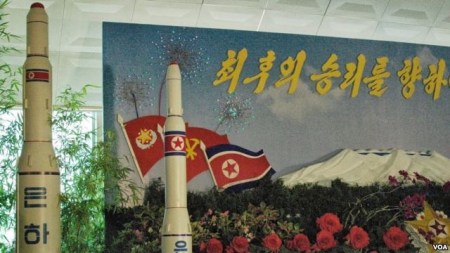
A model of the North Korean Unha-9 long-range rocket on display at a floral exhibition in Pyongyang. (Image source: Steve Herman/VOA News/Wikimedia Commons)

Dr. Peter Huessy is President of GeoStrategic Analysis, a defense consulting firm he founded in 1981, and was the senior defense consultant at the National Defense University Foundation for more than 20 years.

Waiting for North Korea’s Next Nuclear Test

May 28, 2017

Waiting for North Korea’s Next Nuclear Test, PJMedia, Claudia Rosett, May 27, 2017

(To the extent that history is a good predictor of the future, more sanctions — even if enforced briefly — won’t work. Regime change, maybe. But how can we find a suitable replacement for Kim Chi-un Kim Jong-un? Has the recent high-level defector been asked? It would be stupid to let the Norks know whether he has been and, even worse, what, if anything, he said because anyone he suggested would be killed. No matter how much the leakers and media would like to know, secrecy is absolutely necessary. –DM)

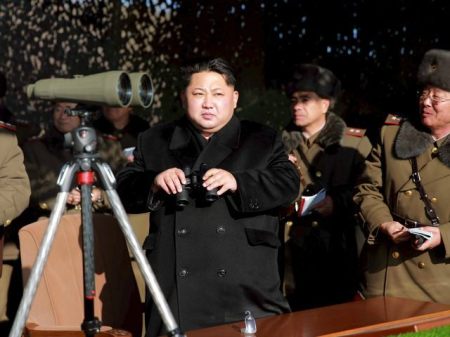
In this undated photo distributed by the North Korean government Monday, May 22, 2017, North Korean leader Kim Jong Un watches the test launch of a solid-fuel “Pukguksong-2” at an undisclosed location in North Korea. (Korean Central News Agency/Korea News Service via AP)

The threats from North Korea keep rising — not only its nuclear program, but such matters as its cyber warfare projects, plus the example Pyongyang continues to set of how a malign and predatory tyranny can survive by arming itself with the world’s most destructive weapons and threatening liberally to use them. We should have no doubt that Iran and others are taking notes.

What’s certain is this: None of this will be resolved by America writing off regime change as the real goal in Pyongyang while waiting to respond with another stack of UN sanctions, however neatly pre-negotiated, to North Korea’s next nuclear test.

******************************

Just last month, Secretary of State Rex Tillerson told the United Nations Security Council that the era of letting North Korea call the shots was over. Commenting on a record in which North Korea has carried out five nuclear tests since 2006, two of them just last year, Tillerson said: “For too long the international community has been reactive in addressing North Korea.” He added, “Those days must come to an end. Failing to act now on the most pressing security issue in the world may bring catastrophic consequences.”

Yet here we are, with Reuters reporting, based on a news conference held Friday in Beijing by senior State Department official Susan Thornton, that the U.S. is “looking at discussing with China a new Security Council resolution on pre-negotiated measures to reduce delays in any response to further nuclear tests or other provocations from the North.”

In other words, the U.S. is waiting to react to North Korea’s next nuclear test, which North Korean officials have already threatened to carry out, and for which preparations have been visibly underway.

With the variation that the diplomatic response (providing China agrees) would be “pre-negotiated,” this sounds disturbingly similar to the ritual that President Obama’s administration dolled up under the fatuous label of “strategic patience.” The result, on Obama’s watch, was that North Korea carried out four of its five nuclear tests to date, and accelerated its missile program to include over the past three years — as The Wall Street Journal reported recently — the launches of “more major missiles than in the three previous decades combined.”

The Obama ritual went like this: North Korea would carry out a forbidden nuclear test (in 2009, 2013, and two in 2016). The U.S. would turn to the UN Security Council, which after a period of closed-door wrangling would respond by approving yet another sanctions resolution, which would then be advertised by the U.S. as tough… tougher… toughest. Whatever.

Recall America’s former ambassador to the UN, Samantha Power, declaring after the passage of UN Security Council Resolution 2270 in March 2016 (in response to North Korea’s fourth nuclear test) that “this resolution is so comprehensive, there are many provisions that leave no gap, no window.” That resolution was followed last September by North Korea’s fifth nuclear test, to which the UN responded by adding to the gapless, windowless sanctions resolution #2270 the even more gapless and windowless resolution #2321.

One might reasonably ask: Why reserve all those ever tougher sanctions for North Korea’s next nuclear test, or the one after that? If gapless, windowless sanctions have yet more holes that need plugging, why not do it all now?

If I might hazard a guess, the obstacle is not solely that veto-wielding permanent Security Council members China and Russia have no serious interest in trying to throttle North Korea’s Kim regime. Even when they vote for those ever tougher UN sanctions, they have been, to put it generously, highly casual about enforcing them. On the evidence, China — despite its public expressions of disapproval and disappointment over each North Korean nuclear test — has nonetheless, for decades now, allowed North Korea to proceed. It is past time to ask quite seriously whether Beijing (never mind its public posturing) reached a quiet decision quite some years ago that China can live comfortably enough with a nuclear-armed North Korea that dedicates itself to bedeviling such leading democracies as South Korea, America and Japan.

Nor is the problem solely that sanctions, to whatever degree they are attempted, have virtually no chance of forcing North Korea into a good-faith deal to give up its long-established, deeply entrenched nuclear program. In previous talks and deals (1994, 2005, 2007, as well as President Obama’s attempted 2012 so-called Leap Day missile-freeze deal), Pyongyang racked up an unbroken record of lying, cheating, pocketing the gains and carrying on with its threats and WMD projects.

In the prime case in which sanctions did seem to get serious traction — when U.S. sanctions persuaded Macau in 2005 to freeze North Korea-linked accounts in Banco Delta Asia — North Korea went ahead in 2006 with its first nuclear test, then came to the bargaining table for a deal in 2007, and took to the cleaners the eager diplomats of President Bush’s “soft power” second term.  The antics of that era included State Department special envoy Chris Hill demanding the help of the U.S. Treasury and Federal Reserve to transfer back to North Korea, via the banking system (at North Korea’s behest), some $25 million in tainted funds that had been frozen at Banco Delta Asia in Macau; a U.S. handout of millions to pay Pyongyang for the Potemkin spectacle in 2008 of blowing up a dispensable cooling tower at North Korea’s Yongbyon nuclear complex; and the removal of North Korea from the U.S. government’s blacklist of terror-sponsoring states (a concession which to this day the State Department has yet to remedy). The 2007 deal fell apart as Bush was leaving office, and in May of 2009 North Korea welcomed Obama’s presidency by conducting its second nuclear test.

Today, with North Korea working at speed toward an ability to target the United States, the U.S. fallback is to try to pressure China, under threat of sanctions that would hurt China itself, to defang North Korea. That approach allows for plenty of employment in Washington, in the debates, design and attempts to apply such sanctions. But somewhere out there lies the question of how to sustain any such approach, on the ground (and the seas) in Asia, and where it might actually lead. Sanctions tend to erode over time, as their targets adapt. If North Korea is richly capable of the duplicities that have repeatedly foiled nuclear negotiators, China has vastly more reach and resources available for its own gambits. Even if the ever-tougher-sanctions approach leads to a deal, who or what then guarantees (the deep flaws of Obama’s Iran nuclear deal  come to mind) that once the strictures are loosened, North Korea, or China, would abide by that deal? (Forget the UN, which has to date failed abysmally to stop North Korea’s nuclear program, and which relies on individual member states to police their own enforcement of sanctions.)

The further fallback is the threat of U.S.-led military force, which is what the Trump administration is now turning to in a number of ways, including the deployment of a third aircraft carrier group as part of the “armada” Trump is sending to the Western Pacific. Part of the idea here is also to put China on notice that the U.S. is serious.

The problem here is that to be effective, military threats need to be credible. After eight years of Obama’s “patience,” following North Korea’s successes with its nuclear extortion racket going back to the early 1990s, the consistent signal from three U.S. presidents — Obama, Bush and Clinton — has been that the U.S. for all its vast firepower would rather be snookered at the bargaining table, or simply do nothing, than actually risk a military strike that could turn into a hot war with North Korea.

It doesn’t help that on May 19 Defense Secretary Jim Mattis told Pentagon reporters that any military solution to North Korea would be “tragic on an unbelievable scale,” so “our effort is to work with the U.N., work with China, work with Japan, work with South Korea to try to find a way out of this situation.” Nor does it help that on May 23, 64 Democratic lawmakers sent a public letter to Trump, asking for details of his plans for a negotiated solution of “the nuclear issue on the Korean peninsula,” and warning Trump against including in any such plans an “ill-advised military component.” If — after the agonies of the 1950-1953 Korean War, and in view of North Korea’s current military threat to Seoul and increasingly dangerous arsenal — the U.S. is not prepared to go to war again to stop North Korea, then the prudent course would be at least to keep quiet about it. Otherwise, the result is to neuter any U.S. threat of force, further emboldening North Korea.

Which brings us to the core problem, the grand dilemma looming behind all the machinations described above. There is really only one way out of this situation, only one real solution, and that is an end to the Kim regime in North Korea. On humanitarian grounds alone, the fall or overthrow of the Kim regime would be fully justified, and is long, long overdue. In view of North Korea’s rising threats to others, its growing arsenal, its record of peddling munitions to the likes of Syria and Iran, and its unbroken record of abusing any and all deals, there is no other answer. The Kim regime has to go.

But getting rid of the Kim regime is in itself risky. However it might happen, whether Kim’s regime might be destroyed by military force, throttled by sanctions, overthrown from within, or somehow shoved from power through some combination of these factors, no one knows exactly what might follow, or how things might then play out.

And so, with variations that have repeatedly failed to end the threat, one U.S. administration after another has defaulted to a “status quo” in which the effort is not to get rid of the Kim regime, but to manage it — as if it were some sort of highly unpleasant chronic medical condition.

Thus did  Tillerson tell the UN Security Council meeting last month, at its special meeting on North Korea, that “our goal is not regime change, nor do we desire to threaten the North Korean people or destabilize the Asia Pacific region.”

Newsflash: The Asia Pacific region is already being destabilized, by nuclear-arming North Korea itself, as well as China — with its own military buildup, its island-building territorial grabs offshore, and its threats to freedom of navigation. What we are witnessing is not a durable status quo, but a trajectory, in which a U.S. impulse for peace in our time keeps steering us toward cataclysm ahead. What Obama achieved with his “strategic patience” was to postpone the day of reckoning long enough to hand off a threat grown vastly worse to his successor.

How this gets resolved in any way favorable, or even remotely safe, for America and its democratic allies is a hideous conundrum. But the situation right now is very far from safe. The threats from North Korea keep rising — not only its nuclear program, but such matters as its cyber warfare projects, plus the example Pyongyang continues to set of how a malign and predatory tyranny can survive by arming itself with the world’s most destructive weapons and threatening liberally to use them. We should have no doubt that Iran and others are taking notes.

What’s certain is this: None of this will be resolved by America writing off regime change as the real goal in Pyongyang while waiting to respond with another stack of UN sanctions, however neatly pre-negotiated, to North Korea’s next nuclear test.

North Korea: China ‘Dancing to the Tune of the U.S.’ with ‘Absurd’ Opposition to Nuclear Program

May 5, 2017

North Korea: China ‘Dancing to the Tune of the U.S.’ with ‘Absurd’ Opposition to Nuclear Program, BreitbartJohn Hayward, May 4, 2017

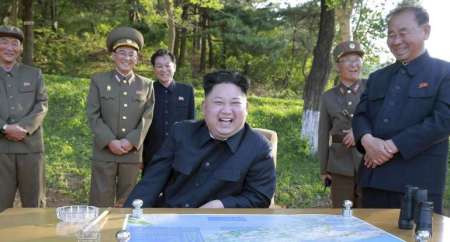
AFP PHOTO / KCNA via KNS REPUBLIC OF KOREA

North Korea is a bottomless fountain of apocalyptic threats against the U.S. and its allies, but on Wednesday, its state-run media lashed out against China with unprecedented fury, accusing the Chinese of “dancing to the tune of the U.S.” with “absurd and reckless remarks” about Pyongyang’s nuclear weapons program.

The North Korean outburst was prompted by a string of editorials in China’s similarly state-controlled media which “criticized the North’s nuclear weapons program and called for Beijing to cut off oil supplies if the North conducted another nuclear test,” as the New York Times summarizes them.

“One must clearly understand that the DPRK’s line of access to nukes for the existence and development of the country can neither be changed nor shaken, and that the DPRK will never beg for the maintenance of friendship with China, risking its nuclear program which is as precious as its own life, no matter how valuable the friendship is,” snarled the unusually harsh response from North Korea’s Rodong Sinmun newspaper. (“DPRK” is North Korea’s name for itself, the Democratic People’s Republic of Korea.)

“China should no longer try to test the limits of the DPRK’s patience. China had better ponder over the grave consequences to be entailed by its reckless act of chopping down the pillar of the DPRK-China relations,” the op-ed continued.

North Korea accused China of providing “lame excuses for the base acts of dancing to the tune of the U.S.” and betraying Pyongyang’s friendship “in order to avert a war which would bring danger to China.” It railed against “absurd and reckless remarks” from “ignorant politicians and media persons” in China.

“We didn’t cross the ‘red line’ of the (North Korea)-China relationship. China is violently stomping on and crossing it without hesitation,” declared another passage spotlighted by CNN.

The editorial specifically complained about “rubbish” in Chinese publications accusing North Korea of creating tensions in northeast Asia and giving the United States “excuses for deploying more strategic assets.”

On the contrary, China should “acknowledge in an honest manner that the DPRK has just contributed to protecting peace and security of China, foiling the U.S. scheme for aggression by waging a hard fight in the front line of the showdown with the U.S. for more than seven decades, and thank the DPRK for it,” according to the North Korean paper.

The New York Times notes that this broadside was not an unsigned editorial from the editors at large but was attributed to a specific author named Kim Chol.

Of course, no one would imagine such a provocative article could be published by any North Korean outfit without the blessing of dictator Kim Jong-un, but putting a single name on the piece gives North Korea a little wiggle room to disavow its harsh words if China objects too strongly or does whatever is needed to calm the Kim regime down. In either of those eventualities, it is a safe bet that someone in Pyongyang named “Kim Chol” will have a very bad day.

Another cushion for the blow noted by the NYT is that Kim Chol’s op-ed did not castigate the government of China or the Communist Party per se; the fiery criticism was directed at Chinese media – which, of course, is only slightly more independent of the government and ruling party than North Korean media.

North Korean editorialists have grumbled about Chinese policy before, but it usually takes the important precaution of leaving China’s name out of the editorials, referring vaguely to a “neighboring country.”

Indications that China might decide to handle North Korea’s outburst with kid gloves quickly appeared. The Chinese Foreign Ministry stressed both Beijing’s “consistent and clear” position on denuclearizing the Korean peninsula and “good-neighborly and friendly relations with the DPRK.”

China’s Communist Party organ, the Global Times, at first responded with some soothing noises about the marvelous friendship between Beijing and Pyongyang, slipping in a few barbs about the importance of denuclearization, China’s unwillingness to “allow its northeastern region to be contaminated by North Korea’s nuclear activities,” and a little reminder that North Korea would have been defeated by South Korea and the United States in the 1950s without Chinese intervention.

On Thursday, the Global Times directly addressed the Kim Chol editorial, very pointedly observing it was the first time China was specifically named in such a tirade.

“Overall, the editorial is nothing more than a hyper-aggressive piece completely filled with nationalistic passion,” sniffed the Global Times. “Pyongyang obviously is grappling with some form of irrational logic over its nuclear program.”

The editorial goes on to tell North Korean media to pipe down while officials in Beijing and Pyongyang hammer out their policy differences through “higher levels of dialogue with one another.” A half-dozen passages in the Global Times response boil down to condescending advice that North Korean is making its situation worse by publicly criticizing China.

“The direction of China-North Korea relations remains in the hands of China. Whether KCNA editorials mention China or Chinese media by name or not, those missions will not change the inherent logic and trend of a relationship that has been in place for over six decades. The more editorials KCNA publishes, the better Chinese society will be able to understand how Pyongyang thinks, and how hard it is to solve this nuclear issue,” the concluding paragraph reads.

Another commentary published by Rodong Sinmun on Wednesday warns Japan that it would be “blanketed with radioactive clouds if a nuclear war occurs on the Korean peninsula.”

“Not only those who try to harm us but their supporters will not be safe if any war breaks out,” this op-ed stated, adding that it would be a “piece of cake” for North Korea’s military to devastate Japan.

How to Defuse the Crisis with North Korea

May 2, 2017

How to Defuse the Crisis with North Korea, American ThinkerHerbert E. Meyer, May 2, 2017

(There is no excellent solution and the concept behind the suggestion needs to be expanded. However, something along its lines may be the best we can do. North Korean peasants would be better off as East German clones and China would prefer the arrangement to a reunification of North and South Korea. Please see also, Krauthammer: U.S. does have cards to play against North Korea and my parenthetical comment there. — DM)

North Koreans would have far more confidence that a guarantee of sovereignty by the U.S. and South Korea would hold if China’s leaders backed it publicly, as well as privately. And if the Chinese would promise to provide the level of economic support that North Korea needs to keep it at least stable, and perhaps more prosperous than it is now, that would help encourage the generals to act. Let’s hope that President Trump at least talked about all this when he met at Mar-a-Lago last month with his new best-buddy, Chinese president Xi.

*********************

The looming crisis with North Korea provides a perfect illustration of what’s gone wrong with the way Washington works. Everyone is so eager to propose a policy, no one can be bothered to articulate an objective. So policymakers start arguing about what to do, before deciding what they want to accomplish. That’s like arguing over what route to take, before deciding where you want to go. (Which, to point out the obvious, is why we keep ending up in the middle of nowhere, or upside down in a ditch.)

Here’s one possible objective that would defuse this crisis and perhaps even bring a few decades of stability: to turn North Korea into a modern version of East Germany.

For those of you too young to remember the Cold War, during those decades after World War II Germany was divided. West Germany was free, prosperous, and an American ally. East Germany was a miserable dictatorship, not very prosperous, and a Soviet satellite. (To get a feel for what life was like in East Germany, watch the great movie The Lives of Others, and the German television seriesWeissensee.) But during all these decades, East Germany was never a threat to West Germany, or to the U.S. Its communist regime wanted only to be left alone. And in return, the West Germans and the Americans made it absolutely clear they had no intention of unifying Germany by attacking or otherwise bringing down the East.

When the Korean war ended with an armistice in 1953, that country was divided. South Korea became free, prosperous, and an American ally. North Korea became a miserable dictatorship, not very prosperous, and a sort-of satellite of China. The difference between Germany and Korea is that while East Germany wanted only to be left alone, North Korea keeps threatening to conquer South Korea and reunify the country under its control, and to fire nuclear-armed missiles at the U.S. itself.

President Trump’s Got Their Attention

But now, for the first time in its history — and thanks entirely to President Trump — North Korea faces the real possibility of a massive military attack, certainly to destroy its nuclear facilities and perhaps even to obliterate the regime itself. And there’s nothing like the looming prospect of an attack by the United States to get a government’s attention.

Simply put, it may be possible to defuse the current crisis without a war by cutting a deal along these lines: If North Korea will give up its nuclear weapons and cease threatening South Korea and the U.S., the U.S. and South Korea will guarantee North Korea’s sovereignty.

Once again, there’s an historic parallel between Korea and Germany: Adolf Hitler was crazy; a foaming-at-the-mouth, chewing-the-carpet raving lunatic. He was also a brilliant, cunning politician who not only held onto power, but who kept within his grip the total loyalty of Germany’s military leaders. These generals weren’t crazy; they were hard, practical, highly intelligent men who had fought and lost World War I and then rebuilt Germany’s war machine. They knew in their bones that another world war would devastate their country. They understood that invading Russia would end in catastrophe.

Yet the generals didn’t get rid of Hitler. While a small number were prepared to overthrow Hitler, most were caught up in appalling, fawning loyalty to him that had more to do with twisted psychology than with military strategy. The minority willing to act received no encouragement from the Western Allies. The others plunged ahead, caught in Hitler’s hypnotic spell. There’s no way to know this for sure, but it’s widely accepted among historians that if the generals had gotten rid of Hitler in 1937 or 1938, there would not have been a Second World War. (Plots to overthrow Hitler by some brave German continued after the war started, but by that time it was too late; all their efforts failed.)

We can argue all day whether Kim Jong-un is crazy, but it’s obvious he isn’t, um, normal. He’s held onto power, and he’s kept within his grip the loyalty of North Korea’s generals. These generals aren’t crazy. Crazy people cannot build weapons, organize complex programs to develop nuclear bombs — or build roads, operate electric power systems, keep the trains and buses running, assure that at least some food gets produced and distributed, operate schools and hospitals. They must be hard, practical, and highly intelligent. And while they may not be charming and fun to hang out with, they aren’t suicidal.

How to Organize a Coup d’Etat

Today, just like the German generals in the Spring of 1939, North Korea’s generals are careening toward war. But the point of studying history is to learn from it. Back in 1939 there was no serious effort in London, Paris, and Washington to try and break Hitler’s grip on his generals and to help them organize a coup d’etat. So the world plunged into war. Might it be possible to do this now? Is there some way to break Kim Jong-un’s grip on his generals — to snap them out of their hypnotic spell and help them to organize a coup before it’s too late?

For an effort like this to have even a chance of success, we’ll need answers to these questions:

Who are these guys? Presumably our intelligence service knows at least something about the two or three dozen officials who actually run North Korea. Well, which ones are most likely to abandon Kim and work with us? Who are the ones we would like to see take power?

How do we reach them? Of course, we can communicate with these generals over the airwaves, so to speak. That would involve official statements by President Trump and his national security team threatening war, and clearly offering a guarantee of regime survival in exchange for disarmament. But there must also be ways of reaching these officials individually — and very privately.

What precisely do we want them to do? We want the generals to replace Kim and his closest advisors with officials who will work with the U.S. to dismantle North Korea’s nuclear weapons program, then work with South Korea to establish the kind of sullen but stable peace that existed for decades between West and East Germany.

What help do they need? It’s possible that a serious threat to attack by President Trump, combined with the offer of regime survival in return for disarmament, will be sufficient to push at least some of the generals into taking action. But they may need more help, for instance a massive propaganda campaign to generate support for them before they act by telling the North Korean population how their lives will become immeasurably better once Kim is replaced. The generals also may need the kind of help that only a powerful intelligence service like ours can provide, for instance a covert communications system so they can be in touch with us, and with one another, without being overheard by Pyongyang’s security officials. They may even need the kind of help only the Pentagon can provide, for instance SEAL Team Six.

China’s help would vastly increase the chances of success. Beijing’s diplomatic and intelligence services probably have a better grasp of what’s actually going on in Pyongyang than ours. And they can probably provide detailed information about which generals to work with, and which to avoid — or remove. Most of all, the North Koreans would have far more confidence that a guarantee of sovereignty by the U.S. and South Korea would hold if China’s leaders backed it publicly, as well as privately. And if the Chinese would promise to provide the level of economic support that North Korea needs to keep it at least stable, and perhaps more prosperous than it is now, that would help encourage the generals to act. Let’s hope that President Trump at least talked about all this when he met at Mar-a-Lago last month with his new best-buddy, Chinese president Xi.

Don’t bother asking the usual Washington policymakers whether turning North Korea into a modern version of East Germany might actually be possible. They will reply — in unison, within two-billionths of a second — No, this is impossible! Kim Jong-un is crazy, and the North Koreans will never give up their nukes or agree to stop threatening South Korea and the U.S. Well, they may be right. On the other hand, these are mostly the same geniuses who told us, also with 100 percent confidence, that it was impossible to win the Cold War, and impossible for Donald Trump to get elected president. Impossible things sometimes do happen, even in politics — especially in politics. Given the risk we face of nuclear war, this is worth a shot.

Why China ‘urgently’ recruiting Korean-Chinese interpreters for town near North Korea

May 1, 2017

Why China ‘urgently’ recruiting Korean-Chinese interpreters for town near North Korea, Korea Times, Park Si-soo, May 1, 2017

(Please see also, Krauthammer: U.S. does have cards to play against North Korea. Might China be preparing for reunification with North Korea instead of an invasion? — DM)

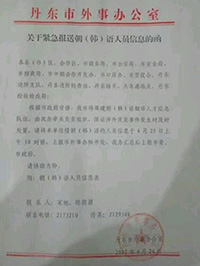
A Chinese government document ordering the town of Dandong to recruit Korean-Chinese interpreters. / Captured from the Oriental Daily

A Chinese town near the border with North Korea is “urgently” recruiting Korean-Chinese interpreters, stirring speculation that China is bracing for an emergency situation involving its nuclear-armed neighbor.

The Oriental Daily, a Hong Kong-based news outlet published the story on Apr. 27, including a photo of a Chinese government document ordering the town of Dandong to recruit an unspecified number of Korean-Chinese interpreters to work at 10 departments in the town, including border security, public security, trade, customs and quarantine.

The document did not specify the reason behind the unusual, large-scale recruiting. But experts and local citizens said the move indicated that China was bracing for a possible military clash between the United States and North Korea.

This might trigger a huge exodus of North Koreans to border towns in China.

Whether this dismal scenario will become a reality is largely up to North Korea’s leader Kim Jong-un.

U.S. President Donald Trump has repeatedly warned that the world’s superpower will strike North Korea’s nuclear facilities if Kim proceeds with a sixth nuclear test or test fires an intercontinental ballistic missile.

The Dandong administration also has ordered its officials to work rotating night shifts since April 25, according to South Korea’s news agency Yonhap.

Meanwhile, China has dismissed reports that it has sent 150,000 additional troops to its border with the North.

North Korea launches new missile. US sabotages

April 29, 2017

North Korea launches new missile. US sabotages, DEBKAFile, April 29, 2017

(???????????????? — DM)

North Korea early Saturday, April 29, launched a medium ballistic missile. It failed, detonating in North air space seconds after launch, just like the first one that was sabotaged by the US on April 16, DEBKAfile reports. US President Donald Trump tweeted as soon as he was informed: “North Korea disrespected the wishes of China & its highly respected President when it launched, though unsuccessfully, a missile today. Bad!”

He was apparently hinting that he would wait for China’s reaction before the US took action.

This missile was also the same as the first, a KN-17, a single-stage, short to medium range, liquid-fueled Scud or No Dong variant. It was test-fired Saturday as a deliberate act of defiance by Kim Jong-un in the face of Trump’s warning Thursday, “There is a chance that we could end up having a major, major conflict” over his expanding nuclear and missile capabilities. Hours earlier, on Friday, American, Chinese and Russian foreign ministers all stood up at the UN Security Council meeting in New York to demand that he give up his nuclear and missile programs.

State Department Secretary Rex Tillerson called for tough new action to punish Pyongyang.

The latest missile launch was not announced by Pyongyang. Nor was it fired from the usual base near the port city of Sinpo, but a site near the capital. US military sources estimated that the KN-17, most likely an upgraded Scud missile adapted for anti-ship warfare, was intended to support Kim’s threat to sink one of the US warships approaching Korean waters with two Japanese destroyers.

One of Tokyo’s major subways systems says it shut down all lines for 10 minutes early Saturday after receiving warning of a North Korean missile launch. Tokyo Metro official Hiroshi Takizawa says the temporary suspension affected 13,000 passengers.

Thunder Run to Seoul: Assessing North Korea’s War Plan

April 25, 2017

Thunder Run to Seoul: Assessing North Korea’s War Plan, Real Clear DefenseRaymond Farrell, April 25, 2017

(A North Korean invasion seems highly unlikely for several reasons.

By 1950, Kim Il-sung had convinced Stalin that an invasion would be relatively easy because Dean Atcheson, the U.S. Secretary of State, had omitted South Korea from a list of countries the U.S. would defend if attacked. (When North Korea attacked, Atcheson advised President Truman to defend South Korea.)  Moreover, the few U.S. troops in South Korea when the invasion occurred were under the control of the State Department, not the U.S. military, and their primary job was to prevent South Korea from invading North Korea. The South Korean troops were, at best, largely untrained and poorly equipped. Stalin accordingly provided substantial new equipment, training and logistical support to the North Korean troops. Now, there are now approximately 28,000 U.S. military personnel in South Korea and many of them train on a regular basis with their well equipped South Korean counterparts.  

China has warned that although it will take no action to help North Korea unless the U.S. invades. It seems highly unlikely that we will do so, unless North Korea invades South Korea first. That suggests that to prevent a retaliatory US invasion of North Korea, possibly resulting in US forces approaching the Yalu river (which brought China into the fight against US and allied troops), China will take whatever steps may be necessary, perhaps even invading North Korea herself, to prevent North Korea from crossing the DMZ into South Korea. Kim Jong-un-may be crazy, but he does not appear to be stupid.- DM)
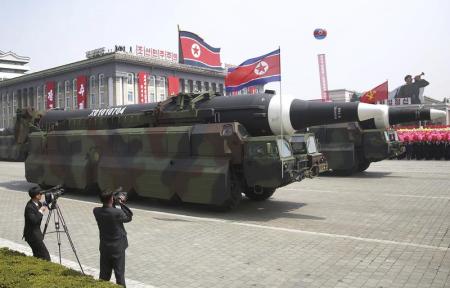
 

AP Photo/Wong Maye-E

For Westerners, North Korea is perennially on and off of the headlines. This year, the confluence of a new US president, the US missile attack in response to the use of chemical weapons in Syria, and an apparently in-your-face program of missile and nuclear tests on the part of North Korea has returned the world’s last Stalinist state to comment threads and coffee-room speculation. Military professionals obviously follow these events even more closely, and Maj. ML Cavanaugh’s recent thoughtful pieces for MWI serve as an example.

But for military planners in South Korea (the Republic of Korea or ROK) and the United States, planning for war with North Korea (the Democratic People’s Republic of Korea or DPRK) has been constant since the last Korean War ended in 1953. Indeed many will be aware that the Korean War ended in an armistice only, rather than a formal peace treaty, so that the two sides remain technically at war. An interesting consequence of this is that while Western military staff colleges spend a great deal of time studying strategy and campaign design, ROK planners focus purely on one strategic problem and one campaign: Korean War II.

While there are some variables, ROK (and DPRK) leaders know who their enemy will be, what his capabilities are, what the war aims of each side will be, and under what terrain, weather and population conditions they must fight. It is therefore possible to wargame the campaign with an unusual degree of precision. Based on my studies as an exchange officer at ROK Army Staff College and training with US planners, I am convinced that the combined ROK/US forces would quickly win the military conflict, though it would be hard-fought and civilian casualties would be high. But what is the ROK estimate of how such a war would unfold? And what are the major assumptions and variables that might alter that story?

The China Wildcard

The first and biggest assumption is that China would not intervene. It is of course possible that renewed fighting on the Korean peninsula could arise as a consequence of Sino-US conflict elsewhere. On one hand, this scenario is actually better for the defending ROK/US forces since the outbreak of Sino-US conflict elsewhere would presumably trigger heightened readiness in South Korea and this would eliminate one of the main pillars of North Korea’s war strategy—operational surprise. On the other hand, even limited war elsewhere in Asia would reduce the numbers of US forces available to fight in Korea and threaten ROK/US plans to establish air supremacy over the peninsula.

Regardless of how war breaks out, a Korean campaign would still most likely begin the same way: with an attack by in-place North Korean forces which will likely be defeated. Once that initial attack is absorbed and ROK forces have been fully mobilized, ROK/US forces will be in a position to go over to the offensive, advance into North Korea, and decisively defeat DPRK forces. The main factor that will determine the later outcome is the potential presence of Chinese forces: If China stays out, expect a fairly quick defeat of North Korean forces, and presumably the regime. But Chinese intervention would probably result in the war becoming stalemated just as the first conflict did. The terrain in Korea favors defense and limits the forces which can be employed, so that with Chinese forces committed, neither side could be expected to achieve a decisive advantage.

It is also possible to imagine scenarios in which China signals a willingness to intervene—or actually intervenes—to prevent the complete collapse of a DPRK that has been defeated on the battlefield. These kinds of what-happens-once-we-defeat-Kim problems are difficult and professionally fascinating, but this article is concerned with how we get there and so will assume that, whatever diplomatic end-game is developing off-stage, China has not intervened in any significant way.

The North’s Attack Plan

So what would the initial North Korean attack look like? Unlike in 1950, when Soviet, Chinese and North Korean planners had a realistic prospect of conquering South Korea in a war, an attack today has only a small chance of victory within a narrow time window. In 1950, DPRK forces enjoyed large initial advantages in numbers, troop quality, and all classes of equipment including tanks and aircraft. Today all of those initial advantages except artillery and numbers are on our side, and even the numbers are more balanced. DPRK planners recognize their inferiority in technology and, after ROK mobilization, even in numbers. They understand that ROK/US forces will have air superiority initially, and (unless China intervenes) air supremacy within days. They therefore plan to win by striking quickly, by surprise, while ROK forces are still mobilizing, US reinforcements are not yet in theatre, and while our airpower is largely committed to overcoming the DPRK integrated air defense system and targeting WMD storage sites, launchers, and command, control, and communications (C3) networks.

Recognizing that ROK forces will be on some degree of heightened readiness during a crisis, the regime will use its formidable intelligence and special operations capability to obscure preparations for an attack and slow ROK responses. Its own past history of symbolic attacks, placing its forces on alert, and angry promises to destroy its enemies will actually work in its favor in this case: ROK/US intelligence agencies will expect some kind of posturing from the North and may therefore misidentify attack preparations as lesser actions. DPRK agents will also count on the psychological reluctance of the South Korean population and government to believe that war is imminent. They will actively seek to influence the ROK democratic decision-making process to get inside our decision cycle. In particular, ROK mobilization will require a political decision and every hour of delay imposed through threats, deception, information and cyber attacks, or direct action will have consequences. In the end, even if ROK/US commanders do recognize the signs of an attack before it begins, it will still take time to react. In that time, DPRK commanders hope to win.

There will be no need for detailed orders. Just as ROK forces know and rehearse their war plan, DPRK forces are largely in place, in numbers sufficient to achieve some local breakthroughs on the major routes towards Seoul—their first operational objective. North Korea will hope to begin mobilization before South Korea does, and thereby turn their currently modest advantage in numbers into a temporarily significant one. DPRK forces will rely, Soviet-style, on the use of overwhelming artillery and rocket fires to break through ROK prepared positions along the DMZ, while using deep fires to attack C3 nodes, routes forward, and mobilization centers. Strikes against targets in Seoul and the surrounding urban areas will have the additional useful effect of causing fear and choking routes with a panicked populace.

On the subject of routes it is worth considering the limited space for mechanized maneuver in central Korea: The eastern half of the peninsula is largely mountainous with roads running along valley floors. The grain of the country will tend to push DPRK forces southwest (towards Seoul). The western half of the peninsula around Seoul and the Han River system is slightly flatter, but at least south of the DMZ the land is now so built up that once major routes come under fire it will be slow going for both sides. It’s not good country for heavy forces, and until recently both sides planned to use mostly lighter infantry to fight on the line. Recent announced changes to ROK force structure see a much greater emphasis on heavy forces—perhaps to get more combat power out of a smaller overall force—but the terrain suggests that such forces will likely be difficult to maneuver. Furthermore, DPRK tactics emphasize the use of infiltration to achieve local penetrations and attack deeper, tactical targets. Their line formations include elite sub-elements specially trained for these tasks, and the terrain—whether urban or forested mountain—is ideal for it. Road-bound heavy forces will be especially susceptible to such tactics.

The final element in the DPRK plan is an extensive deep battle across the entire South Korean depth using some one hundred thousand special operations forces (SOF). An interesting feature of this war is that since both sides look and speak more or less alike, covert insertion and operation is easier for each side—but especially so for North Korean agents who may move freely within South Korea’s open society.

Some DPRK SOF will have been pre-positioned. More will be inserted by sea, air, and ground infiltration shortly before the main attack, exploiting—little-green-men-style—any public uncertainty or national command paralysis for temporary deniability. One of the main tasks for DPRK SOF in this preliminary phase will be to support the deception plan by encouraging and magnifying whatever confusion and chaos may accompany a crisis, and especially to foster political uncertainty and indecision in the critical hours before the main attack. Deniable attacks against political leadership, false-flag provocations, staged anti-war protests, terrorist attacks aimed at causing panic, and limited attacks against key C3 nodes will begin in this stage. This phase could last for days or even weeks, but hours are more likely.

Once DPRK main forces attack across the DMZ, the remaining DPRK SOF will surge south by sea and air towards targets in Seoul and in depth. Many will be destroyed en route by defending ROK forces, and more will be defeated at their objectives, but DPRK planners hope to overwhelm ROK defenses by sheer numbers of SOF and inflict temporary but serious damage while they still have operational surprise. SOF targets in this phase will be national C3 nodes, including political leadership, mobilization centres, airfields, ports and naval bases, and choke points on major routes. As with artillery strikes, fighting by SOF on objectives in Seoul will be aimed at heightening panic and demoralizing political leadership, and will be exploited by DPRK information warfare agencies to give the impression that the front has already reached the ROK capital.

With luck, DPRK planners hope to have main forces entering Seoul within the first week, from which position they can either transition to defense and negotiate from strength or, if conditions permit, push on to decisively defeat ROK forces.

But this plan is very optimistic. ROK planners understand it well and are prepared to counter it. Forces defending along the DMZ are in strong, prepared positions supported by obstacles. ROK C3 is hardened and redundant. Rear-area security forces are substantial and their plans are kept current and rehearsed. Even given some disruption by DPRK SOF, mobilization is expected to generate millions of men within days.

The Unknowns

There are three main variables which might affect this estimate: First, the combat performance of either side cannot be known for certain. My own guess is that ROK forces would fight very well—especially on defense. But there are ways in which North Korea may attempt to undermine ROK morale: Both sides consider the other to be cousins awaiting liberation and this could be used as part of a skillful information operations campaign—particularly if ROK forces seek to advance into the North. The possible combat performance of DPRK forces is even less predictable. On the one hand, the DPRK population has been brainwashed from birth. On the other hand, North Korea’s people fear their own leadership and are often on the brink of starvation. It is possible that they might fight fanatically, but also that, given a chance, they would turn on their leaders. We simply don’t know.

The second main variable is the potential DPRK use of WMD. Finding and killing these will be a high priority for ROK/US commanders, but it is possible that some will survive, especially in the first few days. The North’s leaders may decide to use chemical weapons for battlefield advantage or, if they fail to enter Seoul, may seek to blackmail the ROK government with the possibility of chemical or even nuclear attack against it. Of course the use, or even threatened use, of WMD might invite US retaliation in kind, but a desperate or simply risk-taking Kim regime could gamble that our side would blink first.

The third and related variable is what the DPRK regime would do in defeat. Facing defeat, it is possible that army commanders, or even their troops, would turn on the leadership and depose the regime. On the other hand, if Kim retains enough control over his forces but believes that he is on the brink of being deposed, it is possible that he could—with nothing left to lose—simply unleash whatever WMD he still possesses.

The Takeaway: DPRK Will Make it Ugly

Recognizing that in war nothing ever goes entirely as expected, and that there are some major unknowns, this is based on what we do know about North Korea’s force structure, its comparative strengths, and terrain and other considerations—along with my own assessment of how Korean War II would initially unfold. But regardless of how it played out, one thing is near certain: It would entail horrific destruction and suffering. Tens or hundreds of thousands could become casualties. In defeat, North Korea would become a 25-million strong humanitarian catastrophe. And that is just with conventional weapons: The possible consequences of attacking Seoul with WMD are almost too awful to contemplate. There is a role for force here—a strong ROK/US posture has certainly constrained North Korean aggression for decades—and in no way should DPRK threats be simply acceded to. But under current conditions, and given the scale of likely destruction, planners should strongly question whether each DPRK provocation—even the imminent development of a ICBM—justifies risking such a war.
Haley: China’s Been a ‘Really Great Friend’ to the U.S. Regarding North Korea

April 24, 2017

Haley: China’s Been a ‘Really Great Friend’ to the U.S. Regarding North Korea, Washington Free Beacon, April 24, 2017

(Please see also, Chinese media: ‘China’s intervention not needed when only N.K.’s nuke facilities are hit’ — DM)


U.S. Ambassador to the United Nations Nikki Haley called China a “great friend” on Monday regarding its efforts to assist the U.S. with pressuring North Korea over its nuclear program.

Haley appeared on “CBS This Morning,” in addition to the other two network morning shows, to discuss rising tensions with North Korea over its nuclear and missile tests, as well as other foreign policy issues facing the Trump administration.

President Trump spoke on the phone Sunday night with Chinese President Xi Jinping, and CBS host Norah O’Donnell asked Haley what more China needs to do to deter the North Koreans from taking more provocative actions. China is North Korea’s most important ally and main trading partner, giving Beijing strong influence over the rogue state.

“I think China is really in good faith doing quite a bit,” Haley said. “They are trying to put pressure on North Korea. What we’ve said is we want you to put more pressure on North Korea, whether that’s with coal, whether that’s with oil, whether that’s with other sanctions … I think China’s been a really great friend of ours, and the way they came together with us to do the statement last week showed that we are united against wanting North Korea to stay away from doing any sort of nuclear threats.”

Haley added that North Korean leader Kim Jong-un is “flailing” and trying to show strength to his people.

“They’re panicking right now,” she said.

Last week, a Chinese spokesman said Beijing was “gravely concerned” about North Korean nuclear activity and praised the U.S. for “constructive” remarks about resolving the issue peacefully.

North Korea has continually made belligerent gestures toward the U.S., displaying a video last week showing the U.S. in flames during a military celebration.

Trump has softened his rhetoric about China, even refusing to call the country a currency manipulator after months of calling it one on the campaign trail, due to its assistance in pressuring North Korea.

“What, am I going to start trade war with China in the middle of him working on a bigger problem with North Korea?” Trump said last week. “I’m dealing with China with great respect. I have great respect for him. We’ll see what he can do.”

Trump has also cited friendly relations with the Chinese president as a reason to not start a trade war with the world’s largest country.

Chinese media: ‘China’s intervention not needed when only N.K.’s nuke facilities are hit’

April 24, 2017

Chinese media: ‘China’s intervention not needed when only N.K.’s nuke facilities are hit’ Dong-a Ilbo, April 24, 2017

A Chinese state-run media outlet said that if North Korea continues nuclear and missile development, China may not provide military support to China even if the U.S. launches preemptive strike on the North. China and North Korea have agreed to provide military assistance if one of them gets under military attack, and hence the latest report is construed as Beijing’s stern warning against Pyongyang.

If the U.S. launches surgical strikes on North Korea’s nuclear facilities, China will seek diplomatic deterrence but military intervention is not needed, China’s state-run Global Times said on Saturday. However, the daily repeated its previous stance that f the U.S. and South Korean militaries cross the 38th parallel to invade the North and seek to topple the North Korean regime, China should immediately start military intervention.”

With the U.S. and China stepping up pressure on North Korea, U.S. President Donald Trump held calls in succession with Japanese Prime Minister Shinzo Abe and Chinese President Xi Jinping Sunday morning, and discussed ways to resolve the North Korean nuclear issue. President Trump reportedly asked the Japanese and Chinese leaders to extend cooperation to manage the situation wherein signs of North Korea’s sixth nuclear test are mounting. Notably, in his call with Chinese President Xi, President Trump reportedly commended Beijing’s recent efforts to deter the North’s nuclear development and called on Beijing to use more specific measures to pressure the North.

In the premiere of “Born in China, a movie jointly produced by the U.S. and China held at the Chinese embassy in Washington on Friday, Chinese Ambassador to the U.S. Cui Tiankai said that President Trump will visit China in the second half of this year. After President Trump and President Xi held summit at Trump’s Mar-a-Lago estate in Florida on April 6 and 7, the two leaders agreed to President Trump’s return visit to China at the earliest date.

Krauthammer: U.S. does have cards to play against North Korea

April 21, 2017

Krauthammer: U.S. does have cards to play against North Korea, Mercury News, April 20, 2017

(Mr. Krauthammer offers a reasonable alternative to the reunification of North and South Korea.

Do present-day South Koreans really want reunification? Nearly half a century ago, when I was an Army JAG officer and spent two tours of duty in South Korea, I travelled widely and got to know many Koreans. They were generally enthusiastic about reunification. Now? Not so much, I think.

German reunification was widely embraced and cost the West about $1.9 trillion. South and North Korea have been separated about twenty years longer than East and West Germany had been. Now, younger working South Koreans — with fewer close relatives in the north than their parents and grandparents had half a century ago — would bear much of the cost of Korean reunification. Reunification gave former West Germany Frau Merkel. Korean reunification, providing a wave of unskilled, perhaps hopelessly brainwashed, North Koreans with very little to offer South Korea and needing much adaptation to South Korean democracy, would be about as useful to South Korea as a North Korean version of Frau Merkel. — DM)

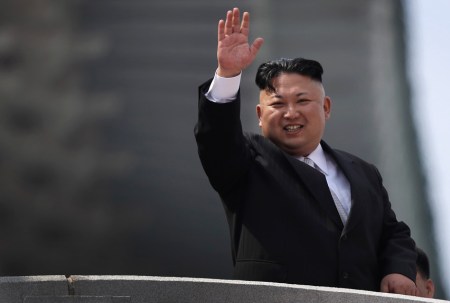
North Korean leader Kim Jong Un waves during a military parade on Saturday, April 15, 2017, in Pyongyang, North Korea (AP Photo/Wong Maye-E)

Because Beijing has such a strong interest in the current regime, we could sweeten the latter offer by abjuring Korean reunification. This would not be Germany, where the communist state was absorbed into the West. We would accept an independent, but Finlandized, North.

During the Cold War, Finland was, by agreement, independent but always pro-Russian in foreign policy. Here we would guarantee that a new North Korea would be independent but always oriented toward China. For example, the new regime would forswear ever joining any hostile alliance.

**************************

WASHINGTON — The crisis with North Korea may appear trumped up. It’s not.

Given that Pyongyang has had nuclear weapons and ballistic missiles for more than a decade, why the panic now? Because North Korea is headed for a nuclear breakout. The regime has openly declared that it is racing to develop an intercontinental ballistic missile that can reach the United States — and thus destroy an American city at a Kim Jong Un push of a button.

The North Koreans are not bluffing. They’ve made significant progress with solid-fuel rockets, which are more quickly deployable and thus more easily hidden and less subject to detection and pre-emption.

At the same time, Pyongyang has been steadily adding to its supply of nuclear weapons. Today it has an estimated 10 to 16. By 2020, it could very well have a hundred. (For context: the British are thought to have about 200.)

Hence the crisis. We simply cannot concede to Kim Jong Un the capacity to annihilate American cities.

Some will argue for deterrence. If it held off the Russians and the Chinese for all these years, why not the North Koreans? First, because deterrence, even with a rational adversary like the old Soviet Union, is never a sure thing. We came pretty close to nuclear war in October 1962.

And second, because North Korea’s regime is bizarre in the extreme, a hermit kingdom run by a weird, utterly ruthless and highly erratic god-king. You can’t count on Caligula. The regime is savage and cult-like; its people, robotic. Karen Elliott House once noted that while Saddam Hussein’s Iraq was a prison, North Korea was an ant colony.

Ant colonies do not have good checks and balances.

If not deterrence, then prevention. But how? The best hope is for China to exercise its influence and induce North Korea to give up its programs.

For years, the Chinese made gestures, but never did anything remotely decisive. They have their reasons. It’s not just that they fear a massive influx of refugees if the Kim regime disintegrates. It’s also that Pyongyang is a perpetual thorn in the side of the Americans, whereas regime collapse brings South Korea (and thus America) right up to the Yalu River.

So why would the Chinese do our bidding now?

For a variety of reasons.

• They don’t mind tension but they don’t want war. And the risk of war is rising. They know that the ICBM threat is totally unacceptable to the Americans. And that the current administration appears particularly committed to enforcing this undeclared red line.

• Chinese interests are being significantly damaged by the erection of regional missile defenses to counteract North Korea’s nukes. South Korea is racing to install a THAAD anti-missile system. Japan may follow. THAAD’s mission is to track and shoot down incoming rockets from North Korea but, like any missile shield, it necessarily reduces the power and penetration of the Chinese nuclear arsenal.

•  For China to do nothing risks the return of the American tactical nukes in South Korea, withdrawn in 1991.

• If the crisis deepens, the possibility arises of South Korea and, most importantly, Japan going nuclear themselves. The latter is the ultimate Chinese nightmare.

These are major cards America can play. Our objective should be clear. At a minimum, a testing freeze. At the maximum, regime change.

Because Beijing has such a strong interest in the current regime, we could sweeten the latter offer by abjuring Korean reunification. This would not be Germany, where the communist state was absorbed into the West. We would accept an independent, but Finlandized, North.

During the Cold War, Finland was, by agreement, independent but always pro-Russian in foreign policy. Here we would guarantee that a new North Korea would be independent but always oriented toward China. For example, the new regime would forswear ever joining any hostile alliance.

There are deals to be made. They may have to be underpinned by demonstrations of American resolve. A pre-emptive attack on North Korea’s nuclear facilities and missile sites would be too dangerous, as it would almost surely precipitate an invasion of South Korea with untold millions of casualties. We might, however, try to shoot down a North Korean missile in mid-flight to demonstrate both our capacity to defend ourselves and the futility of a North Korean missile force that can be neutralized technologically.

The Korea crisis is real and growing. But we are not helpless. We have choices. We have assets. It’s time to deploy them.