Posted tagged ‘China and North Korea’

North Korea Nuclear Test Puts Pressure on China and Undercuts Xi

September 4, 2017

North Korea Nuclear Test Puts Pressure on China and Undercuts Xi, New York Times

(Assuming the accuracy of the analysis, it is doubtful that President Trump has much economic or other leverage with China vis a vis North Korea. — DM)

President Xi Jinping of China arriving on Sunday for the opening ceremony of a business forum in Fujian Province. Credit Pool photo by Mark Schiefelbein

The biggest concern for China’s leadership is the possibility of North Korea turning on China, the country’s only ally. “If cornered, North Korea could take military action against China, given the relationship has reached a historic low,” Mr. Zhao said.

China supplies more than 80 percent of the North’s crude oil, and suspending delivery would be the ultimate economic sanction, more far-reaching than those imposed, with China’s support, by the United Nations.

 ****************************

BEIJING — It was supposed to be Xi Jinping’s moment to bask in global prestige, as the Chinese president hosted the leaders of some of the world’s most dynamic economies at a summit meeting just weeks before a Communist Party leadership conference.

But just hours before Mr. Xi was set to address the carefully choreographed meeting on Sunday, North Korea’s leader, Kim Jong-undetonated his sixth nuclear bomb.

Mr. Kim has timed his nuclear tests and missile launches with exquisite precision, apparently trying to create maximum embarrassment for China. And on Sunday, a gathering in southeast China of leaders from Russia, Brazil, India and South Africa, members of the so-called BRICS group, was immediately overshadowed by news of the test, which shook dwellings in China and revived fears of nuclear contamination in the country’s northeast region.

This is not the first time Mr. Kim has chosen a provocative moment to flaunt his country’s weapons. In May, he launched a ballistic missile hours before Mr. Xi spoke at a gathering of world leaders in Beijing assembled to discuss China’s signature trillion dollar One Belt, One Road project.

The confluence of North Korea’s nuclear testing and Mr. Xi’s important public appearances is not a coincidence, analysts said. It is intended to show that Mr. Kim, the leader of a small, rogue neighboring state, can diminish Mr. Xi’s power and prestige as president of China, they said. In fact, some analysts contended that the latest test may have been primarily aimed at pressuring Mr. Xi, not President Trump.

“Kim knows that Xi has the real power to affect the calculus in Washington,” said Peter Hayes, the director of the Nautilus Institute, a research group that specializes in North Korea. “He’s putting pressure on China to say to Trump: ‘You have to sit down with Kim Jong-un.’”

What Mr. Kim wants most, Mr. Hayes said, is talks with Washington that the North Korean leader hopes will result in a deal to reduce American troops in South Korea and leave him with nuclear weapons. And in Mr. Kim’s calculation, China has the influence to make that negotiation happen.

While some Chinese analysts say North Korea should be made to pay a price for its contempt of China, the North’s ally and major trading partner, they were not optimistic that Sunday’s test would change Mr. Xi’s determination to remain above the fray and not get his hands sullied trying to force Mr. Kim to change his ways.

Even the North’s claim that the weapon detonated was a hydrogen bomb that could be mounted on an intercontinental ballistic missile would probably not sway Mr. Xi, they said.

“This sixth nuclear test should force China to do something radical; this will be a political test,” said Cheng Xiaohe, a nuclear expert at Renmin University. “But the mood is not moving that way.”

China’s Foreign Ministry did express “strong condemnation” of the test. But despite the North’s repeated incitements, the Chinese leadership is likely to stick to its position that a nuclear-armed North Korea is less dangerous to China than the possibility of a political collapse in the North, Mr. Cheng said. That could result in a unified Korean Peninsula under the control of the United States and its ally, South Korea.

China fears such an outcome if it uses its greatest economic leverage: cutting off the crude oil supplies that keep the North’s rudimentary economy running.

“Cutting off oil supplies could severely impact North Korean industries and undermine the regime’s stability, a solution which China and Russia have serious qualms about,” said Zhao Tong, a fellow at the Carnegie-Tsinghua Center for Global Policy in Beijing.

China has put forward a proposal that hinges on North Korea stopping its nuclear testing in exchange for an end to American military exercises around the Korean Peninsula.

But Mr. Xi is consumed at the moment with domestic matters, Chinese analysts said. The political machinations surrounding the Communist Party’s National Congress that will convene in Beijing in mid-October to select new members of the ruling elite are at the top of his agenda. Mr. Xi will be awarded his second five-year term at the meeting.

China always aims for domestic calm in the period leading up to the secretive congress, and so it is unlikely to do anything before Oct. 19, the start of the conclave, Mr. Zhao said.

The biggest concern for China’s leadership is the possibility of North Korea turning on China, the country’s only ally. “If cornered, North Korea could take military action against China, given the relationship has reached a historic low,” Mr. Zhao said.

China supplies more than 80 percent of the North’s crude oil, and suspending delivery would be the ultimate economic sanction, more far-reaching than those imposed, with China’s support, by the United Nations.

Even The Global Times, the nationalist, state-run newspaper, said several months ago that China should consider cutting off its oil supplies to North Korea if Mr. Kim detonated a sixth nuclear bomb. But with the party congress looming, the paper modified its position Sunday.

“The origin of the North Korean nuclear issue is the sense of uncertainty that is generated by the military actions of the U.S./South Korea military alliance,” the paper said. “China should not be at the front of this sharp and complicated situation.”

There were also some doubts whether severing oil supplies would make much a huge difference to the North Korean regime. “The economic effects will be substantial but not regime crippling,” said Mr. Hayes of the Nautilus Institute, which specializes in the North’s energy needs.

The hardships, he said, would be most felt by ordinary people, with less food getting to market and fewer people able to travel between cities in buses.

The North’s army has oil stockpiles for routine nonwartime use for at least a year, Mr. Hayes said. “They can last for about a month before they run out of fuel in wartime, at best; likely much earlier,” he said.

Another major concern for the Chinese government is the fears of residents in the northeast of the country about nuclear contamination from North Korea’s test site at Punggye-ri, not far from the Chinese border.

Many residents in Yanji in Jilin Province, which borders the North, said they felt their apartments shake after the test. Some posted photos of stocks of food and drinks shattered on the floors of a grocery store. At first residents believed the cause was an earthquake, they said, and only later in the day heard the news from state-run media that North Korea had detonated a nuclear bomb.

“I was in my study when the earthquake began,” said Sun Xingjie, an assistant professor at Jilin University in Changchun about 350 miles from the North Korean test site. Mr. Sun said he checked with friends on social media, and they determined from the location and the depth of the explosion that it was a nuclear test.

Even though there is no evidence of any contamination from the test reaching China, it is a worry of residents, Mr. Sun said.

“We are at the border region, so we have a sense of fear about leakage from the nuclear test,” he said.

Cadence Column: Asia, August 28, 2017

August 28, 2017

Cadence Column: Asia, August 28, 2017,   via China Daily Mail, August 28, 2017

China should be upset over North Korea for deeper reasons than on the surface. Trump’s “fire and fury” comment a few weeks ago was the clear explanation.

Donald Trump was not in favor of the W. Bush invasion of Iraq. Trump does not like large footprints of war. If this administration authorizes action in North Korea, it would not be anything like Iraq. It would be surgical and instant. There might not be time to react.

With the threat growing from China’s venture missions—flying its flag on man-made islands since it can’t find other ways to fly its flag on more soil—the Pentagon would be foolish not to seek an opportunity for a small demonstration. By not bringing North Korean threats to an absolute halt, China may be giving the US just that opportunity.

China and Russia neither want North Korea to be volatile nor shut down. Perhaps they don’t understand North Korea’s political DNA. It seems they all want to have their cake and eat it too and blame the world if they can’t, a mindset common in Communist regimes.

So, Communism itself is on trial, for its ability to deliver on its goals. But, so on trial also is Democracy’s ability to respond if Communism fails to deliver.

Trump, Putin, Xi: Talking fades to shows of force

July 31, 2017

Trump, Putin, Xi: Talking fades to shows of force, DEBKAfile, July 31, 2017

(Please see also, Haley Says ‘No Value’ in Another UN Resolution Against North Korea: ‘The Time for Talk Is Over’. — DM)

The message from Beijing was clear: The threat to Chicago and Los Angeles would have to be dealt with by the White House in Washington, not Beijing.

********************************

Over the weekend, three world leaders, US president Donald Trump, Russia’s Vladimir Putin and China’s leader Xi Jinping stepped off the diplomatic path over their differences on world issues and switched to displays of military might.

In a show of force after North Korea’s two ICBM tests, two US B-1B bombers capable of delivering nuclear weapons, escorted by South Korean and Japanese fighters, took off from Guam Saturday, July 29 and cut across the Korean peninsula. There was no word on whether they entered North Korean skies.

Further west, US Vice President Mike Pence toured East European capitals. Speaking in Tallinn, Estonia, he assured “our Baltic allies” – as well as Georgia and Montenegro, his next destinations: “We are with you and will stand with you on behalf of freedom.”  He said that the president would soon sign the latest round of sanctions voted on by Congress, since “Russia’s destabilizing activities and support for rogue regimes and its activities in Ukraine are unacceptable.”

Shortly after President Donald Trump criticized China over failing to deal with North Korea, President Xi Jinping in a general’s uniform viewed a huge military parade Sunday marking the People’s Liberation Army’s 90th anniversary. Xi is the PLA’s commander in chief. Whereas the annual parade usually takes place in Beijing, this one was staged at the remote Zhurihe military base in Inner Mongolia., with the participation of 12,000 soldiers, 100 bombers and fighters and a display of 600 weapons systems, 40 percent of them new products of China’s arms industries.
“The world isn’t safe at the moment,” the Chinese president told his people. “A strong army is needed more than ever.”

The Russian president meanwhile showcased his naval might in a huge parade of vessels stretching from the Dnieper River in Moscow to Saint Petersburg, through the Baltic port of Kaliningrad, to Crimea on the Black Sea and up to Russia’s Syrian base at Tartus.  Taking part were 50 warships and submarines.

Standing on the deck of the presidential warship as it sailed past the Kremlin’s walls, Putin congratulated the Russian navy on its great advances.

He then disembarked, headed to his office and ordered 755 U.S. diplomats to leave the country by Sept. 1, in retaliation for the new round of sanctions against Russia ordered by the US Congress. More than 1,000 people are currently employed at the Moscow embassy and three US consulates in Russia.

“We waited for quite some time that maybe something will change for the better, had much hope that the situation will somehow change, but, judging by everything, if it changes, it will not be soon,” Putin said. “It is time for us to show that we will not leave anything unanswered.” He added menacingly that there are many areas of Russian-American cooperation whose discontinuation would be harmful to the US. “I hope we don’t have to go there,” he said.

These muscle-flexing steps by the three world powers add up to an ominous shift from their brink-of-cold war diplomatic interaction to a new level with the potential for tipping over into limited military clashes.

The penny has finally dropped for Trump that President Xi has no intention of cracking down on North Korea’s Kim Jong-un, even though he declared after a successful second test of an intercontinental ballistic missile that “the US mainland is without our striking range.”

The message from Beijing was clear: The threat to Chicago and Los Angeles would have to be dealt with by the White House in Washington, not Beijing.

Xi may accept that the US president may eventually be forced to take some military action against North Korea’s missile and nuclear facilities. But he may also be counting on such action being a one-off, like the 59-US Tomahawk missile barrage that hit the Syrian air base of Shayrat on April 7.  Because that dramatic strike was not the start of an organized campaign against the regime in Damascus, it failed to unseat Bashar Assad and in fact made him stronger. Once America has vented its anger, the Chinese president hopes its military offensive against Kim will be over and done with.

For six months, Putin waited to see whether Trump was able to beat down the media-boosted war waged against his presidency by political and intelligence enemies at home, much of it focused on the Russian dimension. His patience with the US president and his troubles at home is clearly at an end.

On Sunday, July 30, Russian Deputy Foreign Minister Sergei Ryabkov called the new sanctions “completely weird and unacceptable,” adding “If the US side decides to move further towards further deterioration we will answer, we will respond in kind. We will mirror this. We will retaliate,” he stressed.

The gloves have clearly come off for the ramping up of friction among the three powers in the various world flashpoint arenas, whether in Europe, the Far East, or other places.

Haley Says ‘No Value’ in Another UN Resolution Against North Korea: ‘The Time for Talk Is Over’

July 31, 2017

Haley Says ‘No Value’ in Another UN Resolution Against North Korea: ‘The Time for Talk Is Over’ Washington Free Beacon , July 31, 2017

( Sounds like serious shit… – JW )

Nikki Haley / Getty Images

U.S. Ambassador to the United Nations Nikki Haley said Sunday that she is ready to take action and not just hold more talks following North Korea’s latest intercontinental ballistic missile (ICBM) launch.

Haley released a statement denying that the U.S. was seeking to form an emergency session at the U.N. She said that it would be useless and even counterproductive to further sanction the regime of North Korean leader Kim Jong-un without action.

“There is no point in having an emergency session if it produces nothing of consequence,” she said. “North Korea is already subject to numerous Security Council resolutions that they violate with impunity and that are not complied with by all U.N. Member States.”

“An additional security council resolution that does not significantly increase the international pressure on North Korea is of no value,” Haley said. “In fact, it is worse than nothing, because it sends the message to the North Korean dictator that the international community is unwilling to seriously challenge him.”

She directly addressed China, the regime’s closest ally, and said that Beijing must intervene. China has insisted that it is not responsible for North Korea, even as the U.S. has accused the Chinese leadership of propping up Pyongyang.

“China must decide whether it is finally willing to take this vital step. The time for talk is over,” Haley said. “The danger the North Korean regime poses to international peace is now clear to all.”

President Donald Trump also focused his Twitter fire on China. He said on Saturday that China does nothing on North Korea despite having “easy” options to “solve this problem.”

I am very disappointed in China. Our foolish past leaders have allowed them to make hundreds of billions of dollars a year in trade, yet…

…they do NOTHING for us with North Korea, just talk. We will no longer allow this to continue. China could easily solve this problem!

China hit back on Monday after Trump’s tweets. The Chinese Foreign Ministry, in a statement sent to Reuters, said the international community needs to work together to address the North Korean nuclear issue and that China is not responsible for Pyongyang’s aggression.

South Korea announced Saturday that it will begin talking with the Trump administration about expanding the country’s nuclear capabilities. The Chinese have opposed any actions that would put Seoul in control of nuclear weapons.

Japanese Prime Minister Shinzo Abe also told reporters that the Trump administration promised to “take all necessary measures to protect” Japan.

North Korea launched its latest test missile into Japanese waters on Friday.

LISTEN: Secretary of State Rex Tillerson takes questions in off-camera news briefing

July 7, 2017

LISTEN: Secretary of State Rex Tillerson takes questions in off-camera news briefing, PBS via YouTube, July 7, 2017

According to the blurb beneath the video,

Secretary of State Rex Tillerson spoke and took questions at an off-camera news briefing on Friday after participating in talks with Russia at the G20. Treasury Secretary Steven Mnuchin also spoke briefly before Tillerson.

Top Armed Services Dem: Russia, China ‘Spectacularly Disingenuous’ on North Korea

July 5, 2017

Top Armed Services Dem: Russia, China ‘Spectacularly Disingenuous’ on North Korea, PJ MediaBridget Johnson, July 5, 2017

(Please see also, North Korean Missiles Reaching USA. President Trump seems to have decided that joint action with China and Russia won’t work and that unilateral action by America will be needed. — DM)

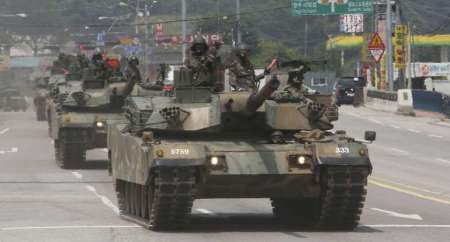
South Korean army K-1 tanks move during the annual exercise in Paju, South Korea, near the border with North Korea, on July 5, 2017. (AP Photo/Ahn Young-joon)

China and Russia issued a joint statement calling Pyongyang’s ICBM test “unacceptable.”

“The two sides propose that the DPRK (North Korea) as a voluntary political decision declares a moratorium on testing nuclear explosive devices and ballistic rocket launches, and the US and South Korea refrain from carrying out large-scale joint exercises,” the statement said. “Parallel to this, the opposing sides should start negotiations and affirm general principles of their relations including the non-use of force, rejection of aggression and peaceful co-existence.”

“Neither one of them is doing a darn thing to stop North Korea. And they want to use it as an excuse to push us out of the region,” he added. “What we have to make clear to them is it’s going to have the exact opposite effect. Once North Korea is able to threaten us and even now, as they threaten our allies, we have to be in there to protect our own interests. 

******************************

The top Democrat on the House Armed Services Committee declared this morning that the “threat from North Korea, regrettably, is not going to be removed” by the “global action” proposed by the Trump administration to curb Kim Jong-un’s behavior.

Pyongyang said Tuesday that it successfully test-fired Hwasong-14, a long-range intercontinental ballistic missile. According to Chosun Ilbo in South Korea, state TV in the North declared the regime “a full-fledged nuclear power… possessed of the most powerful intercontinental-ballistic rocket capable of hitting any part of the world.”

Kim reportedly watched the launch at the scene. The missile, said to be capable of reaching Alaska or Hawaii, flew for 39 minutes before hitting open waters.

Secretary of State Rex Tillerson issued a statement Tuesday evening condemning the July Fourth launch. “Testing an ICBM represents a new escalation of the threat to the United States, our allies and partners, the region, and the world,” he said. “Global action is required to stop a global threat.”

“Any country that hosts North Korean guest workers, provides any economic or military benefits, or fails to fully implement UN Security Council resolutions is aiding and abetting a dangerous regime. All nations should publicly demonstrate to North Korea that there are consequences to their pursuit of nuclear weapons. We intend to bring North Korea’s provocative action before the UN Security Council and enact stronger measures to hold the DPRK accountable,” Tillerson continued.

“The United States seeks only the peaceful denuclearization of the Korean Peninsula and the end of threatening actions by North Korea. As we, along with others, have made clear, we will never accept a nuclear-armed North Korea.”

President Trump and his national security team “are continuing to assess the situation in close coordination with our allies and partners,” he added.

Armed Services Committee Ranking Member Adam Smith (D-Wash.) doubted that Tillerson’s vow would put pressure on North Korea.

“If there is an idea floating around out there for how we can remove that threat, I’m open to it. But we have been circling around this discussion of what we want China to do and what we want sanctions to do and all these other different pieces,” Smith said. “The bottom line is, what we need against North Korea, we need to put the best economic sanctions we can. I think it’s perfectly appropriate for the secretary of state to try to put pressure on other nations to do the same. But the most important thing we need is a credible military deterrent, so that whatever North Korea does in terms of building a missile, they know that if they act against South Korea or against Japan or against us, we will obliterate them.”

“That’s why THAAD [missile defense system] is important. That is why our alliance with South Korea and Japan is important, to have that credible military force, because what’s been proven — and all of the options have been discussed with your previous guests — is that North Korea is going to do it. They want to build nuclear weapons. They want to develop an intercontinental ballistic missile. And short of an all-out war on the Korean Peninsula, we don’t really have an option for stopping them.”

China and Russia issued a joint statement calling Pyongyang’s ICBM test “unacceptable.”

“The two sides propose that the DPRK (North Korea) as a voluntary political decision declares a moratorium on testing nuclear explosive devices and ballistic rocket launches, and the US and South Korea refrain from carrying out large-scale joint exercises,” the statement said. “Parallel to this, the opposing sides should start negotiations and affirm general principles of their relations including the non-use of force, rejection of aggression and peaceful co-existence.”

Smith slammed the statement as “spectacularly disingenuous.”

“Neither one of them is doing a darn thing to stop North Korea. And they want to use it as an excuse to push us out of the region,” he added. “What we have to make clear to them is it’s going to have the exact opposite effect. Once North Korea is able to threaten us and even now, as they threaten our allies, we have to be in there to protect our own interests. China’s not acting against North Korea. And the reason they’re not acting against North Korea is, they don’t want to cut off North Korea’s economic aid. They don’t want North Korea to collapse because they don’t want millions of North Korean refugees pouring across their border. They’re not happy that North Korea is causing such instability in the region, but the alternative of them trying to crush the regime somehow is something they’re not willing to do, and they haven’t been willing to do it through four administrations. So, we need a credible military deterrent, and that is our only option.”

Smith noted that Kim’s actions have been “all about ensuring regime survival,” as he’s “looked at Iraq and Afghanistan and Libya, and they feel that unless they have a nuclear weapon and a credible deterrent of their own, that their regime is in jeopardy.”

“So, all the economic sanctions, all that needs to be done. But understand what I’m saying here. As you have discussed, there is not a good military option,” he said. “Thinking that we can preemptively go in there and somehow take out their capabilities, whatever we do leads to a massive war in the Korean Peninsula… we need our THAAD system in the region. We need a system to give us a shot at shooting down that missile if they decide to launch it. And then we also need a clear diplomatic policy that we will destroy them.”

After the THAAD system was installed in South Korea, Trump said Seoul should fork over a billion dollars for the missile defense. New South Korean President Moon Jae-in recently suspended further THAAD deployment pending a review of the program.

Smith stressed that Russia and China must “stop screwing around.”

“If you guys really want us to be less involved in the region, then you have got to figure out a way to control North Korea,” he said. “Now, I don’t think they’re going to do that. But that means that we have to stay active in the region.”

North Korean Missiles Reaching USA

July 5, 2017

North Korean Missiles Reaching USA, Front Page MagazineMatthew Vadum, July 5, 2017

(Peace talks have failed and the leftist view seems to be “if at first you don’t succeed try the same thing again.” President Trump does not agree and is no longer willing to rely on China. He recently tweeted, “Trade between China and North Korea grew almost 40% in the first quarter. So much for China working with us – but we had to give it a try!” Please see also, Trump Hits China Over Trade Relationship With North Korea. If, as is now apparent, China wants more fruitless negotiations, it’s time to employ our military resources to eliminate North Korea’s nuclear and missile capabilities. An EMP attack could be effective.– DM)

But Americans are finally being disabused of left-wing arms control fantasies, and fortunately, after eight years of dithering and appeasement, we now have a president who actually wants to defend the country from external threats.

And alongside President Trump there are serious adults in the White House and Foggy Bottom willing to respond with an appropriate show of force to the latest provocation from Pyongyang and take other necessary action.

Pentagon spokesman Dana White said “we remain prepared to defend ourselves and our allies and to use the full range of capabilities at our disposal against the growing threat from North Korea.”

*************************************

Less than six months into Donald Trump’s presidency America has awakened to the nightmare of a North Korea armed with intercontinental ballistic missiles that the Trump administration says are capable of reaching Alaska.

U.S., South Korean, and Japanese officials say the North Korean Hwasong-14 ICBM flew approximately 580 miles in 40 minutes and achieved an altitude of 1,500 miles, besting previously reported North Korean test results. North Korea’s successful but unexpected test is a sobering reminder of how urgently the United States needs to ramp up its antiballistic missile program after years of reckless military downsizing by the Obama administration.

The North Korean launch was “the big story we have all been waiting for,” Professor Bruce Bechtol of Angelo State University in Texas told Fox News on Tuesday. “All of the paradigms have changed. It is now time to see what action the USA will take.”

The missile was apparently launched from a mobile launcher, which “nearly destroys our warning time and also means that the North Koreans have a real shot at launching this system at us without us being able to destroy it on the ground.”

North Korea also carried out a successful ballistic missile test on May 14, and the U.S. Missile Defense Agency conducted its first successful interception of an ICBM on May 30. A long-range ground-based interceptor missile launched from Vandenberg Air Force Base in California hit and destroyed the ICBM launched from the U.S. Army’s Reagan Test Site on Kwajalein Atoll in the Marshall Islands.

This idea of missile defense, oft-compared to trying to shoot a bullet with another bullet, grew out of President Reagan’s Strategic Defensive Initiative (SDI), derided by left-wingers at the time and for years after as “Star Wars.” Unsurprisingly, Barack Obama used to scoff at the idea that a missile could take out another missile.

Meanwhile, Monday evening after news of the successful Hwasong-14 ICBM test broke, President Trump took to Twitter.

North Korea has just launched another missile. Does this guy have anything better to do with his life? Hard to believe that South Korea and Japan will put up with this much longer. Perhaps China will put a heavy move on North Korea and end this nonsense once and for all!

Apparently, “this guy” refers to dictator Kim Jong-un. Communist China has been propping up Kim’s dictatorship for years. The Trump administration wants China to push its North Korean ally harder to scrap its nuclear weapons program.

During Independence Day remarks at a picnic for military families on the South Lawn of the White House Trump did not refer to North Korea’s activities but said, “we do have challenges, but we will handle those challenges. Believe me.”

How did we get to this dangerous juncture in world affairs?

Blame the Left. After all, it’s not rocket science.

While left-wingers in Washington were busy reaching out to Islamofascists and projecting American weakness on the international scene over the eight long years of Barack Obama’s presidency, Kim Jong-il and his heir Kim Jong-un were busy transforming their Stalinist hellhole of a country into a nuclear power. They were aided not just by the permissive Obama administration, which did more or less nothing to curb Pyongyang’s nuclear ambitions, but also years earlier by the enabling Clinton administration.

In 1994 Bill Clinton unveiled an agreement between the U.S. and North Korea that he claimed would achieve “an end to the threat of nuclear proliferation on the Korean Peninsula.” Under the deal, North Korea “agreed to freeze its existing nuclear program and to accept international inspection of all existing facilities,” Clinton said at the time. The pact “is good for the United States, good for our allies, and good for the safety of the entire world.”

But Americans are finally being disabused of left-wing arms control fantasies, and fortunately, after eight years of dithering and appeasement, we now have a president who actually wants to defend the country from external threats.

And alongside President Trump there are serious adults in the White House and Foggy Bottom willing to respond with an appropriate show of force to the latest provocation from Pyongyang and take other necessary action.

While American and South Korean forces conducted joint ballistic missile drills following the North’s ICBM test, Secretary of State Rex Tillerson said yesterday that the U.S. government would “never accept a nuclear-armed North Korea.” He urged countries around the world to fully enforce UN sanctions against the rogue nation, saying “global action is required to stop a global threat.”

Pentagon spokesman Dana White said “we remain prepared to defend ourselves and our allies and to use the full range of capabilities at our disposal against the growing threat from North Korea.”

The UN Security Council may convene an emergency meeting as soon as today. On Twitter, U.S. Ambassador to the UN Nikki Haley demonstrated her exasperation at having to devote her Independence Day holiday to emergency consultations by using the hashtag “#ThanksNorthKorea.”

Haley doesn’t have it quite right. If she wants to sarcastically “thank” anybody for the North Korean ICBM test, she should be “thanking” Barack Obama and Bill Clinton, whose suspect policies helped a pariah nation join the nuclear club.

Hmm: China’s National Oil Firm Cuts Off North Korea

June 28, 2017

Hmm: China’s National Oil Firm Cuts Off North Korea, Hot Air, Ed Morrissey, June 28, 2017

Beijing had already cut off coal imports from North Korea, depriving Kim of income that could have been used to pay for the fuel. It looks like a squeeze, one that may be picking up in intensity, and one that sends a direct message to North Korea’s military leaders, who will understand only too well what a fuel embargo will do to their readiness posture. It won’t take much more for the situation to reach critical mass on the Korean peninsula.

***********************

Has North Korea run out of credit with China, or has Beijing finally run out of patience with Pyongyang? China’s state-run petroleum operation has cut off fuel sales to rogue nation, Reuters reports, ostensibly due to a lack of payment. However, it’s no secret that the Trump administration has put a lot of pressure on Beijing to get tougher with the Kim regime, and a fuel cutoff will hit Kim Jong-un where he’s most vulnerable:

China National Petroleum Corp has suspended sales of fuel to North Korea over concerns the state-owned oil company won’t get paid, as pressure mounts on Pyongyang to rein in its nuclear and missile programmes, three sources told Reuters.

It’s unclear how long the suspension will last. A prolonged cut would threaten critical supplies of fuel and force North Korea to find alternatives to its main supplier of diesel and gasoline, as scrutiny of China’s close commercial ties with its increasingly isolated neighbour intensifies.

North Korea needs the fuel not just for its farmers and shipping, but also for its military. That presents a particularly difficult problem for Pyongyang’s leaders, who already operate in a crisis-shortage environment. Kim can’t afford to cut back on military supplies, not with all of the saber rattling taking place at the moment, which means he’ll have to starve the rest of the country of fuel resources, which will hamper food production and distribution even further. It will ratchet up internal tension, and it might get worse if military needs can’t be satisfied.

CNPC won’t sell the fuel on credit, Reuters’ Chen Aizhu notes, which means that Pyongyang is having trouble coming up with hard currency. Aizhu’s source says the issue came up over “the last month or two,” and that timing is intriguing. Four months ago, Kim ordered a bizarre assassination of his older brother Kim Jong-nam, using VX nerve agent in the airport of Malaysia’s capital of Kuala Lumpur.  The target and especially the weapon made it clear who ordered the hit, and Malaysia — one of the few nations willing to do business with North Korea — cut off diplomatic and economic ties to Pyongyang, which set off a round of hostage-taking by the Kim regime. Malaysia had been a key partner in avoiding international sanctions and a vital link to hard currency for Pyongyang until the assassination. If North Korea has had trouble paying for diesel and gasoline over the last couple of months, it might signal that Pyongyang has no more options for avoiding sanctions and that its economic back is against the wall, so to speak.

Aizhu’s sources say that this was a “commercial decision,” but nothing’s that simple in China. Beijing had already cut off coal imports from North Korea, depriving Kim of income that could have been used to pay for the fuel. It looks like a squeeze, one that may be picking up in intensity, and one that sends a direct message to North Korea’s military leaders, who will understand only too well what a fuel embargo will do to their readiness posture. It won’t take much more for the situation to reach critical mass on the Korean peninsula.

Spotlight: China, U.S. reach consensus at high-level security dialogue

June 24, 2017

Spotlight: China, U.S. reach consensus at high-level security dialogue, XinhuaNet, June 24, 2017

(The words sound friendly, but what do we get at what cost? — DM)

Chinese State Councilor Yang Jiechi (1st R) co-chairs a diplomatic and security dialogue with U.S. Secretary of State Rex Tillerson (1st L) and Secretary of Defense James Mattis (2nd L) as Fang Fenghui (2nd R), a member of China’s Central Military Commission (CMC) and chief of the CMC Joint Staff Department, also participates in the dialogue in Washington D.C., the United States, on June 21, 2017. China and the United States began their first diplomatic and security dialogue on Wednesday at the U.S. State Department in Washington D.C. (Xinhua/Yin bogu)

At the dialogue, China the United States agreed to work closely on the Korean Peninsula’s nuclear issue.

Both countries reaffirmed their commitment to achieving the goal of “complete, verifiable and irreversible” denuclearization on the Peninsula.

*********************

WASHINGTON, June 23 (Xinhua) — China and the United States reached an important consensus on the development of bilateral relations and security issues at a high-level dialogue held Wednesday in the U.S. capital of Washington D.C.

The First Round of China-U.S. Diplomatic and Security Dialogue, which was described by both sides as “constructive” and “fruitful,” represents a major step in implementing the consensus reached by Chinese President Xi Jinping and his U.S. counterpart Donald Trump during their meeting in Florida in April.

Looking ahead, the two sides pledged to expand mutually-beneficial cooperation and manage differences on the basis of mutual respect, all in a bid to promote the steady development of China-U.S. relations in the long term.

FREQUENT DIALOGUES

Following Wednesday’s dialogue, U.S. Secretary of State Rex Tillerson said such talks “provide an opportunity to consider how we’re going to engage and how we’re going to live with one another over the next 40 years.

“The action items we have agreed upon today have set a foundation for additional areas of cooperation and we look forward to our next interaction at this level and between our two presidents,” said the top U.S. diplomat.

Emphasizing the importance of high-level exchanges, China and the United States expressed their willingness to achieve a positive outcome for the Hamburg meeting between the two Presidents in July and Trump’s state visit to China later this year.

Meeting with Chinese State Councilor Yang Jiechi at the White House on Thursday, Trump said he looked forward to meeting with Xi in Hamburg and visiting China. He also hoped that these high-level interactions will further promote the development of U.S.-China relations.

PRODUCTIVE MILITARY RELATIONSHIP

Fang Fenghui, a member of China’s Central Military Commission (CMC) and chief of the CMC Joint Staff Department, participated in the dialogue co-chaired by Yang, Tillerson and U.S. Secretary of Defense James Mattis.

At the dialogue, China and the United States recognized that their military-to-military relationship is an important component in the bilateral ties. The two sides agreed that the relationship between the militaries of the two powers should be “constructive, pragmatic, and effective,” according to a statement released Friday.

China and the United States are committed to implementing the annual military exchange program and enhancing high-level engagements, starting with the visits between the two defense ministers and the visit of the Chairman of the U.S. Joint Chiefs of Staff to China as soon as possible.

The two sides also “reaffirm the importance of building mutual understanding, and of reducing the risk of miscalculation between our two militaries,” said the statement.

MAINTAINING COORDINATION ON KOREAN PENINSULAR ISSUE

At the dialogue, China the United States agreed to work closely on the Korean Peninsula’s nuclear issue.

Both countries reaffirmed their commitment to achieving the goal of “complete, verifiable and irreversible” denuclearization on the Peninsula.

“The two sides are ready to continue their efforts to this end, including by fully and strictly implementing relevant United Nations Security Council resolutions, and by promoting relevant dialogue and negotiation,” said the statement.

The two countries also reaffirmed their commitment to maintaining peace and stability on the Peninsula, according to the statement.

John Bolton: Trump ‘in the Right Place’ on North Korea, but State Dept. Continues 25 Years of Failed Policy

June 23, 2017

John Bolton: Trump ‘in the Right Place’ on North Korea, but State Dept. Continues 25 Years of Failed Policy, BreitbartJohn Hayward, June 23, 2017

(Reunification of North and South Korea would be very expensive for South Korea and may not be as appealing to South Korea as it once was. China is very much opposed because it perceives — wrongly in my view — a unified Korea on its border as a threat. How about unification of North Korea and China instead? — DM)

“We’ve tried that for 25 years with respect to the nuclear program. It has had no effect. I don’t think you can change the behavior of the North Korean regime because I don’t think you can change its character,” he said.

“That, to me, is why the only real solution to eliminate the nuclear threat, to stop this treatment of both foreigners and their own citizens, to give the people of North Korea a chance for a decent life, you have to end the regime. My own view is you reunite North and South Korea. The U.S. has to persuade China it’s in their interests to do it. It’s a heavy lift. I acknowledge that. But otherwise, we just keep doing what we’ve done ever since this regime was formed shortly after World War II. It only respects force, and nobody wants to see use of force on the Korean peninsula today, with its potentially tragic consequences,” said Bolton.

“The State Department can keep doing what it’s done unsuccessfully for 25 years. Year 26 is going to be exactly the same. I think we’ve got to try something very, very different. If we don’t, we’re going to get the same result,” he cautioned.

Bolton said he thinks President Trump himself is “in the right place on this.”

********************************

On Friday’s Breitbart News Daily, former U.N. ambassador John Bolton talked about the death of American student Otto Warmbier, recently released from more than a year of captivity in North Korea, most of which he spent in a coma. He also discussed what Warmbier’s death means for America’s North Korea policy moving forward. Bolton then looked at the one-year anniversary of the Brexit vote and U.S. policy toward the Israeli-Palestinian conflict.

“It’s obviously a personal tragedy,” Bolton told SiriusXM host Alex Marlow. “Here’s a perfectly healthy young man, goes to North Korea, and comes back and dies a few days later. Obviously, we are all feeling for his family and his friends.”

“But I think for the United States as a whole, the lesson here is about the character of the North Korean regime: that they’re so barbaric, that even if you take everything they say as true, that Otto Warmbier stole a political poster – you know, that’s what college kids do. Slap him on the wrist, put him in jail for a day, kick him out of the country. That’s what civilized countries do, but not North Korea,” he said.

“Not only did they brutalize him; they lied about it consistently for a year-and-a-half,” he noted. “They’re still holding three other Americans. They have a long history of kidnapping South Korean and Japanese citizens over the past several decades. This is the way they treat foreigners. They run a 25-million-person prison camp in their own country, under just horribly primitive conditions for most citizens. And they’re pursuing deliverable nuclear weapons and appear to be pretty close to achieving that.”

“This is not a regime that you can reason with in the same sense Americans think of that term,” Bolton contended. “They may be rational in terms of the regime in North Korea, but it’s not rational in our terms. That’s why I’m somewhat distressed with the Trump administration reaction, or at least the State Department reaction of saying, ‘Well, we’re just going to apply more pressure on North Korea to get them to change their behavior.’”

“We’ve tried that for 25 years with respect to the nuclear program. It has had no effect. I don’t think you can change the behavior of the North Korean regime because I don’t think you can change its character,” he said.

“That, to me, is why the only real solution to eliminate the nuclear threat, to stop this treatment of both foreigners and their own citizens, to give the people of North Korea a chance for a decent life, you have to end the regime. My own view is you reunite North and South Korea. The U.S. has to persuade China it’s in their interests to do it. It’s a heavy lift. I acknowledge that. But otherwise, we just keep doing what we’ve done ever since this regime was formed shortly after World War II. It only respects force, and nobody wants to see use of force on the Korean peninsula today, with its potentially tragic consequences,” said Bolton.

“The State Department can keep doing what it’s done unsuccessfully for 25 years. Year 26 is going to be exactly the same. I think we’ve got to try something very, very different. If we don’t, we’re going to get the same result,” he cautioned.

Bolton said he thinks President Trump himself is “in the right place on this.”

“I think he, as much as anybody – maybe more than anybody in his administration – understands the danger of North Korea’s nuclear weapons program,” Bolton added. I think he understands and said publicly what a terrible treatment Otto Warmbier received. It should never happen to anybody and shouldn’t happen again.”

“He’s just tweeted a few days ago he doesn’t think China has delivered on the commitments Xi Jinping made when he was here in the United States at the Mar-a-Lago summit. What Trump said then, what he’s implied in the tweet, is that China’s jiving us again – as they have been on North Korea for 25 years, and the United States will have to solve this on its own,” he said.

“The question is whether the bureaucracy responds to the president. At this point, I don’t see it, unfortunately. I don’t rule it out. Obviously, things could be happening that are not public yet. But I think the president’s in one place, and the bureaucracy is in another. The bureaucracy’s in the same place on North Korea it has been for 25 years. It just doesn’t change,” he lamented.

Bolton’s policy recommendations for North Korea included restoring “all of the sanctions previously imposed on North Korea.”

“I would correct the Bush administration’s…one of Condi Rice’s worst mistakes is taking North Korea off our list of state sponsors of terrorism. I would put them right back on that list. They’re not only state sponsors, they are terrorists themselves, given this treatment of Otto Warmbier and many others, American and non-American alike,” he declared.

“I’d put the pressure on, no doubt about it, but I think we’ve got to be realistic: it’s not going to work. It’s not going to change their behavior. They’ll find ways to evade it. Sanctions have been evaded by the North Koreans successfully with the help of China and Russia for decades. We’ve got to have a very straight talk with China about reunification, and if that doesn’t work, then our options are limited and unattractive,” Bolton warned.

Marlow turned to Britain’s exit from the European Union, which reached its one-year anniversary on Friday. He noted that very little progress has been made during the past year.

“It’s disappointing, I must say,” Bolton agreed. “It’s due to several factors. It’s due to the fact that, obviously, David Cameron had to be replaced as prime minister. I think the supporters of leaving the European Union in the Conservative Party hoped to get a champion of the Leave position in as prime minister. That didn’t happen, although Theresa May seemed to be prepared to negotiate for a hard Brexit if necessary. But then she called this snap election, and it seemed like a brilliant move at the time, but it’s resulted in the Conservative Party actually losing seats in the House of Commons, so they’re in disarray.”

“I think it’s going to be hard for Theresa May to survive politically, so you’ve had this turmoil in domestic politics that’s gotten in the way of negotiations,” he said. “I think that those who advocated Leave just need to grit their teeth and continue on because the decision to leave was then, and is today, the right decision for Britain.”

“The elites, the high-minded in Europe and in Britain and in America, all think that they should reverse their decision. That’s not going to happen. People need to get used to that,” he said.

“I think President Trump said some time ago he wanted to step up and establish a bilateral trade relationship between the U.S. and a U.K. no longer in the E.U. I think we should be moving ahead on that,” Bolton advised. “There are certain constraints the Brits face, but we can lay out the big principles so that businesses and financial services institutions on both sides of the Atlantic know what’s coming. I think it’s a win-win for the U.S. and the U.K., and I hope we pay more attention to that.”

“As hard and as unproductive as the past year has been, the fundamental decision remains correct. They just need to fight through it,” he said.

Marlow observed that the hard British left has been working out an alliance with Islamists. “It seems like the encroaching Islamist philosophies of Islamism are becoming much more prevalent and more accepted, and it seems like the priorities of the folks in the Jeremy Corbyn wing of British politics seem to be getting a much more powerful voice than I was anticipating,” he said.

“I must say, within the Labor party in Britain, the only religion that seems to be favored is Islam,” Bolton replied. “Christianity, Judaism are old-fashioned. The levels of anti-Semitism in the Labor party are at historically high levels. I think it has to do with their ideology. I think that this self-segregation, this unwillingness to join the broader U.K. culture, is a huge potential problem.”

“You know, none of the European countries have the concept of the melting pot the way we do in the United States, where people come from all over the world and get into the melting pot and emerge as Americans,” he pointed out. “It’s a huge strength of the United States. It’s why we’ve been a draw for people from all over the world forever. They understand that when they come here, they’re going to do something very different in their lives. They’re going to join a nation that is unique in the world, founded on an idea, and they change.”

“When we’ve seen in recent years people coming to this country who don’t want to get into the melting pot, who don’t want to be Americanized – they don’t even like that word; I think it’s a word we should use more often – it’s a problem for us,” he added.

“The Brits are the closest of the European countries to having that ability, but it’s been failing them for a number of years. It doesn’t work at all on the continent of Europe itself. I think this split within society, this view that some can live under sharia law, everybody else will live under the regular English legal system, is the beginning of the end of the democratic society. I don’t want to be apocalyptic about it, but I think that’s the direction it’s moving in,” Bolton said.

“The Europeans are in the midst of a decision whether they understand it or not, given the hundreds of thousands – indeed, millions – of refugees and migrants that are coming from North Africa and the Middle East,” he contended. “This is a process that’s been in play for a long time. Maybe they don’t care so much about their cultural identity. That’s their choice to make, if they want to lose it. But there are demographic trends at play here that could foreshadow a very different Europe by the end of this century. If they don’t insist on integration into the broader society, then it won’t happen.”

“In the United States, people have come here historically because they want to become Americans. They want to shed some of the baggage of the countries they’re leaving from. To the extent we suffer from that same European problem, we will have the same issues here – maybe a little bit later than the Europeans, but inevitably, we will face the same problems,” he predicted.

“I think it’s emblematic of this unwillingness to deal with this issue that you’re seeing almost daily acts of terrorism across Europe. It hasn’t happened here yet, but we’re beginning to see that pattern, and I think it’s only going to get worse,” said Bolton.

Marlow asked for Bolton’s view of the visit by President Trump’s son-in-law Jared Kushner to the Middle East and the persistent issue of Palestinian payments to the families of suicide bombers, blatantly encouraging violence in a way that makes talk of a “peace process” farcical.

Bolton agreed these payments to the families of terrorists are “a very significant issue.”

“Secretary of State Tillerson testified – I think it’s about two weeks ago now – that the Palestinian Authority said it wasn’t going to make such payments anymore,” he recalled. “The next day, the government of Israel said that’s not true; it’s still going on.”

“You’ve got a fundamentally different perspective on many, many things in that region,” he said. “I think Jared Kushner, I think the president himself, are approaching this in good faith with a good heart. They want to see what they can do. I’ve believed for some time, however, that the two-state solution has run into a dead end. It’s not going to work. It’s not doable. The Palestinian Authority doesn’t have the legitimacy or the capability of making commitments and then carrying them out. I think you’ve got to look at something radically different.”

“I just have to say, as my honest diplomatic and political assessment, repeating the Middle East peace process as we’ve known it this past forty or fifty years, the idea of a two-state solution, isn’t going to go anywhere,” Bolton concluded.