Posted tagged ‘Chechens’

Russia posts troops 8km from the Israeli Golan

July 25, 2017

Russia posts troops 8km from the Israeli Golan, DEBKAfile, July 25,2017

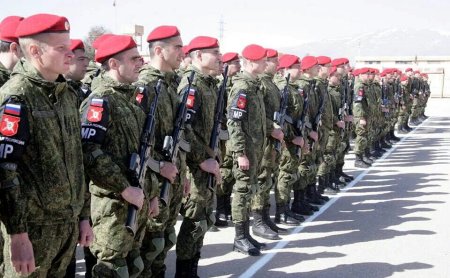
Most of the Russian troops were recruited in Chechnya, Dagestan and Ingushetia, republics known for their Muslim extremist activity.

DEBKAfile recalls that the Russians brought into embattled Daraa earlier this month to monitor the first ceasefire zone did not require Hizballah to withdraw. Iran’s Lebanese proxy is still there. Israel fears that Hizballah will repeat this exercise in the second ceasefire zone and establish a presence opposite the Golan without the Russians raising a finger to keep them out.

*******************************************

Russia has quietly moved troops to a point in southern Syria that is 8km from Israel’s Golan border, in the face of Israeli objections, DEBKAfile reports exclusively. Moscow used the uproar over the Temple Mount standoff and the diplomatic crisis between Israel and Jordan to cover its creeping troop deployment almost up to Syria’s borders with Israel and Jordan.

Tuesday, July 15, Prime Minister Binyamin Netanyahu, Defense Minister Avidor Lieberman and Chief of Staff Lt. Gen. Gady Eisenkott visited Bashan Division headquarters on the Golan for a rundown on the Russian deployment just opposite. (see photo)

DEBKAfile’s military sources report that some 800 Russian troops face Israel and another 400 are positioned on the border with Jordan. They have set up a roadblock east of Quneitra 8km from Israeli positions on the Golan. They have also strung an additional four to six lookout posts, some of them 13km from Israeli military positions, along the 64km Syrian-Israeli border – from Mount Hermon in the north, up to a point south of Qunetra in the south.

Most of the Russian troops were recruited in Chechnya, Dagestan and Ingushetia, republics known for their Muslim extremist activity.

Israel has repeatedly objected to the proximity of this Russian military presence, and asked the Trump administration to prevent it. But the protests from Jerusalem went unheeded in Washington and Moscow. President Donald Trump and Defense Secretary James Mattis regard the creation of US-Russian sponsored ceasefire zones in southwestern Syria as an essential component of their military cooperation in Syria and the war on ISIS.

DEBKAfile’s military sources report that, on Monday, July 24, Moscow announced the Russian deployment after the fact in messages to Washington, Jerusalem and Amman. They were all too engrossed in coping with the crises that had sprung up over Temple Mount and in relations between Jerusalem and Amman to pay much attention to this Russian fait accompli.

According to the announcement by Col.-Gen Sergey Rudskoy, Chief of the Main Operational Directorate of the Russian General Staff, the Russian units were in already in place on July 21 and 22:

“We informed our colleagues from the United States, Jordan and Israel, through military diplomatic channels in advance of the deployment of the Russian-controlled forces around the perimeter of the de-escalation zone in southern Syria,” he wrote.

DEBKAfile recalls that the Russians brought into embattled Daraa earlier this month to monitor the first ceasefire zone did not require Hizballah to withdraw. Iran’s Lebanese proxy is still there. Israel fears that Hizballah will repeat this exercise in the second ceasefire zone and establish a presence opposite the Golan without the Russians raising a finger to keep them out.

The Ukraine-ISIS Alliance

November 30, 2015

The Ukraine-ISIS Alliance, American ThinkerSierra Rayne, November 30, 2015

In July, the New York Times was reporting that three full Islamic battalions were fighting in eastern Ukraine.

What a mess. The question for the West now is who they would rather having controlling Ukraine’s territory in the near future — ISIS or Russia — and the answer is clearly the latter. If the West wants to build a common coalition against the Islamic State, the best approach may be to remove the Islamic State of Turkey from NATO, allow Russia to take Ukraine, and then invite Russia into NATO (or whatever new alliance seems appropriate) in our common cause against the global jihad.

***********************

Back in February, The Intercept was the first media outlet to reveal clear linkages between ISIS and Ukraine. The article by Marcin Mamon begins by recounting how the leader of the Islamic State’s underground branch in Istanbul was headed to Ukraine to join other members of ISIS in fighting those from Eastern Ukraine that want further autonomy from Kiev and a likely political alliance with Moscow.

Immediately we have a problem. It is unlikely that many average citizens in the West are aware that ISIS is fighting on the side of the Ukraine nationalists. If they were, public opinion might drastically shift towards support for Russia — as it should. Better to have Ukraine be a proxy state of Russia than yet another budding member of the global Islamic Caliphate taking shape.

Any arguments that ISIS is helping Ukrainian nationalists fight the Russian backed separatists out of the goodness of its heart, and that ISIS will just pack up and leave Ukraine if a victory is won, strain all measures of credulity. If the Russian separatists lose in eastern Ukraine, Ukraine may very well be on the path to falling under control — at least partially — of ISIS, placing ISIS with a state under its control on the borders of several NATO members. Did the West possibly back the wrong horse in Ukraine? Should we instead have supported Russia?

Kiev has become an important access point for ISIS terrorists into Western Europe:

Ukraine is now becoming an important stop-off point for the brothers, like Ruslan. In Ukraine, you can buy a passport and a new identity. For $15,000, a fighter receives a new name and a legal document attesting to Ukrainian citizenship. Ukraine doesn’t belong to the European Union, but it’s an easy pathway for immigration to the West. Ukrainians have few difficulties obtaining visas to neighboring Poland, where they can work on construction sites and in restaurants, filling the gap left by the millions of Poles who have left in search of work in the United Kingdom and Germany.

Remarkably, Justin Raimondo at the website Antiwar.com predicted the problems this would cause back in early March of this year:

We are told that ISIS is planning terrorist attacks in Europe, and security forces are busy rounding up suspects all across the continent – and yet here is this gaping hole in the West’s defenses, where “the brothers” are quietly infiltrating without much notice in the Western media. In cooperation with ultra-nationalist groups like Right Sector, which have also formed their semiautonomous battalions, the Islamists of Ukraine, brandishing Ukrainian passports, have opened a gateway to the West …

As US aid flows into Ukraine, how much of it will trickle down to these allies of ISIS — and to what future use will it be put? If John McCain and Lindsey Graham have their way, US arms will soon find their way into the hands of these terrorists, whose jihad against the Russians is bound to turn westward and strike at the capitals of Europe.

This is blowback with a vengeance: we are creating our own enemies, and giving them the weapons to harm us, even as we claim the need for universal surveillance in order to fight them. The mad scientists formulating US foreign policy are raising an army of Frankenstein monsters — who are sure to come after their deluded creators.

Like clockwork, eight months later we have the Paris attacks.

In July, the New York Times was reporting that three full Islamic battalions were fighting in eastern Ukraine. At about the same time, Elliot Friedland in The Jewish Voice was warning against the problems arising from this Islamic incursion in Ukraine:

Yet there are Islamist paramilitary battalions fighting alongside Ukrainian forces, which are aligned with the Islamic State and Chechen Islamist factions. If the U.S. steps up military aid to Ukraine, whose army is notoriously corrupt it may fall into the hands of Islamist battalions currently funded by a mixture of Ukrainian oligarchs, Gulf patrons, violent crime and extortion. The Ruskayya Blatina website said that a few militias belonging to the terrorist group ISIS began to fight against the Russian soldiers in Ukraine with support from the American authorities who gave recommendations to the Ukrainian government regarding the Islamic State … Islamic State-aligned fighters also use Ukraine as a cheap and easy place to buy weapons, which can then be smuggled to Iraq and Syria and Chechenya.

During the past two months, connections between Ukraine and ISIS have moved up the chain of command, as evidenced by a top Ukrainian official giving his public support for ISIS. Just last week, weapons — including a FN-6 antiaircraft missile system — from the Ukrainian military “magically” ended up in the hands of ISIS which “were meant to be delivered to the militant group in Syria via smuggling routes in Turkey.”

Soon after, the Russian hacking group CyberBerkut claimed it is “in possession of documents indicating that employees of the Ukrainian state-owned defense conglomerate Ukroboronprom had discussions with Qatari government officials over the possible sale of surface-to-air missiles [the S-125-2D Pechora-2D (NATO reporting name SA-3 Goa)] in September,” weapons that were almost undoubtedly destined for ISIS. According to the leaked documents, the U.S. embassy in Doha also approved the deal.

What a mess. The question for the West now is who they would rather having controlling Ukraine’s territory in the near future — ISIS or Russia — and the answer is clearly the latter. If the West wants to build a common coalition against the Islamic State, the best approach may be to remove the Islamic State of Turkey from NATO, allow Russia to take Ukraine, and then invite Russia into NATO (or whatever new alliance seems appropriate) in our common cause against the global jihad.

“Oh what a tangled web we weave, When first we practise to deceive!” — Sir Walter Scott, Marmion, Canto vi. Stanza 17


Russian marines join Hizballah in first Syrian battle – a danger signal for US, Israel

September 24, 2015

Russian marines join Hizballah in first Syrian battle – a danger signal for US, Israel, DEBKAfile, September 24, 2015

KweirisAir480

[T]he most ominous aspect for the US and Israel of the Russian attack on the Syrian airbase is that Russian marines were combined with Syrian and Hizballah special forces.

*********************

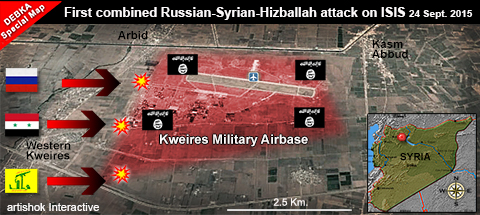
Before dawn on Thursday, Sept. 24, Russian marines went into battle for the first time since their deployment to Syria, DEBKAfile’s military and intelligence sources reveal. Russian Marine Brigade 810 fought with Syrian army and Hizballah special forces in an attack on ISIS forces at the Kweiris airbase, east of Aleppo.

This operation runs contrary to the assurances of President Vladimir Putin to Prime Minister Binyamin Netanyahu on Sept. 21 – just three days ago – that Russian forces in Syria were only there to defend Russian interests and would not engaged in combat with the Syrian army, Hizballah or Iranian troops.

The ISIS force defending the air base is dominated by Chechen fighters under the command of Abu Omar al-Shishani, who is considered one of the terrorist organization’s leading commanders in the last two years. The 27-year-old al-Shishani hails from the Chechen enclave of Pankisi in Georgia, like many others who joined ISIS from 2012.

However, targeting Chechen fighters was not the only reason for the order given by Russian command in Syria to attack the air base.  In DEBKA Weekly 678 of September 11, we predicted that the first Russian mission in Syria would be to break the Syrian rebel siege on Aleppo, Syria’s second-largest city.

As their first step, the Russians would have to prevent the cutoff of highway 5, running from Aleppo to Damascus, and keep it open for Syrian army reinforcements and military equipment to the city.

The offensive to regain Kweiris airbase that fell to ISIS in mid-June is the first step in the implementation of Russia’s operational plan for the Aleppo area.

Meanwhile, little substance was to be found in the reports appearing, mainly in the United States, suggesting that Putin, disappointed by the Obama administration’s unwillingness to send the US Air Force to collaborate with Russia in the fight against ISIS, would try to talk Obama round if and when they meet on the sidelines of the UN General Assembly on September 28.

According to DEBKAfile’s sources, these reports were spread to cover up the serious crisis in the US war against ISIS.

While Russia poured troops and advanced hardware into Syria, establishing bases and launching offensive action, the US anti-Islamic State effort suffered a heavy blow with the decision of Obama’s ISIS war czar, Gen. John Allen, to step down in early November.

Sources close to the general were quoted as referring to his frustration “with the White House micromanagement of the war and its failure to provide adequate resources.”’

The fact that the Russian forces launched their attack on ISIS shortly after the announcement of Allen’s upcoming resignation shows that Putin is not waiting for US cooperation in the war on the Islamist terrorists.    That said, DEBKAfile’s military sources point out that the most ominous aspect for the US and Israel of the Russian attack on the Syrian airbase is that Russian marines were combined with Syrian and Hizballah special forces.

For the first time in 41 years, since the 1974 war of attrition against the IDF on the Golan, Russian troops are fighting alongside Syrian forces. It is also the first time that a world power like Russia is willing to go into battle with an acknowledged terrorist group, such as Hizballah.

Our sources point out that the joint attack was completely counter to the tone and the content of the comments exchanged by Putin and Netanyahu at their summit.

A full report on Russian military activity and strategic objectives in Syria, and a rundown of the content of the Putin-Netanyahu talks in Moscow appear in the coming issue of DEBKA Weekly out Friday, September 25.

Behind Islamic State’s Battlefield Gains, Battle-Hardened Chechens

September 27, 2014

Behind Islamic State’s Battlefield Gains, Battle-Hardened Chechens, Global Security Org via VOA, Mike Eckel, September 26, 2014

“I think that’s a reason why the Islamic State has been as successful as they’ve been,” said Bill Roggio, founder of the Long War Journal, a website that tracks jihadi groups.

“The fighters from the Caucasus, they have experience in fighting professional militaries, the Russians, they’ve been doing guerrilla warfare for decades and this experience is translating to the battlefield,’ he said. ‘They tend to be tactically proficient.”

“These aren’t the guys that go around occupying someone’s villa then sitting around by the swimming pool eating Snickers bars. They are hard fighters,” said Richard Barrett, senior vice president at the Soufan Group, a New York-based security consulting group.

*****************

Among the legions of foreign fighters who have turned the Islamic State into the world’s most dangerous terrorist organization, the Chechens stand out.

They crow on YouTube videos about battlefield successes, wave Arabic language flags referencing the war-torn Russian region, and in some cases, sport striking red beards.

In all, hundreds of fighters from Russia’s North Caucasus, where Chechnya is located, and other Russian-speaking regions are believed to be fighting in Syria and Iraq, alongside the Islamic State and al-Qaida-linked groups like the Al-Nusra Front.

The Chechens aren’t the largest group among the thousands of foreigners in Syria, but they may be playing an outsized role, as many, battle-hardened by years fighting Russian forces, help spearhead the Islamic State’s sweeping successes through Syria and Iraq, experts said.

This bodes poorly not only for U.S. efforts to roll back the Islamic State in the near term, but also could mean a new cycle of violence is looming for Russia’s long-troubled North Caucasus.

And this may be an indication why the U.S. State and Treasury departments on Wednesday slapped new financial sanctions on several top Chechens, and the military units they lead.

“I think that’s a reason why the Islamic State has been as successful as they’ve been,” said Bill Roggio, founder of the Long War Journal, a website that tracks jihadi groups.

“The fighters from the Caucasus, they have experience in fighting professional militaries, the Russians, they’ve been doing guerrilla warfare for decades and this experience is translating to the battlefield,’ he said. ‘They tend to be tactically proficient.”

“These aren’t the guys that go around occupying someone’s villa then sitting around by the swimming pool eating Snickers bars. They are hard fighters,” said Richard Barrett, senior vice president at the Soufan Group, a New York-based security consulting group.

Caucasus calm

After two wars waged by Russia since 1994, the North Caucasus has become relatively stable, free of all-out war and major terrorist attacks.

Poverty, unemployment, corruption and rights abuses still plague the region.

Despite Russian successes in killing leading Chechen militants— Shamil Basayev, Ibn al-Khattab, Abu Hafs al-Hudani, Abu al-Walid, Doku Umarov— the insurgents have not given up, regrouping under a new leader reportedly based in Dagestan, immediately to the east of Chechnya.

Many of those fighters joined the fight in Syria early on, as the uprising that began in 2011 morphed into a chaotic civil war.

Some of the less experienced ones may have been encouraged to gain battlefield experience in Syria by the then-head of the Chechen insurgent network, Doku Umarov, according to Barrett.

Umarov, who founded an organization known as the Caucasus Emirate in 2007, died in August 2013, possibly after being poisoned.

Omar the Chechen

Among those experienced fighters traveling to Syria was Tarkhan Batirashvili, whose nom de guerre is Omar al Shishani.

Batirashvili, an ethnic Chechen, grew up in a remote part of the former Soviet republic of Georgia, and served in the Georgian army, even reportedly battling the Russian armed forces during the August 2008 war.

According to the Treasury Department, Batirashvili this year became a senior military commander for the Islamic State and a member of the Shura Council— a top consultative body to the Islamic State leadership, including al-Baghdadi.

The group Batriashvili used to lead, the Jaish al-Muhajireen wal-Ansar (Army of Emigrants and Supporters), or the Muhajireen Brigade, was among two groups sanctioned by the Treasury Department on Wednesday.

Batirashvili “has assumed a very prominent military command role within IS’ Syria-based operations, with him likely being the most senior operational military commander in Syria,” said Charles Lister, a well-regarded analyst and a visiting analyst with the Brookings Doha Center think-tank, said in an email interview.

“The large majority of IS’ most high-profile offensives on the Syrian side of the border have been connected in some way or another with (his) leadership,” he said.

Among the successes Batriashvili has been credited with, or claimed credit for, was the Aug. 2013 seizure of the Minigh airport near Aleppo, which reportedly featured multiple suicide bombers.

Then there’s Murad Margoshvili, known as Muslim al Shishani, who reportedly served in the air defense division of the Soviet army in Moldova and fought alongside a key leader in the Chechen terrorist circles more than a decade ago.

Margoshvili, who heads a Chechen regiment called Junud al Sham, was one of a dozen individuals hit with State Department sanctions Wednesday. Like Batirashvili, he is notable for having a long red beard.

Elaborately produced videos showing Margoshvili training fighters have been circulating in recent weeks on some YouTube channels.

Another video published Sept. 2 showed Arabic-speaking fighters standing near a Russian fighter jet seized at a Syrian airbase, threatening to liberate the Caucasus from Russian control. The video is subtitled in Russian.

Chechen rifts

The Chechen cause in Syria is not monolithic; different groups have different loyalties, experts said.

And Chechens traditionally have strong identification with their clans or extended family networks, which makes rivalries and turf wars common, at home or abroad.

In Syria, Batirashvili’s decision to pledge allegiance to the head of the Islamic State created a rift among Chechen units, experts said.

Fighters with his former unit, the Muhajireen Brigade, retained their loyalties to the Caucasus Emirate, which had ties to Al-Qaida dating back more than a decade. Lister argued that could strengthen the Caucasus Emirates’ links to Al-Qaida in the long-term.

“I’m sure the Russians are as worried about that as anybody,” Barnett said. “Blowback is always possible. As the Islamic State gets knocked back by the U.S., there’s more of a likelihood that these fighters will be pushed back into other regions” like the Caucasus.

“If history is any judge, you don’t take threats from a group like this, that has shown the capacity to do major attacks in the past, you don’t take these threats lightly,” Roggio said.