Posted tagged ‘Britain and Islamists’

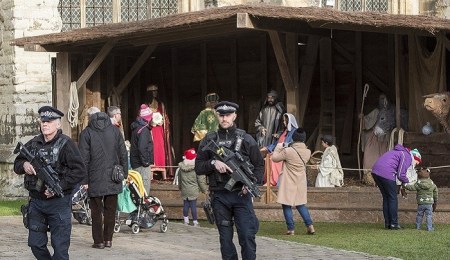
UK: Heavily-armed police guard Canterbury Cathedral nativity scene

December 22, 2016

UK: Heavily-armed police guard Canterbury Cathedral nativity scene, Jihad Watch,

(Islamophobia alert! Nothing to do with the Religion of Peace! Most likely the threat is from those violent Amish nuts again. — DM)

So much for peace on earth and goodwill to all. Who would have thought only two decades ago that a nativity scene would need heavily armed guards? The guards at Canterbury Cathedral situation demonstrates an inherent clash of values.

Christianity is already virtually wiped out in the middle east by jihadist thugs and its well on its way on Western soil, unless Westerners have a change in attitude and wake up.

nativity-scene-guarded

“So much for peace and goodwill to all men: Machine gun police guard Canterbury cathedral and its nativity scene as security is stepped up across the UK in the wake of attack on Berlin”, by Rebecca Camber, Liz Hull and Andy Dolan, Daily Mail, December 20, 2016:

Within the hallowed grounds of one of the most famous Christian buildings in England, the traditional Christmas nativity scene should have been a place of peace and tranquillity.

But yesterday crowds who gathered to appreciate the sacred scene at Canterbury Cathedral were confronted by the fearful sight of armed police bearing assault rifles patrolling the manger where the figure of Baby Jesus lay.

The extraordinary image offers a chilling glimpse of Britain braced for a possible terrorist attack just days before Christmas in the wake of atrocities in Berlin and Turkey.

Security was stepped up dramatically around the UK yesterday after a total of 12 people were killed and 58 injured when a truck was driven into crowds at a Christmas market in Berlin, hours after a Russian Ambassador was assassinated in Turkey on Monday night.

Within hours of the carnage which Islamic State claimed responsibility for, police in Britain responded by throwing a ring of steel around potential major targets including the Changing of the Guard.

In an unprecedented move, Scotland Yard announced that roads around Buckingham Palace would be closed to vehicles from today and additional barriers placed around the guard movements over the next three months.

The measure was described as a ‘necessary precaution’ to protect the substantial number of military personnel and huge crowds drawn to the spectacle which takes place daily between 10.45am and 12.30pm.

Elsewhere in the country, other forces dispatched scores of officers to Christmas markets in towns and cities to prevent a copycat attack….

Police say there is no intelligence to suggest an attack in Britain is imminent.But there are fears that the call from ISIS could lead to a lone wolf attack from any of the 400 militants who have returned here from fighting in Syria or Iraq……

UK Home Office allows jihad preacher banned in Pakistan to preach in UK mosque (but even mosque bans him)

December 12, 2016

UK Home Office allows jihad preacher banned in Pakistan to preach in UK mosque (but even mosque bans him), Jihad Watch

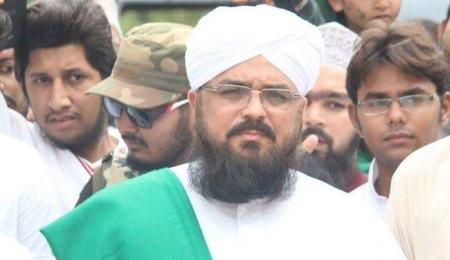
Syed Muzaffar Shah Qadri preaching of hatred and jihad violence is so hardline that he is banned from preaching in Pakistan, but the UK Home Office paused from its banning of foes of jihad terror long enough to welcome into Britain. However, the negative publicity over this move was such that even the mosque that had planned to host him has now canceled, claiming that they are shocked! shocked! to learn that Qadri preaches intolerance, hatred, and violence.

This is the comic opera that is contemporary Britain: the Home Office is so bent on appeasing Islamic supremacists that it goes farther than even mosques in the country are willing to do.

syed-muzaffar-shah-qadri

“Mosque leaders dump plans to host controversial hate preacher exposed by Sunday Post,” by Gordon Blackstock, Sunday Post, December 11, 2016:

MOSQUE leaders have praised The Sunday Post for warning them they had booked a hate preacher so extreme he’s banned in Pakistan.

Last week we exclusively revealed that hardline cleric Syed Muzaffar Shah Qadri had been asked to speak at Falkirk Central Mosque.

The booking came despite the fact the preacher had been banned in his native Pakistan for his hardcore message.

The cleric has openly praised a murderer linked to the killing of Glasgow shopkeeper Asad Shah, 40, who was stabbed 27 times by killer Tanveer Ahmed, 32, after wishing customers a “Happy Easter”.

Now, the mosque has dumped any plans to host the controversial cleric – and thanked The Sunday Post for alerting them to the preacher’s background.

Mosque committee member Khalid Saeed is delighted the paper helped spare their blushes.

“The mosque would never knowingly give a platform to views that counter our beliefs of tolerance and non- violence,” he said.

“We would like to take this opportunity to thank The Sunday Post for raising this issue and would like to reiterate our community’s zero tolerance for hatred or violence of any kind.

“Following engagement with members and our own youth committee, Falkirk Central Mosque will ensure that progressive values are promoted and where possible will work with Police Scotland to ensure community safety.

“In addition, the mosque committee is reviewing its procedures when allowing an external booking to ensure this never happens again.”

Politicians praised the mosque for its stance. Scottish Conservative equalities spokeswoman Annie Wells said: “This is a welcome move.”

Concerns were raised about Syed Muzaffar Shah Qadri with British authorities before he arrived from Pakistan last month.

Sources claim a Home Office anti-terror line was tipped off about the cleric. However, The Home Office has refused to be drawn on the issue….

Shari’a Law Meets the Internet

December 8, 2016

Shari’a Law Meets the Internet, Gatestone InstituteDenis MacEoin, December 8, 2016

Shari’a councils should not have the right effectively to deny women rights they hold as British citizens under British law.

In the end, the biggest problem is that there is no system of external regulation for the councils. There is no legal requirement for them to keep full records of the cases they adjudicate on, no requirement to report to a civil authority with the right to prevent abuses, and not even a requirement for any council to register with a government agency.

The Muslim Brotherhood in the US itself listed the Fiqh Council of North America (FCNA) as one of several organizations who shared their goals, including the destruction of Western civilization and the conversion of the US into a Muslim nation.

The “minorities” jurisprudents generally favour a non-violent approach to the encounter of Islam and the West, while retaining a critical stance towards the latter and a conviction that Islam must, in the end, replace it. But on occasion, as in the Middle East, violence is sanctioned.


The UK has for several years faced problems with its growing number of shari’a councils (often misleadingly called courts). These councils operate outside British law, yet frequently give rulings on matters such as divorce, child custody, inheritance and more, which are based on Islamic law and in contradiction of the rights of individuals (usually women) under UK legislation. Many Muslim communities in cities such as Bradford, Birmingham, Luton, or boroughs such as Tower Hamlets in London are both sizeable and close-knit; individuals in them are made to live lives in accordance with Pakistani, Bangladeshi and Islamic traditional norms. This means that contact with British life at large is often restricted, with a lack of assimilation that traps many women and girls into lives very close to the lives of their sisters in Muslim countries.

Much of the concern about the “courts” has been expressed by Baroness Caroline Cox, whose bill to limit their impact on Muslim women has passed more than once through the House of Lords and, recently, into the House of Commons. Her personal determination and clear-sightedness have meant that the matter has remained for several years a focus for debate in politics and the media. Her arguments have received widespread support from women’s rights organizations, especially several concerned with the rights of Muslim women.

This year, in addition, two important academic studies of the issue have appeared. First was Machteld Zee’s “Choosing Sharia?: Multiculturalism, Islamic Fundamentalism & Sharia Councils,” which appeared in January. Zee is a Dutch political and legal scholar who carried out research in the UK, where she was given limited access to two shari’a councils, one in Birmingham and one in London. Her book devotes much time to the problems of what she calls “Essentialist Multiculturalism,” specifically the way multiculturalist theorists condemn individuals to be treated according to the culture and religion to which they belong, rather than as people who may wish to reject one or both of these.

An equally pertinent and academically sound treatise appeared in May: Elham Manea’s “Women and Shari’a Law: The Impact of Legal Pluralism in the UK.” Manea is of Yemeni origin; an Associate Professor in the Political Science Institute at the University of Zurich, a Fulbright Scholar, and a consultant for Swiss government agencies and international human rights organizations. Her book also focuses on the way in which multiculturalism undermines individual rights, especially in a chapter entitled, “A Critical Review of the Essentialist Paradigm.”

“Essentialists” demand that individuals conform to the cultural and legal norms of whatever community they are born into, and apparently prefer a multiculturalist vision of competing cultures and faith groups that maintain social distinctions. rather than mixed but well-integrated societies. The result is that restrictions are placed on the freedom of individuals to take their own path in life. In the instance of close-knit Muslim communities, the heaviest impact is on women. This involves forced and early marriage, first-cousin marriage, restriction of education for girls, rejection of appeals for divorce, denial of a woman’s right to child custody, and enforcement of the rule that women are only entitled to much lower inheritance payments than their brothers. It also means that women are limited in their freedom to work. In fundamentalist communities, their loss of that freedom means that they are forced to stay in the home to cook and look after children. This loss of freedom effectively destroys their opportunity to work (or be educated) alongside men. Women are often forbidden to adopt Western clothing norms even while living in open, Western societies. Shari’a “courts” have a deeply regressive influence on matters such as these.

Baroness Cox does not call for the abolition of the shari’a councils, given that Muslims have a right to turn to their own advisors for advice. But shari’a councils should not have the right effectively to deny women rights they hold as British citizens under British law. Many Muslim women are married purely under Islamic law and their marriages are not registered by civil registrars: this means that they can be denied their right to ask for a divorce or child custody from British courts. In the end, the biggest problem is that there is no system of external regulation for the councils. There is no legal requirement for them to keep full records of the cases they adjudicate on, no requirement to report to a civil authority with the right to prevent abuses, and not even a requirement for any council to register with a government agency — leading to the problem of how many councils exist in the country.
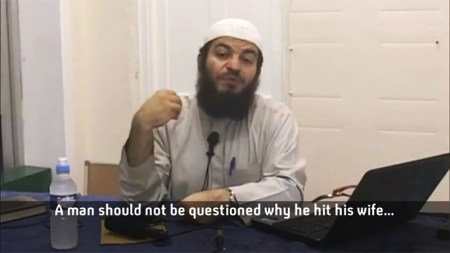
1013Haitham al-Haddad is a British shari’a council judge, and sits on the board of advisors for the Islamic Sharia Council. Regarding the handling of domestic violence cases, he stated in an interview, “A man should not be questioned why he hit his wife, because this is something between them. Leave them alone. They can sort their matters among themselves.” (Image source: Channel 4 News video screenshot)

If political reluctance to upset Muslims is not allowed to prevent Caroline Cox’s bill from becoming law, then there is hope that proper regulation will succeed the present chaos and irregularity that surround the councils as they are now operated. But even this may not be enough. Because of this absence of proper supervision, shari’a rulings impact British Muslims from three directions: through the shari’a councils, from the larger bodies to the informal “courts” that are reputed to operate from small terraced houses in Bradford, Birmingham and elsewhere; through the many online fatwa “banks” (websites) to which individuals refer themselves; and through the fatwas issued by the European Council for Fatwa and Research, based in Dublin.

These last two sources of shari’a rulings are usually ignored in studies of Islamic law in Britain, but they do, in fact, account for an undetermined number of responses to questions from individual Muslims in this country, and more formal diktats seen as binding across Europe, including the UK.

What I term “fatwa banks” are websites run either by individual muftis[1] or larger collective sites on an international scale. The sites I used in “Sharia Law or One Law for All” were Sunnipath, Ask Imam (answers from South Africa, but accessed through the Jamia Madina Mosque in Hyde), Madrasa In’aamiyyah, Darul Iftaa Leicester[2], IslamOnline.net[3], Ask the Scholar, Ask an Alim, Leicester, and the Islamic Shariah Council (Leyton in London).

Others operate out of other countries and in different languages, but can be accessed from the UK without difficulty. The most popular is IslamQ&A, which provides rulings in English and fifteen other languages. It is run from Saudi Arabia by the Salafi mufti Shaykh Muhammad Saalih al-Munajjid, and is not only one of the most popular Salafi websites, but also, according to Alexa.com, the world’s most popular website on the topic of Islam generally. The impact of its fatwas worldwide cannot be exaggerated. It includes some rulings on jihad.[4] There is no space here to reproduce these in full, but here are a few in brief that show the extent to which shari’a rulings diverge from British laws and values.

  1. Waging jihad against Americans (and other enemies of Islam) is to be encouraged.
  2. Shari’a law takes priority over secular law.
  3. A husband may prohibit his wife from leaving the house.
  4. Shari’a law can override British courts.
  5. A Muslim lawyer should not always act in accordance with UK law where it contradicts shari’a.
  6. Polygamy is acceptable even if against the law.
  7. A man may divorce his wife but keep that a secret from her.
  8. Execution or severe beating for homosexuals is correct.
  9. A wife has no property rights in case of divorce.
  10. There is no requirement to register a marriage according to the law of the country one lives in.
  11. A Muslim woman may not marry a non-Muslim man.
  12. Insurance is forbidden even if required by law.
  13. Child marriage is justified.
  14. A husband is not obliged to support a childless wife.
  15. A husband has conjugal rights over his wife. “Both partners have the right to have their physical demands met.” The only difference is that the husband may demand this, while the wife cannot.
  16. Divorce does not require a witness.
  17. Taking out insurance is forbidden.
  18. Medical insurance schemes are forbidden.
  19. If being a police officer in West contradicts shari’a, it is forbidden.
  20. Beating one’s wife is permissible (unless it harshly done).
  21. The mere intention to divorce is sufficient to make it valid, regardless of what is said.

Many of the above rulings are shocking, and by no means all websites or British shari’a councils will endorse many of them. But there they are, freely available to Muslims everywhere. If a believer tends towards strict interpretations of the sacred texts or the laws, he or she may well gravitate to fatwa banks such as these, and may well act on their basis rather than on the judgements of the nearest shari’a council. After all, what real authority do the muftis on the councils have beyond that of the other, online muftis? Shaykh Yusuf al-Qaradawi, for example, outranks pretty well all other contemporary Muslim authorities, with his TV show “Shari’a and Life” reaching an estimated 60 million viewers, and his learned essays promoting his personal views within the overall context of the Muslim Brotherhood, one of the most fundamentalist of today’s Islamic organizations.

Let us leave the British councils for a moment. There is another external source of fatwas. In many Muslim states, shari’a laws may be, and often are, imposed, often to the extent of punishing crimes from theft to murder. This means that matters that would not be crimes in Western states, such as adultery, blasphemy, or apostasy receive corporal punishments or the death penalty.

Knowing that there is no freedom in the West to criminalize these latter faults or to apply shari’a punishments for them, it became essential to come up with fatwas that would give authoritative guidance to Muslims in Western countries on how to conduct themselves in the “Land of War” (“Dar al Harb”, the opposite of the “Land of Islam”) while remaining shari’a-observant. The overall aim is to bring shari’a into Western societies by the back door. Even if Western governments like that of the UK were to find ways to register and control shari’a courts, or even abolish them, religious authorities could subvert this by presenting fatwas that would recommend certain behaviours for individuals and small communities.

The deliberations of the jurisprudents resulted in the need to adapt shari’a rulings to the situation of large-scale Muslim communities living outside enforceable Islamic jurisdictions. This endeavour has been termed Fiqh al-‘Aqalliyyat (“Jurisprudence of the minorities“). The purpose of this system — in which the classical system of Muslims ruling non-Muslims has been reversed — is to find a way to use shari’a without incurring the wrath of the indigenous legal system in secular parliamentary democracies. This has some resemblance to Muslim efforts during the colonial era to use shari’a in personal affairs in British and French colonies such as India or Algeria.

In its current form, the jurisprudence of the minorities dates back to the 1990s. It was developed by two individuals, the formerly mentioned Shaykh Yusuf al-Qaradawi and the late Shaykh Dr. Taha Jabir al-Alwani of Virginia. Al-Qaradawi is, among other things, president of the International Union of Muslim Scholars, a body founded in 2004 with its headquarters in the vastly wealthy Wahhabi state of Qatar. Its close ties to the Muslim Brotherhood have led to its designation by the United Arab Emirates as a terrorist organization. It boasts a membership of at least 90,000 Islamically-qualified scholars from around the world, representing several different sectarian positions.

Al-Alwani (d. 2016) was the founder and former chairman of the Fiqh Council of North America(FCNA), whose 18 members issue religious rulings, resolve disputes, and answer questions relating to Islamic practice. Their declared purpose:

“To consider, from a Shari’ah perspective, and offer advice on specific undertakings, transactions, contracts, projects, or proposals, guaranteeing thereby that the dealings of North American Muslims fall within the parameters of what is permitted by the Shari’ah.”

The FCNA too has close ties to the Muslim Brotherhood, which may, under a bill launched by Senator Ted Cruz, soon be designated by the US as a terrorist organization in its own right. The Muslim Brotherhood in the US itself listed the FCNA as one of several organizations who shared their goals, including the destruction of Western civilization and the conversion of the US into a Muslim nation.

The “minorities” jurisprudents generally favour a non-violent approach to the encounter of Islam and the West, while retaining a critical stance towards the latter and a conviction that Islam must, in the end, replace it. But on occasion, as in the Middle East, violence is sanctioned. When asked in an interview about Palestinian suicide bombings, al-Alwani responded, “We think that the Palestinian people have the right to defend themselves in the way they view as suitable and we will back it and support it.”[5]

That view was, until recently, shared by al-Qaradawi, who has supported terrorism, including suicide bombings.

Dr. Denis MacEoin is the author of Sharia Law or One Law for All as well as many academic books, reports, and hundreds of academic and popular articles about Islam in many dimensions. He is a Distinguished Senior Fellow at the Gatestone Institute.


[1] A mufti (a religious scholar who issues fatwas) is a learned man specializing in Islamic law; he issues judgements on cases, determining what is compliant with his law school, but the sentencing is carried out by a judge (a qadi). Sometimes, the same person performs both functions.

[2] The Darul Iftaa in Leicester was founded and run by Mufti Muhammad ibn Adam al-Kawthari, a graduate of the Deobandi Darul Uloom in Bury.

[3] This important site features a “Live Fatwa” session, where answers are given by Muhammad al-Mukhtar al-Shinqiti, director of the Islamic Center of South Plains in Lubbock, Texas. Al-Shinqiti is a prominent figure in Fiqh al-‘Aqalliyyat.

[4] Examples of fatwas from the above sites (apart from Islam Q&A, which I did not consult at that time) may be found in “Sharia Law or One Law for All,” pages 74 to 127. Unwittingly, they provide insights into the topics to which British Muslims who speak English have access: not just the archives of fatwas that they maintain, but in order to ask questions themselves on matters from oral sex to male doctors seeing female patients.

[5] Cited Fishman p. 11 from the London Arabic newspaper, Al-Sharq al-Awsat.
UK: Another Massive Charity Commission Whitewash

December 4, 2016

UK: Another Massive Charity Commission Whitewash, Gatestone Institute, Samuel Westrop, December 4, 2016

In its report, the Charity Commission makes note of the iERA’s promotion of hate preachers, but treats the charity as a victim of such extremism, rather than an instigator.

According to the Commission, bureaucracy is the solution — the iERA’s extremism will be solved by more “adequate procedures… to prevent abuse of the charity, its status, facilities or assets.”

Those more familiar with the iERA will know that asking this Salafist charity to produce and follow its own counter-extremism plan is akin to demanding that the Ku Klux Klan introduce affirmative action hiring processes.

Extremist charities are not private institutions: charitable status affords extraordinary legal and financial benefits, including the opportunity for radical Islamist organisations to claim government subsidies. But no government should allow extremist networks to exploit charitable status. Shut these charities down, and ban those Islamist activists from ever again becoming trustees of a charitable organisation.

On November 4, the British charity regulator, the Charity Commission, published a report of its inquiry into the Islamic Education and Research Academy (iERA), a British Salafist group and religious training organisation. The inquiry was initially welcomed by moderate Muslim groups and counter-extremism analysts, but many will be disappointed with the Charity Commission’s recommendations.

More than a dozen pieces have been written for the Gatestone Institute examining the iERA’s links to extremism, as well as the failure of government, media and even Jewish organisations to tackle this fast-growing Salafist group. In 2014, one of these articles exclusively revealed that the “Portsmouth Five,” a notorious group of ISIS recruits from southern England, were all members of an iERA youth group.

In 2014, the Council of Ex-Muslims of Britain published their own comprehensive report, which looked even more closely at the officials, preachers and extremist links of the iERA. In the wake of significant media coverage, the Charity Commission launched their investigation. The “inquiry’s scope,” the Charity Commission claims, was to look at the iERA’s extremist links, as well as its “financial management.”

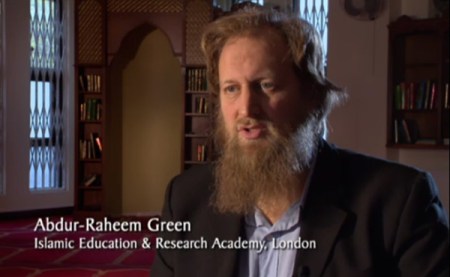
There was no shortage of evidence. The head of the iERA, Abdur Raheem Green, is a former jihadist who warns Muslims of a Jewish “stench,” encourages the death penalty as a “suitable and effective” punishment for homosexuality and adultery, and has ruled that wife-beating “is allowed.”

1074The head of the Islamic Education and Research Academy (iERA), Abdur Raheem Green, is a former jihadist who warns Muslims of a Jewish “stench,” encourages the death penalty as a “suitable and effective” punishment for homosexuality and adultery, and has ruled that wife-beating “is allowed.” (Image source: BBC video screenshot)

Other iERA officials have included Zakir Naik, an Islamic preacher whose NGO has just been raided and designated “unlawful” by Indian law enforcement; and Abdullah Hakim Quick, who has called upon God to “clean and purify al-Aqsa from the filth of the Yahood [Jews]” and “clean all of the lands from the filth of the Kuffar [non-believers].”

In its report, the Charity Commission makes note of the iERA’s promotion of hate preachers, but — as it has done in the past — treats the charity as a victim of such extremism, rather than an instigator. According to the Commission, bureaucracy is the solution: the iERA’s extremism will be solved by more “adequate procedures… to prevent abuse of the charity, its status, facilities or assets.” External speakers, the Charity Commission advises, should “sign the charity’s Anti-Extremism, Data Protection and Equal Opportunities disclaimers.” The iERA, concludes the Charity Commission, should produce “risk assessments” for all events and put in place an effective “counter-extremism policy.”

Those more familiar with the iERA will know that asking this Salafist charity to produce and follow its own counter-extremism plan is akin to demanding that the Ku Klux Klan introduce affirmative action hiring processes. But such demands make sense to civil servants in London, who adhere to the government line that because British Islam is inherently good, any real examples of extremism can only be the work of corrupting outside influences.

Counter-extremism analysts have seen such blindness from the Charity Commission before. In 2013, the Charity Commission reported on the offices of an unnamed charity:

“We visited the charity’s premises and saw images of the leader of the group that is a proscribed terrorist organisation were displayed on the walls of the charity’s offices. We also identified that the charity had organised marches at which supporters of the proscribed organisation were present.”

Was this charity, evidently dedicated to the support of a banned terrorist organisation, shut down? No. Instead, the Charity Commission decided to “instruct the trustees to develop and implement robust controls to manage the charity’s activities and the use of its premises.”

Also in 2013, the Charity Commission opened an investigation into International Islamic Link, a taxpayer-funded Shi’ite charity that previously described itself as “the office of … Ayatullah Nasir Makarem Shirazi.” Aytollah Shirazi is one of the Iranian’s regime most hardline clerics. He is known for issuing a fatwa for the murder of Iranian pro-democracy activist Roozbeh Farahanipour. He is also known for his unwavering commitment to Holocaust denial and his support for killing adulterers and homosexuals.

Once the Charity Commission opened an investigation into International Islamic Link, the organisation told the Charity Commission that they had no link with this Iranian cleric. Nevertheless, the Charity Commission, despite clear evidence to the contrary, declared that they were “satisfied” with the charity’s response.

The Charity Commission treats the claims made by trustees of extremist charities as irrevocable truth, and responds to evidence of extremism merely by urging more stringent bureaucratic oversight.

In 2014, Gatestone Institute published information about the Islamic Network. This extremist group’s website advocated the murder of apostates, encouraged Muslims to hate non-Muslims and claimed “The Jews scheme and crave after possessing the Muslim lands, as well as the lands of others.” After investigating the charity, the Charity Commission decided to give the Islamic Network booklets titled, “How to manage risks in your charity.”

The recent Charity Commission whitewash into the iERA is just one more example of a weak, ineffective charity regulator. Extremist charities are not private institutions: charitable status affords extraordinary legal and financial benefits, including the opportunity for radical Islamist organisations to claim government subsidies through a “tax-back” scheme named Gift Aid. Although the iERA’s accounts do not mention the amount if receives from the Gift Aid program, the group encourages donors to “consent yes to gift aid.”

If a private organisation wishes to promote non-violent, bigoted Islamist ideology, then a free society should allow them to do so. But no government should allow extremist networks to exploit charitable status. Shut these charities down, and ban those Islamist activists from ever again becoming trustees of a charitable organisation.

UK bans three bishops from Iraq and Syria from entering the country

December 4, 2016

UK bans three bishops from Iraq and Syria from entering the country, Jihad Watch

“There is a serious systemic problem when Islamist leaders who advocate persecution of Christians are given the green light telling them that their applications for UK visas will be looked on favourably, while visas for short pastoral visits to the UK are denied to Christian leaders whose churches are facing genocide.

**********************************

The UK Home Office banned me from entering the country for saying: “[Islam] is a religion and is a belief system that mandates warfare against unbelievers for the purpose for establishing a societal model that is absolutely incompatible with Western society” — which is a demonstrably true statement. The UK Home Office recently admitted Shaykh Hamza Sodagar into the country, despite the fact that he has said: “If there’s homosexual men, the punishment is one of five things. One – the easiest one maybe – chop their head off, that’s the easiest. Second – burn them to death. Third – throw ’em off a cliff. Fourth – tear down a wall on them so they die under that. Fifth – a combination of the above.” The Home Office also recently admitted two jihad preachers who had praised the murderer of a foe of Pakistan’s blasphemy laws. One of them was welcomed by the Archbishop of Canterbury.

But these three bishops from areas where Muslims are persecuting Christians cannot enter. Probably Home Office officials were afraid of offending their own Muslim population by doing so.

Britain is not finished?

bishops

“Britain BANS heroic bishops: Persecuted Christian leaders from war zones refused entry,” by Caroline Wheeler, Express, December 4, 2016:

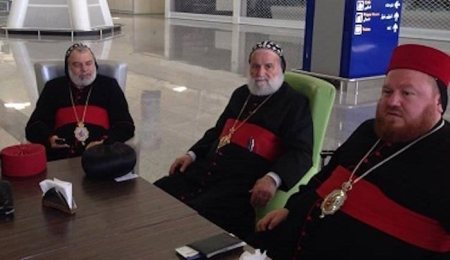
THREE archbishops from war-torn Iraq and Syria have been refused permission to enter the UK despite being invited to London to meet Prince Charles.

The Christians, including the Archbishop of Mosul, were told there was “no room at the inn” by the Home Office when they applied for visas to attend the consecration of the UK’s first Syriac Orthodox Cathedral.

Last night the decision was described as “unbelievable” by critics who pointed out that extreme Islamic leaders had been allowed visas.

The Prince of Wales addressed the congregation at St Thomas Cathedral in London last week, while both the Queen and the Prime Minister sent personal messages of congratulations.

Prince Charles, who has previously described the persecution of the Christians in the Middle East as a “tragedy”, used his address to highlight the suffering of Syrian Christians.

But the welcome did not extend to Nicodemus Daoud Sharaf, the Archbishop of Mosul, nor to Timothius Mousa Shamani, the Archbishop of St Matthew’s, which covers the Nineveh valley in northern Iraq, who were refused UK visas to attend the event on November 24.

The UK also refused to grant a visa to Archbishop Selwanos Boutros Alnemeh, the Archbishop of Homs and Hama in Syria.

In his case the British embassy told him that it would not waiver from its policy of not granting visas to anyone in Syria.

The men were also told they were denied entry because they did not have enough money to support themselves and they might not leave the UK.

Last night the leader of the UK’s Syriac Orthodox Christians Archbishop Athanasius Toma Dawod condemned the decision.

He said: “These are men who have pressing pastoral responsibilities as Christian areas held by IS are liberated.

“That is why we cannot understand why Britain is treating Christians in this way?”

Dr Martin Parsons, head of research at the Barnabas Fund, an aid agency which has helped more than 8,000 Christians escape persecution at the hands of IS, said: “It’s unbelievable that these persecuted Christians who come from the cradle of Christianity are being told there is no room at the inn, when the UK is offering a welcome to Islamists who persecute Christians.”

The Home Office recently issued guidance stating that there should be a presumption that senior members of Egypt’s Muslim Brotherhood should be granted asylum in the UK – despite the fact that the Muslim Brotherhood has repeatedly incited violence against Egyptian Christians.

Dr Parsons also claims that visas were granted in July to two Pakistani Islamic leaders who have called for the killing of Christians accused of blasphemy.

He said: “There is a serious systemic problem when Islamist leaders who advocate persecution of Christians are given the green light telling them that their applications for UK visas will be looked on favourably, while visas for short pastoral visits to the UK are denied to Christian leaders whose churches are facing genocide.

“That is an urgent issue that Home Office ministers need to grasp and correct.”…