Ex-NATO Commander Calls for Non-Cyber Response to Russia’s Election Hacks Breedlove: ‘Null’ response from Obama admin will reward Russia for bad behavior.
BY:
November 3, 2016 4:26 pm
Source: Ex-NATO Commander Calls for Non-Cyber Response to Russia

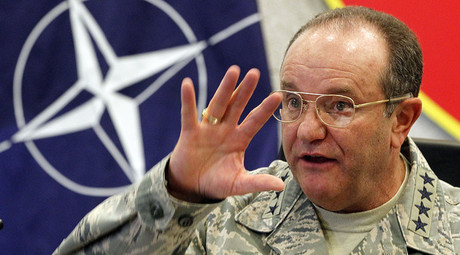
Philip Breedlove / AP
NATO’s former top commander recommended the U.S. government respond to Russia’s attempts to influence the presidential election through non-cyber means, emphasizing that a “null” answer would merely reward Moscow’s bad behavior.
Gen. Philip Breedlove, former NATO supreme allied commander for Europe and head of the U.S. European Command, said that the United States should considering using a combination of its diplomatic, information, military, and economic tools to punish Russia for directing hacks into U.S. political institutions.
“I don’t believe that a null set is the answer. I believe that we cannot reward bad behavior with no answer,” Breedlove told an audience at the Atlantic Council, a Washington-based international relations think tank, on Thursday when asked to recommend an appropriate U.S. response to the election-related cyber attacks.
“I also believe—and this is discussed quite openly—we rely so much more on cyber than some of our competitors in the world that if we were to start a big fight in cyber, we stand to lose so much more,” Breedlove said. “I don’t think that necessarily is the answer. Again, what I think is that our nation has a broad series of tools—diplomatic, information, military, economic. That’s a crude approximation, but there’s a lot of tools to use and I think that we need to do that creatively, judiciously.”
The retired four-star Air Force general echoed warnings previously sounded by cyber security experts about the vulnerabilities of the United States in starting a “tit-for-tat” cyber conflict with Russia.
Last month, the U.S. intelligence community formally blamed the Russian government for directing cyber attacks on U.S. individuals and organizations, including the Democratic National Committee, in order to influence the presidential election, an accusation that Moscow has denied. The White House has promised to deliver a “proportional” response to Russia for orchestrating the hacks.
Breedlove’s own private emails were released by DC Leaks, a website that has been linked to Russian hackers, earlier this year. The DNC emails, as well as those from the personal email of Hillary Clinton campaign chair John Podesta, have been released by WikiLeaks, which has denied having connections to the Russian government.
Breedlove described Russia’s provocations in cyber space, including the attempted election interference, as an element of Moscow’s “hybrid” warfare or pursuits of conflict “below the threshold.” He criticized the United States for exhibiting “tolerance” for Moscow’s actions.
“What does our tolerance say? What does our action or inaction say as it relates to everything from cyber in an election to continually meddling in the borders in South Ossetia? Where are we setting the bar as it relates to this conflict below the lines or below the thresholds, and what, again, does inaction mean?” Breedlove asked.
The retired general recommended that the next U.S. administration consider using a more “balanced” combination of diplomatic, information, military, and economic tools to deal with Russian aggression, rather than the Obama administration’s current approach of using economic sanctions and pursuing diplomatic relations to turn a corner with Moscow.
Breedlove also said Russia has been emboldened in recent years and views its global influence more positively.
“What Russia wants first and foremost is to be seen as an equal and be treated as a world superpower in a multipolar context. And frankly, what is the view from Moscow right now? They are probably pretty happy,” Breedlove observed. “They see themselves at the center of most of the great power conflict that is going on. They see themselves even at the center of the discussion about the U.S. election. So, I would say that right now Russia feels better about themselves on the world’s stage than they did years before.”
Breedlove retired from his dual-hatted post in May after 39 years of military service. Since his departure, already tense relations between the United States and Moscow have worsened over developments in Syria and a breakdown in cooperation between the powers on nuclear energy. NATO’s decision to deploy four battalions to the Baltic States and Poland on its eastern flank over Russia’s continued intervention in Ukraine has also aggravated Moscow, which has begun deploying forces and military equipment westward.
Breedlove acknowledged the high tensions with Russia but spoke optimistically about the opportunity of the next administration to find a path toward productive dialogue and cooperation with Russia.
At the same time, he expressed concern over Moscow’s pursuit of “below the threshold” competition and its willingness to escalate conflict, as well as the reemergence of the nuclear issue. This week, a high-level Russian official indicated that Norway would become a nuclear target after giving the United States permission to station hundreds of Marines on its borders.
The former commander also highlighted the improvements in Russia’s military capabilities that have been exhibited over the course of Moscow’s interventions in Georgia, Ukraine, and Syria over the last eight years.
“In the western and central and southern military districts, Russia is able to amass force and capability very quickly,” Breedlove explained. “The Russian force is a learning and adaptive force. It did not do so well in the first incursion into Georgia. It got much better when it went into Crimea. It learned in Crimea and was even better when it went into Donbass, and then was even better at several of the things they needed to be good at when they went into Syria.”
“It’s not the 10-foot-tall Soviet Union, but clearly it is a capable force,” he added.





 anneinpt
 artaxes
 danmillerinpanama
 davidking1530
 Peter Hofman
 Joseph Wouk
 Peter
Peter Louisiana Steve
 WarSclerotic
Recent Comments