Posted tagged ‘Baghdad’

Peshmerga head speaks of struggle against IS

October 18, 2014

Peshmerga head speaks of struggle against IS, Al-Monitor, Faraj Obaji, October 17, 2014
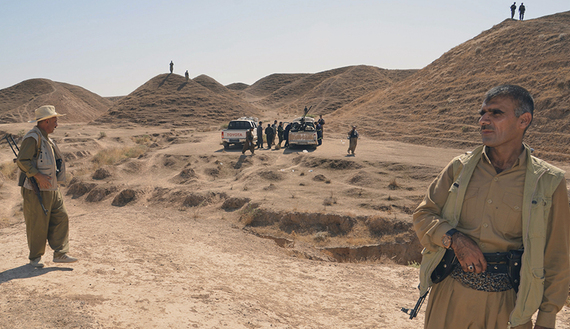
Kurdish peshmerga fighters stand guard around vehicles left behind by fleeing Islamic State militants during clashes in the al-Zerga area near Tikrit cityKurdish peshmerga fighters stand guard around vehicles with weapons and ammunition left behind by fleeing Islamic State militants during clashes in the al-Zerga area near Tikrit city in Salahuddin province, Oct. 8, 2014. (photo by REUTERS)

Commenting on the criticism of certain Kurdish parties inside Kobani, regarding the lack of support provided by KRG to the besieged city, he said, “Despite the differences with certain Kurdish political parties in the city, the KRG expressed its readiness to support our brothers in the city and we asked Washington and its allies to help the resisting Kurdish fighters.

“We helped them as much as possible, and the KRG’s president affirmed this. But, we cannot offer more. We are still waiting for international aid. The region initially includes 5 million people, add to that one and a half million displaced from Syria and the Iraqi provinces. We are helping them and taking care of them, and this is a huge burden.”

******************

Eliminating the Islamic State (IS) in Iraq does not seem to be an easy mission that will happen anytime soon; it seems rather impossible. The terrorist attacks against Iraq exposed how weak the Iraqi army is, how fragile its military structure and intelligence services are, and how it is unable to protect its country against any attack.

Some believe that the responsibility of the army’s failure to fight IS should be borne by the political authority ruling the country since 2004, which was unable to build an army based on a unified doctrine. Others consider the policies adopted by former Prime Minister Nouri al-Maliki faulty and the maliciousness allowed the terrorist group to enter the country, while the political conflicts between the central government and the Sunni leaderships provided an embracing environment for the group in Sunni provinces.

Secretary-General of the Ministry of Peshmerga Lt. Gen. Jabbar Yawar spoke to An-Nahar regarding the situation in Iraq in general, and in the Kurdistan Regional Government (KRG) in particular, in light of the IS threat, which occupied a number of Iraqi provinces, reaching the besieged Kobani.

The peshmerga harasses IS

The Kurdish military leader welcomed the international aid provided to the KRG, which is fighting a crucial battle against IS. He said, “The military aid which reached KRG saved it from falling into the hands of the terrorist group and allowed peshmerga forces to move from the negative defense position to the striker position, inflicting heavy losses on IS.”

Yawar does not hesitate to say, “The peshmerga forces’ position in the fight against IS is much better than the Iraqi army’s position. We are in a continuous fight along the 1,050-kilometer [650-mile] border of five Iraqi provinces, starting from Mosul to Erbil and passing through Kirkuk, Saladin and Diyala.”

He said, “The peshmerga forces have liberated the Mosul Dam and continues to liberate the rest of the regions that have fallen into the hands of IS, while creating plans to completely achieve this.”

The fall of Mosul and Anbar

Yawar attributed the fall of Mosul and Anbar to several reasons, most importantly, the fragility of the army in both provinces. He said, “The army in Mosul was fragile, and its six military units failed to withstand IS. There were also the political conflicts between the Sunni blocs and the government in Baghdad, which prevented these forces from fighting IS in Mosul, Saladin and parts of Kirkuk. These forces either handed over their advanced and heavy weapons to the group and fled, or joined and began to fight alongside IS.”

“The lack of a unified fighting doctrine among the army, and the shortage of air support, were all elements that contributed in the army’s quick collapse and IS’ occupation of a number of Iraqi provinces, especially the Sunni ones,” he said.

The difficulty in liberating Sunni regions

On the subject of the army’s situation in provinces in general, Yawar said that he found “a certain difficulty in liberating the Sunni-dominated regions from IS, such as Anbar, Saladin and Mosul, especially after it fell into the hands of the terrorists who took over its weapons on June 10.” He said that although they used all available means, the Iraqi forces were unable to liberate the city of Heet in Anbar and Tikrit, the center of Saladin province. “The situation on the field unfortunately proves that IS only controls the Sunni-dominated regions. We hope that our Sunni brothers, who are suffering the group’s injustice, will cooperate with the federal government and the KRG in order to eliminate this terrorist group,” he explained.

How did IS reach Erbil’s borders?

When asked how IS was able to reach KRG even though its intentions to occupy the region were obvious, Yawar answered with regret: “We knew before the group attacked Mosul on June 10 that it was up to no good in Iraq and Mosul. We were alerted by the joint committees and meetings that we used to hold in Baghdad, that there were some suspicious and dangerous movements on the borders with Syria. We were advised to strike them at an early stage, but we did not listen. The federal government and its former prime minister, Nouri al-Maliki, believed our proposals were political outbidding. Even when IS attacked Mosul, we asked them to allow us to support the federal forces there, but they told us that they were able to fight back themselves. Then Mosul fell, its residents fled and, due to Maliki’s faulty policy, IS was able to reach Baghdad’s borders.”

When asked why the terrorist group was able to reach Erbil, Yawar said, “When IS’ attack began, the peshmerga fought with all its strength, but it does not own advanced weapons such as the ones the group took from Mosul, because Maliki’s government never reinforced, trained or funded the peshmerga forces, although they are official governmental forces, according to the federal constitution.

“Despite all this, the peshmerga withstood IS from June 10 until the beginning of August. However, when we ran out of munitions and had no source of getting any, the group was able to penetrate our defense and move toward Erbil. Yet, thanks to Washington’s assistance and some of the countries participating in the international alliance, we were able to change the negative defense equation in Erbil and attack IS to liberate our lands,” he said.

Baghdad will not fall

The Kurdish leader ruled out the possibility of Baghdad falling for the time being, according to the available security data. “Until now, the Iraqi army can protect Baghdad and prevent the penetration of IS, which has spread in neighboring regions, such as Amiriya, Fallujah, Saqlawiyah and Ramadi,” he said.

We helped Kobani as much as we could

Commenting on the criticism of certain Kurdish parties inside Kobani, regarding the lack of support provided by KRG to the besieged city, he said, “Despite the differences with certain Kurdish political parties in the city, the KRG expressed its readiness to support our brothers in the city and we asked Washington and its allies to help the resisting Kurdish fighters.

“We helped them as much as possible, and the KRG’s president affirmed this. But, we cannot offer more. We are still waiting for international aid. The region initially includes 5 million people, add to that one and a half million displaced from Syria and the Iraqi provinces. We are helping them and taking care of them, and this is a huge burden.”

Yawar said, “The region has not been able to help Kobani like it should, due to its tough and complex geographic location, as it is 300 kilometers [185 miles] from the Syrian border, and it’s hard for aid to reach it. Kobani’s situation is geographically similar to Gaza or Sinjar.”

Raids

Yawar is not afraid that IS, which he believes is an extension of al-Qaeda in Afghanistan, will persist. He said, “The situation in Iraq and Syria today is similar to that of Tora Bora and Afghanistan. The airstrikes are beneficial for the peshmerga, Kobani and even for the Iraqi government, as they halt the advance of IS militants and drain them. These strikes also destroy IS warehouses and heavy weapons. But, to free these areas completely from IS, a comprehensive international operation should be put in place, like the one in Afghanistan, and there should be an actual training campaign for the Iraqi forces to defend themselves. However, I rule out the possibility of a foreign land intervention in Iraq, with the existing conflict between the ruling political parties.”

No Kurdish expansion

Political circles have been talking about a Kurdish expansion in an attempt to build the awaited state. In this regard, Yawar says, “We are part of the federal state, and neither of us expands into the other’s territories. Until now, there aren’t any official international borders between us and the federal state. We have some problems in many regions administratively. But the KRG and Baghdad are both facing IS threat. We should destroy it first, then resort to the constitution to solve the pending problems with the Baghdad government regarding the land, oil, the budget and Peshmerga.”

 

CBS: Islamic State Gains Ground, ‘Closer To Total Control’ Of Anbar Province

October 14, 2014

You Tube, October 14, 2014

ISIS on verge of seizing “complete control” in Anbar: tribal official

October 9, 2014

ISIS on verge of seizing “complete control” in Anbar: tribal official, Asharq al-Awsat, October 9, 2014

(According to Wikipedia, “The paper was founded with the approval of the Saudi royal family and government ministers, and is noted for its support of the Saudi government.[2] The newspaper is owned by Faisal bin Salman, a member of the Saudi royal family.[3]“– DM)

A man looks at a vehicle belonging to the Iraqi security forces in the Anbar province town of HitA man looks at a vehicle belonging to the Iraqi security forces in the Anbar province town of Hit, Iraq, on October 6, 2014. (Reuters)

It was Anbar’s police force that was protecting citizens from ISIS, he said, adding that military forces were actively hindering efforts to combat the extremist group. “Unfortunately, the military has become a source of assistance for ISIS because for the most part ISIS is able to attack and defeat the military, taking control of their arms and equipment,” said Ibrahim.

**********************

Baghdad, Asharq Al-Awsat—Iraq’s restive western province of Anbar is on the verge of completely falling into the hands of the Islamic State of Iraq and Syria (ISIS) unless urgent action is taken to address military failures, the Anbar Tribal Council warned on Wednesday.

The Anbar Tribal Council, the senior-most Sunni tribal organization in the province, is backing central government attempts to combat ISIS but has complained to Baghdad about the appointment of Lt. Gen. Rashid Fleih as head of the Anbar Military Command, calling for him to be replaced. In comments to Asharq Al-Awsat, Anbar Tribal Council member Faris Ibrahim said “[Fleidh] is unable to do anything.”

“The security situation in Anbar Province is going from bad to worse due to a lack of support, as well as the almost complete absence of security and military leadership. The military leadership is unable to devise new plans to address ISIS advances on the ground,” Ibrahim added.

“ISIS has strongly advanced in a number of areas in the province following the formation of the international alliance, as part of attempts to impose their position on the ground as a fait accompli.”

The Anbar Tribal Council member alleged that ISIS is also setting up sleeper cells in the province with the objective of entrenching its position and securing even more territory.

More than 500,000 residents of Anbar province have been displaced by fighting between Iraqi forces and ISIS since the conflict began in December 2013. Despite Iraqi military efforts and the formation of an international alliance to combat the terrorist group, ISIS has continued to advance in Iraq. ISIS forces most recently took over the town of Hit last week, leading to attempts by Shi’ite volunteer fighters backed by Iraqi military forces to recapture the western town.

“It is strange that while ISIS is developing its presence and capabilities on the ground in Anbar, military and security leadership are not doing anything new to address this. As a result of this, most parts of Anbar province are now completely in ISIS’s hands, including Ramadi city center,” Ibrahim told Asharq Al-Awsat.

It was Anbar’s police force that was protecting citizens from ISIS, he said, adding that military forces were actively hindering efforts to combat the extremist group. “Unfortunately, the military has become a source of assistance for ISIS because for the most part ISIS is able to attack and defeat the military, taking control of their arms and equipment,” said Ibrahim.

International efforts to combat ISIS in Iraq have focused on central and northern parts of the country, where ISIS is actively advancing. The terrorist group had initially advanced into Iraq from Syria through the western province, which had been the center of a Sunni-led protest movement against former Prime Minister Nuri Al-Maliki’s government over its perceived sectarian bias.

The government put together by the new premier, Haider Al-Abadi, has received a cautious welcome from Iraq’s Sunnis. However, the Anbar Tribal Council has called for Baghdad and the anti-ISIS international alliance to do more for Anbar.

Faris Ibrahim called on Baghdad to do more to tackle ISIS in Anbar, saying it was a critical front in the overall struggle, yet remained overlooked.

He said: “These operations have not reached the required level. It is strange that Anbar province has been completely forgotten over the past three months with the focus being on Mosul and the northern provinces. However, everybody knows that Anbar is the main incubator of ISIS and it is expanding to Iraq’s other regions from here . . . Therefore ignoring Anbar has led to disaster, as we are seeing today.”

Islamic State reportedly on Baghdad’s outskirts after week of victories

October 4, 2014

Islamic State reportedly on Baghdad’s outskirts after week of victories, Sydney Morning Herald, Mitchell Prothero, October 14, 2014

A diplomat in Irbil, the capital of the autonomous Kurdistan region, said an IS  presence in Abu Ghraib would put Baghdad International Airport within artillery range of the militants.

The airport is a key lifeline for Western embassies and holds a joint operations centre staffed by US military advisers.

***********************

Irbil, Iraq: Islamic State militants have taken control of key cities in Iraq’s western province of Anbar and have begun to besiege one of the country’s largest military bases in a weeklong offensive that’s brought them within artillery range of Baghdad.

IS,  also known as ISIS, and its tribal allies have dominated Anbar since a surprise offensive last December, but this week’s push was particularly worrisome, because for the first time this year Islamist insurgents were reported to have become a major presence in Abu Ghraib, the last Anbar town on the outskirts of the capital.

“Daash is openly operating inside Abu Ghraib,” according to an Iraqi soldier, who used the common Arabic term for IS . “I was at the 10th Division base there two days ago, and the soldiers cannot leave or patrol,” he said, asking that he be identified only as Hossam “Daash controls the streets.”

Hundreds of kilometres to the west, IS  forces continued their push into the Syrian Kurdish city of Kobane, where it appeared unlikely that Turkey would intervene to stop the advance. Kurdish officials from the town said the Turkish government had yet to respond to their pleas for weapons, and reports from the Turkish-Syrian border said there was no evidence Turkey was preparing to take action.

A diplomat in Irbil, the capital of the autonomous Kurdistan region, said an IS  presence in Abu Ghraib would put Baghdad International Airport within artillery range of the militants.

“We know they have captured substantial numbers of 155mm howitzers,” said the diplomat, whose country is participating in the US-led anti-IS coalition.

“These have a range of about [30 kilometres] and if they are able to hold territory in Abu Ghraib then the concern they can shell and ultimately close [the airport] becomes a grave concern.”

The airport is a key lifeline for Western embassies and holds a joint operations centre staffed by US military advisers.

Anbar is a predominantly Sunni Muslim province that remains deeply suspicious of the Shiite-dominated government in Baghdad, and IS has pressed to expand its control there since last winter’s initial offensive. In the past week, the militants have scored a string of other victories in the province.


ISIS Baghdad March: Islamic State 1 Mile Away From Iraqi Capital

September 29, 2014

ISIS Baghdad March: Islamic State 1 Mile Away From Iraqi Capital, International Business Times, September 29, 2014

(If the Islamic State takes Baghdad, use of airstrikes by the “coalition of the willing” without “boots on the ground” will bring multiple civilian casualties and be problematical, at best. Iraqi boots? They might help, but only after a year or more of training. — DM)

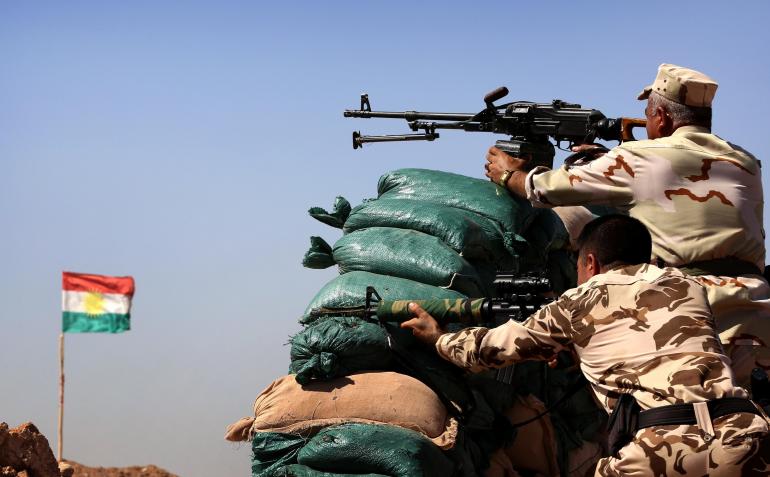
image-456313666Peshmerga fighters hold a position behind sandbags at a post in the strategic Jalawla area, in Diyala province, which is a gateway to Baghdad, as battles with Islamic State (IS) jihadists continue on September 27, 2014. The United States, which leads the coalition, initially launched strikes in Iraq on August 8 and widened its campaign on September 23, 2014 to include Syria, where IS has its headquarters. SAFIN HAMED/AFP/Getty Images

The Islamic State group is allegedly closing in on Baghdad, according to a report from a vicar at Iraq’s only Anglican church that claims the jihadists formerly known as ISIS are roughly one mile away from the Iraqi capital. Airstrikes against ISIS targets were supposed to stop the group from taking Baghdad.

“The Islamic State are now less than 2km (1.2 miles) away from entering Baghdad. They said it could never happen and now it almost has,” Canon Andrew White of the Foundation for Relief and Reconciliation in the Middle East, a British-based charity that supports Iraq’s only Anglican church in Baghdad, said on his Facebook page early Monday morning. “Obama says he overestimated what the Iraqi Army could do. Well, you only need to be here a very short while to know they can do very, very little.”

The Christian aid group was referring to the U.S. president’s interview Sunday night on “60 Minutes,” the CBS news magazine show, where Obama conceded that his administration underestimated the ascendancy of ISIS. More than 1,000 Iraqi troops were reportedly killed Sunday in clashes with ISIS about 10 miles outside of Baghdad.

The advance by ISIS toward Baghdad shows that the group isn’t weakening despite U.S.-led airstrikes in Iraq. ISIS executed 300 Iraqi soldiers last week during their march toward the Iraqi capital and attempted to break into a prison in northern Baghdad.

“This attack is very significant. It is the first infantry-like, complex, and penetrating attack in Baghdad city by ISIS since the fall of Mosul in June of this year,” the Washington-based nonprofit Institute for the Study of War wrote on its website, referring to Iraq’s second-largest city, which is in the Islamic State’s hands. “ISIS likely carried out the attack to release some of the pressure it is facing as a result of the recent U.S. air campaign targeting its positions. The attack also signifies that, despite the heightened defenses of Baghdad in the aftermath of the fall of Mosul, ISIS is still able to carry out attacks in an area where it is unlikely to have active sleeper cells.”

U.S.-led airstrikes against ISIS in Iraq and Syria have come under criticism over their effectiveness. U.S. Secretary of State John Kerry defended the military action last week in a CNN interview. Kerry claimed“Baghdad could have fallen” if it weren’t for the airstrikes, which have predominantly been launched in the northern part of Iraq.

ISIS Baghdad March: Is Islamic State Targeting The Iraqi Capital?

September 26, 2014

ISIS Baghdad March: Is Islamic State Targeting The Iraqi Capital? International Business Times, September 26, 2014

(How difficult might it be for the IS, et al, to move more troops into already occupied places near Baghdad, consolidate them there, and then send them to take Baghdad? The Iraqi armed forces have functioned poorly in the past and might well not put up a successful defense.

Were the IS to take Baghdad, what might the “coalition of the willing” do about it? Air strikes on a city of more than 7,216,040, many of them civilians, seem unlikely. In any event, civilian deaths would not likely concern the IS more than they concerned Hamas, and would provide gruesome photos welcomed for propaganda purposes.– DM)

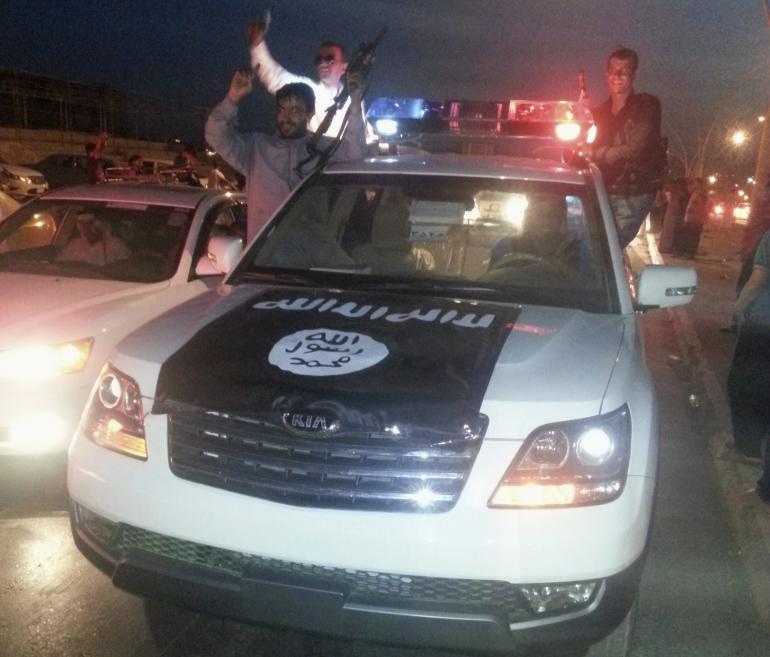
cop car in MosulFighters of the Islamic State group, also known as ISIS or ISIL, celebrate on a police vehicle along a street in the city of Mosul, June 23, 2014. Reuters

ISIS has been circling Baghdad for years. The Islamic State carried out 641 operations in Baghdad last year, up from 371 operations in 2012, including car bombs, armed assaults and assassinations, according to the Institute for the Study of War.

The multi-nation campaign against ISIS might have prodded the militants to refocus their efforts in Iraq, where the Islamic State has many strategic territories near Baghdad . . .

*****************

The Islamic State may be refocusing its sights on Baghdad after the extremist group overran an Iraqi military base and executed 300 soldiers Sunday amid ongoing U.S. airstrikes aimed at weakening the militants’ infrastructure and resources, according to military analysts. Other targeted attacks in recent weeks also suggest the militants are plotting against the Iraqi capital more than three months after international leaders first warned of the group’s aspirations to take Baghdad.

The base attack came days after the militant group also know as ISIS launched 14 mortar rounds during a foiled attempt to break into the Adala Prison in northern Baghdad. ISIS also launched an attack earlier this month in Baghdad’s Iskan neighborhood that likely targeted the offices of the political group and militia, the Badr Organization, according to the Institute for the Study of War in Washington, D.C.

“This attack is very significant. It is the first infantry-like, complex, and penetrating attack in Baghdad city by ISIS since the fall of Mosul in June of this year,” the think-tank wrote on its website. “ISIS likely carried out the attack to release some of the pressure it is facing as a result of the recent U.S. air campaign targeting its positions. The attack also signifies that, despite the heightened defenses of Baghdad in the aftermath of the fall of Mosul, ISIS is still able to carry out attacks in an area where it is unlikely to have active sleeper cells.”

It’s unclear if the U.S. airstrikes in Iraq have accomplished the Obama administration’s stated mission to “degrade and destroy” ISIS. Some military analysts and U.S. critics have said the Obama administration needs to send ground troops to Iraq to wipe out ISIS, while others have said the airstrikes have successfully managed to slow down the militant group’s advances.

“The U.S. has made it pretty much impossible to undertake the large-scale mobile operations that ISIS was doing earlier in the summer,” Michael Knights, who specializes in military and security affairs in Iraq for the Washington Institute for Near East Policy, said. “It has changed the nature of the beast.”

But ISIS’ goal of taking most of western and central Iraq hasn’t changed since the airstrikes, said Bill Roggio, a senior fellow with the Foundation for Defense of Democracies in Washington who specializes in Iraq. While Baghdad might be out of their reach, other territories remain vulnerable, Roggio said.

“They are just continuing their operations,” he said in a telephone interview. “The airstrikes haven’t stopped them for continuing to do what they have been doing all along, which is take control of territory.”

ISIS has been circling Baghdad for years. The Islamic State carried out 641 operations in Baghdad last year, up from 371 operations in 2012, including car bombs, armed assaults and assassinations, according to the Institute for the Study of War.

ISIS gained international prominence in June when it seized northern cities such as Tikrit, Saddam Hussein’s hometown, and Mosul, Iraq’s second largest city, and began holding mass executions of Iraqi soldiers. At the time, military analysts predicted the Sunni militants had their sights on Baghdad. Obama responded by sending 300 military advisers to Iraq to share intelligence with Iraqi soldiers. More recently, the Obama administration began offensive airstrikes against ISIS territories near Baghdad last week in its latest effort to pushback the militant group. At the same time, the U.S. began airstrikes against the Islamic State and other militant groups in Syria.

The multi-nation campaign against ISIS might have prodded the militants to refocus their efforts in Iraq, where the Islamic State has many strategic territories near Baghdad, Knight said.

“Most of the people who watch Iraq say if ISIS is going to punch, it’s going to be in the Baghdad area,” he said in a telephone interview. “I have been surprised that it hasn’t happened … They are well positioned for that.”