Posted tagged ‘Assad’

Assad to Netanyahu: Help Me Keep my Seat and I Guarantee You a Calm Golan

July 30, 2016

Assad to Netanyahu: Help Me Keep my Seat and I Guarantee You a Calm Golan, JNi.Medi via Jewish Press, July 30, 2016

(But what about Iran? — DM)

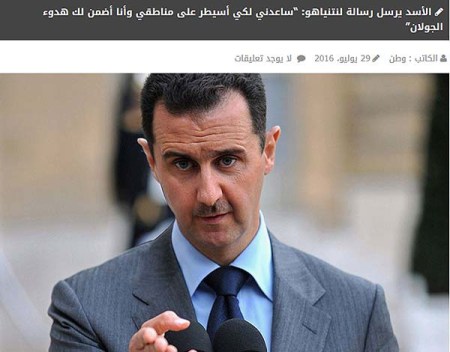
assad to Israel“Assad sends a message to Netanyahu: ‘Help me to control my region and I guarantee you a calm Golan.'”

A Kuwaiti news website on Friday cited a source saying Israeli Prime Minister Benjamin Netanyahu has received a message from Syrian President Bashar al-Assad, in which Assad vowed to keep the Golan as a demilitarized zone, and the rest of Syria committed to a cease-fire with Israel, if Netanyahu commits to not engaging Israel in an effort to topple Assad.

The source commented that Assad was saying to Netanyahu, in effect: “Help me to control my region and I guarantee calm for Israel in the Golan Heights.”

Commenting on rumors that former US ambassador to Israel Martin Indyk is slated to be President Hillary Clinton’s special envoy on the peace process between Israel and its neighbors, the source told the news website that Israel is very concerned over a report that was prepared by Indyk for President Bill Clinton about the Golan Heights. Israel is anxious to point US attention to the fact that the situation on south Syria and south Lebanon has been altered by the five-year civil war, and American notions about returning the Golan to Syria are absurd under these circumstances. Assad apparently wishes to take advantage of an opportunity to strike a deal with the Israelis to secure their neutrality in the war.

Meanwhile, Politico.eu reported Saturday that Saudi Arabia’s Foreign Minister Adel Al-Jubeir said his country is offering Russia access to the Gulf Cooperation Council Market and regional investment funds in return for pulling its support for the Assad regime.

“We are ready to give Russia a stake in the Middle East that will make Russia a force stronger than the Soviet Union, greater than China’s,” the Saudi minister said, adding, “It would be reasonable for Russia to say, that’s where our relations will advance our interests, not with Assad. We don’t disagree on the end game in Syria but on how to get there. Assad’s days are numbered,” he urged, “so make a deal while you can.”

Syrian-Russian Provocations Could Spark Golan Clash

July 28, 2016

Syrian-Russian Provocations Could Spark Golan Clash, DEBKAfile, July 28, 2016

EinZivan2

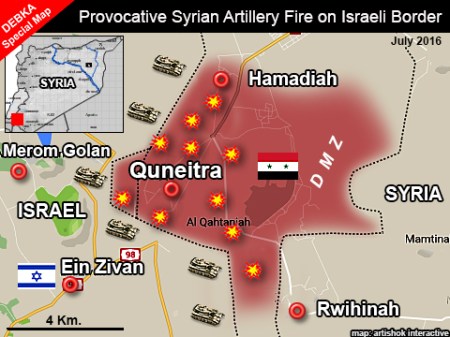
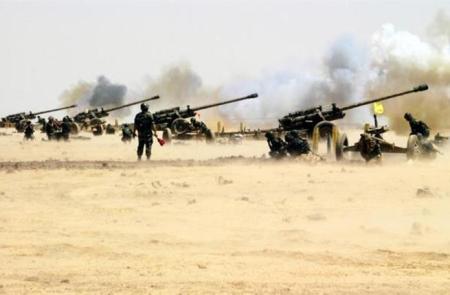
For four days since July 25, the Syrian army has been continuously firing artillery batteries – moved close to Israel’s defense lines on the Golan border – in a manner that comes dangerously close to provoking an Israeli response. This carefully orchestrated Syrian campaign goes on around the clock.

It is the first time in the six years of the Syrian war that Bashar Assad has ventured to come near to provoking Israel. But now he appears to be emboldened by his Russian ally.

The IDF is holding its fire for the moment. But Israeli military and government leaders know that the time is near for the IDF to be forced to hit back, especially since it is becoming evident that the Syrian army’s steps ae backed by Russia.

DEBKAfile’s military sources provide details of the Syrian steps:

  • The Syrian army’s 90th and 121nd battalions have been firing their artillery batteries non-stop across a 10km band along the Golan border from Hamadia, north of Quneitra, up to a point facing the Israeli village of Eyn Zivan. (See attacked map).
    This means that the Syrian army has seized the center of buffer zone between Israel and Syria and made it a firing zone.
  • This artillery fire fans out across a radius that comes a few meters short of the Israeli border and the IDF troops stationed there. It then recedes to a distance of 500 to 600 meters and sweeps across the outposts and bases of the Syrian rebel forces believed to be in touch with Israel or in receipt of Israeli medical aid.
  • The new Syrian attack appears to hold a message for Jerusalem: For six years, you supported the rebels against the Assad regime in southern Syria. That’s now over. If you continue, you will come face to face with Syrian fire.
  • Damascus is also cautioning those rebels:  For years, you fought us with Israel at your backs. But no longer. Watch us bring you under direct artillery fire, while the IDF sits on its hands.
  • On July 26, Russian media published an article revealing that Russia had delivered to the Syrian Air Force, advanced SU-24M2 front-line bombers, which is designed for attack on frontlines of battle. Israeli officials were unpleasantly taken aback by the news. Up until now, the Russians and Syrians refrained from deploying air strength in South Syria near the Israeli border. Now the Syrian air force has the means to do so.
  • DEBKAfile military sources report that the SU-24M2, following recent upgrades and modifications in Russian factories, is now capable of dropping smart bombs – ballistic bombs with a guidance system on their tails that enable them to hit targets with precision.This guidance system does not rely on US GPS satellites but rather the equivalent Russian GLONASS system which is linked to a network of 21 Russian satellites and partially encrypted for military usages.
    In addition, the SU-24M2 is equipped with a system that projects the information the pilot needs (flight details and battle details) on the plane’s windshield (head-up display) and on the pilot’s visor.
  • The Russians delivered to the Syrians two of these sophisticated airplanes this week, out of 10 that they will supply soon.

The IDF has concluded that it is only a matter of time before these planes appear in Southern Syria and so generate a new and highly combustible situation on Israel’s northern and northeastern borders.

The Russians are colluding with Damascus to inform Israel that it will no longer be allowed by either to continue backing the rebel forces in southern Syria or sustain the buffer zone which they man.

Israel may pay dear if Prime Minister Binyamin Netanyahu, Defense Minister Avigdor Lieberman, and Chief of Staff Lt. Gen. Gadi Eisenkot decide to continue to abstain from hitting back at the Syrian fire which is aimed every few hours at the vicinity of IDF posts or the impending arrival of Russian bombers. The price in store would be the weakening of the IDF’s hold on the Golan border.

First Palestinians in Syria war – under Hizballah

June 19, 2016

First Palestinians in Syria war – under Hizballah, DEBKAfile, June 19, 2016

Hezbollah_Zabadani_12.8.15Hizballah artillery in action in Syria

On Sunday, June 19, helicopters of the Syrian Air Force started transporting Palestinian militia fighters from the Damascus area to the Deir-ez-Zor region of eastern Syria, DEBKAfile’s military sources said in an exclusive report. They are joining Hizballah troops in an all-out assault on Islamic State’s grip on the area, notably the Euphrates River valley.

The Hizballah buildup was first revealed by DEBKAfile Friday, June 17.

It is the first time since the Syrian war began in 2011 that Palestinians are fighting for the regime of President Bashar Assad under the direct command of Hizballah. It is also the first time Palestinian forces are engaged in direct combat with ISIS.

The Palestinian troops are from a militia set up by Syrian and Iranian military intelligence officers called the al-Jaleel Forces, or the “Young Men Return to Palestine Movement”. It was armed and trained for terrorist attacks deep inside Israeli territory.

However, after Russian President Vladimir Putin promised Israeli Prime Minister Binyamin Netanyahu, during their June 9 meeting in Moscow, that no terror forces of any kind, whether Iranian, Syrian or Hizballah, would be allowed to set foot in southern Syria, or gain access to Israel’s northern border, the Palestinian militia was reassigned to the eastern Syrian front to boost the Hizballah operation against ISIS.

In the last hours, the Palestinian fighters were transferred from Damascus to al-Qusour near Deir ez-Zor and some, according to DEBKAfile’s military and intelligence sources, were sent directly into battle against ISIS as soon as they arrived in the area, and immediately suffered losses. Syrian sources name three fatalities as Mohamed Abbas, Eid al-Mohamed and Essam al-Abbas, with no further details.

On Friday, June 17, our military sources first revealed the new Hizballah mission: 

Hizballah this week ordered a general military call-up for their biggest combat mission in the Syrian war since their forces began fighting in support of the Assad regime in 2013, DEBKAfile military forces report.

Iran’s Lebanese proxy has been assigned the task of expelling the Islamic State from broad areas it occupied in the Deir ez-Zor region of eastern Syria and, in particular, the Euphrates River valley which connects eastern Syria and western Iraq.

This Hizballah offensive is designed to open the way for the pro-Iranian Shiite Popular Mobilization Forces and the Badar Forces militias which entered the ISIS-held Iraqi town of Fallujah Friday June 17 to move west and up the Iraqi side of the valley. The two militias spearheaded the Fallujah operation under the command of Iran’s Maj. Gen. Qassem Soleimani of the Revolutionary Guards and Ground Corps Brig. Gen. Mohammad Pakpour.

The plan is for Hizballah forces to meet these pro-Iranian militia forces on the Syria-Iraq border and so gain control over the most important strategic land pass between Iraq and Syria.

Whereas the pro-Iranian militias in Iraq are fighting under US air cover, Hizballah is assured of Russian air support in Syria.  And so, for the first time in the Syria conflict and its own history, Hizballah will receive air cover from both the US and Russia, the two superpowers now coordinating their military moves in Syria and Iraq.

This strategy, which essentially connects the Syrian and Iraqi campaigns against ISIS, was charted on June 9, at a secret meeting in Tehran of the Russian, Iranian and Syrian defense chiefs.

DEBKAfile military sources in Washington say that the operation’s plan was put before President Barack Obama and he sanctioned it as part of the war on ISIS.

In the run-up to the Syrian segment of the plan, Hizballah is transferring substantial combat strength from Lebanon into Syria, and emptying its other Syrian fronts, especially around Aleppo, for the large-scale concentration around Palmyra.

The Hizballah force will start out by targeting the Syrian town of Al-Sukhna, 63km south of Palmyra and 136km north of Deir ez-Zor, thus gaining command of M20, the main highway link between northern to eastern Syria. DEBKAfile military sources say that this military offensive by Hizballah against ISIS, with combined US-Russian support, threatens to transform a terrorist organization dedicated to fighting Israel in the service of Iran into one of the most powerful armies in the Middle East. Israel cannot stop this happening. The former Israel defense ministers who harangued this week against the Netanyahu government’s alleged “scaremongering” willfully ignored this dangerous development. They must also be held at least partly accountable for the failure of Israel’s air raids over Syria to diminish Hizballah’s military capabilities.

Breaking: State Dept. Protests Obama Lethargy

June 17, 2016

Breaking: State Dept. Protests Obama Lethargy, Power LineSteven Hayward, June 16, 2016

There’s an old joke about how it would be nice if there was an American Interests desk at the State Department, since Foggy Bottom was usually more sympathetic to foreign nations than our own. The truth behind that joke is what makes so extraordinary the story the Wall Street Journal is reporting tonight about the 51 State Department employees who have signed a petition calling for a tougher military policy against the Assad regime in Syria:

BEIRUT—Dozens of State Department officials this week protested against U.S. policy in Syria, signing an internal document that calls for targeted military strikes against the Damascus government and urging regime change as the only way to defeat Islamic State.

The “dissent channel cable” was signed by 51 State Department officers involved with advising on Syria policy in various capacities, according to an official familiar with the document. The Wall Street Journal reviewed a copy of the cable, which repeatedly calls for “targeted military strikes” against the Syrian government in light of the near-collapse of the ceasefire brokered earlier this year.

The views expressed by the U.S. officials in the cable amount to a scalding internal critique of a longstanding U.S. policy against taking sides in the Syrian war, a policy that has survived even though the regime of President Bashar al-Assad has been repeatedly accused of violating ceasefire agreements and Russian-backed forces have attacked U.S.-trained rebels.

The Wall Street Journal doesn’t say so directly, but this represents massive internal disgust with the pusillanimity of Obama going on for several years now. That the State Departmentwould want stronger military action is simply extraordinary. Here and there the reality of the matter breaks through:

“It’s embarrassing for the administration to have so many rank-and-file members break on Syria,” said a former State Department official who worked on Middle East policy. . . The recent letter marked a move by the heart of the bureaucracy, which is largely apolitical, to break from the White House.

In other words, this is a no-confidence vote on Obama’s Middle East policy, from a government body that is otherwise endlessly accommodating to drift and indecision.

Syrian Opposition Official: West Responsible For Assad Remaining In Power; U.S. Enabled Russia To Become Main Player In Syria Crisis

May 19, 2016

Syrian Opposition Official: West Responsible For Assad Remaining In Power; U.S. Enabled Russia To Become Main Player In Syria Crisis, MEMRI, May 18, 2016

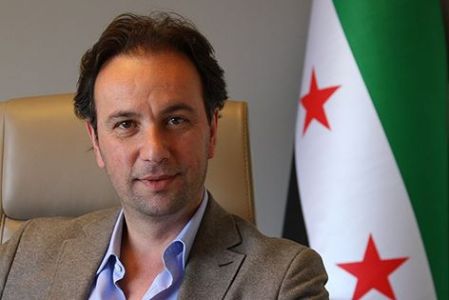
Khaled Khoja, who served as president of the National Coalition for Syrian Revolutionary and Opposition Forces until March 2016, gave an interview to the London-based Saudi daily Al-Sharq Al-Awsat on April 17, 2016, in which he harshly attacked the international community and particularly the U.S. Khoja argued that the U.S. never desired regime change in Syria and therefore did not take a decisive stand against Bashar Al-Assad despite his many crimes, and did not significantly support the Syrian opposition. According to him, the Americans showed apathy regarding the crisis, enabling Russia to fill the vacuum that they had created in a way that suited Russian interests. He added that the purpose of American military aid to the Kurds was to create a Kurdish canton, which would effectively lead to the splintering of Syria. Khoja stressed that the Syrian High Negotiations Committee remains insistent that the first step is to establish a transitional governing body, and only then can a new constitution, elections, and other topics be addressed.

It should be mentioned that the interview was given prior to the April 19 announcement by the head of the Syrian High Negotiations Committee, Riyad Hijab, that its delegation was suspending its participation in the Geneva talks.

Following are excerpts from the interview:[1]

28054Khaled Khoja (image: Zamanalwsl.net)

We Insist On A Serious Transition Of Power And All Authority

Khoja started by mentioning the Syrian High Negotiations Committee’s expectations from the current round of the Geneva talks: “We are here to focus on forming the governing body for the transitional phase. U.S. Special Envoy Staffan de Mistura is continuing his relentless efforts to begin discussing the political transitional phase, which will be based on establishing the ‘governing body,’ as stated in the Geneva announcement, UN Security Council Resolution 2218, and other resolutions. We have been empowered by opposition forces to discuss realizing these goals and we cannot deviate from them. Negotiations today should pick up where Geneva II left off [in February 2014] under the supervision of [former UN Special Envoy to Syria] Lakhdar Brahimi. We must start by forming this [governing] body and then proceeding to discuss the issues of the constitution, the elections, and other matters that fall under the governing body’s authority. Naturally, we have clear views on all these issues, which we will reveal at the appropriate time. I wish to say that we reject the verbal slips replacing the phrase ‘transitional governing body’ with ‘transitional regime’ or ‘transitional government’ and adhere to ‘transitional phase governing body’ and all it implies – meaning a serious transition of power and all authority.”

International And American Support For The Opposition Is Feeble

According to Khoja, “the position of international, and especially American, support for the Syrian opposition is feeble. The sad thing is that the true positions [of the U.S. and international community] regarding Assad is still feeble and vague despite all the evidence marking Bashar Al-Assad as a ‘war criminal,’ and despite the many official American statements that hold him responsible for ongoing killing and acts of slaughter. The lack of international political desire to push for the start of the transitional political phase in Syria has provided Assad and the parties supporting him, whether Iranians or Russians, with room to maneuver, enabling him [Assad] to continue heading the regime and to remain a chaos-creating factor in the region, [a factor] which exacerbates the refugee crisis and uses it as a card for pressuring neighboring countries and Europe, and which exports ISIS and terrorism…”

U.S. Apathy Is A Main Factor In Russia Becoming The Main Player In The Crisis

Khoja said further: “There is clearly American apathy regarding the Middle East, which opens the door for Russia to fill the vacuum left by the Americans… When we speak of the mass extermination of the Syrian people, their expulsion, the use of chemical weapons against them, the documentation of regime crimes in detention centers, forced disappearances, preplanned acts of murder, and red lines that have become green lights – all this causes observers to lose faith in the American position… Had the Americans not created this vacuum, we would not have been in the state we are in today, and Russia would not have become the main player in the crisis, holding the reins of initiative… Politically speaking, I believe the American position has not changed much since the onset of the Syrian revolution… [From the start] there was no real American support for change… The military aid we received [from the U.S.] is no match for the [American] military aid received by the Kurdish [Democratic] Union Party and the Kurdish People’s Defense Unit militias [YPG]. We believe that this aid for the Kurds was meant to create a new Kurdish ‘canton’ and to enforce a new reality as a foregone conclusion. American apathy has turned Syria into a series of ‘cantons’. The ‘Southern Canton,’ which is apart from the ‘Northern Canton,’ the ‘Kurdish Canton,’ and the ‘Alawi Canton.’ We cannot discount the possibility that as part of the political process, we will see a strengthening of [the phenomenon] of these cantons, but we will absolutely not agree to this…”

Syria Cannot Remain A Group Of Cantons In The Medium And Long Term

Khoja said that during the second round of negotiations there was talk of a federal solution that was “marketed by the Americans, the Russians, and UN Special Envoy de Mistura, who spoke openly and explicitly in one press conference on the topic of federation. Except that he did not discuss this issue with us, but rather only with other parties. The Russians did not hide their support for the federal solution and in my opinion, there is a serious attempt to create facts on the ground in Syria in order to strengthen the ‘canton’ situation.

“Any international solution, regardless of which parties promote it, cannot impose a situation that the Syrian people do not agree to. It is possible that the current situation will continue in the near future, but not in the medium and long term. The proof of this is that in the 1920s, the French tried to establish four statelets in Syria, but they only lasted a few years.”


Endnotes:


[1] Al-Sharq Al-Awsat (London), April 17, 2016.

IRGC routed in Syria by new missile

May 16, 2016

IRGC routed in Syria by new missile, DEBKAfile, May 16, 2016

Khan_tuman_ambush_5.16

[N]either the Iranians nor Hizballah can win the war for Assad.

***************************

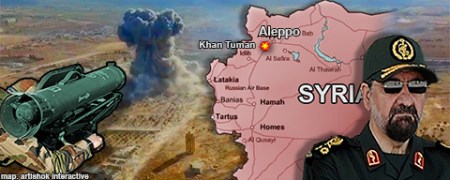
The battle on May 6 in the village of Khan Touman, located southwest of Aleppo near Route 5, the main highway leading to Damascus, will go down in the annals of the Syrian war as the biggest defeat suffered by the Iranian Revolutionary Guard Corps (IRGC) and Hizballah, as well as the battle that changed the face of the war.

DEBKAfile’s military and intelligence sources report that an Iranian force consisting of IRGC troops and Hizballah was ambushed by fighters from the Jaysh al Fath organization, part of the Nusra Front.

Until this battle took place, Iranian and Hizballah commanders in Syria did not know that the rebels had received a shipment of MILAN antitank missiles provided by Turkey and funded by Saudi Arabia.

The encounter with the advanced weapon system brought the IRGC and Hizballah to rout.

The Iranians admitted that 17 of their fighters fell in the battle, including 13 from the IRGC’s “Karbala” Division that is usually based in Iran, and 22 were wounded. Among the dead were two Iranian brigadier generals. At least ten IRGC troops were taken prisoner by the rebels. Five or seven Iranian troops were executed immediately, and an unknown number were taken from the area to an undisclosed location.

Hizballah claimed that none of its troops were killed or taken prisoner. However, that statement was actually an attempt to hide that at least 15 of its fighters were killed. According to intelligence sources that monitored the battle, Hizballah’s death toll was even higher.

The defeat was a major shock to the Iranian and Hizballah hierarchies In Tehran and Beirut, and officials vowed that revenge would be coming soon.

The immediate result of the shock was the appointment of Gen. Mohsen Rezaei, commander of the IRGC 26 years ago in the 1980s, who retired years ago and was a candidate in several presidential elections.

DEBKAfile’s sources report that Rezaei is one of the only IRGC commanders to have visited many times in the West, mainly to participate in international conferences, and has spoken freely with Western military and intelligence officers on the situation in Iran and the Middle East.

It is hard to believe that he will succeed in turning the clock back for Iran and Hizballah in Syria. Rezaei’s appointment indicates confusion   or panic in the Iranian hierarchy that does not know how to respond to the defeat.

KhanTuman480

In addition, it is still not clear whether Rezaei will replace Gen. Qassem Soleimanias commander of Iran’s forces in Syria, or be subordinate to him.

DEBKAfile’s military sources point out that bringing Rezaei to Syria does not resolve Iran and Hizballah’s main military problem, as the battle in Khan Touman showed. If the rebels continue to receive advanced weapons like antitank and antiaircraft missiles, they will become superior to the three military forces fighting for Syrian President Bashar Assad, namely Iran’s standing army and IRGC troops, the Syrian army and Hizballah.

In other words, neither the Iranians nor Hizballah can win the war for Assad.

Seven days after the battle, the commander of Hizballah’s forces in Syria, Mustafa Bader Al-din, was killed by a ground-to-ground missile strike near the Damascus international airport. Later claims by various sources that he was killed in battle at Khan Touman were actually attempts to conceal the two biggest military blows suffered by the Iranians and Hizballah in Syria

Why Middle Eastern Leaders Are Talking to Putin, Not Obama

May 9, 2016

Why Middle Eastern Leaders Are Talking to Putin, Not Obama, Politico, Dennis Ross, May 8, 2016

John Hinderaker at Power Line writes,

Dennis Ross is a respected, if thoroughly conventional, expert on the Middle East. A Democrat, he has served in both Republican and Democratic administrations as an adviser and envoy. Ross served in the State Department as Hillary Clinton’s Special Advisor for the Persian Gulf and Southwest Asia. Subsequently, he joined President Obama’s National Security Council staff as a Special Assistant to the President and Senior Director for the Central Region, which includes the Middle East, the Persian Gulf, Afghanistan, Pakistan and South Asia. So when Ross writes, in Politico, that Obama’s foreign policy weakness is hurting American interests, we should take notice.

— DM)

Putin and Middle Eastern leaders understand the logic of coercion. It is time for us to reapply it.
*****************************

The United States has significantly more military capability in the Middle East today than Russia—America has 35,000 troops and hundreds of aircraft; the Russians roughly 2,000 troops and, perhaps, 50 aircraft—and yet Middle Eastern leaders are making pilgrimages to Moscow to see Vladimir Putin these days, not rushing to Washington. Two weeks ago, Israeli Prime Minister Benjamin Netanyahu traveled to see the Russian president, his second trip to Russia since last fall, and King Salman of Saudi Arabia is planning a trip soon. Egypt’s president and other Middle Eastern leaders have also made the trek to see Putin.

Why is this happening, and why on my trips to the region am I hearing that Arabs and Israelis have pretty much given up on President Barack Obama? Because perceptions matter more than mere power: The Russians are seen as willing to use power to affect the balance of power in the region, and we are not.

Putin’s decision to intervene militarily in Syria has secured President Bashar Assad’s position and dramatically reduced the isolation imposed on Russia after the seizure of Crimea and its continuing manipulation of the fighting in Ukraine. And Putin’s worldview is completely at odds with Obama’s. Obama believes in the use of force only in circumstances where our security and homeland might be directly threatened. His mindset justifies pre-emptive action against terrorists and doing more to fight the Islamic State. But it frames U.S. interests and the use of force to support them in very narrow terms. It reflects the president’s reading of the lessons of Iraq and Afghanistan, and helps to explain why he has been so reluctant to do more in Syria at a time when the war has produced a humanitarian catastrophe, a refugee crisis that threatens the underpinnings of the European Union, and helped to give rise to Islamic State. And, it also explains why he thinks that Putin cannot gain—and is losing—as a result of his military intervention in Syria.

But in the Middle East it is Putin’s views on the uses of coercion, including force to achieve political objectives, that appears to be the norm, not the exception—and that is true for our friends as well as adversaries. The Saudis acted in Yemen in no small part because they feared the United States would impose no limits on Iranian expansion in the area, and they felt the need to draw their own lines. In the aftermath of the nuclear deal, Iran’s behavior in the region has been more aggressive, not less so, with regular Iranian forces joining the Revolutionary Guard now deployed to Syria, wider use of Shiite militias, arms smuggling into Bahrain and the eastern province of Saudi Arabia, and ballistic missile tests.

Russia’s presence has not helped. The Russian military intervention turned the tide in Syria and, contrary to Obama’s view, has put the Russians in a stronger position without imposing any meaningful costs on them. Not only are they not being penalized for their Syrian intervention, but the president himself is now calling Vladimir Putin and seeking his help to pressure Assad—effectively recognizing who has leverage. Middle Eastern leaders recognize it as well and realize they need to be talking to the Russians if they are to safeguard their interests. No doubt, it would be better if the rest of the world defined the nature of power the way Obama does. It would be better if, internationally, Putin were seen to be losing. But he is not.

This does not mean that we are weak and Russia is strong. Objectively, Russia is declining economically and low oil prices spell increasing financial troubles—a fact that may explain, at least in part, Putin’s desire to play up Russia’s role on the world stage and his exercise of power in the Middle East. But Obama’s recent trip to Saudi Arabia did not alter the perception of American weakness and our reluctance to affect the balance of power in the region. The Arab Gulf states fear growing Iranian strength more than they fear the Islamic State—and they are convinced that the administration is ready to acquiesce in Iran’s pursuit of regional hegemony. Immediately after the president’s meeting at the Gulf Cooperation Council summit, Abdulrahman al-Rashed, a journalist very well connected to Saudi leaders, wrote: “Washington cannot open up doors to Iran allowing it to threaten regional countries … while asking the afflicted countries to settle silently.”

As I hear on my visits to the region, Arabs and Israelis alike are looking to the next administration. They know the Russians are not a force for stability; they count on the United States to play that role. Ironically, because Obama has conveyed a reluctance to exercise American power in the region, many of our traditional partners in the area realize they may have to do more themselves. That’s not necessarily a bad thing unless it drives them to act in ways that might be counterproductive. For example, had the Saudis been more confident about our readiness to counter the Iranian-backed threats in the region, would they have chosen to go to war in Yemen—a costly war that not surprisingly is very difficult to win and that has imposed a terrible price? Obama has been right to believe that the regional parties must play a larger role in fighting the Islamic State. He has, unfortunately, been wrong to believe they would do so if they thought we failed to see the bigger threat they saw and they doubted our credibility.

Indeed, so long as they question American reliability, there will be limits to how much they will expose themselves—whether in fighting the Islamic State, not responding to Russian entreaties, or even thinking about assuming a role of greater responsibility for Palestinian compromises on making peace with Israel. To take advantage of their recognition that they may need to run more risks and assume more responsibility in the region, they will want to know that America’s word is good and there will be no more “red lines” declared but unfulfilled; that we see the same threats they do; and that U.S. leaders understand that power affects the landscape in the region and will not hesitate to reassert it.

Several steps would help convey such an impression:

⧫ Toughen our declaratory policy toward Iran about the consequences of cheating on the Joint Comprehensive Plan of Action to include blunt, explicit language on employing force, not sanctions, should the Iranians violate their commitment not to pursue or acquire a nuclear weapon;

⧫ Launch contingency planning with GCC states and Israel—who themselves are now talking—to generate specific options for countering Iran’s growing use of Shiite militias to undermine regimes in the region. (A readiness to host quiet three-way discussions with Arab and Israeli military planners would signal we recognize the shared threat perceptions, the new strategic realities, and the potentially new means to counter both radical Shiite and Sunni threats.)

⧫ Be prepared to arm the Sunni tribes in Iraq if Prime Minister Haider al-Abadi continues to be blocked from doing so by the Iranians and the leading militias;

⧫ In Syria, make clear that if the Russians continue to back Assad and do not force him to accept the Vienna principles (a cease-fire, opening humanitarian corridors, negotiations and a political transition), they will leave us no choice but to work with our partners to develop safe havens with no-fly zones.

Putin and Middle Eastern leaders understand the logic of coercion. It is time for us to reapply it.


US, Russia aim to ‘decapitate’ Syrian military

May 7, 2016

US, Russia aim to ‘decapitate’ Syrian military, DEBKAfile, May 7, 2016

Assad_dressed_in_military_uniform10.12

The US, Russia and the Syrian rebels started discussions this weekend over the composition of a list of Syrian generals who will be dishonorably discharged over war crimes they committed during the country’s civil war, DEBKAfile’s military and intelligence sources say in an exclusive report.

The generals will not face trial at an international tribunal over their war crimes. They will be able to leave Syria along with their families and their possessions, just like President Bashar Assad and his clan.

Our sources add that atop the list are the commanders of the Syrian air force who carried out the majority of the Assad regime’s attacks on the rebels over the past five years, including the atrocities of the past few days.

The sources say that the Americans and the Russians intend to “decapitate” the command but leave the military’s structure in its current form while integrating rebel fighters and commanders into its units. The rebel commanders are to receive ranks equivalent to their current ones in the new Syrian army.

DEBKAfile’s exclusive report on Wednesday, May 4, that Russia is ready to discuss the terms for Assad’s ouster surprised and stunned the political and military hierarchy in Tehran. In urgent consultations held the same day, it was decided to dispatch Iran’s deputy foreign minister for Arab and African affairs, Hossein Amir-Abdollahian, to Moscow without delay in order to determine whether the report was accurate.

The senior Iranian diplomat arrived in the Russian capital the following day and met with Deputy Foreign Minister Mikhail Bogdanov, the chief strategist of Russia’s Middle East policy.

Immediately after the meeting, Amir-Abdollahian said Iran will continue supporting Assad and the Syrian people in fighting terrorism, and make efforts to achieve success at intra-Syrian talks, namely the negotiations in Geneva between the Assad regime and the Syrian opposition. The Iranian diplomat did not say a single word about Assad’s future.

However, Moscow was one step ahead of Tehran. Shortly before Amir-Abdollahian deplaned in the Russian capital, Russian Foreign Minister Sergei Lavrov made a bombshell statement, saying “Assad is not our ally, by the way. Yes, we support him in the fight against terrorism and in preserving the Syrian state. But he is not an ally like Turkey is the ally of the United States.”

Our sources said it was a put-down for both Washington and Ankara, whose relationship has deteriorated recently.

DEBKAfile’s military sources report that Assad has not failed to notice the latest developments, and he continues to use Syrian, Iranian and Hizballah forces to attack the rebels in the parts of Aleppo that they control. This comes despite the announcement on Saturday, May 7, by Moscow and the Russian military in Syria that the ceasefire in the northwestern city had been extended by 72 hours.

Assad is keeping the Syrian army in reserve to defend his region against the US-Russian plan to depose him.

Saudi Columnist Following Pulverizing Of Aleppo: Assad Is The No. 1 Terrorist; Is Putin Any Different From Al-Baghdadi? Is Khamenei More Humane Than Al-Zawahiri?

May 5, 2016

Saudi Columnist Following Pulverizing Of Aleppo: Assad Is The No. 1 Terrorist; Is Putin Any Different From Al-Baghdadi? Is Khamenei More Humane Than Al-Zawahiri? MEMRI, May 5, 2016

Following the massive attack on the city of Aleppo by the Syrian regime and its Russian ally, which included the destruction of a hospital, Saudi columnist Khalaf Al-Harbi penned an article in which he harshly attacked the Syrian regime as well as the leaders of Russia, Iran and Hizbullah. Writing in the government Saudi daily ‘Okaz, he accused these leaders of committing a “genocide” of the Syrian people, and the international community of silent complicity in this crime. He added that this crime was comparable to, if not worse than, the crimes of terrorist organizations such as ISIS and Al-Qaeda.

The following are excerpts from the article:[1]

27877Khalaf Al-Harbi (image: All4syria.info)

“In disaster-ridden Aleppo, a [Syrian air force] jet dropped barrel bombs on a hospital that was treating victims of previous airstrikes. The wounded [victims], the doctors and [other] patients were killed, and at the same time another jet bombed the rescue teams and civil defense [forces]. All this, of course, under the pretext of combatting terrorists!

“What action can terrorists carry out that is worse than the destruction of a hospital[?]

“Look at all the terrifying ISIS videos and the barbaric Al-Qaeda statements, and you will see the same [acts], possibly even less severe ones. If ISIS sends a suicide [bomber] to blow up a vegetable market, Bashar [Al-Assad] and Putin’s jets, together with Iran and Hizbullah, have already erased an entire city, and strove with all their might to exterminate its peaceful residents.

“What’s the difference between Putin and [ISIS leader] Abu Bakr Al-Baghdadi? Is it possible that [Iranian Supreme Leader] Khamenei any more humane than [Al-Qaeda Leader] Al-Zawahiri? Did [Al-Qaeda in Iraq leader] Al-Zarqawi commit any crimes that [Hizbullah leader] Hassan Nasrallah has refused to commit? And as for Bashar Al-Assad – he cannot even be compared to the most satanic among people and demons, since he is the number one terrorist butcher, who receives the blessings of the international community, and in most cases has even conspired with it.

“Moreover, one could say that the case of Al-Baghdadi, Al-Zawahiri, and other terrorist leaders is simpler than that of Putin, Khamenei, Nasrallah, and Bashar, since these terrorist leaders are wanted all over the world, whereas the leaders of the barrel bombs are presidents of UN member-states. The silence regarding the crimes [of these leaders] provides certain legitimacy to the methodical extermination [they carry out in Syria], while we thought that such matters have long ago disappeared from the world.

“If the horrible crimes taking place in Aleppo today are classified as ‘combatting terrorism,’ then we say to the supporters of the barrel bombs – you will surely lose [this] campaign. This, because the child whose good family was destroyed in front of him will not become a peace activist or a human rights activist, but will seek an organization even more barbaric than ISIS to [join, in order to] avenge his family that was wiped off the face of the earth. Shame will continue to hound all those who, for political or sectarian reasons, supported [the dropping of] barrel bombs…”


Endnotes:

[1] ‘Okaz (Saudi Arabia), May 2, 2016.

Suddenly Russia consents to consider Assad’s ouster

May 4, 2016

Suddenly Russia consents to consider Assad’s ouster, DEBKAfile, May 4, 2016

Washington and Moscow have made dramatic progress over the last few days in marathon telephone talks between Secretary of State John Kerry and Foreign Minister Sergei Lavrov on ending the war in Syria. Russia agreed for the first time to discuss the possibility that Syrian President Bashar Assad will step down, and the conditions under which such a process will take place, according to DEBKAfile’s intelligence sources.

The sources add that the Russians also agreed to begin to negotiate the future of senior Syrian military commanders who are carrying out the war against the rebels. The contacts that include the Saudis and the Jordanians have reached such an advanced stage that participants have started to prepare lists of Syrian commanders who will be removed or remain in their posts.

One of the clearest signs of the progress was the arrival of nearly all of the heads and commanders of the Syrian rebel organizations on Monday and Tuesday (May 2-3) for intensive talks at the US Central Command Forward-Jordan, a war room outside Amman staffed by officers from the US, Jordan, Saudi Arabia and the UAE. The gathering was arranged via a series of meetings held in Geneva over the last few days between the top diplomats of the US, Saudi Arabia and Jordan.

Our sources report that US officials and senior officers in charge of the Obama administration’s strategy for the war in Syria presented the rebel leaders and commanders with a series of agreements already reached by Washington and Moscow on ways of ending the war. The main part of the agreement focused on the resignation of Assad and the departure of him and his family from the country-the Syrian opposition’s key demand for continuing the talks.

The rebel leaders were asked by the US officials and officers, who were accompanied by Saudi and Jordanian officials, to help facilitate implementation of the agreed measures and not to try to interfere with them, or in other words, to stop the fighting.

According to the information from our sources, the discussions in Jordan are continuing.

Washington’s current goal is achieve a ceasefire in all of Syria that will prevent an imminent attack by Russian, Iranian, Syrian and Hizballah forces on Aleppo, the country’s second-largest city.

Our military sources report that on Monday and Tuesday, by order of President Vladimir Putin, the Russian air force suddenly halted its airstrikes in the Aleppo area.

Thus, the Iranian, Syrian and Hizballah armies are preparing to launch their assault without the air support needed to capture the city. Even though the Syrian air force can operate in an uninhibited manner in the Aleppo area, it is not up to a large-scale and decisive attack.

No specific information is forthcoming for the Russian U-turn on Assad ousters in mid offensive for the recovery of Aleppo.

However Putin is prone to sudden zigzag in policies.