Posted tagged ‘Anti Semitism’

US considers new, softened nuclear offer to Iran

September 26, 2014

US considers new, softened nuclear offer to Iran

Compromise being weighed would allow Tehran to keep half of its centrifuges in exchange for various checks and balances

By George Jahn September 26, 2014, 10:11 am

via US considers new, softened nuclear offer to Iran | The Times of Israel.

As expected but faster than I thought

Illustrative photo of centrifuges enriching uranium (photo credit:
US Department of Energy/Wikimedia Commons)
 

UNITED NATIONS (AP) — The US is considering softening present demands that Iran gut its uranium enrichment program in favor of a new proposal that would allow Tehran to keep nearly half of the project intact while placing other constraints on its possible use as a path to nuclear weapons, diplomats told The Associated Press.

The initiative, revealed late Thursday, comes after months of nuclear negotiations between Iran and six world powers that have failed to substantially narrow differences over the future size and capacity of Tehran’s uranium enrichment program. Iran insists it does not want atomic arms but the West is only willing to lift nuclear-related sanctions if Tehran agrees to substantially shrink enrichment and other activities that Iran could turn toward making such weapons.

The US, which fears Tehran may enrich to weapons-grade level used to arm nuclear warheads, ideally wants no more than 1,500 centrifuges left operating. Iran insists it wants to use the technology only to make reactor fuel and for other peaceful purposes and insists it be allowed to run at least the present 9,400 machines.

The tentative new US offer attempts to meet the Iranians close to half way on numbers, said two diplomats who demanded anonymity because their information is confidential. They said it envisages letting Iran keep up to 4,500 centrifuges but would reduce the stock of uranium gas fed into the machines to the point where it would take more than a year of enriching to create enough material for a nuclear warhead.

That, they said, would give the international community enough lead time to react to any such attempt.

The diplomats emphasized that the proposal is only one of several being discussed by the six powers — the US, Russia, China, Britain, France and Germany — and has not yet been formally submitted to the Iranians.

Other ideas also include letting Iran have more than 1,500 machines but removing or destroying much of the infrastructure needed to make them run — wiring, pipes used to feed uranium gas and other auxiliary equipment.


A meeting at the P5+1 talks with Iran at UN headquarters in Vienna, on July 3, 2014 (photo credit: AFP/Joe Klamar)

A meeting at the P5+1 talks with Iran at UN headquarters in Vienna,
on July 3, 2014 (photo credit: AFP/Joe Klamar)


Both ideas would allow the Iranians to claim that they did not compromise on vows that they would never emasculate their enrichment capabilities, while keeping intact American demands that the program be downgraded to a point where it could not be quickly turned to making bombs.

The new proposals reflect Washington’s desire to advance the talks ahead of a November 24 deadline that was extended from July. The current round began a week ago on the sidelines of the UN General Assembly, leading to speculation that foreign ministers of the negotiating nations would join in the talks. But the diplomats said that was no longer planned because of the lack of substantial progress.

The fates of a reactor under construction near the city of Arak and of an underground enrichment facility at Fordo are also contentious issues. The US and its Western allies want the reactor converted to reduce to a minimum its production of plutonium, an alternate pathway to nuclear arms. And they insist that the Fordo plant be shuttered or used for something else than enrichment because it is fortified and thought to be impervious to air attacks.

UN Security Council unifies behind anti-IS measures

September 25, 2014

UN Security Council unifies behind anti-IS measures

Special UN Security Council meeting chaired by Obama sees international support rise for anti-Islamic State airstrikes in Syria;

EU warns against possible attacks by al-Qaeda in bid to regain spotlight

Yitzhak Benhorin

Published: 09.25.14, 09:12 / Israel News

via UN Security Council unifies behind anti-IS measures – Israel News, Ynetnews.


The UN Security Council unified behind the international attempt to fight the Islamic State group and demanded on Wednesday that all states make it a serious criminal offense for their citizens to travel abroad to fight with militant groups, or to recruit and fund others to do so.

UHHHHH, hamas , qatar and so on ??? who can believe this ? what about arming terrorist, sory freedom fighters, oposition forces so you want, by who ??


At a meeting chaired by US President Barack Obama, the 15-member council unanimously adopted a US-drafted resolution that compels countries to “prevent and suppress” the recruitment and travel of militant fighters to foreign conflicts.

The resolution will be penned by over 100 nations and de facto removed legal hurdles for US airstrikes in Syria, which unlike Iraq, did not invite the US’ intervention.

Not for Isareli aistrikes on the hamas terorist ??

“The United States of America will work with a broad coalition to dismantle this network of death,” Obama told the General Assembly of the United Nations. “Today I ask the world to join in this effort.”

So now can Israel dismantle hams ?

“We will use our military might in a campaign of airstrikes to roll back ISIL,” he declared, using an alternative acronym for the group.


UN Security Council (Photo: AFP)

After his address, Obama chaired a meeting of the UN Security Council which unanimously approved a binding resolution on stemming the flow of foreign jihadists to Iraq and Syria.

The resolution requires all countries to adopt laws that would make it a serious crime for their nationals to join jihadist groups such as ISIS and the Nusra Front, Al-Qaeda’s branch in Syria.

And what about hamas ?

Obama described the resolution as “historic” at the special session of the Council, only the sixth time in UN history that the council was convening at the level of heads of state.


US President Barack Obama (Photo: AFP)

The UN action reflects mounting international concern over rising numbers of foreign fighters joining the Islamic State militant group and the threat they pose when returning home. Some 12,000 fighters from more than 70 nations have joined extremist groups in Syria and Iraq, experts say.

British Prime Minister David Cameron told the Security Council that the beheadings of two American journalists and a British aid worker by a fighter with an apparent British accent “underlines the sinister, direct nature of this threat.”

The council resolution is under Chapter 7 of the UN Charter, which makes it legally binding for the 193 UN member states and gives the Security Council authority to enforce decisions with economic sanctions or force.

It targets fighters traveling to conflicts anywhere in the world, but does not mandate military force.

Obama is building a global coalition against Islamic State, which has captured swaths of Syria and Iraq and urged its followers to attack citizens of various countries. The United States has led air strikes against the group in Iraq and Syria.

“The words spoken here today must be matched and translated into action,” Obama told the Security Council after the adoption of the resolution. “For if there was ever a challenge in our interconnected world that cannot be met by one nation alone, it is this – terrorists crossing borders and threatening to unleash unspeakable violence.”

Obama chaired the Security Council because the United States is president of the body for September.

The UN resolution expresses concern that “foreign terrorist fighters increase the intensity, duration and intractability of conflicts, and also may pose a serious threat to their states of origin, the states they transit and the states to which they travel.”

Australian Prime Minister Tony Abbott told the council that the passports of more than 60 Australians had been suspended to stop them from joining extremist groups in the Middle East. Both Abbott and Cameron outlined their efforts to strengthen laws.

Terror target: Israel

The European Union’s counterterrorism coordinator, Gilles de Kerchove said al-Qaeda may try to show its relevance by carrying out attacks in Europe, the United States or Israel, the European Union’s counterterrorism coordinator said on Wednesday.

De Kerchove warned of the risk of competition between Islamic State and al-Qaeda, which has renounced its offshoot as too brutal.

“It is possible that Al-Qaida may want to mount attacks to show that the organization is still relevant, they are still in the game,” De Kerchove told a European Parliament committee.

He said some militants had moved from Afghanistan and Pakistan to Syria, where they formed part of the al-Qaeda-linked Khorasan Group.

He added that it appeared they planned to recruit Europeans who had travelled to Syria to fight and persuade them to use their passports to return and mount attacks in Europe, Israel and the United States.

While Islamic State was the main target of a US-led air assault in Syria this week, American officials said they also targeted the Khorasan Group, with the aim of disrupting a plot against US or European targets that the Pentagon said was “nearing the execution phase.”

De Kerchove estimated that more than 3,000 Europeans were in Syria, had been there or planned to go there to fight, and that there was a real risk some of them could return and bring violence back to Europe.

“We have seen that in Brussels with the killing of four persons at the Jewish Museum. It raises their level of tolerance of violence to such a level that there is a risk when they come back that killing is something normal,” he said.

Arab states risk backlash by joining Syria strikes

September 25, 2014

Arab states risk backlash by joining Syria strikes

As Gulf nations flex their military muscles, they are also treading dangerous, and complicated, political waters

By Adam Schreck September 25, 2014, 9:07 am

via Arab states risk backlash by joining Syria strikes | The Times of Israel.


Hamas backed by Qatar and building rockets again  and the USA is in coalition with Qatar an use Qatar air bases .

And obama blame Israel for the turmoil in the middle east  , and abu mazen smellls his change in the UN.

The President called out to the Israeli leadership and public to not give up peace. “This conflict is the main source of problems in the region; for far too long, it has been used in part as a way to distract people from problems at home. And the violence engulfing the region today has made too many Israelis ready to abandon the hard work of peace”.


Saudi Arabian air force pilots sit in the cockpit of a fighter jet at an undisclosed location on September 23, 2014, after taking part in a mission to strike Islamic State targets in Syria (Photo credit: AFP photo/Handout — Saudi Press Agency)


DUBAI, United Arab Emirates (AP) — The Arab nations that joined the United States in striking the Islamic State group in Syria were unusually open about it, throwing aside their usual secrecy and wariness about appearing too close to Washington. Saudi Arabia even released heroic-looking photos of its pilots who flew the warplanes.

Their boasting reflects the depth of Gulf nations’ concern over the threat of the extremist group sweeping over Iraq and Syria. It also shows their desire to flex some military muscle toward regional rival Iran, a key supporter of the Syrian and Iraqi governments.

But the Sunni monarchies run the risk of a backlash by hard-line Islamists angered by the attacks against the Sunni fighters, whom many see as battling a Shiite-led government in Baghdad. Militant websites sympathetic to the Islamic State group lit up on Wednesday with the photos of the Saudi pilots, alongside calls for them to be killed.

Even beyond the ranks of hard-liners, many around the region are suspicious of US motives in yet again launching military action in an Arab nation. Many among the Syrian rebels grumble that the United States and Arab nations ignored their pleas for action against Syrian President Bashar Assad for years and are intervening now against the radicals only because it is in their interest.

Moreover, the US expanded the strikes beyond the Islamic State, hitting al-Qaeda’s branch in Syria, the al-Nusra Front, in a bid to take out a cell called the Khorasan Group that is believed to be plotting attacks against the United States. That has other Syrian rebel factions with Islamic ideologies — and there are many of them — worried they, too, could be hit by the Americans.

“For four years, we called on the West to help us topple the regime, but it’s clear the target is the Islamic factions,” said a Damascus-based opposition activist, Abu Akram al-Shami, speaking via Skype.

The countries whose air forces carried out strikes were all Sunni-led states run by hereditary monarchs with longstanding ties to the American military: Saudi Arabia, the United Arab Emirates, Jordan and Bahrain. Another Gulf monarchy, Qatar, played a supporting role, according to the Pentagon. US President Barack Obama — who had been eager for Arab backing in the campaign — praised them for their willingness to stand “shoulder to shoulder” with the US.

Perhaps most vulnerable to a backlash is Jordan, which borders Syria and has a strong community of Islamists and ultraconservative Salafis who have sympathies with the Islamic State group. Jordan was the homeland of Abu Musab al-Zarqawi, the man who founded al-Qaeda’s branch in Iraq, which eventually evolved into the Islamic State group. He was killed eight years ago in a US airstrike in Iraq.

Mohammed al-Shalabi, a prominent figure in the jihadi-Salafi movement in Jordan, told The Associated Press that while the Islamic State group has “made mistakes” — killing journalists, for example — it is still part of the Muslim nation and US strikes against it will only build support for it.

“The US is hated in the region because of its support for Israel. People will now feel sympathy with (the Islamic State group) against the US,” he said.

“This war is not in Jordan’s interests,” the deputy head of the Muslim Brotherhood in Jordan, Zaki Bani Rsheid, told the Al-Ghad newspaper. He warned that the war would only boost the power of Iran across the region and that Jordan’s participation could bring “responses targeting its internal security and stability.”

In a move some saw as an attempt to soothe Salafi anger, a Jordanian court on Wednesday acquitted and freed a radical Muslim preacher known for his pro-al-Qaeda sermons, Abu Qatada. Analysts said the preacher could help give legitimacy to the campaign against the Islamic State group — or at least help keep Salafis quiet over it.

The action in Syria makes for the largest grouping of Arab military forces against a common target since the broad-based coalition formed to evict Saddam Hussein’s Iraqi forces from Kuwait in 1991, according to analysts at the Austin, Texas-based geopolitical intelligence company Stratfor.

Their participation reflects the growing concern among Gulf countries — particularly Saudi Arabia and the Emirates — about the rise of Islamist groups in the wake of the Arab Spring, such as the Muslim Brotherhood movement and various al-Qaeda affiliates.

“The Islamic State represents a direct threat to the national security of these countries,” said Hossam Mohamed, a political analyst at the Regional Center for Strategic Studies in Cairo.

Saudi Arabia and the Emirates, the two richest of the group, boast some of the region’s best-equipped militaries, including Western-made fighter jets and Apache attack helicopters.

The Emirates in particular has been playing a more active military role. It has deployed troops as part of the NATO-led mission in Afghanistan and, along with Qatar, contributed warplanes to the alliance’s aerial campaign over Libya in 2011 that helped lead to the ouster of Moammar Gadhafi. American officials have also said the Emirates carried out airstrikes against Islamist rebels in Libya last month, but the country has not confirmed that.

American and French sorties targeting the extremists have flown from air bases in Qatar and the Emirates, and from the aircraft carrier USS George H.W. Bush, which is assigned to the US Navy’s Fifth Fleet, based in Bahrain. Saudi Arabia has agreed to host training facilities for Syrian rebels on its territory.

It remains unclear how much of a military role the countries will play from here on. Their participation may turn out to be token, the Stratfor analysts said — or “these airstrikes could develop into a small but growing assertiveness among the region’s Arab monarchies.”

However, Saudi Arabia and its allies are looking beyond just striking the extremists. They want to pressure Iran and eventually turn the campaign against Assad, whose ouster they seek, said Mustafa Alani, an expert on security and terrorism at the Geneva-based Gulf Research Center.

“They are not hoping to topple the regime by military strikes. Military strikes are only a means to generate pressure on the regime to accept a diplomatic political solution,” Alani said. “The idea is to weaken the regime to send a clear message.”

Gazans Speak Out: Hamas War Crimes

September 25, 2014

Gazans Speak Out: Hamas War Crimes

by Mudar Zahran

September 19, 2014 at 5:00 am

via Gazans Speak Out: Hamas War Crimes.

If Hamas does not like you for any reason all they have to do now is say you are a Mossad agent and kill you.” — A., a Fatah member in Gaza.

“Hamas wanted us butchered so it could win the media war against Israel showing our dead children on TV and then get money from Qatar.” — T., former Hamas Ministry officer.

“They would fire rockets and then run away quickly, leaving us to face Israeli bombs for what they did.” — D., Gazan journalist.

“Hamas imposed a curfew: anyone walking out in the street was shot. That way people had to stay in their homes, even if they were about to get bombed. Hamas held the whole Gazan population as a human shield.” — K., graduate student

“The Israeli army allows supplies to come in and Hamas steals them. It seems even the Israelis care for us more than Hamas.” — E., first-aid volunteer.

“We are under Hamas occupation, and if you ask most of us, we would rather be under Israeli occupation… We miss the days when we were able to work inside Israel and make good money. We miss the security and calm Israel provided when it was here.” — S., graduate of an American university, former Hamas sympathizer.

While the world’s media has been blaming Israel for the death of Gazan civilians during Operation Protective Edge, this correspondent decided to speak with Gazans themselves to hear what they had to say.

They spoke of Hamas atrocities and war crimes implicating Hamas in the civilian deaths of its own people.

Although Gazans, fearful of Hamas’s revenge against them, were afraid to speak to the media, friends in the West Bank offered introductions to relatives in Gaza. One, a renowned Gazan academic, who spoke on condition of anonymity, said that as soon as someone talked to a Western journalist, he was immediately questioned by Hamas and accused of “communicating with the Mossad”. “Hamas makes sure that the average Gazan will not talk to Western journalists — or actually any journalists at all,” he said, continuing:

“Hamas does not want the truth about Gaza to come out. Hamas terrorizes and kills us just like Daesh [ISIS] terrorizes kills Iraqis. Hamas is a dictatorship that kills us. The Gazans you see praising Hamas on TV are either Hamas members or too afraid to speak against Hamas. Few foreign [Western] journalists were probably able to report what Gazans think of Hamas.”

When asked what Gazans did think of Hamas, he said:

“The same as Iraqis thought of Saddam before he was toppled. He still won by 90-something percent in the presidential elections. If Hamas falls today in Gaza, people here will do what Iraqis did to Saddam’s statue after he fell. But even though Western journalists may not have been able to speak freely with Gazans, they still need a story to send to their editor by the end of the day. So it is just easier and safer for them to stick to the official line.”

“What was that,” I asked: “‘Blame Israel’?”

“I don’t know about that,” he said. “More like, ‘Never blame Hamas!’. Hamas was making a ‘statement’: Opposing Hamas Means Death. Hamas is a dictatorship that kills us.”

M., a journalist, confirmed his view. “I do not believe any of the people Hamas killed in the last weeks were Israeli spies,” he said. “Hamas has killed many people for criticizing it, and claimed they were traitors working for Israel during the war.”

That conversation took place four weeks before Hamas killed 21 alleged “Israeli Mossad agents.”

D, a store owner, said:

“There were two major protests against Hamas during the third week of the war. When Hamas fighters opened fire at the protesters in the Bait Hanoun area and the Shijaiya, five were killed instantly. I saw that with my own eyes. Many were injured. A doctor at Shifa hospital told me that 35 were killed at both protests. He went and saw their bodies at the morgue.”

To verify those reports, I spoke to a second Gazan academic, who holds a PhD. from a Western university, who stated:

“Hamas did kill protesters, no doubt about that. But we could not confirm how many were actually killed. If I have to guess, the number was more than reported. I am confident that not all of the 21 men Hamas killed on August 22 were collaborating with Israel. Hamas killed those men because it was weakened by Israel’s attacks and felt endangered. So it went on a ‘Salem Witch-Hunt.’ They arrested everyone who opposed them and had to make a few examples to scare people from standing against Hamas. Hamas’s tactic worked. Now Gazans are afraid to talk against Hamas even in front of their own family members. Gazans are probably afraid to criticize Hamas even in their sleep!”

As already reported by the award-winning journalist, Khaled Abu Toameh, Hamas killed one of its leaders, Ayman Taha, and blamed Israel for it.

Asked about Abu Toameh’s report, S., a Gazan political activist said:

“Taha was already in Hamas’s jail before Israeli operations started. Hamas imprisoned him and tortured him because he was critical of its radical policies. He had warned Hamas not to cooperate with Qatar and Iran. Eye-witnesses said they saw Hamas militants bring him alive into the yard of Shifa hospital in Gaza and shoot him dead. They kept mutilating his body in front of viewers and little children and left it on the hospital’s yard for a few hours before allowing the staff to take it to the morgue.”

A., a Fatah member in Gaza, spoke over Skype — fearful that Hamas was intercepting phone lines:

“Even before the Israeli operation began, Hamas rounded up 400 of our members and other political-opposition figures. I would not be surprised if Hamas kills them all and then claims they were killed in an Israeli bombing. Hamas already beheaded a man known for opposing its views on the 22nd day of the war, then reported on its Facebook page that he was caught sending intelligence information to Israel. If Hamas does not like you for any reason, all they have to do now is claim you are a Mossad agent and kill you.”

S. a medical worker, said:

“The Israeli army sends warnings to people [Gazans] to evacuate buildings before an attack. The Israelis either call or send a text message. Sometimes they call several times to make sure everyone has been evacuated. Hamas’s strict policy, though, was not to allow us to evacuate. Many people got killed, locked inside their homes by Hamas militants. Hamas’s official Al-Quds TV regularly issued warnings to Gazans not to evacuate their homes. Hamas militants would block the exits to the places residents were asked to evacuate. In the Shijaiya area, people received warnings from the Israelis and tried to evacuate the area, but Hamas militants blocked the exits and ordered people to return to their homes. Some of the people had no choice but to run towards the Israelis and ask for protection for their families. Hamas shot some of those people as they were running; the rest were forced to return to their homes and get bombed. This is how the Shijaiya massacre happened. More than 100 people were killed.”

Another Gazan journalist, D., said:

“Hamas fired rockets from next to homes. Hamas was running from one home to another. Hamas lied when it claimed it was shooting from non-populated areas. To make things even worse for us, Hamas would fire from the balconies of homes and try to drag the Israelis into door-to-door battles and street-to-street fights — a death sentence for all the civilians here. They would fire rockets and then run away quickly, leaving us to face Israeli bombs for what they did. They are cowards. If Hamas militants are not afraid of dying, why do they run after they fire rockets from our homes? Why don’t they stay and die with us? Are they afraid to die and go to heaven? Isn’t that what they claim they wish?”


Hamas boasted that Palestinian civilians were killed while Hamas’s terrorists remained alive, hiding in their underground bunkers and tunnels. (Image source: Hamas video screenshot)
 

K, another graduate student at an Egyptian university who had gone to Gaza to see his family but was unable to leave after the war started, said on July 22:

“When people stopped listening to Hamas orders not to evacuate and began leaving their homes anyway, Hamas imposed a curfew: anyone walking out in the street was shot without being asked any questions. That way Hamas made sure people had to stay in their homes even if they were about to get bombed. God will ask Hamas on judgment day for those killers’ blood.”

I asked him if Hamas used people as “human shields.” He said: “Hamas held the entire Gazan population as a human shield. My answer to you is yes.”

Palestinian Authority President Mahmoud Abbas told the press on September 6 that Hamas had killed 120 Fatah members who broke the curfew.

T., a former Hamas Ministry officer, said: “Hamas fires from civilian areas for a good reason: The Israelis call the civilians and give them ten minutes to evacuate. This gives Hamas time to fire another rocket and run away.”

Why, I asked, did Hamas not allow people to evacuate?

“Some people say Hamas wants civilians killed in order to gain global sympathy, but I believe this is not the main reason. I think the reason is that if all the people were allowed to evacuate their homes, they all would have ended up in a certain area in Gaza. If that happened, it would have made the rest of Gaza empty of civilians, and the Israelis would have been able to hit Hamas without worrying about civilians in all those empty areas. Hamas wanted civilians all over the place to confuse the Israelis and make their operations more difficult.”

S., a Gazan businessman, said:

“The cease-fire Hamas agreed to carried the same conditions the Egyptians and the Israelis offered during the second week of the war — after only 160 Gazans had been killed. Why did Hamas have to wait until 2,200 were killed, and then accept the very same offer? Hamas has blackmailed the world with the killed Gazan civilians to make itself look like a freedom fighter against an evil Israel. Hamas showed Gazans that it could not care less for their blood and their children. And why should Hamas care? Its leaders are either in mansions in Qatar or villas in Jordan. Mashaal [Khaled Mashaal, the head of Hamas] is in Qatar, Mohammad Nazzal is in Jordan and Abu Marzouk is in Cairo: why should they want a ceasefire? Everyone here in Gaza is wondering why Hamas rejected so many ceasefires. Hamas knows it will not defeat Israel’s army, so why did it continue fighting? The answer is simple: Hamas wanted us butchered so it could win the media war against Israel by showing our dead children on TV and then get money from Qatar.”

I asked S. if other Gazans shared his view. He said,

“Gazans are not stupid. We are now telling Hamas: Either you bring victory and liberate Palestine as you claim, or simply leave Gaza and maybe give it back to the Palestinian Authority or even Israel — or even Egypt! We have had enough of Hamas’s hallucinations and promises that never come true.”

O., a researcher who lives in Gaza Strip’s second largest city, Khan Younis, said:

“Most of us see Hamas as too radical and too stubborn, especially the way it was refusing ceasefires offered from Israel. They even refused a 24-hour ceasefire during the third week of the war. They denied us even 24 hours of quiet to bury the dead. Even some Hamas loyalists here are asking why Hamas refused several ceasefires and made us suffer. Hamas did this on purpose because Hamas is a slave to Qatar. Qatar wants the war to go on because it is a terrorist Islamist country, and Hamas wants more of us dead to appease its masters in Qatar. Let’s be realistic, Hamas is in a bad shape now. Israel destroyed most tunnels; that is why Hamas had to join the ceasefire talks in Cairo. Were the Israelis’ hits to Hamas not so painful, Hamas would not be negotiating in the first place. At the same time, Hamas is asking Israel for the impossible, like an open seaport and an airport. Israel would never allow that, and Hamas knows this, but Hamas might just be buying time by throwing out these demands. You have to keep in mind that Hamas is not concerned with our conditions as Gazans. After all it is our children who are dying, not the children of Hamas’s leaders. Hamas is weak now, and I believe it lost most of its tunnels. Israel’s Iron Dome destroyed so many of their rockets before they landed in Israel; that is why Hamas is being ruthless with Gazans. When Hamas locks people inside homes about to be bombed, when it kills people protesting against it and when it executes alleged traitors without even a trail, these are war crimes.”

A report by the Washington Institute, released in July, also reports that most Gazans are not happy with Hamas’s governance.

“It is true,” said A., a teacher. “I do not know a single Gazan who is pro-Hamas at the moment, except for those on its payroll. Hamas maintains its control here through a military dictatorship, just like North Korea. People will be killed if they protest. Even Gazans living abroad fear to criticize Hamas because Hamas will take revenge on their relatives who are here.”

M., a Gazan television producer, stated:

“Of course I am against Israel and I want it out of Gaza and out of the West Bank, but I still believe Hamas is more of a threat to the Palestinian people. Hamas took over Gaza by killing us [Palestinians] and throwing our young men from high buildings. That is what Hamas is about: murder and power. Hamas is also delusional. Its leaders refused the Egyptian cease-fire proposal, they got hit hard by the Israelis, and then when the war stopped, they declared victory. Even the prophet Muhammad, peace be upon him, admitted it when he lost Ohoud war [A war in which pagan Arabs defeated Muhammad’s army and in which Muhammad was almost killed]. Hamas lives in its own fantasy world. Hamas wanted the dead bodies to make Israel look ugly. The media has exerted a huge pressure on Israel for every dead Gazan. In that sense, Hamas’s tactic has worked, and we have seen more Western tolerance of Hamas, especially in Europe. Of course Hamas doesn’t care if we all die so long as it achieves its goals. We are not going to accept living under Hamas any longer. Even if there is calm, and the firing stops, we are going to still be under Hamas’s mercy, where all basic living standards are considered luxuries. Hamas is just buying time by going to the ceasefire talks. Hamas does not want a ceasefire.”

When asked why that was, he said, “Ask Qatar’s Sheikh, not me. He is Hamas’s god who gives them billions and tells them what to do. May God curse Qatar!”

A first-aid volunteer, E., said that Hamas militants had confiscated 150 truckloads of humanitarian supplies the day before. He said the supplies were donated by charities in the West Bank and that their delivery was facilitated by the IDF. He commented: “This theft angers all of us [Gazans]. The Israeli army allows supplies to come in, and Hamas steals them. It seems even the Israelis care for us more than Hamas.”

Another aid worker, A., confirmed that Hamas steals the humanitarian supplies given to Gaza. “They [Hamas] take most of it, sell it to us, and just give us the stuff they do not want.”

A Gazan mosque’s imam said that the most precious aid item Hamas stole was water. “Gazans are thirsty and Hamas is stealing the water bottles provided to us for free and selling them at 20 Israeli shekels [approximately $5] for the big bottle and 10 Israeli shekels for the small one.”

H., who did not want his profession to be mentioned, lost one of his legs in an Israeli raid. I asked him who he thought was responsible for his injury. He stated:

“Hamas was. My father received a text-message from the Israeli army warning him that our area was going to be bombed, and Hamas prevented us from leaving. They said there was a curfew. A curfew, can you believe that? I swear to God, we will take revenge on Hamas. I swear to God I will stand on my other foot and fight against Hamas. Even if Israel leaves them alone, we will not. What had my two-year-old nephew done to be killed under the rubble of our home so Khaled Mashaal [Hamas leader based in Qatar] could be happy? We want change at any cost. I am not claiming the Israelis are innocent, but I know Hamas has fired rockets from every residential spot in Gaza. If that was not hiding behind civilians, then it was stupidity and recklessness. Nobody who is normal, in his right mind, in Gaza supports Hamas. People have lost parents, children and friends, and have nothing more to lose. I believe if given the chance and the weapons, they will stand against Hamas.”

K., a Gazan school teacher agreed:

“When Hamas starts caring for our children we will start caring for Hamas. Hamas has one policy, to attack Israel; so Israel attacks back, and gets us killed and Hamas then gets more money from Arabs and Erdogan [Turkey’s president]. My son has autism; he cannot handle the sounds of rockets and bombs landing. Why would I support Hamas, which causes this suffering to him? Gazans have had enough of Hamas, any claims that we love Hamas is just propaganda. A recent poll indicates that most of us support Hamas; this is not true, except maybe in the West Bank where they have not yet lived under Hamas rule. I cannot accuse the polling center of fabricating the poll, but my safest explanation for the result is that Gazans polled are too afraid to give their true opinions of Hamas. Hamas watches everything here. Most Gazans now have to deal with the aftermath of the war. Almost 300,000 Gazans are now homeless and Hamas is not providing them with anything. So why would they or their extended families have any love for Hamas? Would there be any common sense to that? Most Gazans are angry at Hamas, and most of us would love to see them replaced by any other force.”

Despite all Hamas has done to Gazans, they do not seem to hold much love — or less hatred — for Israel.

S., a graduate of an American university and a former Hamas sympathizer, warned:

“Don’t get fooled. Gazans are not in love with Israel yet, but they do not want to fight Israel anymore. We do not want to embrace Israel; we just want to live normally without wars. We want to live and work in Israel like we used to. We are under Hamas occupation, and if you ask most of us, we would rather be under Israeli occupation, instead. I would welcome Netanyahu to rule Gaza so long as Hamas leaves, and I think most Gazans feel the same way. We miss the days when we were able to work inside Israel and make good money, we miss the security and calm Israel provided when it was here, but politically speaking, we just think of it as the better of two evils: Israel and Hamas.”

M., who lost his 11 year old daughter in an Israeli bombing said: “I will not forgive either Hamas or Israel for losing my daughter. If you ask me if I hate Israelis, my answer would be no, but do I love them? Of course not. There is too much blood between us, but I can only hope someday we both will move on and heal our wounds.”

When asked what he would do if he were in Israel’s place, being attacked non-stop by Hamas, he responded: “I do not care if both Israel and Gaza burn in hell.”

F., a Gazan physician, said:

“I wish Israel never existed, but as it does not seem to be going away, I would rather be working in Israel like I used to before the first Intifada, not fighting it. Hamas sympathizers, apologists and appeasers should be ashamed of themselves for supporting a terrorist organization that has butchered civilians, Israeli and Palestinian. Apparently a group of Israelis is working on bringing Hamas leader Khaled Mashaal to trial in the International Criminal Court. But perhaps the world should consider putting all the Hamas leaders on trial for crimes against the Gazan people.”

Fatah’s Gaza Branch Making Rockets to Use before Next Cease-Fire [video]

September 25, 2014

Hamas is making new rockets while Israel demands disarmament

By: Palestinian Media Watch

Published: September 24th, 2014

via The Jewish Press » » Fatah’s Gaza Branch Making Rockets to Use before Next Cease-Fire .

Fatah Al Aqsa terrorists shows off “cease-fire” rocket production.


Gaza’s branch of Fatah, Hamas’ rival terrorist party headed by Palestinian Authority chairman Mahmoud Abbas, showed off its continuing rocket-manufacturing capabilities for visiting Russian journalists, Palestinian Media Watch (PMW) reported.

Fatah invited Russian TV (RT) last week to a rocket production facility to witness and film the actual production of new rockets. Fatah’s military wing, the Al-Aqsa Martyrs’ Brigades, depleted its reserves while taking an active part in the Gaza war alongside Hamas, firing rockets at Israeli towns and cities:

“The moment the war ended, the Palestinian military wings renewed military production in order to replenish the stock, which was emptied during the war,”  according to an Arab journalist for RT, quoted by Fatah on its Facebook page.

A Fatah video, as seen below, shows Fatah members at work producing new rockets, and a masked Fatah terrorist explained, “We are preparing and developing rockets in the productions’ division of the Al-Aqsa Martyrs’ Brigades – Al-Asifa Army following the ceasefire agreement in preparation for the coming battles.”

The Palestinian Authority does not want another cease-fire unless it has plenty of rockets on hand to make sure that the truce is temporary. Terrorists in Gaza, like those in the Judea and Samaria who received thousands of rifles from Israel in the 1990s to keep the peace as part of the Oslo Accords, never store their weapons for a long period of time. Their idea of “defense” is to use them to attack Israel, whose existence is considered an offensive act.

The journalist added that Fatah is making rockets because the partial blockade imposed by Israel and Egypt interferes with efforts to smuggle weapons into Gaza.

Of course, Israel could put an end to all smuggling simply by removing the maritime blockade. Then, Fatah, Islamic Jihad, Hamas and all of the other terrorist groups simply could bring in weapons at will in response to the “humanitarian gesture” by Israel.

Fatah’s activity in the war, in which it lost 17 times more members than those identifying with Hamas, is a sign that Fatah and Hamas have achieved unity in the area of terror, if not on the diplomatic front.

A Sept. 10 Fatah post, translated and published by PMW, quoted the RT reporter as stating. “We are visiting the Al-Aqsa Brigades – Al-Asifa Army (i.e., Fatah’s military wing)… where fuel for rockets and mortar shells is being produced.”

An Al-Aqsa Martyrs’ Brigades fighter added, “We are preparing and developing rockets in the productions’ division of the Al-Aqsa Martyrs’ Brigades – Al-Asifa Army following the ceasefire agreement in preparation for the coming battles. During the last war, we fired rockets at the Zionist enemy. We have notified the enemy that we have many more [rockets]. We have also successfully developed the K-132 rocket, which is here beside me.”


This is What Happens When You Attack Israel

September 17, 2014

For too long the media and international community have been preaching that “Palestinians” bear no responsibility for the consequences of their decisions and they are passive victims of the conflict.

By: Shalom Bear
Published: September 17th, 2014

via The Jewish Press » » This is What Happens When You Attack Israel.


A Gaza building, reportedly used by Hamas, destroyed by the IDF on August 26, 2014.
Photo Credit: Emad Nassar/Flash90
 

Leftwing websites love to play up the photos of destruction of Gaza. The poor, suffering, innocent “Palestinians”, victims of Israeli aggression and collective punishment, are their front page stories.

Their bottom line is always the same, the Gazans (or the “Palestinians”) are not responsible for their actions and decisions; they’re passive victims of the conflict.

But it’s not true.

Even before their violent takeover of Gaza, Hamas received the largest block of votes in Gaza, giving them the majority, in fact Hamas secured 76 out of 132 seats – that’s 58% – in the Palestinian Authority’s parliament.

The people of Gaza, knowing full well the genocidal charter of Hamas, voted Hamas in. There’s no getting around that.

It’s both immoral and patronizing to say Gaza’s residents (or the Arabs in Judea and Samaria) voted Hamas in because Hamas’s social programs are more important to them than Hamas’s plans for genocide.

It is now well documented that the destruction in Gaza by the IDF was limited to areas that Hamas was using to attack Israel, whether it be for their command centers, missile silos, terror tunnels, or terrorist positions. For the most part, areas that were not involved in the fighting emerged from the war mostly unscathed.

Even within terror-infested neighborhoods, there are buildings that were hit, and buildings that weren’t.

Owners of many of the hit buildings were profiting from Hamas, charging them rent and receiving payment for letting Hamas store their weapons there, build terror tunnels entrances underneath their homes, or to set up rocket launchers in their orchards and backyards.

Unfortunately, there were also other civilian locations which Hamas illegally decided to use during the war, to attack Israel from.

The problem is that the international community refuses to report on the Arab civilian’s complicity and collusion with the terrorists, preferring to always portray them as the innocent victims, stuck in a situation out of their control.

Last week a Hamas official accidentally let it slip that Gazans are not letting Hamas back into their homes.

So much for the myth of the innocent and oppressed Gazans who can’t stand up to Hamas.

What was missing until now was any incentive for the Gazans to stand up to Hamas.

After all, the media and the UN teach them that there are absolutely no consequences to their actions – so why not let part of your house be converted into a missile silo to wipe out the Jews.

But now, the Gazans have learned an important life lesson. If you participate in any way in the genocidal attempt to destroy Israel, there are significant consequences to your actions.

The media should keep showing these photos of the destruction in Gaza.

Some day, the Gazans and the Arabs in Judea and Samaria will demand the right to vote from their leaders in the Palestinian Authority and Hamas.

They will once again need to decide whether they want the corrupt terrorists to take over, or if they want the ruthless terrorists to take over.

Unfortunately, a poll right after the war showed that Hamas was more popular than ever.

But perhaps, just perhaps, with a little retrospection, they’ll look at these pictures from Gaza and say, “We want a third option.”

Poll: Hamas Would Rule Judea and Samaria in New Elections

September 2, 2014

Hamas won the war in political terms, but that won’t stop Kerry.

By: Tzvi Ben-GedalyahuPublished: September 2nd, 2014

via The Jewish Press » » Poll: Hamas Would Rule Judea and Samaria in New Elections.


Hamas’ Ismail Haniyeh would replace Abbas chairman of the Palestinian Authority if elections were held today.
Photo Credit: Abed Rahim Khatib / Flash 90


Hamas would win election in Judea and Samaria and well as Gaza and Ismail Haniyeh would defeat Mahmoud Abbas if elections were held today, according to a new poll conducted by the Palestinian Center for Policy and Survey Research.

Before the war in Gaza, Abbas had a 12 point margin over Haniyeh, 53 percent against 41 percent.

The new survey was carried out on the last day of the war and during the first four days of last week’s cease-fire. If elections were held today, Haniyeh would trounce Abbas by a 2-1 margin, with 61 percent support of the voters as opposed to only 32 percent for Abbas.

The pollster, Khalil Shikaki, said that Abbas probably will recoup some of his losses because Hamas’ popularity previously fell after battles after mini-wars with Israel, but a 2-1 gap will be hard to overcome.

More worrisome, the poll revealed that 86 percent of the respondents think that Hamas should resume rocket attacks on Israel if the partial blockade is not completely lifted, and only 15 percent think that Hamas should be dis-armed after all sanctions are lifted.

In addition, 72 percent of Arabs in Judea, Gaza and Samaria support the Hamas strategy of using arms to attack Israelis in Judea and Samaria.

An overwhelming majority of 79 percent believe that Hamas won the war.

Hamas has not enjoyed such high support in Judea and Samaria since 2006, shortly after it ousted Abbas’ Fatah faction from Gaza in a bloody terrorist militia war.


To a certain extent, Abbas’ propaganda machine is directly responsible for Hamas’ overwhelming support. Years of demonizing Israel and Jews in the school system and in Palestinian Authority media has produced the desired effect of widespread hate and distrust of Israel and Jews.

False, malicious and twisted reporting have convinced Arabs in Judea and Samaria that the “occupation” is the cause of all or their problems, and a recent on-the-street survey by a Canadian living in Israel discovered that most Arabs that Israel carried out a “holocaust” in Gaza. Most of those interviewed also are ignorant of the Holocaust or think that the numbers of those butchered by the Nazi was grossly exaggerated, as seen in the video below.

Last month, the Israel Security Agency (Shin Bet) announced that a Hamas network, directed from Turkey, was planning a coup to overthrow Abbas. Haaretz reported Tuesday that a partial transcript of the investigation revealed that the plan actually was to wait for the Palestinian Authority to collapse and then take over power.

However, Hamas propaganda has consistently tried to undermine the Abbas regime, and every terrorist attack in Judea and Samaria weakens Abbas’ image that he is able to provide security.

Abbas has made a Frankenstein out of the “Peace Process,” demanding everything and accepting no compromise. The longer he cannot come up with the goods, the more his popularity falls. His only hope to force Israel to agree to impossible demands, such as allowing mass immigration of millions of so-called “refugees” and giving up land to connect Gaza with Judea and Samaria, is to go to the United Nations and the International Court. That process, which would provide doubtful result but in any case could take years, and the Arab street has lost its patience.

If U.S. Secretary of State John Kerry still thinks he can fall out of the clouds with his precious peace process, which has proved to be a war process, he will have a hard time pretending that Hamas is not in the picture.

PA plan seeks Palestinian state, IDF pullout within 3 years

September 2, 2014

PA plan seeks Palestinian state, IDF pullout within 3 years

Present a map of future Palestine or face international condemnation and an end to West Bank security cooperation, Abbas to tell Israel

By Times of Israel staff and Avi Issacharoff

September 2, 2014, 3:12 pm

via PA plan seeks Palestinian state, IDF pullout within 3 years | The Times of Israel.


Palestinian Authority President Mahmoud Abbas (photo credit: Issam Rimawi/Flash90)


alestinian Authority President Mahmoud Abbas plans to present a framework for renewed peace talks with Israel, according to a Palestinian ex-minister close to Abbas.

In an effort to jumpstart stalled peace talks and expedite the establishment of a Palestinian state, Abbas is preparing to present Israel with a specific timetable for talks and a detailed set of demands.

According to former PA minister of religious affairs Mahmoud al-Habash, the plan calls for new talks over a maximum of nine months, which would secure an Israeli withdrawal from the agreed-upon territory slated for the future Palestinian state in no more than three years.

Abbas is reportedly demanding that the chief issue of contention between the sides, the location of the borders between the two states, be determined at the start of talks. The first three months would be devoted to establishing the borders, and the following six months for the remaining issues, including refugees, Jerusalem, settlements, security arrangements and water, Habash said, according to the Ynet news site.

During the talks, Abbas will demand the freezing of settlement construction and the implementation of the fourth phase of the prisoner release that was called off as the previous talks broke down earlier this year.

Abbas is slated to present his plan to the upcoming gathering of Arab League foreign ministers in Cairo on September 7. PA chief negotiator Saeb Erekat and intelligence chief Majed Faraj have met with European leaders and are slated to travel to Washington to present the plan to senior American officials.

As The Times of Israel reported Monday, Abbas envisions filing a request with the Americans to pressure Israel to present a map of a future Palestinian state as the basis for substantive negotiations. After Israel presents the map, Abbas’s plan calls for the Israeli withdrawal according to the three-year timetable, and the establishment of a Palestinian state with Jerusalem as its capital.

If Israel rejects or delays resuming talks under Abbas’s proposed framework, the PLO, headed by Abbas, would turn to unilateral moves, including appeals to the International Criminal Court against Israeli policies and officials.

In such a scenario, Abbas intends to apply all the diplomatic means at his disposal to pressure Israel, including, within three months, to seek a UN Security Council resolution that recognizes the establishment of a Palestinian state on the 1967 lines.

Since the Palestinians expect the US to veto any Security Council resolution, they intend to then approach the General Assembly with the same request. After that, the PLO will seek to join international bodies and organizations, and then to campaign to have Palestine recognized as a nation under occupation according to the Geneva Conventions.

If none of those moves achieves Abbas’s goal of the declaration of a Palestinian state, he threatens to halt joint security operations with Israel, so central to the recent relative calm in the West Bank, and hand over all responsibility for rule in Palestinian cities to the IDF.

Were that to happen, the PA would effectively, if not formally, cease to function.

Ending joint security operations is still a long way off and, at this stage, there could yet be changes, developments, and restructuring of the Abbas plan. But, for Abbas and his close confidants, matters are clear: Israel has until the end of the calendar year to decide whether or not it intends to present a map of the future Palestine. If the answer is negative, a diplomatic confrontation between the PA and Israel will be unavoidable, and will also lead to the cessation of the joint security apparatus.

Iran Begins Arming Palestinian Terrorists

August 29, 2014

Iran Begins Arming Palestinian Terrorists

Promises ‘the annihilation of the Zionist regime’

BY:
August 28, 2014 6:20 pm

via Iran Begins Arming Palestinian Terrorists | Washington Free Beacon.


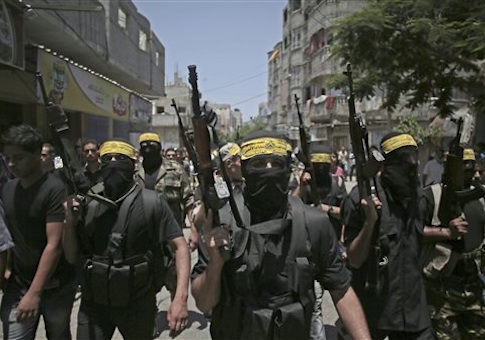
Masked Palestinian militants march with guns / AP

 Iranian military leaders say that they have begun weapons deliveries to Palestinian terrorists in the West Bank and elsewhere in the region after months of promising increased military support for Israel’s enemies, according to regional reports.

A top Iranian military commander confirmed that weapon shipments to the West Bank have already begun and that more will be sent to other “Palestinian resistance groups.”

“Arming the West Bank has started and weapons will be supplied to the people of this region,” Brigadier General Mohammad Reza Naqdi, the commander of Iran’s volunteer Basij force told the state-run Fars News Agency on Wednesday.

The announcement was made after weeks of inflammatory statements from Iranian leaders threatening war on Israel and promising to rearm Palestinian militants such as Hamas so that they can continue their war on the Jewish state.

The military leader also confirmed what has long been suspected by Israeli intelligence agencies: That Iran is responsible for training and arming Hamas with highly advanced rockets that were used to penetrate deep into Israeli territory during the most recent conflict.

Much of the arms Hamas deployed “were the products of the Islamic Republic of Iran,” Fars reported Naqdi as saying.

Iran is arming terrorists in the more moderate West Bank of Israel—as opposed to the Hamas-run Gaza Strip—because attacks on Israel from this area will ensure “the annihilation of the Zionist regime.”

“The Zionists should know that the next war won’t be confined to the present borders and the Mujahedeen will push them back,” Naqdi said.

An Iranian General this week vowed to launch a surprise attack on Israel in retaliation for an Israeli drone that was reportedly shot down near an Iranian nuclear site.

Anger at the incident has also prompted Tehran to step up its military support for Palestinian terrorists.

“We will accelerate arming the West Bank and we think that we are entitled to give any response (to the recent aggression) which we deem appropriate,” Brigadier General Amir Ali Hajizadeh, commander of Iran’s Revolutionary Guards Corps’ (IRGC) Aerospace Force, was quoted as saying on Monday.

Iran also is considering military force, according to Hajizadeh.

The IRGC claims to have shot down the Israeli drone with a surface to air missile. It lashed out at Israel in vitriolic terms in a statement issued earlier in the week.

“This mischievous attempt once again made the adventurous nature of the Zionist regime more evident and added another black page to the dark record of this fake and warmongering regime, which is full of crimes and wickedness,” the IRGC said in its statement.

Iran has been promising to arm Palestinian terrorist for weeks as the most recent conflict between Israel and Hamas escalated.

“The West Bank must be armed like Gaza,” Iranian Supreme Leader Ayatollah Ali Khamenei said in late July. He echoed these comments on Twitter.

Iran also has boasted of its past arming of Hamas terrorists.

“Today, the fighters in Gaza have good capabilities and can meet their own needs for weapons,” an Iranian lawmaker reportedly stated on television in July. “But once upon a time, they needed the arms manufacture know-how and we gave it to them.”

Mashaal Vows Cease-Fire a Step to New ‘Resistance’ War against Israel

August 29, 2014

By: Tzvi Ben-Gedalyahu

Published: August 28th, 2014

via The Jewish Press » » Mashaal Vows Cease-Fire a Step to New ‘Resistance’ War against Israel.


Hamas chief Khalid Mashaal rallies supporters in Gaza (archive).
Photo Credit: Screenshot

Hamas’ supreme leader Khaled Mashaal dashed any hopes of long-term peace with Israel in a speech in Qatar on Thursday in which he shot from the hip at Israel and also at his terrorist organization’s new partner, the rival Fatah movement headed by Palestinian Authority chairman Mahmoud Abbas.

His lengthy speech in Qatar, which has financed Hamas terror and which fought Egyptian cease-fire proposals, followed by one day a “victory” speech by Ismail Haniyeh, the senior Hamas political leader in Gaza. Mashaal’s silence while Haniyeh accepted the cease-fire is a clear sign of a fierce power struggle between Hamas in Gaza and between Mashaal and Qatar, which holds the purse strings.

Mashaal also claimed victory, with lies that Hamas missiles hit the Ben Gurion Airport, which is not true, and that more than 5 million Israelis hid in bomb shelters, a gross exaggeration. However, there is no doubt that Hamas succeeded in scaring the daylight out of millions of Israelis, interrupting a few flights and generally turning half of Israel into sitting ducks.

And this won’t be the last time, regardless of a cease-fire, he warned.

“Whatever happened [in Gaza] is not the end to this story, and this is not the last operation to free Palestine. It was an important stop on the way to victory,” Mashaal declared.

His speech threw every obstacle possible on the road to negotiations with Israel. The talks are supposed to begin in a month, leaving open the possibility, or probability, that Prime Minister Binyamin Netanyahu is carrying on secret negotiations that will be formalized in 30 days.

The Prime Minister suffered another blow to any trust that Israelis may have for him with a report on Thursday that he met secretly with Jordanian King Abdullah, and perhaps Abbas, prior to the cease-fire, circumstantial evidence that Israel negotiated under fire, contrary to Netanyahu’s promise.

If Mashaal gets his way, there won’t be any talks because one of the new powers in Gaza is slated to be Abbas, whose security forces would patrol Gaza borders, according to the Egyptian proposal. That would provide Cairo with another tactic to get rid of Hamas.

Mashaal nailed Abbas to the wall in his speech, accusing him of throwing cold water on the resumption of the intifada during the war by allowing his security forces to limit protests.

“The next operation needs to use all of the Palestinian capabilities, not just part of them,” Mashaal said. “The resistance is holy and weapons are holy. There is no such thing as a country without weapons.”

A country or not, Gaza still has at least 2,000 rockets as well as anti-tank rockets and presumably anti-aircraft missiles. It still has rocket factories, one of which was filmed in production by Hamas during one of the failed cease-fires during the war.

Netanyahu had demanded that any halt in violence would be accompanied by disarming Hamas, but this week’s cease-fire only left the issue to be put on the negotiating table, along with Hamas’s demands for a deep-sea port and an airport.

Mashaal’s speech was full of hate and crude accusations that Israel inflicted a “Holocaust” on Gaza by “destroying schools and hospitals,” which all but the most extreme anti-Israel media now know were used by Hamas as rocket launching and terrorist command centers.

“We are against what Hitler did to the Jews, and Israel committed a second Holocaust in Gaza. Israel is an embarrassment to Jews and to the entire world,” according to Mashaal.

His rhetoric was aimed at Abbas as well as Israel. If and when negotiations begin, Egypt and the United States will be on the side of Abbas, who despite his unity government with Hamas has proved politically smart by a patient and single-minded tactic of using international support to slowly but surely win concession after concession from Israel until there is nothing left to negotiate.

Including Gaza as part of the Palestinian Authority works to Abbas’ benefit because it will solidify position that a Palestinian Authority state needs to on contiguous territory, meaning that Sderot residents can start packing up and leaving their homes as well as their bomb shelters, which would save Hamas lots of time and money when digging terror tunnels from the Western Negev to Ashdod.

Mashaal’s aim is the same as Mashaal, but his strategy is different When Mashaal says that there will be another war to “free Palestine,” he is referring to all of Israel, from Kiryat Shmona in the north to Eilat in the south, and from the Dead Sea in the east to the Mediterranean Sea on the west.

Abbas talks about a “two-state solution,” the magic phrase that sends U.S. Secretary of State John Kerry into hallucinations and hypnotizes the foreign media into pretending that the Palestinian Authority’s maps of “Palestine” don’t include the existence of Israel.

But Mashaal reminded everyone in his speech that he has people on his side.

He thanked his sponsors for terror, namely Qatar, Turkey, Yemen and Algeria, and he thanked South Africa and Latin American countries for boycotting Israel.