Posted tagged ‘Ankara’

‘Coup against parliament:’ Politicians and analysts slam lifting of Turkish MPs’ immunity

May 21, 2016

‘Coup against parliament:’ Politicians and analysts slam lifting of Turkish MPs’ immunity

Published time: 20 May, 2016 21:53

Source: ‘Coup against parliament:’ Politicians and analysts slam lifting of Turkish MPs’ immunity — RT News
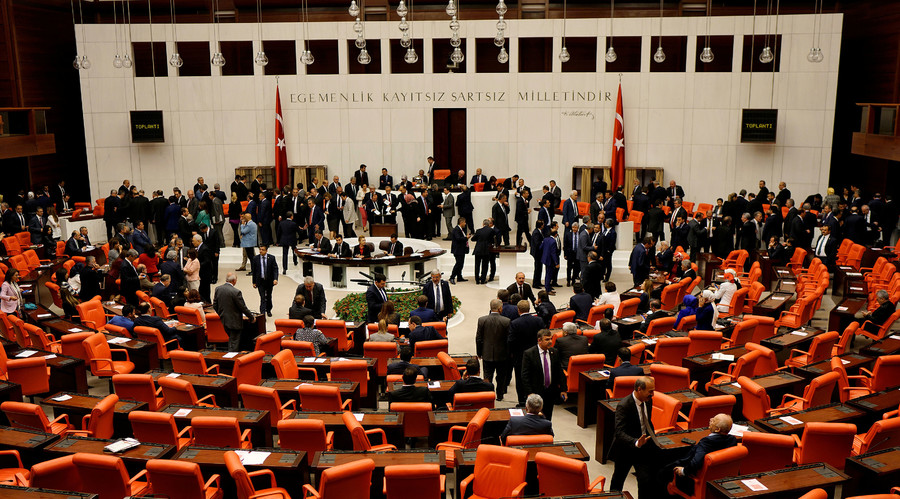
Turkish lawmakers attend a debate at the Turkish parliament in Ankara, Turkey, May 20, 2016. © Umit Bektas / Reuters

Stripping MPs of legal immunity was a power grab by the Erdogan-controlled parliament, RT was told by Turkish politicians and analysts, many of whom believe the move is aimed at stifling the opposition, especially the pro-Kurdish HDP party.

The Turkish parliament’s decision to take away lawmakers’ immunity from prosecution “is a coup staged against the parliament itself,” Alp Altınors, deputy chairman of the opposition pro-Kurdish Peoples’ Democratic Party (HDP), told RT, adding that the move violates democratic norms.

“This is a planned expulsion of HDP from the parliament, because HDP is the most active opposition group in the parliament,” he said, accusing Turkish President Recep Tayyip Erdogan of “planning and organizing” the move in order to transform the parliament into a “tool of the [government].”

Read more

Chairs belonging to MPs of Turkey's main opposition Republican People's Party (CHP) are seen empty after the parliamentarians left a debate to protest against the Parliament Speaker Ismail Kahraman, at the Turkish parliament in Ankara, Turkey, May 20, 2016. © Umit Bektas

This initiative was directed against the opposition, Gunes Engin, an advisor to HDP lawmaker Filiz Kerestecioglu, told RT in an interview, stressing that “a total number of 138 deputies” representing different opposition parties were stripped of their immunity, most of whom are from the HDP.

“It is very sad news for Turkish democracy because what they want now is to push all the MPs from [Turkish] Kurdistan and other opposition MPs, [who] come together for the need of democracy, out of the parliament,” she said in the interview.

She also said the vote gave Erdogan “a victory by [parliamentarians’] own hands,” adding that “the current situation in Turkey… would be a big fail for all the democratic forces.”

In the meantime, Shwan Zulal, a business consultant and political analyst, told RT that this amendment will be used by the government to crack down on the opposition and “arrest or put away any MP.”

“This is a targeted approach [used] by President Erdogan [aimed at] making sure that Kurdish MPs within parliament will be put away on very flimsy charges [like] terrorism or… showing support for the [outlawed Kurdistan Workers Party] PKK,” he said.

He also stressed that Erdogan “wants to have absolute power in Turkey” and needs to be able to push his legislation through the parliament in order to achieve that goal. He does not have it yet, however, as his party does not have the necessary majority, Zulal added, implying that Erdogan is seeking a way to shift the balance of power in the legislature.

Read more

Turkish President Tayyip Erdogan. © Umit Bektas

Zulal’s ideas were partly echoed by human rights activist Professor Murat Somer from the Koc University in Istanbul, who said in an interview with RT that stripping lawmakers of their immunity would seriously diminish the role of the parliament, as it would drastically limit the ability of legislators to act freely.

“They [lawmakers] will be less able to do politics because they may, in fact, be prosecuted. And they may be tried, … punished, and get sentenced at the end, [so] they will not be able to function as they do so far,” Somer said.

He added that this move “will create a large series of legal questions and complexities” that could eventually “destabilize” or even “paralyze” the parliament, leading to a situation that “will strengthen the government and may lead to the outcome, [in which] the government will make more and more decisions without parliamentary oversight.”

Selahattin Demirtas, leader of the opposition Peoples’ Democratic Party (HDP), had already denounced the move as a blow against the people’s will, vowing to challenge it in the Constitutional Court.

At the same time, President Erdogan hailed approval of the bill as “historic” for the country.

Earlier on Friday, the Turkish parliament passed a bill that would amend the constitution to allow MP’s to be stripped of their legal immunity from prosecution. In the third and final vote, 376 out of 550 legislators voted in favor of the bill. The measure paves the way for many opposition, and particularly pro-Kurdish, legislators to be charged for “support of terrorism” due to their views on Turkey’s Kurdish issue.

The development comes while the Turkish military is in the midst of an operation against Kurds fighting for greater autonomy in the country’s southeast. Ankara’s new campaign ended a two-year ceasefire between the ethnic group and the government that had lasted since 1984. The military crackdown, which has been underway since July of 2015, has already claimed the lives of hundreds of Turkish soldiers and police officers, as well as thousands of Kurdish militants and between 500 and 1,000 civilians, according to different estimates provided by opposition parties and NGOs.

ISIS, oil & Turkey: RT films trove of jihadist docs detailing illegal trade with Ankara (EXCLUSIVE)

March 24, 2016

ISIS, oil & Turkey: RT films trove of jihadist docs detailing illegal trade with Ankara (EXCLUSIVE)

Published time: 24 Mar, 2016 03:00 Edited time: 24 Mar, 2016 05:12

Source: ISIS, oil & Turkey: RT films trove of jihadist docs detailing illegal trade with Ankara (EXCLUSIVE) — RT News

Islamic State documents, including invoices, which militants abandoned while retreating in haste. / RT

An RT Documentary crew filming in northern Syria has seen Islamic State (IS, ISIS/ISIL) documents abandoned by retreating terrorists and found by the Kurds that, along with captured IS recruits, provide a stunning insight into the alleged Turkey-IS oil trade links.

Shortly after the outbreak of the Syrian war, IS became a game-changer in Iraq and, in particular, Syria. Beheadings on camera, mass killings, and enslavement, as well as apparent connections to the Paris and Brussels attacks had become synonymous with the terror group, giving it wide publicity.

Running a viable militant organization with such remarkable capabilities would be impossible without some logistical and financial support from the outside.

Turkey, which has been actively engaged in the Syrian war since the outset, has repeatedly denied claims that it is aiding IS. However, while Ankara insists that it is the jihadist group’s sworn enemy, facts on the ground often tell a different story.

RT has spoken to several witnesses who were involved in Islamic State’s trade activities and accessed the terror group’s documents, which provide insight into how and where foreign militants enter Syria to join the terrorist “state.”

Abandoned buildings used by ISIS militants in northern Syria.

Detailed oil invoices

The RT Documentary team did most of its filming in the town of Shaddadi, located in the Syrian province Hasakah, which has been partly overrun by IS jihadists. Following the liberation of Shaddadi, which is home to some 10,000 people, RT filmed Kurdish soldiers walking around what used to be the homes of IS fighters and examining piles documents that had been left behind.

Some of the files seized at the scene turned out to be detailed invoices used by IS to calculate daily revenues from their oil fields and refineries, as well as the amount of oil extracted there. All the documents had Islamic State’s symbol at the top.

Example of an Islamic State invoice specifying the quantity of oil sold.

The files showed that “IS has kept very professional records of their oil business,” said the author of the new RT Documentary on Islamic State filmed in northern Syria, who chose to remain anonymous for security reasons.

Every invoice included the name of the driver, the vehicle type driven, and the weight of the truck, both full and empty, as well as the agreed upon price and invoice number.

One of the discovered invoices dated 11 January, 2016, says that IS had extracted some 1,925 barrels of oil from Kabibah oil field and sold it for $38,342.

IS oil goes to Turkey – IS fighters come via Turkey

RT spoke to local residents who had been forced to work in the IS oil industry about what it was like working at the terrorist-controlled oil refinery and where the extracted oil was sold.

The locals attested that “the extracted oil was delivered to an oil refinery, where it was converted into gasoline, gas and other petroleum products. Then the refined product was sold,” the RT documentary’s author said. “Then intermediaries from Raqqa and Allepo arrived to pick up the oil and often mentioned Turkey.”

Important information revealing the connection between IS and Turkey was provided by a Turkish militant previously captured by the Kurds. The IS recruit said on camera that the terrorist group does, in fact, sell oil to Turkey.

“Without even us asking the fighter directly, he admitted that the reason why it was so easy for him to cross the Turkish border and join IS was, in part, due to the fact that Turkey also benefited. When asked how, he said that Turkey gets something out of it – something such as oil.”

RT was also able to speak with a Kurdish soldier in the area, who displayed a collection of passports he had gathered from the dead bodies of IS fighters. The documentary crew’s exclusive footage shows the documents of several jihadists who had come from all over the world, including countries such as Bahrain, Libya, Kazakhstan, Russia, Tunisia, and Turkey.

Passports belonging to Islamic State fighters bearing stamps from Istanbul, Turkey.

Most of these foreign fighters seemed to have come via Turkey, as all of their passports contained entry stamps issued at Turkish border checkpoints.

A YPG member also provided some photos that were retrieved from a USB drive allegedly belonging to future IS militants. One photo showed three men standing in front of the Obelisk of Theodosius, known today as Sultanahmet Meydani, a famous landmark in Istanbul. The next photo showed the three among other fellow militants somewhere in Syria – all armed and equipped.

One of the IS fighters that RT interviewed revealed that there had been no border guards waiting for them when they crossed from Turkey into Syria.

Islamist propaganda printed in Istanbul

Turkey’s logistical support for extremist fighters trying to overthrow Syrian President Bashar Assad’s government, or at least its non-interference with their cross-border movements, has been widely reported, but little has been said about the ideological support coming from Turkish soil.

Among the documents left behind by the terrorists at an IS-run hospital, RT’s crew discovered an Islamist propaganda leaflet printed in Arabic titled “How to wage a perfect battle against the criminal Assad’s regime,” which described ways to combat the Syrian government.

Curiously, the brochure was printed in Turkey, with the cover openly displaying the postal address and phone number of an Istanbul printing house, supplemented by Facebook contacts.

Cover of an Islamist, anti-Assad propaganda leaflet printed in Istanbul, Turkey.

“Many of the people spoke about the connection with Turkey. Turkey is the direct neighbor of IS. If it was willing to close the ‘connection’ between Turkey and IS, the terrorist organization could no longer survive,” the author of the RT documentary said, recalling interviews with Kurds and captured IS recruits. “If IS would stop receiving weapons, new recruits, food, and other help from Turkey, then IS would lose a big sponsor.”

Turkey benefits from Islamic State because the terrorist group provides it with cheap oil and is fighting both Syria’s government and Kurdish population. This is an opinion shared by both Kurds and their mortal enemies from the jihadist organization. The IS documents obtained by RT may provide additional evidence revealing the dirty game being played by the government of Turkish President Recep Tayyip Erdogan in Syria.

US embassy issued warning on impending attack in Ankara 2 days before Sunday blast

March 14, 2016

US embassy issued warning on impending attack in Ankara 2 days before Sunday blast

Published time: 14 Mar, 2016 09:09 Edited time: 14 Mar, 2016 09:26

Source: US embassy issued warning on impending attack in Ankara 2 days before Sunday blast — RT News

Emergency workers work at the explosion site in Ankara, Turkey March 13, 2016 © Stringer
The US embassy in Turkey issued a security warning to American citizens two days before a blast caused by a suicide car bomb hit the center of Ankara on Sunday evening. At least 37 people were killed and 125 injured in the explosion.

The American embassy had warned on its website about a “potential plot to attack Turkish government buildings and housing in the Bahcelievler neighborhood,” in Çankaya District, where the Turkish National Library is located among other landmarks. “US citizens should avoid this area,” the embassy stated.

“We advise US citizens to review their personal security plans, remain aware of your surroundings and local events, monitor local news stations for updates, and follow local authority instructions,” it added on Friday.

The Sunday blast, the second attack in the administrative heart of the city in under a month, occurred near Guven Park and Kizilay Square, several kilometers from Bahcelievler. The site of the explosion is close to the Justice and Interior Ministries, a top courthouse, and the former office of the country’s prime minister. The blast, which could be heard several kilometres away, appears to have been triggered by a car exploding near a bus stop, Turkish broadcaster TRT reported, adding that the site is a major transportation hub.

“It’s a car bomb, [it happened] in the heart of Ankara… and today is Sunday, many people may be outside,” Turkish journalist Onur Burcak Belli told RT by phone, adding that the scene of the blast is “very close to a shopping mall.”

While no one has claimed responsibility for the attack, two senior security officials told Reuters that the initial findings suggested that members of the outlawed Kurdistan Workers’ Party (PKK) or an affiliated group were responsible. The PKK has been waging an armed struggle for Kurdish autonomy since 1984.

On Friday, Turkish Interior Minister Efkan Ala said that new military operations against PKK members could be expected in several mostly Kurdish-populated towns in the east of the country. The Turkish military operation against PKK militants in the southeast was launched in July 2015, breaking a ceasefire agreement that had held for two years. The Turkish crackdown against the Kurds has been criticized by human rights groups. Amnesty International reported in January that at least 150 civilians, women and children among them, have been killed in the Turkish military operation, saying that some 200,000 people had been put at risk and were being denied access to services due to strict curfews.

READ MORE: Turkey keeps shelling Kurds, backing terrorist groups in Syria – Russian MoD

In February, 28 people were killed and 61 injured in a blast in Ankara, when a car bomb, reportedly targeting military personnel, went off close to the parliament building. Turkish Prime Minister Ahmet Davutoglu immediately blamed a Syrian Kurdish militia fighter for the attack, which further proved that the YPG was a terrorist organization, the PM said. “Yesterday’s attack was directly targeting Turkey and the perpetrator is the YPG and the divisive terrorist organization the PKK. All necessary measures will be taken against them,” Davutoglu said in a televised speech. Within hours, Turkish warplanes bombed PKK bases in northern Iraq, and shelled YPG positions in northern Syria, a security source told Reuters.

Daesh Terrorists: A Multifunction Tool in Hands of Ankara, Riyadh, NATO

February 20, 2016

Daesh Terrorists: A Multifunction Tool in Hands of Ankara, Riyadh, NATO

Ekaterina Blinova

15:29 20.02.2016

Source: Daesh Terrorists: A Multifunction Tool in Hands of Ankara, Riyadh, NATO

The West and its Mideast partners are playing deceiving Machiavellian games in Syria, F. William Engdahl told Sputnik, adding that Russia is in a most risky situation if it believes that the other actors involved in the conflict, such as Recep Erdogan or King Salman and his impulsive son Prince Mohammed, are reasonable, as hate knows no reason.

While tensions are simmering over the prospect of a Turkish-Saudi invasion of Syria, six members of the UN Security Council, including the US, UK and France, have voiced their objections to a Russian draft resolution aimed at restoring the sovereignty of the Middle Eastern state, fanning the flames.The draft resolution, which denounces any actions that undermine the sovereignty and territorial integrity of Syria and condemns any plans for a foreign military invasion, has been dismissed by the US and French UN ambassadors as “having no future.”

It is rather surprising that the proposed resolution, aimed at peace in Syria and the protection of the fundamental values of the UN charter, has immediately come under fire from Washington and the major European powers. However, there is an obvious explanation: the Western powers have repeatedly violated international law, having acted militarily in Syria without official permission from the legitimate government of President Bashar al-Assad.

In light of this, the contours of the Western strategy in Syria are getting clearer. The question then arises whether the Syrian Arab Army, backed by Russia’s Air Force, will help Damascus restore sovereignty and re-unite Syria?

“What I feel is that at present the energy in Syria is, regrettably, one of death and destruction, everywhere. This cannot easily be healed such that Syria becomes a healthy sovereign nation as it was perhaps a century ago, prior to World War I. This is the destructiveness of war. It is not a question of military reconquest of land lost in the past five years of war. Were it so easy, the world would have healed the scars of all wars centuries ago. No one side ‘wins’ in war, only in peace,” American-German researcher, historian and strategic risk consultant F. William Engdahl told Sputnik in an exclusive interview.

By stepping in in Syria, Russia has actually entered a geopolitical chess tournament with crafty Western players. Will Vladimir Putin and Bashar Assad beat Washington’s geopolitical grandmasters at their own game?”This is a very difficult question to answer. My honest feeling is that the American Patriarchs as I prefer to call them, not grandmasters, have a deep plan with their many wars in the Middle East. The plan is simple — spread hate, destruction, a killing energy, not only in the Middle East oil countries but also in the EU as well as inside the United States, in China, everywhere, with their wars over oil in the end,” Engdahl pointed out.

Fighters of the al-Qaida-inspired Islamic State of Iraq and the Levant (ISIL) parade in a commandeered Iraqi security forces armored vehicle down a main road at the northern city of Mosul, Iraq. (File)
© AP Photo/
Fighters of the al-Qaida-inspired Islamic State of Iraq and the Levant (ISIL) parade in a commandeered Iraqi security forces armored vehicle down a main road at the northern city of Mosul, Iraq. (File)

If the world is busy with such destruction, those Patriarchs have the misguided feeling they will prevail, the strategic risk consultant underscored, adding that we are in a kind of world war already.

“They ignited the Maidan Square coup in February 2014 to disrupt growing, positive economic and political relations, especially between Germany and Russia, to an extent between the EU and Russia. They have demonized Russia and her President in their media. China will be next in their sights,” Engdahl stressed.

Indeed, a belt of instability has stretched from North Africa and the Balkans to Central Asia and beyond. Five years have passed since the “Day of Rage” in Libya which was aimed against the rule of Muammar Gaddafi. The uprising, enthusiastically supported by the West, has lured the country into constant turmoil. Meanwhile, in another part of the world, the Afghani failed state is still desperately fighting against Islamic extremists.”I believe that they felt they were losing their control to nations [which were] acting more independently and sovereign in recent years, like Russia, like Germany, like China, like Iran and other states encouraged to assert national autonomy against the wishes of NATO. Of course, in the end they will only lose, but if we are not conscious of who we are, and who they are, as Sun Tzu said, they will manage to create huge destruction before that point. Simply think about the deep scars of the war 75 years ago,” the researcher told Sputnik.

A soldier of the Syrian Arab Army is seen here in Aleppo
© Sputnik/ Iliya Pitalev
A soldier of the Syrian Arab Army is seen here in Aleppo

Does that mean the notorious Daesh (ISIL/ISIS) is a kind of “agent of destruction”?

“Daesh, simply said, is Saudi Arabia’s monarchy. In my most recent book, The Lost Hegemon: Whom the gods would destroy, I describe in great detail the perverse ‘unholy alliance,’ brokered by the CIA in the early 1950s to mate the Egyptian death cult known as the Muslim Brotherhood with the primitive Saudi Wahhabist branch of Islam. The consequence of that was Mujahedeen, the Chechen wars, Bosnia’s Mujahedeen war against the Serbs, and now Al Qaeda-Al Nusra and Daesh. Erdogan’s family, supported in a perverse alliance by this Saudi monarchy, is embracing Daesh as a weapon to kill Kurds and create some kind of New Ottoman Sultanate, and to enable Saudi control of the oil and gas of Iraq, of Syria and of Yemen,” Engdahl elaborated.

“But they will fail,” the researcher remarked.

Despite the fact that the international community has repeatedly expressed its deep concerns over Daesh’s “extraordinary levels of funding” and the imminent danger this poses to the Western civilization, UN Under-Secretary-General for Political Affairs Jeffrey Feltman admitted on February 9 that the terror group continues to sell stolen oil on the global market.Some experts believe it would be impossible, hadn’t a “tacit agreement” been concluded by European and American decision-makers. Back in June 2014 French intellectual, founder and chairman of Voltaire Network Thierry Meyssan called attention to the fact that Daesh and al-Nusra Front were selling stolen crude on the international market, “so monitored by Washington,” without hindrance. That can only mean one thing, Meyssan suggested: they are either authorized by Washington or linked to storefront oil companies.

So, why do Washington and Western “oil barons” allow Daesh to continue selling stolen oil, replenishing its vaults with more money for war, terror and destruction?

“NATO uses Daesh and allows the oil to flow to that end, luring Erdogan and Salman into a well-planned trap. NATO, of course, is controlled by Washington and those American Patriarchs who steer the military-industrial complex and their oil barons. We need only to look at the statement recently of Hakan Fidan, head of Turkish MIT intelligence, urging the West to see Daesh as legitimate Muslims with a right to be respected and you get the idea,” Engdahl emphasized.

“Everyone in this war is deceiving, playing Machiavellian games — Erdogan, Salman and his son, Prince Salman, Under-Secretary-General for Political Affairs Jeffrey Feltman, John Kerry, Obama, Cameron, Hollande. Russia is in a most risky situation in Syria if it and its leading people have any illusion that the other actors are reasonable. Hate knows no reason,” the researcher warned.


Accidental Turkish airspace incursion ‘used to involve NATO in info war against Russia over Syria’

October 6, 2015

Accidental Turkish airspace incursion ‘used to involve NATO in info war against Russia over Syria’

Published time: 6 Oct, 2015 09:53

Edited time: 6 Oct, 2015 11:01

Source: Accidental Turkish airspace incursion ‘used to involve NATO in info war against Russia over Syria’ — RT News

NATO Secretary General Jens Stoltenberg. © Francois Lenoir
The incident with the Russian jet, which accidentally violated Turkey’s airspace, has been used to include NATO in the media war against Moscow’s anti-terror op in Syria, said Aleksandr Grushko, Russia’s envoy to the Western military alliance.

“The impression is that the incident in Turkish airspace was used in order to include NATO as an organization into the information campaign unleashed in the West, which perverts and distorts the purposes of the operation conducted by the Russian air forces in Syria,” Grushko said.

According to Grushko, NATO has ignored clarifications from Russia about the plane incident. All attempts to explain the reasons behind the incident fell on deaf ears, however, with NATO Secretary General Jens Stoltenberg describing the situation as “unacceptable violations of Turkish airspace.”

“Similar incidents are clarified through bilateral or military channels,” Grushko said. “This is common practice.”

“The fact that clarifications from the Russian side have been ignored just gives away the true intentions of the initiators of the [NATO] Council meeting.”

On Monday, Russia admitted making a mistake after its warplane violated Turkey’s airspace. The Russian Defense Ministry has explained that bad weather caused the incident.

Ankara has accepted the explanation, saying there is no ill feeling between the two countries. NATO has slammed Moscow for what it deemed “irresponsible behavior,” however.

The incident, which took place on Saturday, saw Turkey scramble two F-16 jets after a Russian military aircraft crossed into Turkish airspace near the Syrian border.

Ankara also claimed that a MiG-29 fighter jet, which is used by both Russia and Syria, harassed two of its F-16s on Sunday by locking radar on to them as they patrolled the Turkish-Syrian border.

The NATO chief refused to confirm the report.

“Whether the Russian planes locked their fire control radars onto the Turkish planes is something I cannot comment on,” Stoltenberg told reporters.


