Posted tagged ‘Al Qaeda’

Arab states risk backlash by joining Syria strikes

September 25, 2014

Arab states risk backlash by joining Syria strikes

As Gulf nations flex their military muscles, they are also treading dangerous, and complicated, political waters

By Adam Schreck September 25, 2014, 9:07 am

via Arab states risk backlash by joining Syria strikes | The Times of Israel.


Hamas backed by Qatar and building rockets again  and the USA is in coalition with Qatar an use Qatar air bases .

And obama blame Israel for the turmoil in the middle east  , and abu mazen smellls his change in the UN.

The President called out to the Israeli leadership and public to not give up peace. “This conflict is the main source of problems in the region; for far too long, it has been used in part as a way to distract people from problems at home. And the violence engulfing the region today has made too many Israelis ready to abandon the hard work of peace”.


Saudi Arabian air force pilots sit in the cockpit of a fighter jet at an undisclosed location on September 23, 2014, after taking part in a mission to strike Islamic State targets in Syria (Photo credit: AFP photo/Handout — Saudi Press Agency)


DUBAI, United Arab Emirates (AP) — The Arab nations that joined the United States in striking the Islamic State group in Syria were unusually open about it, throwing aside their usual secrecy and wariness about appearing too close to Washington. Saudi Arabia even released heroic-looking photos of its pilots who flew the warplanes.

Their boasting reflects the depth of Gulf nations’ concern over the threat of the extremist group sweeping over Iraq and Syria. It also shows their desire to flex some military muscle toward regional rival Iran, a key supporter of the Syrian and Iraqi governments.

But the Sunni monarchies run the risk of a backlash by hard-line Islamists angered by the attacks against the Sunni fighters, whom many see as battling a Shiite-led government in Baghdad. Militant websites sympathetic to the Islamic State group lit up on Wednesday with the photos of the Saudi pilots, alongside calls for them to be killed.

Even beyond the ranks of hard-liners, many around the region are suspicious of US motives in yet again launching military action in an Arab nation. Many among the Syrian rebels grumble that the United States and Arab nations ignored their pleas for action against Syrian President Bashar Assad for years and are intervening now against the radicals only because it is in their interest.

Moreover, the US expanded the strikes beyond the Islamic State, hitting al-Qaeda’s branch in Syria, the al-Nusra Front, in a bid to take out a cell called the Khorasan Group that is believed to be plotting attacks against the United States. That has other Syrian rebel factions with Islamic ideologies — and there are many of them — worried they, too, could be hit by the Americans.

“For four years, we called on the West to help us topple the regime, but it’s clear the target is the Islamic factions,” said a Damascus-based opposition activist, Abu Akram al-Shami, speaking via Skype.

The countries whose air forces carried out strikes were all Sunni-led states run by hereditary monarchs with longstanding ties to the American military: Saudi Arabia, the United Arab Emirates, Jordan and Bahrain. Another Gulf monarchy, Qatar, played a supporting role, according to the Pentagon. US President Barack Obama — who had been eager for Arab backing in the campaign — praised them for their willingness to stand “shoulder to shoulder” with the US.

Perhaps most vulnerable to a backlash is Jordan, which borders Syria and has a strong community of Islamists and ultraconservative Salafis who have sympathies with the Islamic State group. Jordan was the homeland of Abu Musab al-Zarqawi, the man who founded al-Qaeda’s branch in Iraq, which eventually evolved into the Islamic State group. He was killed eight years ago in a US airstrike in Iraq.

Mohammed al-Shalabi, a prominent figure in the jihadi-Salafi movement in Jordan, told The Associated Press that while the Islamic State group has “made mistakes” — killing journalists, for example — it is still part of the Muslim nation and US strikes against it will only build support for it.

“The US is hated in the region because of its support for Israel. People will now feel sympathy with (the Islamic State group) against the US,” he said.

“This war is not in Jordan’s interests,” the deputy head of the Muslim Brotherhood in Jordan, Zaki Bani Rsheid, told the Al-Ghad newspaper. He warned that the war would only boost the power of Iran across the region and that Jordan’s participation could bring “responses targeting its internal security and stability.”

In a move some saw as an attempt to soothe Salafi anger, a Jordanian court on Wednesday acquitted and freed a radical Muslim preacher known for his pro-al-Qaeda sermons, Abu Qatada. Analysts said the preacher could help give legitimacy to the campaign against the Islamic State group — or at least help keep Salafis quiet over it.

The action in Syria makes for the largest grouping of Arab military forces against a common target since the broad-based coalition formed to evict Saddam Hussein’s Iraqi forces from Kuwait in 1991, according to analysts at the Austin, Texas-based geopolitical intelligence company Stratfor.

Their participation reflects the growing concern among Gulf countries — particularly Saudi Arabia and the Emirates — about the rise of Islamist groups in the wake of the Arab Spring, such as the Muslim Brotherhood movement and various al-Qaeda affiliates.

“The Islamic State represents a direct threat to the national security of these countries,” said Hossam Mohamed, a political analyst at the Regional Center for Strategic Studies in Cairo.

Saudi Arabia and the Emirates, the two richest of the group, boast some of the region’s best-equipped militaries, including Western-made fighter jets and Apache attack helicopters.

The Emirates in particular has been playing a more active military role. It has deployed troops as part of the NATO-led mission in Afghanistan and, along with Qatar, contributed warplanes to the alliance’s aerial campaign over Libya in 2011 that helped lead to the ouster of Moammar Gadhafi. American officials have also said the Emirates carried out airstrikes against Islamist rebels in Libya last month, but the country has not confirmed that.

American and French sorties targeting the extremists have flown from air bases in Qatar and the Emirates, and from the aircraft carrier USS George H.W. Bush, which is assigned to the US Navy’s Fifth Fleet, based in Bahrain. Saudi Arabia has agreed to host training facilities for Syrian rebels on its territory.

It remains unclear how much of a military role the countries will play from here on. Their participation may turn out to be token, the Stratfor analysts said — or “these airstrikes could develop into a small but growing assertiveness among the region’s Arab monarchies.”

However, Saudi Arabia and its allies are looking beyond just striking the extremists. They want to pressure Iran and eventually turn the campaign against Assad, whose ouster they seek, said Mustafa Alani, an expert on security and terrorism at the Geneva-based Gulf Research Center.

“They are not hoping to topple the regime by military strikes. Military strikes are only a means to generate pressure on the regime to accept a diplomatic political solution,” Alani said. “The idea is to weaken the regime to send a clear message.”

The “Khorasan Group”, New Name, Old Threat

September 24, 2014

The “Khorasan Group”, New Name, Old Threat, Center for Security PolicyKyle Shideler, September 24, 2014

There has been an attempt to try to separate out elements of Al Qaeda, into Core, and affiliates, and in the case of the Khorasan group, small units within affiliates. Or for that matter to disassociate ISIS from Al Qaeda, as ISIS being “too brutal”, when the reality is that ISIS hasn’t engaged in any tactic that Al Qaeda didn’t institute first.

This is a misguided attempt to convince people that what we face is a series of minor groups, and that the enemy who attacked us on 9/11 is broken, and/or on the run. The reality is we face an overarching enemy, a Global Islamic Movement – which is how they identify themselves – operating in accordance with a knowable strategic doctrine that we are not addressing.

That doctrine is Shariah law. It is the same law that ISIS is instituting in its territory, and the same one that Jabhat al Nusra and several of the other Syrian groups would institute in Syria if they prove successful in defeating Assad.

Until we are prepared to discuss the conflict in ideological terms, we will forever be playing “whack-a-mole” with a never ending series of “new” threats.

*****************

Recent media coverage has been bombarded by revelations of a “new terror threat“, “more dangerous than ISIS”, the Khorasan Group.

Khorasan refers to the historical area under the Islamic Caliphate that corresponds to Iran/Afghanistan/Pakistan and the subcontinent, and the Khorasan Group, according to intelligence officials speaking to the media, consists of a relatively small (between fifty and a hundred) group of veteran Al Qaeda fighters from the Afghanistan/Pakistan region. These fighters are said to include a number of highly skilled bomb makers and other operatives, led by Muhsin al-Fadhli, a native Kuwaiti, and long time Al Qaeda insider, who specializes in financing and facilitation. Jihadist social media is hinting that Al-Fadhli may have been killed in the first round of U.S. bombing.

Khorasan Group’s mission, supposedly, has been to find jihadists with western passports who have travelled to Syria, train them, and reinsert them into the West to conduct spectacular attacks of the kind that Al Qaeda is famous for.

Khorasan Group operates in and among Al Qaeda’s Syrian affiliate Jabhat al-Nusra, and there’s been lively debate in the counterterrorism community over whether its really worthwhile distinguishing between Jabhat al-Nusra and Khorasan group at all. This is significant because Jabhat al-Nusra, despite being Al Qaeda, is deeply intertwined with the Syrian rebels at-large, and they are widely supported by these rebels, including those that the Obama strategy calls for arming and training to fight ISIS. For their part, Jabhat al Nusra hasn’t made the distinction, claiming they were the recipient of U.S. bombings.

It’s entirely plausible that intelligence suggested that this Khorasan group was preparing an imminent attack, and even if they weren’t, they are definitely enemies of America and a legitimate target.

But the extra hype about this specific group, and separating them out as somehow different or more threatening than Jabhat al Nusra, and Al Qaeda proper, has more to do with attempting to limit the negative reaction from rebels within Syria, and to distract Americans from the reality that in Syria there really are few good guys, with a possible exception of the Kurdish forces, who aren’t really receiving support. That strategy has already failed, with multiple Syrian rebel groups complaining about the strikes against Jabhat al Nusra, includingone group expected to be the core of the force the U.S. intends to train to send against ISIS.

There has been an attempt to try to separate out elements of Al Qaeda, into Core, and affiliates, and in the case of the Khorasan group, small units within affiliates. Or for that matter to disassociate ISIS from Al Qaeda, as ISIS being “too brutal”, when the reality is that ISIS hasn’t engaged in any tactic that Al Qaeda didn’t institute first.

This is a misguided attempt to convince people that what we face is a series of minor groups, and that the enemy who attacked us on 9/11 is broken, and/or on the run. The reality is we face an overarching enemy, a Global Islamic Movement – which is how they identify themselves – operating in accordance with a knowable strategic doctrine that we are not addressing.

That doctrine is Shariah law. It is the same law that ISIS is instituting in its territory, and the same one that Jabhat al Nusra and several of the other Syrian groups would institute in Syria if they prove successful in defeating Assad.

Our enemy knows that you can not defeat an opponent you do not name. They do not say that their war is with the U.S. Army,  the 75th Ranger Regiment, or the 5th Special Forces Group. They say plainly and openly, that their war is with America, and the allies of America, and more importantly, that it is an ideological war, based on a conflict between belief systems which are irreconcilable.

Until we are prepared to discuss the conflict in ideological terms, we will forever be playing “whack-a-mole” with a never ending series of “new” threats.

ISIS Releases ‘Flames of War’ Feature Film to Intimidate West

September 21, 2014

ISIS Releases ‘Flames of War’ Feature Film to Intimidate West, Clarion ProjectRyan Mauro, September 21, 2014

After releasing the trailer last week, the Islamic State released the full film — a gory, bravado flick showcasing their ruthless tactics in Syria.

Islamic-state-flames-of-war-full-film-IPA screen shot from ‘Flames of War.’ The American narrator of the film is on the far left.

This up-to-date, sophisticated cinematography combined with the bloodthirsty message the film makes Flames of War reminiscent of Hitler propagandist Leni Riefenstahl’s 1935 film, Triumph of the Will.

**********************

True to its promise, the Islamic State terrorist group released a 55-minute video (see below) narrated by an operative in Syria with an American accent.  At the same time, Al-Qaeda has released a new video (see below) featuring an American recruit named Adam Gadahn calling on Muslims to pursue regime change in Pakistan.

The Islamic State video is far above the Al-Qaeda video in terms of production. The 55-minute film, titled Flames of War, is professionally edited and highlights the Islamic State’s seizure of the Syrian Army’s 17th Division base near Raqqah.

Footage is shown from the attack and then the film shows an Islamic State fighter near the base speaking in fluent English with an American accent. Captured Syrian soldiers are shown digging their own graves. One claims that 800 of Assad’s troops were at the base and were defeated by only 20-30 Islamic State members. The captives are then shot point blank and shown gruesomely falling in the ditches.

Flames of War uses the narrator to explain the Islamic state’s version of the events, namely, that they are merely trying to establish god’s law on earth but are being attacked by Assad, the Americans, the West and various other foes.

The film utilizes romantic imagery carefully crafted to appeal to dissatisfied and alienated young men, replete with explosions, tanks and self-described mujahedeen winning battles. Anti-American rhetoric provides the voice-over to stop motion and slow motion action sequences. The use of special effects such as bullet-time is interspersed with newsreel footage.

This up-to-date, sophisticated cinematography combined with the bloodthirsty message the film makes Flames of War reminiscent of Hitler propagandist Leni Riefenstahl’s 1935 film, Triumph of the Will.

The film finishes with a written statement from Islamic State “Caliph” Abu Bakr al-Baghdadi referring to the U.S. as the “defender of the cross.” The message appears to indicate that the group believes U.S. combat forces will be sent to Iraq.

“As for the near future, you will be forced into a direct confrontation, with Allah’s permission, despite your reluctance. And the sons of Islam have prepared themselves for this day, so wait and see, for we too are also going to wait and see,” it says.

The new Al-Qaeda video with Adam Gadahn is simple and only features a lecture from him. The contrast between the two videos is a microcosm of how Al-Qaeda has faded into the background as the Islamic State has risen and is winning the next generation of jihadists.

Gadahn is from California and converted to Islam in 1995. He moved to Pakistan in 1998. He has been acting as an Al-Qaeda spokesman since 2004 and is often called “Azzam the American.”

The name of Gadahn’s newest video is, “The Pakistani Regime: The Agent of the Devil.” The Pakistani military began an offensive in North Waziristan, a terrorist stronghold, in June. A senior Pakistani Taliban commander was just killed in the fighting.

It is undated, but Gadahn mentions the Iraqi government led by Prime Minister Nouri al-Maliki, dating it to before August 15 when al-Maliki resigned. Gadahn last appeared in a video in March confirming the death of Abu Khalid al-Suri, the official liaison between Al-Qaeda chief Ayman al-Zawahiri and terrorists in Syria.

The focus of the new Al-Qaeda video is to urge Muslims to topple the Pakistani government and attack its military and intelligence services in order to replace it with a “just and prosperous Islamic state.” He preaches that Muslims are to follow Taliban leader Mullah Omar as their emir.

Gadahn tells the audience that only overthrowing the Pakistan government can prevent invasions by India and China, the dismantling of its nuclear weapons arsenal and the dividing of the country into several states. He states:

“The fastest way to achieve regime change in Pakistan is to target American and other Western and Zionist interests on our soil and theirs and besiege their diplomatic compounds and enclaves until the occupiers go back home where they belong.”

By “occupiers,” Gadahn is referring to any foreign presence that impedes the creation of an Islamic state with sharia governance. The native Muslim population that opposes such a goal would be branded as apostates, carrying the punishment of death.

Although Al-Qaeda is urging jihadists to focus on Pakistan, Gadahn singles out the government of Saudi Arabia as the “biggest Western tool of them all.”

Gadahn’s video comes at a time of increased concern about an Al-Qaeda attack on the West because of a special unit it has established in Syria named Khorasan.

It consists of top operatives from Pakistan that were trained by Ibrahim al-Asiri, an operative from Al-Qaeda’s branch in Yemen called Al-Qaeda in the Arabian Peninsula. He is known for inventing bombs that can penetrate airport security by hiding them in underwear and ink cartridges. It was previously reported that al-Asiri had switched allegiance to the Islamic State.

CBS News reports that intelligence sources described al-Asiri as “the most innovative bomb-builder in the jihadist world.”

The Khorasan operatives were sent to Syria with the specific objective of recruiting jihadists with Western passports so they can potentially get onto airliners and blow them up.

One commonality in the two videos is that both groups preach that battlefield success is proof of Allah’s approval. The Islamic State video, for example, says “Allah helps you and grants you victory” and repeats that point several times.

“Allah is with his believers and it is he who directs the RPG grenade, punishing the enemy with the hands of the Mujahadeen,” the film states.

If battlefield successes indicate Allah’s approval, then battlefield defeats must indicate Allah’s disapproval or even divine judgment. That is part of the reason for the Islamic State’s rise and Al-Qaeda’s decline.

Understanding this doctrine can help the West undermine the enemy’s support. Jihadists can spin their setbacks and tell supporters that Allah rewards patience, but it is hard to convince audiences that Allah is on your side if you repeatedly suffer defeat. If moderate Muslims reinforce that doubt, then the group’s troubles increase exponentially.

View Flames of War, Full film:

View Pakistani Regime: The Agent of the Devil:


Fighting in Syria spawns separate civil war in global jihadist movement

August 29, 2014

Fighting in Syria spawns separate civil war in global jihadist movement, Fox News, Jamie Dettmer, August 28, 2014

BaghdadizawahiriThe civil war in Syria has spawned another civil war in the global jihadist movement, with Islamic State, ruled by Abu Bakr al-Baghdadi (l.), and Al Qaeda, led by Ayman al-Zawahiri, (r.), emerging as sworn enemies.

All that comes even as Islamic State, estimated to include less than 20,000 fighters, continues to seize villages and kill enemies in Syria. If the well-funded upstart terror group hopes to stay on top of the global jihad movement, it will have to maintain its momentum.

*************

Syria’s bloody civil war has spawned a separate rift with ramifications well beyond the region known as the Levant — a battle for the very soul of the global jihad movement.

Islamic militants who poured into the embattled nation to help the Free Syrian Army in its bid to topple dictator Bashar Assad are now fighting Assad, the rebels and each other in a barbaric free-for-all. At the center is the split between Al Qaeda’s regional affiliate, Jabhat al-Nusra, and the newly emerged Islamic State, which are fighting each other on the battlefield and in the war for recruits to the cause of Islamic terrorism.

Last week, Al-Nusra, struggling to stay relevant and recruit fighters, released a video featuring three of their fighters as they head off in northern Syria near the city of Aleppo to battle the Islamic State, which was disowned by Al Qaeda. The message was that they, not Islamic State, have the purer motives.

“We in the Al Nusra Front only fight to raise the word of Allah, to make the oppressed triumphant,” one fighter says. “We only fight to get rid of the enemy Bashar and his soldiers. We have come to fight them so that we can impose Allah’s laws on the country. We have not come to oppress people, steal from people, or take their property.”

Another fighter urges Islamic State fighters to defect and “return to the truth” by joining Al Nusra, which is aligned with several Islamist rebel militias in Syria and has been fighting against the Islamic State since last winter, when Al Qaeda leader Ayman al-Zawahiri disavowed Abu Bakr al-Baghdadi, the boss of the upstart group then known as ISIS.

“Al Qaeda announces that it does not link itself with [ISIS] … It is not a branch of the Al Qaeda group, does not have an organizational relationship with it and [Al Qaeda] is not the group responsible for their actions,” the terror network’s General Command declared.

The pointed disavowal sparked mass defections from Al Baghdadi’s burgeoning operation. Jihadist and rebel groups eager to avenge ISIS assassinations of their comrades, took it as a sign it was open season on ISIS.

But Al Baghdadi, whose mentor was Abu Mousab al-Zarqawi, a Jordanian militant who himself was rebuked in 2005 by Al Zawahiri for excessive extremism in Iraq, clawed back. The success Islamic State, as it is now known, has enjoyed since is testament to his leadership skills and strategic savvy of the jihadist veterans from Iraq and Chechnya who are at the core of ISIS. By forming alliances with Sunni tribes along the border and deep into Iraq, Al Baghdadi managed to magnify his power.

Some terror experts believe Al Zawahiri, Usama bin Laden’s successor as Al Qaeda chief, was too slow in identifying Al Baghdadi as a serious rival for leadership of the global jihad movement. Tensions had existed within the jihadist movement in Syria since April 2013, the year before the disavowal, and “core Al Qaeda failed to take a genuinely commanding line,” said Charles Lister, a terrorism expert with the think tank Brookings Doha Center.

Some analysts view the split as having been prompted by Al Qaeda’s leadership fear that Al Baghdadi was too cruel with his beheadings, beatings and whippings and imposition of religious Shariah law on territory his men controlled.

But the dispute is, in some ways, more of a generational difference and a vying for the loyalty of jihadists affiliates and offshoots around the world – a jostling that is fracturing the jihadist movement and represents the biggest challenge Al Qaeda has faced since U.S. Navy SEALs took out bin Laden.

Many of the younger generation of jihadists support the Al Baghdadi idea of seizing territory and carving out a jihadist caliphate. They want their own state and have tired of Al Qaeda’s traditional approach of gradualism.

Caliphate refers to a system of government stretching across most of the Middle East and Turkey that ended nearly a century ago with the fall of the Ottomans.

And Al Baghdadi has been smart in his marketing – outshining Al Nusra in the use of social media to recruit and message.

“Taken globally, the younger generation of the jihadist community is becoming more and more supportive, largely out of fealty to its slick and proven capacity for attaining rapid results through brutality,” Lister said.

Al Baghdadi’s announcement of a caliphate in the summer straddling the border of Syria and Iraq – he has ambitions to spread it all the way west to Lebanon — has increased his standing among jihadi groups worldwide and more foreign fighters are choosing to join him than Al Nusra.

Several important affiliates have sworn allegiance to ISIS, while many others are avoiding declaring their choice between al Baghdadi or Al Qaeda, preferring to hedge their bets and wait to see who comes out on top.

On the ground in Syria and Iraq, the top dog at the moment is ISIS. With the advanced weaponry it has captured from fleeing Iraqi forces and the money it looted from Iraq’s regional banks, it has taken over the group and has much to offer recruits.

But Islamic State’s expansion has brought new battlefronts that could stretch the terror group to the breaking point. In Iraq, where it has carried out horrific executions of Christians and other religious minorities, it now faces hardened Kurdish fighters, the Iraqi Army, U.S. airstrikes and a budding international coalition and even Iran.

All that comes even as Islamic State, estimated to include less than 20,000 fighters, continues to seize villages and kill enemies in Syria. If the well-funded upstart terror group hopes to stay on top of the global jihad movement, it will have to maintain its momentum.

Israeli forces caught up in Al Qaeda’s complex toils in both Golan and Gaza

August 28, 2014

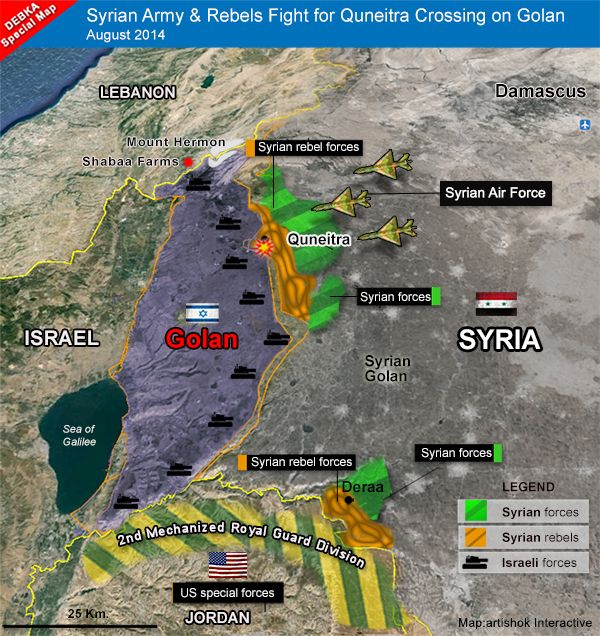
Israeli forces caught up in Al Qaeda’s complex toils in both Golan and Gaza. DEBKAfile, August 28, 2014

GolanSyrianAir

The cross-border incident on the Golan Wednesday, Aug. 27, in which an Israeli officer was injured by stray fire from the fighting between Syrian army and rebel forces near Quneitra, put this battle zone on the front pages. However,DEBKAfile’s military sources report that this incident, fought by only 300 combatants on each side backed by 10 tanks, had no real military importance for the Syrian conflict at large. The Syrian army, helped by Iran and Hizballah, is winning and the rebel side is crumbling.

The battle for Qoneitra, fought 200 meters from the Israeli border, is much more important as a touchstone in quite a different setting, that concerns not only Israel but the complicated US posture against the many-headed Al Qaeda peril in the Middle East.

The US, Jordan and Israel are quietly backing the mixed bag of some 30 Syrian rebel factions which Tuesday, Aug. 26, seized control of the Syrian side of the Quneitra crossing, the only transit point between Israeli and Syrian Golan. However – here comes the rub – Al Qaeda elements have permeated all those factions.

The crossing is formally under the control of UNDOF, an international peacekeeping force, which too is falling apart as contingents are recalled by their governments.

Damascus hit back at the rebels Thursday, Aug. 28, by sending the Syrian air force to destroy the new rebel positions. This was a flagrant contravention of Israel-Syrian armistice agreements. The Israeli air force might have been justified in scrambling to combat the Syrian air incursion, but was not ordered to do so.

This appeared to contradict a fact which Israel has kept very dark: The 30 or so Syrian rebel offensive to wrest Quneitra would have stood no chance without Israel’s aid – not just in medical care for their injured, but also in limited supplies of arms, intelligence and food. Israel acted as a member, along with the US and Jordan, of a support system for rebel groups fighting in southern Syria. Their efforts are coordinated through a war-room which the Pentagon established last year near Amman. The US, Jordanian and Israeli officers manning the facility determine in consultation which rebel factions are provided with reinforcements from the special training camps run for Syrian rebels in Jordan, and which will receive arms.

All three governments understand perfectly that, notwithstanding all their precautions, some of their military assistance is bound to percolate to Al Qaeda’s Syrian arm, Jabhat Al-Nusra, which is fighting in rebel ranks. Neither Washington or Jerusalem or Amman would be comfortable in admitting they are arming Al Qaeda’s Nusra Front in southern Syria.

And not only Nusra: It turned out in this week’s incident that some of the rebel fighters come from the terrorist group Ansar Beit al-Maqdis, a coalition of Al Qaeda contingents based in the Egyptian Sinai Peninsula and Gaza Strip. Another piece of this dissonant jigsaw is Al Maqdis’ close alignment for its violent operations with the Palestinian Hamas ruling Gaza, with which Israel has just been locked in a deadly 50-day war.

Wednesday night, at his news conference to sum up that war, Prime Minister Binyamin Netanyahu included in his list of Israel’s diplomatic successes, the winning over of world opinion to the perception that Hamas and Al Qaeda belong to the same family of terrorists and share the same fundamentalist ideology, which must be fought.

As he spoke, Al Qaeda fighters, intermingled with Syrian rebel factions, fetched up just yards from Israel’s northern border fence.

DEBKAfile’s military sources say that Washington, Amman and Jerusalem can expect to keep the embarrassing fact fairly quiet only until the first black Al Qaeda flag is raised over a rebel position at the Quneitra crossing or a captured Syrian post opposite the line of Israeli positions on the Golan. Israel will then face a new dilemma on this sensitive front, which will take some explaining.

Busting the Media’s ISIS Myths

August 14, 2014

Busting the Media’s ISIS Myths, Front Page Magazine, Daniel Greenfield, August 14, 2014

(Dear me! Mr. Greenfield is so politically incorrect that he blames the religion of peace death for bad things. How dare he? — DM)

isis

The Caliphate, like the Reich, is a utopia which can only be created through the mass murder and repression of all those who do not belong. This isn’t a new vision. It’s the founding vision of Islam.

The narrative that ISIS was more extreme than Al Qaeda because it killed Shiites and other Muslims doesn’t hold up even in recent history.

The media finds it convenient to depict the rise of newly extremist groups being radicalized by American foreign policy, Israeli blockades or Danish cartoons. A closer look however shows us that these groups did not become radicalized, rather they increased their capabilities.

What is wrong with ISIS is what is wrong with Islam.

**********

Know your enemy. To know what ISIS is, we have to clear away the media myths about ISIS.

ISIS is not a new phenomenon.

Wahhabi armies have been attacking Iraq in order to wipe out Shiites for over two hundred years. One of the more notably brutal attacks took place during the administration of President Thomas Jefferson.

That same year the Marine Corps saw action against the Barbary Pirates and West Point opened, but even Noam Chomsky, Michael Moore and Howard Zinn chiming via Ouija board would have trouble blaming the Wahhabi assault on the Iraqi city of Kerbala in 1802 on the United States or an oil pipeline.

Forget the media portrayals of ISIS as a new extreme group that even the newly moderate Al Qaeda thinks is over the top; its armies are doing the same things that Wahhabi armies have been doing for centuries. ISIS has Twitter accounts, pickup trucks and other borrowed Western technology, but its ideology and brutality have always been part of Islam. They are not a new phenomenon.

Sunnis and Shiites have been killing each other for over a thousand years. Declaring other Muslims to be infidels and killing them is also a lot older than the suicide bomb vest.

Al Qaeda and ISIS are at odds because its Iraqi namesake had a different agenda. Al Qaeda always had different factions with their own agendas that were not more extreme or less extreme, but emerged from varying national backgrounds.

Bin Laden prioritized Saudi Arabia and America. That allowed Al Qaeda to pick up training from Hezbollah which helped make 9/11 possible. This low level cooperation with Iran was endangered when Al Qaeda in Iraq made fighting a religious war with Shiites into its priority.

That did not mean that Bin Laden liked Shiites and thought that AQIQ was “extreme” for killing them.

During the Iraq War, Bin Laden had endorsed Al Qaeda in Iraq’s goal of fighting the Shiite “Rejectionists” by framing it as an attack on America. AQIQ’s Zarqawi had privately made it clear that he would not pledge allegiance to Osama bin Laden unless the terrorist leader endorsed his campaign against Shiites.

Bin Laden and the Taliban had been equally comfortable with Sipahe Sahaba and Lashkar-e-Jhangvi which provided manpower for the Taliban while massacring Shiites in Afghanistan and Pakistan. Last year LEJ had killed over a hundred Shiite Hazaras in one bombing.

The narrative that ISIS was more extreme than Al Qaeda because it killed Shiites and other Muslims doesn’t hold up even in recent history.

The media finds it convenient to depict the rise of newly extremist groups being radicalized by American foreign policy, Israeli blockades or Danish cartoons. A closer look however shows us that these groups did not become radicalized, rather they increased their capabilities.

ISIS understood that targeting Shiites and later Kurds would make it more appealing to Sunni Arabs inside Iraq and around the Persian Gulf. Bin Laden tried to rally Muslims by attacking America. ISIS has rallied Muslims by killing Shiites, Kurds, Christians and anyone else who isn’t a proper Sunni Arab.

Every news report insists that ISIS is an extreme outlier, but if that were really true then it would not have been able to conquer sizable chunks of Iraq and Syria. ISIS became huge and powerful because its ideology drew the most fighters and the most financial support. ISIS is powerful because it’s popular.

ISIS has become more popular and more powerful than Al Qaeda because Muslims hate other Muslims even more than they hate America.

ISIS is not an outside force that inexplicably rolls across Iraq and terrorizes everyone in its path. It’s actually the public face of a Sunni coalition. When ISIS massacres Yazidis, it’s not just following an ideology; it’s giving Sunni Arabs what they want.

A surviving Yazidi refugee had told CNN that his Arab neighbors had joined in the killing. This wasn’t just ISIS terrorizing a helpless population. It was Islamic Supremacism in action.

ISIS is dominating Iraq and Syria because it draws on support from the Sunni Arab population. It has their support because it is killing or driving out Christians, Yazidis, Shiites and a long list of peoples who either aren’t Muslims or aren’t Arabs while giving their land and possessions to the Sunni Arabs.

The media spent years denying that the Syrian Civil War was a sectarian conflict between Sunnis and Shiites. It’s unable to deny the obvious in Iraq, but it carefully avoids considering the implications.

An army alone will have trouble committing genocide unless it has the cooperation of a local population that wants to see another group exterminated.

When we talk about ISIS, we are really talking about Sunni Arabs in Iraq and Syria. Not all of them, but enough that ISIS has become the standard bearer of the Sunni side in the civil wars in Syria and Iraq.

Hillary Clinton and John McCain can complain that we could have avoided the rise of ISIS if we had only armed the right sort of Jihadists in Syria, but if ISIS became dominant because its agenda had popular support, then it would not have mattered whom we armed or didn’t arm.

We armed the Iraqi military to the teeth, but it didn’t do any good because the military didn’t represent any larger consensus in an Iraq divided along religious and ethnic lines.

To understand ISIS, we have to unlearn what the media tell us. The media tells us that terrorists only represent an extreme edge of the population. If they have popular support, it’s only because the civilian population has somehow become radicalized. (And usually it’s our fault.)

And yet that model doesn’t hold up. It never did.

The religious and ethnic strife in the Middle East out of which ISIS emerged and which has become its brand, goes back over a thousand years. If support for terrorism emerges from radicalization, then the armies of Islam were radicalized in the time of Mohammed and have never been de-radicalized.

The Caliphate, like the Reich, is a utopia which can only be created through the mass murder and repression of all those who do not belong. This isn’t a new vision. It’s the founding vision of Islam.

What is wrong with ISIS is what is wrong with Islam.

We can defeat ISIS, but we should remember that its roots are in the hearts of the Sunni Muslims who support it. ISIS and Al Qaeda are only symptoms of the larger problem.

We can see the larger problem flying Jihadist flags in London and New Jersey. We can see it trooping through Australian and Canadian airports to join ISIS. We can see it in the eyes of the Sunni Arabs murdering their Yazidi neighbors.

ISIS is an expression of the murderous hate within Islam. We are not only at war with an acronym, but with the dark hatred in the hearts of Jihadists in Iraq and Pakistan… and next door.