Posted tagged ‘Air strikes’

Isis reconciles with al-Qaida group as Syria air strikes continue

September 28, 2014

Isis reconciles with al-Qaida group as Syria air strikes continue, The Guardian, September 28, 2014

(But we have been told authoritatively that the Islamic State is not Islamic. How, then, could strikes against it possibly be a “war on Islam?” — DM)

Jabhat al-Nusra denounces US-led attacks as ‘war on Islam’, and leaders of group holding meetings with Islamic State.
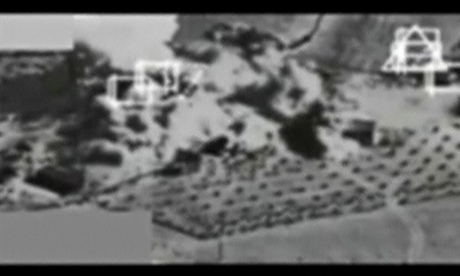
Kobani strikeA still from a video from a plane camera shows smoke rising after an air strike near Kobani. Photograph: Reuters

Barack Obama said the intelligence community did not appreciate the scale of the threat or comprehend the weakness of the Iraqi army. In an interview on CBS 60 Minutes, he said: “Over the past couple of years, during the chaos of the Syrian civil war, where essentially you have huge swaths of the country that are completely ungoverned, they were able to reconstitute themselves and take advantage of … chaos. And so this became ground zero for jihadists around the world.”

*********************

Air strikes continued to target Islamic State (Isis) positions near the Kurdish town of Kobani and hubs across north-east Syria on Sunday, as the terror group moved towards a new alliance with Syria’s largest al-Qaida group that could help offset the threat from the air.

Jabhat al-Nusra, which has been at odds with Isis for much of the past year, vowed retaliation for the US-led strikes, the first wave of which a week ago killed scores of its members. Many Nusra units in northern Syria appeared to have reconciled with the group, with which it had fought bitterly early this year.

A senior source confirmed that al-Nusra and Isis leaders were now holding war-planning meetings. While not yet formalised, the addition of at least some al-Nusra numbers to Isis would strengthen the group’s ranks and further its reach at a time when air strikes are crippling its funding sources and slowing its advances in both Syria and Iraq.

Al-Nusra, which has direct ties to al-Qaida’s leader, Ayman al-Zawahiri, denounced the attacks as a “war on Islam”, in an audio statement posted over the weekend. A senior al-Nusra figure told the Guardian that 73 members had defected to Isis last Friday alone and that scores more were planning to swear allegiance in coming days.

“We are in a long war,” the group’s spokesman, Abu Firas al-Suri, said on social media platforms. “This war will not end in months nor years, this war could last for decades.”

In the rebel-held north there is growing resentment among Islamist units of the Syrian opposition that the strikes have done nothing to weaken the Syrian regime. “We have been calling for these sorts of attacks for three years and when they finally come they don’t help us,” said a leader from the Qatari-backed Islamic Front, which groups together Islamic brigades. “People have lost faith. And they’re angry.”

British jets flew sorties over Isis positions in Iraq after being ordered into action against the group following a parliamentary vote on Friday.

David Cameron has suggested he might review his decision to confine Britain’s involvement to Iraq alone, but for now the strikes in support of Kurdish civilians and militants in Kobani were being carried out by Arab air forces from Saudi Arabia, Jordan, the UAE and Bahrain.

The US was reported to have carried out at least six strikes near the centre of Kobani, where the YPG Kurdish militia is fighting a dogged rearguard campaign against Isis, which is mostly holding its ground despite the jet attacks.

Kobani is the third-largest Kurdish enclave in Syria, and victory for Isis there is essential to its plans to oust the Kurds from lands they have lived in for several thousand years. Control of the area would give the group a strategic foothold in north-east Syria, which would give it easy access to north-west Iraq.

Isis continued to make forays along the western edge of Baghdad, where its members have been active for nine months. The Iraqi capital is being heavily defended by Shia militias, who in many cases have primacy over the Iraqi army, which surrendered the north of the country.

That rout – one of the most spectacular anywhere in modern military history – gave Isis a surge of momentum and it has since seized the border with Syria, menaced Irbil, ousted minorities from the Ninevah plains and threatened the Iraqi government’s hold on the country.

Barack Obama said the intelligence community did not appreciate the scale of the threat or comprehend the weakness of the Iraqi army. In an interview on CBS 60 Minutes, he said: “Over the past couple of years, during the chaos of the Syrian civil war, where essentially you have huge swaths of the country that are completely ungoverned, they were able to reconstitute themselves and take advantage of … chaos. And so this became ground zero for jihadists around the world.”

ISIS Baghdad March: Is Islamic State Targeting The Iraqi Capital?

September 26, 2014

ISIS Baghdad March: Is Islamic State Targeting The Iraqi Capital? International Business Times, September 26, 2014

(How difficult might it be for the IS, et al, to move more troops into already occupied places near Baghdad, consolidate them there, and then send them to take Baghdad? The Iraqi armed forces have functioned poorly in the past and might well not put up a successful defense.

Were the IS to take Baghdad, what might the “coalition of the willing” do about it? Air strikes on a city of more than 7,216,040, many of them civilians, seem unlikely. In any event, civilian deaths would not likely concern the IS more than they concerned Hamas, and would provide gruesome photos welcomed for propaganda purposes.– DM)

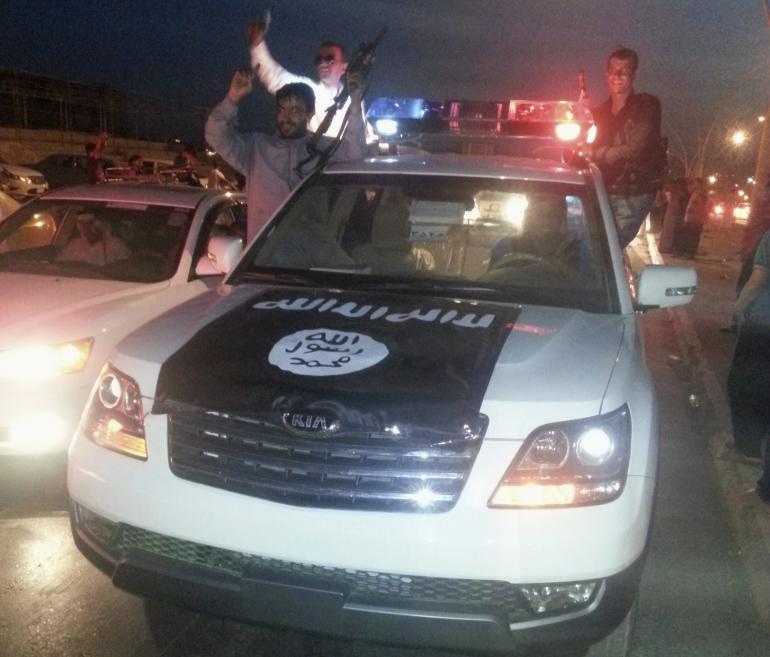
cop car in MosulFighters of the Islamic State group, also known as ISIS or ISIL, celebrate on a police vehicle along a street in the city of Mosul, June 23, 2014. Reuters

ISIS has been circling Baghdad for years. The Islamic State carried out 641 operations in Baghdad last year, up from 371 operations in 2012, including car bombs, armed assaults and assassinations, according to the Institute for the Study of War.

The multi-nation campaign against ISIS might have prodded the militants to refocus their efforts in Iraq, where the Islamic State has many strategic territories near Baghdad . . .

*****************

The Islamic State may be refocusing its sights on Baghdad after the extremist group overran an Iraqi military base and executed 300 soldiers Sunday amid ongoing U.S. airstrikes aimed at weakening the militants’ infrastructure and resources, according to military analysts. Other targeted attacks in recent weeks also suggest the militants are plotting against the Iraqi capital more than three months after international leaders first warned of the group’s aspirations to take Baghdad.

The base attack came days after the militant group also know as ISIS launched 14 mortar rounds during a foiled attempt to break into the Adala Prison in northern Baghdad. ISIS also launched an attack earlier this month in Baghdad’s Iskan neighborhood that likely targeted the offices of the political group and militia, the Badr Organization, according to the Institute for the Study of War in Washington, D.C.

“This attack is very significant. It is the first infantry-like, complex, and penetrating attack in Baghdad city by ISIS since the fall of Mosul in June of this year,” the think-tank wrote on its website. “ISIS likely carried out the attack to release some of the pressure it is facing as a result of the recent U.S. air campaign targeting its positions. The attack also signifies that, despite the heightened defenses of Baghdad in the aftermath of the fall of Mosul, ISIS is still able to carry out attacks in an area where it is unlikely to have active sleeper cells.”

It’s unclear if the U.S. airstrikes in Iraq have accomplished the Obama administration’s stated mission to “degrade and destroy” ISIS. Some military analysts and U.S. critics have said the Obama administration needs to send ground troops to Iraq to wipe out ISIS, while others have said the airstrikes have successfully managed to slow down the militant group’s advances.

“The U.S. has made it pretty much impossible to undertake the large-scale mobile operations that ISIS was doing earlier in the summer,” Michael Knights, who specializes in military and security affairs in Iraq for the Washington Institute for Near East Policy, said. “It has changed the nature of the beast.”

But ISIS’ goal of taking most of western and central Iraq hasn’t changed since the airstrikes, said Bill Roggio, a senior fellow with the Foundation for Defense of Democracies in Washington who specializes in Iraq. While Baghdad might be out of their reach, other territories remain vulnerable, Roggio said.

“They are just continuing their operations,” he said in a telephone interview. “The airstrikes haven’t stopped them for continuing to do what they have been doing all along, which is take control of territory.”

ISIS has been circling Baghdad for years. The Islamic State carried out 641 operations in Baghdad last year, up from 371 operations in 2012, including car bombs, armed assaults and assassinations, according to the Institute for the Study of War.

ISIS gained international prominence in June when it seized northern cities such as Tikrit, Saddam Hussein’s hometown, and Mosul, Iraq’s second largest city, and began holding mass executions of Iraqi soldiers. At the time, military analysts predicted the Sunni militants had their sights on Baghdad. Obama responded by sending 300 military advisers to Iraq to share intelligence with Iraqi soldiers. More recently, the Obama administration began offensive airstrikes against ISIS territories near Baghdad last week in its latest effort to pushback the militant group. At the same time, the U.S. began airstrikes against the Islamic State and other militant groups in Syria.

The multi-nation campaign against ISIS might have prodded the militants to refocus their efforts in Iraq, where the Islamic State has many strategic territories near Baghdad, Knight said.

“Most of the people who watch Iraq say if ISIS is going to punch, it’s going to be in the Baghdad area,” he said in a telephone interview. “I have been surprised that it hasn’t happened … They are well positioned for that.”
