Posted tagged ‘Air strikes’

Egypt seizes Bab el Mandeb ahead of Iran. Saudis bomb Iran-backed Yemeni Houthis. US launches air strikes over Tikrit

March 26, 2015

Egypt seizes Bab el Mandeb ahead of Iran. Saudis bomb Iran-backed Yemeni Houthis. US launches air strikes over Tikrit, DEBKAfile, March 26, 2015
Yemen3_1

The separate operations in Yemen and Iraq attested to the widening breach between the Sunni Arab camp and the Obama administration and the former’s resolve to thwart US strategy for buying a nuclear deal with Tehran by empowering Iran to attain the rank of leading Middle East power.

**********************

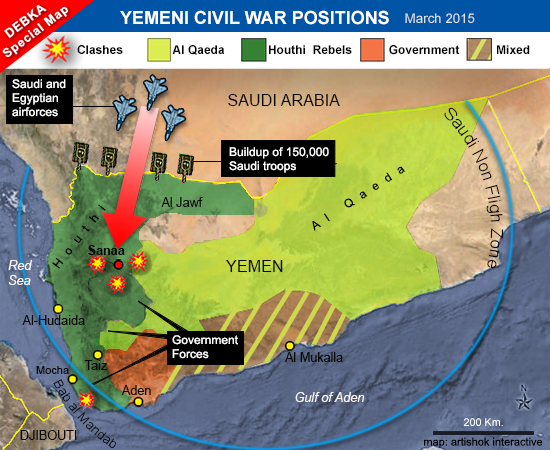
In a surprise step, Egyptian marine naval and marine forces Thursday morning, March 26, seized control of the strategic Bab El-Mandeb Straits to foil Tehran’s plans to grab this important energy shipping gateway between the Red Sea, the Gulf of Aden and the Suez Canal, DEBKAfile’s military sources report from the Gulf. Egypt disguised the raid as a counter-piracy operation. It rounded off the Saudi-led air strikes launched the same morning against Iran-backed Houthi rebels in Yemen. These operations signaled the start of a major Sunni Arab revolt against Iran’s approaching takeover of Yemen, through its Houthi proxy, and advances in other strategic positions in the Middle East, with Washington’s support.

Thursday morning too, the US launched the US launched its first air strikes against Islamic State positions in the Iraqi city of Tikrit, rallying to the aid of the Iranian-commanded Iraqi operation, which had failed to dislodge the jihadis in two weeks of fighting.

The separate operations in Yemen and Iraq attested to the widening breach between the Sunni Arab camp and the Obama administration and the former’s resolve to thwart US strategy for buying a nuclear deal with Tehran by empowering Iran to attain the rank of leading Middle East power.

DEBKAfile reported earlier Thursday morning:

Iran’s Revolutionary Guards (IRGC) are now leading war action in four Mid East arenas: Syria, Iraq, Yemen and Lebanon, while building Shiite “popular” armies deferring to Tehran in three: Syria, Iraq and Yemen.

The formal announcements coming from Riyadh and Washington attempted to gloss over the open breach. The Saudis Wednesday indicated that their military buildup on the Yemeni was “purely defensive,” while Washington subsequently declared support for the Saudi-Gulf-Egyptian air strikes after they began.

According to our Washington sources, President Obama decided Wednesday to accede to the Iraqi premier Haider al-Abadi’s request for air support to de-stall the Tikrit operation against ISIS. Iran’s Al Qods Brigades chief, Gen. Qassem Soleimani, who commanded the operation from the start has departed the scene.

Nothing has been said to indicate whether the Iranian forces, including Revolutionary Guards officers, remain in the area. It appears that the Obama administration prefers as little as possible to be mentioned about US-Iranian battlefield coordination in Iraq versus the Islamists, especially since it was not exactly a big success. At the same time, US air strikes launched to support ground forces are bound to be coordinated with their commanders, who in this case happen to be mostly Iranian. In the last two weeks of the Tikrit operation, liaison between the US and Iranian military in Iraq was routed through the office of the Iraqi Prime Minister in Baghdad.

Early Thursday, Riyadh reported that the Saudi Royal Air Force had taken out Houthi air defenses, destroyed numerous Houthi fighter planes and were imposing a wide no-fly zone over Yemen.

Egypt is providing political and military support for Saudi-GCC operation against Houthi fighters in Yemen, the Egyptian state news agency said Thursday. Egypt’s Foreign Ministry was quoted as saying this support could involve Egyptian air, naval and ground forces, if necessary.

DEBKAfile’s military sources add: The Saudis declared Yemeni air space a no-fly zone to achieve to goals: (1) To deny the Yemeni forces advancing on the key port city of Aden access to air cover which would undoubtedly have been forthcoming from mutinous elements of the Yemeni air force. Without it, the rebel advance would be severely hobbled, and, (2) to prevent Iranian warplanes from landing at Yemeni air bases with deliveries of military equipment and ammunition their Houthi proxies.

Gulf sources disclose that Saudi Arabia has placed 100 warplanes and 150,000 troops with heavy weapons at the disposal of the operation against Iran’s Yemeni proxy, the Zaydi Houthis, as well as pressing into service Pakistani, Moroccan and Jordanian military units. This force is a sign that Riyadh intends of following up its air action with a ground invasion across the border into Yemen to crush the revolt in its backyard.

Developing…
Israeli fighter jets stage warning passes against Syrian air force intruders over Golan. Air tension high

February 24, 2015

Israeli fighter jets stage warning passes against Syrian air force intruders over Golan. Air tension high, DEBKAfile, February 24, 2015

Barrel-bombs-Qunitra_23.2.15Syrian barrel bombs dropped on Quneitra

Israeli fighter jets flew passes over the Golan Monday, Feb. 23 as a warning to Syrian helicopters and fighter planes to stop encroaching on the no-fly zone, in violation of standing Israeli-Syrian armistice agreements. This is reported by DEBKAfile’s military sources.

The Syrian warplanes planes came over Quneitra Monday to drop barrel bombs on Syrian rebel forces holding the town. Spotters on Israeli Golan counted at least 30 bombs dropped by helicopters under cover of Syrian air force jets. Their crews took no notice of the Israeli fighter jets and drones present at the time and continued their attacks regardless.

At the end of the Syrian operation, Israeli aircraft conducted its warning passes over the Golan town.

Our sources report that this was the second day in a row that the Syrian air force had bombed the same sector. Sunday, they struck rebel positions in the Tel Al-Harra area 6-8 km from the Israeli Golan border. Israel’s inaction then encouraged Damascus to move its warplanes closer to the border the next day and fly into the no-fly zone.

This time, Israeli avoided a direct clash, but broadcast a warning that a confrontation was possible if the Syrians returned for a repeat. Western and Middle East military sources interpret the Israeli flights over Quneitra Monday as a clear warning to Damascus that Israel will not tolerate Syrian air raids close to its Golan lines or any incursions in airspace banned by their armistice agreements.

Six months ago, on Sept. 23, an Israeli Patriot air defense battery downed a Syrian Sukhoi-24 which ventured into its air space. The plane crashed just inside the Syrian border. The IDF claimed at the time that the Syrian plane had strayed across the border by mistake – and so the incident ended. However, Israeli commanders were certain that there was no mistake and that the Syrians were testing the alertness of Israel’s air defenses and gauging its readiness to deploy its air might for challenging aerial incursions.


What Is the Islamic State Trying to Accomplish?

February 7, 2015

What Is the Islamic State Trying to Accomplish? National Review on line, Andrew C. McCarthy, February 7, 2015

(As soon as Obama defeats climate change, he may begin to focus on other less important problems.  — DM)

pic_giant_020715_SM_ISIS-Fighter(Image: ISIS video)

The Islamic State and al-Qaeda are our problem.

*********************

The Islamic State’s barbaric murder of Lieutenant Mouath al-Kasaebeh, the Jordanian air-force pilot the jihadists captured late last year, has naturally given rise to questions about the group’s objectives. Charles Krauthammer argues (here and here) that the Islamic State is trying to draw Jordan into a land war in Syria. It is no doubt correct that the terrorist group would like to destabilize Jordan — indeed, it is destabilizing Jordan. Its immediate aim, however, is more modest and attainable. The Islamic State wants to break up President Obama’s much trumpeted Islamic-American coalition.

As the administration proudly announced back in September, Jordan joined the U.S. coalition, along with the United Arab Emirates, Saudi Arabia, Bahrain, and Qatar. The only potential value of the coalition is symbolic: It has enabled the president to claim that Muslim countries were lining up with us against the Islamic State. Militarily, the coalition is of little use. These countries cannot defeat the Islamic State.

Moreover, even the symbolism is insignificant. Symbolism, after all, cuts both ways. As I pointed out when the administration breathlessly announced the coalition, our five Islamic partners have only been willing to conduct (extremely limited) aerial operations against the Islamic State. They would not attack al-Qaeda targets — i.e., the strongholds of al-Nusra (the local al-Qaeda franchise) and “Khorasan” (an al-Qaeda advisory council that operates within al-Nusra in Syria).

Obviously, if the relevance of the five Islamic countries’ willingness to fight the Islamic State is the implication that the Islamic State is not really Islamic, then their unwillingness to fight al-Qaeda equally implies their assessment that al-Qaeda is representative of Islam. The latter implication no doubt explains why the Saudis, Qatar, and the UAE have given so much funding over the years to al-Qaeda . . . the terror network from which the Islamic State originates and with which the Islamic State shares its sharia-supremacist ideology.

I’ll give the Saudis this: They don’t burn their prisoners alive in a cage. As previously recounted here, though, they routinely behead their prisoners. In fact, here’s another report from the British press just three weeks ago:

Authorities in Saudi Arabia have publicly beheaded a woman in Islam’s holy city of Mecca. . . . Laila Bint Abdul Muttalib Basim, a Burmese woman who resided in Saudi Arabia, was executed by sword on Monday after being dragged through the street and held down by four police officers.

She was convicted of the sexual abuse and murder of her seven-year-old step-daughter.

A video showed how it took three blows to complete the execution, while the woman screamed “I did not kill. I did not kill.” It has now been removed by YouTube as part of its policy on “shocking and disgusting content”.

There are two ways to behead people according to Mohammed al-Saeedi, a human rights activist: “One way is to inject the prisoner with painkillers to numb the pain and the other is without the painkiller. . . . This woman was beheaded without painkillers — they wanted to make the pain more powerful for her.”

The Saudi Ministry of the Interior said in a statement that it believed the sentence was warranted due to the severity of the crime.

The beheading is part of an alarming trend, which has seen the kingdom execute seven people in the first two weeks of this year. In 2014 the number of executions rose to 87, from 78 in 2013.

Would that the president of the United States were more worried about the security of the United States than about how people in such repulsive countries perceive the United States.

In any event, the Islamic State is simply trying to blow up the coalition, which would be a useful propaganda victory. And the strategy is working. It appears at this point that only Jordan is participating in the airstrikes. While all eyes were on Jordan this week for a reaction to Lieutenant al-Kasaebeh’s immolation, the administration has quietly conceded that the UAEsuspended its participation in bombing missions when the pilot was captured in December.

The explanation for this is obvious: The Islamic countries in the coalition know they can’t stop the Islamic State unless the United States joins the fight in earnest, and they know this president is not serious. The White House says the coalition has carried out a total of about 1,000 airstrikes in the last five months. In Desert Storm, we did 1,100 a day.

Seven strikes a day is not going to accomplish anything, especially with no troops on the ground, and thus no search-and-rescue capability in the event planes go down, as Lieutenant al-Kasaebeh’s did. With no prospect of winning, and with a high potential of losing pilots and agitating the rambunctious Islamists in their own populations, why would these countries continue to participate?

The Islamic State knows there is intense opposition to King Abdullah’s decision to join in the coalition. While the Islamic State’s sadistic method of killing the pilot has the king and his supporters talking tough about retaliation, millions of Jordanians are Islamist in orientation and thousands have crossed into Syria and Iraq to fight for the Islamic State and al-Qaeda. There will continue to be pressure on Jordan to withdraw. Without a real American commitment to the fight, this pressure will get harder for Abdullah to resist.

Jordan has no intention of getting into a land war the king knows he cannot win without U.S. forces leading the way. But the Islamic State does not need to lure Jordan into a land war in order to destabilize the country — it is already doing plenty of that by intensifying the Syrian refugee crisis, sending Jordanians back home from Syria as trained jihadists, and trying to assassinate Abdullah.

I will close by repeating the larger point I’ve argued several times before. We know from experience that when jihadists have safe havens, they attack the United States. They now have more safe havens than they’ve ever had before — not just because of what the Islamic State has accomplished in what used to be Syria and Iraq (the map of the Middle East needs updating) but because of what al-Qaeda has done there and in North Africa, what the Taliban and al-Qaeda are doing in Afghanistan, and so on.

If we understand, as we by now should, what these safe havens portend, then we must grasp that the Islamic State, al-Qaeda, and the global jihad constitute a threat to American national security. That they also (and more immediately) threaten Arab Islamic countries is true, but it is not close to being our top concern. Ensuring our security is a concern that could not be responsibly delegated to other countries even if they had formidable armed forces — which the “coalition” countries do not.

The Islamic State and al-Qaeda are our problem.

Inside The ISIS-Al Qaeda Merger Talks

November 11, 2014

Inside The ISIS-Al Qaeda Merger Talks, Daily BeastJamie Dettmer, November 11, 2014

(If Abu Bakr al-Baghdadi — the Islamic State leader whose disagreements with al Qaeda led to a split — is dead or otherwise out of the game, will that help to facilitate an Islamic State –  Jabhat al Nusra union? — DM)

The merger, if it comes off, would have major ramifications for the West. It would reshape an already complex battlefield in Syria, shift forces further against Western interests, and worsen the prospects for survival of the dwindling and squabbling bands of moderate rebels the U.S. is backing and is planning to train.

******************

U.S. airstrikes have helped drive ISIS and al Nusra together, and the Khorasan group is trying to cement the deal. The big losers: Everybody else—except Assad.

ISTANBUL—Jihadi veterans known collectively as the Khorasan group, which have been targeted in two waves of airstrikes by U.S. warplanes, are trying to broker an alarming merger between militant archrivals the Islamic State and Jabhat al Nusra, the official Syrian branch of al Qaeda.

The merger, if it comes off, would have major ramifications for the West. It would reshape an already complex battlefield in Syria, shift forces further against Western interests, and worsen the prospects for survival of the dwindling and squabbling bands of moderate rebels the U.S. is backing and is planning to train.

“Khorasan sees its role now as securing an end to the internal conflict between Islamic State and al Nusra,” says a senior rebel source. The first results are already being seen on the ground in northern Syria with a coordinated attack on two rebel militias favored by Washington.

All three of the groups involved in the merger talks—Khorasan, Islamic State (widely known as ISIS or ISIL), and al Nusra—originally were part of al Qaeda. Khorasan reportedly was dispatched to Syria originally to recruit Westerners from among the thousands of jihadi volunteers who could take their terror war back to Europe and the United States. But among ferocious ideologues, similar roots are no guarantee of mutual sympathy when schisms occur.

Current and former U.S. officials say they are unaware of any cooperation between ISIS and al Nusra, and they doubt that a merger or long-term association could be pulled off. “I find it hard to believe that al Nusra and Islamic State could sink their differences,” says a former senior administration official. “The rift between them is very deep,” he adds.

But senior Syrian opposition sources say efforts at a merger are very much under way and they blame Washington for creating the circumstances that make it possible. Moderate rebels accuse the Obama administration of fostering jihadi rapprochement by launching ill-conceived airstrikes on al Nusra while at the same time adamantly refusing to target the forces of Syrian President Bashar al-Assad in the U.S. military intervention in the region.

This, they say, has created the opening for a possible understanding between the jihadists and is creating sympathy for al Nusra. Other Islamist rebels and the wider population in insurgent-held areas in northern Syria question American motives and designs and remain furious at the U.S. decision not to help topple Assad.

“Al Nusra knows more airstrikes are coming, so why wait,” says an opposition source. If the Americans are going to lump them together with ISIS, maybe best to join forces. “What made the possibility of their coming together are the airstrikes.”

The opposition sources, who agreed to interviews on the condition they not be identified, warn that mounting cooperation between the two jihadist groups already is evident in specific operations.

Earlier this month, ISIS sent more than a hundred fighters in a 22-vehicle column to assist its onetime competitor, al Nusra, in the final assault on a moderate Islamist rebel alliance, the Syrian Revolutionaries Front, commanded by Jamal Maarouf in Idlib province.

The jihadis also targeted a secular brigade of insurgents, Harakat al-Hazm, which the U.S. has supplied with advanced anti-tank weaponry, because it tried to intervene and separate the SRF and al Nusra.

“Da’esh fighters weren’t really needed,” says one of the sources, “Al Nusra had sufficient numbers but the support given is highly symbolic.” (Da’esh is the Arabic acronym for ISIS.)

The coordination being claimed between the two groups would be the first time ISIS militants have cooperated with al Nusra since the winter ,when al Qaeda’s overall leader Ayman al-Zawahiri issued what seemed a definitive statement: “Al Qaeda announces that it does not link itself with [ISIS] … It is not a branch of the al Qaeda group, does not have an organizational relationship with it.”

The al Qaeda old guard and the ambitious ISIS leader Abu Bakr al-Baghdadi, who bristled at orders from Zawahiri, fell out over strategy and the attacks that his mainly foreign fighters were mounting against Syrian rebels. But the rift was, not least, a matter of personalities and egos. Al-Baghdadi has since attempted to declare himself the true leader of all true Muslims (by his lights) as the Caliph of the Islamic State. Zawahiri is not about to sign on to that.

Thus reports that al-Baghdadi may have been badly wounded or even killed in a U.S.-led coalition airstrike mounted last week near Mosul, while they may sound like good news for the coalition, could be even better news for the jihadis. Syrian rebel sources say al-Baghdadi’s elimination might well assist an agreement being struck between ISI and al Nusra.

The senior opposition sources say the coordination in the fight with the Syrian Revolutionaries Front was agreed on at a meeting held just west of Aleppo between representatives of the two jihadi groups and overseen by members of the Khorasan group.

U.S. intelligence agencies accuse the Khorasan veterans of plotting attacks against commercial airliners in the West. The U.S. targeted them with a wave of sea-launched cruise missiles on Sept. 23 and last week hit again with wide-ranging airstrikes on al Nusra positions as well, partly in a bid to hit the veterans. Several members of the group have been killed, but top leaders are still thought to have escaped the targeting and U.S. officials say they can’t confirm who has survived and who hasn’t.

There were representatives at the meeting from other hardline groups as well, such as Jund al-Aqsa, a jihadi offshoot, and Ahrar al-Sham, a group al Qaeda was instrumental in forming.

At the meeting a few nights before the final jihadi push against the SRF, which was attended by al Nusra leader Abu Mohammad al-Golani, the participants agreed, say opposition sources, that the Syrian Revolutionaries Front should be eliminated as an effective fighting force.

The assault on the weekend of Nov. 1 sealed weeks of battles between al Nusra and the SRF. The jihadis have now captured a series of towns and villages in Idlib province—Maarshorin, Maasaran, Dadikh, Kafr Battikh, Kafr Ruma, Khan al-Subul, and Deir Sunbul, Maarouf’s hometown. And al Nusra fighters have in recent days moved further north, coming within three miles of the important crossing on the Turkish border at Bab al-Hawa. The SRF has been left with virtually no territory.

Meanwhile, the secular Hazm movement was forced by al Nusra fighters to withdraw from its strongholds in Idlib, including Khan al-Subul, where it stored about 10 percent of its equipment. Hazm denies reports that jihad fighters managed to seize U.S.-supplied TOW anti-tank missiles, but concedes that al Nusra was able to secure 20 tanks, five of which were fully functional, six new armored personnel carriers recently supplied from overseas, and dozens of the group’s walkie-talkies, with the result that Hazm fighters elsewhere had to ditch their sets lest ISIS listen in.

(Some Hazm members bought the walkie-talkies themselves from Best Buy during a visit to the U.S.—suggesting that aside from TOW missiles the Obama administration has not been that generous in supplying the brigade.)


What do Kobani airdrops mean for regional politics?

October 21, 2014

What do Kobani airdrops mean for regional politics? Al-MonitorAmberin Zaman, October 20, 2014

Smoke and flames rise over Syrian town of Kobani after an airstrikeSmoke and flames rise over the Syrian town of Kobani after an airstrike, as seen from the Mursitpinar crossing on the Turkish-Syrian border in the southeastern town of Suruc, Oct. 20, 2014. The United States told Turkey that a US military airdrop of arms to Syrian Kurds battling the Islamic State in Kobani was a response to a crisis situation and did not represent a change in US policy. (photo by REUTERS/Kai Pfaffenbach

The US will use its new leverage over the PYD to push the Kurds to engage with factions opposed to Syrian President Bashar al-Assad, particularly the Free Syrian Army. The YPG’s existing battleground alliance with various rebel factions will, therefore, probably expand.

****************

On Oct. 19, the US Central Command (CENTCOM) announced that it had conducted multiple airdrops near the Syrian Kurdish town of Kobani, which has remained under siege by Islamic State (IS) fighters for more than a month. CENTCOM said US C-13 cargo planes had made multiple drops of arms, ammunition, and medical supplies provided by Kurdish authorities in Iraq. The move is set to have a profound effect on regional balances between Turkey, the Kurds and the United States that will likely reverberate in Tehran and in Damascus as well.

For several weeks now, the US and its allies have been bombing IS positions around Kobani. But the delivery of weapons takes the de facto alliance between the Syrian Kurds and the United States to a new level.

Turkey, which borders Kobani, is best positioned to help the Syrian Kurds. But the country’s ruling Justice and Development (AKP) party has spurned repeated Syrian Kurdish demands to allow weapons and fighters to cross through Turkey into the Syrian Kurdish enclave. On Oct. 18, Turkish President Recep Tayyip Erdogan said that the Syrian Kurdish Democratic Union Party (PYD), whose armed wing the People’s Protection Units (YPG) is battling IS in Kobani, were “the same as the PKK. “It’s a terrorist organization. It would be very, very wrong to expect us to openly say ‘yes’ to our NATO ally America to give this kind of [armed] support [to the PYD],” Erdogan declared.

Erdogan was referring to the PYD’s close links to the Kurdistan Workers Party (PKK), which has been fighting on and off for self-rule inside Turkey since 1984. The PKK is on the State Department’s list of terrorist organizations, and until last month successive US administrations refused to have any contact either with the PKK or the PYD. But the PKK and the YPG’s effectiveness against IS both in Iraq and Syria has triggered a paradigm shift in US strategic thinking. The US and the Syrian Kurds are now allies in the war against IS.

US Secretary of State John Kerry told reporters in Jakarta, Indonesia that while the Obama administration understood Turkey’s concerns, it would have been “irresponsible” and “morally difficult” not to support the Syrian Kurds in their fight against IS.

Kerry said IS had chosen to “make this a ground battle, attacking a small group of people there who, while they are an offshoot group of the folks that our friends the Turks oppose, they are valiantly fighting ISIL and we cannot take our eye off the prize here.” Kerry stressed, however, that it was “a momentary effort” and that the US had “made it very clear” to Turkey that it “is not a shift in the policy of the United States.”

Kerry’s words came hours after US President Barack Obama spoke over the telephone with Erdogan about Kobani. News emerged soon after that Turkey would be allowing Iraqi Kurdish peshmerga fighters to cross through Turkey into Kobani carrying fresh weapons for the YPG. How in the space of 48 hours did Turkey go from calling the PYD terrorists to opening an arms corridor for them?

As analysts ponder these dizzying changes, here a few immediate factors to consider:

      1. Turkey could have led the effort to support anti-IS forces in Kobani by letting arms and fighters through its borders weeks ago. This would have bolstered the peace process between Turkey and its own Kurds, while averting the public relations disaster caused by images of Turkish tanks and soldiers looking on as the Syrian Kurds battled IS in Kobani, thereby reinforcing claims that “Turkey supports IS.

      2. The fact that Turkey was forced into opening a corridor to Kobani only after the US informed Ankara that it would go ahead with the airdrops anyway only increases doubts about Turkey’s commitment to working with its Western partners. It also plays into the hands of Erdogan’s domestic rivals, who will now say he is America’s poodle and that the US is using the PKK to tame Turkey.

      3. One big question is whether the recent days’ events mean that the PYD will move away from the PKK. The likely answer is that the PKK will seek to move closer to the US. The PKK has already established a channel of communication with the US via the PYD in Syria, and is also fighting alongside US-supported Kurdish peshmerga forces in Iraq. Any attempt to drive a wedge between the PYD and the PKK is doomed to fail. Abdullah Ocalan, the imprisoned founder and leader of their PKK, commands the loyalty of Syrian and Turkish Kurds alike.

      4. Any US-PKK dialogue would make the PKK less likely to resume violence against the Turkish army, as this would tarnish its burgeoning legitimacy. Turkey could yet turn the situation to its advantage and make goodwill gestures to the Syrian Kurds. These could include opening the sealed border with the PYD-controlled town of Serkaniye (Ras al Ain). The fact that US drones flew drone reconnaissance missions over Kobani out of the Incirlik air base has gone largely unnoticed in the media. So Turkey actually has helped, but chose not to advertise this.

      5. The Kurds adeptly used the media and global public opinion — which depicted them as the region’s secular, pro-Western force, a space formerly occupied by Turkey — to draw the US into the battle for Kobani. The battle for Kobani then became a symbol of the contest between IS and the coalition, one that the US could no longer afford to lose. Moreover, the concentration of IS forces around Kobani allowed the US to inflict heavy losses on IS fighters.

      6. Iraqi Kurdish President Massoud Barzani is probably unhappy about US engagement with the PYD/PKK, which he views as rivals. But, unlike Turkey, he has turned the situation to his own advantage by projecting himself as a benevolent leader who has aided fellow Kurds in their time of need.

      7. The US will use its new leverage over the PYD to push the Kurds to engage with factions opposed to Syrian President Bashar al-Assad, particularly the Free Syrian Army. The YPG’s existing battleground alliance with various rebel factions will, therefore, probably expand.

      8. Is the de facto non-aggression pact between the Syrian regime and the Kurds coming unstuck? It’s too early to say, because the US insists that its military intervention in Syria is limited to countering IS. The Kurds are likely to continue to hedge their bets for as long as they can.

      9. And what of the PYD’s other primary benefactor, Iran? Will its friendship with the Americans anger the clerics? Much will depend on whether the US and Iran can reach a deal over Iran’s nuclear program. Should the talks fail, the PKK may become an instrument of US policy to be used against Iran.

      10. Any alliance in the Middle East should never be taken for granted.


How to defeat Islamic State’s war machine

October 15, 2014

How to defeat Islamic State’s war machine, Al-MonitorMetin Turcan, October 14, 2014

(Which team is the “junior varsity?”

The article suggests the obvious need for close air support using trained ground forces to guide aircraft to strike useful targets. The U.S. has trained “boots” capable of doing that, but Obama continues to assert that the U.S. will have no ground combat presence in Iraq or Syria. U.S. spotters would need be in combat areas, would be targeted by Islamic State forces and would therefore need to engage in combat. Non-U.S. target spotters, in addition to needing substantial technical training, would also need to be capable of communicating with aircraft pilots. In many if not most case, spotters capable of communicating in English would be needed. –DM)

Although much has been written to explain the tactical military successes of the Islamic State (IS), there has not yet been a comprehensive assessment of how, since June 2014, IS has managed to rule over terrain larger than Lebanon to include 8 million Iraqis and Syrians.

How has it been possible that in a short three months IS has been able to control extensive terrain, with 3,000 IS fighters capturing Mosul, which was guarded by 30,000 Iraqi soldiers, and after seizing Mosul on June 10 engage in battles two days later with Iraqi forces in towns north of Baghdad, 230 miles from Mosul?

Although one can allude to the delayed reaction of the international community, the lack of strong military opposition to IS, the international support IS has acquired and the support from Sunni tribes and political bodies in areas it captures, none of it defies the reality that — at the tactical level — IS is an extremely lethal and effective war machine. To understand this key determinant of IS gains, one has to understand that reality. This article will attempt to analyze the factors contributing to IS’ military efficiency, particularly at the tactical level.

Factors that boost tactical effectiveness of IS can be summarized as fluid and decentralized command and control structure; novel hybrid military tactics blending conventional warfare with terrorist tactics; effective use of armored platforms in offensive operations; dispersion; preservation of momentum at all costs; effective exploitation of topographic and human terrains; simplicity and flexibility in planning; and conducting operations and high levels of initiative and morale.

Fluid and decentralized command control structure

IS does not have permanent and centralized command and control structure in the traditional sense of warfare. Unlike contemporary armies of the world, IS doesn’t make sharp distinctions between strategic, operative and tactical levels. In their traditional warfare, tactical achievements is the way to achieve strategic objectives. For IS, the basic goal is to score tactical successes and expand on them step by step. Deviating from the traditional approach, what IS fields is a bottom-up command structure focused on a fast pace for small military achievements. At the moment, US-led airstrikes have been mostly against IS communication and training facilities. It is extraordinary that there is not a single control facility that has been hit by allied airstrikes.

IS warfare combines and hybridizes terrorist tactics, urban guerrilla warfare and conventional warfare.

IS is adept enough to conduct armor attacks at night and is skilled in accurate firing of their main tank guns with thermal cameras, and is capable of planting improvised explosive devices in critical areas and routes. It wages hybridized guerrilla warfare and conventional armored warfare by deploying eight to 10 men teams carrying out building-by-building, block-by-block clear and hold operations in urban terrain.

After the recent air attacks, IS has dispersed its forces to the extreme. Its teams have been minimized to two or three vehicles and eight to 10 men. Their concealment has been highly professional. IS’ executive orders are brief, setting out what the mission is in simple terms, leaving how it is to be carried out to field units.

It is imperative to acknowledge that a typical IS militant is endowed with a win-win mindset that assures him that to kill in jihad is a blessing, but if he is martyred he will end up in paradise also. No wonder IS combatants are high-adrenalin fighters who can kill and get killed without hesitation.

A typical IS operation goes like this: An IS armored unit of tanks or a mobile unit of eight to 12 fighters with two to three vehicles are informed by WhatsApp, a message on Facebook or Twitter or phone text message, and if this mode is not available through their own radio net, to assemble at a certain place at a certain time. This is the first time we are seeing combat units making use of social media in combat operations. Before its operations, IS disseminates propaganda messages via social media to enemy fighters and civilians living in the targeted urban settlements to demoralize and dishearten them. IS operations and logistics units that are thus alerted assemble at a meeting point within two to three hours, and after another 1 ½ hours of coordination discussions and logistics preparations the operation is underway.

One must remember that a regular IS tank driver is trained to drive his tank at night with a thermal camera, and that the commander of the team has enough tactical military knowledge to best deploy his tanks. Then it is a matter of attacking the enemy’s weakest point, preferably after the morning prayers. Vehicles stage the first phase of the attacks, followed by infantry attacks that depend on the nature of the enemy’s opposition. In these attacks, IS has been remarkably successful in creating a balance between the phased campaign design and maintaining the tempo of warfare. The high tempo of combat is routine for an IS fighter, but usually too high for opposing soldiers.

How to defeat IS?

How to first stop IS and then defeat it? The secret is in a concept that has so far been lacking the forces fighting IS in Syria and Iraq: Close air support that can only be provided by intense cooperation between ground troops and air units. Coalition air attacks so far are at least limiting IS advances; close cooperation between ground forces and armed helicopters such as AH-64 or fixed-wing platforms such as A-10 Thunderbolts can enable full integration of each air mission with fire and movement of ground forces, and bring the end to IS.

The question then becomes how the US-led coalition can provide that level of air support, and who has the substantial technical know-how and military expertise needed on the ground.

We know special forces elements of countries contributing to the coalition are participating in operations to provide precision target guiding with laser pointers. But this has been limited. Then what can be the solution?

Either the local forces fighting against IS will have to learn this technique that requires high military expertise, or special detachments formed by countries contributing to the coalition will be assigned to each combat zone or to major units as a close air support coordinator. It is no surprise then that the hottest topic in ongoing military discussions is who will provide this close air support and how. When tailoring strategies of close air support, one should keep in mind that IS has MANPADs (man-portable air defense systems) that make air units providing close air support highly vulnerable in their low-speed and low-altitude missions.


Kurds make grisly discoveries after retaking ISIS-held territory

October 15, 2014

Kurds make grisly discoveries after retaking ISIS-held territory, Hot Air, Noah Rothman, October 14, 2014

(How serious are we and our coalition of the unwilling about at least degrading the Islamic State? — DM)

There is mixed news from the two fronts in Iraq and Syria where coalition airpower and indigenous partner forces on the ground are fighting Islamic State militants.

Near the Syrian border city of Kobani, reports indicate that Kurdish defenders are beginning to make some gains as they continue to defend the city against the ISIS onslaught. A key hill atop which ISIS fighters famously planted their flag late last week has reportedly been retaken by Kurdish forces.

“The advance came as the US said it had conducted 21 air strikes near the town, slowing down the IS advance,” the BBC revealed. “Tall Shair hill had been captured more than 10 days ago by IS militants.”

As ISIS retreated from the front near the Syrian-Turkish border, Kurdish forces made a series of gruesome discoveries.

“Refugees in Suruc, Turkey, have told how relatives and neighbors were beheaded by [ISIS] militants, while another spoke of how he had seen ‘hundreds’ of decapitated corpses in the besieged town,” The Independent reported on Tuesday.

Amin Fajar (38) a father-of-four who left Kobane and made it across the border and into Suruc, told a British newspaper: “I have seen tens, maybe hundreds, of bodies with their heads cut off.

“Others with just their hands or legs missing. I have seen faces with their eyes or tongues cut out – I can never forget it for as long as I live.”

The Daily Telegraph confirmed The Independent’s reporting about the activities in which ISIS engaged in the areas under their control:

“I have seen tens, maybe hundreds, of bodies with their heads cut off. Others with just their hands or legs missing. I have seen faces with their eyes or tongues cut out — I can never forget it for as long as I live,” Amin Fajar, a 38-year-old father of four, told the Daily Mail about the incredible scene in Kobane.

“They put the heads on display to scare us all.”

Another resident, 13-year-old Dillyar, watched as his cousin Mohammed, 20, was captured and beheaded by the black-clad jihadis as the pair tried to flee the battle-scarred town.

“They pushed him to the ground and sawed his head off, shouting, ‘Allahu Akbar,’ ” the boy said. “I see it in my dreams every night and every morning I wake up and remember everything.”

This unconfirmed video featuring Kurdish fighters in Kobani, flagged by Jeff Gauvin, reveals the extent of the damage done to the city over the course of weeks of fighting.

While America’s partners on the ground are enjoying some successes in Syria, the dispatches from Iraq are far more grim.

There, ISIS continues its siege on Anbar province in preparation for an assault on the capital city of Baghdad. After taking control of a military training base on Monday, CNN reported that ISIS has surrounded one of the largest Iraqi airbases in the country on Tuesday and is preparing to take it.

“According to police sources,” CNN’s Ben Wedeman reported, “the Ayman Asad Airbase, which is about 110 miles to the west of Baghdad – one of the biggest bases in Anbar province – is now surrounded by ISIS fighters, and the people on the base are expecting an attack within the coming hours on that base.”

“We understand that there are Iraqi soldiers who have already fled the base,” Wedeman continued. “We were getting reports for several hours that some of the soldiers had left, shedding their uniforms, leaving their weapons behind.”

That depressing revelation should concern military advisors who believe Iraqi forces defending Baghdad can hold out against an ISIS assault on Baghdad despite outnumbering the attackers by a reported six-to-one ratio. These latest developments reinforce the position of Army Chief of Staff Gen. Raymond Odierno who said with some trepidation recently he was only “somewhat” confident Baghdad could hold out.

CBS: Islamic State Gains Ground, ‘Closer To Total Control’ Of Anbar Province

October 14, 2014

You Tube, October 14, 2014

Isis fighters seize key military base in Iraq’s Anbar province

October 13, 2014

Isis fighters seize key military base in Iraq’s Anbar province, Financial Times, Borzou Daragahi, October 13, 2014

“The clashes started in early October, and now the armed groups have taken full control of the town,” said a university professor who fled Hit for a nearby town with his wife and three children three days ago. Speaking by phone, he asked that his name not be published. “The problem was the air strikes; they were shelling houses and residential areas, which led to about 50 per cent of the population fleeing.” [Emphasis added.]

***************

Islamist insurgents on Monday seized control of a key military garrison and town in western Iraq, allowing them to surround the provincial capital.

Witnesses and officials reported that Iraqi forces abandoned the military base in Hit, a rural enclave of about 100,000 people on the Euphrates River in Anbar province, to the surging forces of the Islamic State of Iraq and the Levant, or Isis, after days of fierce clashes and US and Iraqi air strikes that sent residents fleeing for safety.

“The clashes started in early October, and now the armed groups have taken full control of the town,” said a university professor who fled Hit for a nearby town with his wife and three children three days ago. Speaking by phone, he asked that his name not be published. “The problem was the air strikes; they were shelling houses and residential areas, which led to about 50 per cent of the population fleeing.”

The news of Hit’s fall came as Philip Hammond, the UK foreign secretary, arrived in Baghdad for meetings with politicians and security officials. The UK has joined the US in conducting aerial combat and intelligence missions against Isis, as well as training Iraqi troops.

“The action the UK has taken to date, including air strikes and surveillance flights, shows the UK will play its part in standing with the Iraqi people in their fight against Isil,” he said, according to an announcement.

Despite the US-led air strikes, Iraq has been struggling to fend off Isis advances in Iraq’s Anbar province. The group and its allies have been battling Iraqi forces for control of the sparsely populated province for months, and already control the city of Fallujah, 50km east of Anbar’s capital, Ramadi, and 55km west of Baghdad.

A security source in Iraq described the loss of Hit as a “tactical withdrawal” by the Iraqi army unit that controlled the base and protected the town. It is the latest military base to fall in Anbar.

Jassim Assal, the deputy governor of the province, insisted in comments made to Baghdad TV that the police and army retain “almost compete control” over the provincial capital of Ramadi, despite the withdrawal and the assassination on Sunday of the province’s police chief.

Hit lies well away from the strategic international highway linking Baghdad to the Jordanian border. But Isis’s control of the town would put it in a position to attack Ramadi from two sides.

US forces have in recent days struck numerous targets in and around Hit. The Iraqi defence ministry issued a statement saying the Baghdad government had launched 500 air strikes against Isis’s “dens” in four provinces, including Anbar, in the past week.

But Iraq’s ground forces have proved largely incapable of capitalising on the air strikes to hold territory or take new ground and have watched their control over the province erode week after week since Isis’s June sweep through much of northern and western Iraq.

In recent days, Anbar’s members of parliament have described dire conditions in Hit and warned of an impending massacre similar to when Isis captured and executed dozens of soldiers in Saqlawiyah, or Tikrit.

Iraqi officials say Isis now controls 80 per cent of Anbar province, which is mostly uninhabitable desert. Some Iraqi officials have warned that Ramadi could fall within two weeks to Isis, giving it near full control of the province, which is adjacent to the capital.


Bombing for show? Or for effect?

October 10, 2014

Bombing for show? Or for effect? Washington Post OpinionCharles Krauthammer, October 9, 2014

The indecisiveness and ambivalence so devastatingly described by both of Obama’s previous secretaries of defense, Leon Panetta and Bob Gates, are already beginning to characterize the Syria campaign.

The Iraqis can see it. The Kurds can feel it. The jihadists are counting on it.

*********************

During the 1944 Warsaw uprising, Stalin ordered the advancing Red Army to stop at the outskirts of the city while the Nazis, for 63 days, annihilated the non-Communist Polish partisans. Only then did Stalin take Warsaw.

No one can match Stalin for merciless cynicism, but President Recep Tayyip Erdogan of Turkey is offering a determined echo by ordering Turkish tanks massed on the Syrian border, within sight of the besieged Syrian town of Kobane, to sit and do nothing.

For almost a month, Kobane Kurds have been trying to hold off Islamic State fighters. Outgunned, outmanned and surrounded on three sides, the defending Kurds have begged Turkey to allow weapons and reinforcements through the border. Erdogan has refused even that, let alone intervening directly. Infuriated Kurds have launched demonstrations throughout Turkey protesting Erdogan’s deadly callousness. At least 29 demonstrators have been killed.

Because Turkey has its own Kurdish problem — battling a Kurdish insurgency on and off for decades — Erdogan appears to prefer letting the Islamic State destroy the Kurdish enclave on the Syrian side of the border rather than lift a finger to save it. Perhaps later he will move in to occupy the rubble.

Moreover, Erdogan entertains a larger vision: making Turkey the hegemonic power over the Sunni Arabs, as in Ottoman times. The Islamic State is too radical and uncontrollable to be an ally in that mission. But it is Sunni. And it fights Shiites, Alawites and Kurds. Erdogan’s main regional adversary is the Shiite-dominated rule of Syria’s Bashar al-Assad. Erdogan demands that the United States take the fight to Assad before Turkey will join the fight against the Islamic State.

 It took Vice President Biden to accidentally blurt out the truth when he accused our alleged allies in the region of playing a double game — supporting the jihadists in Syria and Iraq, then joining the U.S.-led coalition against them. His abject apologies to the United Arab Emirates, Saudi Arabia and Turkey notwithstanding, Biden was right.

The vaunted coalition that President Obama touts remains mostly fictional. Yes, it puts a Sunni face on the war. Which is important for show. But everyone knows that in real terms the operation remains almost exclusively American.

As designed, the outer limit of its objective is to roll back the Islamic State in Iraq and contain it in Syria. It is doing neither. Despite State Department happy talk about advances in Iraq, our side is suffering serious reverses near Baghdad and throughout Anbar province, which is reportedly near collapse. Baghdad itself is ripe for infiltration for a Tet-like offensive aimed at demoralizing both Iraq and the United States.

As for Syria, what is Obama doing? First, he gives the enemy 12 days of warning about impending air attacks. We end up hitting empty buildings and evacuated training camps.

Next, we impose rules of engagement so rigid that we can’t make tactical adjustments. Our most reliable, friendly, battle-hardened “boots on the ground” in the region are the Kurds. So what have we done to relieve Kobane? About 20 airstrikes in a little more than 10 days, says Centcom.

That’s barely two a day. On the day after the Islamic State entered Kobane, we launched five airstrikes. Result? We hit three vehicles, one artillery piece and one military “unit.” And damaged a tank. This, against perhaps 9,000 heavily armed Islamic State fighters. If this were not so tragic, it would be farcical.

No one is asking for U.S. ground troops. But even as an air campaign, this is astonishingly unserious. As former E.U. ambassador to Turkey Marc Pierini told the Wall Street Journal, “It [the siege] could have been meaningfully acted upon two weeks ago or so” — when Islamic State reinforcements were streaming in the open toward Kobane. “Now it is almost too late.”

Obama has committed the United States to war on the Islamic State. To then allow within a month an allied enclave to be overrun — and perhaps annihilated — would be a major blow.

Guerrilla war is a test of wills. Obama’s actual objectives — rollback in Iraq, containment in Syria — are not unreasonable. But they require commitment and determination. In other words, will. You can’t just make one speech declaring war, then disappear and go fundraising.

The indecisiveness and ambivalence so devastatingly described by both of Obama’s previous secretaries of defense, Leon Panetta and Bob Gates, are already beginning to characterize the Syria campaign.

The Iraqis can see it. The Kurds can feel it. The jihadists are counting on it.


