Posted tagged ‘Afghanistan’

Oops. First Female Afghan Fighter Pilot Pleads For Asylum In America

December 27, 2016

Oops. First Female Afghan Fighter Pilot Pleads For Asylum In America, Hot Air, JAZZ SHAW, December 27, 2016

(Nah. Obama’s America prefers jihadists. — DM)

Afghan air force 2nd Lt. Niloofar Rhmani and Capt. Aaron Marx preflight a Cessna 208 at Kabul International Airport, Afghanistan. On this day, Rhmani became the first woman to fly a fixed wing combat mission. Marx hails from San Antonio, Texas, and is deployed from RAF Mildenhall, England, were he pilots KC-135R Stratotankers. (U.S. Air Force photo/Master Sgt. Ben Bloker)

Afghan air force 2nd Lt. Niloofar Rhmani and Capt. Aaron Marx preflight a Cessna 208 at Kabul International Airport, Afghanistan. On this day, Rhmani became the first woman to fly a fixed wing combat mission. Marx hails from San Antonio, Texas, and is deployed from RAF Mildenhall, England, were he pilots KC-135R Stratotankers. (U.S. Air Force photo/Master Sgt. Ben Bloker)

Niloofar Rahmani has become somewhat famous in the United States. She’s the first female fighter pilot from Afghanistan and her story has been sold as proof of a new dawn of western ideals in her home country. That story fell apart somewhat this year, however. In order to complete her training she’s been serving at various bases in the United States, and during the course of this process she has asked for asylum in America because she fears returning to her home nation. This has enraged the Afghanistan government and she’s been accused of lying by her own military command. (New York Times)

Contending that her “life isn’t at risk at all,” military officials in Afghanistan have asked that the United States reject the asylum case of Capt. Niloofar Rahmani, the first female fixed-wing pilot in the Afghan Air Force.

On Thursday, Captain Rahmani revealed that she had applied for asylum this summer, saying she felt unsafe in Afghanistan, where she and her family have received death threats. For the last 15 months, she has been training at air bases in Arkansas, Florida and Texas.

This attempt to flee for her life is proving embarrassing for the United States. While it sounds like Rahmani is a capable pilot, she’s become more of a political selling point for the war in Afghanistan, showing how the country is slowly but surely modernizing and our efforts there have not been in vain. The fact that she wishes to stay here to avoid some sort of honor killing or other peril shows that things really haven’t changed all that much.

The idea that she wasn’t facing any danger (as Afghan officials claim) seems problematic at best. Back in March of 2015, after she was honored during a ceremony with First Lady Michelle Obama, the pilot was being interviewed and talked about the threats she faced both from the Taliban and her own family.

She shared the extreme pressure she is under with female pilots from the 3rd Marine Aircraft Wing. Rahmani said she has been subjected to multiple death threats from members of the Afghan military, people in her own country, the Taliban and eventually her extended family.

Her sister she said was beaten and is forbidden from seeing her own daughter. Her bother had to hide from gunfire while walking home from class one day. Her family has to move every couple of months to stay safe.

While serving in the military is something to be proud of, for Rahmani, there is a huge price to pay. “Being a female in the military is a shame for all family,” she said.

It’s not just the Taliban putting her in danger. The current government in Afghanistan is still ruled by people very much set in the old ways. One of the worst examples is Abdul Rashid Dostum. A former warlord, he’s now the Vice President of that nation and you should see what he’s been up to lately. (Washington Post)

Dostum has long been infamous for his cruelty: He has reportedly ordered tanks driven over enemies’ legs and been accused of suffocating hundreds of Taliban prisoners in sealed truck containers. He is also known for violent and abusive rages. But none of the accusations ever landed him in serious trouble. He was either too intimidating, or too important, to challenge.

But now, Dostum may have gone too far.

His latest alleged victim, a 63-year-old former provincial governor named Ahmad Ishchi, has accused Dostum on television of imprisoning him, beating him and ordering him raped in November; Ishchi has also submitted to medical tests at a U.S. military hospital. This time, Dostum, 62, is not a warlord but the first vice president of a government backed by the United States and Europe — a heartbeat away from replacing President Ashraf Ghani.

This is the reality of the nation that Niloofar Rahmani will be returning to if her request for asylum is denied. Their government and particularly their military remain mired in ancient, repressive culture, where pedophilia is openly embraced by military commanders and women are killed as punishment for being raped. Getting out of line and above your station – particularly for women – can be a death sentence. And to repeat the point, it’s not just the Taliban doing all of this.

I don’t know whether the final decision on this request will be handled by the Obama administration or Trump, but if we really honor the contributions of Ms. Rahmani as much as we claim to, her request should be approved. If we send her back there and she winds up dead, the blame won’t be placed entirely on people in Afghanistan.

Seven Afghan military trainees have disappeared from U.S. military bases this month

September 28, 2016

Seven Afghan military trainees have disappeared from U.S. military bases this month, Jihad Watch

afganmiloff

They may simply be seizing the opportunity not to return to Afghanistan. Or they may be jihadis. No way to tell. But to question these training programs on the grounds that they may constitute a threat to national security would have been “Islamophobic.”

“Missing Afghans Raise Terrorism Fears,” by Bill Gertz, Washington Free Beacon, September 27, 2016 (thanks to Cecilia):

Several Afghan nationals undergoing military training in the United States disappeared from U.S. military bases this month, according to Pentagon and Homeland Security officials.

“During the month of September, seven Afghan students were considered absent without leave (AWOL) during international military student programs,” Pentagon spokesman Cmdr. Patrick L. Evans said.

Three of the Afghan military trainees fled from a Pentagon training program two weekends ago during the bombing spree in New York and New Jersey by Afghan-born bombing suspect Ahmad Rahami, raising concerns among security officials that the missing Afghan students may be linked to terrorism or plans for attacks in the United States.

The disappearance of the Afghans comes amid heightened fears of increasing Islamist terror attacks around the country. The attacks have included the New York area bombings and attempted bombings, a knife attack at a Minnesota mall by a Somali jihadist, and other regional shootings.

Two of the missing Afghans had been training at Fort Leonard Wood, Missouri, and one was training at Fort Gordon, Georgia.

An Army source said the Afghans who left the weekend of the New York area bombings appeared to be part of a coordinated effort. The three men are being probed for possible connections to Rahami. “Initial assessment is that there is not relation and the timing is coincidental,” the source said.

Evans declined to comment on whether the Pentagon has security concerns about the missing Afghans.

Sarah Rodriguez, a spokeswoman for the Immigration and Customs Enforcement service, said authorities are pursuing the Afghans.

“ICE Homeland Security Investigations is aware of the situation, and is actively working to locate these individuals in coordination with the State Department and the Department of Defense,” she said, declining specifics because of the ongoing investigation.

However, the service, which tracks illegal aliens, was notified of the missing Afghans.

Four other Afghan military trainees fled over the Labor Day weekend, two from Fort Benning, Georgia, one from Fort Lee, Virginia, and one from an Army facility in Little Rock, Arkansas.

A defense official said two of the Afghans were accounted for and suggested the two men may have fled the United States.

It is not the first time Afghan military students have disappeared. Two maintenance airmen from the Afghan Air Force disappeared from Moody Air Force Base in Georgia in December. One was later found in Virginia….

Fifteen years after the 9/11 attacks, al Qaeda fights on

September 12, 2016

Fifteen years after the 9/11 attacks, al Qaeda fights on, Long War Journal, September 11, 2016

All appeared lost for Osama bin Laden and al Qaeda in December 2001. In the years leading up to the 9/11 hijackings, bin Laden believed that the US was a “paper tiger” and would retreat from the Muslim majority world if al Qaeda struck hard enough. The al Qaeda founder had good reasons to think this. American forces withdrew from Lebanon after a series of attacks in the early 1980s and from Somalia after the “Black Hawk Down” episode in 1993. The US also did not respond forcefully to al Qaeda’s August 1998 embassy bombings in Kenya and Tanzania, or the USS Cole bombing in October 2000.

But bin Laden’s strategy looked like a gross miscalculation in late 2001. An American-led invasion quickly overthrew the Taliban’s regime just weeks after 19 of bin Laden’s men hijacked four airliners and crashed them into the World Trade Center, the Pentagon, and a field in Pennsylvania. Some of al Qaeda’s most senior figures were killed in American airstrikes. With al Qaeda’s foes closing in, bin Laden ordered his men to retreat to the remote Tora Bora Mountains. Here, bin Laden must have thought, al Qaeda would make its last stand. The end was nigh.

Except it wasn’t.

Bin Laden slithered away, eventually making his way to Abbottabad, Pakistan. When Navy SEALs came calling more than nine years later, in early May 2011, the world looked very different.

Documents recovered in bin Laden’s compound reveal that he and his lieutenants were managing a cohesive global network, with subordinates everywhere from West Africa to South Asia. Some US intelligence officials assumed that bin Laden was no longer really active. But Bin Laden’s files demonstrated that this view was wrong.

Writing in The Great War of Our Time: The CIA’s Fight Against Terrorism – From al Qa’ida to ISIS, former CIA official Mike Morell explains how the Abbottabad cache upended the US intelligence community’s assumptions regarding al Qaeda. “The one thing that surprised me was that the analysts made clear that our pre-raid understanding of Bin Laden’s role in the organization had been wrong,” Morell writes. “Before the raid we’d thought that Bin Laden’s deputy, Ayman al Zawahiri, was running the organization on a day-to-day basis, essentially the CEO of al Qaeda, while Bin Laden was the group’s ideological leader, its chairman of the board. But the DOCEX showed something quite different. It showed that Bin Laden himself had not only been managing the organization from Abbottabad, he had been micromanaging it.”*

Consider some examples from the small set of documents released already.

During the last year and a half of his life, Osama bin Laden: oversaw al Qaeda’s “external work,” that is, its operations targeting the West; directed negotiations with the Pakistani state over a proposed ceasefire between the jihadists and parts of the government;ordered his men to evacuate northern Pakistan for safe havens in Afghanistan;instructed Shabaab to keep its role as an al Qaeda branch secret and offered advice concerning how its nascent emirate in East Africa should be run; received status reports on his fighters’ operations in at least eight different Afghan provinces; discussed al Qaeda’s war strategy in Yemen with the head of Al Qaeda in the Arabian Peninsula and other subordinates; received updates from Al Qaeda in the Islamic Maghreb, including details on a proposed truce with the government of Mauritania; authorized the relocation of veteran jihadists to Libya, where they could take advantage of the uprising against Muammar al Qaddafi’s regime; corresponded with the Taliban’s leadership; and generally made decisions that impacted al Qaeda’s operations everywhere around the globe.

Again, these are just a handful of examples culled from the publicly-available files recovered in bin Laden’s compound. The overwhelming majority of these documents remain classified and, therefore, unavailable to the American public.

Al Qaeda has grown under Zawahiri’s tenure

The story of how bin Laden’s role was missed should raise a large red flag. Al Qaeda is still not well-understood and has been consistently misjudged. Not long after bin Laden was killed, a meme spread about his successor: Ayman al Zawahiri. Many ran with the idea that Zawahiri is an ineffectual and unpopular leader who lacked bin Laden’s charisma and was, therefore, incapable of guiding al Qaeda’s global network. This, too, was wrong.

There is no question that the Islamic State, which disobeyed Zawahiri’s orders and was disowned by al Qaeda’s “general command” in 2014, has cut into al Qaeda’s share of the jihadist market and undermined the group’s leadership position. But close observers will notice something interesting about al Qaeda’s response to the Islamic State’s challenge. Under Zawahiri’s stewardship, al Qaeda grew its largest paramilitary force ever.

Brett McGurk, the Special Presidential Envoy for the Global Coalition to Counter ISIL, warned about the rise of Al Nusrah Front during testimony before the Senate Foreign Relations Committee on June 28. “With direct ties to Ayman al Zawahiri, Osama Bin Laden’s successor, Nusra[h] is now al [Qaeda’s] largest formal affiliate in history,” McGurk said. US officials previously contacted by The Long War Journal said Nusrah could easily have 10,000 or more fighters in its ranks.

It is worth repeating that Nusrah grew in size and stature, while being openly loyal to Zawahiri, after the Islamic State became its own jihadist menace. Far from being irrelevant, Zawahiri ensured al Qaeda’s survival in the Levant and oversaw its growth.

image-posted-by-tilmidh-usamah-bin-ladin-1024x348

On July 28, Al Nusrah Front emir Abu Muhammad al Julani announced that his organization would henceforth be known as Jabhat Fath al Sham (JFS, or the “Conquest of the Levant Front”) and would have no “no affiliation to any external [foreign] entity.” This was widely interpreted as Al Nusrah’s “break” from al Qaeda. But Julani never actually said that and al Qaeda itself isn’t an “external entity” with respect to Syria as the group moved much of its leadership to the country long ago. Al Nusrah’s rebranding was explicitly approved by Abu Khayr al Masri, one of Zawahiri’s top deputies, in an audio message released just hours prior to Julani’s announcement. Masri was likely inside Syria at the time.

Julani, who was dressed like Osama bin Laden during his appearance (as pictured above), heaped praise on bin Laden, Zawahiri and Masri. “Their blessed leadership has, and shall continue to be, an exemplar of putting the needs of the community and their higher interests before the interest of any individual group,” Julani said of Zawahiri and Masri.

Most importantly, Al Nusrah’s relaunch as JFS is entirely consistent with al Qaeda’s longstanding strategy in Syria and elsewhere. Al Qaeda never wanted to formally announce its role in the rebellion against Bashar al Assad’s regime, correctly calculating that clandestine influence is preferable to an overt presence for many reasons. This helps explain why Nusrah was never officially renamed as “Al Qaeda in the Levant” in the first place. However, fifteen years after the 9/11 attacks, there is such widespread ignorance of al Qaeda’s goals and strategy that Nusrah’s name change is enough to fool many.

Al Qaeda has grown in South Asia as well. In Sept. 2014, Zawahiri announced the formation of Al Qaeda in the Indian Subcontinent (AQIS), which brought together elements of several existing jihadist organizations. AQIS quickly got to work, attempting to execute an audacious plan that would have used Pakistani arms against American and Indian ships. The plot failed, but revealed that al Qaeda had infiltrated Pakistan’s military.

Pakistani officials recently told the Washington Post that they suspect AQIS has a few thousand members in the city of Karachi alone. And al Qaeda remains closely allied with the Taliban while maintaining a significant presence inside Afghanistan. In October 2015, for instance, Afghan and American forces conducted a massive operation against two large al Qaeda training camps in the southern part of the country. One of the camps was approximately 30 square miles in size. Gen. John F. Campbell, who oversaw the war effort in Afghanistan, explained that the camp was run by AQIS and is “probably the largest training camp-type facility that we have seen in 14 years of war.”

With Zawahiri as its emir, al Qaeda raised its “largest formal affiliate in history” in Syria and operated its “largest training” camp ever in Afghanistan. These two facts alone undermine the widely-held assumption that al Qaeda is on death’s door.

Elsewhere, al Qaeda’s other regional branches remain openly loyal to Zawahiri.

From April 2015 to April 2016, Al Qaeda in the Arabian Peninsula (AQAP) controlled a large swath of territory along Yemen’s southern coast, including the key port city of Mukalla. An Arab-led coalition helped reclaim some of this turf earlier this year, but AQAP’s forces simply melted away, living to fight another day. AQAP continues to wage a prolific insurgency in the country, as does Shabaab across the Gulf of Aden in Somalia. Shabaab’s leaders announced their fealty to Zawahiri in February 2012 and remain faithful to him. They have taken a number of steps to stymie the growth of the Islamic State in Somalia and neighboring countries. Shabaab also exports terrorism throughout East Africa, executing a number of high-profile terrorist attacks in recent years.

Al Qaeda in the Islamic Maghreb (AQIM) continues to operate in West and North Africa, often working in conjunction with front groups. Like al Qaeda’s branches elsewhere, AQIM prefers to mask the extent of its influence, working through organizations such as Ansar al Sharia and Ansar Dine to achieve its goals. Late last year, Al Murabitoon rejoined AQIM’s ranks. Al Murabitoon is led by Mohktar Belmokhtar, who has been reportedly killed on several occasions. Al Qaeda claims that Belmokhtar is still alive and has praised him for rejoining AQIM after his contentious relations with AQIM’s hierarchy in the past. While Belmokhtar’s status cannot be confirmed, several statements have been released in his name in recent months. And Al Murabitoon’s merger with AQIM has led to an increase in high-profile attacks in West Africa.

In sum, AQAP, AQIM, AQIS and Shabaab are formal branches of al Qaeda and have made their allegiance to Zawahiri clear. Jabhat Fath al Sham, formerly known as Al Nusrah, is an obvious al Qaeda project in Syria. Other organizations continue to serve al Qaeda’s agenda as well.

Al Qaeda’s veterans and a “new generation” of jihadist leadership

As the brief summary above shows, Al Qaeda’s geographic footprint has expanded greatly since the Sept. 11, 2001 terrorist attacks. Some US officials argue that al Qaeda has been “decimated” because of the drone campaign and counterterrorism raids. They narrowly focus on the leadership layer of al Qaeda, while ignoring the bigger picture. But even their analysis of al Qaeda’s managers is misleading.

Al Qaeda has lost dozens of key men, but there is no telling how many veterans remain active to this day. Experienced operatives continue to serve in key positions, often returning to the fight after being detained or only revealing their hidden hand when it becomes necessary. Moreover, al Qaeda knew it was going to lose personnel and took steps to groom a new generation of jihadists capable of filling in.

3-aq-leaders-released-from-iran-1023x313From left to right: Saif al Adel, Abu Mohammed al Masri and Abu Khayr al Masri. These photos, first published by the FBI and US intelligence officials, show the al Qaeda leaders when they were younger.

Last year, several veterans were reportedly released from Iran, where they were held under murky circumstances. One of them was Abu Khayr al Masri, who paved the way for Al Nusrah’s rebranding in July. Another is Saif al Adel, who has long been wanted for his role in the 1998 US Embassy bombings in Kenya and Tanzania. At least two others freed by Iran, Abu Mohammed al Masri and Khalid al Aruri, returned to al Qaeda as well.

Masri, Al Adel, and Aruri may all be based inside Syria, or move back and forth to the country from Turkey, where other senior members are based. Mohammed Islambouli is an important leader within al Qaeda. After leaving Iran several years ago, Islambouli returned to Egypt and eventually made his way to Turkey, where he lives today.

Sitting to Julani’s right during his much ballyhooed announcement was one of Islambouli’s longtime compatriots, Ahmed Salama Mabrouk. The diminutive Mabrouk is another Zawahiri subordinate. He was freed from an Egyptian prison in the wake of the 2011 uprisings.

Al Qaeda moved some of its senior leadership to Syria and several others from this cadre are easy to identify. But al Qaeda has also relied on personnel in Yemen to guide its global network. One of Zawahiri’s lieutenants, Hossam Abdul Raouf, confirmed this in an audio message last October. Raouf explained that the “weight” of al Qaeda has been shifted to Syria and Yemen, because that is where its efforts are most needed.

The American drone campaign took out several key AQAP leaders in 2015, but they were quickly replaced. Qasim al Raymi, who was trained by al Qaeda in Afghanistan in the 1990s, succeeded Nasir al Wuhayshi as AQAP’s emir last summer. Raymi quickly renewed his allegiance to Zawahiri, whom Raymi described as the “the eminent sheikh” and “the beloved father.” Another al Qaeda lifer, Ibrahim Abu Salih, emerged from the shadows last year. Salih was not public figure beforehand, but he has been working towards al Qaeda’s goals in Yemen since the early 1990s. Ibrahim al Qosi (an ex-Guantanamo detainee) and Khalid al Batarfi have stepped forward to lead AQAP and are probably also part of al Qaeda’s management team.

This old school talent has helped buttress al Qaeda’s leadership cadre. They’ve been joined by men who signed up for al Qaeda’s cause after the 9/11 attacks as well. In July, the US Treasury Department designated three jihadists who are based in Iran. One of them, known as Abu Hamza al Khalidi, was listed in bin Laden’s files as part of a “new generation” of al Qaeda leaders. Today, he plays a crucial role as the head of al Qaeda’s military commission, meaning he is the equivalent of al Qaeda’s defense minister. Treasury has repeatedly identified other al Qaeda members based in Iran, Afghanistanand elsewhere.

Some members of the “new generation” are more famous than others. Such is the case with Osama’s son, Hamzah bin Laden, who is now regularly featured in propaganda.

This brief survey of al Qaeda is not intended to be exhaustive, yet it is still sufficient to demonstrate that the organization’s bench is far from empty. Moreover, many of the men who lead al Qaeda today are probably unknown to the public.

The threat to the West

Testifying before the Senate Armed Services Committee in February, Director of National Intelligence James Clapper warned that al Qaeda “nodes in Syria, Pakistan, Afghanistan, and Turkey” are “dedicating resources to planning attacks.” His statement underscored how the threats have become more geographically dispersed over time. With great success, the US worked for years to limit al Qaeda’s ability to strike the West from northern Pakistan. But today, al Qaeda’s “external operations” work is carried out across several countries.

During the past fifteen years, Al Qaeda has failed to execute another mass casualty attack in the US on the scale of the 9/11 hijackings. Its most recent attack in Europe came in January 2015, when a pair of brothers backed by AQAP conducted a military-style assault on the Charlie Hebdo office in Paris. AQAP made it clear that the Charlie Hebdo massacre was carried out according to Zawahiri’s orders.

Thanks to vigilance and luck, al Qaeda hasn’t been able to replicate a 9/11-style assault inside the US. Part of the reason is that America’s defenses, as well as those of its partner nations, have improved. Operations such as the 9/11 hijackings are also difficult to carry out in the first place. Even the 9/11 plan experienced interruptions despite a relatively lax security environment. (Most famously, for example, the would-be 20th hijacker was denied entry into the US at an Orlando airport in the summer of 2001.)

But there is another aspect to evaluating the al Qaeda threat that is seldom appreciated. It is widely assumed that al Qaeda is only interested in attacking the West. This is flat false. Most of the organization’s resources are devoted to waging insurgencies in Muslim majority countries.

The story in Syria has been telling. Although al Qaeda may have more resources in Syria than anywhere else, Zawahiri did not order his men to carry out a strike in the West. Al Qaeda’s so-called “Khorasan Group” laid the groundwork for such operations, but Zawahiri did not give this cadre the green light to actually carry them out. Zawahiri’s stand down order is well known. In an interview that aired in May 2015, for instance, Julani explained that the “directives that come to us from Dr. Ayman [al Zawahiri], may Allah protect him, are that Al Nusrah Front’s mission in Syria is to topple [Bashar al Assad’s] regime” and defeat its allies. “We have received guidance to not use Syria as a base for attacks against the West or Europe so that the real battle is not confused,” Julani said. However, he conceded that “maybe” the mother al Qaeda organization is plotting against the West, just “not from Syria.” Julani emphasized that this “directive” came from Zawahiri himself.

To date, al Qaeda has not lashed out at the West from inside Syria, even though it is certainly capable of doing so. Al Qaeda’s calculation has been that such an attack would be too costly for its strategic interests. It might get in the way of al Qaeda’s top priority in Syria, which is toppling the Assad regime. This calculation could easily change overnight and al Qaeda could use Syria as a launching pad against the West soon. But they haven’t thus far. It helps explain why there hasn’t been another 9/11-style plot by al Qaeda against the US in recent years. It also partially explains why al Qaeda hasn’t launched another large-scale operation in Europe for some time. Al Qaeda has more resources at its disposal today than ever, so the group doesn’t lack the capability. If Zawahiri and his advisors decided to make anti-Western attack planning more of a priority, then the probability of another 9/11-style event would go up. Even in that scenario, al Qaeda would have to successfully evade the West’s defenses. But the point is that al Qaeda hasn’t been attempting to hit the West nearly as much as some in the West assume.

In the meantime, it is easy to see how the al Qaeda threat has become more diverse, just as Clapper testified. AQAP has launched several thwarted plots aimed at the US, including the failed Christmas Day 2009 bombing. In 2009, al Qaeda also plotted to strike trains in the New York City area. In 2010, a Mumbai-style assault in Europe was unraveled by security services. It is not hard to imagine al Qaeda trying something along those lines once again. Other organizations tied to al Qaeda, such as the Pakistani Taliban, have plotted against the US as well.

Fifteen years after the 9/11 attacks, al Qaeda lives. Fortunately, Zawahiri’s men have not replicated the hijackings that killed nearly 3,000 Americans. But the al Qaeda threat looms. It would be a mistake to assume that al Qaeda won’t try a large-scale operation again.

*The spellings of al Qaeda and bin Laden are changed in this quote from Morell to make them consistent with the rest of the text.

Military brass told numerous US soldiers in Afghanistan to ignore child sex abuse by Afghan “allies”

September 3, 2016

Military brass told numerous US soldiers in Afghanistan to ignore child sex abuse by Afghan “allies”, Jihad Watch

Women are so despised and devalued in Islamic culture that it leads to this sort of thing. And even though this article says that Muslim clerics and the Taliban object to the practice, the Qur’an says that in Paradise, the blessed will be attended not only by the famous virgins, but by boys like pearls as well:

“Those are the ones brought near in the Gardens of Pleasure, a company of the former peoples and a few of the later peoples, on thrones woven, reclining on them, facing each other. There will circulate among them young boys made eternal with vessels, pitchers and a cup from a flowing spring.” — Qur’an 56:11-18

“And they will be given to drink a cup whose mixture is of ginger, a fountain within Paradise named Salsabeel. There will circulate among them young boys made eternal. When you see them, you would think them scattered pearls. And when you look there, you will see pleasure and great dominion.” — Qur’an 76:17-20

And the U.S. military leadership was so intent on pursuing our futile, fruitless, wasteful, pointless misadventure in Afghanistan that they became accessories to this behavior. The whole lot of them should be dishonorably discharged.

Jason-Brezler

“Navy analysis found that a Marine’s case would draw attention to Afghan ‘sex slaves,’” by Dan Lamothe, Washington Post, September 1, 2016:

Last fall, the Navy Department had a controversial disciplinary case before it: Maj. Jason C. Brezler had been asked by Marine colleagues to submit all the information he had about an influential Afghan police chief suspected of abusing children. Brezler sent a classified document in response over an unclassified Yahoo email server, and he self-reported the mistake soon after. But the Marine Corps recommended that he be discharged for mishandling classified material.

The Navy Department, which oversees the Marine Corps, had the ability to uphold or overturn the decision. However, rather than just looking at the merits of the case, Navy officials also assessed that holding new hearings on the case would renew attention on the scandal surrounding child sex abuse in Afghanistan, according to military documents newly disclosed in federal court.

The documents, filed Tuesday in a lawsuit by Brezler against the Navy Department and Marine Corps, also show that Marine and Navy officials in Afghanistan were aware in 2012 of allegations of abuse against children by the Afghan police chief but that the chief was allowed to keep his position in Helmand province anyway. This became a major issue after a teenage boy who worked for the chief — and allegedly was abused by him — opened fire on a U.S. base Aug. 10, 2012, killing three Marines and badly wounding a fourth.

The five-page legal review, written last October by Lt. Cmdr. Nicholas Kassotis for Vice Adm. James W. Crawford III, the judge advocate general of the Navy, recommended that the Marine Corps’ actions against Brezler be upheld. Calling for a new administrative review, known as a Board of Inquiry, would delay actions in the case another six to nine months and possibly increase attention on the case, “especially in the aftermath of significant media attention to the allegations regarding the practice of keeping personal sex slaves in Afghanistan,” Kassotis wrote. A month later in November, acting assistant Navy secretary Scott Lutterloh upheld the Marine Corps’ decision.

Brezler’s case has drawn new attention in recent months as critics of presidential candidate Hillary Clinton have compared her email controversy to Brezler’s, noting that the officer’s military career is on the brink of being over. He sued the Marine Corps and Navy Department in 2014, saying that he was a victim of reprisal for discussing his case with a member of Congress, and it has languished in court since. Brezler wants to block his dismissal, which is now on hold.

Navy and Marine Corps officials declined to discuss the case or the new documents filed in it, citing the pending litigation. A spokesman for the Justice Department, which is handling the lawsuit for the government, also declined to comment.

The Navy Department’s observation about Brezler’s case was made as another U.S. service member’s career was in jeopardy because of his response to alleged child sex abuse in Afghanistan. In that instance, Army Sgt. 1st Class Charles Martland made headlines after the Army decided last year to involuntarily separate him from the service because of a reprimand he had received for hitting an Afghan Local Police (ALP) official in 2011 after the man laughed about kidnapping and raping a teenage boy. The Army overturned its decision in April and allowed Martland, a Green Beret, to stay in the military after Rep. Duncan D. Hunter (R-Calif.) intervened.

The Martland case opened a dialogue in which numerous veterans of the war in Afghanistan said they were told to ignore instances of child sex abuse by their Afghan colleagues. The Defense Department’s inspector general then opened an investigation into the sexual assault reports and how they were handled by U.S. military officials who knew about them.

Brezler’s attorney, Michael J. Bowe, said Wednesday in an email that his client is entitled to a “real review” of his case — “not a whitewash designed to avoid uncomfortable press stories about child rape by our ‘partners’ in Afghanistan.

“Our service members deserve better,” he added….

Indeed.

Taliban storms district in eastern Afghanistan

August 27, 2016

Taliban storms district in eastern Afghanistan, Long War Journal, August 27, 2016

Taliban has regenerated its forces since the US withdrew the bulk of its combat forces, is threatening provincial capitals and seizing district centers, and operating openly as a military forces in multiple regions throughout Afghanistan. Additionally, Al Qaeda has become so emboldened by the success of the Taliban that it has established training camps in the country.

*****************

The Taliban took control of the district of Jani Khel in the eastern Afghan province of Paktia yesterday after laying siege to the district center for more than two weeks.

Both Afghan officials and the Taliban confirmed that Jani Khel fell to the Taliban late last night. On Voice of Jihad, the Taliban’s official website, the group claimed that it “stormed the enemy installations in Jani Khel district of Paktia province including district headquarters, police station and all its security and combat posts.”

“Mujahideen took over the district and overran 10 combat posts as well as police checkpoints, raising Islamic Emirate’s white flag,” the Taliban continued. Additionally, it claimed it killed “48 enemy personnel consisting of Arbakis [local militia], police and soldiers of ANA,” or Afghan National Army, and seized “15 armored tanks and 16 armored fighting vehicles,” and destroyed an additional six armored personnel carriers. The Taliban’s claims cannot be confirmed; the group routinely exaggerates the number of casualties inflicted on Afghan forces.

The governor of Jani Khel confirmed the Taliban’s claim that it did overrun the district.

“Our district was surrounded by Taliban for almost five days,” governor Abdul Rahman Solamal told Reuters. “Hundreds of them attacked our check posts overnight. If we do not retake it soon then Taliban can easily move from one province to another and can undermine security in at least three provinces.”

Solamal warned on Aug. 10 that the district was in danger of falling to the Taliban.

“The clashes are still ongoing two kilometers from the center of Janikhel,” he told TOLONews. “If supporting troops are not sent into Janikhel as soon as possible, the district will fall into the hands of the Taliban.”

Solamal’s plea for reinforcements and the failure of the Afghan government and military to provide support to districts under the threat of Taliban assaults has become all too common. The Taliban is sustaining offensive operations throughout Afghanistan as Afghan security forces, backed by US airpower and special forces, continue to struggle containing the jihadist group. Reports from Afghanistan indicate that the provincial capitals of Kunduz and Helmand are also in danger of falling to the Taliban.

The Taliban currently control or contest more than 80 of Afghanistan’s 400 plus districts, according to a study by The Long War Journal. That number may be higher as reports from some districts known to be Taliban strongholds are unavailable.

The Obama administration’s response to the deteriorating security situation has been to slow the withdrawal of US forces from the country, leaving 8,400 troops in Afghanistan instead of the 5,400 originally planned. Still, nearly 1,400 US troops will be withdrawn by the end of the year despite the fact that President Barack Obama described the security environment in Afghanistan as “precarious.” We have yet to hear an explanation as to how fewer troops will help the worsening security situation.

The US military continues to downplay Taliban gains and exaggerate the performance of the Afghan National Defense and Security Forces. On Aug. 25, Brigadier General Charles Cleveland, deputy chief of staff for communications for Resolute Support, NATO’s mission in Afghanistan, said that Afghan forces “are generally on a positive trajectory.”

“But overall, as we look at the country holistically, and as we compare and add into that the progress that we’ve seen at the ministry of defense and the ministry of interior from an institutional level, overall we still do believe that the ANDSF is performing better this year than they performed last year. We think that they are still generally on track with their offensive campaign plan, Operation Shafaq. And then finally, we still believe that they are generally on a positive trajectory.”

Cleveland made the statement despite the fact that that Taliban has regenerated its forces since the US withdrew the bulk of its combat forces, is threatening provincial capitals and seizing district centers, and operating openly as a military forces in multiple regions throughout Afghanistan. Additionally, Al Qaeda has become so emboldened by the success of the Taliban that it has established training camps in the country.

American University Attacked in Kabul, Afghanistan

August 24, 2016

American University Attacked in Kabul, Afghanistan, ABC News, August 24, 2016

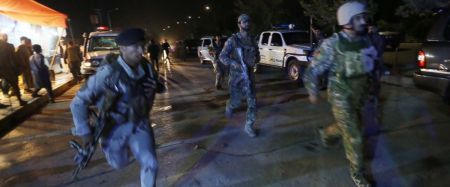
ap_kabul_attack_01_jc_160824_12x5_1600

The American University of Afghanistan in Kabul came under attack today, as security forces exchanged gunfire with the attackers.

The gunfire that was reported in the vicinity of the school has now stopped, according to a source in the Kabul Police Force. The same source told ABC News that two people were killed and five were injured in the attack.

The victims have not been publicly identified.

The U.S. State Department this morning acknowledged reports of the attack on an official Twitter account.

“Reports of attack on American University in Kabul. Exercise caution, avoid unnecessary movement in the area & monitor news for updates,” the agency said.

Reports of attack on American University in . Exercise caution, avoid unnecessary movement in the area & monitor news for updates.

10:45 AM – 24 Aug 2016

Massoud Hossaini, a photographer for The Associated Press, tweeted that he was trapped inside during the attack.

“Help we are stuck inside AUAF and shooting flollowed [sic] by Explo this maybe my last tweets,” he wrote.

The AP later reported that he was safe, and had escaped from the school.

The attackers managed to enter Noor Hospital, adjacent to the school, according to eyewitnesses.

The American University of Afghanistan opened in 2006, and was a pet project of former first lady Laura Bush, who helped launch the institution on a 2005 visit to Kabul, the capital.

Much of its funding has come from the U.S. Agency for International Development, which administers civilian foreign aid, and today has more than 1,700 full- and part-time students. It has produced 29 Fulbright Scholars and maintains partnerships with many U.S. colleges, such as Stanford, Georgetown and the University of California network.

The school says on its webpage that it “embraces diversity and community” in Afghanistan.

But it has been no stranger to threats of violence since its creation.

Two professors at the university — one American and one Australian — were abducted at gun point outside the university campus earlier this month, underscoring the deteriorating security situation in the capital and across the country more generally.

Also, two people employed by the university were killed in 2014 when a suicide bomber set off an explosion inside of a Kabul restaurant that was popular with ex-pats.

ABC News’ Aleem Agha and Jon Williams contributed to this report.

Gunmen wearing Afghan military uniforms kidnap American, Australian in Kabul

August 8, 2016

Gunmen wearing Afghan military uniforms kidnap American, Australian in Kabul, Jihad Watch

The AP headline says that the perpetrators were “gunmen posing as Afghan soldiers,” but there is no reason why the kidnappers couldn’t be members of the Afghan military, which is rife with jihadis, as the green-on-blue killings demonstrate.

Meanwhile, the hostages will now be killed, enslaved, ransomed or freed outright.

Here is a salient passage on this issue from a Shafi’i manual of Islamic law:

When an adult male is taken captive, the caliph considers the interests … (of Islam and the Muslims) and decides between the prisoner’s death, slavery, release without paying anything, or ransoming himself in exchange for money or for a Muslim captive held by the enemy. (Umdat al-Salik o9.14)

A revered Islamic jurist, Al-Mawardi, agrees with ‘Umdat al-Salik:

As for the captives, the amir has the choice of taking the most beneficial action of four possibilities: the first, to put them to death by cutting their necks; the second, to enslave them and apply the laws of slavery regarding their sale or manumission; the third, to ransom them in exchange for goods or prisoners; and fourth, to show favor to them and pardon them. (Al-Ahkam As-Sultaniyyah (The Laws of Islamic Governance), 4.5)

American-University-of-Afghanistan

“Gunmen posing as Afghan soldiers kidnap American, Australian in Kabul: official,” by Rahim Faiez, Associated Press, August 8, 2016:

KABUL – Five gunmen wearing Afghan military uniforms have abducted an American and an Australian in the Afghan capital, Kabul, a security official said Monday.

The two foreigners were taken from their SUV while driving on Sunday night on a main road near the American University of Afghanistan, according to Sediq Sediqqi, spokesman for the Afghan Interior Ministry. They are believed to be employees of the university and were travelling between the university and their residence, he said.

No one immediately claimed responsibility for the abduction.

Sediqqi also added that initial reports show that up to five armed men stopped the foreigners’ vehicle and carried out the kidnapping. The two abducted are both men, he said. He did not reveal any more details except to say that an investigation is underway.

The U.S. Embassy in Kabul issued a brief statement confirming the kidnapping of an American citizen but gave no further details “due to privacy concerns.”

“U.S. Embassy security officials are working closely with Afghan law enforcement and security colleagues and AUAF to assist in the investigation into the kidnapping,” it said, referring to the American University of Afghanistan.

Australia’s Department of Foreign Affairs and Trade also issued a statement confirming “the apparent kidnapping of an Australian in Kabul.” No further details were released, also for privacy concerns.

“We continue to advise Australians not to travel to Afghanistan because of the extremely dangerous security situation, including the serious threat of kidnapping,” it said….

Sediqqi said that kidnappers in all the Kabul cases, including Monday’s, had been wearing military uniforms, establishing a pattern and hinting at some form of organized gang activity….

General Allen’s Service to Al Qaeda’s Paymasters

August 4, 2016

General Allen’s Service to Al Qaeda’s Paymasters, Front Page Magazine, Daniel Greenfield, August 4, 2016

ga (1)

After two American soldiers were murdered by an Islamic terrorist in Afghanistan while a crowd of protesters shouted “Death to Americans” and “Death to Infidels”, General Allen visited his men. 

“There will be moments like this when you’re searching for the meaning of this loss. There will be moments like this when your emotions are governed by anger and a desire to strike back,” Allen pleaded. “Now is not the time for revenge, now is not the time for vengeance.”

General Allen had already apologized to the killers for the “desecration” of the Koran by American soldiers who had been destroying copies of the hateful document being used by Taliban prisoners to send notes to each other. “I offer my sincere apologies for any offence this may have caused, to the president of Afghanistan, the government of the Islamic Republic of Afghanistan, and most importantly, to the noble people of Afghanistan,” he had whined.

The “noble people” of Afghanistan were the ones chanting “Death to America” and “Death to Infidels”.

Meanwhile General Allen was telling the American soldiers grieving the loss of their own that the real tragedy was the destruction of the terrorist books. “Now is how we show the Afghan people that as bad as that act was in Bagram, it was unintentional and Americans and ISAF soldiers do not stand for this.”

Then Allen said that he was “proud” to call General Sher Mohammad Karimi “my brother”. Karimi, was the Afghan military strongman who had defended previous attacks on NATO troops and demanded that the American soldiers be put on trial.

“We admit our mistake,” General Allen cringingly continued. “We ask for our forgiveness.”

Then he praised the “Holy Koran”. Six American military personnel faced administrative punishments for doing their duty in order to appease the murderous Islamic mob in all its nobility in Afghanistan.

This was typical of General Allen’s disgraceful tenure. It is also typical of his post-military career which has included a prominent spot at Brookings and a speaking slot at the Democratic National Convention. After his enthusiastic endorsement of Hillary and attacks on Trump, Hillary has insisted that anyone who criticizes Allen is not fit to be president because Allen is a “hero and a patriot”.

If there’s anyone who is an expert on heroism and patriotism, it’s Hillary.

Allen’s heroic post-military career brought him to Brookings. The road from the think tank runs to Qatar which donated nearly $15 million to promote its agenda. That agenda took General Allen to its US-Islamic World Forum in Doha, Qatar.

Allen praised the “magnificent institutions” of Qatar. He endorsed the mobilization of the Jihadist terror groups known as Popular Mobilization Forces, some of whom have American blood on their hands and are owned and operated by Iran. Allen insisted that “many PMF fighters are not Shia-hardliners but Iraqis who volunteered last summer, answering Grand Ayatolah Ali Sistanti’s fatwa to defend Iraq.”

Then Allen sank to a new unimaginable low by urging compassion toward ISIS Jihadists from abroad.

“We must strive to be a Coalition of compassionate states,” Allen insisted. “There is no denying that many societies find the idea of rehabilitating foreign fighters objectionable. And indeed, those who have broken the laws of our lands must be held accountable. But long-term detention cannot be the sole means of dealing with returning foreign fighters.”

Then he touted “deradicalization” and “reintegration” programs by Muslim countries for Jihadists.

Allen claimed that seeing the “Muslim faith practiced and lived” in Afghanistan had made him a “better Christian”. But his messaging wasn’t surprising considering his employment and his location.

Qatar was a key international state sponsor of terror.

Khalid Sheikh Mohammed, the mastermind of 9/11, had been tipped off by a member of the Qatari royal family. The same Qatari royal family whose shindig Allen had shown up to perform at. Their terrorist media outlet, Al Jazeera, had been Al Qaeda’s media drop outlet of choice.

Qatar is a strong backer of Hamas. It has been accused of funding Al Qaeda. More recently it’s been linked to backing Al Qaeda’s local platform in Syria, the Al Nusra Front. The Taliban opened an office in Qatar. Even an early ISIS leader got his start with patronage from Qatar’s royal family.

A strong backer of the Arab Spring, Qatar exploited the chaos by aggressively smuggling weapons to Jihadists in the region. Two years ago, a bipartisan majority on the House Foreign Affairs Subcommittee on the Middle East and its Subcommittee on Terrorism, Nonproliferation and Trade had called for an investigation of Qatar’s links to terrorist funding.

General Allen’s visit to Qatar was shameful. He was praising and pressing the flesh of the paymasters of Islamic terrorists whose hands were and are covered in American blood. Allen had betrayed the soldiers fighting against Islamic terrorists. He had betrayed his country and his cause. He is a traitor to both.

Allen’s disgusting DNC performance was the climax of a series of betrayals. It is not the worst speech he has ever given. Nor is it the most dishonest or the most despicable.

General Allen has gone from serving his country to serving the enemies of his country. That is the man whose endorsement Hillary Clinton is proudly waving around as if it is a badge of honor instead of a badge of shame.

Allen is neither a hero nor a patriot. He is a man who has sold his soul to the highest bidder. Hillary Clinton has won this latest bid for Allen’s shopworn soul, alongside the tyrants of Qatar who trade in human slaves on a global scale. It is likely worth about as much as Hillary’s own soul. Whatever tattered spiritual scraps are left of it.

The mass deaths of American soldiers in Afghanistan under Obama still remains a largely untold story. It is the story of how Obama and his collaborators among the military elite sold out our soldiers and left them to die on the battlefield without allowing them to defend themselves so as not to offend the “noble people” of Afghanistan and their fine religious traditions.

74.5% of American deaths in Afghanistan occurred under Obama. Countless more came home, crippled and scarred. While General Allen hobnobs at parties with Al Qaeda bosses, the men he betrayed come back in body bags.

They are heroes. Allen is a traitor.

Obama backtracks on Afghanistan withdrawal, cites ‘precarious’ security situation

July 8, 2016

Obama backtracks on Afghanistan withdrawal, cites ‘precarious’ security situation, Long War Journal, , July 7, 2016

President Barack Obama called the security environment in Afghanistan “precarious” and said today he will keep more troops on the ground in Afghanistan than previously planned. Obama repeatedly promised to end the US mission in Afghanistan before the end of his administration in 2017, but a worsening security situation stemming from previous ill-timed reductions in force and a resilient Taliban proved that to be impossible.

“Instead of going down to 5,500 troops by the end of this year, the United States will maintain approximately 8,400 troops in Afghanistan into next year, through the end of my administration,” Obama said in a briefing at the White House.

Despite admitting the deteriorating conditions, Obama announced he will reduce the number of troops in the country by 1,400 by the end of 2016. Obama did not explain how withdrawing an additional 1,400 US forces this year will aid in the fight against the Taliban and its allies. The Taliban has regained ground in the strategic province of Helmand and other areas in spite of direct US military support to Afghan forces.

Obama admitted that the Taliban has continued to wage an effective insurgency and has taken control of territory.

“The Taliban remains a threat,” Obama said. “They’ve gained ground in some places.”

There are currently 9,800 troops in country conducting an “advise and assist” mission to Afghan forces as well as counterterrorism operations. Those two missions will not change, he stated.

The admission that security in Afghanistan is worsening is a dramatic shift by the Obama administration. Previously the administration maintained that Afghan forces were capable of sustaining combat operations with minimal or no US assistance.

However, this view flew in the face of the realities on the ground. The Taliban waited out the US “surge” that targeted their bastions in the south, and began attacking vulnerable Afghan forces when US troops began their withdrawal. By 2014, the Taliban gained control of a handful of far-flung districts while maintaining a guerrilla campaign throughout the country.

By the summer of 2015, the Afghan government admitted that four districts were under Taliban control. A study by The Long War Journal indicated that by the beginning of October 2015, the Taliban controlled 29 districts and contested another 36.

The Afghan government, which has notoriously underestimated the threat posed by the Taliban and areas under the jihadist group’s control, admitted in late June 2015 that nine district were now controlled by the Taliban and another 40 are heavily contested.The Long War Journal estimated that the Taliban controls 39 districts and contest another 43.

Perhaps the most worrisome indicator of deteriorating security in Afghanistan is the discovery of al Qaeda training camps in the country. Al Qaeda operated two large scale training camps, including a large facility, in the Shorabak district in Kandahar for more than a year before they were discovered by US forces. One of the camps occupied an area of 30 square miles and was well provisioned with weapons, ammunition, communications gear, and other equipment. In October 2015, a large US military strike force took four days to clear the two al Qaeda camps in Shorabak. More than 150 al Qaeda fighters are thought to have been killed during the operation.

The US military only discovered the location of the two camps in Shorabak after raiding another in Paktika province in July 2015. Abu Khalil al Sudani, one of al Qaeda’s most senior figures, is thought to have been killed during that raid. Al Qaeda obviously assessed the situation in Paktika as being safe enough to place one of their top leaders there.

The Shorabak raids shocked the US military and intelligence and forced them to revised its long-held estimate of 50 to 100 al Qaeda operatives in Afghanistan upwards to 300 in country. For more than six years, The Long War Journal has warned that official estimate of al Qaeda’s presence in Afghanistan is erroneous, and the jihadist group remains a significant threat to this day. [See LWJ report, US military admits al Qaeda is stronger in Afghanistan than previously estimated.]

The Untold Story Behind The “Mutiny At The State Department” Where Dozens Demand War With Syria

June 19, 2016

The Untold Story Behind The “Mutiny At The State Department” Where Dozens Demand War With Syria

by Tyler Durden – Jun 17, 2016 6:37 PM

Source: The Untold Story Behind The “Mutiny At The State Department” Where Dozens Demand War With Syria | Zero Hedge

Confirming once again that the entire US Middle-East campaign over the past 4 years has been one ongoing plan to destabilize and eliminate Syria’s president Bashar al-Assad from power – certainly including the involvement of ISIS which as we reported a year ago was “created” and facilitated by the Pentagon as a tool to overthrow Assad, an analysis which yesterday gained renewed prominence – overnight the WSJ reported that dozens of State Department officials this week protested against U.S. policy in Syria, signing an internal document that calls for “targeted military strikes against the Damascus government and urging regime change as the only way to defeat Islamic State.”

In other words, over 50 top “diplomats” are urging to eliminate Assad in order to “defeat ISIS”, the same ISIS which top US “diplomats” had unleashed previously in order to… eliminate Assad.

While one can understand the US state department’s relentless eagneress to create yet another failed state led by a US puppet ruler, one wonders if at least the boilerplate justification could not have used some more fine tuning.

Amusingly, the whole thing is wrapped in a narrative that the State Department is ready and willing to “mutiny” against Obama’s pacifism, because you see it was Obama who has been so successful in extricating and removing US troops from harm’s way in both the middle east and Afghanistan. Oh wait…

Here are the full details from he WSJ:

The “dissent channel cable” was signed by 51 State Department officers involved with advising on Syria policy in various capacities, according to an official familiar with the document. The Wall Street Journal reviewed a copy of the cable, which repeatedly calls for “targeted military strikes” against the Syrian government in light of the near-collapse of the ceasefire brokered earlier this year.


The views expressed by the U.S. officials in the cable amount to a scalding internal critique of a longstanding U.S. policy against taking sides in the Syrian war, a policy that has survived even though the regime of President Bashar al-Assad has been repeatedly accused of violating ceasefire agreements and Russian-backed forces have attacked U.S.-trained rebels.

More spin: why has Obama been so “against” unleash a full blown invasion on Syria? “Obama administration officials have expressed concern that attacking the Assad regime could lead to a direct conflict with Russia and Iran.”

Oh so that’s why the nuclear arms race is now officially back, just a few weeks after the US launched a ballistic missile shield over Europe, in the process shifting the entire post-cold war nuclear proliferation balance of power. Got it.

Meanwhile, the attempt to paint Obama as a liberal, peace loving dove continue:

“It’s embarrassing for the administration to have so many rank-and-file members break on Syria,” said a former State Department official who worked on Middle East policy. These officials said dissent on Syria policy has been almost a constant since civil war broke out there in 2011. But much of the debate was contained to the top levels of the Obama administration. The recent letter marked a move by the heart of the bureaucracy, which is largely apolitical, to break from the White House.

Oh, if only Obama would be more willing to install even more pro-US puppet regimes… like in Afghanistan, Libya, Egypt, Tunisia, Iraq, Ukraine and so on, and so on… Clearly all of these have turned out so well, that certainly things would be so much better in the middle east. Well, maybe not, but at least that damn Qatari pipeline would finally start flowing.

So why leak this now:

The internal cable may be an attempt to shape the foreign policy outlook of the next administration, the official familiar with the document said. President Barack Obama has balked at taking military action against Mr. Assad, while Democratic presidential hopeful Hillary Clinton has promised a more hawkish stance toward the Syrian leader. Republican candidate Donald Trump has said he would hit Islamic State hard but has also said he would be prepared to work with Russia in Syria.


The cable warns that the U.S. is losing prospective allies among Syria’s majority Sunni population in its fight against the Sunni extremist group Islamic State while the regime “continues to bomb and starve” them. Mr. Assad and his inner circle are Alawite, a small Shiite-linked Muslim sect and a minority in Syria. In Syria’s multisided war, the regime, Islamic State and an array of opposition rebel groups are all battling each other.

It gets better:  “Failure to stem Assad’s flagrant abuses will only bolster the ideological appeal of groups such as Daesh, even as they endure tactical setbacks on the battlefield,” the cable reads, using an Arabic acronym for Islamic State.

But wait, as the Pentagon itself admitted, the “Daesh” was carefully bred by the US government precisely for this reason: to overthrow Assad. Don’t believe us? Read the following line from the leaked document:

“… there is the possibility of establishing a declared or undeclared Salafist Principality in eastern Syria (Hasaka and Der Zor), and this is exactly what the supporting powers to the opposition want, in order to isolate the Syrian regime, which is considered the strategic depth of the Shia expansion (Iraq and Iran).”

Does not compute.

There is more: “The cable asserts Mr. Assad and Russia haven’t taken past cease-fires and “consequential negotiations” seriously and suggests adopting a more muscular military posture to secure a transitional government in Damascus.”

The Russian-led force is also pushing toward Raqqa from the south, making the march on the Islamic State stronghold a strategic and symbolic competition between the rival coalitions. Islamic State is also being rolled back in Iraq, where U.S.-allied government forces have retaken major cities and are advancing in Fallujah, the first city the extremists fully occupied back in 2014

Well, sure: with Russia’s backing of a sovereign nation, why should Assad fold to relentless US pressure. Actually that may well be the point: the US is humiliated that a small, feeble middle-eastern nation dares to defy it for years, just because it has the backing of the Kremlin. We don’t need to explain the ugly optics of this.

Perhaps the real reason why the cable has “emerged” now is because due to Russian intervention, ISIS will soon be history:

Although Islamic State is losing ground to multiple, U.S.-backed offensives in Syria, Iraq and Libya, Western diplomats say they worry the group has embedded itself so deeply in the population that it will be a major influence for years to come, eventually going underground as its quasi-army is defeated.

And finally, one last reason emerges: the US is merely pandering to Saudi demands, something it has clearly done very well ever since the Sep 11 attacks which covered up Saudi involvement:

The cable also echoes the growing impatience among U.S. Gulf allies with the lack of military intervention targeted at the Damascus government to force Mr. Assad to resign and make way for a transitional government. Peace talks between Syria’s government and opposition collapsed in April over Mr. Assad’s fate, with the regime insisting he should stay in power, while the negotiated cease-fire continued to disintegrate. Saudi Arabia and the United Arab Emirates have pressed the U.S. to provide more sophisticated weapons to rebels. But Washington has resisted.

In other words, if the US does fold and proceeds with military strikes, i.e. full blown invasion and war, on Assad, it will once again be Saudi Arabia that is running US foreign policy, and pushing the US nation into what may be a state of open war with Russia.

We can only hope the American people wake up and stop this travesty before Saudi Arabia’s favorite presidential candidate is elected president.